
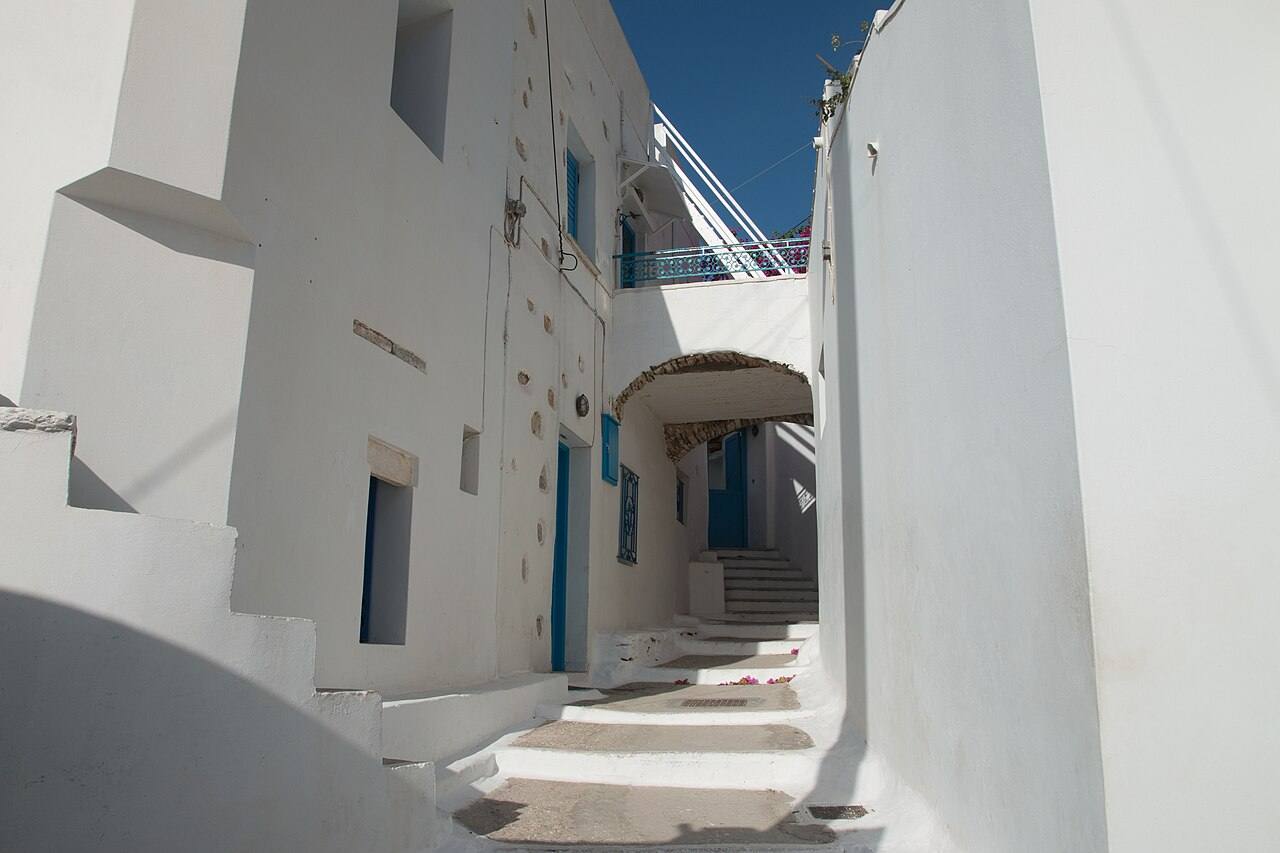
The villages of Amorgos are strung along the island’s long mountain ridge and around its two bays. Whitewashed clusters of houses, blue-domed churches and shaded squares kept quiet and traditional far from mass tourism. Above the bay of Aegiali rise the loveliest of them, the mountain villages of Langada and Tholaria, while the ports of Katapola and Aegiali and the scattered hamlets of the south each keep their own character. Plan the whole trip with Greece Tours.
This guide takes the villages in turn: the mountain villages of Langada and Tholaria. The ports of Katapola and Aegiali, the quiet villages of the south, their tavernas and festivals. How to tour them. Read it beside the wider Amorgos travel guide and the guide to the capital, Chora.
What are the best villages to visit in Amorgos?
Beyond the capital Chora, the best villages are the mountain settlements of Langada and Tholaria above Aegiali, the two ports of Katapola and Aegiali, and the quiet villages of the south around Arkesini.
Amorgos is a long, mountainous island, and its villages fall into distinct groups. The capital, Chora, high on the central ridge, is the grandest, covered in its own guide. Above the northern bay of Aegiali cluster the mountain villages of Langada and Tholaria, the loveliest on the island, while Aegiali and Katapola are the two working port towns.
In the quieter south and centre lie scattered farming villages and hamlets, such as Arkesini and Vroutsi, keeping an unspoilt, rural character amid terraces and ancient ruins. Together these settlements, linked by old stone paths, preserve a traditional Cycladic life that mass tourism has largely passed by.
The sections below take the most rewarding villages in turn. Touring them by car or on foot, pausing for a meal in a mountain taverna and a glass of the local raki. Is one of the defining pleasures of Amorgos and the best way to feel the island’s traditional life away from the beaches.
Why visit Langada in Amorgos?
Langada is one of the loveliest and largest mountain villages of Amorgos, set high above Aegiali bay amid the island’s highest peaks.
Langada climbs the terraced slopes high above the bay of Aegiali, surrounded by the highest mountains on the island. One of the larger villages of Amorgos, it is a maze of whitewashed alleys, arches and steps. Dotted with cafes and tavernas serving traditional food, good coffee and raki. It keeps a strong, authentic village life.
Near the village stands the church of Panagia Epanochoriani. Every year on the fifteenth of August the feast of the Panagia draws islanders and visitors to one of the biggest celebrations of the Amorgian year. With free food and wine and music late into the night. Langada is also a hub of the island’s hiking trails.
With its beauty, its tavernas and its festivals, Langada rewards a visit and a stay. Especially for walkers, as the old stone paths link it with Tholaria, Aegiali and the remoter north. Wandering its lanes and pausing in a square with a view over the bay is one of the pleasures of the northern villages.
Why visit Tholaria in Amorgos?
Tholaria is a small, traditional mountain village above Aegiali bay, prized for its lovely lanes, its tavernas with live music in summer and its wide views over the bay.
Tholaria is the smaller and quieter of the two great mountain villages above Aegiali. It is truly a lovely little place. A cluster of whitewashed houses, blue domes and narrow lanes on the terraced slopes. It takes its name from the vaulted Roman tombs, tholoi, found nearby, a hint of the island’s deep past.
In summer the village comes alive with visitors drawn to its tavernas and cafes. On peak-season evenings the tavernas often lay on live entertainment. Greek singing and dancing, giving Tholaria a warm, festive atmosphere. Above all it offers some of the finest views on the island, over the sweep of Aegiali bay far below.
Tholaria can be reached by road or, more rewardingly, on foot from Aegiali along one of the old walking paths, a scenic climb of around thirty to forty-five minutes. Together with Langada, it forms a triangle of villages with Aegiali, linked by the trails that thread the beautiful northern slopes of Amorgos.
What is Katapola like?
Katapola is the main port of Amorgos, a relaxed working harbour in a deep central bay, ringed by fishing boats, tavernas and rooms.
Katapola wraps around a deep, sheltered bay in the centre of the island’s coast and is the main ferry port of Amorgos, as well as a relaxed resort village. Fishing boats bob along the waterfront, which is lined with tavernas, cafes and rooms, giving the port an easy. Authentic charm. It is the most central and best-connected of the island’s settlements.
The bay holds sheltered coves and a decent beach, and small boats run from the quay to the sandy cove of Maltezi across the water. Above the port rises the hilltop of the ancient city of Minoa, one of the island’s three ancient sites, reached by a short walk with fine views over the bay.
The monastery and the south, and with its good bus, ferry and boat links, Katapola is the most practical of the island’s villages and a popular base, as the guide to where to stay in Amorgos describes.
What is Aegiali like?
Aegiali is the second port of Amorgos, set on a broad northern bay with the island’s best sandy beach.
Aegiali spreads around a wide bay in the north of the island and is the second ferry port of Amorgos. Its great asset is its beach, the long, sandy, gently shelving main beach that is the best on the island. Backed by tavernas and easy for families, with further sandy coves curving around the bay.
The village itself has a relaxed, faintly bohemian atmosphere. With a good choice of rooms and tavernas and a little more nightlife than elsewhere on the island, lively enough without being brash. It is a popular base for a beach holiday and for hiking, with trails leaving directly from the bay.
Directly above Aegiali rise the mountain villages of Langada and Tholaria, so the bay combines beach, village life and walking in one corner of the island. This mix makes Aegiali one of the most appealing bases and villages on Amorgos, especially in the north.
What villages are there in the south of Amorgos?
The quiet south of Amorgos holds scattered farming villages and hamlets such as Arkesini, Vroutsi and Kamari, keeping an unspoilt, rural character amid terraces and ancient ruins.
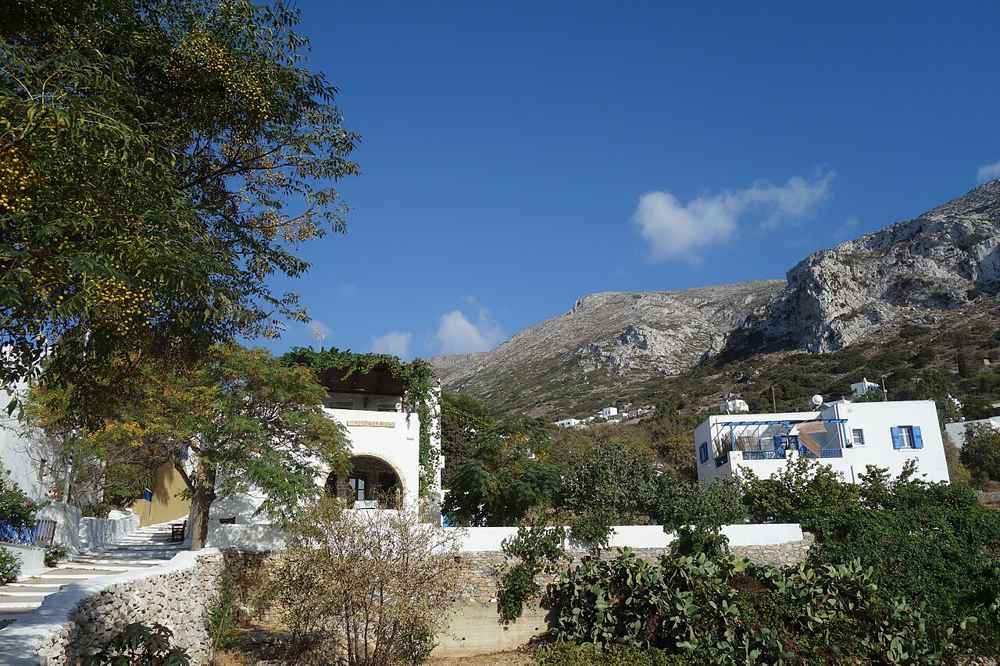
Beyond the two bays and the central ridge, the south of Amorgos keeps its quietest, most traditional villages. The scattered settlement of Arkesini and nearby hamlets such as Vroutsi and Kamari sit amid terraced fields and olive groves. Far from the tourist flow, preserving an old, rural way of life on the slopes above the sea.
This corner holds much of the island’s ancient heritage: the remains of the ancient city of Arkesini and, close by. The remarkably well-preserved Hellenistic watchtower known as the Tower of Agia Triada, testifying to the strategic past of the south. The wild beaches of Mouros and the southern coves lie below.
The southern villages reward those willing to drive the winding roads to reach them. Offering a glimpse of the island at its most unspoilt and a base for exploring the quiet south, its ancient sites and its dramatic coast.
How do you tour the villages of Amorgos?
The villages of Amorgos are best toured by hire car, which reaches the scattered settlements the bus rarely serves, or on foot along the old stone paths, especially the trails linking Aegiali, Langada and Tholaria.
Amorgos is a large, mountainous island. Its villages lie far apart, so a hire car or scooter is the practical way to tour them. Reaching the mountain villages above Aegiali and the remoter hamlets of the south. The local bus links the ports of Katapola and Aegiali with Chora and the main beaches, enough for the principal settlements.
For the northern villages, the old stone footpaths are the most rewarding way to travel, and the walk between Aegiali, Langada and Tholaria along the trails, with its views over the bay, is a highlight in itself, as the guide to hiking in Amorgos describes.
Whether by car, bus or on foot, touring the villages, pausing for a meal in a mountain taverna and timing a visit for a summer festival, is one of the finest ways to experience the traditional Amorgos, part of the wider island covered in the things to do guide.
Frequently Asked Questions
Which is the most beautiful village in Amorgos?
Beyond the capital Chora, the mountain villages of Langada and Tholaria above the bay of Aegiali are often called the most beautiful on Amorgos. Whitewashed clusters of houses and blue-domed churches on terraced slopes with sweeping sea views, famous for their tavernas and summer festivals. Chora itself, the grand Cycladic capital on the central ridge crowned by a Venetian castle, is the island’s finest town, while Katapola and Aegiali charm as relaxed port villages.
How do you get from Aegiali to Langada and Tholaria?
The mountain villages of Langada and Tholaria rise just above the bay of Aegiali and are reached either by road or. More rewardingly, on foot along the old stone walking paths. The scenic climb from Aegiali up to Tholaria takes around thirty to forty-five minutes. A trail links on to Langada. Forming a triangle of villages connected by footpaths, one of the classic short hikes on Amorgos with fine views over the bay.
Are the villages of Amorgos worth visiting?
Yes. The villages of Amorgos are among the island’s greatest pleasures. From the whitewashed capital Chora and the lovely mountain villages of Langada and Tholaria above Aegiali to the relaxed ports of Katapola and Aegiali and the unspoilt hamlets of the south. Kept quiet and traditional far from mass tourism, with their lanes, churches, tavernas and lively summer festivals, they offer an authentic taste of Cycladic life away from the beaches.