
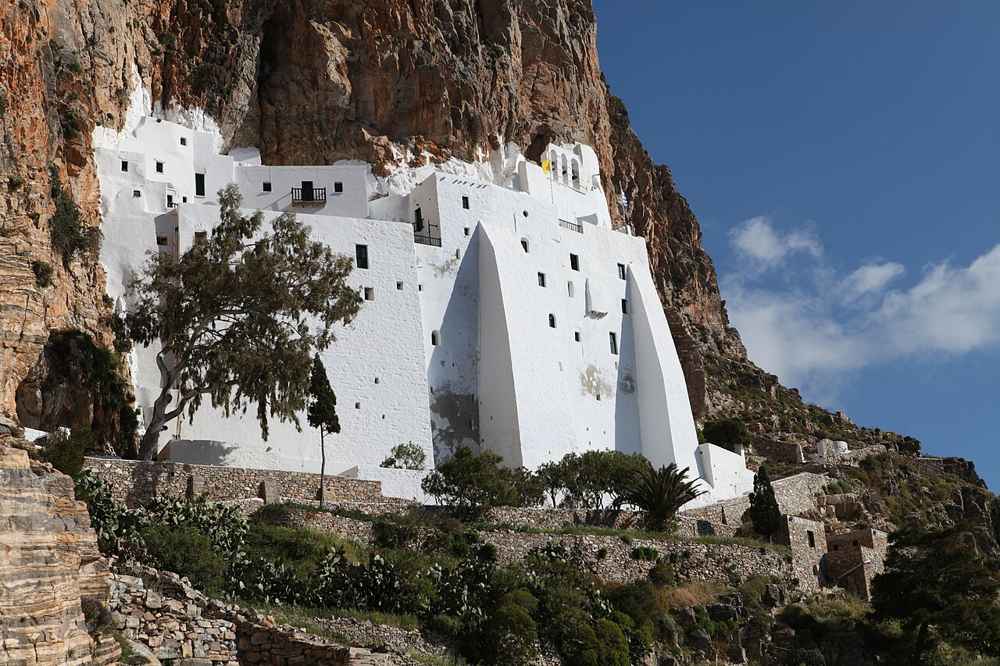
Amorgos is the wild, mountainous edge of the Cyclades, a long ridge of an island rising steeply from a deep blue sea far to the east of the archipelago. It is best known as the setting of Luc Besson’s film The Big Blue. Its draws are dramatic: the cliff-hanging Hozoviotissa Monastery, crystalline diving coves. An award-worthy network of hiking trails and a string of unspoilt villages that have kept the island quiet while its neighbours filled with crowds. Plan the whole trip with Greece Tours.
This guide ranks the experiences that define a visit: the emblematic monastery, the beaches made famous by the film, the old stone footpaths. The capital Chora and its Venetian castle, the boat trips to sea caves and islets, the mountain villages and the island’s distinctive food. Read it beside the wider Amorgos travel guide to plan ferries, dates and a base.
What are the top things to do in Amorgos?
The signature experiences are visiting the cliff-top Hozoviotissa Monastery, swimming at the Big Blue beaches like Agia Anna, hiking the old stone trails, exploring the capital Chora, and taking a boat trip to the sea caves, islets and remote coves.
Amorgos packs a remarkable variety into a small, rugged island. The heart of a visit is the emblematic Hozoviotissa Monastery. A white ribbon of a building pressed into a sheer cliff high above the sea. The island is equally a place for walking its old footpaths, swimming in its clear coves and touring its quiet villages.
The two ports and their bays, Katapola in the centre and Aegiali in the north, anchor the island, with the whitewashed capital Chora on the ridge between them. Around them lie the beaches made famous by The Big Blue, the diving and snorkelling coves. The boat trips along the wild coast. The mountain villages that keep the island’s traditions alive.
A first visit works best by mixing land and sea: a day for the monastery and Chora. Days for the beaches and a boat trip. At least one walk on the old trails. The sections below take each of the island’s highlights in turn, with the practical detail to fit them into a stay of three or four days.
Why visit the Hozoviotissa Monastery in Amorgos?
The Hozoviotissa Monastery is the emblem of Amorgos, an eleventh-century white monastery built into a sheer cliff hundreds of metres above the sea below Chora.
Founded in 1017 and among the oldest monasteries in Greece, Hozoviotissa clings to the near-vertical rock face of Mount Profitis Ilias below Chora. Its dazzling white walls seeming to grow straight out of the cliff. Reached by a steep climb of around three hundred steps, it rewards the effort with a working monastery of tiny chapels. A revered icon of the Virgin. One of the great views in the Aegean.
The building is astonishing: eight floors stacked into the cliff, each only metres wide, linked by narrow stairs and passages hewn into the rock. Monks still live here and welcome visitors with the traditional offering of rakomelo, a warm honey-and-raki spirit, and loukoumi, in a gesture of hospitality unchanged for centuries.
A dress code applies, as at any Greek monastery, with covered shoulders and knees required, and opening hours are limited to the morning and late afternoon. Seeing Hozoviotissa in person, framed by the cliff and the deep blue sea, is the single essential experience of Amorgos and the image every visitor carries away.
What is there to see in Chora, the capital of Amorgos?
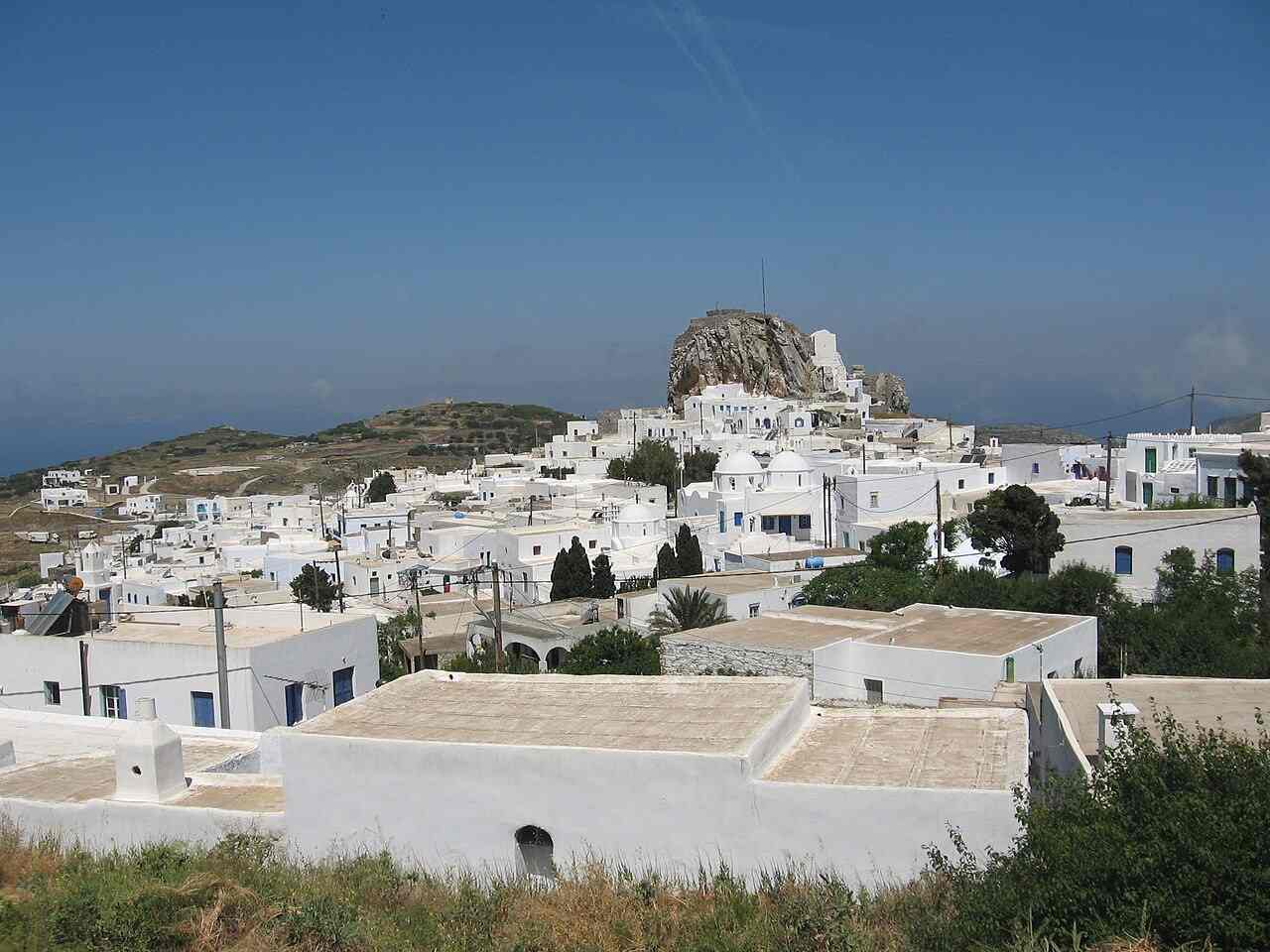
Chora, the capital, is a classic Cycladic town on the island’s high ridge, a maze of whitewashed lanes, blue-domed churches and small squares crowned by a ruined Venetian castle. Old windmills line the approach and the views reach both coasts.
Amorgos town, known as Chora, sits high on the spine of the island, safe from the pirates who once raided the coast. It is among the most beautiful capitals in the Cyclades, a car-free tangle of narrow marble lanes, whitewashed houses. Tiny churches, said to number around forty. Shaded squares where cafes and tavernas spill out under bougainvillea.
Above the town rises a rocky outcrop topped by the ruins of a Venetian castle, the Kastro. Reached by a short scramble that gives a sweeping view over the rooftops and both sides of the island. A line of old stone windmills stands on the ridge at the edge of town, a favourite spot to watch the sunset over the Aegean.
Chora is a place to wander slowly, browsing the small shops, pausing in the squares and following the lanes as they open onto sudden views. Come in the early evening when the light softens and the town comes to life. Combine it with the short drive or walk down to the Hozoviotissa Monastery, which sits just below.
What are the best beaches to visit in Amorgos?
The most famous is Agia Anna, where The Big Blue was filmed, a pebbly cove beneath the monastery.
Amorgos is not an island of long golden sands but of dramatic, clear-water coves set beneath cliffs. The most celebrated is Agia Anna, near Chora and below the monastery. A small pebbly beach of astonishing blue water where Luc Besson filmed The Big Blue, ideal for snorkelling among the rocks and caves.
In the wild south-west, Mouros is a striking pebble cove with caves and water so clear you can see the seabed. Reached by a path down from the road near Arkesini. Around the northern bay of Aegiali lie the island’s sandiest beaches, the long Levrossos. Psili Ammos and Hohlakas, easier for families and reached on foot or by a short boat hop.
From the port of Katapola, small boats run to the sheltered coves of Maltezi, Plakes and Kambi that no road serves. With such a varied coast, Amorgos rewards a mix of beach days, and the dedicated guide to Amorgos beaches covers each in turn, with access and which to choose on a windy day.
Is Amorgos good for hiking?
Yes. Amorgos is one of the best hiking islands in the Cyclades, with a network of waymarked old stone paths linking Chora, the monastery, the two ports and the mountain villages.
Walking is one of the island’s defining pleasures. Amorgos has a signed network of old kalderimia, the stone-paved paths that once linked every village, cleared and waymarked for walkers. The paths cross a dramatic landscape of terraces, ridges and cliffs high above the sea, with long views over the Aegean at almost every turn.
The signature short walk climbs from Chora to the Hozoviotissa Monastery and on down to Agia Anna beach, combining the island’s two icons in a single morning. A longer, classic route runs the length of the island between the ports of Katapola and Aegiali. A full day on foot, while gentler loops link the mountain villages of Langada and Tholaria above Aegiali.
Spring and autumn are the finest seasons for walking, when the paths are cool and green and the wildflowers are out. Sturdy shoes, sun protection and water are essential, as shade is scarce on the open ridges. For the full network of trails and grades, see the guide to hiking in Amorgos.
What is the Big Blue connection to Amorgos?
Amorgos is the island of The Big Blue, Luc Besson’s film that made its deep, clear waters world-famous.
For visitors Amorgos is inseparable from The Big Blue, Le Grand Bleu, Luc Besson’s cult film about free-diving that was largely shot on the island in the late 1980s. Its images of impossibly deep blue water and stark Cycladic light brought Amorgos to a global audience and remain a large part of its allure.
The most famous location is Agia Anna beach below the monastery, where the film’s small white chapel and turquoise cove appear on screen, and where fans still come to swim. The film’s legacy lingers across the island in the names of bars and boats and in the free-diving and snorkelling culture it helped inspire.
Seeking out the film’s locations, above all Agia Anna and the waters around it, is a rite of passage for many who visit, whether or not they know the film. The clear, deep sea that the film celebrated is still the island’s greatest natural asset and the reason its coves reward every swimmer and diver.
Can you dive and snorkel in Amorgos?
Yes. The clear, deep water of Amorgos, made famous by The Big Blue, is superb for diving and snorkelling.
The water that made the island famous is its underwater draw. Amorgos has some of the clearest, deepest sea in the Cyclades. A diving centre based on the island runs trips for beginners and certified divers alike to reefs. Walls and the waters around the small islet of Nikouria, with equipment provided.
For snorkellers, no gear beyond a mask is needed to enjoy the coves. Agia Anna, Mouros with its caves, and the rocky shores around Katapola all offer clear water, fish and dramatic rock formations just off the beach. The sheltered bays are calm enough for gentle snorkelling even when the open sea is choppy.
The free-diving heritage of The Big Blue still colours the island’s water culture, and organised snorkelling and diving trips are among the most rewarding things to do here. The combination of clarity, depth and dramatic underwater scenery makes Amorgos a standout for anyone drawn to the sea.
What boat trips can you take in Amorgos?
Boat trips from Katapola and Aegiali reach the coves, sea caves and islets that no road serves, including Nikouria island, the beaches of Maltezi and Kambi, and the far south around Kalotaritissa and the Olympia shipwreck.
Amorgos has a long, cliff-bound coastline with beaches and caves reachable only by sea, and boat trips are the way to see them. Small excursion boats and caiques run in season from the harbours of Katapola and Aegiali. Cruising to sheltered coves for swimming and snorkelling and along the dramatic shore beneath the ridges.
Popular runs cross to the islet of Nikouria off the north coast, with its clear-water beaches, and to the coves of Maltezi, Plakes and Kambi near Katapola. Longer trips head to the wild south around Kalotaritissa, taking in sea caves and the waters above the Olympia shipwreck, and private charters let a group set its own route.
A day on the water is one of the most relaxing ways to experience the island, opening up the emptiest. Clearest coves and giving a view of the coast. Of the monastery on its cliff, from the sea. Boat trips pair well with an inland day of walking and village touring for a fuller sense of the island.
Which villages you visit in Amorgos?
Beyond Chora, the port villages of Katapola and Aegiali reward exploring, along with the mountain villages of Langada and Tholaria above the northern bay and Arkesini in the south. Each keeps whitewashed lanes, tavernas and its own character.
The two ports each have their own charm. Katapola, in a deep central bay, is a relaxed working harbour of fishing boats, tavernas and rooms wrapped around the water, while Aegiali in the north sits above the island’s best sandy beach and has a laid-back, slightly bohemian feel and fine sunset views.
Above Aegiali, the mountain villages of Langada and Tholaria are the loveliest on the island. Whitewashed clusters of houses and blue-domed churches on green terraced slopes, linked by old footpaths and famous for their tavernas and their lively summer festivals. They are the base for some of the best walking on Amorgos.
In the quieter south, the scattered village of Arkesini and its hamlets keep an unspoilt, rural character amid terraces and ancient ruins. Touring the villages by car or on foot, pausing for a meal in a mountain taverna. Is one of the pleasures of the island and shows a traditional Cycladic life that mass tourism has passed by.
What is the Olympia shipwreck in Amorgos?
The Olympia is a rusting cargo ship that ran aground off Amorgos in and still lies half-submerged in a bay near Kalotaritissa in the south.
In the far south of the island, in a bay near the beach of Kalotaritissa, the wreck of the cargo ship Olympia has lain since it ran aground in . Its rusting orange hull tilted in the shallows against a backdrop of cliffs and clear water. It has become one of the island’s most photographed and atmospheric sights.
The wreck gained lasting fame through its appearance in The Big Blue. It draws a steady stream of visitors who come to see it from the shore or from the water. A viewpoint above the bay gives the classic photograph. Boat trips and swimmers approach it from the sea, though the hull itself is unstable and best admired from a distance.
Combining the Olympia wreck with the southern beaches of Kalotaritissa and Paradisia makes a rewarding half-day in the wild end of the island. Reached by the road that runs south from Chora through Arkesini or by boat from Katapola. It is a striking, slightly eerie counterpoint to the island’s whitewashed villages and blue coves.
What ancient sites can you see in Amorgos?
Amorgos has three ancient cities, Minoa above Katapola, Arkesini in the south and Aegiali in the north, along with the well-preserved Hellenistic Tower of Agia Triada. Their ruins, set on scenic hilltops, add depth to the island’s long history.
Amorgos was settled in antiquity by three separate city-states, and their remains reward those interested in the island’s history. Above the port of Katapola, the ancient city of Minoa occupies a commanding hilltop, with the foundations of a temple. A gymnasium and stretches of wall reached by a short walk from the harbour and a fine view over the bay.
In the south, the ancient city of Arkesini and, nearby. The remarkably well-preserved Hellenistic watchtower known as the Tower of Agia Triada stand among the terraces, testifying to the island’s strategic past. The third ancient city lay at Aegiali in the north, beneath the modern bay.
These sites are modest compared with the great ruins of the mainland, but their dramatic hilltop settings and the sense of the island’s deep past make them worthwhile stops. Minoa in particular combines easily with a stay in Katapola, a short climb from the port to the ancient acropolis and its views.
What food you try in Amorgos?
Amorgos is known for rakomelo, a warm honey-and-raki spirit, and for hearty dishes like patatato, goat stewed with potatoes. Local specialities include xerotigana pastries, fava, island cheeses and psimeni raki, best enjoyed in the mountain village tavernas.
The island’s rugged land gives it a hearty, traditional cuisine. The signature dish is patatato, kid goat or lamb slow-cooked with potatoes, tomato and herbs, served at festivals and in the village tavernas. Fava, the Cycladic split-pea puree, wild greens, island cheeses and fresh fish from the harbours round out the table.
Amorgos is above all famous for its drink: rakomelo. The local psimeni raki, a spirit distilled and sweetened with honey and spices. Served warm in winter and enjoyed across the island, offered to visitors even at the Hozoviotissa Monastery. For something sweet, the crisp fried pastries called xerotigana, drizzled with honey, are the local speciality.
Eating on Amorgos means seeking out the mountain tavernas of Langada and Tholaria and the harbour tables of Katapola and Aegiali, where the food is home-cooked and the atmosphere unhurried. A meal of patatato and local cheese, finished with rakomelo, is one of the authentic pleasures of a visit to the island.
What festivals and traditions does Amorgos keep?
Amorgos keeps its religious festivals, the panigyria, held on saints’ days through the summer with food, wine, music and dancing. The mountain villages of Langada and Tholaria and the monastery’s feast are the high points of the island’s calendar.
Island life on Amorgos still turns on the church calendar. The panigyria, the festivals held on the feast days of local saints, are the great social events of the year. On a summer evening a village square fills with long tables of home-cooked food, local wine and rakomelo. Live music and dancing that runs late into the night. Visitors are welcomed to join.
The mountain villages above Aegiali, Langada and Tholaria, are especially known for their lively festivals, as is the feast of the Panagia Hozoviotissa on the twenty-first of November, when the whole island honours its emblematic monastery. These celebrations preserve old customs, music and dishes that have faded elsewhere in the Cyclades.
For a visitor, stumbling on a village panigyri, or simply sharing a meal and a glass of psimeni raki in a mountain taverna. Is a way into the living tradition of the island. This surviving village culture, rooted in the remote and unspoilt character of Amorgos, is a large part of what sets it apart from its busier neighbours.
When is the best time to visit Amorgos?
Late May to early October is best for the beaches and the sea, while spring and autumn suit hiking, when the island is green and cool.
For a beach and sea holiday, the warm, settled months from late May through September are ideal, with the water comfortable for swimming into October. Amorgos stays quieter than the famous Cyclades even in high summer. July and August are its busiest weeks, when rooms be booked well ahead and the meltemi wind blows hardest.
For walkers, spring, from April to May, is the finest season, when the island is at its greenest and the wildflowers are out, with autumn a close second as the heat fades. The trails and the mountain villages are at their best in these cooler shoulder months, which also bring lower prices and a calmer pace.
The strong summer meltemi can whip up the exposed coast and occasionally disrupt the ferries and smaller boats, so building some flexibility into travel plans helps in July and August. Whatever the month, Amorgos rewards visitors who want an authentic, uncrowded island, as the guide to the wider island explains.
What day trips can you take from Amorgos?
From Amorgos you can take a boat day trip to the Little Cyclades, the tiny islands of Koufonisia, Iraklia, Schinoussa and Donousa, or a boat excursion to the islet of Nikouria and the island’s own remote coves.
Amorgos sits at the eastern edge of the Cyclades beside the cluster of small islands known as the Little Cyclades. A day trip to one of them is a rewarding excursion. Boats and ferries run in summer to Koufonisia, with its famous turquoise water. To quieter Iraklia, Schinoussa and Donousa, each a tiny, unspoilt island of beaches and a single village.
Closer to home, a boat trip to the uninhabited islet of Nikouria off the north coast makes an easy half-day to some of the clearest water around the island. Excursion boats from Katapola and Aegiali reach the remote southern coves and the Olympia shipwreck that no road serves.
For a longer outing, ferries connect Amorgos with Naxos and the central Cyclades, though the distances make these better suited to onward island-hopping than a same-day return. The Little Cyclades and the island’s own boat trips are the most rewarding day trips, showing the wild, watery heart of this corner of the Aegean.
How days do you need in Amorgos?
Three to four days let you see the Hozoviotissa Monastery and Chora, swim at the best beaches, walk a section of the trails and tour the villages.
Amorgos is a long, spread-out island with distinct ends, so it repays more than a fleeting stop. A stay of three to four days allows time to see the monastery and the capital, swim at Agia Anna and the northern beaches. Take a boat trip or a dive, walk at least one section of the old trails and tour the mountain villages.
Walkers drawn by the trail network can fill a week or more, tackling the full island crossing and the village loops, while divers and beach lovers can spend their days working through the coves. The island’s two ends, Katapola and central Chora versus northern Aegiali, each merit a base, and visitors split their stay between them.
It rewards a longer, slower stay rather than a rushed day trip. For a first visit, four days captures the island’s icons and its distinctive mix of dramatic landscape, clear sea and traditional village life without rushing.
Frequently Asked Questions
What is Amorgos best known for?
Amorgos is best known as the island of The Big Blue, Luc Besson’s cult film about free-diving, shot largely at Agia Anna beach. It is also famous for the dramatic Hozoviotissa Monastery, an eleventh-century white monastery built into a sheer cliff, for its clear, deep waters ideal for diving. For its excellent network of hiking trails. For keeping the quiet, authentic character that its more famous Cycladic neighbours have lost.
Is Amorgos worth visiting?
Yes. Amorgos rewards travellers who want a wild, authentic and uncrowded Greek island with dramatic scenery, superb hiking and some of the clearest water in the Cyclades. It offers the emblematic Hozoviotissa Monastery, the Big Blue beaches, boat trips to sea caves and islets. Unspoilt mountain villages and hearty local food, all far from the crowds of Santorini and Mykonos, though it takes longer to reach by ferry.
How do you get around Amorgos?
Amorgos has a local bus that links the ports of Katapola and Aegiali with Chora and the main beaches times a day in summer. Which suits visitors staying near these hubs. To reach the remoter beaches, villages and ancient sites, though, a hire car, scooter or quad, collected at Katapola or Aegiali. Is the practical choice, as the island is large and mountainous with its highlights spread far apart.
Do you book the Hozoviotissa Monastery in advance?
No booking is needed to visit the Hozoviotissa Monastery. It keeps limited opening hours. Generally in the morning and again in the late afternoon, and closes at midday, so it is worth checking the current times before setting out. A modest dress code applies, with shoulders and knees covered for both men and women, and the climb of around three hundred steps requires reasonable fitness.