
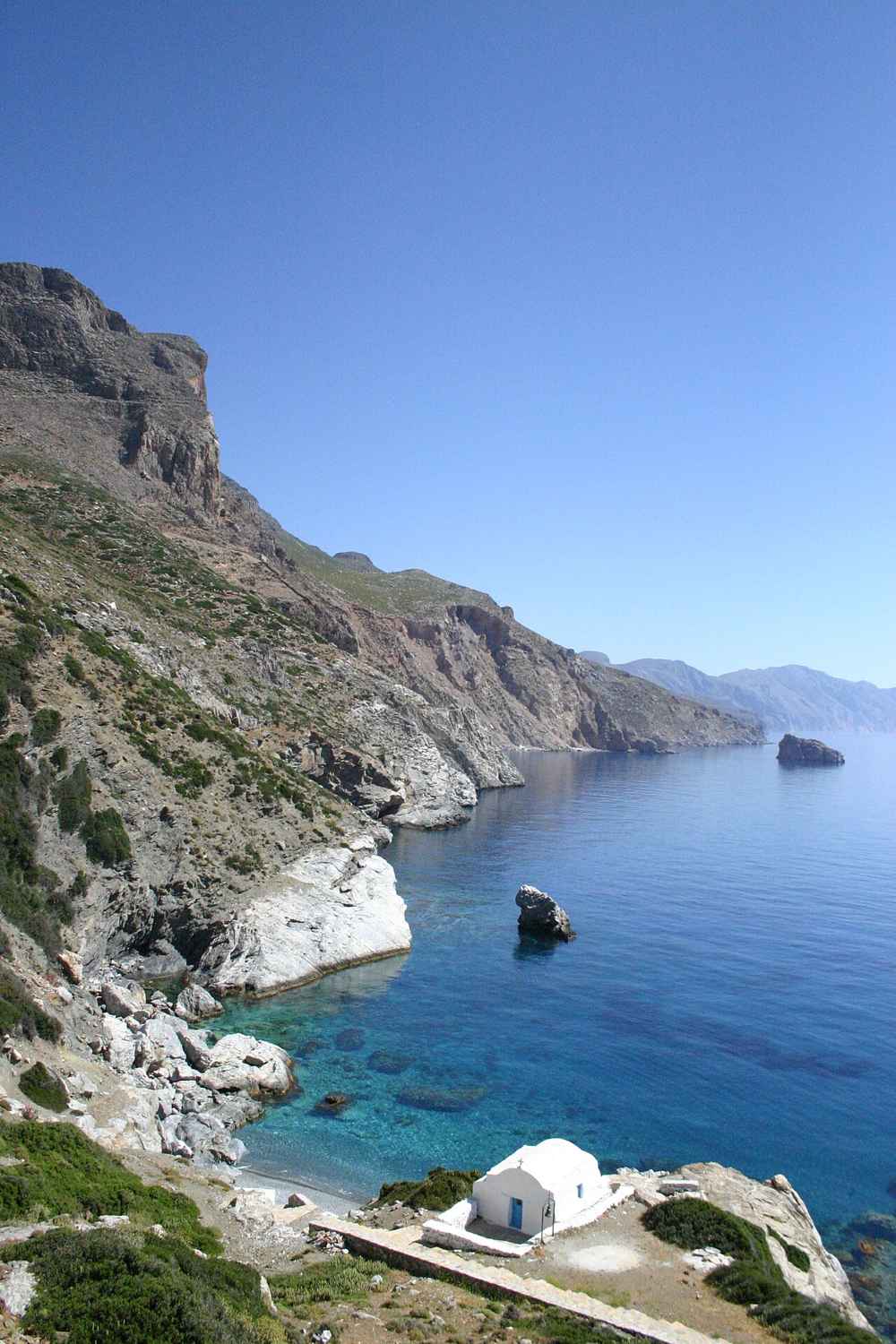
The beaches of Amorgos are not long golden sands but dramatic, crystal-clear coves set beneath towering cliffs, the wild coast that Luc Besson chose for The Big Blue. From the pebbly turquoise of Agia Anna below the monastery to the cave-backed water of Mouros. The sandy bays of Aegiali and the boat-only coves of the centre and south, the island rewards swimmers and snorkellers who value clarity and drama over sand. Plan the whole trip with Greece Tours.
This guide takes the beaches in turn, grouped by area: the coves near Chora, the sandy bays of Aegiali, the boat-only beaches near Katapola. The wild south around Kalotaritissa. The islet of Nikouria, with how to reach each and which to choose on a windy day. Read it beside the wider Amorgos travel guide and the island’s things to do.
What are the best beaches in Amorgos?
The best beaches are Agia Anna, of Big Blue fame, cave-backed Mouros in the south, the sandy Levrossos and Psili Ammos near Aegiali, the boat-only coves of Maltezi and Kambi near Katapola, and the clear water of Nikouria islet across.
Amorgos is a long, cliff-bound island, and its beaches are scattered along a rugged coast rather than gathered in one resort strip. They divide roughly by area: the clear coves near Chora and Katapola in the centre, the sandiest beaches around the northern bay of Aegiali. The wild coves of the far south. The boat-only beaches and the islet of Nikouria that no road reaches.
What unites them is the water, some of the clearest and deepest in the Cyclades, the very quality that drew the makers of The Big Blue. Most of the beaches are pebble or coarse sand backed by cliffs, dramatic and clean, with a handful organised with sunbeds and tavernas and many left wild.
The sections below take the beaches area by area, with how to reach each and what to expect. Because the coast faces different directions, there is almost always a sheltered beach whatever the wind, which makes choosing by the day’s conditions the key to enjoying the island’s sea. A rented vehicle or the excursion boats open up the full range, while bus-served beaches like Aegiali. Agia Anna and Kalotaritissa cover the best-known highlights of the coast for visitors travelling without their own transport around the island.
Why is Agia Anna the most famous beach in Amorgos?
Agia Anna is the most famous beach on Amorgos because Luc Besson filmed The Big Blue here, in a pebbly turquoise cove beneath the Hozoviotissa Monastery near Chora.
Set on the coast below Chora and the cliff-hanging monastery, Agia Anna is a compact beach of white pebbles and rocky ledges lapped by extraordinarily clear, deep blue water. It is not large, in fact it is a series of small coves rather than one broad beach. Its beauty and its film fame make it the island’s best-known shore.
The water is the draw: crystalline, deep and ideal for snorkelling among the rocks and small caves. With the little white church of Agia Anna and the monastery high above completing the scene. There are no sunbeds or big facilities, only a small canteen, so bring water and shade, and arrive early in summer as the coves fill quickly.
Agia Anna sits a short drive or a scenic walk from Chora and the monastery, making it easy to combine the island’s two icons in a single outing. Its rocky ledges and clear water suit confident swimmers and snorkellers more than families with small children, who find easier sand around Aegiali.
What is Mouros beach like?
Mouros is a dramatic pebble cove on the wild south-west coast of Amorgos, backed by cliffs and caves, with calm, glass-clear water ideal for snorkelling. It is reached by a ten-minute walk down a path from the road near Arkesini.
Mouros is one of the most striking beaches on the island, a cove of grey pebbles and rock set beneath high cliffs on the exposed south-west coast. Its water is famously calm and clear. Transparent that the seabed is visible far out, and two caves to the side of the beach draw swimmers and snorkellers to explore.
Reaching Mouros takes a little effort, which keeps it uncrowded: you drive from Chora towards Arkesini. Leave the car where the road ends. Walk down a path for around ten minutes to the shore. There are no facilities, so bring everything you need, and note that the pebbles and rocks make water shoes useful.
The reward is a wild, dramatic swimming spot with some of the clearest water on Amorgos, backed by caves and cliffs and far from any crowd. Mouros suits confident swimmers and snorkellers seeking scenery and solitude, and it pairs well with a tour of the quiet southern villages and the Olympia shipwreck nearby.
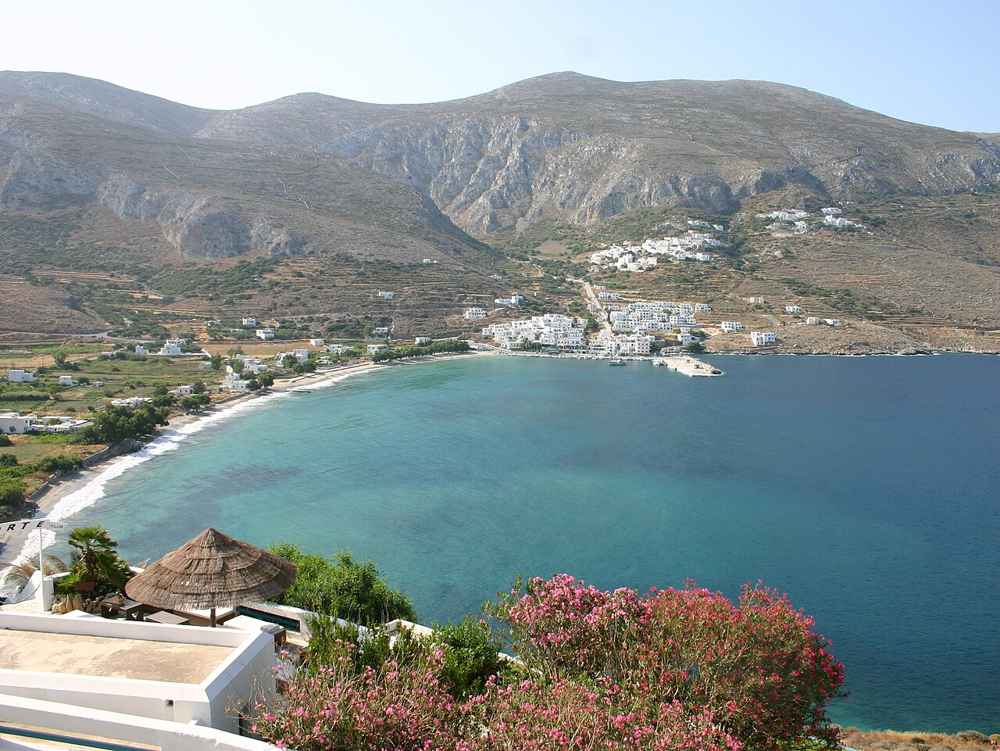
Which beaches are near Katapola?
Near the port of Katapola lie the sheltered coves of Maltezi, Plakes, Agios Panteleimonas and Kambi, most reached by a short boat hop from the harbour or on foot. They offer calm, clear water close to the island’s central base.
The deep central bay of Katapola shelters a cluster of small beaches within easy reach of the port. Maltezi is the favourite, a sandy cove of calm turquoise water reached by a regular small boat from the harbour or a walk over the headland. With a taverna behind it, making it an easy half-day from a Katapola base.
Nearby, Plakes and Agios Panteleimonas offer more sheltered swimming, and the little beach of Kambi sits along the same stretch of coast. The bay’s position makes these beaches calm when the north wind blows, a reliable choice on a breezy day, and their proximity to the port suits visitors without a car.
The boats that run from Katapola to Maltezi and the neighbouring coves through the day are part of the pleasure. A short cruise across the clear bay to a beach no road serves. For the port itself and where to stay, see the wider Amorgos guide.
Which beaches are around Aegiali bay?
The northern bay of Aegiali holds the island’s sandiest beaches: the long Levrossos, Psili Ammos and Hohlakas, plus family-friendly Aegiali beach at the port itself.
The broad bay of Aegiali in the north gives Amorgos its most conventional beaches. The main beach at the port is a long, gently shelving stretch of sand, organised with sunbeds and tavernas and safe for children. The easiest place to swim on the island and a good base for a relaxed beach holiday.
A string of sandy beaches curves around the bay beyond the port: Levrossos, backed by tamarisk trees and often described as the finest sand on the island. Then Psili Ammos and Hohlakas, each quieter than the last and reached by a coastal path or a short boat hop from Aegiali. Some are known for a relaxed, clothing-optional atmosphere at their far ends.
These northern beaches are the sandiest and most family-friendly on Amorgos. Sheltered and easy to reach. They pair naturally with a stay in Aegiali and a walk up to the mountain villages of Langada and Tholaria above. They are the counterpoint to the dramatic rocky coves of the island’s centre and south.
What is Nikouria island and its beaches?
Nikouria is a small uninhabited islet just off the north coast of Amorgos, reached by a short boat crossing.
Off the north coast, near the road between Aegiali and the centre, the little uninhabited islet of Nikouria lies a few hundred metres offshore. A small boat shuttles across in summer from the jetty opposite, a crossing of only minutes, to what many consider the most beautiful swimming water on Amorgos.
The islet has two or three sandy and pebbly beaches with shallow, brilliantly clear turquoise water, sheltered and calm, ideal for families, swimmers and snorkellers. There are no roads and facilities, so visitors bring their own water and shade and enjoy an almost private island beach for the day.
Nikouria is a highlight of the island’s beaches and a favourite stop on boat trips along the north coast. The short crossing and the clarity of the water make it well worth the small effort. It combines easily with a stay in Aegiali or a boat tour from Katapola.
What are the best beaches in the south of Amorgos?
The wild south holds Kalotaritissa, a sheltered sandy bay good for families, along with Paradisia and Ammoudi nearby and the striking bay of the Olympia shipwreck. Remote and dramatic, they reward the drive to the island’s far end.
The southern tip of Amorgos, reached by the road that runs down through Arkesini, is the island’s wildest, emptiest corner. Kalotaritissa is its main beach, a protected, sandy bay with shallow, clear, shallow water ideal for families. A small taverna and sunbeds. A bus link that makes it accessible without a car.
Around Kalotaritissa lie the smaller coves of Paradisia and Ammoudi. Just offshore in a neighbouring bay sits the rusting hull of the Olympia shipwreck. Run aground in and famous from The Big Blue, a dramatic and slightly eerie backdrop to a swim. A viewpoint above gives the classic photograph.
The southern beaches suit those who want seclusion and scenery and are willing to drive the winding road to reach them. Combined with the ancient ruins of Arkesini and the wreck. They make a rewarding day in the quiet end of the island, far from the busier beaches of the centre and north.
Which Amorgos beaches are best for families?
The best family beaches are the sandy, sheltered bays of Aegiali and Levrossos in the north, the calm cove of Maltezi near Katapola, the shallow water of Kalotaritissa in the south, and the clear, gentle beaches of Nikouria islet across.
Families with young children are best served by the island’s sandier, calmer beaches rather than its dramatic rocky coves. The main beach at Aegiali is the standout, a long, gently shelving stretch of sand with sunbeds. Shade and tavernas, safe and easy. Neighbouring Levrossos offers similar soft sand a short walk away.
Near Katapola, the sheltered cove of Maltezi has calm turquoise water and a taverna behind, reached by an easy boat hop, while in the south Kalotaritissa is a protected sandy bay with shallow water and a bus link. The beaches of Nikouria islet, with their clear, shallow, sheltered water, are another fine family choice reached by a short boat ride.
These beaches combine sand, shelter and facilities, the qualities that matter with children, and are spread around the island so a family can find one whatever their base. The rockier, wilder coves like Agia Anna and Mouros, by contrast, suit confident swimmers and snorkellers more than small children.
Which Amorgos beaches are best for snorkelling and seclusion?
For snorkelling and solitude, head to cave-backed Mouros and Agia Anna near Chora, the clear water of Nikouria islet, and the remote southern coves. Their transparent water, rocks and caves reward snorkellers willing to reach beaches without facilities.
Amorgos is a snorkeller’s island, its deep, clear water full of rocks, ledges and small caves. Agia Anna, with its transparent coves beneath the monastery. Mouros in the south, with its two caves and glass-clear water. Are the standouts, both rocky, dramatic and ideal for exploring with a mask just off the shore.
For clarity combined with calm, the beaches of Nikouria islet are hard to beat, their sheltered turquoise water perfect for gentle snorkelling, while the remote coves of the south and the boat-only beaches near Katapola offer solitude and clear water away from any crowd.
These beaches reward self-sufficiency, as most have no sunbeds or tavernas, so bring water, shade and snorkelling gear. The trade-off is dramatic scenery, brilliant water and, outside high summer, the chance of a cove to yourself, the essence of the wild coast that made the island famous.
Are Amorgos beaches sandy or pebbly?
Most Amorgos beaches are pebble or coarse sand backed by cliffs, with the clearest water in the Cyclades. The sandiest beaches are around Aegiali bay in the north, while the central and southern coves are more often pebble and rock.
Amorgos is not a sandy island in the way of Cyclades. Its dramatic, cliff-bound coast produces mostly beaches of pebbles, coarse sand and smooth rock, clean and clear but firmer underfoot, so water shoes are useful at many of them. The trade-off for the lack of soft sand is the island’s extraordinary water clarity.
The exception is the northern bay of Aegiali, whose beaches, the main port beach, Levrossos, Psili Ammos and Hohlakas, are genuinely sandy and gently shelving, the easiest on the island. Maltezi near Katapola and Kalotaritissa in the south also offer sand, and the beaches of Nikouria islet mix sand and pebble.
Elsewhere, the celebrated coves of Agia Anna and Mouros are pebble and rock, prized for their water and setting rather than their sand. Knowing this helps in choosing a beach: head north to Aegiali for sand and families, and to the central and southern coves for drama, clarity and snorkelling.
How do you reach the beaches of Amorgos?
Many Amorgos beaches are reached by hire car or the local bus, which links Katapola, Chora, Aegiali and Kalotaritissa.
The main beaches are served by the island’s roads and its bus. A local bus runs times a day in summer between the ports of Katapola and Aegiali, the capital Chora. Agia Anna and Kalotaritissa in the south, enough to reach the principal beaches without a car, though the timetable thins outside high season.
For the freedom to reach the remoter coves and the southern beaches, a hire car, scooter or quad. Collected at Katapola or Aegiali, is the practical choice on this large, mountainous island. Some of the finest beaches, though, such as Maltezi near Katapola and the islet of Nikouria, are reached only by short boat hops from the harbours.
A beaches, including Mouros, require a walk down a cliff path from the road, keeping them quiet. Between the bus, a hire vehicle, the excursion boats and a little walking, all the island’s beaches are reachable, and mixing the modes is part of the pleasure, as the guide to things to do in Amorgos describes.
Which Amorgos beach is best on a windy day?
On a windy day, when the summer meltemi blows from the north, head to the sheltered coves near Katapola such as Maltezi and Plakes, or the south-facing beaches of the far south, which stay calm when the exposed northern and.
The strong summer meltemi wind blows from the north across the Cyclades, and on Amorgos it can whip up the exposed beaches while leaving others calm. The deep central bay of Katapola and its coves, Maltezi, Plakes and Agios Panteleimonas. Are well sheltered and stay swimmable when the wind is up, the reliable choice on a blowy day.
The south-facing beaches of the far south, around Kalotaritissa, are also protected from the north wind, as is Mouros in its sheltered south-west cove. The northern bay of Aegiali, by contrast, can be exposed when the meltemi is strong, so it pays to read the wind and choose accordingly.
There is almost always a calm beach somewhere on Amorgos whatever the wind, which is the key to enjoying its sea. Asking locally about the day’s conditions, or simply heading to the sheltered Katapola coves, ensures a good swim even in the height of the meltemi.
Which beaches can you reach only by boat in Amorgos?
Several of the finest Amorgos beaches are reached only by boat: Maltezi, Plakes and Kambi near Katapola, the beaches of Nikouria islet off the north coast, and remote coves in the south.
Amorgos has a cliff-bound coast where some of the best swimming coves have no road to them, and reaching them by sea is part of their appeal. From the port of Katapola, small boats run through the day to the sandy cove of Maltezi and the neighbouring beaches of Plakes and Kambi. A short, scenic crossing of the clear central bay.
Off the north coast, a boat shuttles across to the uninhabited islet of Nikouria and its brilliant turquoise beaches, while excursion boats from Aegiali and Katapola reach the wild coves of the south and the bay of the Olympia shipwreck. Private charters and organised trips let a group visit several boat-only beaches in a day.
These boat-access beaches are among the quietest and clearest on the island, rewarding the small effort of the crossing. They pair naturally with a wider boat trip along the coast, as the guide to things to do in Amorgos describes, giving a view of the cliffs and the monastery from the sea.
What you bring to the beaches of Amorgos?
For most Amorgos beaches, bring water, shade, water shoes and snorkelling gear, as coves are pebble or rock and have no facilities. Only a handful of beaches have sunbeds and tavernas, so come prepared, especially at the wilder coves.
A little preparation makes the difference. Water shoes are useful on the pebble and rock coves like Agia Anna and Mouros. A mask and snorkel unlock the clear water and small caves that are the island’s underwater draw. Sun protection and drinking water are essential where there is no canteen.
Shade is scarce on beaches, so a sun umbrella or a beach tent is worth carrying to the coves that lack tamarisk trees or sunbeds. Cash is handy for the small canteens and boat fares, as card payment is not always possible at the remoter beaches and jetties.
The organised beaches, the main beach at Aegiali, Maltezi near Katapola and Kalotaritissa in the south, provide sunbeds, umbrellas and tavernas, so less is needed there. Knowing in advance which beaches have facilities and which are wild, as this guide sets out, helps you pack for the day and choose a beach to match.
What is beach life like in Aegiali compared with Katapola?
Aegiali in the north has the island’s sandiest beaches and an easy, relaxed beach-holiday feel, while Katapola in the central bay offers sheltered coves reached by short boat hops.
The two ports give two different beach experiences. Aegiali, set on a broad northern bay, has the long sandy main beach and the string of sandy coves at Levrossos, Psili Ammos and Hohlakas. All within walking or a short boat hop, giving it the feel of a relaxed beach resort with a bohemian edge and fine sunsets.
Katapola, in a deep sheltered bay in the centre. Has less sand at the port itself but quick access by small boat to the calm coves of Maltezi, Plakes and Kambi across the water. It is a quieter, working harbour, central for touring the whole island and reaching Chora, the monastery and Agia Anna, which sit just above.
Which base suits depends on the trip: Aegiali for sandy beaches, families and a beachy stay near the northern mountain villages; Katapola for a central, calm port and boat-hop coves. Many visitors staying longer split their time between the two ends, as the wider Amorgos guide explains.
Which Amorgos beach is best for a first visit?
For a first visit, Agia Anna captures the island’s fame and dazzling water, while the sandy main beach at Aegiali is the easiest all-round swim.
A first-time visitor torn over where to swim can start with the beaches that best sum up the island. Agia Anna, the pebbly turquoise cove of Big Blue fame beneath the monastery, is the essential Amorgos beach. Unmatched for its water and setting, though small and rocky and best for confident swimmers and snorkellers.
For an easier, sandier swim, the main beach at Aegiali is the most comfortable all-rounder, with sand, shade and tavernas, ideal for a relaxed day or for families. From Katapola, a short boat ride to the calm cove of Maltezi gives a gentle, scenic introduction to the clear central-bay water.
Between these three, a first visit covers the island’s range, the dramatic and famous, the easy and sandy, and the sheltered boat-hop cove. From there, the wilder coves of Mouros and the south and the clear water of Nikouria islet reward a deeper exploration of the coast on later days.
Are the beaches of Amorgos safe for swimming?
Most Amorgos beaches are safe for swimming, but the water deepens quickly at the rocky coves and there are no lifeguards, so care is needed.
The beaches of Amorgos are generally safe and the water clean, but the island’s dramatic coast means conditions vary. At the rocky coves like Agia Anna and Mouros the seabed drops away quickly into deep water. Which suits confident swimmers and snorkellers but calls for care with children. The pebbles and rocks underfoot make a pair of water shoes well worth packing.
The sandy, gently shelving bays around Aegiali and the protected cove of Kalotaritissa in the south are the calmest and shallowest, the safest choice for children and weaker swimmers. As on most Greek island beaches, there are no lifeguards, so swimmers look out for themselves and for changing conditions.
The main hazard is the summer meltemi wind. Which can raise waves and currents on the exposed northern and eastern shores. On windy days the sheltered coves of Katapola bay and the south are the safer choice. Checking the day’s wind and choosing a sheltered beach accordingly keeps swimming safe and easy whatever the conditions. Jellyfish and sea urchins appear from time to time, as anywhere in the Aegean. A glance at the water and a pair of water shoes are sensible precautions at the rockier coves.
When is the best time for the beaches of Amorgos?
Late May to early October is the beach season on Amorgos, with the sea warm for swimming from June into October. June and September bring warm water, thinner crowds and lower prices, while July and August are busiest and windiest.
The beach season on Amorgos runs through the warm, settled months of late spring to early autumn. The sea is comfortable for swimming from June into October. The long days and reliable sun make these the months to enjoy the island’s coves. With the water at its warmest in August and September.
The shoulder weeks of June and September are, for many, the sweetest time for the beaches: warm water. Quieter coves and lower prices, without the peak-season crowds and the strongest winds. Amorgos stays calmer than the famous Cyclades even in high summer, but its beaches are at their most peaceful outside July and August.
The one thing to watch is the meltemi wind of high summer, which favours beaches over others, so reading the wind helps whatever the month. The sea holds its warmth well into October, so a late-season trip still rewards beach lovers as the crowds thin and the island quietens. For the island-wide picture of seasons, weather and crowds, see the guide to the Amorgos travel guide.
Frequently Asked Questions
What is the most beautiful beach in Amorgos?
Agia Anna is often called the most beautiful and is certainly the most famous. A pebbly turquoise cove beneath the Hozoviotissa Monastery where The Big Blue was filmed, prized for its dazzling clear water. Others give the title to cave-backed Mouros in the south for its glass-clear sea, to the sandy Levrossos near Aegiali. Or to the sheltered beaches of the islet of Nikouria, which many consider the clearest swimming water on the island.
Does Amorgos have sandy beaches?
Yes, though it is not primarily a sandy island. The sandiest beaches lie around the northern bay of Aegiali, the main port beach along with Levrossos, Psili Ammos and Hohlakas, all gently shelving and family-friendly. Maltezi near Katapola and Kalotaritissa in the south also offer sand, and the islet of Nikouria mixes sand and pebble. Elsewhere, the celebrated coves of Agia Anna and Mouros are pebble and rock, prized for their clear water rather than their sand.
Are there organised beaches with sunbeds in Amorgos?
Yes. The main beach at Aegiali, the cove of Maltezi near Katapola, and Kalotaritissa in the south are organised with sunbeds, umbrellas and tavernas behind the sand. Many of the island’s beaches, however, including the famous Agia Anna and Mouros, are wild and unorganised. With no facilities beyond at most a small canteen. It is wise to bring water, shade and snorkelling gear when heading to the remoter coves.
Can you reach Amorgos beaches without a car?
Yes, to an extent. The local bus links the ports of Katapola and Aegiali with Chora. Agia Anna and Kalotaritissa times a day in summer. Small boats run from Katapola to Maltezi and from the north coast to Nikouria islet, so a good range of beaches is reachable without a car. To reach the remoter coves and the far south freely, though, a hire car, scooter or quad is the practical choice on this large, mountainous island.