
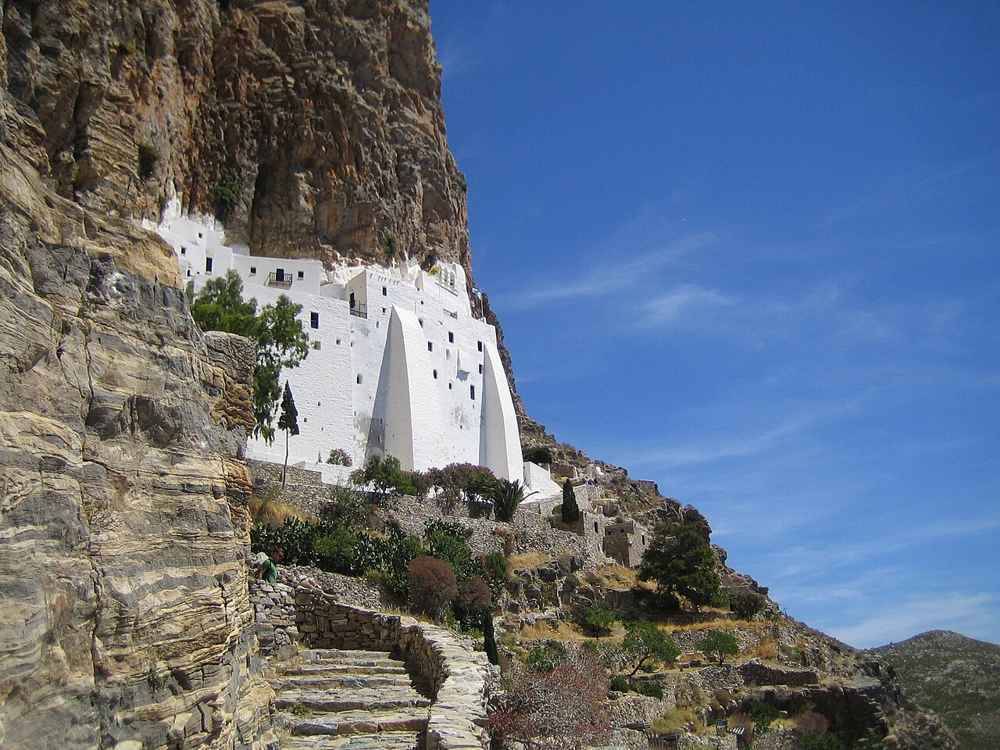
The Hozoviotissa Monastery is the emblem of Amorgos, a dazzling white monastery pressed into a sheer cliff hundreds of metres above the sea below the capital Chora. Eight storeys high yet only metres wide, it clings to the rock face of Mount Profitis Ilias like a swallow’s nest. One of the most dramatic religious buildings in Greece and the island’s defining sight. Plan the whole trip with Greece Tours.
This guide covers the monastery in full: its long history and the legend of its miraculous icon, why it was built into the cliff. How to reach it and climb the steps, the opening hours and dress code, the hospitality of the monks and the views. Read it beside the wider Amorgos travel guide and the island’s things to do.
What is the Hozoviotissa Monastery in Amorgos?
The Hozoviotissa Monastery is a Byzantine monastery on Amorgos, built into a sheer cliff below Chora and dedicated to the Virgin Mary.
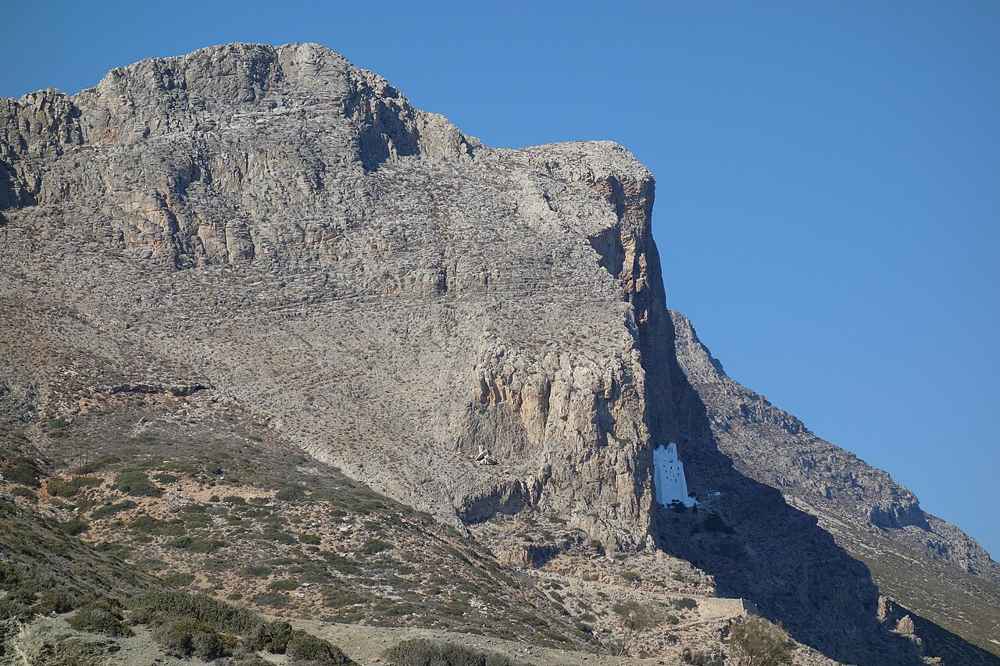
Set into the near-vertical rock face of Mount Profitis Ilias on the south-east coast, below the capital Chora, Hozoviotissa is a monastery unlike any other. Its blinding white walls appear to grow straight out of the grey cliff. From a distance the building seems impossibly narrow. A thin ribbon of masonry clinging to the rock high above the deep blue sea.
The monastery is dedicated to the Panagia Hozoviotissa, an icon of the Virgin Mary. It remains a living Orthodox community. Home to a small number of monks who keep its daily round of prayer. It is by accounts the second oldest monastery in Greece, and its dramatic setting has made it the single most famous sight on Amorgos.
For visitors, Hozoviotissa is the essential experience of the island, a place of pilgrimage, history and astonishing views. The white monastery on its cliff appears on every postcard and guidebook of Amorgos. Seeing it in person. Framed by the rock and the sea, is what most travellers remember above all.
What is the history of the Hozoviotissa Monastery?
The Hozoviotissa Monastery was rebuilt in 1088 by the Byzantine emperor Alexios I Komnenos, with tradition tracing its origins to the ninth or early eleventh century.
The monastery’s origins reach deep into the Byzantine era. Tradition traces a first foundation to the ninth century. The great rebuilding that gave Hozoviotissa its imperial standing came in 1088 under the Byzantine emperor Alexios I Komnenos. Whose patronage secured the monastery’s wealth and independence. These centuries make it, by accounts, the second oldest monastery in Greece.
Through the changing rulers of the Aegean, Hozoviotissa endured. When the Venetians took Amorgos in the late thirteenth century they respected and even embellished the monastery. When the Ottomans came to the Cyclades in the sixteenth century it continued to function, largely untouched by the attacks and pirate raids that scarred so much of the islands.
That long continuity is part of the monastery’s power: for around a thousand years, through Byzantine, Venetian and Ottoman times, monks have kept the flame here on the cliff. The building, the icon and the treasures within are a living record of the island’s faith and of the wider history of the Christian Aegean. Endowed by emperors and respected by later rulers, the monastery long held estates and privileges that sustained it, a mark of the standing it enjoyed across the Byzantine world.
Why is the Hozoviotissa Monastery built into the cliff?
The Hozoviotissa Monastery was built into the cliff for protection and concealment.
The dramatic siting was a matter of survival. The Aegean of the medieval and early modern centuries was plagued by pirates and raiders, and a monastery on open ground was an obvious target. By building into a hidden fold of the cliff, high above the sea and shielded by the mountain. The monks made Hozoviotissa almost invisible from the land and hard to reach or assault.
The building’s astonishing shape follows from the rock. Squeezed into a narrow ledge in the cliff, it rises through eight slender floors rather than spreading out. Each storey only metres wide, linked by steep internal stairs and passages partly hewn from the stone. The white walls both waterproof the masonry and, over time, became the monastery’s signature.
The result is a building that is part monastery, part fortress, wedded to the mountain. Its concealment preserved it through centuries of danger. Today that same setting, clinging to the sheer rock above the blue Aegean. Is exactly what makes Hozoviotissa so unforgettable to those who climb up to it. Few monasteries anywhere occupy so improbable a perch, and the daring of its builders is as striking as its beauty.
What is the legend of the Hozoviotissa icon?
Legend says the icon of the Panagia Hozoviotissa arrived by sea from the East, from Hozeva in the Holy Land, unaided by any crew.
The monastery takes its name and its soul from its icon of the Virgin Mary, the Panagia Hozoviotissa. Tradition holds that the icon came from the monastery of Hozeva in the Holy Land, or by other accounts from Cyprus. Cast into the sea to save it from the iconoclasts and carried across the water to Amorgos without any human hand to guide the boat.
A second legend explains the monastery’s improbable position. When the faithful began to build higher up or on easier ground, the story goes, their tools were found each morning moved to the ledge in the cliff where the monastery now stands, a sign that the Virgin herself had chosen the spot. A builder’s auger is said to remain embedded in the rock as a token of the tale.
These legends, retold to every visitor, give Hozoviotissa its aura of the miraculous. Whatever their historical basis, they express the deep devotion the icon inspires. The sense. Strong when you stand on the cliff, that the monastery belongs to its impossible perch by something more than human design. Pilgrims still come to venerate the icon and to hear the old stories from the monks themselves.
How do you visit the Hozoviotissa Monastery?
The monastery sits just below Chora on the south-east coast.
Hozoviotissa lies a short distance below the capital, and reaching it is part of the experience. On foot, a signposted footpath leaves the edge of Chora and drops toward the coast. A walk of around twenty minutes with the white monastery growing ever more dramatic ahead, arriving at the tarmac road that leads to the gate.
By car or scooter, you drive the short road down from Chora and park at the foot of the monastery. From where a flight of around three hundred paved steps climbs steeply up the cliff to the entrance. The climb is strenuous in the heat, so it is best tackled in the cooler morning or late afternoon, with water to hand.
You arrive, the final approach is the same steep stairway hugging the rock, with the sea falling away below and the monastery looming white above. Combining the visit with a wander through Chora and its castle and a swim at Agia Anna beach just below makes a full and rewarding day.
What are the opening hours and dress code at the monastery?
Hozoviotissa is generally open from 8am to 1pm and again from 5pm to 7pm, closing in the middle of the day.
The monastery keeps the hours of a working religious community rather than a museum. It is usually open to visitors in the morning, from around eight until one. Again in the late afternoon and early evening. From about five until seven, closing over the hot midday hours. Times can vary with the season and with services, so it is worth checking locally before setting out.
Modest dress is required and enforced. Men must wear long trousers, not shorts. Women a skirt below the knee. With shoulders covered for everyone. Wraps are sometimes available to borrow at the entrance, but it is easier to arrive dressed appropriately. The dress code applies inside the building, not on the climb up.
Entrance is free, though a donation toward the upkeep of the monastery is welcomed and appreciated. Photography is generally not permitted inside the chapels and around the icon. Out of respect for the sacred space. The interior is one to experience rather than to photograph, while the exterior and the views are yours to capture.
What do the monks offer visitors at Hozoviotissa?
By long tradition, the monks of Hozoviotissa welcome visitors who complete the climb with a glass of the local rakomelo or raki and a piece of loukoumi.
Reaching the top of the steps, visitors are met with a gesture of hospitality unchanged for generations. The monks offer each guest a small glass of the island’s rakomelo, a warm honey-and-raki spirit, or plain raki. Together with a cube of loukoumi, the sweet Greek delight, a welcome reviver after the steep climb in the heat.
The custom is more than a courtesy. It expresses the monastic tradition of receiving the traveller and the pilgrim as a guest. It gives a moment of quiet contact with the life of the community. Received in the cool of the monastery’s rooms, high on the cliff, the simple offering is one of the small, memorable pleasures of a visit.
This hospitality is extended freely to all who make the climb, whatever their faith, and asks nothing in return beyond respect for the place. It is part of what makes Hozoviotissa more than a spectacular building: a living monastery that still keeps the old ways of welcome on its remote and beautiful cliff. Accepting the offering, even a token sip, is the courteous response, and a moment to rest and take in the cool interior after the heat of the climb.
What can you see inside the Hozoviotissa Monastery?
Inside, a steep stack of tiny rooms and chapels rises through eight floors carved into the cliff, holding the revered icon of the Panagia Hozoviotissa, old ecclesiastical treasures, manuscripts and relics, and windows that open onto sheer drops to the.
Beyond the narrow entrance, the monastery unfolds vertically, a warren of small whitewashed rooms, chapels. Cells and passages stacked through eight floors and linked by steep, worn stairs cut into the rock. The scale is intimate and human, a contrast to the vast cliff outside, and every so often a small window frames a dizzying view straight down to the water.
The heart of the monastery is the main church, or katholikon, home to the celebrated icon of the Panagia Hozoviotissa, venerated for centuries and credited with miracles. Around it the monastery preserves old icons, silver and gold ecclesiastical objects, embroidered vestments, manuscripts and relics, a rich treasury gathered over its long history.
Moving up through the floors, past the chapels and the monks’ quarters to the small terraces near the top. Gives a sense of how a community has lived and prayed here for a thousand years in this improbable place. The climb through the building, ending with the view from its heights, is the essence of the visit. The narrowness of the building means visitors move in single file up the worn stairs. Adding to the sense of entering a world apart, sealed into the rock and the centuries.
When is the feast day of the Hozoviotissa Monastery?
The Hozoviotissa Monastery celebrates its feast on the 21st of November, the day of the Presentation of the Virgin Mary. The festival draws islanders and pilgrims to the monastery and the surrounding villages for services and traditional celebrations.
The monastery’s great day is the 21st of November, the feast of the Presentation of the Virgin Mary in the Temple, to whom Hozoviotissa is dedicated. On this day the island honours its emblematic monastery with services, and the occasion is one of the high points of the Amorgian religious calendar, drawing pilgrims and islanders alike.
Around the feast, the villages and the monastery keep the traditions of a Greek panigyri. With worship followed by shared food, local wine and rakomelo. The fellowship that binds the island community. The date falls well outside the tourist season, giving the celebration an authentic, local character.
For most visitors, of course, the monastery is seen in the summer months, but knowing the feast day gives a sense of its living role in the island’s year. Hozoviotissa is not a relic but a working monastery whose calendar still shapes the devotion and the celebrations of Amorgos.
What are the views from the Hozoviotissa Monastery?
From the monastery’s windows and terraces, the view plunges down the cliff to the deep blue Aegean and stretches along the wild south-east coast of Amorgos.
The reward for the climb, beyond the monastery itself, is the view. From the small windows and the terraces near the top, the eye falls hundreds of metres straight down the cliff to the intensely blue sea below. Ranges out across the open Aegean and along the rugged. Uninhabited coast that stretches away on either side.
The monastery faces the sea rather than the land, so from islands and boats it is the white speck high on the cliff that first announces Amorgos. From within, that relationship is reversed, and the visitor looks out from the rock over the water that both protected and defined the community for a thousand years.
The play of light on the sea and the cliff changes through the day, and the views are finest in the softer light of the late afternoon. Combined with the drama of the building and the setting. The outlook from Hozoviotissa is one of the great sights of the Greek islands and the lasting image of a visit. On a clear day the neighbouring islands of the Little Cyclades and the open sea toward the Dodecanese come into view. Underlining how the monastery has always faced outward to the water rather than to the land.
What is near the Hozoviotissa Monastery?
The monastery sits just below Chora, the whitewashed capital, and directly above Agia Anna, the pebbly cove of Big Blue fame. A visit combines naturally with exploring Chora and its castle and swimming at the beaches below.
Hozoviotissa lies within easy reach of the island’s other central highlights, which makes it simple to build into a day. Directly above stands Chora, the beautiful Cycladic capital on its ridge, with its whitewashed lanes. Churches, windmills and ruined Venetian castle, a short walk or drive up from the monastery road.
Directly below the monastery, on the coast, is Agia Anna. The small pebbly cove of dazzling blue water where Luc Besson filmed The Big Blue, ideal for a swim after the climb. The famous view of the monastery from the beach, white on its cliff above the turquoise sea, is one of the classic images of Amorgos.
Seeing the three together, Chora above, the monastery on the cliff and Agia Anna below, gives the essence of the island in a single outing. For the beaches in detail, see the guide to Amorgos beaches, which covers Agia Anna and the coves nearby. Together the three form the classic day out on Amorgos, easily walked or driven and taking in the island’s finest concentration of sights within a small area.
Can you hike to the Hozoviotissa Monastery?
Yes. The monastery lies on the island’s trail network, and a footpath links it to Chora in about twenty minutes.
For walkers, Hozoviotissa is a natural goal on the old paths of Amorgos. The short signposted footpath from the edge of Chora reaches the monastery in around twenty minutes. A fine alternative to driving, with the white building drawing closer against the cliff as you descend.
The monastery also sits on the celebrated Palia Strata, the old stone route that once linked Chora with the northern bay of Aegiali. Walking a section of this trail past the monastery combines the island’s greatest sight with its finest scenery, and it is one of the classic experiences for hikers on Amorgos.
Reaching the monastery on foot, along the old kalderimia rather than by the road, adds the terraces, chapels and sea views of the trail to the visit. For the full network of routes, grades and the guided options, see the dedicated guide to hiking in Amorgos.
Who are the monks of the Hozoviotissa Monastery?
A small brotherhood of Orthodox monks lives at Hozoviotissa, keeping the daily round of prayer and services and welcoming visitors.
Hozoviotissa is not a museum but a living monastery, home to a small community of monks who maintain its ancient life. They keep the Orthodox cycle of daily prayer and liturgy, care for the revered icon and the treasures. Sustain the fabric of the building against the wind. The sun and the sheer difficulty of its cliff-bound site.
The brotherhood is small, as befits so narrow a building. The monks combine their devotions with the practical work of running the monastery and receiving a steady stream of visitors through the season. It is they who greet each guest at the top of the steps with the traditional raki and loukoumi, a personal contact with the community’s life.
This continuity of monastic life, kept up for around a thousand years on the same remote ledge, is part of what gives Hozoviotissa its atmosphere. Visitors are guests in a working religious house, and a quiet, respectful manner honours the monks whose devotion has preserved the monastery through the centuries. Their quiet presence is a reminder that the building is first a place of worship and only second a spectacle for visitors.
What is the best time of day to visit the Hozoviotissa Monastery?
Early morning and late afternoon are the best times to visit Hozoviotissa, when the light is soft, the climb cooler and the monastery open.
Timing shapes the visit. The monastery opens in the morning and again in the late afternoon and early evening. Closing over the middle of the day. Those two windows are when you can go inside. Both also avoid the fierce midday heat on the exposed climb of around three hundred steps, making the ascent far more comfortable.
The light is finest at the ends of the day. In the early morning the white walls glow against the shadowed cliff, while the late afternoon bathes the monastery and the sea in warm. Golden light, the most rewarding time for photographs of the exterior and the views. Sunset from near the monastery, over the Aegean, is memorable. Bring a camera for the exterior and the outlook, since the interior itself not be photographed.
The morning and late-afternoon openings are also, in high summer, a little quieter than the busiest midday-adjacent hours, giving a calmer experience of the sacred space. Planning the visit around the cooler, more beautiful ends of the day, and checking the current hours locally, makes for the best of Hozoviotissa.
What tips help for visiting the Hozoviotissa Monastery?
Visit in the cooler morning or late afternoon, wear long trousers or a long skirt, carry water for the roughly three hundred steps, and check the opening hours, as the monastery closes midday.
A little planning makes the visit smoother. The climb of around three hundred steps is steep and exposed. The cooler hours of the morning or late afternoon are far more comfortable than the midday heat, and water is worth carrying. Reasonable fitness helps, though visitors take the steps at their own pace with pauses for the view.
Dress for the dress code before you set out: long trousers for men. A long skirt for women. Covered shoulders for both, which saves relying on borrowed wraps at the gate. Check the current opening hours locally, since the monastery closes over the middle of the day and times shift with the season and with services.
Inside, respect the sacred space: photography is generally not permitted in the chapels and around the icon, phones are best silenced, and quiet is expected. Entrance is free, but a donation toward the upkeep of this remarkable place is appreciated, and accepting the monks’ offered raki and loukoumi is part of the experience.
Frequently Asked Questions
How old is the Hozoviotissa Monastery?
The Hozoviotissa Monastery was rebuilt in 1088 by the Byzantine emperor Alexios I Komnenos. Tradition traces its origins back to the ninth or early eleventh century. Making it, by accounts, the second oldest monastery in Greece. For around a thousand years it has functioned as a working monastery on its cliff below Chora. Surviving Byzantine, Venetian and Ottoman rule and the pirate raids that scarred much of the Aegean.
How steps are there at the Hozoviotissa Monastery?
From the road and car park at the foot of the cliff, roughly three hundred paved steps climb steeply up to the entrance of the Hozoviotissa Monastery. Alternatively, a footpath from the edge of Chora reaches the monastery in about twenty minutes. Either way the final approach is strenuous and exposed, so it is best tackled in the cooler morning or late afternoon with water to hand.
Is there a dress code for the Hozoviotissa Monastery?
Yes, a strict dress code applies. Men must wear long trousers rather than shorts, and women a skirt below the knee, with shoulders covered for both, as at any Greek Orthodox monastery. Wraps are sometimes available to borrow at the entrance, but it is easier to arrive dressed appropriately. The code applies inside the monastery; entrance is free, and a donation toward its upkeep is welcomed.
Is the Hozoviotissa Monastery worth visiting?
Yes. The Hozoviotissa Monastery is the emblem and essential sight of Amorgos, a dazzling white monastery built into a sheer cliff high above the sea. Among the oldest in Greece and one of the most dramatic religious buildings in the country. The climb rewards visitors with its extraordinary architecture, its revered icon and treasures, the monks’ traditional hospitality of raki and loukoumi, and plunging views over the deep blue Aegean.