
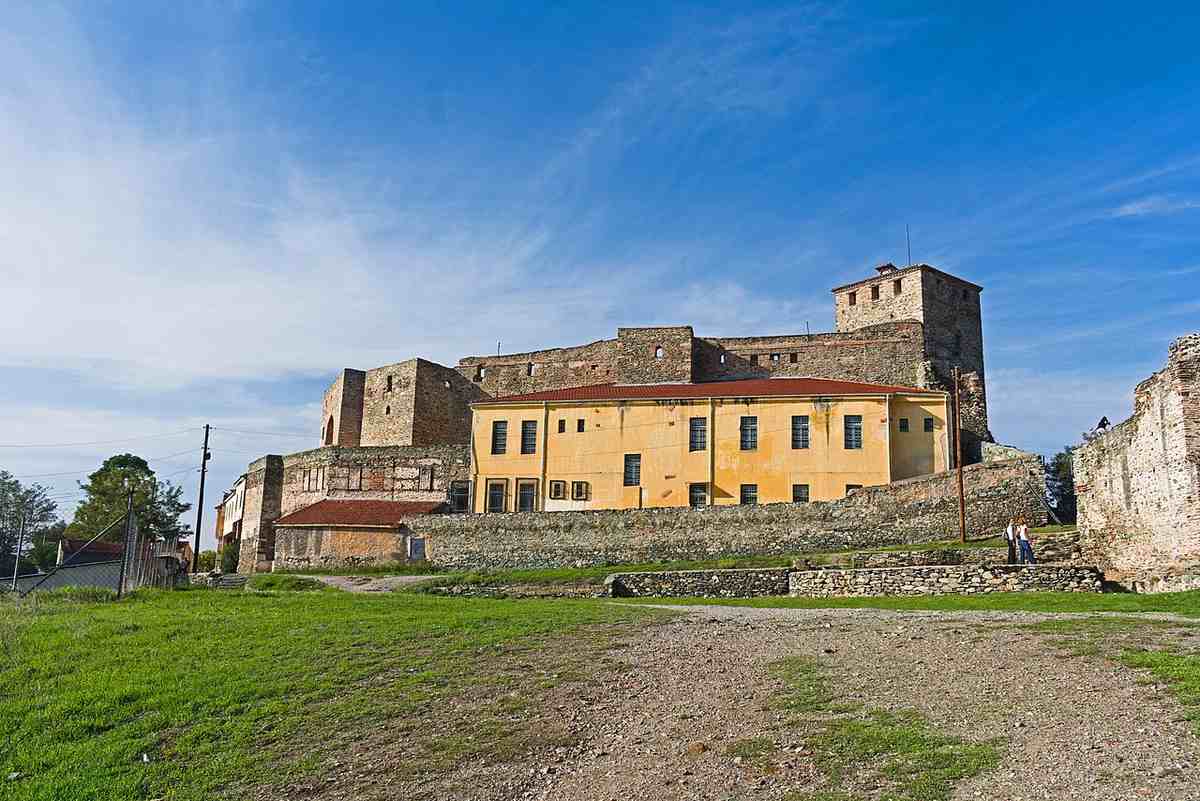
The Eptapyrgio is the acropolis fortress that crowns the Upper Town of Thessaloniki, a citadel of ten towers set into the north-eastern corner of the ancient walls about two hundred metres above the sea. Its Byzantine masonry and its Ottoman gate carry the name Yedi Kule, the seven towers, and its long service as a prison left a mark on the songs and the memory of the city. The fortress rewards the climb through the old lanes below, where the ramparts run down toward the sea and the view opens over the whole gulf. Walk the towers, read the gate inscription, and place the citadel in the fabric of the Upper Town with My Greece Tours.
The citadel repays a slow circuit of its walls rather than a quick look through the gate. Its stones hold the record of the Byzantine defence, the Ottoman garrison, and the prison of the modern age, layer on layer within one enclosure. The sections below cover what the Eptapyrgio is, where its name comes from, and how it grew from a Byzantine redoubt into an Ottoman citadel. The later parts turn to its century as a prison, the walls that fall to the Trigonion tower, the view from the summit, and how to reach the fortress on foot or by bus, whether alone or on the guided Thessaloniki tours.
What is the Eptapyrgio of Thessaloniki?
The Eptapyrgio is a Byzantine and Ottoman fortress on the north-eastern corner of the acropolis of Thessaloniki. It served as the main redoubt of the citadel and the seat of the garrison commander until the late nineteenth century.
The fortress forms a compact walled enclosure at the highest point of the old city, tucked into the angle where the eastern and northern ramparts meet. Its plan gathers ten towers and the curtain walls that link them around a central court, closed against both the land and the town below. The site sits about two hundred metres above the sea, a height that let its garrison watch the approaches to the walled city on every side.
The citadel worked as the strong core of the wider acropolis, the last hold above the Upper Town if the outer walls fell. Its commander answered for the defence of the whole northern height, and in Ottoman times the fortress held the seat of that officer and his men. The enclosure stands apart from the church-rich core of the lower city, a military monument set among the monuments of faith that fill the guides to things to do in Thessaloniki.
The Eptapyrgio now stands open as a protected monument under the care of the Greek state, its walls and towers held for the visitor to walk. The Ministry of Culture took charge of the site at the close of the nineteen-eighties, and its towers house an exhibition on the fortress and its later use. The citadel forms the crown of the walled circuit that earned Thessaloniki a place among the great fortified cities of the Byzantine world.
Why is the fortress called the Eptapyrgio, or Yedi Kule?
The name means the seven towers in both Greek and Turkish, from the Greek epta and the Turkish yedi. The fortress in fact holds ten towers, and the name most likely echoes the Yedikule castle of Constantinople.
The Greek Eptapyrgio joins epta, the word for seven, to pyrgos, the word for tower, so the name reads as the citadel of seven towers. The Ottoman name Yedi Kule carries the same sense, since yedi is the Turkish seven and kule is the Turkish tower. Both names fix the number at seven, a count that the walls of the fortress do not match.
The enclosure carries ten towers rather than seven, a gap between the name and the fabric that has long puzzled the people who study the site. The likeliest reading traces the name to the Yedikule fortress of Constantinople, the famous seven-tower castle of the Ottoman capital. The garrison of Thessaloniki appears to have borrowed the name of the greater citadel and fixed it to their own acropolis fort.
The pair of names marks the two long chapters of the fortress in a single breath, the Greek for its Byzantine centuries and the Turkish for its Ottoman ones. Local speech kept Yedi Kule alive well into the modern age, above all for the prison that the fortress became. The Greek Eptapyrgio holds the formal ground now, yet the older Yedi Kule still sounds in the songs and the street names of the Upper Town.
What is the history of the Eptapyrgio?
The northern towers rose in the Byzantine period, most likely under the emperor Theodosius in the late fourth century. The southern towers followed later, and the Ottomans rebuilt the gate in the fifteenth century.
The five northern towers and their curtain wall form the oldest part of the fortress, tied by most scholars to the reign of Theodosius the Great near the close of the fourth century. That dating sets the citadel within the vast rebuilding of the city walls that gave Thessaloniki its Byzantine defences. The masonry of these towers joins courses of stone with bands of brick, the layered technique that runs through the walls of the Upper Town and the Byzantine churches of Thessaloniki.
The five southern towers and their stretch of wall came later, raised in the middle Byzantine centuries to close the enclosure and strengthen the acropolis core. The result gathered the ten towers into one tight citadel at the summit of the walled city. The fortress held its Byzantine form through the long defence of the city against the sieges that pressed on the walls across the medieval age, a story woven into the wider history of Thessaloniki.
Ottoman forces stormed the acropolis in the fifteenth century, and the new rulers set their own stamp on the gate of the citadel. The city’s first Ottoman governor, Çavuş Bey, rebuilt the main gate and set a marble inscription above it. Its lines record the capture of the acropolis under Sultan Murad, the son of Sultan Mehmed, and the raising of the gate tower about a month after the fall of the city.
The fortress served through the Ottoman centuries as the garrison seat of the acropolis, the base of the commander who held the height above the town. Its towers gained the Turkish names that a later inventory of the citadel set down, from the tower of the lantern to the tower of the powder store. That long military use kept the walls in repair until the fortress passed to a new and grimmer role at the close of the nineteenth century.
Why was the Eptapyrgio used as a prison?
The fortress became a prison in the eighteen-nineties, when its walls were fitted with cells and its garrison role ended. It held prisoners, among them many political detainees, until it closed in nineteen-eighty-nine.
The citadel took on its life as a prison in the last decade of the nineteenth century, its towers and court turned over to cells and its gate barred against escape. A city map of the period already marks the fortress as a place of confinement rather than a garrison post. The thick Byzantine walls that once kept enemies out now served to keep the inmates in, and the fortress held that role for close to a hundred years.
The prison gained a dark name in the twentieth century, when its cells filled with political prisoners through the hardest years of the state. The dictatorship of the nineteen-thirties, the years of occupation, the civil war that followed, and the military junta of the late nineteen-sixties each sent detainees behind its walls. The conditions were harsh, the record grim, and the ground near the fortress carries the memory of executions from those years.
The name Yedi Kule passed into the rebetiko songs of the age, the music of the city’s poor and its outcasts. Singers set the prison at the heart of their laments, so the fortress lives in the Greek song tradition as a byword for confinement and loss. That thread of music keeps the prison alive in the popular memory long after the last cell fell silent.
The prison closed in nineteen-eighty-nine, and the walls emptied of their inmates for the last time. Care of the site passed to the state soon after, which opened the fortress as a monument and set an exhibition in its towers on the years of confinement. The citadel now reads as a record of both its Byzantine defence and its modern use as a jail, the two chapters held within one wall.
How do the walls run down to the Trigonion tower?
The Eptapyrgio anchors the north-eastern corner of the acropolis, and the Byzantine ramparts fall from it along the eastern height. That wall drops through the Upper Town to the Trigonion tower, the round bastion at the seaward angle.
The fortress sits at the top of the walled circuit, where the eastern and northern walls of the acropolis meet at the summit. From that corner the eastern rampart runs downhill, tracing the crest of the ridge above the old lanes and gardens. The wall keeps its towers and its walkway along much of that descent, a stretch that a walker can follow with the citadel above and the sea ahead.
The line of wall reaches the Trigonion tower at the south-eastern angle of the circuit, a massive round tower raised in the Ottoman centuries to hold cannon. Its name means the tower of the triangle, from the corner it guards where the acropolis wall turns toward the sea. The bastion offers the finest low view over the roofs of the Upper Town and the gulf beyond, a natural end to a walk down from the fortress.
The walls tie the Eptapyrgio to the whole defensive circuit that once ringed the city from the sea to the heights. The same ramparts that climb to the citadel run down through the old quarter of Ano Poli, the Upper Town, where the walls still frame the streets and the little squares. A route that joins the fortress to the Trigonion tower reads the Byzantine defences of the city as one continuous line.
What can you see from the Eptapyrgio?
The fortress crowns the highest point of the Upper Town, so its walls open a wide view over the whole city and the Thermaic Gulf. On a clear day Mount Olympus rises across the bay.
The height of about two hundred metres lifts the fortress above the roofs of the city and clears the view to the water. From the walls the eye runs down the slope of the Upper Town, across the dense grid of the modern centre, and out to the curve of the seafront below. The whole shape of the city reads from the summit, the old walls and the new streets set out like a map.
The gulf fills the middle distance, its water broad and bright beyond the line of the shore. The tower on the front stands out along that shore, the same White Tower of Thessaloniki that marks the end of the seaward walls. On a clear morning the ridge of Mount Olympus lifts across the bay, its high summits holding snow into the late spring.
The excavation of the fortress has opened the ground within the walls to the study of its long past. Digs inside the enclosure have brought to light an early Christian basilica and an early Byzantine cemetery church, traces of the sacred use of the height before the citadel took its final form. The systematic study and restoration of the site began at the start of the nineteen-nineties, and the work on the walls and towers has carried on across the decades since.
The view and the walls together make the fortress a fine reward at the head of a climb through the old quarter. Many walkers time the visit for the late afternoon, when the light softens over the gulf and the city turns gold below the ramparts. The summit forms a natural high point of any Thessaloniki walking tour that takes in the Upper Town and its walls.
How do you reach the Eptapyrgio on foot or by bus?
The fortress stands at the top of the Upper Town, reached on foot by climbing the old lanes from the lower city or by a city bus to the ramparts. The walk up takes about thirty to forty minutes.
The climb on foot leads up through the stepped lanes of Ano Poli, past the old houses and the little churches that fill the height above the fire line of the lower city. The route gains ground steadily, so the walker earns the view with a stiff pull uphill. A steady pace from the main avenue of the centre reaches the fortress in about half an hour, with the walls and squares of the Upper Town as reward along the way.
A city bus offers the easier road to the summit for those who would rather save their legs for the walls themselves. Lines from the centre climb into the Upper Town and set down near the fortress, a link worth checking against the current network before the trip. The bus turns the visit into a downhill walk, since a rider can climb by bus and then stroll back down through the lanes to the lower city.
The fortress rewards a plan that ties it to the other sights of the Upper Town rather than a bare there-and-back. A route that climbs to the citadel, walks the wall down to the Trigonion tower, and drops through Ano Poli builds the height into a full morning or afternoon. The stop suits a place near the top of a wider Thessaloniki itinerary that works from the seafront up to the walls.
The practical points of the visit reward a check of the current details before the climb, since the hours of the exhibition and the bus lines shift with the season. A guide smooths the plan and draws out the layers of the walls, the gate, and the prison that a bare visit can leave unread. The fortress fits neatly into a day that reads the Upper Town from the ramparts down, and the wider notes on getting around Thessaloniki help set the route.
How does the Eptapyrgio fit into a walk of the Upper Town?
The Eptapyrgio forms the summit of the Upper Town, the natural top of a walk that climbs from the Roman and Byzantine core through the old quarter. It pairs with the walls and the Trigonion tower in one route.
The fortress crowns the walled height above the older monuments of the centre, so a walk that works uphill reaches it as the last and highest stop. A route from the lower city can take in the round Roman hall of the Rotunda before the long climb through the lanes to the citadel. The order lets a visitor read the city from its Roman heart to its Byzantine crown across a single line.
The Upper Town holds its own web of sights around the fortress, from the surviving walls to the old churches and the fountains of the Ottoman quarter. A walk down from the citadel to the Trigonion tower ties the ramparts into the route and opens the low view over the gulf. The lanes reward a slow pass, since the old houses and the small squares of the quarter carry the character that the fire spared in the lower city.
The fortress works best as the high anchor of a day that reads the whole story of the city in the right order. A traveller who climbs from the seafront through the Roman and Byzantine centre to the walls of the Eptapyrgio recovers the shape of the fortified city on its hill. A guided walk draws the threads of the citadel, the prison, and the ramparts together, so the height reads as one monument rather than a scatter of stones.
Frequently Asked Questions
Where is the Eptapyrgio located?
The Eptapyrgio stands at the top of the Upper Town of Thessaloniki, on the north-eastern corner of the acropolis about two hundred metres above the sea. It sits at the head of the old walled quarter of Ano Poli, reached by a climb up the stepped lanes from the lower city or by a city bus that runs to the ramparts.
Why is the fortress called Yedi Kule?
Yedi Kule is the Ottoman name of the fortress and means the seven towers, from the Turkish yedi for seven and kule for tower. The Greek name Eptapyrgio carries the same sense. The count of seven most likely echoes the famous Yedikule castle of Constantinople, since the citadel of Thessaloniki in fact holds ten towers rather than seven.
How old is the Eptapyrgio?
The oldest part of the fortress, its five northern towers and their wall, dates most likely to the late fourth century under the emperor Theodosius. The five southern towers followed in the middle Byzantine centuries. The Ottomans rebuilt the main gate after they took the acropolis in the fifteenth century and set a marble inscription above it.
Was the Eptapyrgio really a prison?
Yes. The fortress served as a prison from the eighteen-nineties until it closed in nineteen-eighty-nine. Its cells held political prisoners through the dictatorship of the nineteen-thirties, the years of occupation, the civil war that followed, and the military junta of the late nineteen-sixties. The prison lives on in the rebetiko songs that took the name Yedi Kule as a byword for confinement.
Can you go inside the Eptapyrgio?
Yes. The fortress stands open as a protected monument under the care of the Greek state, and its towers house an exhibition on the citadel and its years as a prison. The walls and the central court lie open to the visitor, though the hours of the exhibition shift with the season, so a check of the current schedule rewards the plan before the climb.
What is the Trigonion tower near the Eptapyrgio?
The Trigonion tower is the great round bastion at the south-eastern angle of the acropolis walls, reached by following the rampart downhill from the Eptapyrgio. Its name means the tower of the triangle, from the corner it guards. The Ottomans raised it to hold cannon, and it now offers the finest low view over the roofs of the Upper Town and the gulf beyond.