
Akrotiri is a broad, rocky peninsula reaching north-east from Chania in western Crete. The peninsula holds the city’s airport, the deep natural harbour of Souda Bay, and a scatter of beaches and historic monasteries across its bare hills. Clifftop religious sites, the sandy cove of Stavros, and the hilltop graves of the statesman Eleftherios Venizelos sit within a short drive of Chania old town. The mix of beaches, monasteries, war history and the airport makes the peninsula easy to cover on a half-day trip. Plan an Akrotiri visit around Chania and its western coastline with My Greece Tours.
This peninsula rewards travellers who want beaches, monasteries and a viewpoint in one compact loop north-east of the old town. The sandy cove of Stavros, the clifftop Agia Triada monastery, and the Profitis Ilias hill each sit a short drive apart. The sections below cover the peninsula’s location, its monasteries, its beaches, the Venizelos graves and view, and how to fit Akrotiri into a wider western itinerary. Pair this page with the broader Crete travel guide to place the peninsula within the island’s regions and plan the rest of a western trip.
Where is Akrotiri in Crete and what does the peninsula hold?
Akrotiri is a broad, rocky peninsula reaching north-east from Chania in western Crete. The peninsula holds the city’s airport, the deep natural harbour of Souda Bay, and a scatter of beaches and historic monasteries spread across its bare, low hills.
The peninsula extends north-east from Chania and forms the northern arm that shelters Souda Bay, the deep natural harbour used as the region’s main port. Bare, rocky hills cover most of the ground, rising away from the coast toward the Profitis Ilias hill and the high ridges further inland. Chania airport sits on the peninsula’s plateau, so arriving travellers touch down on Akrotiri before driving into the old town. The road network links the airport, the beaches at Stavros, Kalathas and Marathi, and the three clifftop monasteries in a single driveable loop. The scale stays small, and the whole peninsula measures a short drive from end to end.
A run from Chania old town reaches the far monasteries in well under an hour, so orientation comes quickly to a first-time visitor.
The peninsula packs beaches, monasteries, war history and the airport into a compact area north-east of the city. Souda Bay carries commercial ferries and a naval presence, while the Commonwealth war cemetery on its shore records the fighting of the Battle of Crete. The sandy cove of Stavros, ringed by a bare mountain, sits at the northern tip, and the family beaches of Kalathas and Marathi lie along the western shore. The clifftop Agia Triada monastery, the older Gouverneto monastery and the ruined Katholiko monastery stand among the bare hills to the north-east. The graves of Eleftherios Venizelos crown the Profitis Ilias hill above the city.
This concentration of sights makes the peninsula one of the easiest half-day loops among the things to do in Crete.
Which monasteries stand on the Akrotiri peninsula?
Three historic monasteries stand among the bare hills of the peninsula: the clifftop Agia Triada monastery, the older Gouverneto monastery, and the ruined, cave-set Katholiko monastery. They rank among the finest religious sites on the whole island of Crete.
The clifftop Agia Triada monastery is the largest and most visited of the three, a walled complex of ochre stone standing among vineyards and olive groves on the peninsula’s slopes. The older Gouverneto monastery sits higher and more remote, a fortified building on the bare upper hills reached by a winding road beyond Agia Triada. A walking path from Gouverneto drops down a rocky ravine to the ruined, cave-set Katholiko monastery, one of the oldest religious sites on the peninsula, carved into the gorge and long abandoned. The three stand within the bare hills to the north-east and share a single visiting route.
The three form one loop across the upland, and together they rank among the finest historic sites and hidden gems in Crete.
The monasteries reward an unhurried visit, since the road climbs from the sheltered lowlands near the airport into stark upland where only scrub and stone cover the ground. Agia Triada keeps its church, cloister and a shop selling its own olive oil and wine, and its ochre facade stands out against the bare hillside behind. The walk from Gouverneto to Katholiko crosses open rock with no shade, so it suits cooler hours and firm footwear. The descent into the gorge is steep, and the return climb takes longer than the way down. The route pairs the working monastery, the fortified upper house and the abandoned gorge chapel in one loop.
Travellers building a western itinerary often slot the monasteries alongside the beaches and the Crete beaches of the same peninsula.
What beaches are on the Akrotiri peninsula in Crete?
The sandy cove of Stavros sits at the northern tip, ringed by a bare mountain and famous as the setting for the closing dance in the film Zorba the Greek. Kalathas and Marathi, on the western shore, offer easy family swimming.
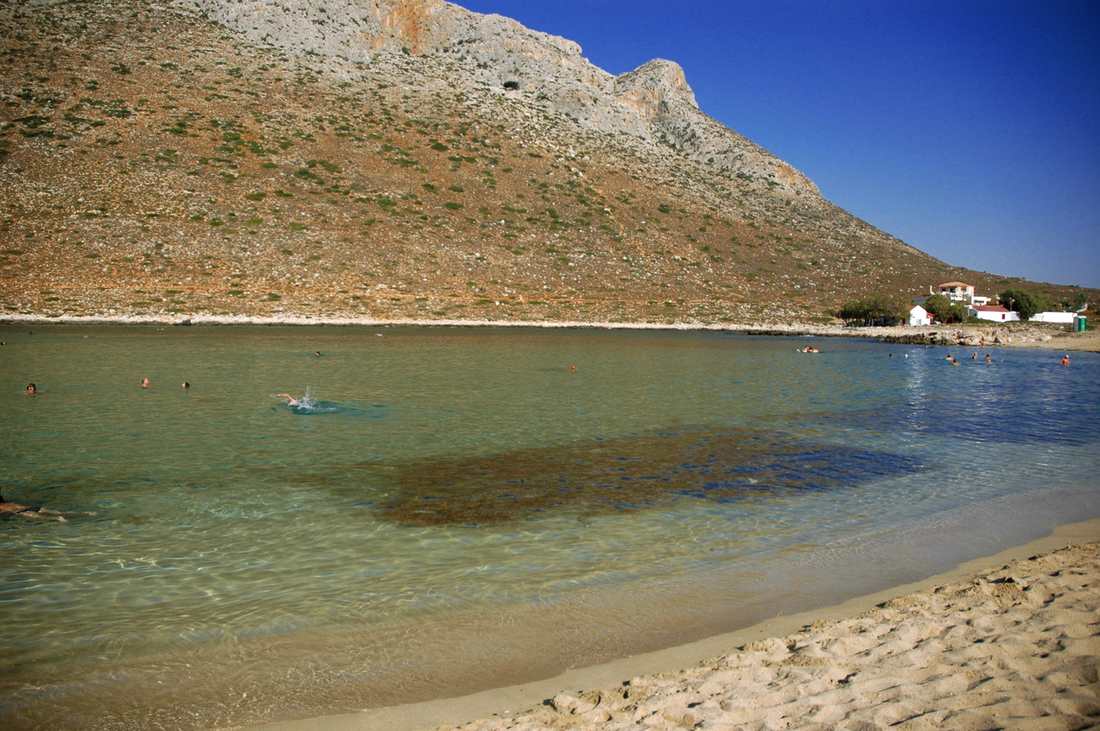
The sandy cove of Stavros is the peninsula’s best-known beach, a near-enclosed bay of calm, shallow water backed by a steep bare mountain that plunges straight into the sea. The setting served as the backdrop for the famous dance scene in the film Zorba the Greek, and the mountain wall gives the cove its distinctive shape on screen. Shallow water and a sheltered shape make Stavros safe for families, and a smaller open beach lies beside the enclosed lagoon for stronger swimmers. Kalathas, on the western shore, is a broad sandy bay with tavernas and a small islet offshore, while Marathi has two small sheltered coves above Souda Bay.
These sheltered northern and western beaches contrast with the wilder cliff swimming at nearby Seitan Limania, east across the peninsula.
Kalathas and Marathi suit travellers who want easy, shallow swimming close to the airport and the old town rather than a long drive across the island. Kalathas fills with local families at weekends and keeps sunbeds, cafes and safe water within a short drive of Chania. Marathi, tucked at the peninsula’s south-eastern edge above Souda Bay, has two small coves with tavernas at the water’s edge and gentle entry for children. Stavros draws day-trippers for its film association and its steep mountain wall, so early hours give the quietest swimming and the easiest parking.
Basing a family on the peninsula puts all three of these beaches within a short reach, and a look at where to stay in Crete helps weigh the peninsula against the old town.
Who was Eleftherios Venizelos and why are his graves on Akrotiri?
Eleftherios Venizelos was a Cretan statesman who became a leading Greek prime minister. His grave and that of his son crown the Profitis Ilias hill on the peninsula, a spot with a sweeping view over Chania and the coast.
Eleftherios Venizelos was born in the Chania region and rose from Cretan politics to become one of the most influential prime ministers in modern Greek history. His grave and that of his son crown the Profitis Ilias hill on the peninsula, chosen for its commanding position above the city he came from. The hill carries a monument, a chapel and a broad terrace, and its height gives a sweeping view over Chania, its harbour, the coast and the White Mountains inland. The graves sit within the same peninsula loop as the beaches and monasteries, a short drive from each.
The site draws visitors for the view as much as the history, and it pairs naturally with a stop in the Chania old town spread out below the hill.
The Profitis Ilias hill also carries a memory of the fight for Cretan union with Greece, and the terrace around the graves is a common evening viewpoint for the sunset over the bay. A cafe near the monument lets visitors linger over the panorama of the old town, the Venetian harbour and the open sea. The graves sit a short drive from both the airport and the beaches, so they fit easily into a peninsula loop of a single afternoon. Reaching the hill takes only minutes from Chania, and the viewpoint gives useful bearings on the wider western coast before continuing to the beaches, the monasteries or the mountains inland.
The climb suits an early or late hour, when the low sun lights the tiled roofs of the town. Out on the peninsula’s tip, the fortified Gouverneto Monastery guards a gorge down to the sea.
How do you fit Akrotiri into a wider Crete itinerary?
Akrotiri works as a half-day loop from Chania, since its beaches, monasteries, war history and viewpoints sit within a short drive of the old town. Most travellers base in Chania and drive out to the peninsula for a morning or afternoon.
The peninsula sits directly beside Chania, so most itineraries treat it as a half-day excursion rather than a separate base. A morning loop takes in the Agia Triada monastery, the walk to Katholiko and a swim at Stavros, while an afternoon version pairs Kalathas beach with the Venizelos graves at sunset. The airport’s location on the plateau means arriving or departing travellers fit one Akrotiri sight around a flight without backtracking. A car makes the loop simple, since the beaches, monasteries and viewpoint lie minutes apart on the same road network.
Using Chania as a base keeps the peninsula, the old town and the wider west within easy reach, so the city serves as the natural hub for a western trip built around Akrotiri and its coastline. On its north tip, the sheltered lagoon of Stavros beach offers calm family swimming below a bare mountain.
Beyond the peninsula, the western coast opens onto the beaches, gorges and mountain villages that fill a longer stay on this side of the island. Akrotiri’s short loop leaves the rest of a day free for the old town, a longer beach drive or a gorge walk from a Chania base. Travellers combine the peninsula with a coastal run to the cliff swimming spots east of the airport and the wide sandy bays west of the city. Slotting the half-day loop early in a western trip gives quick orientation over Chania from the Profitis Ilias hill.
The peninsula sits right at the start of most western routes, making it a natural first stop before the deeper island unfolds toward the mountains and the far south coast.
Frequently Asked Questions
How long do you need to visit Akrotiri?
A single half-day covers the main sights of the peninsula comfortably. A morning or afternoon loop from Chania takes in one or two of the monasteries, a swim at Stavros or Kalathas, and the Venizelos graves on the Profitis Ilias hill. The peninsula stays compact, and its beaches, monasteries and viewpoints sit minutes’ drive apart, so a full day is rarely needed unless the walk down to the ruined Katholiko monastery is added. That gorge path from Gouverneto crosses open rock with no shade and takes longer, pushing a monastery-focused visit toward a longer morning.
Travellers who want to combine the peninsula with the old town usually give Akrotiri the first half of a day and Chania the second. A car makes the loop simple; without one, a taxi or organised trip covers the scattered sights more easily than local buses, which serve only the main beaches at Stavros, Kalathas and Marathi.
Is Akrotiri a good base for a beach holiday in Crete?
The peninsula works better as a day trip than a full beach base for most travellers, though the family beaches at Kalathas and Marathi and the sheltered cove of Stavros give calm, shallow swimming close to the airport. Rooms and small hotels cluster near Stavros and Kalathas, and staying there puts the beaches, monasteries and viewpoints within minutes. The trade-off is distance from Chania’s restaurants, harbour and nightlife, which sit a short drive back toward the city. Families who want quiet water and easy parking often prefer the peninsula, while travellers who want the old town on the doorstep base in Chania and drive out.
The bare, rocky landscape gives the beaches a dramatic backdrop but little natural shade, so tavernas and sunbeds matter for a long day. Weighing the peninsula against the old town is the key call, and the balance turns on whether beaches or evening amenities matter more to the trip.
Can you reach Akrotiri without a car?
Local buses from Chania serve the main beaches at Stavros, Kalathas and Marathi in summer, so a beach day on the peninsula is possible without a car. The monasteries and the Venizelos graves are harder to reach on public transport, since the roads that climb to Agia Triada, Gouverneto and the Profitis Ilias hill see few or no scheduled services. Travellers without a car usually take a taxi for the monastery loop or join an organised half-day trip that ties the beaches, monasteries and viewpoint together. The airport on the peninsula’s plateau is well connected, but its buses run to the city rather than around the local sights.
Renting a car for a day is the simplest way to link the scattered beaches, clifftop monasteries and hilltop graves in one loop. The compact layout of the peninsula rewards even a short self-drive, and a single day’s car hire covers the beaches, the monastery loop and the hilltop graves without any backtracking to the city.