
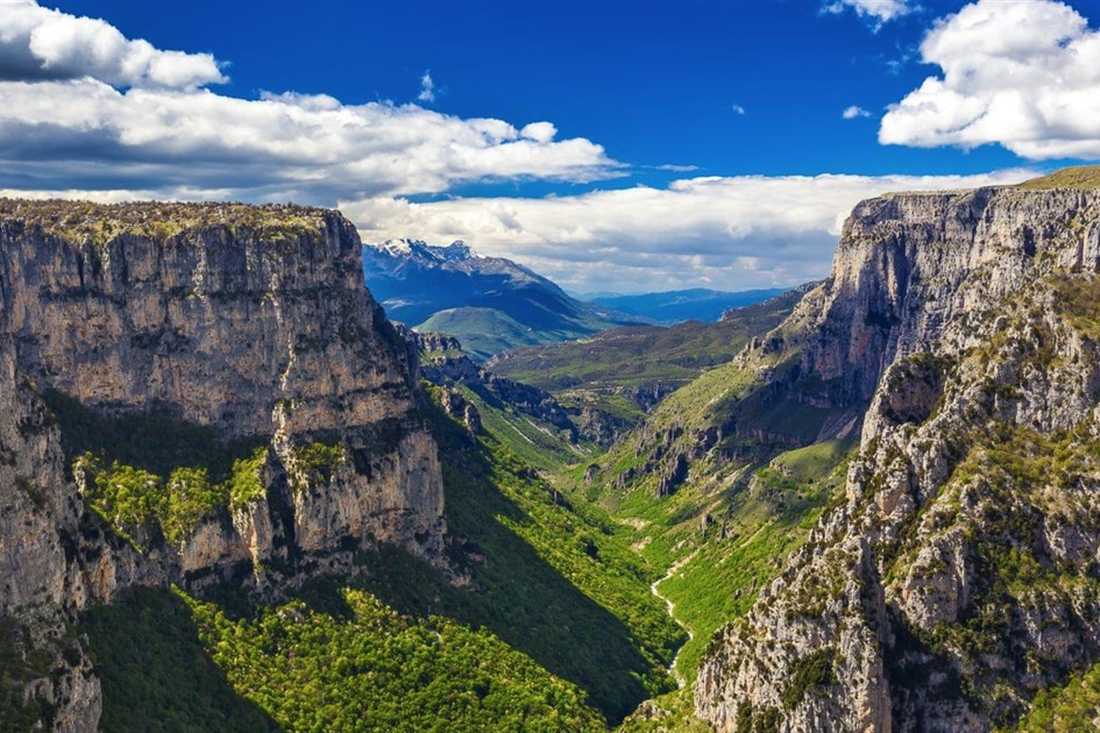
A Zagori day trip from Parga is an 8 to 11-hour excursion from the Epirus coast to the stone villages, stone bridges and Vikos Gorge of Zagori, in the Pindus mountains north of Ioannina. Tours across the rest of the country are listed on Greece Tours.
The sections below cover the tours you can book, the route, Monodendri, the gorge and its viewpoints, the monastery of Agia Paraskevi, the bridges near Kipi, Ioannina, food, what to bring and booking, with links into the Zagori pages. The tours shown are checked on GetYourGuide and Viator.
What is a Zagori day trip from Parga?
A Zagori day trip from Parga is a full-day excursion from the Epirus coast inland. It visits stone villages, stone bridges and the Vikos Gorge in the Pindus mountains north of Ioannina. The trip includes hotel pickup and return.
The journey leaves the coastal town behind and heads into the highlands. Travelers leave the sea for the mountains. This Zagori day trip from Parga covers a large distance across the region.
The route climbs inland into the Pindus mountains. Visitors see stone structures built directly into the landscape. A Zagori day trip from Parga connects the coast to the interior highlands.
- Stone villages in the Pindus mountains
- Historic stone bridges crossing local rivers
- The deep canyon of the Vikos Gorge
- Hotel pickup and return transport
Which Zagori day trips from Parga can you book?
Travelers booking a Zagori day trip from Parga find shared group tours and private excursions on major platforms. GetYourGuide lists two distinct options. Viator and TUI also offer scheduled departures for this route.
GetYourGuide lists a tour called “Zagori & Vikos Gorge Tour From Parga”. This option lasts about ten hours. It focuses on stone bridges, mountain villages and canyon views. Check tours departing from Parga for current schedules.
The same platform lists “From Parga: Private Zagoria Villages & Vikos Gorge Day Trip”. This private option runs for about eleven hours. It serves one party only. The route goes from Parga to Ioannina, Monodendri and Kipi.
This private Zagori day trip from Parga stops at the Vikos Gorge and the monastery of Agia Paraskevi. It also visits the Oxia viewpoint and the stone bridges. Viator lists another option named “Zagoria and Vikos Gorge from Parga”.
TUI offers a full-day tour starting from both Parga and Preveza. This excursion lasts more than eight hours. The guide speaks English throughout the journey. Hotel pickup and return are part of the arrangement.

What route does a Zagori day trip from Parga follow?
A Zagori day trip from Parga travels inland toward the Pindus mountains north of Ioannina. The TUI route follows a specific sequence of stops. Other operators use similar paths through the region.
The drive from Parga to Monodendri takes about one and a half to two hours. This travel time applies to the direct road between the coast and the mountain village. The distance requires steady driving through changing terrain.
The TUI tour begins with a stop in Ioannina. Guests take a short guided stroll in the lakeside capital of Epirus. For more regional options, look at excursions around Ioannina. The coach then continues toward the Zagori area.
Monodendri is the next destination on this Zagori day trip from Parga. Visitors receive over two hours of free time there. A guide leads a walk to the monastery of Agia Paraskevi during this stop.
The route proceeds to the Oxia viewpoint over the Vikos Gorge. The final stops are the Kokkori and Kalogeriko stone bridges. The private GetYourGuide tour names the same places: Ioannina, Monodendri and Kipi.
- Ioannina for a guided lakeside stroll
- Monodendri for free time and a guided walk
- Oxia viewpoint over the Vikos Gorge
- Kokkori and Kalogeriko stone bridges
How long does a Zagori day trip from Parga take?
A Zagori day trip from Parga takes between eight and eleven hours depending on the operator. Shared group tours run for eight to ten hours. Private excursions last up to eleven hours.
The TUI full-day tour lasts more than eight hours. Standard listings on other platforms report durations of eight to nine hours. These times cover the entire period from departure to return.
The GetYourGuide shared tour takes about ten hours. This duration accounts for the driving time and the stops along the route. The private alternative on the same platform requires about eleven hours.
Schedules for these tours start early in the morning. Pickups begin around 08:30 at hotels in Parga. Other operators ask guests to meet at a set point in town instead of providing individual hotel collection.
The drive alone takes one and a half to two hours each way to Monodendri. This transit time forms a large part of the total duration. The remaining hours cover the guided walks and free time at each stop.
- TUI tours last more than eight hours
- Standard listings run eight to nine hours
- Shared GetYourGuide tours take about ten hours
- Private tours require about eleven hours
- Morning pickups start around 08:30
What does a Zagori day trip from Parga include?
A Zagori day trip from Parga includes transport, a guide, entrance fees and hotel pickup. Food and drinks cost extra on the TUI tour. Private tours serve one party exclusively.
The TUI package covers the vehicle and the driver for the entire route. An English-speaking guide accompanies the group at every stop. Entrance fees for the visited sites are part of the arrangement.
Meals are not part of the TUI package. Guests pay for their own food and drinks during the excursion. However, other listings include a traditional lunch as part of the itinerary. Travelers must check the specific details before booking.
Transport logistics vary by operator. The TUI tour provides direct hotel pickup and return. Other operators start around 08:30 with hotel collection in Parga. Alternatively, guests meet at a designated central point in town.
The private GetYourGuide option operates differently from the shared tours. It reserves the vehicle and guide for one party only. This means no other travelers join the group. Every Zagori day trip from Parga covers the core sites regardless of the chosen format.
- Round-trip transport from the coast
- English-speaking guide services
- Entrance fees for scheduled sites
- Hotel pickup or a central meeting point
- Traditional lunch on specific listings
Where is Zagori, and how far is it from Parga?
Zagori is a mountain region in the Pindus mountains of Epirus, northwest Greece. A Zagori day trip from Parga covers about 1.5 to 2 hours of driving to Monodendri. This municipality holds 46 villages across roughly 1,000 square kilometers.
About 3,400 people live in these settlements, known as the Zagorochoria. The city of Ioannina lies at the southern point of this area. Mount Mitsikeli stands 1,810 meters tall and forms the southwest side.
The Aoos river and Mount Tymphe lie to the north. Two national parks protect the land here. One is Vikos–Aoos, which includes the Vikos Gorge. The second park sits around Valia Kalda.
The name Zagori is thought to come from a Slavic word meaning “beyond the mountains”. Ancient Molossians once lived on this exact land.
- Mount Mitsikeli marks the southwest border of the region
- The Aoos river flows along the northern edge
- Mount Tymphe rises in the northern section
- Ioannina sits at the southern point of the municipality
What do the stone villages of Zagori look like?
Each village centres on a square with a large church, a plane tree and a public fountain. Houses are built of local stone. Stone-slab roofs stay in place by their own weight, without cement. A Zagori day trip from Parga reveals this architecture.
The builders used no cement for the roofs. Gravity alone holds the heavy stone slabs in place.
Churches date from the seventeenth century onward. They stand tall next to the central squares. Visitors on a Zagori day trip from Parga walk through these squares to see the old plane trees. These trees grow wide and provide shade over the stone fountains.
Papingo sits in the north of Zagori. It is another village visited on guided tours of the region. Its stone buildings match the style found in the rest of the Zagorochoria. The uniform use of local rock gives every settlement a similar look.
- A large church anchors the center of each village
- A plane tree grows beside the main square
- A public fountain provides water near the square
- Stone-slab roofs stay in place without cement
How did Zagori become rich enough to build its villages?
In the fifteenth century, Zagorians made an agreement with the Ottomans that gave them self-rule. This union was called the Koinon of the Zagorians. Emigrants sent money home to pay for schools, bridges and monasteries. A Zagori day trip from Parga crosses this historic land.
The Koinon allowed the locals to govern their own affairs. This freedom started in the fifteenth century.
Wealth arrived from the seventeenth century onward. The eighteenth century brought the largest flow of funds. Men who left the mountains worked in distant cities. They sent their earnings back to their home villages.
This money paid for the stone bridges that connect the valleys today. It also funded the schools and monasteries seen on a Zagori day trip from Parga. The emigrants wanted their home villages to thrive while they worked far away.
Zagori gained full freedom during the Balkan Wars in the early twentieth century. After that, emigration, war and the Greek Civil War emptied the villages. People left for cities, leaving the stone houses quiet.
Why did UNESCO list the Zagori landscape?
UNESCO listed Zagori as a Cultural Landscape in the early twenty-first century. The organization recognized the villages, bridges and mountain land shaped by people. This listing protects the area. A Zagori day trip from Parga enters this protected territory.
The title of Cultural Landscape applies to places where nature and human work mix.
People shaped this land over centuries. They cut the stone for their roofs from the surrounding hills. Every part of the Zagorochoria shows signs of careful human planning.
The early twenty-first century listing helps keep the area intact. Visitors taking a Zagori day trip from Parga see that landscape up close.
- Villages form a core part of the listed landscape
- Stone bridges show how people crossed the rivers
- Mountain paths reflect centuries of human travel
What is Monodendri, the village at the gorge edge?
Monodendri is a village 41 km north of Ioannina, sitting at 1,060 meters high. About 133 residents live there, and its stone buildings survive intact. Day trips give over two hours of free time here. A Zagori day trip from Parga stops at this settlement.
The church of Agios Athanasios stands in the village square. An open-air stone theatre sits at the edge of the village. Local groups use this theatre for summer festivals.
The Rizari brothers left important gifts to the village. They provided the Rizarios Exhibition Center. They also founded the Rizarios Handicraft School.
Over two hours of free time allows visitors to walk the stone paths. They can enter the exhibition center or sit in the square. A Zagori day trip from Parga reaches this elevation after the long drive up from the coast. The air at 1,060 meters feels cooler than at sea level.
- The church of Agios Athanasios anchors the central square
- An open-air stone theatre hosts summer festivals
- The Rizarios Exhibition Center stands in the village
- The Rizarios Handicraft School is a crafts school
- Free time lasts over two hours for walking the paths
What makes the Vikos Gorge a record holder?
The Vikos Gorge holds a Guinness World Record for its depth relative to its width. A Zagori day trip from Parga brings visitors close to this massive natural feature. Its walls drop far down into the earth.
The gorge lies in the Pindus mountains on the southern slopes of Mount Tymphe. It stretches about 32 km through the Zagori region. Its depth ranges from 120 m to 1,350 m. The width changes from about 2,500 m to a narrow slot at its tightest point.
About 12 km of the gorge sits inside the core zone of the Vikos–Aoos National Park. The main section runs from near the village of Vikos to Monodendri. Water drains into the Voidomatis river, which is a tributary of the Aoos river.
The gorge stream flows only in its lowest part for much of the year. This happens because water sinks directly into the limestone rock.
- The depth reaches up to 1,350 m at its deepest point
- The width narrows to a slot in tight spots
- The total length stretches for about 32 km
- Twelve kilometres fall within the national park core zone
- Water sinks into the limestone for much of the year
Which viewpoints look into the Vikos Gorge?
Two main viewpoints offer views into the deep canyon during a Zagori day trip from Parga. Oxia looks over the deepest section, while Beloi provides an eastern perspective. Both stand high above the gorge floor.
The Oxia viewpoint looks directly over the deepest part of the gorge. An 8 km road leads to it from Monodendri. Groups taking a Zagori day trip from Parga stop at Oxia to look down into the canyon. The height here shows the true scale of the rock walls.
The Beloi viewpoint looks into the gorge from the east side. Reaching it requires travel from the village of Vradeto. It offers a different angle of the same deep cut in the mountains. Hikers walk to Beloi to see the opposite cliffs.
Standing at either viewpoint shows how narrow the gorge becomes at the bottom. These spots give a clear view of the landscape without hiking down.
What is the monastery of Agia Paraskevi at Monodendri?
The monastery of Agia Paraskevi stands right on the edge of the gorge near Monodendri. A Zagori day trip from Parga includes a guided walk to this stone building. It was founded in the fifteenth century.
Guides lead a walk to it from Monodendri.
The monastery was refounded as a convent of nuns in the eighteenth century. Inside the church, old frescoes cover the walls. These painted images show religious figures and scenes. The artwork remains visible to visitors who step inside the small space.
The position of the building gives a direct view down into the gorge. Standing near the walls shows how close the structure is to the drop. The walk to reach it takes visitors along the rocky edge. A Zagori day trip from Parga stops here for both the history and the view.
- Founded in the fifteenth century on the gorge edge
- Refounded as a convent of nuns in the eighteenth century
- Contains old frescoes inside the church walls
- Reached by a guided walk from Monodendri
Which plants and animals live in the Vikos Gorge?
Herbs like lemon balm, spearmint, St John’s wort, and mountain tea grow inside the gorge. A Zagori day trip from Parga passes through this rich plant habitat. Rare wild animals also live on the steep cliffs.
Local healers called the “Vikos doctors” once used these herbs to treat people. They gathered the plants from the gorge walls and forest floor. Visitors walking the trails pass the same plants these doctors collected.
A museum in the village of Koukouli displays about 2,500 dried local plants. This collection shows the wide range of species growing in the area. The display covers the botanical history of the entire region.
The rare chamois lives on the cliffs of the gorge. This wild mountain goat-antelope climbs the steep rock faces. It stays in high areas, including the side ravine of Megas Lakos. Spotting one requires looking carefully at the distant ledges during a Zagori day trip from Parga.
- Lemon balm
- Spearmint
- St John’s wort
- Mountain tea
- The rare chamois climbs the steep cliff faces
Can you hike into the Vikos Gorge on a Zagori day trip from Parga?
A trail runs down from Monodendri into the gorge and north to the Voidomatis springs. However, a Zagori day trip from Parga uses short walks instead. The full crossing takes too long for one day.
The hiking trail continues from the springs on to Papingo or Vikos village. Walking the entire route requires significant time and effort. The distance and elevation changes make it a long hike. Completing the full crossing demands a full day dedicated only to walking.
Guided groups taking a Vikos Gorge hike follow specific routes. Day trips from Parga use short walks to viewpoints and the monastery instead. These shorter paths keep the group together. They allow time for travel back to the coast.
The Voidomatis river connects to the gorge system. Visitors interested in the water can look into Voidomatis river rafting as a separate activity. The river flows through the lower sections of the park. Rafting trips explore a different part of the landscape than the hiking trails.
Short walks still bring visitors close to the gorge environment. The paths to Oxia and Agia Paraskevi cover rocky ground. They provide direct access to the edges of the canyon. A Zagori day trip from Parga focuses on these accessible sections rather than the deep interior.
Which stone bridges does a Zagori day trip from Parga stop at?
A Zagori day trip from Parga ends at the Kokkori and Kalogeriko bridges near Kipi. The region holds more than 160 arched stone bridges built in the eighteenth and nineteenth centuries. These structures feature one, two or three arches.
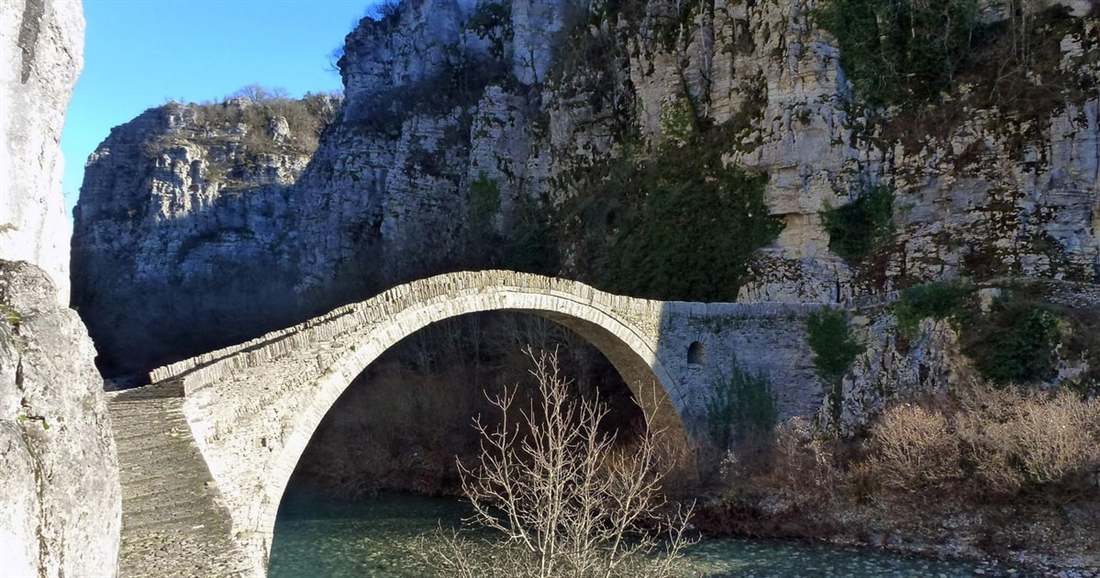
Kipi lies 39 km from Ioannina. A car ride there takes about 50 minutes. The Zagori stone bridges page lists every span in detail.
The area holds other notable crossings as well. The Noutsos bridge stands between Koukouli and Dilofo. The Missios bridge sits below Vitsa. The single-arch Klidonia bridge crosses the Voidomatis river at the mouth of the Vikos Gorge.
Travellers with extra time have another option. A circular walk links Kipi with the Milos, Kalogeriko and Kokkori bridges. This path takes two to three hours to complete on foot.
- The Kokkori bridge features a single high arch.
- The Kalogeriko bridge has three distinct arches.
- The Noutsos bridge connects two specific villages.
- The Missios bridge sits directly below Vitsa.
- The Klidonia bridge crosses the Voidomatis river.
What is the three-arched Kalogeriko bridge?
The Kalogeriko bridge carries three arches over the Bagiotiko stream. It sits about 1.5 km below Kipi. It is a key stop on a Zagori day trip from Parga. People also call this structure the Plakidas bridge.
The first bridge at this spot dates from the early nineteenth century. Later in that same century, a monk named Seraphim rebuilt it. The word Kalogeriko translates to “of the monk” because of his work.
Reaching the water requires a short effort. A gravel pull-in sits on the road between Kipi and Koukouli. From that parking spot, a signed path leads down to the stream. The walk takes five minutes.
Visitors taking a Zagori day trip from Parga see this stonework up close.
What is the single-arch Kokkori bridge?
The Kokkori bridge is a single high arch over the Bagiotiko stream near Kipi. Builders finished it in the mid-eighteenth century. It serves as the final stop on a Zagori day trip from Parga.
The bridge carries the name of the man who paid for it.
The span measures close to 13 m across the water. The top of the arch rises about 10 m above the summer water level.
Getting to the bridge involves a marked pull-off on the Kipi–Koukouli road. Drivers leave their vehicles at this designated spot. From there, a 10-minute walk leads down to the base of the arch.
A Zagori day trip from Parga brings visitors right to this path. Standing under the 10 m rise reveals the scale of the single arch.
- The arch stretches nearly 13 m across the stream.
- The peak rises 10 m above the summer water.
- A marked pull-off sits on the Kipi–Koukouli road.
- The walk takes about 10 minutes.
Who paid for and built the Zagori bridges?
Emigrant benefactors who grew rich in Constantinople, Odessa and Bucharest paid for the bridges. Master masons from Konitsa, Pyrsogianni and Vourbiani built them. Understanding this history adds meaning to a Zagori day trip from Parga.
Zagori men left their home villages and grew rich in distant cities. After gaining wealth, they sent funds back to Epirus to build public works.
The actual construction required highly skilled hands. Stone-building villages produced generations of master masons. Teams from Konitsa, Pyrsogianni and Vourbiani traveled throughout the mountains to raise these structures.
Every bridge on a Zagori day trip from Parga tells this story. The money came from abroad, but the labor stayed local. More than 160 bridges stand as proof of this partnership between emigrants and village craftsmen.
- Benefactors earned their wealth working in Constantinople.
- Other donors built fortunes in the city of Odessa.
- Trade in Bucharest funded additional stone projects.
- Masons from Konitsa shaped the heavy blocks.
- Teams from Pyrsogianni and Vourbiani raised the arches.
What does a Zagori day trip from Parga see in Ioannina?
Ioannina is the capital of Epirus, set on a lake, with an Ottoman past. A Zagori day trip from Parga starts here with a short guided stroll. The group walks through the city before heading north.
The city sits directly on the edge of a large lake.
An Ottoman past left deep marks on the architecture. The guided stroll introduces that past to the group.
The morning walk introduces travellers to the region before they enter the mountains. It sets the context for the stone bridges waiting ahead. Exploring the city center prepares visitors for the rural landscapes of Epirus.
After the walk, the route leaves the lake behind for the villages. Kipi lies 39 km from Ioannina, about 50 minutes by car. Those interested in regional culture can look into an Ioannina food tour for deeper exploration.
On the TUI tour, a Zagori day trip from Parga uses Ioannina as its first stop. The city acts as the gateway between the coast and the mountains.
What to bring on a Zagori day trip from Parga?
A Zagori day trip from Parga requires sturdy shoes with good grip, a light jacket and layers. Pack a daypack holding one to one and a half litres of water. Bring sun protection like a hat, sunscreen, sunglasses, a small snack and cash.
The mountain air stays cooler than the coast. Layers keep visitors comfortable as temperatures change between the villages and the gorge. A light jacket fits easily inside a daypack during warmer hours.
Sturdy shoes with good grip matter on uneven ground. The paths near viewpoints and stone bridges are uneven. Proper footwear keeps every step safe while exploring the area.
- Pack one to one and a half litres of water in a daypack
- Wear sturdy shoes with good grip for uneven ground
- Bring a hat, sunscreen and sunglasses for sun protection
- Carry a light jacket and extra layers for cooler mountain air
- Take a small snack and cash for small purchases
Where do you eat on a Zagori day trip from Parga?
On a Zagori day trip from Parga, food and drinks are extra on the TUI tour. Guests buy lunch in Monodendri after visiting the souvenir shops. Other listings include a traditional lunch featuring pies, grilled meat and local salads.
Monodendri has places to sit down and eat after walking through the village lanes. Visitors order meals at local spots before heading back toward the coast. Eating here gives everyone time to rest.
Traditional lunches feature regional dishes. Pies appear on the table alongside grilled meat and local salads.
Checking the booking details clarifies the meal plan. Certain tours include food, while others leave it to the guest. Knowing this ahead of time helps everyone plan their spending money.
Who suits a Zagori day trip from Parga?
A Zagori day trip from Parga suits travellers who like mountain landscapes, villages and photography. Families with older children enjoy the cooler hills away from the beach. The walks are short, but the ground is uneven.
Photographers find subjects around every corner. Stone bridges, deep gorges and quiet lanes offer constant material for pictures. The changing light across the mountains keeps cameras busy all day.
Families with older children appreciate the break from the hot coast. The hills provide cooler air and open spaces to walk. Younger children struggle with the uneven ground, so older kids handle the paths better.
Tours are not recommended for guests with limited mobility or wheelchairs. The paths to viewpoints and bridges have rough surfaces. Everyone needs steady footing to navigate the village lanes safely.
Travellers looking for different outdoor experiences also consider a jeep tour in Zagori. This option covers similar scenery using off-road vehicles instead of walking.
How does a Zagori day trip from Parga compare with a Meteora day trip from Parga?
A Zagori day trip from Parga lasts eight to eleven hours and stays in Epirus. It focuses on the gorge, villages and bridges. The alternative crosses the Pindus mountains to Thessaly, visits monasteries on rock pillars and takes about twelve hours.
The two excursions cover entirely different landscapes. One stays in the mountains of Epirus, exploring villages and stone structures. The other travels east across the Pindus range into a flat plain marked by tall rocks.
Time spent travelling differs between the two options. A twelve-hour day with a long drive leaves less free time at each stop. The shorter Epirus route allows more hours for walking around the stops.
Visitors comparing these choices read about the Meteora day trip from Parga to understand the eastern route. Both trips start from the same coastal town but head in opposite directions.
Those wanting to stay closer to the coast look at the Acheron river near Parga. This nearby waterway offers a shorter outing without crossing mountain ranges.
How do you book a Zagori day trip from Parga?
To book a Zagori day trip from Parga, check platforms like GetYourGuide, Viator or TUI. Compare pickup points, times, included fees, guide languages and cancellation terms. The TUI tour refunds in full up to one day before departure.
GetYourGuide lists a shared option called “Zagori & Vikos Gorge Tour From Parga”. The same platform offers a private version named “From Parga: Private Zagoria Villages & Vikos Gorge Day Trip”. Private tours let groups set their own pace.
Viator features a listing titled “Zagoria and Vikos Gorge from Parga”. TUI sells a full-day tour covering the same region. Reading the descriptions on each site reveals what every operator includes.
Before paying, verify the exact pickup point and time. Check whether lunch and entrance fees are part of the price. Confirm the language spoken by the guide matches your needs.
- Check the exact pickup point and departure time
- Verify if lunch and entrance fees are included
- Confirm the language spoken by the guide
- Read the cancellation terms before paying
Cancellation terms vary by operator. The TUI tour refunds in full up to one day before the scheduled date. Knowing this rule helps travellers adjust plans without losing money.
Frequently Asked Questions
Is lunch included on a Zagori day trip from Parga?
No, food and drinks are extra on the TUI tour. Guests buy lunch in Monodendri after browsing the souvenir shops. However, other tour listings include a traditional meal.
Does a Zagori day trip from Parga include hiking?
No, there is no long hike on this excursion. The route involves short walks to viewpoints, a monastery and stone bridges. The ground remains uneven throughout these brief walks.
Can people with limited mobility join?
No, these tours are not recommended for guests with limited mobility or wheelchairs. The paths to viewpoints and village lanes have uneven surfaces that require steady footing.
Are entrance fees included?
Yes, entrance fees are included on the TUI tour. Other operators state their fee structure in the booking details. Always check the listing before confirming a reservation.
Can you cancel a Zagori day trip from Parga?
Yes, cancellations are allowed under specific terms. The TUI tour refunds the full amount up to one day before the scheduled departure date. Check other operators for their rules.
Is there phone signal in the gorge?
No, phone coverage is patchy in the gorge and the villages. Mobile signals drop in and out along the route. Tell family members about this before leaving the coast.