
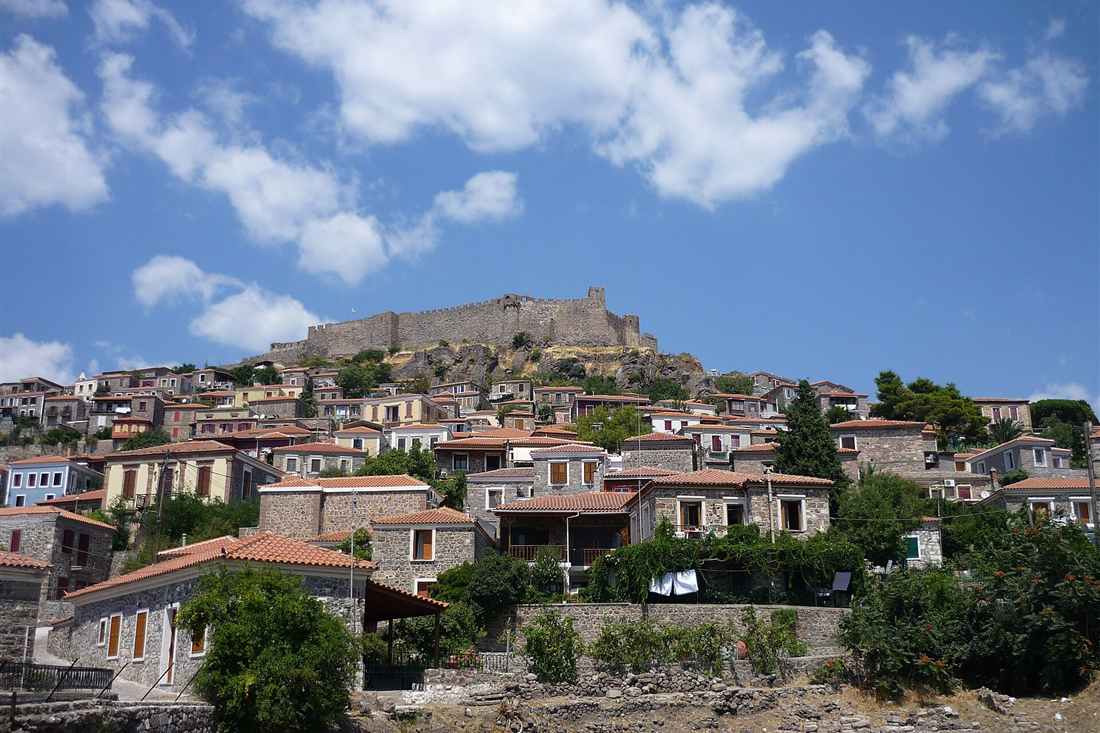
North Aegean islands tours cover the long green islands that run down the coast of Asia Minor: Lesbos with its castles, ouzo and petrified forest, Chios with its mastic villages and the mosaics of Nea Moni, Samos with the Heraion and the Tunnel of Eupalinos, Ikaria with its hot springs and feasts, Limnos with its Bronze Age towns, and Samothrace and Thasos to the north. Plan the rest of the trip with Greece Tours.
This page covers the North Aegean islands tours you can book on each island, the sites, villages, beaches and boat trips they reach, the food, wine and ouzo they taste, the history behind the castles and monasteries, and how the flights, ferries and seasons shape the route.
What do North Aegean islands tours cover?
North Aegean islands tours cover Lesbos, Chios, Samos, Ikaria and Limnos, the five islands of the North Aegean region, together with Samothrace and Thasos to the north and the small islands of Psara, Oinousses, Fournoi and Agios Efstratios. They run as island tours, boat trips, food and wine tastings and walks.
These islands lie along the coast of Asia Minor, from Thasos off the shore of Macedonia to Ikaria and Fournoi at the edge of the Dodecanese. They are big, green and mountainous, and they hold populations that live from farming and fishing as much as from visitors. Mytilene on Lesbos is the capital of the North Aegean region, and Lesbos, Chios and Samos each rank among the ten largest islands in Greece. North Aegean islands tours reach them from Athens, Thessaloniki and the Thracian ports.
The group takes far fewer visitors than the Cyclades. The reason is distance: Lesbos sits 188 nautical miles from Piraeus, and the ferries run overnight. Flights change that, because Mytilene, Chios, Samos, Ikaria and Limnos all have airports with connections to Athens and Thessaloniki. North Aegean islands tours therefore work island by island, with one or two islands to a trip rather than a chain of six.
Which formats do North Aegean islands tours take?
- Full-day island tours by minibus that cross a single island and stop at its villages, monasteries and beaches.
- Half-day sightseeing tours out of the port towns, such as the Chios half-day tour of the castle, Kampos and Nea Moni.
- Food and drink tours: mastiha tasting on Chios, ouzo distilleries at Plomari, the Muscat wineries of Samos and the family wineries of Ikaria.
- Boat trips and cruises: the east coast of Samos with a beach barbecue, the sailing day to Oinousses, private boats on Lesbos and Limnos.
- Walking tours through the mastic villages, the Petrified Forest of Lesbos and the gorges of Samothrace.
- Cross-border day trips to Ephesus and Kusadasi from Samos, to Cesme from Chios and to Ayvalik from Lesbos.
Our pages on Chios day trips and Ikaria tours cover two of those islands in detail, and Greece Tours sets out the wider country.
Which islands make up the North Aegean?
The North Aegean region holds nine islands: Lesbos, Chios, Samos, Ikaria, Limnos, Psara, Oinousses, Fournoi Korseon and Agios Efstratios. Thasos and Samothrace lie in the same sea but belong to the region of East Macedonia and Thrace, and travel writing groups all eleven as the north-east Aegean.
The region was created in the 1987 administrative reform and redrawn by the Kallikratis plan on 1 January 2011 into five regional units: Chios, Ikaria, Limnos, Lesbos and Samos. Its capital is Mytilene. It is the smallest Greek region by economic output, with a gross domestic product of 2.5 billion euros in 2018, and its population fell by 2.6 per cent between the 2011 and 2021 censuses. North Aegean islands tours use those five units as the working map of the group.
Size sets the itinerary. Lesbos covers 1,633 square kilometres and carries 400 km of coast, which makes it the third largest island in Greece. Chios covers 842 square kilometres, Samos 477, Limnos 477 and Ikaria 255. Thasos covers 380 square kilometres and Samothrace 178. A single island fills three days without repetition. North Aegean islands tours plan two islands to a week for that reason.
How far apart are the North Aegean islands?
- Chios to Lesbos: about 50 nautical miles north, with ferries in three to four hours.
- Chios to Samos: about 55 nautical miles south.
- Samos to Ikaria: 10 nautical miles, the shortest hop in the group.
- Lesbos to Limnos: about 70 nautical miles north-west.
- Limnos to Agios Efstratios: 30 km south-west.
- Thasos to Keramoti: 25 minutes by ferry from the mainland shore.
- Chios to Psara: 81 km north-west, with a boat three times a week.
The Mycale Strait between Samos and Turkey narrows to 1.6 km, and the Chios Strait and the Mytilini Strait are barely wider. North Aegean islands tours use those channels for the day trips to the Turkish coast.
What do North Aegean islands tours see on Lesbos?
North Aegean islands tours on Lesbos see Mytilene with its castle and museums, the Genoese fortress above Molyvos, the ouzo distilleries of Plomari, the hill town of Agiasos, the Petrified Forest around Sigri and the salt pans and flamingos of the Kalloni gulf.
Lesbos is the third largest island in Greece, with 83,755 inhabitants counted in 2021 and a third of them in Mytilene. The island is shaped by two deep gulfs, Kalloni and Gera, that cut it almost in half. Olive groves cover the east, volcanic rock the west. Sappho and Alcaeus were born here, which is why Greeks call it the island of the poets. North Aegean islands tours on Lesbos work from Mytilene in the east and Molyvos in the north.
Mytilene keeps a Byzantine and Genoese castle above the harbour, one of the largest in the Mediterranean, and the Archaeological Museum holds Roman mosaics from the House of Menander. The Theophilos Museum at Varia shows the folk painter’s work, and the Teriade Museum beside it holds engravings by Picasso, Chagall and Matisse. The ferry quay lies in the middle of the town. North Aegean islands tours open the island day at the castle and the harbour.
Molyvos, ancient Mithymna, stands under a Genoese fortress on the north coast, with an agora of stone-arched shops climbing to the gate and a Blue Flag pebble beach below. Petra, 6 km south, carries the chapel of Panagia Glykofilousa on a rock in the middle of the village. Eftalou, east of Molyvos, holds hot springs on the shore, and the tour “Lesvos: Guided Tour with Molyvos Castle & Eftalou Beach” links the two. North Aegean islands tours stop here for the fortress and the arched agora.
West Lesbos is a different island again. Bare volcanic hills run from Kalloni to Sigri through Vatoussa, Antissa, Chidira and Messotopos, with few trees and long views. Vatera, on the south coast, runs 9 km of grey sand, the longest beach of the island. Polichnitos, behind it, sends out water at about 88 degrees from springs that rank among the hottest in Europe. North Aegean islands tours cross this side of Lesbos in a full day from Mytilene.
What does the Petrified Forest of Lesbos hold?
The Petrified Forest covers the west of the island, between Eressos, Antissa and Sigri. Volcanic eruptions between 20 and 17 million years ago buried a subtropical forest in ash, and the trunks turned to stone where they stood. Finds include a fossil tree 19.5 m long with roots, branches and leaves, and 150 fossilised logs. The Natural History Museum at Sigri manages the park, and the International Union of Geological Sciences listed the site among 100 geological heritage sites of the world in October 2022. North Aegean islands tours walk the park trails at Sigri and Bali Alonia.
Plomari, on the south coast, distils the ouzo that carries the island’s name abroad, and its two museums, The World of Ouzo and the Varvagiannis museum, open the stills to visitors. Agiasos sits at 475 m on the slope of Mount Olympos, 26 km from Mytilene, with a church of the Virgin, woodcarvers’ workshops and a cobbled lane of tavernas. Skala Eressou, below the birthplace of Sappho, has a long beach of dark volcanic sand and Blue Flag status. Our page on the Lesbos island tour covers the routes across the island.
What do North Aegean islands tours see on Chios?
North Aegean islands tours on Chios see the mastic villages of Pyrgi, Mesta and Olympi, the 11th-century monastery of Nea Moni with its mosaics, the abandoned village of Anavatos on its cliff, the merchant mansions of Kampos and the medieval castle of Chios town.
Chios is the fifth largest Greek island, 50 km from north to south and 29 km at its widest. A ridge runs the length of it, with Pelineon at 1,297 m and Epos at 1,188 m in the north. Chios town holds 32,400 people and is built around the harbour and a castle whose wall runs 1,400 m. Vrontados, the suburb to the north, claims the birthplace of Homer and keeps the rock-cut seat known as the Teacher’s Rock. North Aegean islands tours cross it in a day from the town.
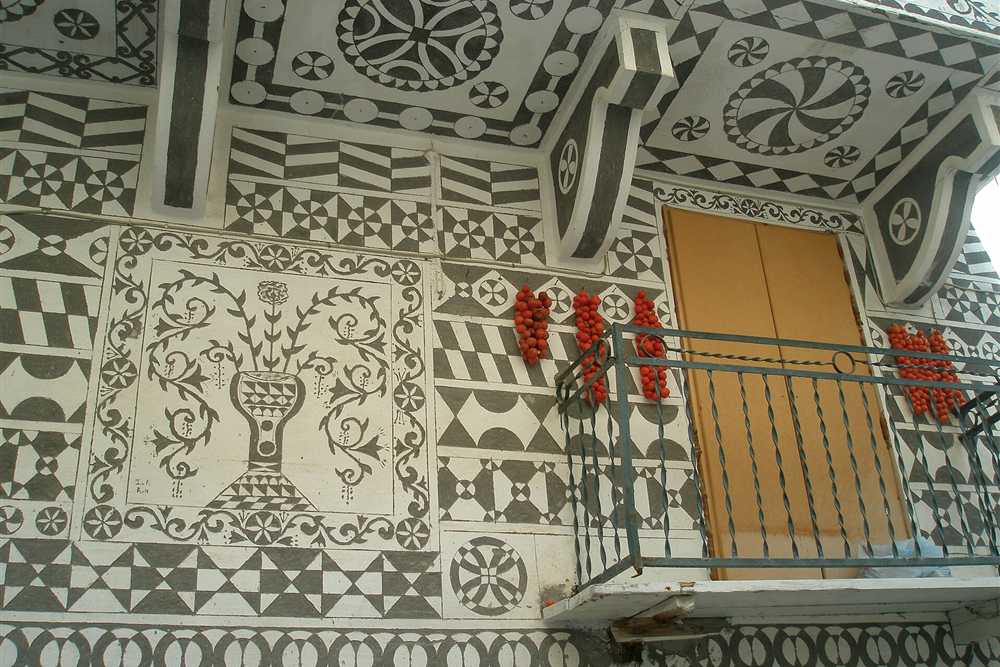
The south of the island is the Mastichochoria, the mastic villages, which have controlled the production of mastic gum since Roman times. Twenty-four of them survive. Pyrgi, 25 km from the town, carries black-and-white geometric patterns called xysta scratched into the plaster of every facade, and it keeps a tower 18 m high at its centre. Mesta and Olympi are walled villages with vaulted lanes and no doors at street level, entered in the Middle Ages only by ladder. North Aegean islands tours take Pyrgi, Mesta and Olympi in one run.
Nea Moni stands in the centre of the island, 15 km from Chios town, on the Provateio Oros. The emperor Constantine IX Monomachos and the empress Zoe founded it after three monks found an icon of the Virgin hanging in a myrtle branch; the katholikon was inaugurated in 1049 and the complex finished in 1055. Its mosaics rank with those of Daphni and Hosios Loukas, and UNESCO inscribed the monastery on the World Heritage List in 1990. North Aegean islands tours pair the monastery with Avgonyma and Anavatos.
An earthquake in 1881 damaged Chios town and left only part of its old character standing, which is why the mastic villages and Kampos carry more of the island’s medieval fabric than the capital does. Emporios, in the south-east, keeps the black volcanic pebbles of Mavra Volia under a red cliff, and Agia Dynami and Vroulidia sit at the southern tip. Volissos, in the north-west, is named in one tradition as the birthplace of Homer.
Anavatos, 10 km beyond it, is a grey stone village stacked up a 300 m cliff, abandoned after 1822 and standing empty. Kampos, south of the town, is a plain of walled citrus estates with stone mansions, waterwheels and gardens that the Genoese families built. Volissos in the north-west keeps a Byzantine castle above the village. Our pages on Chios mastiha, Pyrgi and the Chios villages cover the south of the island in detail. North Aegean islands tours reach Anavatos on the same mountain road as Nea Moni.
What do North Aegean islands tours see on Samos?
North Aegean islands tours on Samos see the Heraion of Hera, the ancient town of Pythagoreion with the Tunnel of Eupalinos, the harbour of Pythagoreio, the mountain villages of Vourliotes and Manolates, the Muscat wineries and the north-coast beaches under Mount Kerkis.
Samos covers 477 square kilometres, runs 43 km long and 13 km wide, and holds 33,814 people. Two mountains shape it: Ampelos in the centre at 1,095 m and Kerkis in the west at 1,434 m, the island’s high point. The Mycale Strait separates it from Turkey by 1.6 km. Vathy in the north-east is the capital, Karlovasi in the north-west the commercial town and seat of the University of the Aegean’s School of Sciences, and Pythagoreio the harbour of the south-east. North Aegean islands tours base themselves at Pythagoreio, Vathy or Kokkari.
UNESCO inscribed Pythagoreion and the Heraion together in 1992. The Heraion lies 6 km south-west of the ancient city, in the marshy basin of the Imbrasos, where cult activity goes back to about 1700 BC. Herodotus called its temple the largest he knew. One column stands of the late Archaic temple, the first of the giant free-standing Ionic buildings, and the Sacred Way ran from it to the city. North Aegean islands tours cover both sites in a morning.
Samos traded across the ancient world. Its red pottery, which the Romans called Samian ware, went out with its wine, and its merchants opened routes to the Black Sea, Egypt, Cyrene, Corinth and Chalcis. The island stayed rich into the Roman centuries. An earthquake of magnitude 7.0 struck 14 km north-east of Samos on 30 October 2020 and damaged buildings at Karlovasi, and the town has been rebuilding since.
What is the Tunnel of Eupalinos?
The Tunnel of Eupalinos runs 1,036 m through Mount Kastro above Pythagoreio. The engineer Eupalinos of Megara drove it in the mid-6th century BC from both ends at once, the first tunnel in history dug that way by a geometric method, and it carried water from a spring at Ayiades into the city for 1,100 years. Herodotus counted it among the three great works of Samos with the Heraion and the harbour mole. Visitors walk a lit section of the channel today. North Aegean islands tours book the tunnel entry together with the Heraion.
The mountain villages sit on the north slope of Ampelos. Vourliotes and Manolates stand among vines and plane trees above Kokkari, linked by a marked path through the Aidonia ravine. The wine of Samos is Muscat Blanc a Petits Grains, grown on terraces to 800 m and vinified by the island’s cooperative at Malagari. Tours such as “Samos: Full Day Guided Island Bus Tour” and “Samos: Polish Island Tour with Wine Tasting & Pottery Workshop” cross the island in a day. Our pages on Samos wine tasting and Samos boat cruises cover those trips.
What do North Aegean islands tours see on Ikaria?
North Aegean islands tours on Ikaria see the hot springs at Therma, the villages of the Raches, the beach and river mouth at Nas, the harbour of Armenistis, the family wineries that press the dark local wine and the paths of the Aitheras range.
Ikaria lies 10 nautical miles south-west of Samos, covers 255 square kilometres and holds 8,312 people. The Aitheras range crosses it from east to west and tops out at 1,037 m, dividing a green northern side of pine and oak from a dry, cliff-bound south. Agios Kirykos is the port and seat, Evdilos the second port on the north coast, and Christos Rachon the main inland village. The island takes its name from Icarus, who fell into the sea beside it. North Aegean islands tours cross the ridge between the two coasts on every trip.
Ikaria has been inhabited since about 7000 BC, and Greeks from Miletus colonised it around 750 BC. Its older names describe it: Dolichi and Makri for its long shape, Ichthyoessa for its fish and Anemoessa for its winds. The island keeps free-ranging goats on every slope, and martens, otters and green toads in its ravines.
The radioactive hot springs at Therma, beside Agios Kirykos, have been used since antiquity and run at 30 to 58 degrees. Armenistis and Gialiskari hold the north-coast beaches, and Nas, further west, sits at the mouth of a river under the ruins of a temple of Artemis Tauropolos. Manganitis and Karkinagri on the south coast are reached by a road cut into the cliff. North Aegean islands tours end the Ikaria day at the baths.
Ikaria is one of the places studied for longevity, and the diet of greens, goat, honey and local wine is the subject of that work. The wineries are small and family-run: “Ikaria: Winery Tour and Tasting with Winemaker” and “Ikaria: Two Family-run Wineries in a Single Day” visit them. The island’s panigyria, village feasts held on saints’ days through the summer, run until dawn with barrel wine, goat stew and the Ikariotikos dance. Our pages on Ikaria wine tasting and Ikaria airport transfers cover the practical side.
What do North Aegean islands tours see on Limnos?
North Aegean islands tours on Limnos see the Venetian castle above Myrina, the Bronze Age town of Poliochne, the sanctuary and theatre at Hephaistia, the sand dunes of Gomati, the bay of Moudros with its war cemeteries and the wineries of the eastern plain.
Limnos covers 477 square kilometres and is the eighth largest island in Greece. It is flat where the others are steep, with Mount Skopia at 430 m as its highest ground. Myrina on the west coast is the capital and port, built around a promontory that carries a Venetian castle, with the Romeikos Gialos on one side and the Tourkikos Gialos on the other. Moudros, on the great bay in the middle, covers the whole eastern peninsula. North Aegean islands tours drive the island in a day from Myrina.
Poliochne, on the east coast, is one of the oldest towns in Europe. It was settled in the late Chalcolithic, before Troy I, and Italian archaeologists have dug it since 1930 in seven phases that they named by colour. Hephaistia, on the north-east coast, was the ancient capital, named for Hephaestus, who fell on Limnos when Zeus threw him out of Olympus; its theatre and sanctuary of the Kabeiroi stand above the sea. North Aegean islands tours take Poliochne and Hephaistia in one eastern loop.
The bay of Moudros served as the Allied base for the Dardanelles campaign in the First World War, and the Armistice of Mudros was signed there on 30 October 1918. The East Mudros Military Cemetery holds 885 Commonwealth graves, among them 148 Australians and 76 New Zealanders. Limnos also keeps a desert of 7 hectares, the Pachies Ammoudies, and the dunes at Gomati on the north coast.
Lemnian earth, a sealed clay dug on the island, was traded through the Roman and Ottoman centuries as an antidote to poison and sold under an official stamp. Pliny the Elder wrote that the shadow of Mount Athos reached the forum of Myrina at the summer solstice, and the ancient geographer Pausanias recorded that a small island off the coast, Chryse, was swallowed by the sea. Volcanic activity on Limnos ended long ago.
Wind defines the island, which Greeks call the wind-ridden one, with average speeds peaking at 20.7 km/h in February. The plain grows Muscat of Alexandria and the red Kalambaki grape, and the island exports flomari pasta, melipasto cheese and thyme honey. The tour “Lemnos: Private Custom Boat Tour” reaches the empty coves of the south. Our page on Limnos airport transfers covers arrivals at the airport near Moudros. North Aegean islands tours on Limnos keep the boat days for the calm mornings.
What do North Aegean islands tours see on Samothrace?
North Aegean islands tours on Samothrace see the Sanctuary of the Great Gods at Palaeopolis, where the Winged Victory now in the Louvre was found, the waterfalls and rock pools of the Fonias gorge, the hot springs at Therma and the summit of Mount Fengari at 1,611 m.
Samothrace measures 17 km across, covers 178 square kilometres and holds 2,596 people. It belongs to the Evros regional unit of Thrace rather than to the North Aegean region. It is the most rugged island of the northern sea: Fengari, also called Saos, rises to 1,611 m, the highest peak of the Aegean islands, and Poseidon watched the Trojan War from it in the Iliad. North Aegean islands tours reach it by the ferry from Alexandroupoli.
The Sanctuary of the Great Gods stands west of the ancient city on the north coast. Its mystery cult was open to slaves and free people alike, and its initiates included Herodotus, Lysander of Sparta and Philip II of Macedon, who met Olympias there. The gods were the Kabeiroi, named in inscriptions only as the Great Gods. The Winged Victory was dedicated on the site and taken to Paris in 1863. The ruins hold the Hieron, the Anaktoron, the Arsinoeion rotunda, the largest circular building of ancient Greece, and a theatre. North Aegean islands tours walk the sanctuary and its museum together.
Greek settlers from Samos reached Samothrace at the end of the 8th century BC and gave it the name Samos of Thrace. Persia occupied it in 508 BC, Athens brought it into the Delian League, Philip II took it, and Vespasian absorbed it into the Roman Empire in AD 70. Under the emperors the sanctuary drew pilgrims from across the Roman world, and its two harbours sat on the sea road from the Troad to Macedonia. The Gattilusi of Genoa held the island from 1355 until the Ottomans took it in 1457.
The Fonias gorge runs off the north slope of Fengari. A marked path follows the torrent to a first waterfall 12 m high with a deep pool below it, then to higher falls for walkers with a guide. The hot springs at Therma feed bathhouses under plane trees, and the village is the start of the climb to the summit, marked with red paint over bare rock. Goats graze the whole mountain, and the island keeps no large resorts. North Aegean islands tours walk the first two pools without a guide and the higher falls with one.
What do North Aegean islands tours see on Thasos?
North Aegean islands tours on Thasos see the ancient agora, theatre and acropolis of Limenas, the marble quarries and double basilica at Aliki, the mountain villages of Panagia and Potamia, the white sand of Golden Beach and the monastery of Archangelos Michael on its cliff.
Thasos is the northernmost major Greek island, 380 square kilometres in area with about 13,000 inhabitants, and it belongs to the region of East Macedonia and Thrace. A ring road of 100 km circles it, and Mount Ipsarion rises to 1,204 m in the middle. Ferries cross from Keramoti to Limenas in 25 minutes and from Kavala to Skala Prinou in 75 minutes, which makes it the easiest island of the group to reach by car. North Aegean islands tours circle it on the ring road.
Greeks from Paros founded the colony around 650 BC, drawn by gold; the poet Archilochus was a descendant of those settlers and called the island an ass’s backbone crowned with wild wood. Herodotus visited a sanctuary of Heracles here that the Phoenicians had built, and the Herakleion stands today. Thasian wine and Thasian marble carried the island’s name through the ancient world, and the mines on the mainland brought the city 200 to 300 Attic talents a year. North Aegean islands tours read that colonial history in the museum at Limenas.
Limenas, the capital, is built over that ancient city. The agora lies open beside the old harbour, the theatre sits in pines above it with the sea as its backdrop, and a path climbs the acropolis past the sanctuary of Athena to a secret stair cut through the rock. The Archaeological Museum holds the kouros carrying a ram, 3.5 m tall, from the 6th century BC. North Aegean islands tours walk the agora, the theatre and the museum in one stop.
Phoenicians worked the gold of Thasos before the Greeks arrived and founded a temple to Melqart that the Greeks rebuilt as the Herakleion. Herodotus reported that the best mines lay on the east side, facing Samothrace. A ring road of about 100 km circles the island under Mount Ipsarion at 1,204 m, and North Aegean islands tours drive it in a day with stops at Aliki, Golden Beach and the mountain villages.
What do tours see around the coast of Thasos?
- Aliki — a twin-bay peninsula of ancient marble quarries, with cuts running into the sea and a ruined double basilica above.
- Golden Beach at Chrysi Ammoudia — a long strip of pale sand under pine-covered slopes on the east coast.
- Giola — a natural rock pool on the cliffs of the south-east, filled by the waves.
- Saliara — the marble beach near Limenas, where the shore is white stone chip.
- Panagia and Potamia — slate-roofed villages under Ipsarion, with the Polygnotos Vagis museum in Potamia.
- Archangelos Michael — a convent on a cliff above the south coast, a dependency of Philotheou on Mount Athos.
The island exports honey, walnuts, olive oil and the Throumba olive with its protected designation of origin. Tavernas in Limenas and Skala Potamias grill the catch of the north Aegean, and the mountain villages roast goat.
Which small islands do North Aegean islands tours reach?
North Aegean islands tours reach Psara and Antipsara north-west of Chios, Oinousses off its north-east coast, Fournoi Korseon between Ikaria and Samos, and Agios Efstratios south-west of Limnos. Each holds a few hundred people and a single village around a harbour.
Psara lies 81 km north-west of Chios and covers 43 square kilometres, with 420 inhabitants and one town. The island armed a merchant fleet that fought through the War of Independence, and on 21 June 1824 Ottoman troops stormed it and killed or enslaved thousands; the survivors blew up the powder magazine on the Black Ridge rather than surrender. The white flag with a cross, crescent, spear and anchor, made on the island in 1824, is kept at the National Historical Museum in Athens. Profitis Ilias, at 512 m, is the high point of a treeless, rocky island. North Aegean islands tours reach it on the boat from Chios town.
The ancient Greeks made a proverb of Psara. The island was too poor and too dry to grow its own vines, so “Psyra celebrating Dionysos” described anyone keeping a feast with nothing to keep it on. Homer, Strabo and Stephanus of Byzantium all name the island as Psyra. Its people have lived from fishing, mainly for slipper lobster, and from shipping ever since.
Oinousses is a cluster of one large and eight small islands 2 km off the north-east coast of Chios and 8 km from Turkey. It produced the ship-owning families of Lemos, Pateras, Hadjipateras, Samonas, Kollakis and Lyras, and the town keeps a naval high school, a maritime museum and a monastery. The sailing trip “Chios and Oinousses Island Full Day Sailing Cruise” crosses to it from Chios town. North Aegean islands tours cross to it on the sailing day from Chios.
Fournoi Korseon is an archipelago between Ikaria, Samos and Patmos. Fournoi town and Chrysomilia on the main island and the island of Thymaina hold the population of about 1,300. Underwater survey has found 58 shipwrecks in its waters, dating from the 4th century BC to the 19th century AD, which makes the archipelago one of the richest wreck sites in the Mediterranean. Its fishermen land the lobster that the tavernas serve with pasta. North Aegean islands tours call there on the sailing route south.
Agios Efstratios lies 30 km south-west of Limnos, covers 43 square kilometres and holds about 300 people. It was a place of internal exile for political prisoners from the 1930s through the junta of 1967 to 1974, and the writers and politicians held there gave it a second history. Its beaches, among them Agios Antonios, Lemonies and Avlakia, are reached by caique, and boats link it with Limnos, Kavala, Kymi and Agios Konstantinos.
Which archaeological sites do North Aegean islands tours visit?
North Aegean islands tours visit the Heraion, Pythagoreion and Tunnel of Eupalinos on Samos, the Sanctuary of the Great Gods on Samothrace, Poliochne and Hephaistia on Limnos, the agora and theatre of ancient Thasos, and the Bronze Age settlements of Thermi and Lisvori on Lesbos.
Two UNESCO World Heritage Sites stand in the group. Pythagoreion and the Heraion of Samos were inscribed together in 1992 for the city walls, the harbour mole, the aqueduct and the Ionic temple. Nea Moni on Chios was inscribed in 1990 for its 11th-century mosaics. The Petrified Forest of Lesbos entered the UNESCO tentative list in 2014 and sits inside the Lesvos Geopark. North Aegean islands tours build their days around those listings.
The prehistoric record here runs deeper than in the Cyclades. Poliochne on Limnos was a walled town before Troy I, laid out with shared party walls and a stone-built assembly hall. Thermi on Lesbos was inhabited from 3000 BC, and the settlement at Lisvori, from 2800 to 1900 BC, lies partly under shallow water. Ikaria has been settled since about 7000 BC, and Miletus colonised it around 750 BC.
- Heraion of Samos — the altar, the Sacred Way and the single standing column of the Rhoikos and late Archaic temples.
- Pythagoreion — the classical walls, the Roman agora, baths and stadium, and the harbour mole under the modern quay.
- Tunnel of Eupalinos — 1,036 m driven from both ends in the 6th century BC, walked today on a lit path.
- Sanctuary of the Great Gods — the Anaktoron, Hieron, Arsinoeion and theatre at Palaeopolis on Samothrace.
- Ancient Thasos — the agora, the theatre, the Herakleion and the acropolis above Limenas.
- Drakano tower — the Hellenistic round tower on the eastern cape of Ikaria, above Faros beach.
- Temple of Messa — the Ionic sanctuary of the Lesbian federation on the Kalloni plain.
Our page on the museums of Chios covers the collections of that island, from the Byzantine Museum in the old mosque to the Mastic Museum above Pyrgi.
Which monasteries and churches do North Aegean islands tours visit?
North Aegean islands tours visit Nea Moni on Chios, the Limonos and Taxiarches monasteries and the church of the Virgin at Agiasos on Lesbos, Panagia Spiliani and Moni Vronta on Samos, Theoktisti on Ikaria and Archangelos Michael on Thasos.
Nea Moni is the first stop of the group. Its katholikon carries mosaics of the great feasts on gold ground, made by craftsmen sent from Constantinople in the 1040s, and the chapel beside it holds the bones of those killed in 1822. The monastery owned a third of Chios around 1300 and housed up to 800 monks; it became a convent in 1952. The Ottomans stormed it in April 1822, when 2,000 people had taken refuge inside. North Aegean islands tours give it an hour for the mosaics and the ossuary.
Lesbos keeps monasteries in the same weight. Limonos, near Kalloni, was founded in 1523 by Ignatios Agallianos and holds a library of manuscripts and a folk museum. Taxiarches at Mantamados keeps an icon of the Archangel Michael modelled in relief from earth, and pilgrims come to it through the year. The Monastery of Saint Raphael at Thermi marks the site where the saints of Lesbos were found in the 1960s. The church of Panagia at Agiasos draws the island’s largest pilgrimage on 15 August. North Aegean islands tours take Limonos and Mantamados on the road north.
On Samos, Panagia Spiliani stands in a cave above Pythagoreio with a chapel at the end of a long rock passage, and Moni Vronta of 1566 sits in the chestnut woods above Vourliotes. Ikaria keeps Theoktisti near Pigi, whose church carries frescoes dated 1688, and the Evangelismos monastery above Nas. On Thasos, the convent of Archangelos Michael hangs over the sea on the south coast and holds a relic of the Holy Nail.
The feast days fill the calendar. Agiasos on 15 August, Mantamados on the Sunday after Easter, the Panagia at Pythagoreio in September, and dozens of village panigyria on Ikaria between June and September, where the whole village eats at long tables and dances until morning. North Aegean islands tours book around them, because the villages fill for each one.
Which beaches do North Aegean islands tours reach?
North Aegean islands tours reach Vatera and Skala Eressou on Lesbos, Mavra Volia and Karfas on Chios, Tsamadou and Psili Ammos on Samos, Seychelles and Nas on Ikaria, Gomati and Thanos on Limnos, Pachia Ammos on Samothrace and Golden Beach on Thasos.
The coasts differ island by island. Lesbos runs 400 km of shoreline, with the 9 km grey-sand strip of Vatera in the south, the dark volcanic sand of Skala Eressou in the west and the pebble of Molyvos and Petra in the north. Eftalou adds hot springs at the waterline. Agios Isidoros, 2 km east of Plomari, is the swim of the south coast. North Aegean islands tours match the beach to the wind of the day.
Chios keeps the strangest beach of the group at Mavra Volia, below Emporios, where black volcanic pebbles run into deep blue water. Karfas and Agia Fotia lie close to Chios town, Lithi and Elinda on the west coast, and Agia Dynami and Vroulidia at the southern tip. Volissos has the long sand of Limnia and Managros in the north-west. North Aegean islands tours stop at Mavra Volia on the drive south.
- Samos — Tsamadou and Lemonakia near Kokkari, Psili Ammos facing Turkey, Potami below Karlovasi and Seitani, reached on foot.
- Ikaria — Seychelles in its rock bowl on the south coast, Nas at the river mouth, Livadi and Mesakti at Armenistis.
- Limnos — Thanos and Plati near Myrina, the dunes at Gomati, and the shallow bay of Keros for windsurfing.
- Samothrace — Pachia Ammos on the south coast, and Kipos further east under the cliffs.
- Thasos — Golden Beach, Paradise, Aliki and the white chip of Saliara.
- Fournoi — Vlychada, Petrokopio and Elidaki, all shingle and all quiet.
The water is deep and clear on every coast because the islands drop fast into the trench that runs along the Turkish shore. Sand is the exception rather than the rule: Vatera, Golden Beach, Thanos and Mesakti hold it, and the rest of the group runs to shingle, pebble and flat rock. The coves on the north side of Samos and the west of Ikaria face the meltemi, so the swimming shifts to the south coast in August.
Blue Flag beaches in the group include Molyvos on Lesbos and Skala Eressou, where the water stays shallow far out. Our page on Chios boat trips covers the coves that no road reaches.
Which boat trips and sailing routes do North Aegean islands tours run?
North Aegean islands tours run boat days along the east coast of Samos with a beach barbecue, sailing crossings from Chios to Oinousses, private boats from Lesbos to the cave chapel of Panagia Krifti, custom boat days on Limnos and caique trips from Fournoi to its empty islets.
The water here is deep and the distances between islands are short, which suits day boats rather than long crossings. From Pythagoreio and Kokkari on Samos, boats run to Psili Ammos, the Seitani coves and the islet of Samiopoula. “Samos: East Coast by Boat with Beachside BBQ” spends the day on that shore, and a second cruise crosses to the west and Marathokampos. North Aegean islands tours use day boats out of every main harbour.
From Chios, “Chios and Oinousses Island Full Day Sailing Cruise” crosses the strait under sail and anchors off the ship-owners’ island. Boats out of Limenas on Chios and Lithi on the west coast reach the caves of the north. Lesbos runs private boats out of Plomari to Panagia Krifti, a chapel inside a sea cave, and rentals that need no licence. Ikaria has a private boat tour with a skipper along the south coast.
- Samos east coast — Psili Ammos, Samiopoula and a barbecue on a beach with no road.
- Chios to Oinousses — a full day under sail across the strait.
- Lesbos to Panagia Krifti — the cave chapel and the hot spring on the south coast.
- Limnos custom boat — the coves of the south and the sea caves under the cliffs.
- Samothrace to Vatos — the south-coast beaches that the road does not reach.
- Fournoi and Thymaina — caiques from Fournoi town to the shingle bays of the archipelago.
Yacht charters work out of Samos, Chios and Lesbos, and the sailing route south from Samos leads through Fournoi to Patmos and the Dodecanese. Our pages on Samos yacht charter and Chios yacht charter cover those boats. North Aegean islands tours under sail start from those three marinas.
Which walks and mountains do North Aegean islands tours climb?
North Aegean islands tours climb Fengari on Samothrace at 1,611 m, Kerkis on Samos at 1,434 m and Pelineon on Chios at 1,297 m, and walk the Fonias gorge, the Aidonia ravine above Kokkari, the mastic-village paths and the old kalderimia of the Raches on Ikaria.
Fengari is the highest summit of the Aegean islands. The path starts at Therma on the north coast of Samothrace and climbs bare rock marked with red paint; the view on a clear day runs from the Troad in the east to Mount Athos in the west. A local legend holds that a wish made on the summit under a full moon comes true. The Fonias gorge below it steps up through pools and waterfalls. North Aegean islands tours climb it with a guide from Therma.
Samos walks the Aidonia ravine between Kokkari, Vourliotes and Manolates, under plane trees and past water mills, and the path to Seitani through the Kerkis foothills. Kerkis itself is climbed from Votsalakia in five hours. Ikaria keeps the densest network of stone paths in the group, linking Christos Rachon, Kastanies and the Chalares gorge, and a guided hike runs to the Alama spring. North Aegean islands tours walk that path between the two villages.
Chios has a marked route from Avgonyma over the ridge to Nea Moni and Anavatos, and paths that link the mastic villages of Mesta, Olympi and Pyrgi through the terraced groves. Lesbos walks the Petrified Forest trails at Sigri and Bali Alonia and the gorge below Agiasos. Thasos crosses Ipsarion from Potamia, and Limnos, flat and open, is walked along its dunes and its coast. North Aegean islands tours walk that ridge in the cool of the morning.
Our page on Chios hiking covers the island’s marked network, and the guided trip “Discover the Hidden Beauty of Chios: Guided Hiking Experience” walks the paths around Avgonyma.
What do North Aegean islands tours eat?
North Aegean islands tours eat Chios mastiha in sweets and spoon desserts, Kalloni sardines and salted mackerel on Lesbos, Samos honey and moustalevria, Ikarian goat with wild greens, Limnos flomari pasta with melipasto cheese and Thasos walnuts in honey.
Each island carries a product that names it. Chios has mastic, a resin bled from Pistacia lentiscus and used since Hippocrates, who prescribed it for the stomach and the breath. It flavours the local sweets, the ice cream, the liqueur and the chewing gum, and it goes into savoury dishes in the mastic villages. Our page on Chios food covers the table of that island. North Aegean islands tours taste it at the growers rather than in the shops.
Lesbos lives on fish and olive oil. The sardines of the Kalloni gulf are salted for two days and eaten raw with ouzo, and the sardine festival at Skala Kalloni in July grills them by the thousand. The island’s cheese, ladotyri, is matured in oil, and the kolokythokeftedes and the giouzlemedes, folded pies of fresh cheese, come from the refugee kitchens of Asia Minor.
- Chios — mastiha sweets, mastelo cheese grilled in wine, aromatic sausages from the mastic villages.
- Lesbos — Kalloni sardines, ladotyri cheese, sfougato omelette, Agiasos pastries.
- Samos — honey from the pine and thyme, moustalevria from Muscat must, katimeria pancakes.
- Ikaria — goat in the oven with wild greens, soufiko vegetable stew, kathoura fresh cheese.
- Limnos — flomari pasta, melipasto and kalathaki cheese, thyme honey from the open plain.
- Thasos — Throumba olives, walnuts in syrup, honey and grilled fish at the harbour tavernas.
The tour “Eat Like a Local: Chios Town Foodie Walking Tour with Lunch” works the market and the bakeries of the town, and “Chios: Mastiha, Local Food Tasting & Seaside Lunch Tour” runs south to the growers. On Ikaria the food comes with the panigyri, where the village cooks goat for hundreds.
Which drinks do North Aegean islands tours taste?
North Aegean islands tours taste the ouzo of Plomari on Lesbos, the Muscat of Samos, the Muscat of Alexandria and Kalambaki of Limnos, the dark barrel wine of Ikaria, the mastiha liqueur of Chios and the wine of Thasos.
Lesbos is the ouzo island. Plomari holds the distilleries that supply the country, and two museums, The World of Ouzo at the Isidoros Arvanitis plant and the Varvagiannis museum, show the copper stills and the anise. The ouzo festival opens the local feast season in mid-July, and the Agios Charalambos celebration at the end of the month adds horse races. Ouzo reaches the table with salted sardines, cheese and olives rather than alone. North Aegean islands tours book the distillery visits at Plomari.
Samos is the Muscat island. Muscat Blanc a Petits Grains grows on terraces that climb to 800 m on the north slope of Ampelos, and the island’s cooperative, founded in 1934, vinifies the crop at Malagari near Vathy. The sweet wines Vin Doux and Nectar carry the appellation, and the cooperative museum shows the old presses and barrels. Samian wine was already famous in antiquity, when the island traded it across the Aegean. North Aegean islands tours end the wine day at the cooperative cellars.
- Plomari ouzo — distilled with anise on Lesbos, tasted at the source in two museums.
- Samos Muscat — sweet and dry wines from terraces to 800 m, with cellar tastings at Malagari.
- Limnos Muscat of Alexandria — the white of the eastern plain, with the red Kalambaki beside it.
- Ikaria barrel wine — dark reds from Fokiano and Begleri grapes in family cellars.
- Chios mastiha liqueur — resin-flavoured, drunk cold after a meal, with mastiha soft drinks beside it.
- Thasos wine — the descendant of the Thasian wine that carried Dionysos on the island’s coins.
The vine goes back a long way in this sea. Thasian wine carried Dionysos and grape bunches on the island’s coins in the 5th century BC, Samian wine was traded across the Aegean in the same centuries, and Chios exported a wine the ancient writers ranked first of all. The Muscat vineyards of Samos climb in terraces that were cut by hand, and the cooperative of the island has bottled them since 1934.
Ikaria pours its wine from the barrel at the panigyria, and the two winery tours of the island end at family cellars with the winemaker pouring. Our page on Ikaria tours covers those visits.
Which museums do North Aegean islands tours visit?
North Aegean islands tours visit the Archaeological Museum of Mytilene, the Theophilos and Teriade museums at Varia, the Mastic Museum above Pyrgi, the Byzantine Museum of Chios, the Archaeological Museum of Vathy on Samos, the Archaeological Museum of Thasos and the museum at the Sanctuary of the Great Gods.
The Archaeological Museum of Vathy holds the colossal kouros of Samos, 4.8 m tall and the largest surviving kouros in Greece, found at the Heraion. Beside it stand bronze and ivory offerings brought to Hera from Egypt, Syria and Cyprus, which show the reach of the island’s trade in the 7th century BC. The new museum in Pythagoreio displays more than 3,000 objects from the ancient town. North Aegean islands tours give the museum an hour before the Heraion.
Mytilene keeps two archaeological museums, the old one in a neoclassical mansion and the new one with the Roman mosaics of the House of Menander. At Varia, 4 km south, the Theophilos Museum holds the naive paintings of Theophilos Hatzimichail, and the Teriade Museum next door holds the Grands Livres with engravings by Picasso, Chagall, Matisse, Leger and Miro, given by the publisher Stratis Eleftheriadis.
- Mastic Museum, above Pyrgi on Chios — the cultivation, the harvest and the trade of the resin.
- Byzantine Museum of Chios, in the old mosque on the main square — icons, sculpture and Genoese tombstones.
- Chios Maritime Museum — ship models and the archives of the island’s shipowners.
- Natural History Museum of the Petrified Forest, Sigri — the fossil trunks and the volcanic story of west Lesbos.
- Archaeological Museum of Thasos, Limenas — the ram-bearing kouros of the 6th century BC.
- Museum of the Sanctuary, Samothrace — a cast of the Winged Victory and the finds of the mysteries.
- Archaeological Museum of Myrina, Limnos — the finds of Poliochne and Hephaistia.
Smaller collections hold their own: the folk museum at Limonos on Lesbos, the maritime museum of Oinousses, the Vagis sculpture museum at Potamia on Thasos and the museum of Ikarian history at Agios Kirykos.
Which day trips cross from North Aegean islands tours to Turkey?
North Aegean islands tours cross to Kusadasi and Ephesus from Samos, to Cesme from Chios and to Ayvalik from Lesbos. The straits are narrow, the boats take about 90 minutes, and the trips run as full days with a return in the evening.
Samos is 1.6 km from the Turkish shore across the Mycale Strait, and the boats leave Pythagoreio and Vathy for Kusadasi. “Samos: Full Day Ephesus and Kusadasi with Bus Transfer” crosses in the morning, drives to Ephesus for the Library of Celsus, the theatre and the marble street, and returns the same evening. Our page on the Ephesus trip from Samos covers that day in detail. North Aegean islands tours sell the Ephesus crossing as a full day.
Chios faces Cesme across the Chios Strait, and a ferry transfer runs between the two ports. Lesbos faces Ayvalik across the Mytilini Strait, with the crossing from Mytilene. Both routes need a passport and both run as scheduled ferries rather than as excursions, so the day is built around the timetable.
The same water carries a second kind of trip. From Samos, boats run south to Patmos for the Cave of the Apocalypse and the monastery of Saint John, a day that leaves Pythagoreio in the morning. Fournoi sits on the way, and the sailing route continues into the Dodecanese.
Which festivals do North Aegean islands tours meet?
North Aegean islands tours meet the panigyria of Ikaria between June and September, the sardine festival at Skala Kalloni in July, the ouzo festival of Plomari in mid-July, the pilgrimage to Agiasos on 15 August and the horse races at Kalloni and Plomari.
The Ikarian panigyri is the best known feast in the Aegean. Each village keeps its saint’s day with tables in the square, goat cooked in vats, barrel wine, violin and lyre, and the Ikariotikos danced in a long chain. The takings pay for the village school, the road or the church. The season runs from June to late September, with one feast or another almost every week. North Aegean islands tours time the Ikaria nights to the feast calendar.
Lesbos fills its summer in the same way. Skala Kalloni grills sardines through a July weekend with ouzo and live music. Plomari opens its ouzo festival in mid-July and closes the month with the feast of Agios Charalambos and horse races. Kalloni holds the panigyri of the Holy Trinity over three days with feasting and racing, and Agiasos draws the island to the church of the Virgin on 15 August. North Aegean islands tours in July and August plan around those dates.
Chios keeps a festival of its own kind at Vrontados on Easter Saturday, when two parishes fire tens of thousands of rockets at each other’s bell towers across the valley. The mastic villages hold their feasts at the end of the harvest in October. On Limnos, the wine and cheese festivals run in August, and on Thasos the villages of Panagia and Theologos keep their saints’ days through the summer.
Which villages do North Aegean islands tours walk?
North Aegean islands tours walk Mesta, Olympi and Pyrgi on Chios, Agiasos and Molyvos on Lesbos, Manolates and Vourliotes on Samos, Christos Rachon and the Raches on Ikaria, Theologos and Panagia on Thasos and Chora on Samothrace.
The villages carry the character of each island. Mesta and Olympi are fortress settlements: a solid outer ring of houses with no doors at street level, vaulted lanes inside, a central tower and four corner towers. They were built between the 14th and 16th centuries against pirate raids, and Mesta is entered through gates in the ring. North Aegean islands tours walk them in an hour, which is all the ground they cover.
Agiasos on Lesbos climbs the slope of Mount Olympos at 475 m, 26 km from Mytilene, with cobbled lanes, woodcarvers, potters and a church of the Virgin that holds the island’s largest pilgrimage. Molyvos stacks stone houses under a Genoese fortress, with the agora of arched shops climbing to the gate. Petra sets a chapel on a rock 40 steps above its square.
Manolates and Vourliotes sit on the north slope of Ampelos on Samos, in vineyards and chestnut woods, linked by the path through the Aidonia ravine. Christos Rachon and the villages of the Raches on Ikaria keep shops that open in the evening and stay open into the night. Theologos was the Ottoman capital of Thasos and keeps slate roofs and a long single street, and Chora on Samothrace hides in a fold of the mountain under a Gattilusi castle, out of sight from the sea.
Our page on Mesta covers the best preserved of the walled villages.
Which castles and fortresses do North Aegean islands tours visit?
North Aegean islands tours visit the castle of Mytilene, the Genoese fortress of Molyvos, the castle of Chios town, the castle of Volissos, the Venetian castle of Myrina on Limnos, the Lykourgos Logothetis castle at Pythagoreio and the Gattilusi walls on Samothrace.
The castle of Mytilene is one of the largest in the Mediterranean. Byzantine work of the 6th century sits under the Genoese rebuilding of the Gattilusi after 1355 and the Ottoman additions after 1462, and the walls enclose a Byzantine cistern, a Turkish medrese and a bath. It stands on the headland between the two harbours of the town. North Aegean islands tours open the Lesbos day here.
Chios town keeps a castle whose perimeter runs 1,400 m, built by the Genoese and the Ottomans over remains that go back to 2000 BC. Inside stand the Giustiniani palace with its frescoes, the Turkish cemetery holding the tomb of Kara Ali, and a quarter of narrow lanes. Volissos, in the north-west, carries a Byzantine fortress on the hill above the village.
- Mytilene castle — Byzantine, Genoese and Ottoman work on the headland of the town.
- Molyvos fortress — the Genoese keep above the north coast of Lesbos.
- Chios castle — 1,400 m of wall, the Giustiniani palace and the old quarter.
- Myrina castle — the Venetian fortress on the promontory that splits the town of Limnos in two.
- Pythagoreio — the castle built by Lykourgos Logothetis in 1824, beside the church of the Transfiguration.
- Chora, Samothrace — the Gattilusi towers above the inland village.
- Drakano, Ikaria — the Hellenistic round tower on the eastern cape, 13 m of standing masonry.
The walls also carry the marks of who paid for them. The Gattilusi of Genoa held Lesbos and Samothrace from 1355, the Giustiniani company ran Chios from 1346, and Venice held Limnos before the Ottomans took it. Each rebuilt on Byzantine foundations rather than starting new, so a single gate at Mytilene or Myrina shows three periods of masonry in one face.
The castles trace the same powers across the group: Byzantium, then Genoa and Venice, then the Ottoman Empire, and the local chiefs of the War of Independence. North Aegean islands tours read that sequence in the masonry of each wall.
Which thermal springs do North Aegean islands tours use?
North Aegean islands tours use the hot springs at Eftalou, Polichnitos, Lisvori and Thermi on Lesbos, the radioactive springs at Therma on Ikaria, the baths at Therma on Samothrace and the spring of Kokkari on Samos. The water runs between 30 and 88 degrees.
Lesbos holds the largest group of springs in Greece, a consequence of its volcanic geology. Polichnitos runs among the hottest in Europe, at about 88 degrees at the source and cooled for the baths. Eftalou, east of Molyvos, sends its water into a domed stone bathhouse at the edge of the sea, so bathers cross from hot water to cold in a step. Lisvori and Thermi complete the set, and the Gera gulf keeps a fifth. North Aegean islands tours add a bath to the north-coast day.
Therma on Ikaria, beside Agios Kirykos, is the spa village of the island. Its springs are radioactive, they run between 30 and 58 degrees, and the treatment centres there have used them since antiquity. The village of Therma on Samothrace takes its name from the same thing: plane-shaded bathhouses at the foot of Fengari, and the start of the summit path.
The springs set the shape of a day. North Aegean islands tours reach Eftalou after Molyvos, Therma after the Fonias gorge, and the Ikarian baths after the drive along the south coast. The bathhouses open in the morning and again in the late afternoon, and the hot pools at Eftalou and Therma sit close enough to the sea for a swim afterwards.
Which crafts and products do North Aegean islands tours buy?
North Aegean islands tours buy mastiha products on Chios, ouzo at Plomari, Muscat wine on Samos and Limnos, pottery and woodcarving at Agiasos and Mantamados, ceramics at Karlovasi, honey on Thasos and Ikaria, and olive oil from Lesbos and Thasos.
Mastic sits at the head of the list. The resin is collected between July and October in a process the growers call kentos: the ground under each tree is cleared and dusted with calcium carbonate, incisions are cut in the bark every four or five days, and the tears harden in 15 to 20 days before they are washed in spring water and cleaned by hand through the winter. The Mastic Growers’ Association regulates the whole chain, and the cultivation of Chios mastic is on the UNESCO list of intangible cultural heritage. North Aegean islands tours visit the growers in the harvest months.
- Mastiha — gum, liqueur, cosmetics, sweets and oil, sold at the Mastihashop and at the growers’ cooperative.
- Ouzo — bottled at Plomari, with the distilleries and their museums open to visitors.
- Wine — Muscat from Samos and Limnos, red barrel wine from Ikaria, Thasian wine from the island’s vineyards.
- Pottery — the workshops of Agiasos and Mantamados on Lesbos and of Karlovasi on Samos.
- Woodcarving — the carved screens and furniture of Agiasos, a craft kept by the village since the 19th century.
- Honey — thyme honey from Limnos and Ikaria, pine and flower honey from Thasos and Samos.
- Olive oil — from the 11 million trees of Lesbos and the Throumba groves of Thasos.
Chian earth, a white clay dug near Pyrgi, was traded in antiquity as a cosmetic and an astringent, and Lemnian earth from Limnos was sold across the Roman world as an antidote to poison. Both are still shown in the local museums. Our page on Chios mastiha covers the harvest and the shops.
Which writers and thinkers do North Aegean islands tours follow?
North Aegean islands tours follow Sappho and Alcaeus on Lesbos, Homer at Vrontados on Chios, Pythagoras, Aristarchus and Epicurus on Samos, Archilochus on Thasos and the painter Theophilos and the poet Odysseas Elytis, whose family came from Lesbos.
Sappho was born at Eresos about 620 BC and wrote at Mytilene; Alcaeus and the statesman Pittacus, one of the Seven Sages, were her contemporaries there. Greeks call Lesbos the island of the poets for them. Skala Eressou, below the ancient town, keeps a bust of Sappho on its square and a long dark beach beside it. North Aegean islands tours reach Skala Eressou on the west-coast day.
Chios claims Homer. Vrontados, the suburb north of the town, holds the rock-cut seat called Daskalopetra, the Teacher’s Rock, where tradition puts the poet teaching. The claim is old: seven cities argued over his birth, and Chios argued longest, on the strength of the Homeridae, a guild of rhapsodes based on the island.
Samos produced Pythagoras, born about 570 BC, after whom Pythagoreio is named, and Aristarchus, the astronomer who first proposed that the Earth turns around the Sun, and Epicurus, who grew up there. Melissus of Samos commanded the island’s fleet against Athens. Thasos produced Archilochus, the 7th-century poet who described the island as an ass’s backbone crowned with wild wood, and the sculptor Polygnotos Vagis in the 20th century.
The modern names run on: Theophilos Hatzimichail, the naive painter of Lesbos, who died in 1934 and has a museum at Varia; the publisher Stratis Eleftheriadis, known in Paris as Teriade, who left the island the Grands Livres; Yiannis Ritsos, who spent his summers at Karlovasi on Samos; and Lykourgos Logothetis, who led Samos in the War of Independence and was born at Karlovasi in 1772.
What do North Aegean islands tours see in Mytilene and Chios town?
North Aegean islands tours see Mytilene’s castle, its two harbours, the domed church of Agios Therapon and the market of Ermou street, and in Chios town the castle quarter, the Giustiniani palace, the Korais Library, the waterfront of Aplotaria and the mansions of Kampos on its edge.
Mytilene holds about a third of the population of Lesbos. The town wraps a headland, with the ferry harbour on one side and the fishing harbour on the other, and neoclassical houses in ochre and pink climbing behind. Agios Therapon carries a dome visible from the sea and holds a Byzantine museum beside it. Ermou runs the length of the town as a market street of grocers, ouzo shops and antique dealers, and it ends at the old Turkish quarter of Epano Skala. North Aegean islands tours walk the town before the island drive.
The archaeological collections split between two buildings: the old museum in a mansion of 1912 with grave stelai and figurines, and the new museum with the mosaics of the House of Menander, laid in the 3rd century AD and showing scenes from the comedies. Varia, 4 km south, holds the Theophilos and Teriade museums in one garden.
Chios town, called Chora by the islanders, holds 32,400 people. The castle stands at the north end of the waterfront, entered by a bridge over the moat, with the Giustiniani palace inside as a museum of Byzantine frescoes and the Turkish baths and cemetery beyond. The Korais Library, third largest in Greece, sits south of the centre with the Argenti folk museum above it.
Kampos begins where the town ends: 5 km of walled citrus estates laid out by the Genoese, with stone mansions of red Thymiana rock, waterwheels in the gardens and orange trees behind every gate. Bicycle and walking tours cross it, and the trip “Chios: Kampos Private Walking Tour” reads the estates one by one. Our page on Chios town covers the capital in detail.
How do North Aegean islands tours move around each island?
North Aegean islands tours move by minibus on guided days, by hire car on independent ones, and by local KTEL buses between the port towns and the main villages. Roads are paved and mountainous, and driving times run longer than the distances suggest.
Distances are real here. Lesbos runs 70 km from Mytilene to Sigri in the west and 62 km to Molyvos in the north, and the road crosses the heads of two gulfs. Chios runs 50 km end to end, with 25 km from the town to Pyrgi and 15 km to Nea Moni on a mountain road. Samos crosses from Vathy to Karlovasi in 45 minutes, and Ikaria takes an hour from Agios Kirykos to Armenistis over the ridge. North Aegean islands tours build each day around one side of the island.
- Mytilene to Molyvos — 62 km, about 75 minutes.
- Mytilene to Sigri — 93 km, about two hours, the longest drive in the group.
- Chios town to Pyrgi — 25 km, about 35 minutes.
- Chios town to Nea Moni — 15 km, about 25 minutes uphill.
- Vathy to Pythagoreio — 14 km, about 20 minutes.
- Agios Kirykos to Armenistis — 41 km, about an hour.
- Myrina to Moudros — 30 km, about 30 minutes across the flat.
KTEL buses link the port towns with the villages on a timetable built for residents, with two or three services a day and fewer at weekends. Taxis work from the ports and the airports. Hire cars are the practical choice on Lesbos and Limnos, the two islands where the sights lie far apart. Our page on Chios car rental covers driving on the middle island.
Which visitors do North Aegean islands tours suit?
North Aegean islands tours suit walkers on Ikaria and Samothrace, birdwatchers on Lesbos in spring, food and wine visitors on Chios and Samos, families on Thasos and Samos, and archaeology visitors wherever the UNESCO sites stand on Samos, Chios and Samothrace.
The group rewards a slow trip. There is no single island that holds everything, so the choice follows the interest. Birdwatchers take Lesbos between late March and mid-May for the Kalloni salt pans and the Kruper’s nuthatch. Walkers take Samothrace for Fengari and the Fonias gorge, or Ikaria for the stone paths of the Raches.
- Walkers — Samothrace, Ikaria and the Aidonia ravine on Samos.
- Birdwatchers — Lesbos in spring, and the Alyki lagoon on Limnos in winter.
- Food and wine — Chios for mastiha, Lesbos for ouzo, Samos and Limnos for Muscat.
- Families — Thasos for its short ferry and shallow beaches, Samos for Pythagoreio.
- Archaeology — Samos for the Heraion and the tunnel, Samothrace for the sanctuary, Limnos for Poliochne.
- Beach days — Thasos, Lesbos at Vatera and Ikaria at Seychelles.
- Sailing — Samos, Fournoi and the route south to Patmos.
North Aegean islands tours work in small groups because the roads are narrow and the sites are compact. A private driver-guide on Lesbos or Limnos covers ground that a bus timetable does not, and on Chios and Samos the half-day tours out of the port town fill the gaps between longer trips.
Which maritime heritage do North Aegean islands tours see?
North Aegean islands tours see the shipwreck field of Fournoi with 58 wrecks, the maritime museum and ship-owning houses of Oinousses, the shipping archives of Chios, the revolutionary fleet of Psara and the First World War harbour of Moudros on Limnos.
This sea carried the trade of the eastern Mediterranean, and the seabed records it. Divers surveying the Fournoi archipelago found 53 wrecks by 2017 and five more in 2018, dating from the 4th century BC to the 19th century AD, with amphorae from the Black Sea, Cyprus, Egypt and Spain and a cargo of 2nd-century Corinthian lamps among the finds. It is one of the densest concentrations of ancient wrecks known.
Oinousses turned that tradition into modern shipping. The Lemos, Pateras, Hadjipateras, Samonas, Kollakis and Lyras families came from this cluster of islands off Chios, and the town keeps a naval high school, a maritime museum of models and instruments, and a monastery endowed by the shipowners. Chios itself ranks among the shipping islands of Greece, and its maritime museum on Stefanou Tsouri street holds the archives.
Psara armed the third fleet of the Greek revolution after Hydra and Spetses, and its fireships fought at Chios and Samos. The island’s 1824 flag with the cross, crescent, spear and anchor hangs in Athens. Limnos holds the other end of the story: the bay of Moudros served as the Allied naval base for the Dardanelles campaign, and the armistice with the Ottoman Empire was signed aboard ship there on 30 October 1918. The East Mudros cemetery keeps 885 Commonwealth graves.
North Aegean islands tours reach the wreck sites only from the surface, since the Fournoi field is protected, but the museums, the shipowners’ houses and the war cemeteries are open.
What Asia Minor heritage do North Aegean islands tours find?
North Aegean islands tours find Asia Minor heritage in the refugee quarters of Mytilene and Chios town, in the villages settled after the 1923 exchange of populations, in the kitchens that brought giouzlemedes and soutzoukakia, and in the churches that carry icons rescued from the opposite coast.
These islands sit within sight of Anatolia, and their populations moved back and forth across that water for centuries. Chios traded with Cesme, Samos with Kusadasi, Lesbos with Ayvalik and Smyrna. Karlovasi on Samos built tanneries and tobacco warehouses on that trade, and its stone factories still stand along the Ormos shore.
The Greco-Turkish war of 1919 to 1922 ended it. The exchange of populations agreed at Lausanne in 1923 moved Orthodox Christians from Anatolia to Greece and Muslims in the other direction, and the North Aegean islands took the first wave because they were nearest. New quarters went up around Mytilene and Chios town, and new villages took the names of the places their people had left.
The cooking arrived with them. Giouzlemedes, the folded cheese pies of Lesbos, the sweets of Chios town, the spiced meatballs and the sour dishes of the eastern tradition all came across in those years. So did the music: the amanedes and the rebetiko of Smyrna, which reached Athens through these ports.
North Aegean islands tours read that history in the same day as the ancient sites. A morning at the Heraion and an afternoon in a refugee quarter of Vathy are 20 minutes apart, and the ferry to Kusadasi leaves from the harbour between them.
Which North Aegean islands tours start in Athens and Thessaloniki?
North Aegean islands tours start in Athens with a flight to Mytilene, Chios, Samos, Ikaria or Limnos, or with an overnight ferry from Piraeus. From Thessaloniki they start with the drive to Keramoti for Thasos, to Kavala for Limnos or to Alexandroupoli for Samothrace.
Athens is the hub for the five islands of the region. Flights run through the year to Mytilene, Chios and Samos and in the warm months to Ikaria and Limnos, and the flight takes 45 to 60 minutes. The ferries leave Piraeus in the evening and arrive in the morning, which turns the crossing into a night’s sleep: eight hours to Chios, eleven to Mytilene, nine to Samos. North Aegean islands tours match the flight to the first island of the trip.
- Athens to Chios — 45 minutes by air, 8 hours by night ferry.
- Athens to Mytilene — 50 minutes by air, 11 hours by night ferry.
- Athens to Samos — 55 minutes by air, 9 hours by ferry through Ikaria.
- Athens to Limnos — 50 minutes by air, with ferries from Lavrio and Piraeus.
- Thessaloniki to Thasos — 170 km by road to Keramoti, then 25 minutes by ferry.
- Thessaloniki to Samothrace — 340 km to Alexandroupoli, then two hours by ferry.
Multi-day trips out of Athens combine a flight with two or three days on one island and a guided day on each. The northern islands work better from Thessaloniki, which puts Thasos within three hours door to door. North Aegean islands tours that cover more than two islands build the ferry legs into the plan, because the inter-island boats run on the timetable of the main lines rather than on their own.
What history do North Aegean islands tours tell?
North Aegean islands tours tell of Aeolian and Ionian cities, of Samos under Polycrates, of Genoese rule on Chios and Lesbos, of the Ottoman centuries, of the massacres of Chios in 1822 and Psara in 1824, and of the union with Greece in 1912 and 1913.
Greek settlement followed two streams. Aeolians took Lesbos and the northern islands, Ionians took Chios and Samos, and Samos became one of the twelve members of the Ionian League. By the 7th century BC Samos ranked among the leading commercial centres of Greece, trading with the Black Sea, Egypt, Cyrene, Corinth and Chalcis, and its tyrant Polycrates built the temple, the tunnel and the mole that Herodotus called the three great works. Chios grew rich on mastic and on shipping, and Lesbos produced Sappho, Alcaeus and Pittacus. North Aegean islands tours read that division in the temples and the dialect names.
The Middle Ages brought Genoa. The Gattilusi family took Lesbos in 1355 and Samothrace with it, and the Giustiniani company ran Chios as a trading colony from 1346, which is why the castles of Mytilene, Molyvos, Chios and Volissos share the same masonry. Venice held Limnos and Samothrace before them, and the Byzantine emperors had ruled the whole sea from Constantinople.
The Ottomans took Lesbos in 1462, Samothrace in 1457 and Chios in 1566. Mastic made Chios a privileged island under the sultans, and the Turkish name of the island, Sakiz Adasi, means gum island. That privilege ended in April 1822, when Ottoman troops killed, enslaved or expelled tens of thousands of Chiots and burned Nea Moni. Psara fell in June 1824. The war ended with the islands still under the sultan.
The First Balkan War brought them into Greece: Lesbos, Chios, Limnos and Samothrace in 1912, Samos in March 1913 after the semi-autonomous Principality of Samos of 1835 dissolved. Thasos followed in 1913. The exchange of populations of 1923 brought refugees from Asia Minor to every island of the group, and their cooking, music and village names are still in place.
Which nature do North Aegean islands tours see?
North Aegean islands tours see the flamingos and waders of the Kalloni salt pans on Lesbos, the Lesvos Geopark with its petrified forest, the pine and oak forests of Ikaria, the Natura sites of Samos where monk seals breed, and the chestnut and plane woods of Samothrace.
Lesbos is one of the first destinations in Europe for birdwatching. The Kalloni gulf, its salt pans and the river deltas draw greater flamingos, glossy ibis, black storks, Cretzschmar’s bunting, the Ruppell’s warbler and the Kruper’s nuthatch, which breeds in the island’s pine forests and nowhere else in Europe outside Turkey. The spring passage between late March and mid-May brings the highest counts, and hides stand at the salt pans and at Metochi lake. North Aegean islands tours run the hides with a local guide in spring.
The Lesvos Geopark, a UNESCO Global Geopark, covers the west of the island with the petrified forest at its centre. The fossil site preserves one of the most complete early Miocene forest ecosystems in the world, which is why the International Union of Geological Sciences listed it in 2022. Volcanic rock, hot springs at Eftalou, Polichnitos and Lisvori, and the crater landscapes around Vatoussa belong to the same geology.
Samos carries golden jackals, stone martens, wild boar, flamingos in the Alyki wetland and monk seals on the north-west coast at Seitani, where the beaches are protected and reached only on foot or by boat. Ikaria holds otters, martens and a cover of Aleppo pine and oak on its north side. Samothrace keeps plants that grow nowhere else, among them Symphyandra samothracica on the cliffs of Fengari, and Limnos protects the Alyki lagoon, where flamingos winter beside the island’s desert of Pachies Ammoudies.
How do ferries and flights reach the North Aegean islands?
Ferries from Piraeus reach Chios in eight hours, Lesbos in eleven and Samos in nine, with night sailings on each route. Airports at Mytilene, Chios, Samos, Ikaria and Limnos take flights from Athens and Thessaloniki, and Thasos is reached by ferry from Keramoti and Kavala.
The main line runs Piraeus, Chios, Mytilene and on to Limnos and Kavala, with a second line to Samos through Ikaria and Fournoi, and a third from Lavrio to Limnos and Agios Efstratios. Thasos has no airport of its own and uses Kavala airport at Chrysoupoli, 15 km from the Keramoti ferry ramp. Samothrace is reached only from Alexandroupoli, by a crossing of about two hours. North Aegean islands tours book the night crossing for the long legs.
- Mytilene airport — flights from Athens, Thessaloniki and European cities in summer, 8 km from the town.
- Chios airport — 3 km south of Chios town, with Athens flights through the year.
- Samos airport — at Pythagoreio, the busiest of the group for charter traffic.
- Ikaria airport — at Faros on the east cape, with Athens flights and a short runway.
- Limnos airport — near Moudros, with Athens, Thessaloniki and Lesbos connections.
- Kavala airport — the gateway to Thasos, 15 km from Keramoti.
- Alexandroupoli airport — the gateway to Samothrace, with the ferry in the port.
Karlovasi on Samos also links to Sigacik in the Seferihisar district of Turkey, which brings a second stream of visitors to the west of the island. Fournoi keeps connections with Ikaria and Samos by boat through the warm months, and its winter service is interrupted from November to April by the winds. Agios Efstratios is served from Limnos, Kavala, Kymi and Agios Konstantinos.
Local hops link the group: Chios to Lesbos, Lesbos to Limnos, Samos to Ikaria and Fournoi, Chios to Psara and Oinousses. The Samos to Ikaria leg takes about an hour on the fast boat. Our pages on Samos airport transfers, Lesvos airport transfers and Chios car rental cover arrivals and driving.
Which itineraries combine the North Aegean islands?
North Aegean islands tours combine Samos with Ikaria and Fournoi in a week, Chios with Psara and Oinousses in five days, Lesbos with Limnos in a week by ferry, and Thasos with Samothrace from the Macedonian and Thracian ports.
The southern chain is the easiest. Samos, Ikaria and Fournoi sit within an hour of each other, all on the same ferry line from Piraeus, and three days on Samos with two on Ikaria covers the temples, the tunnel, the wine and the hot springs. Patmos lies one leg further south for a day trip. North Aegean islands tours sell that week as a single route.
The central chain runs Chios and Lesbos. Four days on Chios take the mastic villages, Nea Moni, Kampos and a sailing day to Oinousses; four on Lesbos take Mytilene, Molyvos, Plomari, Agiasos and the petrified forest. The ferry between them runs in three to four hours. Psara adds a day from Chios by the three-a-week boat.
The northern chain runs Limnos, Agios Efstratios, Samothrace and Thasos, and it works better from Thessaloniki, Kavala and Alexandroupoli than from Athens. Limnos and Thasos sit on opposite ends of the same sea, and Samothrace between them holds the sanctuary and the mountain.
- Seven days, south: Samos three nights, Ikaria two, Fournoi one, with a Patmos day.
- Eight days, centre: Chios four nights, Lesbos four, linked by the evening ferry.
- Seven days, north: Thasos three nights, Samothrace two, Limnos two.
- Ten days, full sweep: Lesbos, Chios and Samos, one flight and two ferries.
Our page on the Chios itinerary sets out one of those weeks day by day.
When do North Aegean islands tours run best?
North Aegean islands tours run best from May to early July and from September to mid-October. Spring brings the bird passage and the wildflowers, September holds the warmest sea, and the August meltemi drives the ferries and the boat trips off the water on Limnos and Ikaria.
The climate is Mediterranean with hot dry summers and mild wet winters. Samos records an annual average of 18.4 degrees and 705 mm of rain, with July the hottest and driest month and December the wettest. Limnos runs two to five degrees cooler than Athens in summer and takes the strongest wind of the group, with average speeds highest in February and a second peak in August. North Aegean islands tours run from April to late October.
- April to May — bird migration on Lesbos, green hills, cool sea, quiet sites.
- June — the panigyria begin on Ikaria, the sea warms, the crowds stay small.
- July and August — the festivals, the full ferry timetable and the meltemi wind.
- September — the warmest water of the year and the grape harvest on Samos and Limnos.
- October — the mastic harvest ends on Chios, the olive picking starts on Lesbos and Thasos.
- November to March — mild and wet, with reduced ferries and most island tours closed.
Our page on the best time to visit Chios sets out the month-by-month pattern for the middle of the group.
Where do North Aegean islands tours stay?
North Aegean islands tours stay in Mytilene or Molyvos on Lesbos, Chios town or a restored house in the mastic villages, Pythagoreio or Kokkari on Samos, Armenistis or Agios Kirykos on Ikaria, Myrina on Limnos, Kamariotissa on Samothrace and Limenas on Thasos.
Each island runs on a port town and one or two resort villages, with no large resort strips. Mytilene suits museums, ferries and the airport; Molyvos and Petra suit the north coast and the beaches. Chios town keeps the Kampos mansions on its edge, some of them converted to guesthouses with their citrus gardens and waterwheels intact, and Mesta rents rooms inside the medieval walls. North Aegean islands tours use those towns as their bases.
Pythagoreio puts the Heraion, the tunnel and the airport within fifteen minutes, and Kokkari faces the mountain villages and the north-coast beaches. On Ikaria, Armenistis serves the beaches and the Raches, and Agios Kirykos the hot springs and the ferry. Myrina on Limnos has the castle, the two shores and the tavernas under it. Kamariotissa is the only harbour on Samothrace, and Limenas on Thasos sits on the ancient city.
Three nights per island is the working figure: one for the port town and its museums, one for a full-island tour and one for a boat or a walk. Five islands in a fortnight is the upper limit that the ferry timetable supports, and two islands in a week is the pattern that most trips follow.
Frequently Asked Questions
Which islands are the North Aegean islands?
Lesbos, Chios, Samos, Ikaria, Limnos, Psara, Oinousses, Fournoi Korseon and Agios Efstratios form the North Aegean region. Thasos and Samothrace lie in the same sea but belong to East Macedonia and Thrace.
Which is the largest North Aegean island?
Lesbos, at 1,633 square kilometres with 400 km of coast, the third largest island in Greece. Chios follows at 842 square kilometres, then Samos and Limnos at 477 each.
How long do North Aegean islands tours take?
Half a day for a sightseeing tour out of a port town, a full day for an island crossing by minibus, and three nights per island for a trip that covers the sites, a boat day and a walk.
Which UNESCO sites stand in the North Aegean?
Pythagoreion and the Heraion of Samos, inscribed together in 1992, and the monastery of Nea Moni on Chios, inscribed in 1990. The cultivation of Chios mastic is on the UNESCO intangible heritage list.
What is mastic and where does it come from?
A resin bled from the mastic tree, Pistacia lentiscus, grown in the 24 mastic villages of southern Chios. The harvest runs from July to October, and the resin is washed and cleaned by hand through the winter.
Which North Aegean island has the hot springs?
Lesbos holds the largest group, at Eftalou, Polichnitos, Lisvori and Thermi, with Polichnitos among the hottest in Europe. Ikaria has the radioactive springs at Therma, and Samothrace has bathhouses at its own Therma.
How do you reach the North Aegean islands?
By air from Athens to Mytilene, Chios, Samos, Ikaria and Limnos, or by night ferry from Piraeus. Thasos is reached from Keramoti in 25 minutes, Samothrace from Alexandroupoli in two hours.
Can you island hop in the North Aegean?
Yes. Chios links to Lesbos in three to four hours, Samos to Ikaria in about one hour, and Lesbos to Limnos on the northern line. The boats follow the main Piraeus routes, so legs run on set days.
Which North Aegean island is best for walking?
Samothrace for Fengari at 1,611 m and the Fonias gorge, Ikaria for the stone paths of the Raches, and Samos for the Aidonia ravine between Kokkari, Vourliotes and Manolates.
What is the Tunnel of Eupalinos?
A water tunnel 1,036 m long, driven through Mount Kastro on Samos in the mid-6th century BC from both ends at once. It supplied the ancient city for 1,100 years and is walked today on a lit path.
Where was the Winged Victory found?
At the Sanctuary of the Great Gods on Samothrace, in 1863. The statue is in the Louvre, and a cast stands in the museum on the site.
Which wine do North Aegean islands tours taste?
Muscat Blanc a Petits Grains from Samos, Muscat of Alexandria and red Kalambaki from Limnos, dark barrel wine from Ikaria and the wine of Thasos, with ouzo from Plomari and mastiha liqueur from Chios beside them.
Can you cross to Turkey from these islands?
Yes. Boats run from Samos to Kusadasi for Ephesus, from Chios to Cesme and from Lesbos to Ayvalik. The straits are narrow, the crossings take about 90 minutes, and a passport is required.
When is the best time for North Aegean islands tours?
May to early July and September to mid-October. Spring brings the bird migration on Lesbos, September holds the warmest sea, and August brings the meltemi wind and the fullest festival calendar.
Which North Aegean island is best for birdwatching?
Lesbos, between late March and mid-May, for the flamingos and waders of the Kalloni salt pans and for the Kruper’s nuthatch, which breeds in its pine forests and nowhere else in Europe outside Turkey.
What happened on Chios in 1822?
Ottoman troops killed, enslaved or expelled tens of thousands of Chiots in April 1822 and stormed Nea Moni, where 2,000 people had taken refuge. Psara fell in the same way in June 1824.