
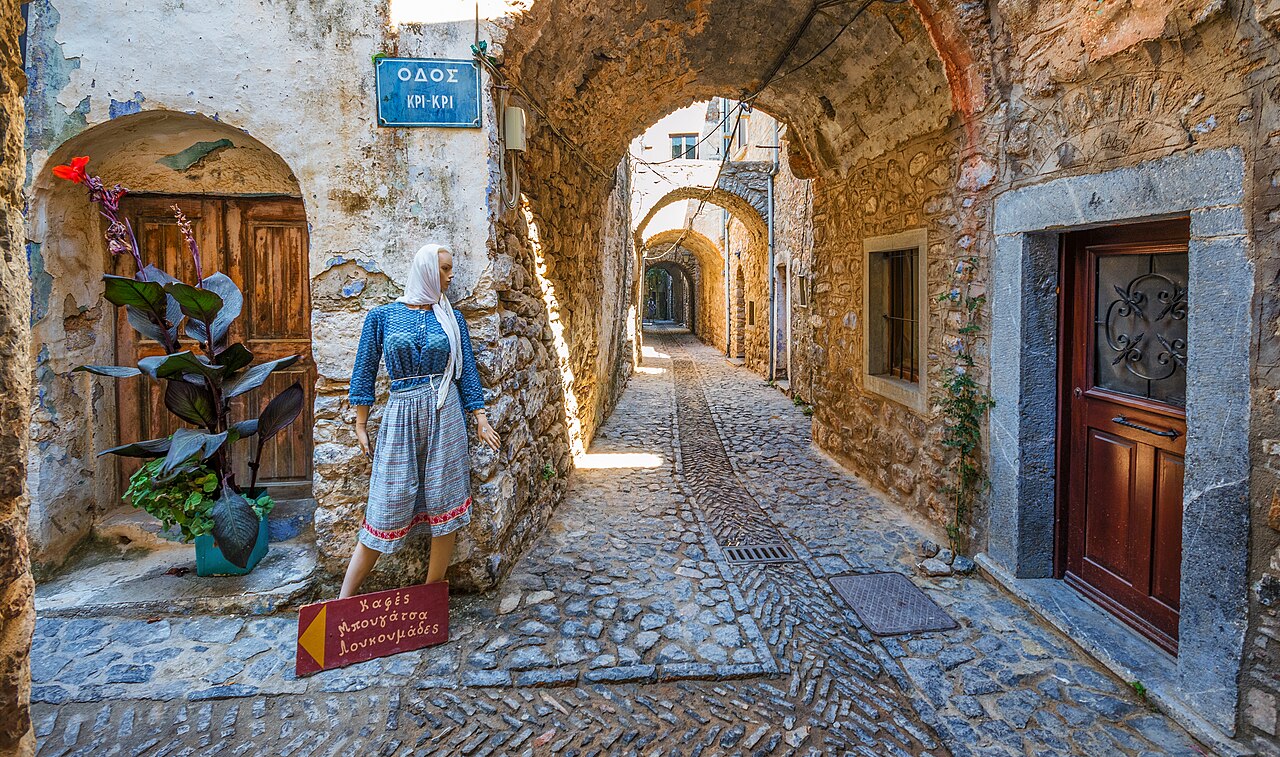
Mesta is the finest surviving medieval village on Chios, a complete fortress-village whose plan has scarcely changed in six hundred years. Its houses stand shoulder to shoulder to form an outer wall, its narrow lanes twist and duck beneath stone arches in a deliberate labyrinth, and at its heart sits one of the largest churches in Greece. Where other villages have been opened up and modernised, Mesta remains a living medieval maze, and stepping through its gate is the closest thing on the island to walking into the fourteenth century. Plan the whole trip with Greece Tours.
This guide covers Mesta in full: its fortified pentagonal plan and covered alleys, the two churches of the Taxiarchis, the central square, the stone guesthouses and the port of Limenas Mesta, and where the village is and how to visit. Read it beside the guide to the Chios mastic villages and the full Chios travel guide.
What is Mesta, the medieval village of Chios?
Mesta is a fortified medieval mastic village in the south of Chios, about 35 kilometres from Chios Town, and the best-preserved of the mastichochoria. Built in the fourteenth century as a defensive labyrinth against pirates, it survives almost unchanged and is protected as a preserved monument.
Mesta is the model mastic village. One of the cluster of medieval villages built around the cultivation of mastic in southern Chios, it is widely regarded as the best preserved of them all, its fortress plan and covered lanes intact where other villages have been altered over the centuries.
It survives as a whole. The village was declared a preserved medieval monument, so its appearance has been protected, and it retains the complete character of a fortified settlement, from its outer ring of houses to the maze within, giving a vivid sense of how the mastic growers lived and defended themselves.
It is a living village, not a museum. For all its antiquity, Mesta is inhabited, its square full of tavernas and its stone houses lived in or restored as guesthouses, so a visit combines the atmosphere of a medieval fortress with a working village, as the guide to the villages of Chios describes.
What is the layout of Mesta?
Mesta has a pentagonal fortified plan: the outer houses are built side by side without gaps to form a defensive wall, with round towers at the corners and gates in the walls. Inside, the narrow alleys twist beneath stone arches in a deliberate labyrinth to confuse invaders.
The village is its own castle. There was no separate fortress; instead the outer ring of houses was built as a continuous wall with no windows or doors facing outward at ground level, defended by small circular towers at the corners and pierced by only a few gates, so the whole settlement formed a fortification.
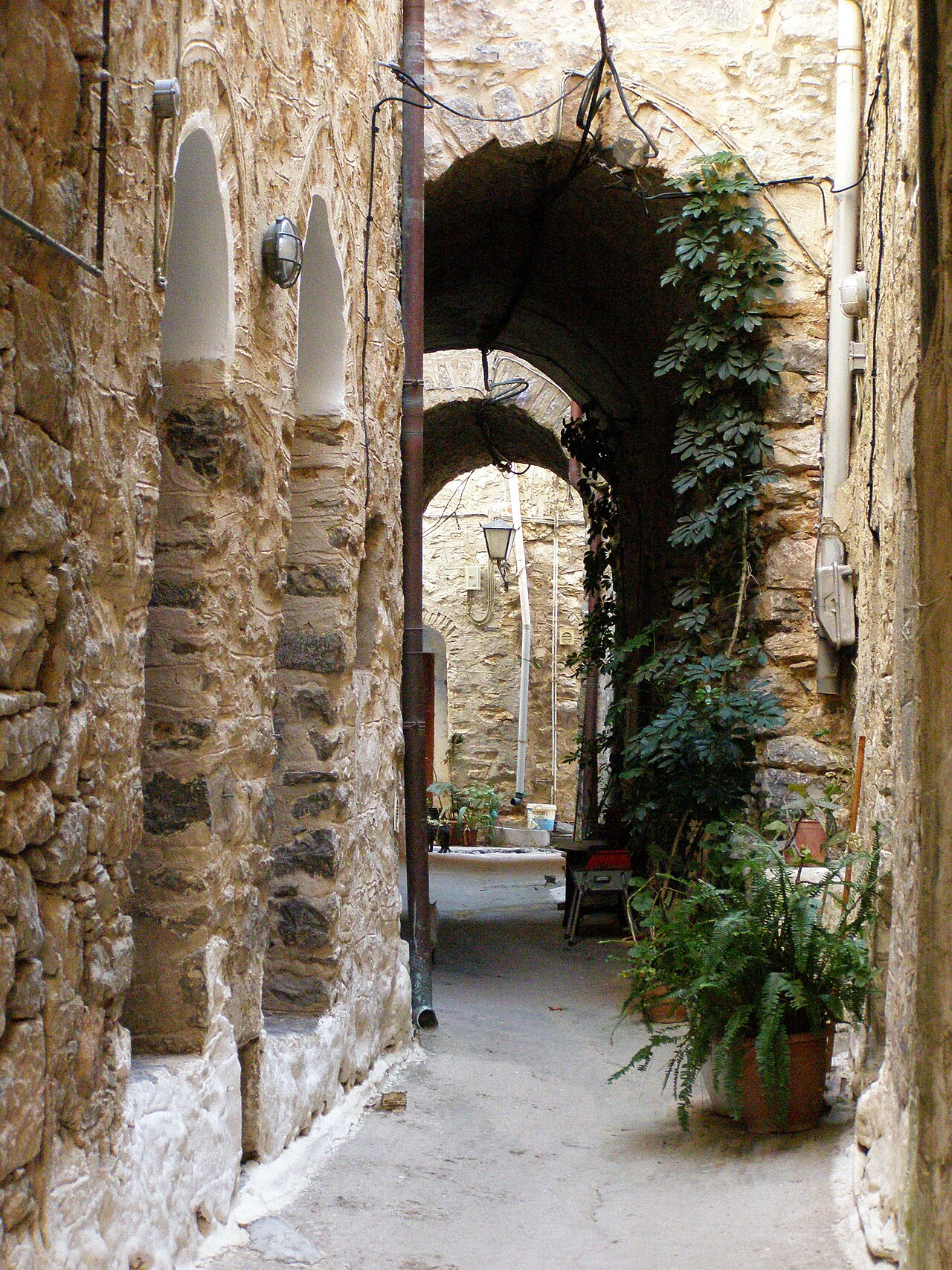
The streets are a designed maze. Within the walls the lanes are narrow and twisting, many of them covered by arches with rooms built above, forming vaulted tunnels, and the plan was laid out as a deliberate labyrinth to slow and confuse any raider who breached the gates before they could reach the centre.
The centre was the last refuge. At the heart of the village stood a central tower or keep and the main church, the final strongpoint if the outer defences fell, and this concentric design, wall, maze and core, is the classic pattern of the mastic villages, seen at its most complete in Mesta.
What are the churches of Mesta?
Mesta has two churches dedicated to the Taxiarchis, the Archangels. The old Taxiarchis dates from the medieval period, while the newer Taxiarchis, built in the nineteenth century, is one of the largest churches on Chios and in Greece, with a richly carved and decorated interior.
The old Taxiarchis belongs to the medieval village. The smaller, older church of the Archangels dates from the village’s fortified age and sits within the maze, a modest medieval building that served the community for centuries before its grand successor was raised.
The new Taxiarchis is the village’s showpiece. Built in the nineteenth century, this large church is among the biggest on the island and one of the larger in Greece, and its interior is richly decorated, with an elaborately carved wooden iconostasis and painted icons that reward a visit.
Both are dedicated to the Archangels. The Taxiarchis, the archangels Michael and Gabriel, are the patrons of the village, and the two churches, old and new, stand as the spiritual heart of Mesta, a focus of village life and festivals alongside the central square.
What can you see and do in Mesta?
In Mesta you can wander the covered labyrinth of alleys, sit in the central square among the tavernas, visit the two Taxiarchis churches, stay in a restored stone guesthouse, and drive down to the small fishing port of Limenas Mesta for a swim and a seafood lunch.
The lanes are the main experience. Exploring the maze of vaulted alleys, arches and tunnels, losing your bearings and finding the light again at a small square or a gate, is the essence of a visit to Mesta, and the village is compact enough to wander at leisure in an hour or two.
The square is the social heart. The central plaza, shaded and lined with tavernas and cafés, is where village life gathers, and it is the natural place to pause for a coffee, a souma or a meal of goat, mastic sweets and local dishes, especially in the evening once the day-trippers have gone.
The port adds the sea. A short drive down from the village, the small fishing harbour of Limenas Mesta offers tavernas by the water and swimming, so a visit can pair the medieval maze with a seafood lunch and a dip, as the guide to the best beaches in Chios notes.
Where do you stay in Mesta, and what is it like in the evening?
Mesta offers restored medieval stone houses as atmospheric guesthouses within its walls, and its evenings are quiet and memorable, the lanes emptying of day-trippers and the central square filling with taverna tables under the stars, a highlight of a stay in the south of Chios.
Staying inside the walls is the draw. Old stone houses in the maze have been restored as characterful guesthouses and small hotels, so visitors can sleep within the medieval fortress-village itself, waking to the sound of the village rather than traffic, an experience quite unlike a beach hotel.
The evening is when Mesta is at its best. Once the coaches leave, the village grows quiet, and the central square comes alive with taverna tables, the covered lanes lit and shadowed, and the medieval atmosphere at its strongest, which is the reason many choose to stay the night rather than pass through.
It suits a slow, atmospheric trip. A base in Mesta puts the southern mastic villages, the beaches and the mastic groves within easy reach while offering the quiet and character of a medieval village, ideal for travellers who prize atmosphere over convenience, as the guide on where to stay in Chios sets out.
Where is Mesta and how do you get there?
Mesta lies in the far south-west of Chios, about 35 kilometres from Chios Town, a drive of around forty-five minutes. It is reached most easily by hire car, with parking outside the walls, and by public bus or organised tour of the mastic villages from the capital.
The village sits deep in the mastic south. It stands about 35 kilometres from Chios Town in the far south-west of the island, the furthest of the main mastic villages, and the drive takes around forty-five minutes on good road through the groves, often taking in Pyrgi and Olympi on the way.
A car is the easiest way to reach it. Driving gives the freedom to combine Mesta with the other mastic villages and the southern beaches, and cars park outside the walls, since the medieval core is car-free and entered on foot through its gates, so comfortable shoes are useful for the stone lanes.
Buses and tours also serve it. Public buses run from Chios Town to Mesta, and organised coach and taxi tours of the mastic villages include it, so it can be reached without a car, as the guides to car rental in Chios and day trips from Chios explain.
When is the best time to visit Mesta?
The best time to visit Mesta is spring and autumn for mild weather and few crowds, or the evening in summer, when the day-trippers have left and the square fills with taverna tables. Early morning is also quiet, and the covered lanes give shade in the summer heat.
The shoulder seasons are the most comfortable. Spring and autumn bring mild weather for wandering the lanes and thin crowds, so the village can be enjoyed at leisure, and these months suit a wider tour of the mastic country and the southern beaches.
Evening is the magic hour in summer. Mesta is a popular stop and coaches arrive through the day in high summer, so the village is at its best in the evening, once they have gone and the square comes alive, or in the early morning before they arrive, when the maze is quiet.
The covered lanes help in the heat. Unlike the exposed ghost village of Anavatos or the open southern beaches, much of Mesta is shaded by its arches and tunnels, so it remains walkable even in the midday heat of summer, though the light and atmosphere are best at either end of the day, as the guide on the best time to visit Chios notes.
What is near Mesta worth combining?
Mesta combines with the other mastic villages of Pyrgi and Olympi, the black-pebble beach of Mavra Volia at Emporios and the sands of Komi, and the Chios Mastic Museum, making a full southern day out from Chios Town by hire car.
Pyrgi and Olympi complete the mastic villages. The painted village of Pyrgi, with its xysta façades, and the quieter Olympi with its cave lie between Mesta and the capital, so a southern day easily takes in all three, each with its own character, as the guide to Pyrgi describes.
The beaches are a short drive. The dramatic black volcanic pebbles of Mavra Volia below Emporios and the sandy family beach at Komi lie within a short drive of Mesta, so a morning in the villages can end with an afternoon swim, along with the port of Limenas Mesta closer still.
The Mastic Museum adds the context. The Chios Mastic Museum near Pyrgi explains the crop that shaped the whole south, so pairing it with Mesta links the fortified village to the mastic economy that built it, as the guide to the museums of Chios notes.
Frequently Asked Questions
Why is Mesta considered the best-preserved village on Chios?
Mesta is considered the best preserved of the medieval mastic villages because its fortified plan and medieval fabric survive almost unchanged, and it has been protected as a preserved monument. The village was built in the fourteenth century as a fortress-village: its outer houses form a continuous defensive wall with round towers at the corners and only a few gates, and inside, the narrow lanes twist beneath stone arches in a deliberate labyrinth designed to confuse pirates and raiders. Where other villages have been opened up, widened or modernised over the centuries, Mesta retains this complete concentric structure of wall, maze and central core, so walking through its gate gives an unusually vivid sense of a living medieval settlement. It remains inhabited, with tavernas on its square and stone houses restored as guesthouses, so it is a working village rather than a museum, which adds to its atmosphere.
What is there to see in Mesta?
The main experience of Mesta is wandering its labyrinth of covered stone alleys, arches and tunnels, a compact maze that can be explored in an hour or two. At the heart of the village are two churches dedicated to the Taxiarchis, the Archangels: the small old Taxiarchis from the medieval period, and the large nineteenth-century new Taxiarchis, one of the biggest churches on Chios and in Greece, with a richly carved and decorated interior. The central square, shaded and lined with tavernas and cafés, is the social heart, best enjoyed in the evening once the day-trippers have gone. Many of the stone houses within the walls have been restored as guesthouses, and a short drive down from the village leads to the small fishing port of Limenas Mesta, with tavernas by the water and swimming, so a visit can pair the medieval maze with a seafood lunch and a dip.
How far is Mesta from Chios Town?
Mesta lies about 35 kilometres from Chios Town, in the far south-west of the island, and the drive takes around forty-five minutes on good road through the mastic groves. It is the furthest of the main mastic villages from the capital, and the route usually passes Pyrgi and Olympi, so the three are easily combined in a single southern day. The easiest way to reach Mesta is by hire car, which also allows you to add the southern beaches, the port of Limenas Mesta and the Chios Mastic Museum. Cars park outside the walls, since the medieval core is car-free and entered on foot through its gates. Public buses run from Chios Town to Mesta, and organised coach and taxi tours of the mastic villages include it, so it can be visited without a car, though a hire car gives the most freedom to explore the south.
Can you stay overnight in Mesta?
Yes, and staying overnight is one of the best ways to experience Mesta. Many of the old stone houses within the medieval walls have been restored as atmospheric guesthouses and small hotels, so visitors can sleep inside the fortress-village itself, in vaulted rooms among the maze of lanes. The village is at its most memorable in the evening, once the day-trippers have left: the covered alleys grow quiet, the central square fills with taverna tables under the stars, and the medieval atmosphere is at its strongest. A base in Mesta suits travellers who prize character and quiet over convenience, and it keeps the southern mastic villages, the beaches and the mastic groves within easy reach. It makes a particularly good choice for couples and anyone seeking a slow, immersive stay in the south of Chios rather than a beach resort.