
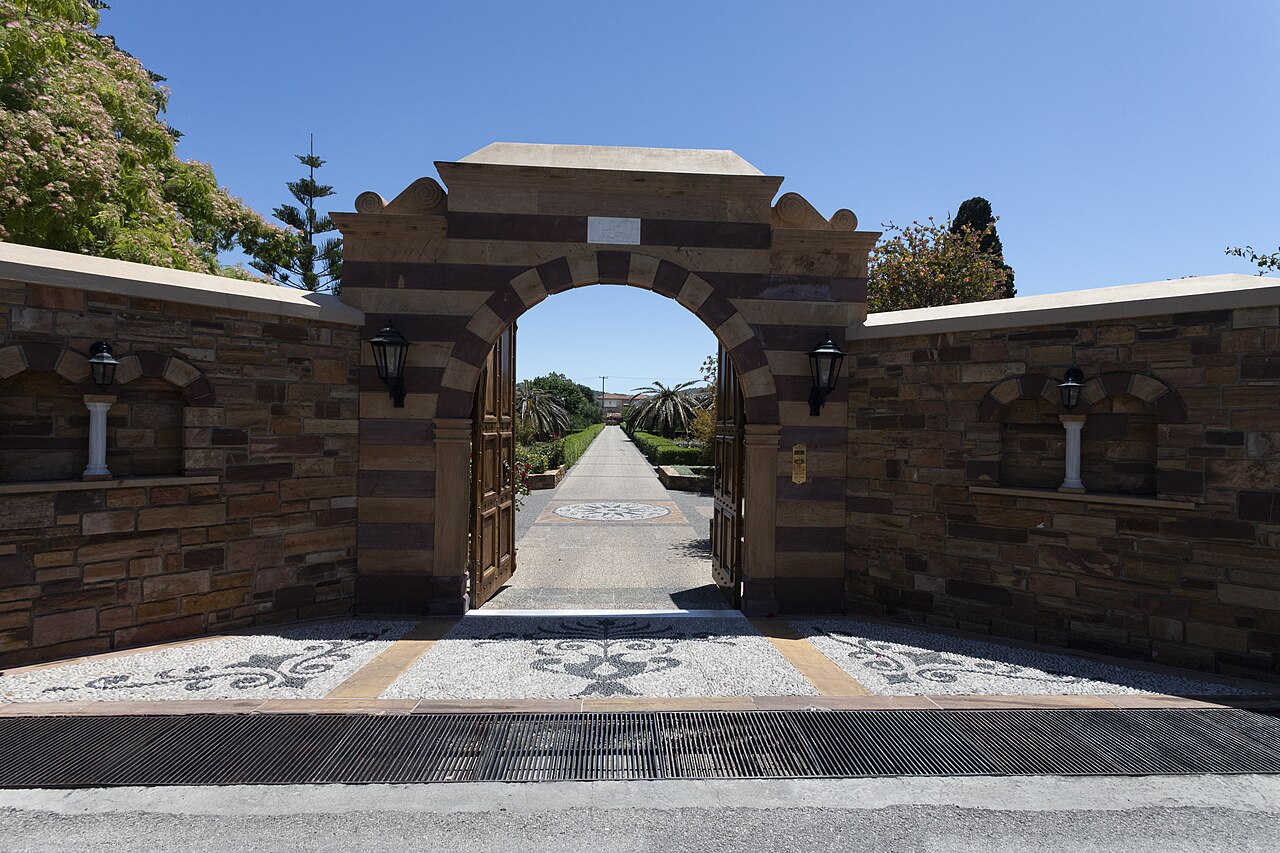
Kampos is a landscape unlike anywhere else in Greece: a fertile plain south of Chios Town given over entirely to walled estates, where high ochre-red walls hide mansions and orchards of mandarin, orange and lemon. Built by the Genoese and Greek merchant families who grew rich on the island’s citrus and mastic, these two hundred enclosed gardens, with their painted mansions, stone cisterns and old irrigation wheels, form one of the most distinctive historic settlements on Chios, and the scent of citrus blossom fills the lanes in spring. Plan the whole trip with Greece Tours.
This guide covers Kampos in full: the walled estates and their Genoese mansions, the PGI mandarins and the manganas water wheels that watered them, the Citrus Museum, and where the plain is and how to visit its lanes. Read it beside the guide to the villages of Chios and the full Chios travel guide.
What is Kampos, Chios?
Kampos is a plain of walled merchant estates about 6 kilometres south of Chios Town, made up of some two hundred enclosed gardens of citrus behind high ochre-red walls, with Genoese-era mansions. It is a protected historical settlement and one of the island’s most distinctive landscapes.
Kampos is a landscape of walls. The fertile plain south of the capital is divided into around two hundred large estates, each enclosed by a high wall of the local reddish stone from Thimiana, and behind the walls lie orchards of citrus and a mansion, so the plain reads as a maze of walled lanes rather than an open field.
It grew from citrus and trade. The estates were built and enriched by the Genoese and Greek merchant families who cultivated and exported the island’s famous mandarins, oranges and lemons as luxury goods, and Kampos was designated a protected historical settlement in recognition of this unique heritage.
It sits close to the town. Only a few kilometres south of Chios Town and running towards the airport, Kampos is the easiest of the island’s historic settlements to reach, and its flat, walled lanes make it ideal for a gentle walk or cycle, as the guide to the villages of Chios describes.
What are the mansions and estates of Kampos?
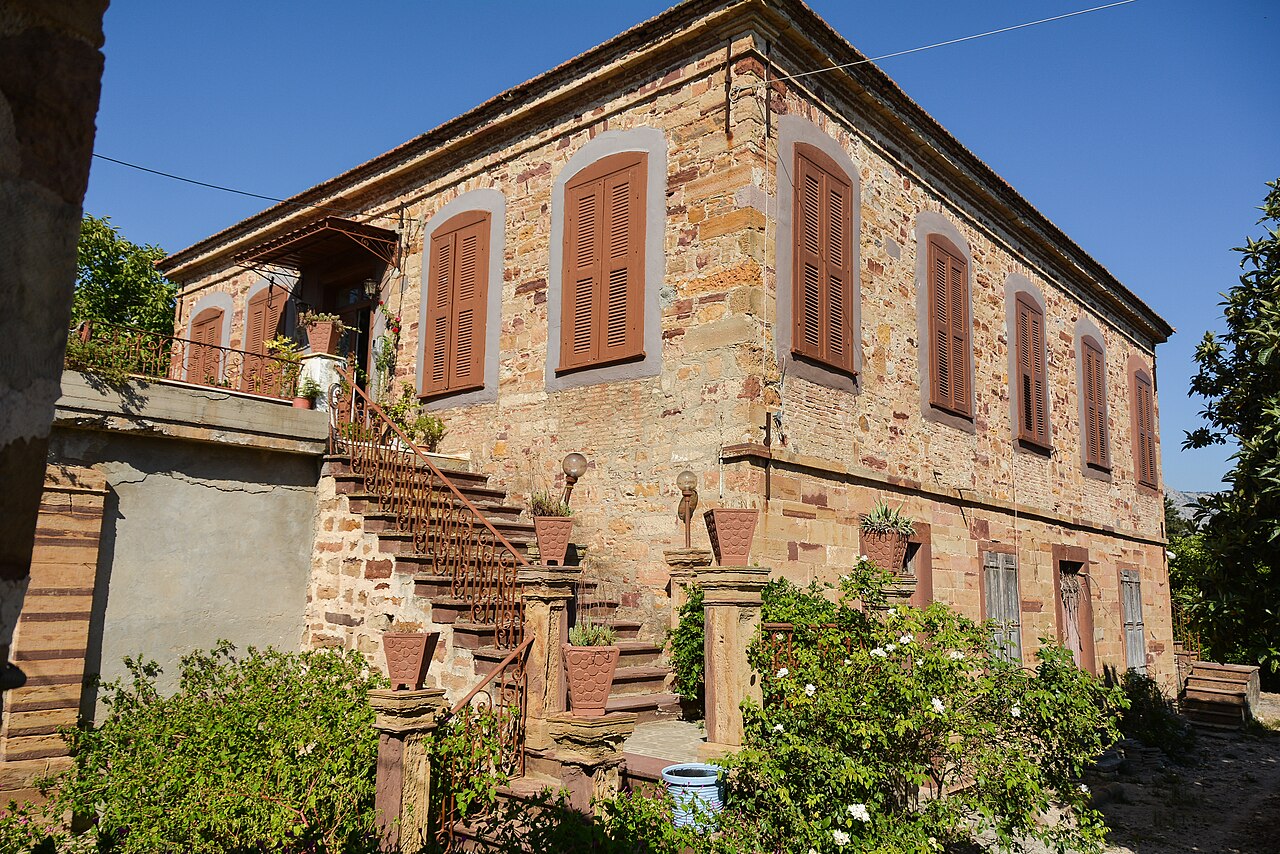
The estates of Kampos are walled compounds enclosing a mansion, an orchard, a stone cistern and a water wheel. The two- and three-storey mansions, flourishing under Genoese rule, have monumental external stairs, large terraces, and bright rooms with fireplaces and painted ceilings.
Each estate is a self-contained world. Behind its high wall and arched gateway, a Kampos estate holds a mansion, an orchard of citrus, a stone-built cistern to store water, and the garden that fed the family, a private domain hidden from the lane outside, which is why the walls were built both against the weather and against prying eyes.
The mansions are grand. Flourishing above all in the Genoese period from the fourteenth to the sixteenth century, the two- and three-storey houses are majestic buildings, with monumental external staircases, spacious terraces, and large, bright rooms warmed by fireplaces and decorated with painted ceilings, the homes of a wealthy landowning class.
Some are open to visitors. Many of the mansions can be visited today, and several have been restored as museums or guesthouses, including the Argentiko, one of the best-known historic estates, belonging to the Argenti family, where visitors get a taste of the aristocratic life of the plain’s past.
What is the citrus of Kampos?
Kampos is famous for its citrus, above all the PGI-protected Chios mandarin, along with oranges and lemons. Grown in the walled orchards for centuries and exported as luxury goods, the fruit brought the plain its wealth, and its blossom scents the lanes in spring.
The mandarin is the plain’s signature. The Chios mandarin, protected as a PGI product, is the most famous of the citrus of Kampos, introduced in the mid-nineteenth century and prized for its aroma, and alongside it the estates grow oranges and lemons, all cultivated in the fertile, well-watered soil behind the walls.
Citrus made Kampos rich. For centuries the fruit of the plain was exported across the Mediterranean as a luxury item, and the wealth it generated built the mansions and maintained the estates, tying the fortunes of the plain to its orchards in the same way that mastic shaped the south.
Spring is the season of blossom. When the citrus flowers, the scent of orange and lemon blossom fills the walled lanes, making spring the loveliest time to walk in Kampos, and the fruit itself appears through the autumn and winter, sold and turned into juice, preserves and spoon sweets, as the guide to Chios food describes.
What are the manganas water wheels of Kampos?
The manganas were the traditional irrigation wheels of Kampos, water-lifting devices that drew groundwater from wells to feed the citrus orchards. The plain has abundant groundwater and the most fertile soil on Chios, and the manganas were the central system that made its cultivation possible.
Water is the secret of the plain. Kampos sits on abundant groundwater and holds the most fertile soil on the island, and it was the ability to raise and distribute that water to the thirsty citrus trees that made the walled orchards productive, so irrigation was at the heart of the estates’ working life.
The manganas did the lifting. These traditional wheels, turned originally by animals walking in a circle, drew water up from the wells and cisterns and fed it through channels to the orchards, and the manganas and their wells were a central feature of every estate, a piece of working heritage now preserved in the restored gardens.
They are part of the visit today. In the estates open to the public and in the Citrus Museum, the old wells, cisterns and water wheels are preserved alongside the mansions and orchards, so a visit shows not only the grand houses but the practical system that watered the plain and sustained its wealth.
What is the Citrus Museum of Kampos?
The Citrus Museum of Kampos is housed in a restored estate, the Perleas or Perivoli, and records the history and traditional methods of growing the plain’s citrus. Set among its own orchards, it lets visitors learn about the crop and taste the local products in an authentic setting.
The museum sits inside a working estate. Rather than a conventional gallery, the Citrus Museum occupies a restored Kampos mansion and its orchard, so the setting is itself the exhibit, with the walled garden, the mansion, the cistern and the water wheel all part of the experience.
It tells the story of the fruit. The displays cover the history of citrus cultivation in Kampos, the traditional methods of growing, packing and exporting the mandarins and oranges, and the trade that made the plain prosperous, giving the context behind the walls and mansions seen on a walk.
It offers a taste and a shop. Visitors can sample and buy the estate’s own citrus products, from juice to preserves and spoon sweets, so the museum links the history to the living produce of the plain, and it makes the natural focal point of a visit, as the guide to the museums of Chios notes.
Where is Kampos and how do you visit it?
Kampos lies about 6 kilometres south of Chios Town, running towards the airport, and is easily reached by car, bike or bus. The flat, walled lanes are best explored on foot or by bicycle, visiting the open estates and the Citrus Museum, with spring the finest season for the blossom.
The plain is close and accessible. Beginning a few kilometres south of the capital and stretching towards the airport, Kampos is the easiest of the historic settlements to reach, a short drive, cycle or bus ride from Chios Town, so it fits easily into a day that also takes in the town or the beach at Karfas.
It is best explored slowly. The flat lanes between the high walls make Kampos ideal for walking or cycling, and the pleasure is as much in wandering the quiet, scented lanes as in visiting any single site, so bikes hired in the town or an unhurried stroll suit the plain better than a quick drive-through.
The estates and museum anchor a visit. Several mansions are open, the Citrus Museum gives the history and a taste, and some estates offer accommodation, so a visit can be as simple as a walk or as full as a stay, ideally in spring when the blossom is out, as the guide on where to stay in Chios notes.
What is near Kampos worth combining?
Kampos combines with Chios Town just to the north, the beach resort of Karfas just to the south, and the airport, making it easy to fit into a day. Its gentle lanes also pair well with the sights of the capital or a swim at Karfas.
Chios Town is minutes away. The capital, with its castle, museums and market, lies just north of Kampos, so the plain and the town combine naturally into a day close to base, as the guide to Chios Town describes.
Karfas adds the beach. The island’s main sandy beach and resort at Karfas lies just south of Kampos and minutes from the airport, so a morning among the citrus estates can end with an afternoon swim, as the guide to the best beaches in Chios sets out.
It suits an arrival or departure day. Because Kampos sits between the town, the beach and the airport, it makes an ideal gentle outing for a first or last day on the island, or a relaxed break from the mountain drives, as the guide to the Chios itinerary suggests.
Frequently Asked Questions
What is Kampos in Chios known for?
Kampos is known for its walled citrus estates and Genoese mansions, a unique historic landscape on the fertile plain about 6 kilometres south of Chios Town. Some two hundred large estates each hide, behind a high wall of local reddish stone, an orchard of mandarin, orange and lemon trees, a two- or three-storey mansion with monumental stairs and painted ceilings, a stone cistern and a traditional water wheel. The plain grew rich over centuries on the export of its citrus, above all the PGI-protected Chios mandarin, as a luxury product. Today many of the mansions are open to visitors, some restored as museums or guesthouses, and the Citrus Museum, housed in an estate among its own orchards, tells the story of the fruit and offers a taste. Protected as a historical settlement, Kampos is one of the most distinctive places on the island, at its loveliest in spring when the citrus blossom scents the walled lanes.
Can you visit the mansions and estates of Kampos?
Yes. Many of the historic mansions and estates of Kampos are open to the public, and several have been restored as museums or guesthouses. The best-known is the Argentiko, the estate of the Argenti family, one of the most recognisable historic estates of the plain, where visitors can get a sense of the aristocratic life of the past. The Citrus Museum, housed in a restored estate among its orchards, is the main site to visit, explaining the history and traditional methods of growing the citrus and offering a tasting of local products. Beyond the individual sites, much of the pleasure of Kampos is simply wandering or cycling the flat lanes between the high ochre walls, glimpsing gateways and gardens, and taking in the atmosphere of the plain. Spring, when the citrus is in blossom and the lanes are scented, is the finest time to visit.
How far is Kampos from Chios Town?
Kampos lies about 6 kilometres south of Chios Town, beginning just beyond the edge of the capital and running towards the island’s airport, which sits at the southern end of the plain. This makes it one of the easiest historic settlements on Chios to reach, a short drive, cycle or bus ride from the town, and easy to combine with the sights of the capital or the beach at Karfas just to the south. Because the plain is flat and its lanes run between high walls, it is ideally explored on foot or by bicycle rather than by car, and bikes can be hired in Chios Town. A visit can be as brief as a walk among the walled lanes or as full as a tour of the open mansions and the Citrus Museum, or even an overnight stay in one of the restored estates. Spring is the best season, when the citrus blossom fills the lanes with scent.