
The mastic villages of Chios, known as the Mastichochoria, are a cluster of medieval fortified settlements in the south of the island. Built to cultivate and protect mastic, the fragrant resin produced nowhere else on earth. With their maze-like alleys, defensive walls and, at Pyrgi, extraordinary black-and-white patterned facades, they are among the most distinctive villages in all of Greece. Plan the whole trip with Greece Tours.
This guide covers the Chios mastic villages in full: what the Mastichochoria are, why they were built as fortresses. The individual villages of Pyrgi, Mesta, Olympi and the rest, the mastic they protect, the mastic museum. How and when to visit. Read it beside the full Chios travel guide and the guide to the best things to do in Chios.
What are the mastic villages of Chios (Mastichochoria)?
The Mastichochoria are a group of about twenty medieval villages in the south of Chios, built between the 14th and 16th centuries to cultivate and protect mastic.
The Mastichochoria, literally the “mastic villages”, are the cluster of medieval settlements in the southern part of Chios that grew up around the cultivation of mastic. The aromatic and valuable resin for which the island is famous. Traditionally numbering around twenty villages, with a core municipality of Mastichochora based at Pyrgi that includes Pyrgi, Mesta. Olympi, Elata, Lithi, Vessa, Armolia, Kalamoti and Patrika, they are unique in Greece both for their purpose and for their architecture.
Built mainly under Genoese rule between the 14th and 16th centuries. The villages were designed as fortresses to guard the valuable mastic crop and their inhabitants from the pirates that plagued the medieval Aegean. Set inland and invisible from the sea, they were laid out on a compact, defensive plan, with the outer ring of houses joined to form a protective wall. A central tower of refuge. A maze of narrow, confusing lanes to disorient any attackers who broke in.
The Mastichochoria are living villages, still inhabited and still tied to mastic, and wandering their stone alleys is like stepping into the Middle Ages. The most famous and rewarding to visit are Pyrgi, with its astonishing patterned houses, Mesta. The best-preserved of the fortified villages. Quieter Olympi, though the smaller villages each have their own character, as the sections below describe.
Why were the Chios mastic villages built as fortresses?
The Chios mastic villages were built as fortresses to protect the valuable mastic crop and their people from pirates during the medieval period, mainly under Genoese rule.
The fortified design of the Mastichochoria was a direct response to the dangers of the medieval Aegean, when pirate raids were a constant threat and mastic was a precious commodity worth defending. Under the Genoese, who controlled Chios from 1346 to 1566 and organised the lucrative mastic trade. The villages were carefully planned settlements built to safeguard both the crop and the lives of the farmers who produced it.
Their defensive architecture followed a clever, consistent plan. The villages were built inland, in positions invisible from the coast so that raiding ships not spot them. Laid out in a closed. Roughly rectangular form with the outermost houses joined back-to-back to create a continuous perimeter wall, pierced by only a few easily defended gates. At the centre stood a tall tower, a final refuge where the population hold out if the walls were breached.
Within this outer ring, the villages are a deliberate labyrinth of narrow, twisting lanes, low archways and covered passages. Designed to confuse and slow any attackers who got inside, while flat rooftops connected the houses to allow the defenders to move and communicate. This ingenious, unified design, born of necessity, is exactly what gives the mastic villages their unique, atmospheric character and their extraordinary state of preservation today.
What is Pyrgi, the painted mastic village, like?
Pyrgi is the largest and most famous mastic village, about 24 kilometres south of Chios Town, home to around a thousand people.
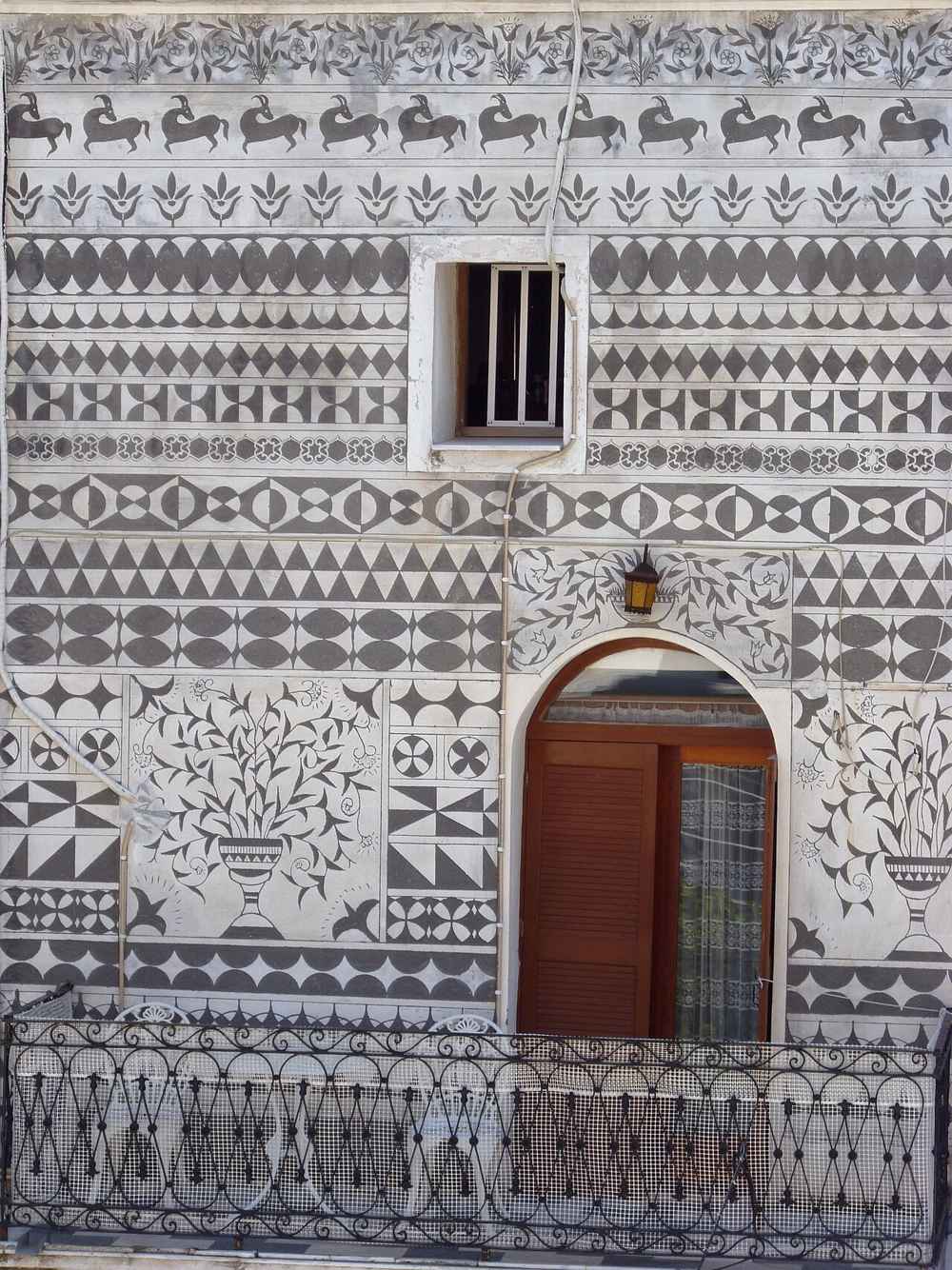
Pyrgi is the largest, liveliest and most visually striking of all the mastic villages. Lying about 24 kilometres south of Chios Town and home to a permanent population of around a thousand. Its fame rests on its xysta, intricate black-and-white geometric patterns of stripes, zigzags, rosettes and lattices scratched into the plaster of the house facades. A decorative technique dating from the Genoese era that covers almost every building and makes the whole village look like a piece of monochrome art.
The effect of these patterned houses massed together, especially around the central square and the medieval church of Agioi Apostoloi with its own richly decorated facade. Is unforgettable. Pyrgi is one of the most photographed villages in Greece. Strings of drying tomatoes hung on the balconies in late summer add splashes of red against the patterns, completing a scene found nowhere else in the country.
Behind its decorative beauty, Pyrgi keeps the fortified plan of the mastic villages. With a tower and a maze of lanes. It remains a working agricultural village at the heart of mastic production. It is the natural base for exploring the region. The modern Chios Mastic Museum, which explains the cultivation and history of the resin. Lies just outside the village, making Pyrgi the essential first stop in the Mastichochoria.
What is Mesta, the best-preserved mastic village, like?
Mesta, about 35 kilometres southwest of Chios Town, is the best-preserved of the fortified mastic villages, a compact medieval maze of stone alleys, archways and hidden courtyards enclosed by an outer wall of houses.
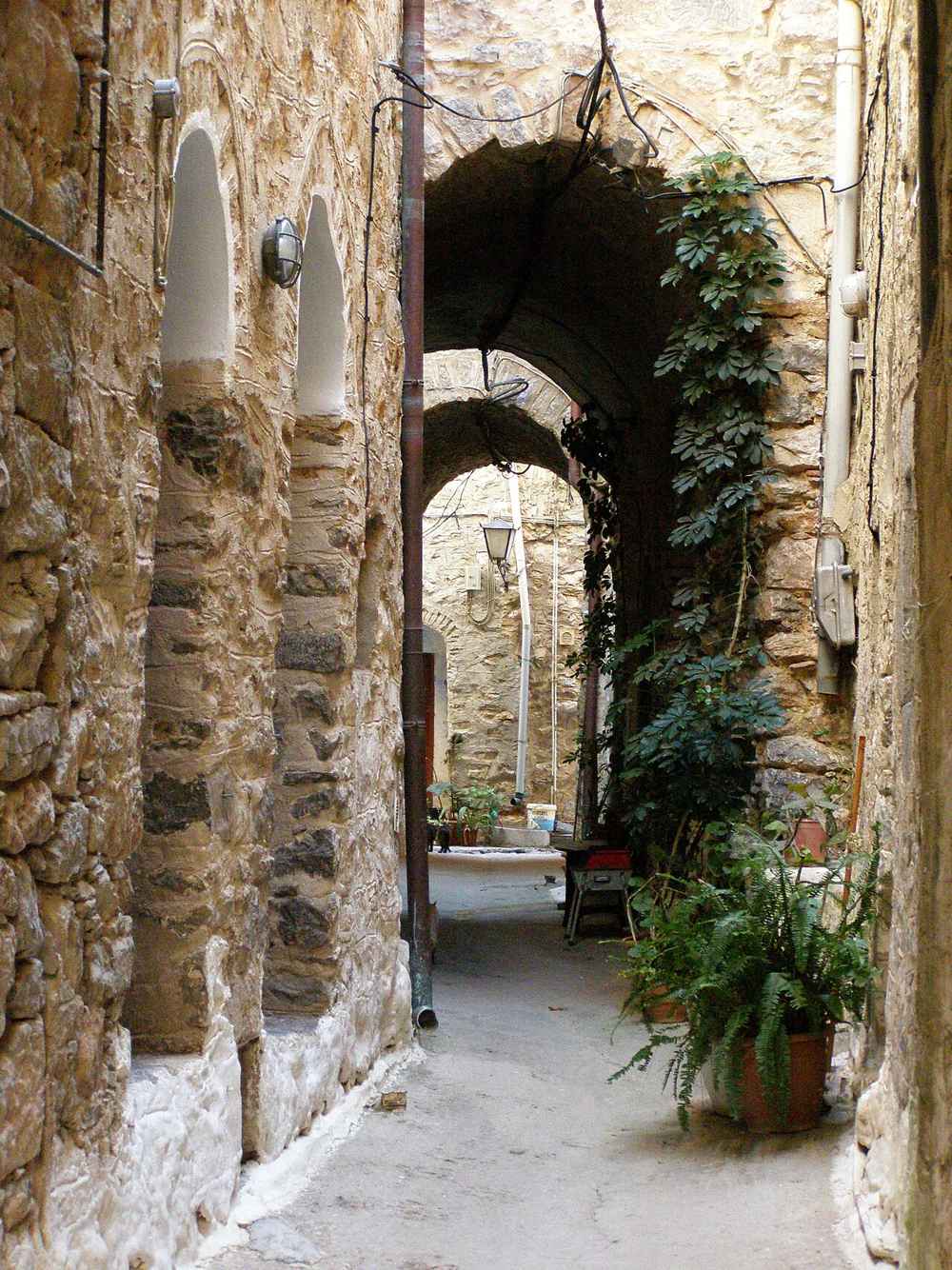
Mesta, some 35 kilometres southwest of Chios Town, is widely considered the best-preserved and most complete of the fortified mastic villages. A place where the medieval defensive plan survives almost intact. Enclosed by its unbroken outer ring of houses, it is entered through a few old gates. Within lies a dense. Atmospheric labyrinth of narrow cobbled lanes, low stone archways, covered passages and hidden courtyards that has changed little in centuries.
Wandering Mesta is a pleasure in itself. It is easy to spend an afternoon losing yourself in its maze. Discovering quiet squares, old stone houses and the flat rooftops that once linked the village for defence. At its centre stands the large 18th-century church of the Taxiarchis, the Archangels, one of the finest on the island. With an ornate carved wooden iconostasis and fine frescoes, while an older church of the same name nearby reflects the village’s long and devout religious life.
Mesta has become a favourite base within the Mastichochoria, with traditional guesthouses set in restored old houses and good tavernas on its little squares, letting visitors sleep within a living medieval village. Quiet, beautiful and authentic, it is for many the highlight of a visit to the mastic villages of Chios.
What is Olympi and the quieter mastic villages like?
Olympi is a quieter, less-visited mastic village between Pyrgi and Mesta, keeping the same fortified plan around a central tower, with the church of Agia Paraskevi and traditional lanes.
Olympi, lying between Pyrgi and Mesta, is the third of the main mastic villages and a quieter, more low-key place than its famous neighbours, which is much of its charm. It preserves the classic fortified layout of the Mastichochoria. Built around a central defensive tower with the outer houses forming a protective wall and a maze of lanes within. It rewards a slow, peaceful wander among locals going about their day.
The heart of the village is the main square with the church of Agia Paraskevi and its carved wooden temple. The well-preserved old building known as the Bank of Olympoi. A two-storey medieval structure, recalls the village’s history. With fewer visitors than Pyrgi and Mesta, Olympi offers an unhurried, authentic experience, ideally paused over a coffee at a village kafeneio in the shade.
Just outside Olympi lies one of the finest natural attractions in the south of the island, the Olympi cave, also called the Sykia cave. A spectacular cavern of stalactites and stalagmites open to visitors, which makes a rewarding addition to a tour of the village. Together, Olympi and its cave show the quieter, more hidden side of the mastic villages, well worth seeking out beyond the two headline settlements.
What are the other mastic villages of Chios?
Beyond Pyrgi, Mesta and Olympi, the other mastic villages include Armolia, known for its pottery, Kalamoti with its fine church, and Elata, Vessa, Lithi and Patrika, each keeping the fortified medieval plan.
Mesta and Olympi draw the most visitors, the Mastichochoria include a number of other villages, each with its own character and each keeping the distinctive fortified layout born of the mastic trade. Armolia, on the main road from Chios Town toward the region, is the island’s traditional pottery centre. Its roadside workshops selling brightly coloured handmade ceramics. It is crowned by the ruins of the medieval Apolichnon castle above the village.
Kalamoti, a larger village toward the southeast, preserves its medieval core and the notable church of the Panagia Agrelopousaina, while smaller settlements such as Elata. Vessa, Lithi and Patrika each retain the closed, defensive plan of the mastic villages, with their maze of lanes and old stone houses. Lithi also has a pretty fishing harbour and beach on the west coast nearby, adding the sea to a village visit.
These lesser-known villages see far fewer visitors than Pyrgi and Mesta. They offer a quieter. More everyday glimpse of life in the Mastichochoria, where mastic is still cultivated and village routines carry on much as they always have. For travellers with a hire car and time to explore, seeking them out is a rewarding way to experience the full sweep of the mastic villages of Chios.
What is mastic and why does it define these villages?
Mastic is the fragrant resin drawn from the lentisk trees of southern Chios, cultivated commercially nowhere else on earth and recognised by UNESCO and as a protected PDO product.
Mastic, or mastiha, is the aromatic resin that weeps as translucent “tears” from the bark of the mastic tree. A variety of lentisk that grows around the Mediterranean but produces its prized resin only in the south of Chios. This natural monopoly, the result of a unique combination of soil, microclimate and centuries of skilled cultivation. Is what gave the region its wealth and its reason for being. It is recognised on the UNESCO list of intangible cultural heritage and protected as a PDO product.
Harvesting mastic is a painstaking traditional craft that still follows the rhythm of the seasons. In summer the farmers clean and level the ground beneath the trees, then make careful incisions in the bark from which the resin slowly drips and hardens into tears over the following weeks, before it is gathered by hand, cleaned and sorted, a labour-intensive process passed down through the families of the Mastichochoria over generations.
It was to protect this valuable crop that the mastic villages were built as fortresses. Mastic still defines them today. Sustaining the local economy and appearing in a remarkable range of products, from the pure chewable resin and mastiha liqueur to sweets, ice cream, cosmetics and medicines. Understanding mastic is essential to understanding the villages, and it is covered further in the full Chios travel guide.
What is the Chios Mastic Museum?
The Chios Mastic Museum is a modern museum near Pyrgi in the south of the island, set amid the mastic groves, which explains the cultivation, harvesting, history and uses of mastic through excellent displays.
The Chios Mastic Museum, run by a cultural foundation and opened in recent years, is a modern, beautifully designed museum devoted entirely to mastic. Set on a hillside amid the mastic groves just outside Pyrgi in the heart of the Mastichochoria. It tells the full story of the resin that shaped the region. From the botany of the mastic tree and the techniques of cultivation and harvesting to the trade, history and uses of mastic over the centuries.
Through well-presented exhibits, film, tools and reconstructions. Often live demonstrations of how the resin is scored from the bark and gathered. The museum brings the tradition to life and explains why mastic is unique to Chios and why it mattered so much that whole villages were fortified to protect it. Its setting among the trees, with views over the groves and coast, adds to the experience.
Visiting the museum is the ideal way to begin a tour of the mastic villages. Giving the context that makes the villages and their history come alive. It appeals to all ages, including children. Combined with a wander through Pyrgi and Mesta and a tasting of mastic products, it completes a rich, rewarding day exploring the Mastichochoria of Chios.
How do you visit the mastic villages of Chios?
You visit the mastic villages by hire car or scooter from Chios Town, about 24 to 35 kilometres south, or on an organised tour. Buses serve the main villages less frequently.
The mastic villages lie in the south of Chios, roughly 24 to 35 kilometres from Chios Town. The most flexible way to visit them is by hire car or scooter. Which lets you explore villages, the mastic museum and the nearby coast at your own pace. The drive south from the capital takes around forty minutes to an hour, on generally good roads. Because Pyrgi. Olympi and Mesta lie close together, it is easy to combine the three in a single rewarding day.
For those without their own transport, public buses run from Chios Town to the main mastic villages, though with limited frequency. They suit visitors happy to plan around the timetable, while taxis can be hired or shared for a day trip. Organised tours from Chios Town are another good option, typically combining the villages with the mastic museum and a tasting. With a guide to explain the history and the mastic tradition.
You travel, allow enough time to wander slowly, as the real pleasure of the villages lies in getting lost in their winding lanes rather than ticking them off a list. To stop for a coffee or a meal and to buy mastic from local workshops. A full day, or even two. Spent among the Mastichochoria is time well spent. Staying overnight in a guesthouse in Mesta or Pyrgi lets you experience the villages after the day visitors have left.
When is the best time to visit the mastic villages?
The best time to visit the mastic villages is spring and autumn, from April to June and September to October, when the weather is mild and the villages quiet.
The mastic villages can be visited year-round, but spring and autumn are the most comfortable and rewarding times. In spring, from April to June, the surrounding countryside is green and flowery, the mastic trees are in leaf and the weather is mild and pleasant for wandering the stone lanes, while autumn, from September into October, brings warm but gentler days and thinner crowds, ideal for unhurried exploration.
Late summer, from around August into September, is the season of the mastic harvest, when the farmers score the trees and gather the resin. Visiting the groves or the museum at this time offers a fascinating chance to see the traditional craft in action, the very activity for which the villages were built. It is a special time to understand the living tradition behind the Mastichochoria.
High summer, in July and August, is hot and the busiest season. The shaded lanes of the villages offer welcome relief from the sun. But an early start avoids both the heat and the coach parties, especially at Pyrgi. Winter is quiet and cooler, with services reduced, but the villages remain atmospheric and authentic, so any season rewards a visit, as the guide to the best time to visit Chios describes.
What you know before visiting the Chios mastic villages?
Know that they are living communities, so respect residents’ privacy and the midday siesta, wear sturdy shoes for the cobbled, uneven lanes, dress modestly at churches, carry cash for small shops, and buy mastic directly.
The mastic villages are not open-air museums but living, working communities. The most important thing is to visit with respect: keep to the public lanes and squares. Avoid intruding on private courtyards and homes, and be mindful that businesses close for the midday siesta, so mornings and late afternoons are the best times to explore and to find shops and tavernas open. Photographing residents deserves a smile and permission first.
Practically, wear sturdy, comfortable shoes, as the villages are a maze of cobbled. Stepped and uneven medieval lanes not suited to smooth soles or wheeled cases. Bring sun protection and water in the warm months, though the shaded alleys offer relief. Dress modestly if entering the village churches, carry some cash as small workshops and kafeneia can be cash-only, and allow time simply to wander without a fixed plan.
Finally, buying mastic and local products, from the pure resin and liqueur to sweets and cosmetics. Directly from the village workshops and producers is both the most authentic souvenir and a way to support the families who keep this unique tradition alive. Treating the villages and their people with care ensures these remarkable places stay as unspoilt and welcoming as they are today. A little courtesy goes a long way. The residents, proud of their heritage. Are often happy to share a word or a story with visitors who show genuine interest and respect.
What is the history of the Chios mastic villages?
The Chios mastic villages grew up in the Middle Ages around the cultivation of mastic, and flourished under Genoese rule from 1346 to 1566, when they were fortified against pirates.
The story of the mastic villages is inseparable from mastic itself, prized since antiquity, but the villages in their present fortified form took shape in the Middle Ages. It was under the Genoese, who ruled Chios from 1346 to 1566 through the Maona trading company, that the Mastichochoria were organised and fortified. Their maze-like defensive plan devised to protect the valuable crop and its growers from the pirates that menaced the medieval Aegean.
Mastic made the region wealthy, and that prosperity continued under the Ottomans, who valued the resin highly, especially for the sultan’s court. And granted the mastic villages special privileges and a degree of self-government in exchange for their prized production. This favoured status helped the villages preserve their architecture, their traditions and their relative autonomy through the centuries of Ottoman rule.
The darkest chapter came in 1822, during the Greek War of Independence, when the island suffered the devastating Chios massacre. The mastic villages, though partly spared because of their value to the Ottomans, did not escape the wider catastrophe that scarred the island. Since then the Mastichochoria have endured as living farming communities, still cultivating mastic much as their ancestors did, their remarkable medieval fabric largely intact.
Where can you eat and stay in the mastic villages?
In the mastic villages you can eat hearty local dishes at tavernas on the squares of Mesta and Pyrgi, from mastelo lamb to fresh seafood, and stay in atmospheric traditional guesthouses set in restored medieval houses, especially in well-preserved Mesta.
The mastic villages offer a genuinely local dining experience, with small family-run tavernas set on the little squares and lanes of Mesta. Pyrgi and the other villages serving hearty, seasonal Chian cooking. Look out for the island’s signature mastelo, a lamb or goat slow-cooked with wine and herbs, along with Chios sausage, fresh seafood. Traditional pies and local cheeses. Finish with mastic-flavoured sweets and a glass of mastiha liqueur, all in an atmospheric medieval setting.
For those who want to go beyond a day trip, staying overnight in the villages is a rewarding experience. Well-preserved Mesta in particular has a number of traditional guesthouses created within restored old stone houses. Keeping their original character while adding modern comfort. Waking within a living medieval village, and wandering its lanes in the quiet of early morning or evening once the day visitors have gone, is unforgettable.
Pyrgi and some of the other villages also offer rooms and guesthouses. It is easy to base yourself in the Mastichochoria for a night or two. Using the region as a base for the mastic museum, the southern beaches and the wider south of the island. A village stay, with dinner at a taverna on the square and a slow evening among the stone alleys under the stars. Is by far the most immersive way to experience the mastic villages of Chios.
What can you buy in the Chios mastic villages?
In the mastic villages you can buy mastic products above all, from the pure resin and mastiha liqueur to sweets, cosmetics and toothpaste, bought directly from village workshops, as well as the traditional handmade pottery of Armolia and local produce.
Shopping in the mastic villages centres, naturally, on mastic. Village workshops and small shops, especially in Pyrgi, sell the pure chewable resin. The famous mastiha liqueur. A wide range of products made with the resin, including sweets, cookies, ice cream, cosmetics, soaps and toothpaste. Buying directly from the producers who grow and harvest the mastic is both the most authentic souvenir and a way to support the families and cooperatives that sustain the tradition.
The village of Armolia, on the road into the region from Chios Town, is the island’s traditional pottery centre. Its roadside workshops sell brightly coloured handmade ceramics in traditional designs. From decorative pieces to practical tableware, making a lovely and useful memento of a visit to the Mastichochoria. Watching the potters at work adds to the pleasure of a stop here. The pottery tradition of Armolia. Like the mastic of the villages beyond, is another living craft that has survived in the south of Chios for centuries.
Beyond mastic and pottery, the villages and their surroundings produce local honey, cheeses. Citrus preserves and spoon sweets. Olive oil, all of which travel well and capture the flavours of the south of Chios. Browsing the small shops and workshops of the villages, often with a friendly explanation of what you are buying. Is a pleasure in itself and a highlight of exploring the mastic villages.
What else is near the Chios mastic villages?
Near the mastic villages lie the dramatic black-pebble beach of Mavra Volia at Emporios, the impressive Olympi (Sykia) cave, the fishing harbour and beach of Lithi, the ancient site of Kato Fana, and quiet southern coves, so a village visit.
The mastic villages sit in the beautiful, unspoilt south of Chios, so a visit combines naturally with the area’s other attractions. Closest and most famous is Mavra Volia, near the village of Emporios just south of the mastic villages, a striking beach of smooth black volcanic pebbles set against deep blue-green water. One of the island’s most distinctive shores and an ideal swim to pair with a morning in the villages. Only a short drive from Pyrgi and Olympi.
For a different kind of highlight, the Olympi cave, also called the Sykia cave, just outside Olympi, is a spectacular cavern of stalactites and stalagmites open to visitors, while the fishing village and beach of Lithi on the west coast. Quiet southern coves such as Vroulidia and Agia Fotia, offer more clear water and relaxed swims within easy reach of the villages.
History lovers can also seek out Kato Fana in the far south, the site of an ancient temple of Apollo near a quiet beach. Adding a layer of classical antiquity to the medieval villages and a sense of just how long this fragrant corner of the island has been inhabited and valued. Together, these nearby beaches, caves and ancient sites mean a day or two in the mastic villages easily expands into a rich exploration of the whole south of Chios, as the guide to things to do in Chios describes.
Are the Chios mastic villages worth visiting?
Yes. The Chios mastic villages are among the most distinctive and rewarding places in Greece, unique medieval fortified settlements built around a crop found nowhere else on earth.
For most visitors, the mastic villages are the single best reason to come to Chios, and they richly reward the journey. Nowhere else in Greece will you find villages quite like these: fortified medieval settlements, remarkably preserved. Built for the express purpose of guarding a crop that grows nowhere else in the world. Still living and working today. The sheer distinctiveness of the Mastichochoria sets them apart from the whitewashed villages of every other island.
The experience they offer is both visual and cultural: the astonishing patterned facades of Pyrgi, the atmospheric labyrinth of Mesta. The quiet authenticity of Olympi and the smaller villages, and, running through it all, the fascinating story of mastic, best understood at the museum and tasted in the local products. It is a rare combination of beautiful architecture, deep history and living tradition, and one that stays with visitors long after they leave. Nowhere else does a single crop explain an entire landscape of villages so completely, which is what makes the Mastichochoria so fascinating as well as so beautiful.
History lovers, photographers, foodies and anyone drawn to authentic. Off-the-beaten-path travel will find the mastic villages unforgettable. They well repay a full day or more of exploring, ideally with a night in a village guesthouse. As the cultural heart of Chios and a highlight of the northeastern Aegean, the Mastichochoria are, quite simply, a place unlike anywhere else, as the guide to the best things to do in Chios confirms.
Frequently Asked Questions
What are the mastic villages of Chios called?
The mastic villages of Chios are collectively called the Mastichochoria, meaning the “mastic villages”. A group of medieval fortified settlements in the south of the island built to cultivate and protect mastic. Traditionally numbering around twenty, they include the well-known villages of Pyrgi, Mesta and Olympi, along with Armolia, Kalamoti, Elata, Vessa, Lithi and Patrika among others. Each keeps the distinctive defensive plan devised under Genoese rule, with an outer ring of houses forming a protective wall. A central tower and a maze of narrow lanes. Each remains a living community tied to the cultivation of mastic, the aromatic resin for which Chios is uniquely famous.
Together they form one of the most remarkable groups of medieval villages in the Mediterranean. Preserved by their remote inland setting and their continued devotion to the crop that built them.
Which is the best mastic village to visit in Chios?
The two essential mastic villages are Pyrgi and Mesta, and most visitors see both. Pyrgi, the largest, is famous for its xysta, the black-and-white geometric patterns covering almost every house facade, making it the most visually spectacular and photogenic of all. Mesta, about 35 kilometres southwest of Chios Town, is the best-preserved of the fortified villages, a beautiful. Atmospheric medieval maze of stone alleys and archways that is a joy to wander and a lovely place to stay overnight. Quieter Olympi, between the two, offers a more low-key, authentic experience and the nearby Sykia cave. For the fullest picture, combine Pyrgi, Mesta and Olympi with the mastic museum in a single day. If you can.
Stay a night in a village guesthouse to experience the Mastichochoria in the quiet of the evening, once the day visitors and coach parties have gone and the lanes belong again to the residents.
How far are the mastic villages from Chios Town?
The mastic villages lie in the south of Chios, roughly 24 to 35 kilometres from Chios Town, a drive of about forty minutes to an hour on generally good roads. Pyrgi is around 24 kilometres south of the capital, with Olympi a little beyond it. Mesta about 35 kilometres to the southwest. And because the three main villages lie close together they are easily combined in a single day trip. The most flexible way to visit is by hire car or scooter, which also lets you reach the mastic museum near Pyrgi and the nearby beaches, while buses from Chios Town serve the main villages less frequently and organised tours are also available.
Whichever way you come, aim to arrive early or stay late to see the villages at their quietest and most atmospheric, as the middle of the day in high season can bring coach parties to Pyrgi in particular.
Why is Pyrgi painted with black and white patterns?
The houses of Pyrgi are decorated with xysta, black-and-white geometric patterns of stripes, zigzags, rosettes and lattices scratched into the plaster. A decorative technique that dates from the Genoese era, when Chios was ruled by Genoa from 1346 to 1566. The technique involves coating the wall with black volcanic sand and a layer of white lime, then scraping away the white to reveal the dark pattern beneath. Almost every facade in the village is decorated this way, making Pyrgi unique in Greece and one of its most photographed villages. The patterns are both a striking local art form and a proud expression of the wealth and identity the mastic trade brought to the village.
Similar decoration is found nowhere else in Greece on such a scale. Which is why Pyrgi is often called the painted village and ranks among the most photographed places in the country.