
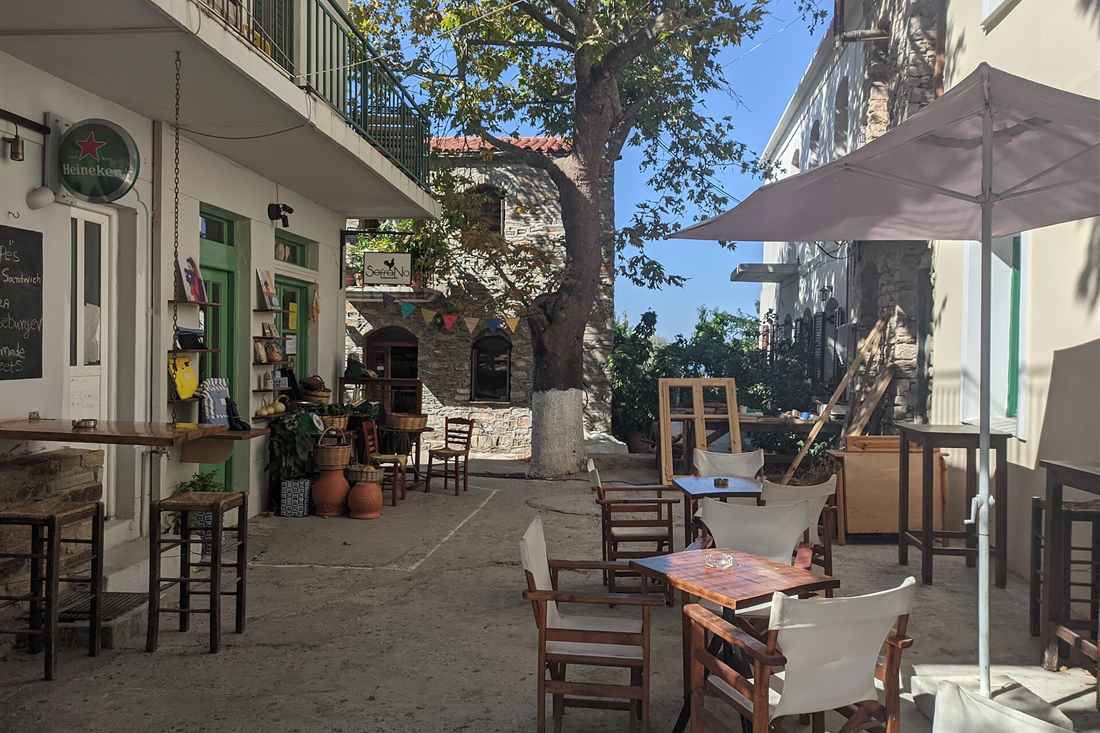
An Ikaria wine tasting is a two to four hour visit to a family winery in the hill villages, walking the terraced vineyard and the cellar with the winemaker before four to eight wines are poured with the island’s cheese, bread and garden vegetables. Plan the rest of the trip with Greece Tours.
This page covers the visit: which wineries receive guests, the Fokiano and Begleri grapes on the slate terraces, the Pramnian wine Homer named, the price bands, what reaches the plate, the Blue Zone table, the September harvest, how to reach the cellars, and how to book an Ikaria wine tasting.
What is an Ikaria wine tasting and what happens during the visit?
An Ikaria wine tasting is a two to four hour visit to a family winery in the hill villages, walking the terraced vineyard and the stone cellar with the winemaker, then sitting to four to eight poured wines with island cheese, bread and garden vegetables.
The sequence is fixed at most cellars. The winemaker meets guests at the gate, walks 200 to 400 metres of dry-stone terrace, names the vines by row, then opens the cellar door where clay pithari, stainless tanks and oak barrels stand together. Pouring starts after the walk, never before, because the vineyard explains the glass. Groups of two to twelve sit at one long table under vine shade or inside the cellar. The Ikaria wine tasting hosts state this at booking. It decides which Ikaria wine tasting to take.
Four wines is the short format, poured across 90 minutes: a dry white from Begleri, a rosé or skin-contact orange, a young Fokiano red and one amphora-aged bottle. The eight-wine format adds older vintages, a sweet late-harvest and the house tsipouro. Pours run 40 to 60 millilitres, so the total across eight glasses sits near half a bottle per person. An Ikaria wine tasting fills first on that count in August.
Food arrives with the second glass rather than at the end. Kathoura cheese, sourdough baked in a wood oven, tomatoes and cucumbers from the garden, olives cured on the property and thyme honey with walnuts fill the plate. On Ikaria the table is the point of the exercise, and the winemaker eats with the group instead of standing behind a counter. The Ikaria wine tasting cellar is set up for it.
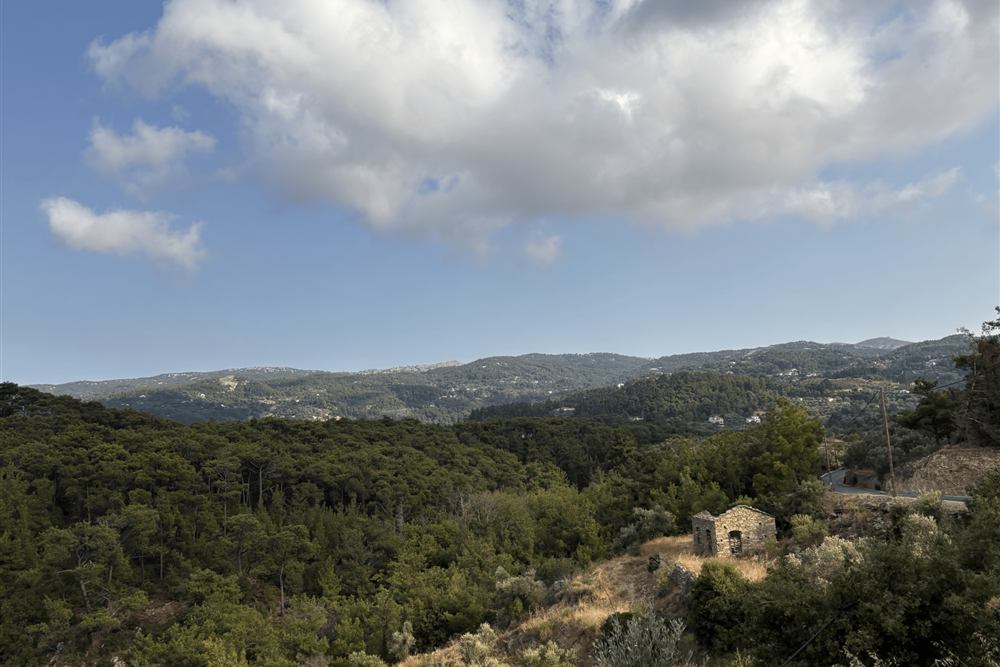
Elevation shapes the whole visit. The cellars sit between 400 and 800 metres above the Aegean, so afternoon temperatures at Profitis Ilias run 5 to 7 degrees below the coast at Armenistis. A visit that starts at 17:00 in July ends in cool air with the sea visible 10 kilometres north. Most hosts speak English, and Greek is spoken at the same table without translation friction. An Ikaria wine tasting keeps the glasses for it.
Which wineries on Ikaria receive visitors for a tasting?
Afianes Wines at Profitis Ilias above Raches, the Karimalis winery at Pigi near Christos Raches, the Ikarian Wine cooperative and small family cellars around Evdilos and Steli all receive visitors, each by advance appointment rather than walk-in arrival.
Afianes Wines works from a stone building at roughly 650 metres, 6 kilometres above the Raches plateau. The house ages wine in buried clay amphorae sealed with beeswax, a method the family revived from the island’s pithari tradition. Visits last 90 minutes to two hours and cover the amphora floor, the barrel room and a seated pour of six to eight labels including Begleri, Fokiano and the amphora-fermented whites. Every Ikaria wine tasting works to that rule. The Ikaria wine tasting price reflects it.
The Karimalis winery at Pigi sits in walking distance of Christos Raches, the village whose shops open in the evening and keep no fixed clock. The Karimalis family farms organically, presses in a small stone building and pairs the wines with a cooked lunch of soufiko, wild greens and goat. Their tastings frequently extend to three hours because the meal is prepared on site. The Ikaria wine tasting season turns on this.
The Ikarian Wine cooperative gathers fruit from growers scattered between Evdilos, Kosikia and Arethousa, and its bottlings show the island style at a lower price point. Around Steli and Mavrato, cellars of 2,000 to 6,000 bottles a year receive two to six people at a time, and an Ikaria wine tasting there happens in a working room with the press still wet. An Ikaria wine tasting starts with this settled.
Appointments matter. Nobody staffs a tasting room full time. A phone call or message 48 hours ahead, or five days ahead in August, secures the slot. Guided programmes handle this contact and combine two cellars in one afternoon, which suits travellers without a rental car. The winemaker confirms it when an Ikaria wine tasting is booked.
What grapes grow on Ikaria and what do the wines taste like?
Fokiano and Begleri are the island’s own varieties, joined by Mandilaria and Athiri. Vines sit on slate and granite terraces between 400 and 800 metres, yields stay low, and the results are dry herbal reds and sharp, saline whites.
Fokiano is the red backbone. It ripens to modest colour and moderate alcohol, near 12.5 to 13.5 percent, and gives dried thyme, sage, red cherry and a dusty tannin that stays light on the palate. Served at 14 to 16 degrees it works with goat and with tomato dishes. Mandilaria, brought from Crete and the Cyclades, deepens colour and tightens tannin in blends of 20 to 30 percent. An Ikaria wine tasting is planned around it. An Ikaria wine tasting fills first on that count in August.
Begleri is the white the island claims as its own. Picked in early September at moderate ripeness, it yields lemon pith, green almond and a salt edge that reflects vineyards sitting 2 to 8 kilometres from open water. Athiri, familiar from Santorini and Rhodes, adds body and pear. Skin-contact versions spend 5 to 20 days on skins and turn amber, with quince and dried herb. Guests at an Ikaria wine tasting meet it in the first half hour.
Soil drives the difference an Ikaria wine tasting demonstrates in the glass. Granite and schist hold little organic matter, so roots run deep and berries stay small. Terraces of 3 to 12 rows are cut into slopes of 25 to 40 percent gradient, all worked by hand because no tractor climbs them. Total island plantings sit near 200 hectares, split among growers with parcels of half a hectare. The Ikaria wine tasting timetable is built on it.
Bush-trained vines dominate the older parcels, the oldest of them 60 to 100 years old and ungrafted in sandy pockets. Yields of 25 to 40 hectolitres per hectare are standard, roughly half what irrigated mainland vineyards deliver. That concentration explains why a 13 percent Fokiano tastes denser than the number suggests. The Ikaria wine tasting hosts state this at booking.
What is Pramnian wine and why does Ikaria claim it?
Pramnian wine is the dark, strong wine Homer names in the Iliad, mixed with barley and cheese for the wounded Machaon. Ikarian producers link it to the island’s ancient vineyard and to Pramnos, and they revive its clay-vessel fermentation today.
The Iliad places Pramneios oinos in Book Eleven, and Odysseus meets it again in the Odyssey when Circe prepares her cup. Ancient writers, including Athenaeus and Pliny, argued over the source, naming Lesbos, Smyrna and Ikaria. The Ikarian claim rests on Pramnos, a mountain name recorded on the island, and on the long-documented reputation of Ikarian vineyards during the classical and Hellenistic periods. This is what an Ikaria wine tasting delivers at the table. The Ikaria wine tasting season turns on this.
Archaeological work on the island has recorded rock-cut treading floors, or patitiria, carved directly into granite outcrops near Kampos, Katafygi and the Raches slopes. Grapes were trodden on the rock and juice ran through a channel into a lower basin, then travelled downhill in skins to buried jars. Those floors, dated to antiquity, sit within sight of vineyards planted today. The Ikaria wine tasting flight is set by it.
Modern practice picks up the thread. Afianes buries clay amphorae to the neck, fills them with whole or destemmed fruit and seals them for 6 to 12 months, and other cellars ferment in pithari of 200 to 800 litres. The wines that emerge carry oxidative depth, dried fig and a grip that stainless steel never delivers, and every Ikaria wine tasting at those cellars pours at least one. That detail shapes an Ikaria wine tasting from the first pour.
No producer sells a bottle labelled Pramnian as a protected name. The claim functions as heritage rather than appellation. Visitors hear it discussed in the cellar with dates and sources, then taste the amphora wine and judge the continuity themselves. Every Ikaria wine tasting works to that rule.
What does an Ikaria wine tasting cost?
A single winery visit with tasting and a food plate runs 25 to 45 euros per person. A two-winery day with pickup and lunch costs 70 to 120 euros. Programmes adding a forest walk or a monastery reach 90 to 150 euros.
The 25 to 45 euro band covers four to six wines poured over 90 minutes to two hours, the vineyard and cellar walk, and a plate of kathoura, bread, olives, tomatoes and honey. Afianes and the smaller Evdilos cellars sit near the lower end for four wines; the eight-wine version with older vintages and a longer seated table pushes toward 45 euros. The Ikaria wine tasting cellar is set up for it. Guests at an Ikaria wine tasting meet it in the first half hour.
The 70 to 120 euro day is the guided format. It includes hotel or port pickup from Agios Kirykos, Evdilos or Armenistis, two cellars 15 to 30 minutes apart, a cooked lunch of soufiko, wild greens and goat, and a driver who stays sober. Duration runs 5 to 7 hours, most departures at 10:00 or 11:00, with groups capped between six and twelve people. An Ikaria wine tasting keeps the glasses for it.
The 90 to 150 euro versions extend an Ikaria wine tasting into the landscape. A 3 to 6 kilometre walk on the Round of Raches path through the Randi oak forest, a stop at Theoktisti monastery near Pigi, or a swim at Nas beach before the second cellar all appear in these programmes. Private departures for two people sit at the top of the band. It decides which Ikaria wine tasting to take.
Bottles bought at the cellar cost 10 to 22 euros, and tasting fees are frequently deducted against a purchase of three bottles or more. Payment in cash is standard at the smallest cellars, since card terminals are absent in parts of the hill villages. Tipping is not expected. An Ikaria wine tasting is planned around it.
What food comes with the wine on the plate?
Goat cheese and fresh kathoura, soufiko the island vegetable stew, wild greens dressed in olive oil and lemon, sourdough bread, thyme honey and walnuts fill the tasting plate. Raki and tsipouro follow the wine, and a full lunch adds roast goat.
Kathoura is the island’s soft young cheese, made from goat milk and eaten within days, with a mild acidity that suits Begleri. Aged goat cheese, harder and saltier, matches Fokiano. Soufiko layers courgette, aubergine, peppers, onion and tomato cooked slowly in olive oil without meat, and it arrives warm or at room temperature depending on the hour. An Ikaria wine tasting starts with this settled.
Wild greens change with the calendar. Between November and April the plate carries horta gathered on the slopes, blanched and dressed. In July and August the garden supplies tomatoes, cucumber and beans instead. Bread is sourdough baked in a wood oven, sometimes with the island’s whole-grain flour, and it soaks the oil left on the plate. Walnuts and thyme honey close the sequence with the sweet wine. The winemaker confirms it when an Ikaria wine tasting is booked.
A full lunch at Karimalis or a village taverna extends this into goat cooked in a clay pot, stuffed vine leaves and lentils, taking the table past two hours. Anyone reading further about Ikaria food and wine finds the same core ingredients repeated across the villages, because the gardens and the herds supply both the tavernas and the cellars. The Ikaria wine tasting price reflects it.
Raki and tsipouro arrive after the wine, distilled from the pomace of the same harvest, at 38 to 45 percent alcohol. Hosts pour 20 millilitre measures. An Ikaria wine tasting that ends without one is rare, and the spirit is served with a spoon of honey or a piece of fruit. This is what an Ikaria wine tasting delivers at the table.
How does the Blue Zone shape an Ikaria wine tasting?
Wine on Ikaria belongs to a daily routine rather than an event. Villagers drink one or two small glasses with food, herbal infusions share the table, meals run two hours, and the same house wine is poured at the summer panigyria.
Ikaria counts as one of five demographic Blue Zones, with a documented share of residents reaching 90 and beyond that exceeds mainland European averages. Research teams working in the Raches villages recorded moderate daily wine consumption alongside a plant-heavy diet, afternoon rest and constant walking on steep ground. Wine at 12 to 13.5 percent, drunk with food in small measures, fits that pattern rather than contradicting it. The Ikaria wine tasting timetable is built on it.
Herbal infusions appear at the same table. Sage, wild mint, rosemary and dittany grow within metres of the vineyards, and hosts brew them before and after the pour. Visitors curious about the Ikaria Blue Zone see the practice at the cellar rather than in a lecture: the kettle sits beside the decanter and both are refilled. The Ikaria wine tasting hosts state this at booking.
Pace is the visible element. Nobody hurries the glasses. Two hours at the table with conversation, food arriving in stages and the sun dropping behind the ridge is the standard rhythm of an Ikaria wine tasting in the hill villages. Guests who arrive expecting a 30 minute counter pour recalibrate within the first quarter hour. An Ikaria wine tasting fills first on that count in August.
The panigyria carry the same wine into public life. Between May and September the villages hold saint’s-day festivals at Christos Raches, Langada, Karkinagri and Akamatra, where barrels of local Fokiano are served from midnight until dawn with goat and violin music. The wine at the cellar and the wine at the festival come from identical vineyards. The Ikaria wine tasting cellar is set up for it.
When is the harvest and when do the tastings run?
Picking happens in September, with early parcels starting late August and high terraces finishing in early October. Tastings run May to October, and outside those months cellars receive visitors by appointment. Harvest week visitors watch the crush directly.
Altitude staggers the calendar. Vineyards at 300 metres near Evdilos ripen 10 to 14 days ahead of parcels at 750 metres above Raches. Begleri and Athiri come in first, from the last days of August into mid-September; Fokiano and Mandilaria follow through late September. Everything is picked by hand into 20 kilogram crates, carried off terraces no vehicle reaches. That detail shapes an Ikaria wine tasting from the first pour.
Visitors present between 5 and 25 September see destemming, treading in the older cellars, pressing and the filling of amphorae. Fermentation runs hot in the room, the smell of carbon dioxide is unmistakable, and hosts pour the previous vintage between tasks. An Ikaria wine tasting during harvest is shorter and less structured, because the family works while it talks. Every Ikaria wine tasting works to that rule.
May, June and early July deliver the calmest visits, with vineyards in flower and fruit set, temperatures at 22 to 28 degrees on the terraces and full attention from the winemaker. August is the busiest month on the island and the hardest for last-minute booking. October brings clear air, 20 to 24 degrees and the new wine still cloudy in tank. The Ikaria wine tasting season turns on this.
Between November and April the work moves to pruning, racking, bottling and terrace-wall repair. Afianes and Karimalis both receive small groups in that window with three to seven days notice, and the tasting moves indoors beside a stove. Ferry and flight frequency drops in winter, which is the real constraint rather than cellar availability. An Ikaria wine tasting starts with this settled.
How do you reach the wineries and do you need a car?
The cellars sit in the hill villages above Evdilos, Raches and Steli, reached by mountain roads with tight hairpins. Drives run 20 to 45 minutes from Agios Kirykos or Evdilos. Guided programmes include pickup, which removes the driving question entirely.
Ikaria measures 40 kilometres end to end, yet the terrain stretches every journey. Agios Kirykos to Evdilos covers 41 kilometres of the north road in 45 to 55 minutes. Evdilos to Christos Raches is 12 kilometres and 20 minutes, climbing from sea level to 650 metres through switchbacks. Armenistis to Profitis Ilias runs 9 kilometres in 20 to 25 minutes on a narrower surface. It decides which Ikaria wine tasting to take.
Rental cars cost 35 to 60 euros a day in July and August, less in May and October, and small hatchbacks handle the roads better than anything wide. Scooters are common on the coast road but a poor match for a tasting, since one designated non-drinking person is required either way. Buses connect Agios Kirykos, Evdilos and Armenistis on a thin schedule and reach no cellar directly. An Ikaria wine tasting is planned around it.
Guided programmes collect guests from Agios Kirykos port, Evdilos port, Therma or the Armenistis and Nas hotels, and drop them back after lunch. Pickup solves the alcohol problem and the navigation problem at once. That is why the two-winery format at 70 to 120 euros carries most of the demand among people planning things to do in Ikaria without a rental. Guests at an Ikaria wine tasting meet it in the first half hour.
Anyone driving to an Ikaria wine tasting spits into the provided bucket, holds to one small glass across two hours, or nominates a passenger. Greek law sets the limit at 0.05 percent blood alcohol, 0.02 for drivers within their first two years, and the mountain descent from 700 metres punishes any lapse. The Ikaria wine tasting timetable is built on it.
Who does an Ikaria wine tasting suit and how do you book?
Couples, small groups, walkers finishing the Round of Raches path and travellers following the Blue Zone route all fit the format. Booking runs two to five days ahead, five in August, with group sizes between two and twelve people.
The Round of Raches is a signposted circular route linking Christos Raches, Kastanies, Mavrato and Pigi across 12 to 15 kilometres of oak forest, stone paths and terrace walls, walked in 4 to 6 hours. Finishing at a cellar near Pigi at 17:00 turns the walk and the table into one afternoon. Boots, water and a layer for the 650 metre elevation are the practical requirements. The Ikaria wine tasting price reflects it.
Families with children are received at the larger cellars, where juice and food replace the pour, but the seated two-hour format suits adults better. Wheelchair access is limited: terraces are stepped and cellar floors uneven, though hosts arrange a seated tasting without the vineyard walk on request. Vegetarian plates are standard, since soufiko, greens, cheese and bread already carry the table. This is what an Ikaria wine tasting delivers at the table.
Booking goes through the winery directly by phone or message, or through a guided operator that bundles two cellars with transport and lunch. Two to five days notice covers May, June, September and October. August demands five days and sometimes a week, because the panigyria calendar and full accommodation across Armenistis and Evdilos compress availability. Confirmation names the arrival time and the group count. The Ikaria wine tasting flight is set by it.
Closed shoes with grip handle the loose schist on the terraces, and a hat matters between 12:00 and 17:00 from June to September. Evening light after 18:00 is the preferred slot for an Ikaria wine tasting, with the temperature down and the sea visible to the north. Bottles bought on site travel home at 10 to 22 euros each. That detail shapes an Ikaria wine tasting from the first pour.
Frequently Asked Questions
What does an Ikaria wine tasting cost?
From 25 to 45 euros per person for a winery visit with the tasting and a plate, 70 to 120 euros for a two-winery day with pickup and lunch, and 90 to 150 euros for the versions that add a forest walk or a monastery stop.
Which wineries can you visit on Ikaria?
Afianes Wines at Profitis Ilias above Raches, with its clay-amphora ageing, the Karimalis winery at Pigi near Christos Raches, the Ikarian Wine cooperative, and small family cellars around Evdilos and Steli, all by appointment.
What grapes grow on Ikaria?
Fokiano and Begleri are the island’s own varieties, planted with Mandilaria and Athiri on slate and granite terraces at 400 to 800 metres, giving dry herb-edged reds and sharp whites from low yields.