
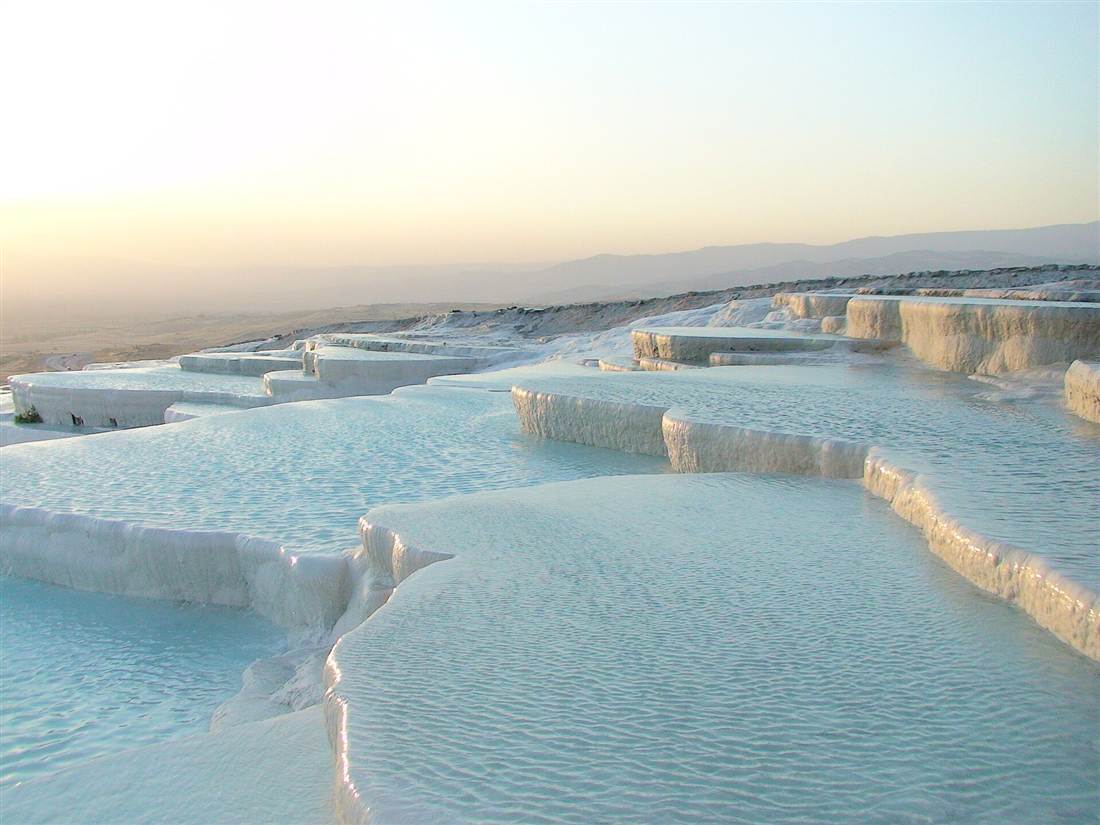
One day in Pamukkale is enough to walk the white travertine terraces, explore ancient Hierapolis and swim in Cleopatra’s Pool, arriving at opening to beat the crowds and staying for the sunset over the terraces. Plan the whole trip with Greece Tours.
This guide lays out one day in Pamukkale in full: whether a day is enough, the ideal hour-by-hour itinerary, when to arrive, which gate to enter, the morning terrace walk, the time at Hierapolis, the midday swim, the museum, lunch, sunset, what to bring, the day-trip option, and the mistakes first-time visitors make.
Is one day enough to see Pamukkale?
Yes. One full day covers the three headline sights of Pamukkale in comfort: the white travertine terraces, the ruined city of ancient Hierapolis on the plateau above them, and Cleopatra’s Antique Pool at the centre. A dawn start to a sunset finish holds all three without a rush.
The site groups its attractions inside one continuous archaeological park, so a single day carries you from bottom to top without leaving the enclosure. The travertines climb the hillside for 2.7 kilometres of white calcium terraces. Directly above them the plateau spreads out the Greco-Roman city of Hierapolis, a UNESCO World Heritage listing with a theatre, a necropolis, colonnaded streets and thermal springs. In the middle sits the thermal swimming pool. All three share the same two ticket gates and the same paved walking spine.
The walking distances stay modest. From the town gate at the base to the far necropolis at the top measures about 2 kilometres of gentle uphill, and the marked barefoot route down the travertines runs 500 metres. A visitor arriving at opening walks the terraces first, tours Hierapolis through late morning, swims at midday, and returns to the terraces for the sunset light. The layout compresses a genuine highlights tour into eight daylight hours.
The one-day format also suits the transport reality. The nearest airport, Denizli Çardak, sits 65 kilometres north-east, and Denizli city with its train and long-distance bus station lies 20 kilometres south. Day visitors on tours from the Aegean coast arrive by coach mid-morning and leave by late afternoon. An independent traveller who bases in Pamukkale town the night before gains the early hours the coaches miss, and that head start is what turns a crowded stop into a full, unhurried day. The Pamukkale guide sets out the full picture of the destination.
The single ticket removes the friction that breaks a tight schedule. One admission at either main gate covers the entire archaeological park — terraces, ruins, streets, theatre, necropolis and museum — with only Cleopatra’s Antique Pool charging a separate fare. You pass the barrier once and roam the plateau freely for the whole day, doubling back to the terraces at dusk on the same stub. No second queue interrupts the loop, which matters when you are threading three headline sights into eight hours of daylight.
One day also matches the physical scale of the walking. The full route — up the travertines, across the plateau, out to the far necropolis and back — totals under 5 kilometres, spread over a whole day with a long swimming break in the middle. That load suits an ordinary walker in ordinary footwear for the ruins and bare feet for the terraces. The verdict holds firmly: Pamukkale is a one-day destination, and a disciplined dawn-to-dusk plan sees every part of it at its finest hour.
What is the ideal one-day Pamukkale itinerary?
Enter at opening around 08:00, walk the travertines and reach the plateau by 09:30, tour Hierapolis until 12:00, break for lunch and a swim in Cleopatra’s Pool until 14:30, revisit the theatre and necropolis through the afternoon, then return to the terraces for the golden light and depart after sunset.
The hour-by-hour outline runs like this. At 08:00 you pass the ticket barrier and start up the barefoot travertine path while the terraces stand near-empty and the water sits still and reflective. By 09:00 you reach the top of the white cascade and step onto the plateau. From 09:30 to 12:00 you work through Hierapolis: the Roman theatre first, then the Temple of Apollo and the Plutonium beside it, the colonnaded Frontinus Street, the Domitian Gate and the northern necropolis.
At 12:00 the heat peaks and the coach crowds thicken, so you break. Lunch sits near the pool complex, and from roughly 12:30 to 14:00 you swim in Cleopatra’s Antique Pool among its submerged marble columns. The midday timing is deliberate: the pool is the one shaded, cooling activity, and it absorbs the hottest, busiest stretch of the day while the outdoor ruins bake.
The afternoon reopens the ruins in softer light. From 14:30 you climb back to the theatre for the wide plateau view, walk the far end of the necropolis with its house-shaped tombs, and visit the Hierapolis Archaeology Museum housed in the restored Roman baths. Around 17:30, as the sun drops, you descend to the travertines a second time. Sunset turns the white calcium gold and pink, the day’s best photographs come off the lower pools, and you leave through the town gate once the light fades. This single loop reads terraces, ruins, water, terraces, and each visit lands at its best hour.
The itinerary flexes around your entry point without losing its shape. A driver who enters the south gate at the top reverses the first hour: tour Hierapolis on arrival while the plateau stands cool and quiet, then walk down the travertines toward the town before the coaches climb up. The pool break still lands at midday, and the theatre and necropolis still fill the afternoon. The fixed points are the early start, the midday swim and the sunset terraces; the order of the ruins and the first terrace pass adjusts to your gate.
Two anchors hold the whole plan together. The first is the 08:00 entry, which buys the empty terraces and the cool ruins before the crowds and the heat arrive together at midday. The second is the sunset descent, which delivers the strongest light of the day onto the white calcium. Everything between those two anchors — the ruins loop and the pool — fits the middle of the day when the terraces are busiest and the sun is hardest, so nothing prime is wasted. Follow the anchors and the eight hours arrange themselves.
What time do you arrive at Pamukkale for a one-day visit?
Arrive at opening in the early morning, around 08:00, before the coach tours reach the site from the Aegean coast and before the midday heat builds. The first two hours give near-empty terraces, still reflective pools, soft light and cool calcium underfoot.
The site opens at first light and the gates admit visitors from early morning through the evening, with the closing hour extending later across the warm months. Coach tours from Kuşadası, Selçuk and Marmaris cover 190 to 250 kilometres to reach Pamukkale, so they arrive between 10:00 and 11:00 and cluster the terraces and the pool through the middle of the day. An 08:00 entry puts you two clear hours ahead of that wave.
The early slot rewards you three ways. The travertine pools hold their water overnight and sit mirror-still at dawn, which is the state that produces the reflection photographs. The white calcium surface stays cool underfoot before the sun heats it, and barefoot walking is mandatory on the terraces. The temperature itself climbs hard through summer afternoons on an exposed, shadeless hillside, so the ruins of Hierapolis are far kinder to walk at 09:30 than at 14:00.
An independent visitor who sleeps in Pamukkale town the night before reaches the town gate on foot in ten minutes and is first through the barrier. That is the decisive advantage over a day-tripper: the coach passenger cannot control the arrival hour, but the overnight guest owns the golden early window entirely. Book the night before, set the alarm, and treat the first ninety minutes as the quietest and most photogenic part of the whole day.
The early arrival also protects the afternoon. By reaching the plateau and finishing the ruins before the midday crush, you free the hottest hours for the pool and the museum, both of which shelter you from the sun. A visitor who starts at 11:00 instead inverts this: the terraces are packed, the ruins bake through the afternoon, and the sunset light arrives before the walking is done. The early hour is not merely pleasant — it is the structural key that lets the rest of the day sit in its correct order.
Which gate do you enter for a one-day visit?
Enter through the south gate on the upper plateau to walk the ancient city first and descend the travertines downhill, or enter the town gate at the base to take the terraces first and climb up to Hierapolis. The town gate suits an early travertine start; the south gate suits arrival by car.
Pamukkale has three entrances. The town gate sits at the foot of the hillside beside Pamukkale village, and from it the barefoot travertine path climbs straight up the white cascade to the plateau. The south gate stands at the top on the Denizli road, with a car park and a level approach into Hierapolis. The north gate opens by the far necropolis at the plateau’s northern edge.
The choice turns on how you arrive and what you want first. An overnight guest in Pamukkale town walks to the town gate in minutes and starts on the terraces at their empty, reflective best, then climbs to the ruins as the morning warms. A driver, or a visitor dropped by taxi, uses the south gate to park level with the plateau, tours Hierapolis while it is cool, and walks down the travertines afterward, which spares the legs the uphill.
Both routes cross the same continuous park on one ticket, so neither locks you out of anything. The practical distinction is direction of travel: the town gate means climb up then walk down at the end, giving you two passes over the terraces; the south gate means walk down once through the terraces after the ruins. For the itinerary built around an early terrace walk and a sunset terrace finish, the town gate is the natural entry. For a car-borne arrival wanting the least uphill, the south gate wins.
The north gate serves a narrower purpose. It opens beside the necropolis at the plateau’s far edge, closest to the tombs and the theatre, and it suits a driver who wants the ruins first and the least walking to reach them. From there you tour Hierapolis, cross the plateau to the pool at midday, and finish down the travertines to the town. For a first-time one-day visitor, the town gate and the south gate remain the two practical choices; the north gate is the specialist’s entry.
How do you walk the travertine terraces in the morning?
Remove your shoes at the marked entrance and carry them, then follow the single designated barefoot path up the white calcium slope. Walk on the ridged, grippy sections, step into the shallow warm pools where bathing is permitted, and allow forty-five minutes to reach the top with photo stops.
Bare feet are compulsory on the terraces, a rule that protects the soft calcium carbonate from shoe damage and grit. You leave footwear at the base or carry it in a bag. The surface divides into two textures: rough ridged travertine that grips well, and smooth wet stretches that turn slippery, so you keep to the ridged sections and take the smooth patches slowly. Thermal water runs warm across parts of the path, cool across others.
The marked route is a single channel up the hillside; straying onto the fragile white terraces off the path is prohibited and fenced in the protected areas. Along the way, designated pools hold ankle-to-knee-deep mineral water where you stand and wade. The morning light and still water make the lower and middle pools the strongest photo spots, with the whole white cascade falling away behind you and the plain of Denizli beyond.
Timing the climb, allow forty-five minutes barefoot from the town gate to the plateau with stops for photographs and a wade. The distance is roughly 500 metres of gentle gradient, not a hard climb, but the barefoot pace is deliberate. Carry water, wear a hat against the exposed sun, and keep a microfibre towel for drying your feet before you put shoes back on at the top. Doing the terraces first, before the crowds and the heat, is the single decision that shapes a good one-day visit.
Pack for the barefoot walk specifically. A small dry-bag holds your shoes and camera as you climb, since both hands stay free for balance on the wet stone. Roll trousers to the knee or wear shorts, because the pools reach shin-deep in places and the thermal water splashes. Sunglasses cut the glare thrown back off the brilliant white surface, which intensifies as the sun rises. A change of dry socks for the top completes the kit.
The white you walk on is living rock. The terraces form as the thermal spring water, saturated with calcium carbonate, cools on contact with the air and deposits a thin layer of travertine with every flow. The barefoot rule and the fenced no-go zones both exist to keep that fragile surface growing rather than staining or crumbling under foot traffic. Understanding that the ground itself is the attraction changes how you tread it — slowly, on the marked line, off the pristine untouched terraces.
How much time do you spend at ancient Hierapolis?
Budget two to three hours for Hierapolis. The Roman theatre, the necropolis, the Plutonium and the Temple of Apollo, the colonnaded Frontinus Street and the archaeology museum in the old baths fill a focused half-day of walking across the plateau above the terraces.
Hierapolis spreads across the flat plateau at the top of the travertines, founded as a Greco-Roman spa city around its thermal springs and listed by UNESCO. The single strongest monument is the Roman theatre, cut into the hillside with its stage building largely intact and seating for a large audience; the climb to the top row rewards you with the widest view over the ruins and the white terraces below. It sits about ten minutes’ walk north-east of the pool complex.
The Plutonium is the site’s strangest feature: a doorway to a cave that vents carbon dioxide from the geology beneath, described in antiquity as an entrance to the underworld. It stands beside the Temple of Apollo at the plateau’s centre. From there the colonnaded Frontinus Street runs the length of the old city between the Domitian Gate at one end and the Byzantine gate at the other, a straight paved spine that orients the whole walk.
The northern necropolis is one of the largest ancient cemeteries in Anatolia, its tumulus mounds, house-shaped tombs and stone sarcophagi stretching along the road out of the city. The Hierapolis Archaeology Museum occupies the restored Roman bath complex and holds the site’s marble statuary and sarcophagi. Walked as a loop — theatre, temple and Plutonium, Frontinus Street, necropolis, museum — the plateau consumes two to three hours at a steady pace, and that block sits comfortably in the late-morning slot before the midday pool break.
The plateau is exposed and shadeless, which shapes how you pace the walk. The theatre climb and the long necropolis road carry no shelter, so you keep water in hand, wear a hat, and take the museum and the pool as the built-in shade breaks. The stones radiate heat by early afternoon, another reason the ruins earn the cooler late-morning slot and the swim earns the midday hour. Steady, hydrated walking clears the whole city inside three hours without strain.
The layout keeps the loop tight. Frontinus Street is the organising axis: the theatre lies to its east, the Temple of Apollo and Plutonium at its southern end, the Domitian Gate and necropolis at its northern end, and the pool and museum near its centre. Walking the street once, with short detours to each monument, threads every headline sight in a single unbroken line. Nothing on the plateau sits more than ten minutes from that spine, so the two-to-three-hour estimate holds even with photo stops and a climb to the top of the theatre.
When do you swim in Cleopatra’s Antique Pool?
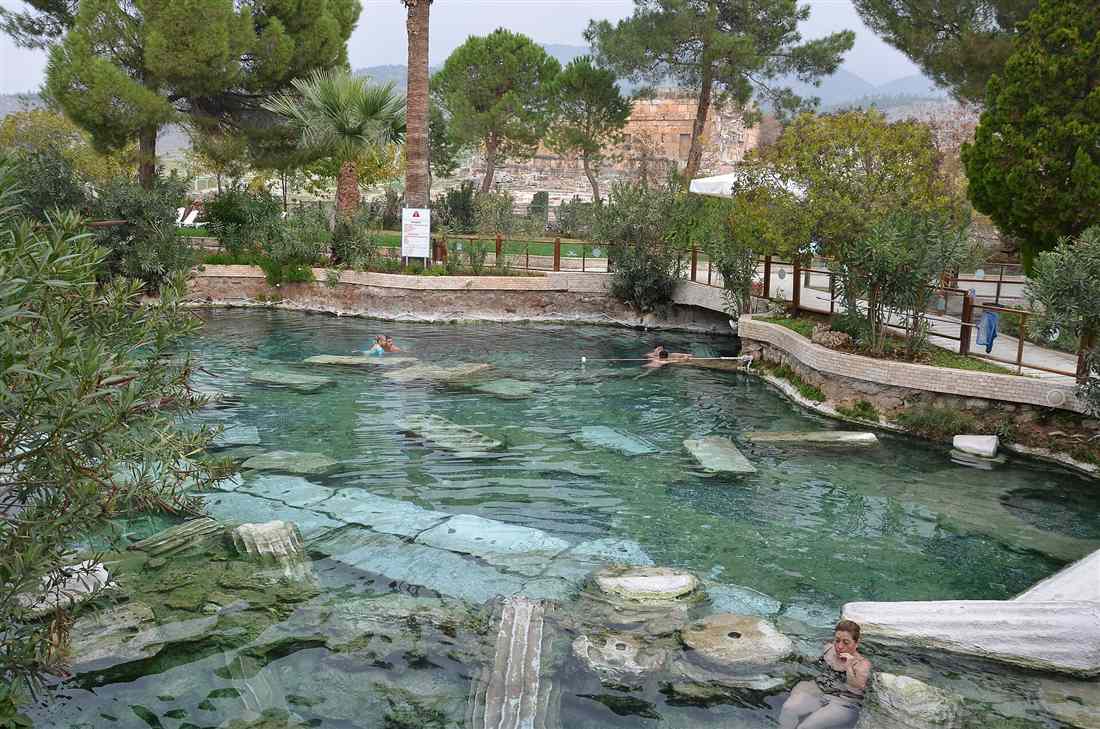
Swim at midday, around 12:30 to 14:00, using the pool as the cooling break at the hottest, most crowded hour. Cleopatra’s Antique Pool charges a separate entry fee on top of the site ticket, and you swim among fallen marble columns and capitals submerged on its floor.
The pool sits at the centre of the plateau, fed by the same thermal spring that built the terraces. Its water holds a steady warm temperature year-round and carries a light mineral fizz. Scattered across the pool bed lie ancient marble columns, drums and carved fragments that toppled from a Roman portico in an earthquake, and swimmers glide directly over them; floating above the submerged colonnade is the experience that gives the pool its fame. The Cleopatra’s Pool guide covers the detail.
The midday timing does double duty. The pool is the one shaded, water-cooled activity on an otherwise exposed site, so it absorbs the two hours when the sun is fiercest and the terraces and ruins are least pleasant. It also lets the coach crowds churn through the outdoor sights while you are in the water rather than competing with them among the stones. You emerge refreshed for the softer afternoon light on the ruins.
Practical notes fix the plan. The pool requires its own ticket, bought at the pool entrance and separate from the main site admission, so carry the extra fare. Changing rooms and lockers stand beside the water. Bring swimwear, a towel and water shoes for the uneven ancient floor. A swim runs an hour with changing time either side, which slots the whole break neatly between the late-morning Hierapolis loop and the afternoon return to the theatre and terraces.
The water itself is a mineral spring, not a chlorinated pool. It runs warm year-round at a steady bath temperature, holds a gentle effervescence of dissolved gas, and carries the same calcium-rich chemistry that built the terraces outside. The depth varies across the floor, deepening around the submerged column drums where you tread water above the marble, and shallowing to standing depth near the edges. A café and shaded seating ring the pool, so lunch and the swim combine into one restorative midday block before the afternoon walking resumes.
When is the best time of day for the terraces and sunset?
The last two hours before sunset deliver the finest light on the terraces. From about 17:00 the low sun turns the white travertine gold and pink, the day-tour coaches leave, and the pools reflect the sky while the crowds thin to a handful of walkers.
Pamukkale faces west, so the sun sets directly over the terraced cliff. The white calcium carbonate acts like a mirror, and in the final hour the pools shift from bright white to warm amber, then to rose and violet as the light drops behind the Menderes valley. Photographers position themselves on the upper travertine platform beside the pool complex, where the full sweep of terraces falls away below in a single frame.
Enter through the South Gate in the afternoon and walk down the travertine barefoot as the temperature eases. The midday glare flattens the whites and the surface heat off the stone peaks near 14:00; by 17:00 the travertine cools underfoot and the pools hold their warm mineral water at a steady 36°C. The site stays open until 21:00 in the summer season, and the last coach parties clear the terraces around 18:00, leaving the ridge quiet for the final descent. Time the visit to reach the lower pools as the sun touches the horizon, then walk back up the illuminated path.
The crowd pattern reinforces the case for evening. Coach parties enter the terraces between 11:00 and 15:00 and cluster on the upper pools for photographs, so the white cliff runs busy through the middle of the day. From 16:00 the buses pull out for the long return drives to the coast resorts, and the density on the travertine drops sharply. By 18:00 the ridge holds walkers spaced metres apart, which turns the descent into a slow, quiet walk rather than a shuffle through queues. The evening also drops the surface temperature of the stone, which peaks under midday sun and cools to a comfortable barefoot walk after 17:00.
What do you see at the Hierapolis Museum in one day?
The Hierapolis Archaeology Museum fills the restored Roman bath house beside the sacred pool. Three halls hold carved marble sarcophagi, statues of Pluto and the Muses, reliefs from the theatre stage, and tombs lifted from the necropolis, all under a cool vaulted roof.
The museum sits a two-minute walk from the Antique Pool, which makes it the natural shaded stop between the terraces and the ruins. The central hall displays the sculptural finds from the Roman theatre, including the frieze panels that decorated the stage front and portraits of emperors and gods. A second hall holds the sarcophagi of the necropolis, richly carved with garlands, lions and mythological scenes, alongside grave stelae inscribed in Greek. The third hall gathers small finds from Hierapolis and the wider region: glass, coins, jewellery, lamps and figurines.
A focused walk through the three halls runs 30 to 45 minutes, which fits a one-day itinerary without cutting into terrace time. The building itself is part of the exhibit, a second-century Roman bath complex with barrel-vaulted ceilings that stay noticeably cooler than the open ruins outside. Entry to the museum carries a separate ticket from the main archaeological site, and the air-conditioned interior gives a welcome break from the exposed travertine during the heat of early afternoon.
Slot the museum into the itinerary at the hottest point of the day. Placing the visit between 13:00 and 15:00 puts you under a stone roof while the sun bakes the open terraces outside, then releases you for the cooling terrace descent afterwards. The exhibits also frame everything else on the site: the sarcophagi explain the necropolis you walk past on the ruins side, the theatre reliefs match the stage you see standing among the tiered seats, and the statues of Pluto tie to the Plutonium, the sacred cave the ancient city built over a natural gas vent. Reading the finds first turns the outdoor ruins from anonymous marble into a legible Roman spa city.
Where do you eat lunch on a one-day Pamukkale visit?
The cafe beside the Antique Pool serves grilled dishes, salads, gozleme and cold drinks with a terrace over the ruins. Pamukkale village, a five-minute drive below the terraces, adds family-run restaurants with fixed-price Turkish menus for a cheaper, quieter lunch.
Inside the site, the pool cafe is the single food outlet on the plateau, so it draws the midday crowd. It stocks bottled water, kofte, chicken skewers, pide and mezze plates, and the prices run above village level because of the location. Sitting here between 12:00 and 14:00 lets you eat while the sun is at its harshest, then return to the terraces once the light softens. The village of Pamukkale spreads at the foot of the white cliff, a cluster of guesthouses and small restaurants where a full lunch of soup, grilled meat and salad costs a fraction of the in-site price.
Carry a full bottle of water onto the terraces whatever your lunch plan. The exposed travertine offers no shade between the South Gate and the pool complex, and the mineral-rich air dries the throat fast. Refill points sit near the Antique Pool and the museum, so top up before the long barefoot walk down the cliff. A packed picnic works for the ruins side, where the shaded benches near the theatre give a spot to eat away from the cafe queue.
What to bring for one day at Pamukkale?
Bring at least two litres of water, a wide-brimmed hat, high-factor sun cream, sunglasses, a towel and swimwear for the Antique Pool, and sandals that slip off fast. Shoes are banned on the travertine, so you walk the white terraces barefoot.
The travertine cliff is a protected surface, and every visitor removes footwear at the top before stepping onto the white stone. The barefoot walk runs about 300 metres down the terraces to the lower pools, so a small dry bag or backpack to carry your shoes keeps your hands free. The ridge is fully exposed with no tree cover, which makes the hat and sun cream essential from morning to late afternoon; the reflected glare off the white surface doubles the sun exposure.
Swimwear unlocks the Antique Pool, the mineral spring where submerged marble columns lie on the pool floor. The 36°C water stays warm through the year, and the pool carries a separate entry fee inside the site. Pack a quick-dry towel, a waterproof phone pouch for photographs among the columns, and a change of clothes for the drive back. Add cash in Turkish lira for the pool ticket, the cafe and the village, since card readers on the plateau run unreliably during peak hours.
Leave the heavy gear at the hotel. The barefoot terrace walk and the pool swim reward a light day pack over a bulky bag, so carry the essentials in a single small backpack: water, sun protection, a towel, swimwear, cash and a phone. A packable rain layer covers the spring and autumn shoulder months, when the valley draws cloud in the afternoon, and a spare plastic bag keeps wet swimwear and the barefoot-walk shoes separate on the drive back. Skip flip-flops that fall off in mud around the pool edge and pick a strap sandal that stays on the foot yet slips off fast at the top of the travertine.
How do you do Pamukkale in one day as a day trip?
Organised coach tours reach Pamukkale in a single day from Kusadasi, Selcuk, Izmir, Antalya, Fethiye, Marmaris and Bodrum. The bus departs before 07:00, drives three to four hours each way, and gives four to five hours on the terraces and at Hierapolis.
Kusadasi and Selcuk sit closest at roughly 190 kilometres, a three-hour drive that leaves the afternoon free on site. Izmir runs about 250 kilometres and three and a half hours. Antalya, Fethiye and Marmaris each sit around three to four hours out across the mountains, while Bodrum is the longest transfer at close to five hours by the coast road. The long-haul departures leave in darkness to protect the mid-site window, and the return delivers you back to the resort late in the evening.
A self-drive day trip gives full control of the timing. Renting a car lets you enter through the South Gate for the downhill terrace walk, park at the top, and set your own pace at the museum and the theatre. The full plan for the destination, including gate choice and driving routes, sits on the Pamukkale guide. Whichever transport you choose, the single fixed rule is early arrival: the coaches converge on the terraces between 11:00 and 15:00, so an entry before 10:00 or a stay past 17:00 avoids the densest crowds.
Compare the two structures before booking. A packaged coach tour bundles the driver, the site entry and a guide into one price, removes the parking and navigation, and suits a traveller with a single free day and no rental car. The trade-off is a fixed window on site: the group arrives together at midday and leaves together in the afternoon, which lands you on the terraces at the busiest, hottest stretch of the day. A self-drive trip costs the car hire and the fuel across the mountains but hands back full control of the schedule, so you enter at opening or hold for the evening light and set your own pace through the ruins, pool and museum.
Can you add Laodicea or Kaklik Cave to one day at Pamukkale?
Yes. Laodicea sits 10 kilometres south of Pamukkale, a 15-minute drive, and adds a 60-to-90-minute walk through a vast Roman city. Kaklik Cave lies 30 kilometres east, a 40-minute drive, holding underground travertine pools nicknamed the cave Pamukkale.
Laodicea rewards an early start. The ruins spread across a plateau of colonnaded streets, two theatres, a stadium and a restored church, and the site stays uncrowded because most tour buses skip it. A tight one-day plan that adds Laodicea starts on the terraces at opening, moves to the ancient city by late morning, and returns to Pamukkale for the sunset light. The background on the city, its churches and its water history sits on the Laodicea guide.
Kaklik Cave trades terrace time for a very different landscape. The cave holds tiered white travertine basins fed by a warm sulphur spring, formed underground the way the Pamukkale cliff formed in the open air. A visit runs 30 to 45 minutes on the walkways above the pools. Adding either extra forces a choice: the terraces plus one side trip fills a full day from dawn to dusk, and stacking both Laodicea and Kaklik onto the same day cuts the terrace window to a rushed hour, which defeats the point of the visit.
Pick the extra that matches the traveller. Laodicea suits the visitor drawn to Roman history, biblical sites and open ruins with almost no crowd, and it slots in during the mid-morning gap before the terraces fill. Kaklik suits the traveller curious about the geology behind Pamukkale, since the underground pools show the same mineral process that built the famous white cliff. A self-drive day accommodates one of the two without strain; a coach tour rarely leaves room for either, because the fixed group schedule spends its hours on the headline site. Build the side trip around the terraces rather than the reverse, and hold the white cliff for the evening whichever extra you add.
Is one day enough for Pamukkale, or do you stay overnight?
One day covers the terraces, the Antique Pool, the Hierapolis theatre and the museum for a visitor arriving early or lingering to sunset. An overnight stay adds the sunrise walk on empty travertine and a dawn swim in the pool before the coaches arrive.
A single day works when the timing is disciplined. Arriving before 10:00 or entering after 16:00 sidesteps the coach crush, and four to five hours on the plateau covers the headline sights at a steady pace. Day visitors who arrive at midday and leave by mid-afternoon fight the densest crowds and the fiercest heat, which is the version of the trip that feels cramped. The itinerary works with an early gate and a late exit built around it.
Staying the night in Pamukkale village unlocks two windows the day-tripper never sees: the terraces at first light, silent and cool, and the sacred pool before the tour groups fill it. The village runs guesthouses and thermal hotels a short walk from the lower gate, and an overnight also frees an afternoon for Laodicea or Kaklik without compressing the terrace time. The room options, the thermal hotels and the village-versus-Karahayit choice sit on the where to stay in Pamukkale guide.
What is a sample one-day Pamukkale timeline from morning to evening?
A full one-day plan runs 08:30 arrival at the North Gate, Hierapolis ruins and theatre until 11:00, the Antique Pool swim at 11:30, lunch at 13:00, the museum at 14:00, then the terrace descent from the top at 16:00 to catch the golden light and sunset by 19:30.
Start at the North Gate to walk the ancient city while the air stays cool. The colonnaded Frontinus Street, the monumental gate, the Roman theatre with its carved stage and the necropolis of stone tombs fill the first two hours. Move to the Antique Pool by late morning to swim among the sunken marble columns before the water fills with midday visitors. Break for lunch at the pool cafe or drop to the village, then use the hottest part of the afternoon for the shaded museum halls.
Reserve the terraces for last. Climb to the top of the travertine cliff by mid-afternoon, remove your shoes, and walk the white pools downhill as the sun drops. The final descent lands you on the lower terraces for the sunset over the valley, and the illuminated path carries you back up afterwards. This sequence turns the crowd pattern to your advantage: ruins and pool in the cool morning, museum in the fierce heat, and the terraces in the soft evening light when the day-trip coaches have gone.
Adjust the anchor points to the transport. A self-drive visitor enters through the North Gate for the ruins-first order above, then drives round to park near the South Gate for the downhill terrace walk at sunset. A coach passenger works the same sequence in reverse from a midday drop-off: pool and ruins on arrival, museum through the heat, terraces before the bus reloads. The one constant across every version is holding the travertine for the end of the day rather than opening on it, because the terraces reward the evening light and empty out exactly when the ruins and pool have already been covered.
What mistakes do first-time visitors make in one day at Pamukkale?
First-timers arrive at midday into the coach crush, keep shoes on and get turned back from the travertine, skip the Antique Pool swim, pack no water for the shadeless ridge, and underestimate the 35°C-plus summer heat that peaks on the exposed white stone.
The timing error costs the most. A visitor who reaches the gate between 11:00 and 14:00 walks the terraces shoulder to shoulder with tour groups and photographs a plateau full of people, then stands in the harshest sun of the day. Entering before 10:00 or after 16:00 fixes both problems at once. The second error is footwear: the travertine is a protected surface walked barefoot, and wardens stop anyone stepping onto the white stone in shoes, so a slip-off sandal and a bag to carry it saves the delay at the top.
Two more traps recur. Visitors on a tight schedule skip the Antique Pool, the one place in the world to swim among fallen Roman columns in 36°C mineral water, and regret it once they see it. And the heat catches people out: the ridge holds no shade, the white surface reflects the sun back up, and the mineral air dries the throat fast, so a hat, high-factor cream and two litres of water separate a comfortable day from a punishing one. Plan the descent for the cooling evening, carry water, strip the shoes, and book the pool ticket at entry, and the one-day trip runs clean from dawn light to sunset.
Frequently Asked Questions
Can you see Pamukkale in one day?
One day is enough for Pamukkale. Arriving at opening lets you walk the travertine terraces, tour ancient Hierapolis with its theatre and necropolis, swim in Cleopatra’s Pool at midday, and stay for the sunset over the white terraces.
What is the best one-day Pamukkale itinerary?
Enter the Upper Gate at opening, walk downhill through Hierapolis to the theatre and necropolis, swim in Cleopatra’s Pool at midday, tour the museum, then walk the travertine terraces in the late-afternoon light for sunset.
Is one day enough for Pamukkale, or do you stay overnight?
One day covers the terraces, Hierapolis and the pool. An overnight in Pamukkale village adds sunrise on the terraces and a quiet early swim before the coaches arrive, the reward for staying the night.