
The Zoodochos Pigi Monastery stands on the far eastern tip of Samos, above Cape Prasso and southeast of the capital. Founded in the sixteenth century, the walled compound holds a domed katholikon, a carved wooden iconostasis and old icons. A shaded courtyard and a seaward terrace look out over the water toward the Turkish coast. The monastery remains an active religious site, and modest dress is required to enter its church. Plan the whole trip with Greece Tours.
The monastery’s greatest draw is its position on the frontier between two lands. From the cliff-top terrace the view crosses the narrow Mycale strait to the Turkish mainland, only about 1.2 kilometres away at its tightest. A winding road runs out from the capital past the east-coast bays in about twenty to thirty minutes. This guide covers the monastery and its founding, the church and its icons, the courtyard and terrace, and the view across the strait to Turkey.
What is the Zoodochos Pigi Monastery on Samos, and where does it stand?
The Zoodochos Pigi Monastery is an active Orthodox monastery on the far eastern tip of Samos. It caps a cliff-top headland above Cape Prasso, southeast of the capital, facing the Turkish coast across the narrow strait.
The Zoodochos Pigi Monastery stands on the far eastern tip of Samos, a Greek island in the eastern Aegean. Its name means the Life-Giving Spring, a common Orthodox dedication to the Mother of God. The monastery occupies a headland above Cape Prasso, southeast of the island capital and its main port. A single winding road carries visitors out to the promontory from the harbour side of the island. The building sits high on the cliff, well above the water, where the land drops steeply toward the sea. Whitewashed walls and a red-tiled roof mark the compound against the green slopes rising behind it.
The eastern Aegean setting places the monastery within sight of the Turkish coast, only a short distance across the narrow strait, and gives the whole site its distinct frontier character.
Cape Prasso forms the easternmost point of Samos, a mountainous and green island off the Turkish coast. The monastery caps this promontory at a height that commands the surrounding sea on three sides. Steep terrain and thick maquis scrub surround the approach, so the compound feels remote despite its road link. The headland projects toward the Mycale strait, the narrow channel that separates the island from Asia Minor. Fishing coves and small bays notch the coast below the cliff, adding shelter to the exposed outer shore. The position was chosen for its seclusion and its command of the eastern sea lanes toward the mainland.
Pilgrims and travellers reach the site by descending east from the capital and following the coast road out to its final headland at the edge of the island.
The cliff-top setting defines every part of a visit to the monastery on Cape Prasso. Air moves constantly across the exposed headland, carrying salt from the water far below the walls. The compound looks out over open sea toward the horizon, unbroken except for the low ridge of the Turkish mainland. A courtyard and terrace face this view directly, giving the enclosed buildings a sense of great openness beyond the gate. The elevation keeps the monastery quiet and separate from the beaches and roads of the eastern coast. Light on the headland shifts through the day, striking the white walls at dawn and warming the stone by afternoon.
The combination of height, isolation and sea makes the location the primary reason travellers cross to this far corner of the island.
Access to the monastery runs east from the capital along a coastal route through the island’s eastern bays. The drive covers the distance in about twenty to thirty minutes, depending on stops along the shore. The road climbs and dips past coves before ending at the headland where the compound stands. The monastery remains an active religious site, so modest dress covers shoulders and knees for anyone entering the church. Visitors treat the grounds as a place of worship rather than a viewpoint alone, keeping their voices low inside the gate. The remote position rewards the effort of the journey with quiet and a wide outlook over the strait.
Signs from the capital point the way east, and the final approach narrows as it reaches Cape Prasso and the open sea.
When was the Zoodochos Pigi Monastery on Samos founded, and how is it built?
Monks founded the Zoodochos Pigi Monastery in the sixteenth century, during a period of monastic building across the eastern Aegean. Its high stone walls enclose a compact compound, giving the site the form of a small fortified religious settlement.
The founding of the monastery dates to the sixteenth century, an era of monastic expansion across the Aegean islands. Communities of monks built enclosed retreats on remote headlands and slopes during this period, seeking distance from coastal raids. The Zoodochos Pigi compound follows that pattern, set on a defensible promontory well away from the main settlements. Its dedication to the Life-Giving Spring links it to a widespread Orthodox tradition honouring the Mother of God. The choice of Cape Prasso placed the community on the island’s eastern edge, facing the sea lanes toward Asia Minor. Later generations maintained and repaired the buildings, keeping the foundation in continuous religious use across the centuries.
The monastery has served as a place of worship and refuge since its early centuries, holding its position on the exposed outer coast.
A winding road connects the monastery to Vathy, the island capital and main ferry port on the northeast coast. The route runs southeast from the town, past the eastern bays, before climbing to the headland above the sea. The walled layout of the compound reflects the defensive thinking of its founding era on an exposed frontier. Thick outer walls ring the buildings, with a single controlled entrance leading into the interior court. Inside, the cells, storerooms and the church sit close together within the protected enclosure. The arrangement allowed a small resident community to live self-contained on the exposed cape.
From the capital, the monastery marks the end of the east-coast road, a destination reached only by those who set out for it. The walls still define the compound’s compact and inward-facing plan.
Stone forms the core of the monastery’s construction, quarried and shaped for the walls and the church within. Whitewash covers much of the masonry, the standard finish of island religious buildings across the Aegean. The compound presents a plain, solid face to the outside, with openings breaking the outer walls. This closed exterior suited a foundation exposed on a remote headland far from any ready help. Within the walls, the buildings open onto a sheltered court protected from the wind off the sea. The contrast between the guarded outer shell and the calm interior is typical of fortified monasteries of the period. Repairs over the centuries have kept the structure sound while preserving its early form.
The result is a compact settlement whose architecture still reflects its sixteenth-century origin.
Monastic foundations like this one shaped the religious geography of the island in the centuries after their founding. The Zoodochos Pigi community held the eastern approaches, while other monasteries occupied different corners of the interior and coast. Each functioned as a small centre of worship, work and hospitality for travellers and pilgrims alike. The walled form allowed these communities to endure through unsettled centuries on an exposed sea border. Land around the compound supported the resident monks with the produce a small community required. The monastery’s continuity from the sixteenth century marks it as one of the island’s older surviving religious sites. Its position on Cape Prasso, at the very edge of Greek territory.
Gives the foundation a significance beyond its modest size and remote setting on the outer coast of the island.
What can visitors see inside the katholikon of the Zoodochos Pigi Monastery?
The katholikon rises under a central dome and holds a carved wooden iconostasis screening the sanctuary. Old icons hang within the church, and painted decoration covers its interior surfaces, forming the devotional heart of the walled compound.
The katholikon is the main church of the monastery, standing at the centre of the walled compound. A dome rises over its core, the typical crowning form of Byzantine and post-Byzantine Orthodox churches. Thick masonry walls carry the weight of the dome and enclose the shadowed interior below the roof. Small windows admit limited light, keeping the church dim in the manner of island monastic churches. The plan gathers the congregation beneath the dome and directs attention toward the sanctuary at the east end. Stone and plaster surfaces inside carry painted images and hanging icons that cover much of the wall space.
The building serves as the devotional focus of the foundation, the point around which the cells and courtyard are arranged. Its compact scale suits the small resident community of the remote headland.
A carved wooden iconostasis divides the nave from the sanctuary inside the katholikon of the monastery. This screen holds ranks of icons and frames the doors through which the clergy pass during the liturgy. The woodwork shows detailed carving, the craft applied to such screens across Orthodox churches of the Aegean. Behind the iconostasis lies the altar area, reserved and screened from the body of the church. In front of it, worshippers gather to face the images and the sanctuary beyond the screen. The iconostasis organises the whole interior, marking the boundary between the congregation’s space and the holy sanctuary. Old icons set into the screen and hung on the surrounding walls carry the church’s devotional imagery.
The carved screen ranks among the most notable features a visitor encounters on stepping into the church.
A visit to the monastery ranks among the quieter things to do in Samos, away from the beaches and harbour towns. The old icons inside the katholikon reward a slow, respectful look within the dim interior of the church. Older images date from the earlier centuries of the foundation, darkened by age and candle smoke. Painted saints and scenes cover panels and wall surfaces, following the fixed programme of Orthodox church decoration. Silver and metal fittings frame certain venerated icons, a common practice in island churches. Worshippers light candles before these images, adding to the soot that has darkened them over time.
The devotional art gives the small church a depth that its plain exterior does not reveal. Visitors treat the interior as a place of prayer, moving quietly among the icons and lamps.
The interior of the katholikon combines architecture, carving and painting into a single devotional whole. The dome overhead, the screen ahead and the icons around the walls all direct worship toward the sanctuary. Colours inside run dark, the effect of age, smoke and the limited daylight through the small windows. This dimness is intentional, focusing attention on the illuminated icons and the lamps that hang before them. The church holds the accumulated offerings and images of generations of resident monks and visiting pilgrims. Each element, from the carved wood to the oldest panel, serves the continuous worship of the foundation. Modest dress is required to enter, in keeping with the church’s active religious use today.
The katholikon repays a careful visit as the historic and spiritual centre of the entire cliff-top compound on Cape Prasso.
What are the courtyard and terrace of the Zoodochos Pigi Monastery like?
The monastery encloses a shaded courtyard at its heart, sheltered from the wind by the surrounding walls. A terrace along the seaward side opens onto sweeping views of the strait and the coast far below the cliff.
The courtyard sits within the walls at the centre of the compound, ringed by the church and the monastic cells. Shade falls across the space from the surrounding buildings and from trees planted inside the enclosure. This sheltered court gives relief from the sun and the wind that sweeps the exposed headland above the sea. Paved and swept, the yard forms the everyday heart of the monastery, connecting its rooms and the church door. Potted plants and flowers often stand around the court, tended by those who keep the site. The enclosed space feels calm and protected, a contrast to the open sea beyond the walls. Visitors pass through the courtyard on their way to the katholikon.
The court preserves the inward, self-contained character of a walled Aegean monastery.
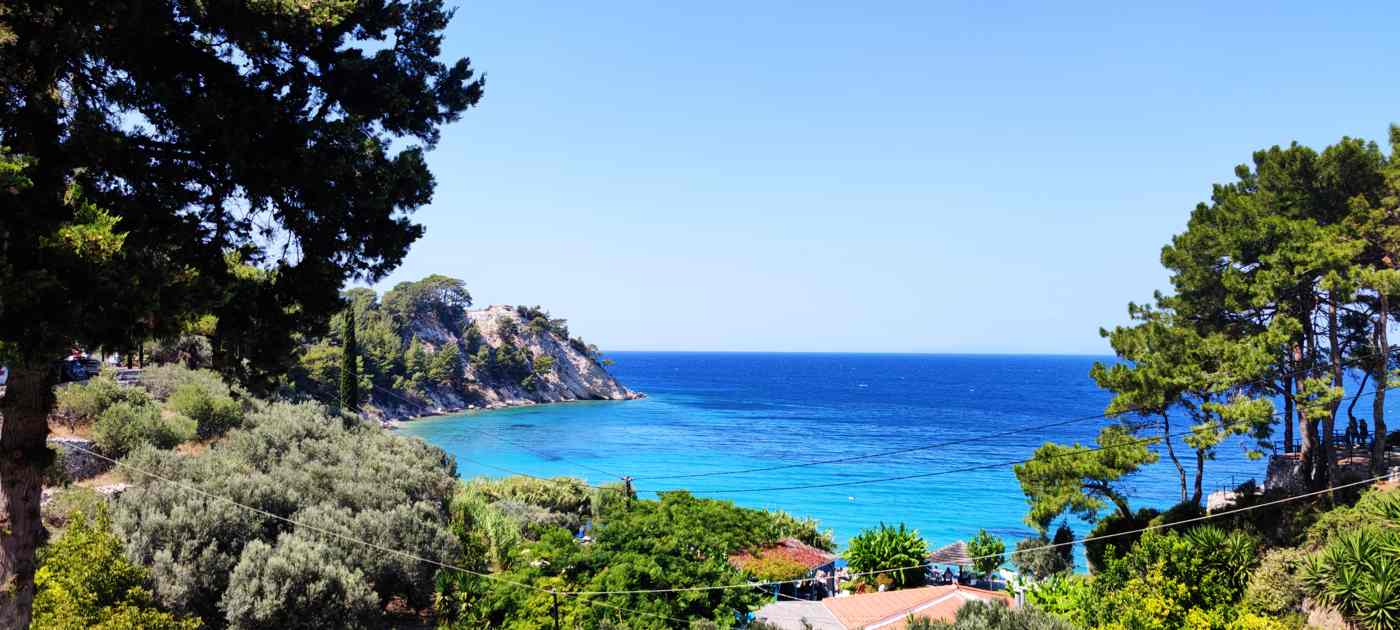
A terrace runs along the seaward edge of the compound, set at the very top of the cliff. From this platform the ground drops away steeply toward the water far below the outer walls. The terrace opens onto a wide view of the strait, the coast and the distant Turkish shore beyond. Low parapets edge the platform, marking the boundary above the steep fall to the sea below. Visitors gather here after the church to take in the outlook that the headland commands. The height gives the terrace a clear line of sight across open water to the eastern horizon. Wind crosses the platform steadily, carrying the salt of the sea below the cliff.
The seaward terrace supplies the sweeping panorama for which the monastery is best known.
The pairing of a sheltered court and an open terrace shapes the whole experience of a visit here. Within the walls the courtyard offers shade, calm and protection from the elements of the headland. Just outside, the terrace exposes the full sweep of the sea and the frontier coast beyond. A short walk brings the visitor from the enclosed court to the exposed cliff edge and its outlook. This movement from enclosure to openness runs through the entire design of the walled compound. The monks built inward for shelter and outward for the command of the eastern approaches. The two spaces together hold the character of the monastery, at once withdrawn and commanding.
The combination explains why the site draws travellers to the far eastern corner of the island.
The grounds around the courtyard and terrace remain simple, in keeping with the monastery’s religious purpose. Benches and shaded corners let visitors rest before or after entering the church of the compound. The seaward view changes through the day as light shifts across the strait and the far coast. Morning sun rises directly out of the sea beyond the terrace, striking the eastern-facing walls first. By afternoon the court holds cool shade while the terrace stays bright above the open water. The setting encourages a slow, quiet visit rather than a brief stop for a single photograph. Modest behaviour and dress apply throughout the grounds, since the site remains in active religious use.
The courtyard and terrace, taken together, give the monastery its balance of shelter and outlook on the outer edge of the island.
What can you see across the strait from the Zoodochos Pigi Monastery?
The terrace looks east across the narrow Mycale strait to the Turkish mainland, which rises close on the far side. The channel narrows to about 1.2 kilometres near the island, placing Asia Minor within clear sight of the cliff.
The Mycale strait separates the eastern tip of the island from the Turkish mainland lying opposite. At its narrowest the channel closes to about 1.2 kilometres, one of the tightest sea gaps in the Aegean. From the monastery terrace this strait fills the foreground of the wide view toward the east. The Turkish coast rises clearly across the water, its hills and shoreline visible in ordinary daylight. The narrowness of the gap makes the far side feel close, almost within reach from the edge of the cliff. Boats and ships pass through the channel below, tracing the busy route between the two coasts.
The strait carries the ancient name of Mycale, the headland on the Asian side facing the island. This meeting of Greek and Turkish shores gives the monastery’s outlook its striking frontier quality.
The view to Turkey defines the monastery more than any single feature of its own buildings. No other place on the island brings the mainland of Asia Minor so close and so clearly into sight. The terrace faces the coast directly, with open water and the narrow strait lying between the two shores. Ridges and settlements on the far shore stand out against the eastern sky beyond the channel. This proximity has shaped the site’s history, placing it on the frontier between two neighbouring lands. The monastery’s founders chose a headland that watched over these eastern approaches to the island. The outlook links the quiet religious compound to the wider geography of the eastern Aegean.
Standing on the terrace, visitors take in a border that has divided and connected the two coasts across the centuries.
Light and weather change the view across the strait through the whole course of a day. At dawn the sun rises out of the sea behind the Turkish hills, throwing the far coast into silhouette. By midday the mainland stands clear and detailed across the short span of water between the shores. Haze can soften the far shore in the heat of the afternoon, blurring the distant ridgeline. Evening light turns the strait gold as the sun sets behind the island’s mountains inland. The narrow channel stays visible throughout, its traffic and currents marking the boundary below the cliff. Each hour offers a different reading of the same frontier view from the seaward terrace.
The constant is the closeness of the two coasts, held apart by little more than a kilometre of open sea.
The outlook across the Mycale strait rewards the journey to this remote corner of the island. The east-coast bays of Kerveli, Poseidonio and Mykali lie along the approach, below the monastery’s headland. From the cliff the coastline curves away north and south, framing the water toward the Turkish mainland. Ships tracing the channel and the near presence of the far shore hold the eye on the terrace. The view gathers the geography of the eastern frontier into one sweep from a single vantage point. This panorama, more than the modest scale of the buildings, draws travellers out to Cape Prasso. The combination of an active monastery and a commanding border view sets the site apart on the island.
The far eastern tip offers a perspective found at no other stop along the entire coast.
What visitors know before entering Zoodochos Pigi Monastery on Samos?
Visitors enter Zoodochos Pigi Monastery through a walled gate, cover shoulders and knees, and keep voices low inside the katholikon. The monastery works as an active religious house, not a ticketed museum.
Practical preparation for Zoodochos Pigi starts with clothing that suits an active Orthodox house on the eastern tip of Samos. Men wear long trousers, women cover shoulders and knees, and short shorts or beach tops stay behind. The monastery reads as a place of prayer above Cape Prasso, so travellers switch off loud music, silence phones, and step through the walled gate quietly. Photography of the courtyard is usually accepted, while the katholikon interior calls for restraint around the iconostasis and the monks at work. A modest scarf tucked in a day bag solves most dress questions on the spot.
These habits carry across every working monastery on the island, from the north slopes to this cliff-top perch facing Turkey. A calm, well-dressed entrance sets the tone for the whole quiet visit above the strait.
Access and timing shape the visit as much as dress does. The road out from Vathy climbs and twists for about 20 to 30 minutes. A rental car or scooter beats waiting for the thin bus service along the east coast. Drivers park on the flat ground outside the walls, since the courtyard itself stays closed to vehicles. The monastery sits roughly 12 kilometres southeast of Samos Town, above the sea, with no shops or cafes at the gate. Travellers carry water, a hat, and small change for a candle, then plan around the midday heat that bakes the exposed headland.
A short walk from the parking area to the terrace rewards the climb with the open view across the Mycale strait. Sturdy shoes and a slow pace suit the uneven ground near the gate.
Respect for the rhythm of the house governs how long a visit lasts and what it involves. Guests stay quiet during services, avoid entering private cells and work areas, and follow any sign that marks a door as closed. The monks keep the grounds, tend the small garden, and receive travellers between periods of prayer, so the gate opens and closes around that daily order. A slow half hour covers the katholikon, the shaded courtyard, and the terrace that drops toward Cape Prasso. Children come along easily when parents keep them close on the low walls above the drop.
Leaving a candle lit and a coin in the box is the customary way to thank an active monastery on Samos for its welcome. A gentle, unhurried manner keeps the visit in step with the house.
Facilities at Zoodochos Pigi stay deliberately simple, matching a small community rather than a tourist site. No entrance fee applies, though a donation box near the katholikon supports upkeep of the walls, the roof, and the icons. A basic toilet sit near the gate, but travellers plan to eat and refuel in Vathy or the east-coast tavernas rather than here. Shade comes from the courtyard trees and the covered walkways, which matter on the sun-struck headland in high summer. Signage stays minimal and mostly Greek, so a little patience and a quiet manner carry the day.
Pairing the monastery with a swim below turns a fifteen-minute stop into a half-day loop that reads the eastern edge of Samos slowly and on its own terms.
How does the winding road from Vathy reach Zoodochos Pigi Monastery?
The road climbs southeast from Vathy through Kalami and the east-coast bays, twisting for about 20 to 30 minutes before ending on the headland above Cape Prasso where the monastery stands.
The drive begins in Vathy, the deep-harbour capital on the northeast coast of Samos, and heads southeast toward the island’s eastern tip. Signs point through the suburb of Kalami before the tarmac narrows and starts to climb the coastal hills. The road curls past olive terraces and low pine, dipping toward small bays and rising again over each shoulder of rock. Traffic stays light outside the peak weeks, though oncoming cars on the tight bends call for a steady speed and full attention. The whole run covers roughly 12 kilometres yet takes about 20 to 30 minutes because of the constant turns.
Drivers who prefer calm roads leave Vathy early, before tour traffic and midday glare fill the narrow eastern corridor of the island. A steady hand on the switchbacks matters more here than speed.
Scenery along the route earns the slow pace and repays every switchback with a fresh angle. The road threads above coves where clear water meets pale rock, and gaps in the pine open sudden windows toward the Turkish coast across the strait. Cape Prasso appears late, a green finger of land carrying the walled monastery at its edge. Cyclists tackle the climb in cooler hours, while scooters handle the hairpins with ease and easy parking at the top. A few pull-offs let drivers pause for the view without blocking the lane. The surface stays paved the whole way.
Edges crumble in places, so keeping to the centre on blind corners protects both the car and the walkers who share this quiet stretch of Samos.
Navigation is straightforward once travellers hold the eastern coast as their guide. From Vathy the route follows brown monastery signs and the general line of the shore, passing turnings for Kerveli, Poseidonio and Mykali on the way out. Offline maps help where mobile signal fades behind the ridges, since the last kilometres run through folded terrain. The final approach drops the driver onto a small, level clearing outside the walls, where a handful of cars fit end to end. No fuel station sits along this branch, so filling the tank in Samos Town before setting out avoids a tense return.
A printed pin or a saved location beats guesswork at the two or three unmarked forks near the top of the headland. Watching for the brown signs at each junction keeps the route simple.
Alternatives to self-driving exist, though they demand planning around a thin schedule. Public buses serve the east-coast villages only times each day, and they stop well short of the monastery gate, leaving a long uphill walk in the sun. Taxis from Vathy reach the headland but cost more and rarely wait, so agreeing a return time before setting off saves stress. Organised tours occasionally fold the monastery into an east-coast loop that also takes in a swim and a taverna lunch. Independent travellers on scooters keep the most freedom, linking the cliff-top site with two or three coves in a single unhurried morning.
They arrive, guests reach a headland that rewards the effort of the winding eastern road out of Vathy. Planning the return before setting off spares a long wait on the quiet coast.
What is the active religious life like at Zoodochos Pigi Monastery on Samos?
Zoodochos Pigi runs as a living Orthodox monastery, its small community keeping daily prayer, tending the grounds, and lighting the katholikon dedicated to the Life-Giving Spring rather than serving as a museum.
Daily life at Zoodochos Pigi follows the unhurried order of a small Orthodox community on the far edge of Samos. The dedication to the Life-Giving Spring, the Zoodochos Pigi, shapes the calendar and the name carved above the gate. Monks or resident caretakers rise for prayer, keep the katholikon and its oil lamps, and maintain the walls that face the open sea toward Turkey. Between services they tend a modest garden, sweep the courtyard, and receive the travellers who climb the headland. The rhythm feels closer to a working farmhouse of faith than to a staffed attraction.
Visitors who arrive quietly meet that rhythm rather than interrupt it, and the pace of the place teaches its own kind of patience above Cape Prasso. The dedication gives the headland its name and its steady daily purpose.
Worship centres on the domed katholikon, where a carved wooden iconostasis screens the sanctuary and old icons line the walls. Candles and hanging lamps light faces darkened by age and incense, and the stone interior holds the cool even when the headland bakes outside. Services follow the Byzantine chant of the Greek Orthodox Church, sung without instruments and led from behind the screen. Feast days draw local families up the winding road, filling the courtyard with a warmth the quiet weekdays lack. Travellers stand at the back, cross themselves or simply watch, and step out before the sacrament if they are not Orthodox.
The church anchors the whole site, its dome the first shape a driver picks out from the last bend of the approach.
Care of the monastery falls to the resident community and the faithful of eastern Samos who value the cliff-top house. Donations left in the box near the katholikon pay for candle oil, roof repairs, and the slow upkeep of icons exposed to salt air. The garden yields herbs and a little fruit, tying the community to the land as older island monasteries always have. Icons and relics kept inside carry names and stories that the caretakers share with respectful guests when time allows. This is charity and continuity rather than commerce, and no shop or ticket desk breaks the mood at the gate.
The monastery survives because its small circle keeps working, quietly, on a headland most island visitors never reach. Every candle bought and coin left keeps the old walls standing another season.
Encounters between guests and the community stay brief, warm, and governed by long custom. A caretaker unlock the katholikon, point out an icon, or offer a spoon of sweet preserve and a glass of water in the old Samos way of hospitality. Silence during prayer, a covered body, and a soft voice signal the respect that opens these small exchanges. Guests never wander into cells, kitchens, or gated corners, and they ask before photographing a person at prayer. Leaving a candle lit and a coin behind closes the visit on the right note.
These unwritten rules hold at every active monastery across Greece, yet they feel especially fitting on this lonely eastern spur of Samos facing the Turkish shore. A word of thanks at the gate closes the short encounter with grace.


How can travellers combine Zoodochos Pigi Monastery with the east-coast coves of Samos?
Travellers pair the monastery with Kerveli, Poseidonio and Mykali, three east-coast coves on the same winding road, turning a fifteen-minute stop into an unhurried half-day of prayer, sea, and taverna lunch.
The east coast of Samos threads the monastery and its nearest beaches onto a single quiet road, so a loop makes obvious sense. Kerveli beach sits in a sheltered bay ringed by pine, its pebbles dropping into clear water that stays calm through most of the summer. The turning for the cove branches off the monastery road, adding only minutes to the drive down from Cape Prasso. Families spread towels under the trees, swimmers strike out toward the headland, and a taverna above the sand covers lunch. Reaching the beach after the monastery balances a still, shaded site with an open. Sunlit swim.
The short hop between them keeps the whole morning within a compact stretch of eastern Samos. Pine shade and calm water make the cove an easy stop for children.
Mykali stretches longer and more open than its neighbours, a broad band of sand and shingle facing the Mycale strait and the mountains of Turkey beyond. The beach catches afternoon breeze, which cools sunbathers and draws windsurfers when the meltemi builds. A scatter of studios and tavernas backs the shore, so a late lunch or a cold drink fits easily between swims. The road from Zoodochos Pigi drops to Mykali in minutes, making it a natural second or third stop on the loop. Travellers who want space rather than shelter choose Mykali over the tighter coves, laying out towels along its length.
The wide view across the strait from the waterline echoes the same seascape the monastery terrace frames from high above. Late afternoon suits Mykali best, when the breeze cools the long open shore.
Poseidonio rounds out the trio as a small fishing settlement where the road nearly touches the Turkish coast across the narrowest reach of the strait. Poseidonio keeps a handful of tavernas along a low waterfront, their tables set over water clear enough to show the sea floor. Fishing boats rock at simple moorings, and the swimming is calm off the rocks and small beaches nearby. The hamlet suits a slow lunch of grilled fish after the monastery and a first swim, with the Anatolian hills filling the horizon. From here the strait looks close enough to touch, a reminder of how tightly Samos leans toward Asia Minor.
A short drive links Poseidonio back to Vathy, closing the eastern loop without retracing the whole climb.
Sequencing the loop well turns three separate stops into one coherent day on eastern Samos. Early travellers take the monastery first, while the katholikon stays cool and the headland light is soft, then descend to a cove as the sun climbs. A swim, a taverna lunch, and a second beach fill the middle of the day, spacing the driving into short, easy legs. Carrying water, a swimsuit, and a modest layer for the monastery covers every stop without a return to Vathy. Roughly 12 kilometres separate the capital from Cape Prasso, and the beaches cluster within minutes of the monastery road.
Ending back in Samos Town by evening leaves the whole eastern shore explored in a single relaxed circuit rather than three rushed errands.
Who does a visit to Zoodochos Pigi Monastery suit, and when is the best time of day?
The visit suits travellers drawn to history, quiet, and sea views rather than nightlife or crowds. Early morning or late afternoon serves best, sparing guests the midday heat on the exposed headland.
Zoodochos Pigi rewards a particular kind of traveller more than the general beach crowd on Samos. Walkers, photographers, and anyone drawn to Orthodox history and quiet stone find the most here, since the pull of the place is calm rather than spectacle. Couples come for the terrace view across the strait, and older visitors value a site reached by car with only a short, level walk to the gate. Faith travellers add it to a route of island monasteries, while sightseers slot it between east-coast swims. Those chasing bars, water parks, or busy sand feel the pace as too slow and move on.
The headland gives its best to guests who arrive without a rush and let the sea, the icons, and the silence set the tempo.
Timing decides how comfortable and how rewarding the visit feels on an exposed eastern spur of Samos. Early morning brings soft light, cooler stone, and an empty courtyard, so photographers and quiet-seekers favour the first hours after the gate opens. The katholikon holds its cool longest then, before the sun turns the headland harsh around midday. Late afternoon offers a second good window, when the heat eases and the light warms the walls toward gold above Cape Prasso. Midday in high summer bakes the open terrace and thins the pleasure of standing at the view.
Planning either end of the day around a swim below keeps the whole outing pleasant rather than a test of endurance under a hard Aegean sun. A hat and water still matter even in the gentler hours on the headland.
Families judge the visit by the age and temper of their children, since the site rewards calm over play. Toddlers need a close hand near the low terrace walls that drop toward the sea, and there is no playground or soft ground to burn energy. School-age children who like castles, boats, and big views take to the walled monastery and the ships crossing the strait. Pairing the stop with a cove such as Kerveli or Mykali gives them the swim that a still religious site cannot, balancing the day. Fifteen to thirty quiet minutes at the gate suit most families before the beach calls.
Parents who frame the monastery as an old fortress facing another country often find their children more curious than restless on the headland.
Fitting the monastery into a wider Samos itinerary depends on the base and the pace a traveller keeps. Guests staying in Vathy reach Cape Prasso in about 20 to 30 minutes and can slot it into a half-day loop with two coves. Those based in Pythagorio or Kokkari face a longer drive, so they fold it into a full day exploring the east coast rather than a quick errand. A morning at the monastery and its beaches leaves the afternoon free for the town, the wine villages, or the harbour. Even a single unhurried visit reads the quiet, seaward character of eastern Samos that busy resort strips never show.
The headland fits best as a slow highlight, not a box ticked between crowded stops. Building the loop around the cool morning hours makes the day flow without strain.
Frequently Asked Questions
Can anyone visit Zoodochos Pigi Monastery on Samos?
Anyone visit Zoodochos Pigi Monastery, since it stays an open, active Orthodox house rather than a closed community or a paid attraction. Travellers of any faith or none walk through the walled gate on the headland above Cape Prasso, view the courtyard and terrace. Step into the katholikon when it is unlocked. The one firm condition is respect for a working place of prayer: covered shoulders and knees, a quiet voice, and no disruption during a service. Non-Orthodox guests watch worship from the back and step out before the sacrament rather than take part.
The monastery receives visitors between periods of prayer, so the gate opens and closes around the community’s daily order rather than fixed tourist hours. Groups keep their numbers low and their manner calm, and they wait outside during a service if the courtyard grows crowded. Arriving quietly, dressed with care, opens the site to every traveller who climbs the winding east-coast road from Vathy toward Cape Prasso.
What I wear to visit Zoodochos Pigi Monastery?
Modest clothing that covers shoulders and knees suits Zoodochos Pigi, matching the custom of every active Orthodox monastery in Greece. Men wear long trousers and a shirt with sleeves, while women choose a skirt or trousers below the knee and a top that covers the shoulders. Short beach shorts, swimwear, and bare midriffs stay behind, since the monastery reads as a house of prayer rather than a sightseeing stop. A light scarf or wrap tucked into a day bag solves most problems on the spot, covering shoulders quickly at the gate. Comfortable flat shoes help on the uneven courtyard stone and the short walk from the parking area.
The dress rule holds even in high summer heat on the exposed headland, so a breathable long layer beats tight or heavy fabric. A hat and sunglasses help on the exposed terrace, though guests remove caps inside the church. Dressing with care before leaving Vathy avoids a wasted climb to a gate you cannot pass.
How do I get to Zoodochos Pigi Monastery from Vathy?
A rental car or scooter is the surest way to reach Zoodochos Pigi, since the monastery sits about 12 kilometres southeast of Vathy on a winding east-coast road. The drive climbs and twists past Kalami and the turnings for Kerveli, Poseidonio and Mykali, taking about 20 to 30 minutes because of the constant bends. Drivers park on a small level clearing outside the walls, then walk a short, flat stretch to the gate. Public buses serve the east-coast villages only times daily and stop well short of the monastery, leaving a long uphill walk in the sun. Taxis from Samos Town reach the headland but rarely wait, so agreeing a return time first avoids being stranded.
Filling the fuel tank in Vathy matters, because no station sits along this branch. Offline maps help where the signal fades behind the ridges near Cape Prasso. Leaving Vathy early spares drivers the tour traffic and the harsh midday glare on the bends.
Is Zoodochos Pigi Monastery suitable to visit with kids?
Children can visit Zoodochos Pigi comfortably when parents keep them close and set the right expectations for a quiet religious site. School-age kids who like castles, ships, and big sea views take to the walled monastery and the boats crossing the strait toward Turkey. Toddlers need a firm hand near the low terrace walls that drop toward the water, since there is no playground, soft ground, or space to run. A calm visit of fifteen to thirty minutes covers the courtyard, the katholikon, and the view before attention fades. Pairing the stop with a nearby cove such as Kerveli or Mykali gives children the swim that a still monastery cannot, balancing the day well.
Framing the site as an old fortress facing another country often turns restlessness into curiosity. Snacks and water help, as no shop sits at the gate on the exposed eastern headland of Samos. Keeping children close on the terrace and inside the church avoids trouble around the drop and the icons.
How much time do I need at Zoodochos Pigi Monastery?
About fifteen to thirty minutes covers Zoodochos Pigi itself, since the site is compact and centres on the katholikon, the shaded courtyard, and the sea terrace above Cape Prasso. That window lets a traveller light a candle, view the carved iconostasis and old icons, and stand at the wall for the sweeping look across the Mycale strait toward Turkey. Photographers and quiet-seekers linger longer, waiting for the light to soften the stone. The drive out from Vathy adds about 20 to 30 minutes each way, so the round trip alone fills more than an hour before any stop. Most visitors treat the monastery as one part of an east-coast loop rather than a destination on its own.
Adding a cove and a taverna lunch stretches the outing into a relaxed half day. Rushing the gate wastes the calm that makes the climb worthwhile in the first place. Building in extra minutes at the terrace lets the sea view and the quiet settle properly.
Can I combine Zoodochos Pigi Monastery with a beach on Samos?
The monastery pairs naturally with the east-coast beaches, since Kerveli, Poseidonio and Mykali sit only minutes off the same winding road below Cape Prasso. Kerveli offers a sheltered pebble cove ringed by pine and a taverna above the sand, ideal for a calm swim after the still religious site. Mykali stretches longer and more open, facing the strait, with afternoon breeze and a scatter of tavernas along the shore. Poseidonio, a small fishing hamlet where Samos leans closest to Turkey, serves grilled fish over clear water at simple waterfront tables. A common plan takes the monastery first, while the katholikon stays cool, then drops to a cove for a swim and lunch as the sun climbs.
Carrying a swimsuit alongside a modest layer for the gate covers both stops without a return to Vathy in between. The short hops between them keep the whole loop within a compact stretch of eastern Samos below Cape Prasso.
Can I take photographs at Zoodochos Pigi Monastery?
Photography of the courtyard, the walls. The sweeping sea view is usually welcome at Zoodochos Pigi. And the terrace above Cape Prasso frames the strait and the Turkish coast beautifully in soft light. Inside the katholikon, restraint is the rule: many Orthodox houses discourage flash near old icons, and some limit photos of the sanctuary and the iconostasis altogether. Travellers watch for a sign at the door and, when unsure, ask a caretaker before raising a camera indoors. Photographing monks or worshippers at prayer needs their clear consent, since the site is a house of faith rather than a set.
Early morning and late afternoon give the kindest light on the stone and the water, rewarding patience over a quick midday snap. Keeping the camera quiet during a service respects the small community at prayer inside the walls. Handled with courtesy, photography records a rare cliff-top monastery above Cape Prasso that most Samos visitors never reach.