
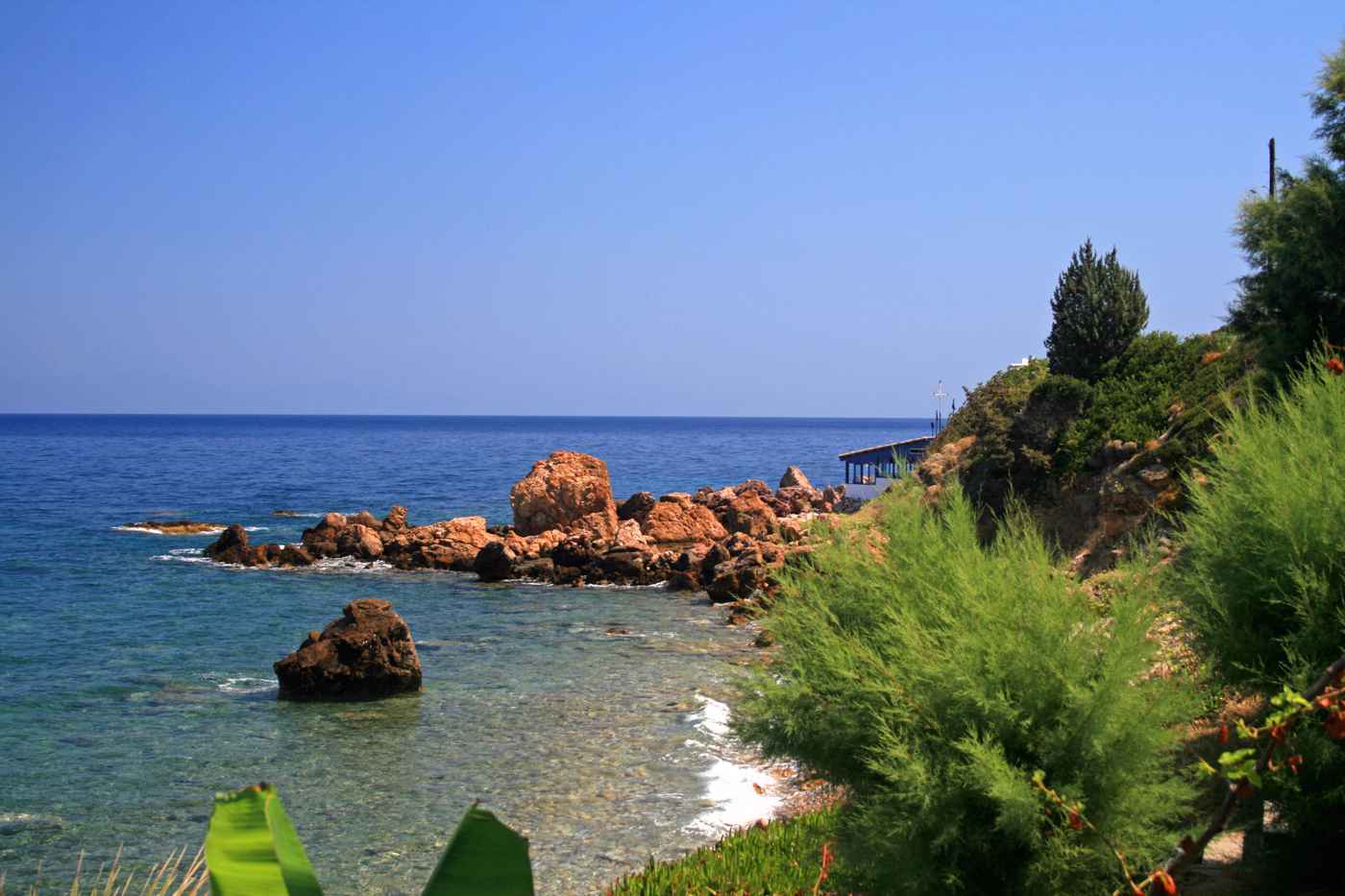
Kerveli is a sheltered pebble-and-sand cove on the east coast of Samos, set southeast of Vathy inside a green bay ringed by pines and olive groves. Calm, clear and deep water, a wooded setting and a quiet, lightly built shore make it a relaxed alternative to the busier beaches of the north coast. A winding road descends from the capital to the shore in about 20 to 25 minutes. Plan the whole trip with Greece Tours.
This guide covers where Kerveli sits on the eastern coast and how the road reaches it from Vathy, the pebble-and-sand shore and the calm deep water, the pine-and-olive setting that frames the bay. The view across the narrow strait to the mountains of Turkey. The quiet, low-development character that sets the cove apart from the crowded north. Each section keeps to the facts of the bay and the coast around it.
Where is Kerveli beach on the east coast of Samos, southeast of Vathy?
Kerveli lies on the east coast of Samos, southeast of Vathy, inside a green bay ringed by pines and olive groves. A winding road descends from the capital to the shore in about 20 to 25 minutes.
Kerveli occupies a sheltered inlet on the eastern shore of Samos, reached by a winding coastal road that leaves Vathy and drops toward the sea in about 20 to 25 minutes. The route threads through the eastern villages, climbing a low ridge before descending in tight bends to the water. Drivers pass olive terraces and pine slopes along the way, and the final stretch opens onto the bay. The road distance from the capital measures roughly 10 kilometres, short enough for a morning swim and a return by lunch. Signposts mark the turn for the cove, and a small parking area sits close to the shoreline.
The approach frames the green bowl of hills that encloses the beach and hints at the calm water below.
The bay faces east and slightly south, opening toward the narrow strait that separates Samos from the Turkish mainland. Two low headlands wrap around the water and give the cove its enclosed shape, so the shoreline reads as a tight crescent rather than an open strand. The village of Kerveli spreads across the slope above, a scatter of houses among gardens and cypress trees. Poseidonio, another small east-coast settlement, sits a short drive to the south, and the sandy beaches of Mykali and Psili Ammos follow further along the same coast. This corner of the island stays green well into the dry season, fed by springs in the hills.
The setting places Kerveli within easy reach of the capital yet clearly apart from the town itself.
Access by car is the simplest way to reach the cove, since the winding descent rewards a vehicle over the limited bus service that runs along the east coast. The final kilometre narrows, and the parking area near the shore fills early on summer mornings when the meltemi wind rakes the north coast and pushes swimmers toward this sheltered side. From the parking, a short level walk leads onto the pebbles. Boats occasionally anchor offshore, drawn by the calm water and the depth close to the shore. The eastern position means the bay catches the early sun, so mornings are bright and the light warms the water before midday.
Shade from the pines behind the beach lingers even as the sun climbs higher over the surrounding hills.
The eastern bays form a distinct pocket of Samos, quieter and greener than the developed north around Kokkari and the harbour towns. Kerveli anchors this group, with Poseidonio, Mykali and Psili Ammos strung along the coast toward the southeast tip near Pythagorio. A drive linking them makes an easy half-day loop from the capital, each cove reached by a spur off the main eastern road. The hills behind rise steeply, covered in pine and olive, and screen the beaches from the wind that funnels down the strait. Fishing boats still work these waters, and the small harbour at Poseidonio shelters a handful of them.
The combination of short distance from town and genuine calm gives this shore its lasting appeal for a relaxed swim away from crowds.
What is the pebble-and-sand cove and the calm, deep water at Kerveli like?
Kerveli’s shore mixes fine pebbles with patches of sand, sloping into clear water that deepens quickly a short way out. The enclosed bay keeps the surface calm and the water clean on most days.
The beach surface at Kerveli combines rounded pebbles near the waterline with softer sand and grit higher up, a texture common to the sheltered eastern Samos beaches. Water shoes help on the pebbles, and the seabed stays firm underfoot as it slopes away from the shore. The water clarity is high, since no river mouth clouds the bay and the pebble bottom traps little silt. Swimmers see the bottom clearly in the shallows, then watch it fall into deeper blue within two or three strokes of the shore. The depth close in suits confident swimmers and snorkellers, while the calm shallows near the pebbles give children a gentler entry.
The cove holds its clarity even through the warm summer months, when sandier bays elsewhere on the island begin to cloud with churned-up grit.
Deep water arrives fast at Kerveli, a trait that sets it apart from the shelving sandy bays elsewhere on the island. Within a short swim of the shore the seabed drops steeply, so the bay suits people who want to swim properly rather than wade for metres. The enclosed shape of the inlet tames the swell, and the two headlands block much of the chop that the meltemi drives across open water. On calm mornings the surface sits almost flat, mirroring the pine slopes above. Snorkellers follow the rocky edges of the bay, where the seabed shifts from pebble to stone and small fish gather in the shade of the headlands.
The water stays cool and fresh, refreshed by its depth rather than warmed in a shallow basin.
The cove measures a modest span, a compact crescent of shoreline rather than a long open beach. Sunbeds and umbrellas occupy the central stretch in season, set out by a taverna behind the shore, while the ends of the beach stay free for towels on the pebbles. The scale keeps the bay intimate, so it fills on peak August days yet rarely feels like the crowded north-coast strands. Pines grow close to the back of the beach and throw natural shade over part of the pebbles in the afternoon. A low retaining edge separates the beach from the road and the parking area.
The short shoreline and the quick drop into deep water together define the character of swimming here, direct and clean and cool.
Calm conditions are the rule rather than the exception at Kerveli, thanks to the eastern aspect and the sheltering arms of the bay. When the meltemi blows hard from the north and whips the beaches around Kokkari, this cove often stays swimmable, its water only lightly ruffled. The protection is not total, and a southerly wind can push a swell straight into the inlet, but such days stay the minority through the summer. The steady calm makes the bay reliable for a swim when other coasts turn rough. Kayakers and small boats use the settled water to explore the neighbouring inlets toward Poseidonio.
The dependable shelter, more than any single feature, is what draws repeat visitors down the winding road from the capital each season.
How does the pine-and-olive green setting frame Kerveli beach?
Pines and olive groves cover the hills that wrap Kerveli, running almost to the waterline and casting shade over the back of the beach. The greenery gives the bay a wooded, sheltered feel rare on Aegean coasts.
The green frame around Kerveli is one of the defining sights of the eastern coast of Samos, an island greener than most of the Aegean thanks to its springs and mountains. Aleppo pines cover the slopes above the bay, their canopy reaching down toward the shore, while old olive groves terrace the gentler ground behind. The trees grow close enough to the beach to throw real shade over the pebbles in the afternoon, a rare comfort on open Greek coasts. Cypresses spike the skyline around the village, and gardens of fig and citrus fill the hollows between houses. The scent of pine resin carries on warm air down to the water.
This wooded setting shapes how the cove feels as much as the sea itself does.
Shade is the practical gift of the pines at Kerveli, and it changes how a day at the beach unfolds. Families spread towels under the canopy at the back of the pebbles, out of the direct summer sun, while the sunbeds in the open catch the full light. The trees soften the heat that bounces off the stones and keep the air cooler than on treeless beaches. Birdsong carries from the branches, and the green backdrop cuts the glare that tires the eyes on bright white shores. The pine litter underfoot gives way to pebbles at the waterline. This band of shade lets visitors stay through the middle of the day rather than retreat.
It marks Kerveli as a place to linger rather than dash in and out again.
The olive groves behind the bay tie Kerveli to the working landscape of the eastern hills, where terraces of trees climb toward the ridge above the capital. These groves are tended plots, not wild scrub, and their silver-grey leaves contrast with the darker green of the pines on the steeper slopes. Stone walls edge the terraces, holding the soil on the incline, and narrow tracks thread between them up to the village. The mix of cultivated olive and natural pine gives the hillside its layered texture, green from the shore to the skyline. Springs in the hills keep the vegetation lush well past the point where other islands turn brown.
The result is a bay that reads as a wooded amphitheatre opening onto the sea rather than a bare strand.
The enclosed green setting also shelters Kerveli from the wind, since the wooded headlands and the rising ground behind block much of the northerly meltemi. This natural windbreak is part of why the bay stays calm when exposed coasts turn rough, and the trees hold the warmth of the day into the evening. Walkers follow paths through the pines to viewpoints above the cove, where the whole green bowl and the blue strait open together. The vegetation supports cicadas whose sound fills the summer afternoons, a constant backdrop to the lapping water. Little concrete breaks the green, since building stays low and scattered among the trees.
The combination of pine, olive and spring-fed hillside makes the bay feel enclosed and protected, a pocket of shade against the open eastern sea.
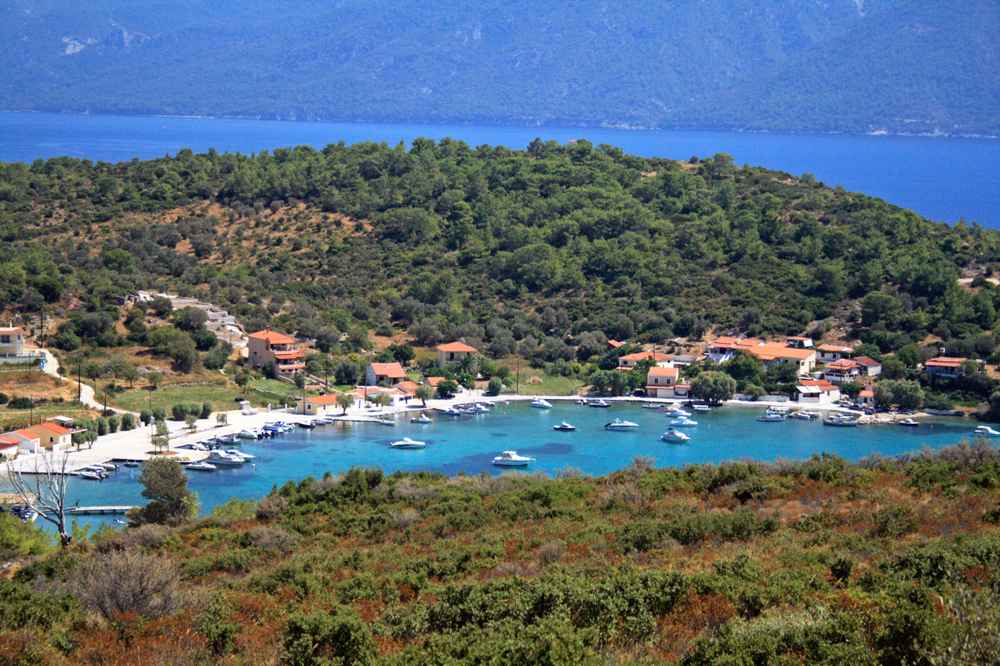
What is the view to Turkey across the strait from Kerveli?
Kerveli faces the Turkish mainland across a narrow strait, so the mountains of Asia Minor fill the horizon beyond the bay. The Mycale channel narrows to about 1.2 kilometres at the closest point of the coast.
The eastern aspect of Kerveli aims the whole bay toward Turkey, and the Anatolian coast stands clear across the water on most days. Brown and grey mountains rise beyond the strait, their ridges sharp in the morning light and hazy blue by afternoon. The Mycale channel that divides the two shores narrows to about 1.2 kilometres at its tightest point further south, though from Kerveli the crossing looks a little wider. Fishing boats and the occasional ferry track across the strait, small against the mainland behind them. At night the lights of Turkish villages glow along the far shore.
This constant sight of another country gives the bay a frontier feel, a reminder that Samos sits at the very edge of the Aegean against Asia Minor across the water.
The strait itself is a busy stretch of sea despite its calm surface, a channel that boats have crossed between Samos and the mainland for centuries. From the pebbles at Kerveli the view runs uninterrupted to the Turkish hills, with no island breaking the horizon to soften the distance. The clarity of the air over the water means the far coast reads in detail on clear days, its valleys and headlands picked out by the sun. Small craft from Pythagorio run day trips across to the Turkish port of Kusadasi, and the route passes within sight of the eastern bays. The proximity has shaped Samian life and trade for generations of islanders.
Watching the light move across the strait through the day is part of the pull of this eastern shore.
Morning is the finest time for the view from Kerveli, since the bay faces east and the sun rises directly over the Turkish mountains beyond the strait. The water lights up first at dawn, and the far coast glows before the beach itself catches the sun over the hills behind. Swimmers in the early water look straight into the brightening horizon across the channel. As the day turns, the mainland fades to a blue silhouette in the haze, then sharpens again toward evening as the heat drops. The changing light on the strait keeps the outlook fresh through the hours.
This eastward view is the opposite of the sunset-facing west coast, and it draws early risers to the pebbles to swim as light spreads over Asia Minor.
The nearness of Turkey turns a swim at Kerveli into a lesson in geography, the two shores close enough that the mainland feels within reach across the blue. This is one of the closest points between Greece and Turkey, and the strait here has carried people and goods between the coasts throughout history. The view underlines how far east Samos lies, tucked against Asia Minor rather than set among the central Cyclades. Vathy runs regular boats to the Turkish coast in season, a short crossing that visitors often add to a Samos stay. From the quiet of the cove the far mountains anchor every view seaward.
The strait, the light and the mainland horizon together give Kerveli an outlook that west-facing Greek beaches rarely match.
How quiet and low-key is Kerveli compared with the busy north coast of Samos?
Kerveli stays quiet and lightly built, with a taverna or two and a row of sunbeds but no resort development. The busy north coast around Kokkari draws far bigger crowds, hotels and nightlife than this sheltered eastern cove.
Development at Kerveli stays deliberately low, limited to a taverna or two behind the beach, a scatter of houses on the slope and a small parking area by the shore. No large hotel breaks the tree line, no beach bar pumps music across the water, and the village keeps the scale of a quiet settlement rather than a resort. The taverna serves food and drinks to swimmers through the day, but nightlife does not exist here in any real sense. This restraint is the point of the place, and it draws visitors who want a swim and a meal in the shade rather than a lively scene.
The absence of building preserves the green setting and the calm that define the bay, and it keeps crowds modest even in August.
The contrast with the north coast is sharp, since Kokkari, Tsamadou and Lemonakia sit on the developed, wind-facing side of the island that draws the bulk of Samos beach tourism. Those bays line up hotels, bars and busy car parks, and the meltemi that hits them turns the sea rough on windy days. Kerveli offers the reverse: shelter, quiet and green, reached by a road that tour buses rarely take. Where the north coast fills with day trippers and windsurfers, the eastern cove stays the preserve of those who seek it out. The two sides of Samos suit different moods, and Kerveli holds the calm end of that range.
Visitors staying in Vathy can swap the busy north for this quiet shore in a short drive.
Peace is the currency at Kerveli, and the bay rewards a slow day rather than a packed itinerary. Swimmers settle in for hours, moving between the deep water, the shade of the pines and a long lunch at the taverna. The soundtrack is cicadas and the light slap of water on pebbles, not loudspeakers or crowds of tourists. Families with older children who can handle the quick-deep water favour the cove, as do couples and walkers exploring the eastern coast. The pace matches the setting, unhurried and low-key throughout. Even on the busiest summer days the compact beach fills without turning frantic, and the winding access road acts as a natural filter on numbers.
This quiet is prized, and it explains why regular visitors return to the same pebbles.
The low-development character ties Kerveli to a wider stretch of the quiet eastern coast, where Poseidonio, Mykali and Psili Ammos share the same restraint. None of these bays carries the resort scale of the north, and together they form the calm counterweight to the busy side of the island. A day spent among them trades nightlife and crowds for shade, clear water and the view across the strait. The eastern coast rewards travellers who value a swim over a scene, and Kerveli sits at its heart. Building stays scattered and low across the whole shore, held back by the steep green hills and the winding roads.
This is the Samos that repeat visitors return for, the sheltered wooded coast that keeps its calm while the north fills each summer.
What facilities does Kerveli beach on Samos offer visitors?
Kerveli keeps a small, low-key set of facilities. A taverna or two sit behind the shore, sunbeds and umbrellas line part of the sand in season, and parking stays simple near the bay.
A family-run taverna stands a short walk back from the water, shaded by pine and tamarisk. It serves Greek plates through the main season, and closes outside the summer months. Tables face the cove, so lunch comes with an open view across the bay toward the Turkish hills. Prices track other east-coast Samos tavernas rather than the resort strips of the north. Bread, salads, grilled fish and local wine fill most menus here. Staff bring water and cold drinks to sunbathers on the sand during busy afternoons. The kitchen leans on Samos produce, including Muscat wine from the Ampelos slopes inland.
Guests wanting a full spread check opening times first, since the taverna keeps shorter hours in spring and autumn than in peak July heat.
Sunbeds and umbrellas cover part of the sand, set out in front of the taverna each morning. Two rows face the water, leaving the rest of the cove open for towels on the pebbles. Renting a pair usually pairs with a drink or lunch order at the taverna. The shaded back of the beach draws families who want relief from the midday sun. Umbrellas thin out toward the edges, where swimmers reach the water over smooth stones. Sunbed numbers stay modest, so the cove rarely feels packed even at the August peak. Early arrivals claim the front row before noon, when the bay fills with day-trippers from Vathy.
The rental setup runs only through the warm season, and the sand returns to bare pebble by late autumn.
Kerveli sits outside any resort zone, so most visitors arrive for the day and sleep elsewhere on the island. A handful of studios and small guesthouses dot the wider bay and the villages above it. Travellers comparing bases for the east coast can read about where to stay in Samos before booking a room near Vathy. Vathy, the island capital, sits about 20-25 minutes north by road and holds the widest choice of hotels. The taverna and beach form the whole commercial footprint here, with no shops, banks or supermarkets at the shore. Guests pack water, snacks and sunscreen for the day, since the nearest full store sits back in Vathy.
This low-density setup keeps Kerveli calm and gives the cove its unhurried east-coast character.
Shade defines the back of the beach, where pines and olive trees grow close to the sand. Visitors spread towels under the branches when the sunbed rows fill, an option families often prefer. The tree line keeps the cove cooler than the exposed north-coast beaches through the afternoon. A rough track and a small parking area sit just behind this greenery, steps from the water. Toilets and a freshwater rinse tie to the taverna rather than a separate beach service. The green backdrop, the taverna and the modest sunbed line make up the full picture at Kerveli. Nothing here matches a big organised resort, and that restraint keeps the bay quiet.
Day visitors find enough to settle in for hours without leaving the shade of the cove.
How do you reach Kerveli beach from Vathy on Samos?
Kerveli lies southeast of Vathy, reached by a winding paved road in about 20-25 minutes. The route climbs over a low ridge, then drops through east-coast villages toward the pine-ringed bay and the shore.
The road to Kerveli leaves Vathy from the south side of the town, climbing away from the harbour. It narrows quickly into a two-lane mountain route with tight bends and short straights. Drivers pass through Kamara and the eastern hamlets, where olive groves line both sides of the tarmac. The surface stays paved the whole way, though the bends demand a steady, unhurried pace. Signs point toward Kerveli and Poseidonio at the main junctions, so the turns stay clear. The final descent opens a view over the bay before the road reaches the shore. Total driving time runs about 20-25 minutes for the roughly 10-kilometre stretch from Vathy.
Traffic stays light outside the midday beach rush, and the route rarely backs up even in August.
A rental car or scooter makes the easiest way to reach Kerveli from Vathy. The bends suit a small car, and parking waits on the rough ground just behind the beach. Scooter riders manage the route with care, watching for gravel on the tighter corners. Fuel stations cluster in Vathy, so drivers fill up before leaving town for the coast. The narrow lanes leave little room for large vehicles, and coaches skip the cove entirely. Two hands stay busy on the wheel through the steep, twisting middle section of the drive. Most visitors treat the short trip as part of the day, pairing Kerveli with nearby Poseidonio.
The quiet road and the green hills make the approach as calm as the bay itself, a fitting start to the day.
Public transport reaches Kerveli only in a limited way through the summer. KTEL buses from Vathy serve the east-coast beaches on a thin summer timetable, lighter outside peak season. The stop sits near the bay, a short walk down to the sand and taverna. Riders check departure times at the Vathy bus station, since the schedule tightens outside July and August. Taxis run the route from Vathy for a fixed island fare, dropping visitors right at the shore. A booked taxi return works well for travellers without a car who want an afternoon swim. The bus fills the gap for budget visitors, though the sparse timing shapes the day.
Car-free travel to Kerveli takes planning, yet the quiet cove rewards the patient effort with calm water.
Timing the drive early pays off on a Kerveli day trip from Vathy. Morning light fills the bay before the sunbeds fill, and the road stays empty on the way down. Afternoon returns climb back over the ridge as the day cools, with the sea behind. The route doubles as a short tour of the green eastern corner of Samos. Cypress, pine and olive frame the tarmac, and the sea flashes between the trees on the descent. Cyclists tackle the climb in spring and autumn, when the heat eases on the exposed sections. Walkers rarely cover the full distance, since the gradient and length suit wheels over feet.
This short, scenic link ties Vathy to one of the calmest coves on the island’s east coast.
Which beaches lie near Kerveli on the east coast of Samos?
Poseidonio, Mykali and Psili Ammos lie south of Kerveli along the same east coast. Poseidonio sits nearest, a small fishing hamlet; Mykali and Psili Ammos stretch as longer sandy beaches toward the strait.
Poseidonio sits just around the headland from Kerveli, a five-minute drive south. The small fishing settlement keeps a sheltered inlet, a short pebble beach and a couple of waterside tavernas. Fishing boats moor along the little quay, and the water stays calm inside the natural cove. Visitors often pair Poseidonio with Kerveli on the same outing, since the two bays sit so close. The hamlet faces the Mycale strait, with the Turkish coast rising clearly across the narrow channel. Depth builds quickly off the quay, so swimmers reach clear water within a short swim. The setting stays quiet, without sunbed rows or a large beach operation on the shore.
Poseidonio suits travellers who want a meal by the water after a swim at Kerveli nearby.
Mykali stretches as a long sand-and-shingle beach further south, past Poseidonio and Psili Ammos. The open bay faces the strait, so the Turkish shore fills the view across the water. Its length spreads visitors out, and quiet patches stay easy to find even in high summer. Small tavernas and rooms back the beach, giving Mykali more services than tiny Poseidonio. The exposed setting catches more wind than sheltered Kerveli, so the surface ripples on breezy days. Shallow water near the shore suits families, with a gentle slope over sand and small stones. The beach runs long enough for a walk along the waterline, away from the sunbed clusters.
Mykali gives east-coast visitors a wider, more open shore to balance Kerveli’s tight, wooded cove nearby to the north.
Psili Ammos names a fine-sand beach on the same east coast, closest of all to the Turkish shore. The Mycale strait narrows to about 1.2 kilometres here, so the mainland opposite looks close enough to touch. Shallow, warm water runs far out over the pale sand, a strong draw for families with young children. Travellers planning the east-coast run can read the full guide to Psili Ammos beach before setting out from Vathy. A cluster of tavernas backs the shore, busier than Kerveli through the peak weeks of summer. The flat, sandy bottom contrasts with Kerveli’s pebble-and-stone entry into deeper water. Psili Ammos and Kerveli sit close enough to pair in one east-coast day.
Their different characters, one sandy and shallow, one pebbly and deep, reward a visit to both.
Choosing among the east-coast coves comes down to what each swimmer wants from the day. Kerveli offers shade, deep clear water and a wooded backdrop, best for a calm, unhurried swim. Poseidonio adds a working fishing quay and a meal by the boats in a tiny inlet. Mykali opens a long, breezy strand for walkers and families who want space to spread out. Psili Ammos brings the shallowest sand and the closest view of the Turkish coast across the strait. All four sit within a 15-minute drive of each other along the same eastern road. A single day covers two or three with ease, swapping pebble for sand between stops.
This tight cluster makes the east coast of Samos a rewarding base for a beach-hopping day.
Does Kerveli beach on Samos stay sheltered when the meltemi blows?
Kerveli faces east and south, sheltered from the north-wind meltemi that batters Samos’s north coast. The bay’s headlands and pine ridge block much of the gust, so the water stays calmer than at Kokkari.
The meltemi drives hard from the north across the Aegean through July and August. North-coast beaches like Tsamadou and Lemonakia take the full force, with chop and blown sand on strong days. Kerveli sits on the sheltered east coast, tucked behind headlands that break the northerly flow. The bay opens toward the strait rather than the open sea, so the swell rarely builds inside. On most summer afternoons the water at Kerveli stays flat while Kokkari whitecaps. The pine ridge above the cove adds a second windbreak against gusts spilling over the hills. Swimmers find calm conditions here when the north coast turns rough and cold.
This shelter makes Kerveli a reliable fallback on the windiest days of the Samos summer season, when other beaches close up.
Swimming at Kerveli starts over a mix of fine pebble and coarse sand at the shoreline. The bottom drops away within a short wade, so the water deepens quickly close to shore. Clear, calm conditions give strong visibility, useful for spotting fish over the rocks at the edges. The deep centre of the cove suits confident swimmers who want to stroke out toward the mouth. Rocky flanks on both sides hold small fish and make good targets for a snorkelling loop. Water temperature climbs through the summer, warmest from July into September along this sheltered east coast. The sheltered bay keeps currents weak, so swimmers cross the cove without a hard pull.
Non-swimmers stay near the shallow entry, where the calm water gives an easy first dip.
Snorkelling works well along the rocky edges that frame the sandy centre of Kerveli. The stone shelves on each flank hold sea bream, wrasse and the odd octopus in the crevices. Visibility often runs about ten metres in the clear, sheltered water of the bay. Snorkellers trace the left-hand rocks first, then cross to the right side over the deeper middle. The pine-shaded shore keeps the entry cool, a relief before and after a long float. Masks and fins ride easily in a daypack, since no rental stand serves the cove. Depth near the rocks suits free-divers who drop three or four metres to inspect the seabed.
The mix of sand, stone and clear water makes Kerveli one of the better east-coast snorkelling stops near Vathy.
Conditions at Kerveli stay gentle enough for most swimmers through the summer season. The sheltered bay keeps the surface calm, so children and older visitors swim without a fight against waves. No lifeguard staffs the cove, a standard case on the small east-coast beaches of Samos. Swimmers watch the deeper centre, where the drop-off surprises those expecting a long shallow shelf. On the rare day the wind swings south or east, small waves push into the open mouth. Even then the bay stays calmer than the exposed north coast under the same conditions. Water shoes help on the pebble entry and over the rocks at the snorkelling edges.
The clear, sheltered water and the quick deep centre define the swim at Kerveli beach on Samos.
Who does the quiet bay of Kerveli on Samos suit best?
Kerveli suits couples, families and swimmers who want calm water over nightlife and crowds. The wooded, low-key cove rewards visitors seeking a slow beach day, and disappoints those chasing bars, watersports or a party scene.
Couples find Kerveli well suited to a quiet swim and a long lunch by the water. Families with older children use the deep, clear cove for confident swimming and easy snorkelling. Swimmers who value calm water over facilities rate the sheltered bay above the busier north coast. The wooded setting draws readers, walkers and anyone after shade through the hot middle of the day. Older visitors reach the sand by a short walk from the parking, then rest under the pines. Photographers catch the strait, the Turkish hills and the pine-framed cove in a single frame. The bay rewards a slow pace rather than a packed schedule of stops.
Kerveli fits travellers who treat a beach day as rest, not as a checklist of sights.
Kerveli disappoints visitors who want a lively beach with bars, clubs and watersports. No jet skis, banana boats or beach clubs run on the quiet east-coast cove. Party-seekers head instead to the north-coast strips or the nightlife of Pythagorio and Vathy. Backpackers on a strict budget find the taverna the only place to eat or drink at the shore. Large groups after a buzzing scene feel the calm here as too still for their plans. The cove holds a modest sunbed count, so those needing guaranteed loungers arrive early. Visitors chasing a long sandy strand prefer Mykali or Psili Ammos over Kerveli’s tight pebble cove.
Matching expectations to the bay’s quiet character keeps a Kerveli day from falling flat for the wrong kind of crowd.
Morning brings the calmest water and the coolest sand at Kerveli through the summer. Early swimmers reach the cove before the sunbeds fill and the parking tightens near noon. Midday sees the taverna busiest, with lunch tables full and the sunbed rows claimed. Afternoon light warms the pines and softens the view across the strait toward the Turkish coast. Late-day visitors find the crowds thinning as day-trippers drive back over the ridge to Vathy. Sunset falls behind the hills inland, so the bay cools early once the sun drops. Evening at the taverna draws a quiet dinner crowd after the beach empties for the night.
Timing a visit around the morning calm or the late-afternoon lull gives Kerveli at its most peaceful and least crowded.
Peak season runs July and August, when the taverna, sunbeds and bus service all operate. Warm water, long days and full facilities draw the largest crowds through these two months. June and September offer warm swimming with thinner crowds, a strong window for a quiet visit. Late spring greens the hills around the cove, though the water stays cool for a swim before June. October cools the sea and starts to close the taverna as the season winds down. Winter empties the bay entirely, leaving the pebble shore, the pines and the empty road. Shoulder-season visitors gain calmer roads, easier parking and a cove closer to its off-peak quiet.
Choosing June or September pairs warm water with the low-key character that defines Kerveli beach on Samos.
Frequently Asked Questions
Is Kerveli beach on Samos good for families with kids?
Kerveli suits families with children who can already swim, thanks to its calm, sheltered water. The bay faces east and south, away from the meltemi, so the surface stays flat on most summer days. The entry mixes fine pebble and coarse sand, then deepens within a short wade toward the centre. Younger children stay in the shallow shoreline zone, where parents keep them within easy reach. The deep middle suits stronger swimmers, so families set a clear limit near the shore. Pine and olive trees shade the back of the beach, giving babies and toddlers relief from the midday sun. A taverna behind the sand serves food and cold drinks, useful for a long family day.
No lifeguard staffs the cove, so adults watch children in the water at all times. Water shoes help small feet on the pebbles and rocks. The quiet setting and gentle water make Kerveli a calm choice for a family beach day near Vathy.
Is there parking at Kerveli beach on Samos?
Parking at Kerveli sits on rough, unpaved ground just behind the beach, steps from the sand. The area holds a modest number of cars, filling fast on peak July and August middays. Early arrivals claim a shaded spot under the pines before the lunch rush from Vathy. The approach road narrows near the shore, so drivers take the final bends slowly toward the lot. No paid parking or attendant operates here, a standard case on the small east-coast beaches of Samos. Scooters and motorbikes tuck in easily, even when car spaces run short at the peak. Late-morning drivers who find the ground full park along the roadside verge and walk down.
The lot empties through the afternoon as day-trippers head back over the ridge. Arriving before noon or after the early-afternoon peak gives the best chance of a close space. The short walk from parking to sand suits families carrying bags, coolers and beach gear.
Are there sunbeds and umbrellas at Kerveli beach on Samos?
Sunbeds and umbrellas cover part of the sand at Kerveli through the warm season. The taverna sets them out each morning in front of the beach, mostly in two rows facing the water. Renting a pair usually pairs with a food or drink order at the taverna behind the shore. The sunbed count stays modest, so the front row fills before noon on peak July and August days. Early arrivals claim a shaded position, while later visitors spread towels on the open pebbles beyond the rows. The wooded back of the beach offers free natural shade under pine and olive branches. Umbrellas thin toward the rocky edges, where swimmers and snorkellers enter the deeper water.
The rental setup runs only in summer, and the sand returns to bare pebble by late autumn. Visitors who want a guaranteed lounger arrive early, since the small cove holds no large sunbed operation. Bringing a towel and a beach umbrella covers the busiest days.
Is Kerveli beach on Samos good for snorkelling?
Snorkelling at Kerveli works best along the rocky shelves that flank the sandy centre of the cove. The clear, sheltered water gives strong visibility, often about ten metres on a calm summer day. Sea bream, wrasse and the odd octopus shelter in the crevices of the stone on each side. Snorkellers start on one flank, trace the rocks, then cross the deeper middle to the far side. The bay stays calm and current-free, so a slow loop of the edges takes little effort. No rental stand serves the beach, so visitors bring their own mask, snorkel and fins. Depth near the rocks suits free-divers who drop three or four metres to the seabed.
Water shoes protect feet over the stones at the entry and along the snorkelling line. Morning offers the flattest water and the best light for spotting fish below. The mix of sand, rock and clarity ranks Kerveli among the better east-coast snorkelling stops near Vathy.
How do you get to Kerveli beach on Samos without a car?
Reaching Kerveli without a car takes a KTEL bus or a taxi from Vathy. KTEL buses serve the east-coast beaches on a thin summer timetable, lighter outside July and August. The stop sits near the bay, a short walk down to the sand and the taverna. Riders check departure and return times at the Vathy bus station, since the schedule tightens off-peak. A taxi runs the route from Vathy for a fixed island fare, dropping visitors at the shore. Booking a taxi return works well for a car-free afternoon swim, given the sparse bus timing. A common approach combines a taxi one way with the bus back, matching the day to the schedule.
The winding road rules out walking the full distance, since the gradient and length suit wheels. Cyclists tackle the climb in spring and autumn, when the heat eases on the exposed sections. Planning the return before setting out keeps a car-free day at Kerveli running smoothly.
What beaches are near Kerveli on Samos?
Nearby beaches to Kerveli line the same east coast south toward the Mycale strait. Poseidonio sits closest, a five-minute drive around the headland to a tiny fishing inlet with tavernas. Mykali stretches further south as a long sand-and-shingle bay, more open and breezy than Kerveli. Psili Ammos follows, a fine-sand beach with shallow warm water and the closest view of the Turkish coast. All three sit within a 15-minute drive along the same eastern road from Kerveli. A single day covers two or three coves, swapping pebble for sand between swims and lunches. Poseidonio suits a meal by the boats, Mykali a long walk, and Psili Ammos a family paddle.
The tight cluster makes the east coast near Vathy a rewarding base for beach-hopping. Kerveli anchors the group with its shade, deep water and sheltered cove. Pairing it with a sandier neighbour balances the day between pebble and sand along this quiet stretch of coast.
What are the quiet months to visit Kerveli beach on Samos?
Quiet months at Kerveli fall in the shoulder season, from May into June and again in September and October. June and September pair warm swimming water with far thinner crowds than the July and August peak. May greens the hills around the cove, though the sea stays cool for swimming early in the month. October cools the water further and starts to close the taverna as the season winds down. Winter empties the bay entirely, leaving the pebble shore, the pines and the quiet road. Shoulder-season visitors gain calmer driving, easier parking and a cove closer to its natural stillness. The taverna and sunbeds keep shorter hours outside July and August, so services thin in the quiet months.
Weekdays stay quieter than weekends across the whole season, since local visitors add to the crowd on days off. Choosing June or September gives warm water and the low-key calm that defines Kerveli beach near Vathy on Samos.