
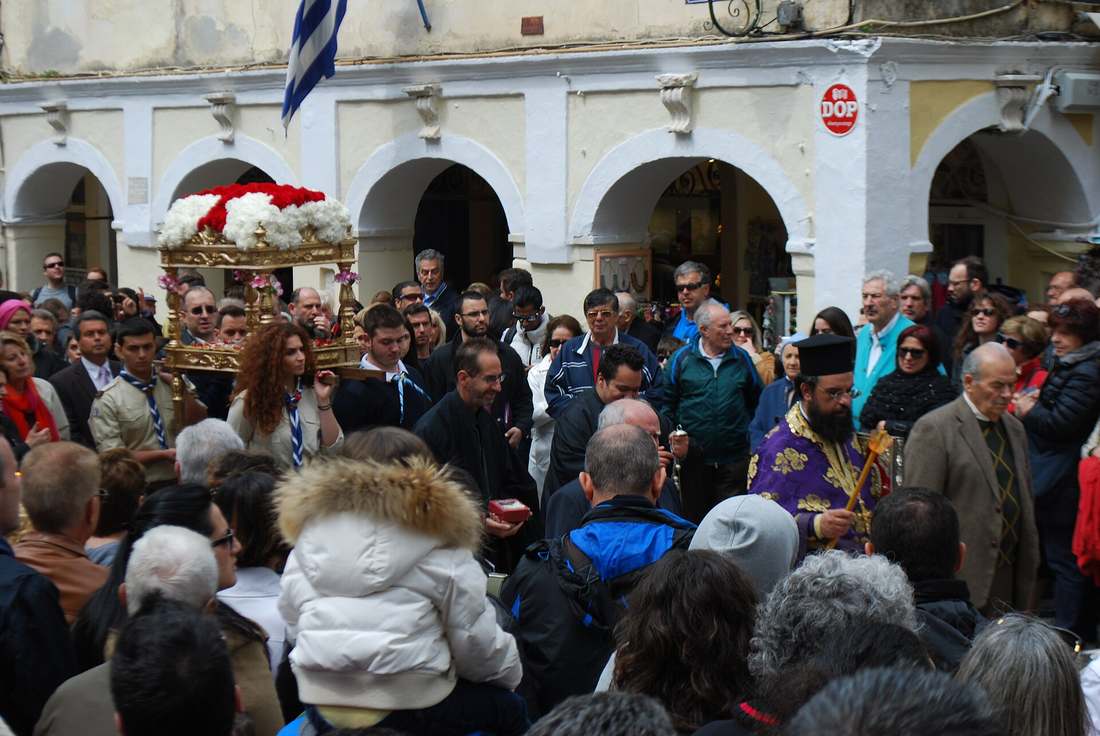
Easter is the greatest religious festival of the year on Zakynthos, kept with deep devotion and distinctive local customs. Holy Week brings solemn church services, the mourning of Good Friday, and processions of the Epitaphios through the streets. On Holy Saturday morning comes a famous custom, when people throw clay pots from their balconies to smash in the streets. The midnight service brings the joy of the Resurrection, and Easter Sunday the roasting of lamb and feasting. Share the island’s most moving season with My Greece Tours.
Easter joins the Orthodox faith to the island’s own customs and its Venetian past. Solemn Holy Week processions, the noisy pot-smashing of Holy Saturday, the midnight Resurrection and the Easter feast fill the capital and the villages. It is the deepest and most vivid season of island life. The sections below cover Holy Week, the pot-smashing custom, the Resurrection, Easter Sunday, and when to see it. Set the festival in its wider surroundings with our Zakynthos travel guide.
What is Easter like on Zakynthos?
Easter is the greatest festival of the year on Zakynthos, kept with deep devotion. Holy Week brings solemn services and processions, Holy Saturday a famous pot-smashing custom, and the midnight Resurrection joy, candles and fireworks, followed by the Easter Sunday feast.
Easter is the high point of the year for the people of the island, far greater than any summer festival. The whole of Holy Week, leading up to it, is marked by daily church services growing in solemnity, by fasting, and by the preparation of homes and churches. The mood moves from mourning to joy across the week, from the sorrow of Good Friday to the triumph of the Resurrection at midnight on Holy Saturday. The churches fill, candles burn, and the streets see processions and gatherings.
For the island, Easter is both the deepest religious observance of the year and a great family and community occasion, kept with a devotion and a set of customs all its own.
The island keeps Easter with its own distinctive traditions, some shaped by its Venetian past and its rich church music. Processions wind through the capital and the villages, church bells and choirs sound, and famous local customs, above all the pot-smashing of Holy Saturday morning, set the island’s Easter apart. The season draws islanders home from afar and fills the churches, the squares and the family table. For a visitor, being on the island at Easter offers a moving and vivid window onto its living faith and culture, a world away from the summer life of the Zakynthos beaches.
Islanders speak of Easter as the true heart of the year, a fixed point that pulls families back to the island. Emigrants and relatives return from Athens and from abroad, and the population of the villages swells in the days before the feast. Preparations run for weeks: the whitewashing of house fronts, the polishing of the family silver, the buying of new clothes for the children. Bakers work long hours over the tsoureki bread and the red-dyed eggs. Church committees clean and dress the great churches, and choirs rehearse the hymns of the Passion. This build-up gives the season a shared purpose that reaches every household.
The result is a festival woven into the fabric of island life rather than staged for outsiders.
What happens during Holy Week on Zakynthos?
During Holy Week on Zakynthos, daily church services grow in solemnity toward Easter. Good Friday brings the mourning of Christ and evening processions of the Epitaphios, the flower-decked bier, carried through the streets of the capital and villages with candles, choirs and crowds.
Holy Week is a time of deepening devotion across the island. Each day brings its own services in the churches, drawing growing crowds as Easter nears, with the faithful following the events of the Passion. Homes are cleaned and prepared, traditional Easter breads and sweets are baked, and the churches are dressed for the great feast. The rhythm of the week moves steadily toward its climax, the mood turning more solemn as Good Friday approaches. The island observes these days with a seriousness and a sense of shared tradition that shape the whole community, from the capital to the smallest hill village.
The most moving day of the week is Good Friday, the day of mourning for the crucified Christ. In the evening, processions of the Epitaphios, the flower-decked bier of Christ, wind slowly through the streets of the capital and the villages. Carried from the churches, accompanied by candles, incense, choirs and solemn music, the biers pass through crowds of the faithful in a scene of great beauty and sorrow. The great church of the island’s patron, Saint Dionysios, and the churches of the town below the castle hill of Bochali all take part. It is one of the most striking sights of the island’s religious year.
Holy Thursday marks a clear turn in the week, the day of the Last Supper and the dyeing of the red eggs. Housewives colour eggs in a deep crimson that stands for the blood of Christ, and knead the sweet tsoureki bread braided into rings. Evening brings the long service of the Twelve Gospels, when the crucifixion is read out and the figure of Christ is carried to the cross before a hushed congregation. Church bells across the island toll in a slow, mournful rhythm through the following day. Women decorate the Epitaphios bier with fresh spring flowers late into the night.
These acts prepare both the churches and the households for the sorrow of Good Friday and the joy that follows it.
What is the pot-smashing custom on Zakynthos?
On Holy Saturday morning, people on Zakynthos throw clay pots, jars and vessels from their balconies and windows to smash in the streets below. The loud custom, shared with a few other places in Greece, marks the coming Resurrection with noise and joy.
The most famous local custom of the island’s Easter comes on the morning of Holy Saturday. At a set hour, during the first celebration of the Resurrection, people lean from their balconies and windows and hurl clay pots, jars and old vessels down to smash on the streets below. The town fills with the crash of breaking pottery and the noise of the crowds, a startling and joyful spectacle. The custom is shared with a few other places in Greece, though it is strongly kept on the island. It marks the turning point of Easter, the first stirring of the Resurrection joy after the mourning of the days before, driving away the old and welcoming the new.
The pot-smashing is one of the sights that draws visitors to the island at Easter. The streets of the capital, in particular, ring with the noise, and crowds gather to watch the pots rain down and shatter. Various explanations are given for the custom, from driving out evil or the old year to marking the earthquake of the Resurrection, but for the island it is above all a beloved tradition, a moment of release and celebration. It is a vivid example of the way the island blends solemn faith with its own lively customs. The custom sits within a whole season of feasting and tradition, part of the rich culture and Zakynthos food of the island’s Easter.
The custom lands with real force in the narrow lanes of the old capital, where balconies almost meet above the street. Households save cracked jars, chipped amphorae and worn kitchen pots through the year for the moment. A signal from the churches sets it off, and pottery rains down in a rolling wave of crashes that echoes off the stone fronts. Shopkeepers below draw their shutters, and children dart in to grab shards from the heaps of broken clay. The air fills with dust, the smell of earth and the cheers of onlookers leaning from the windows above. Visitors gather early at the main squares to find a safe spot with a clear view.
The whole scene lasts a short while, yet it fixes itself firmly in the memory of anyone who sees it.
How is the Resurrection and Easter Sunday celebrated?
The Resurrection is celebrated at the midnight service on Holy Saturday, when the church lights are lit, candles passed, and fireworks fill the sky. Easter Sunday brings the roasting of lamb, feasting, wine and music among family across the island.
The heart of Easter comes at the midnight service on Holy Saturday night. The churches fill to overflowing, and shortly before midnight the lights are put out, leaving all in darkness. Then the priest brings out the holy flame, the light of the Resurrection, and it is passed from candle to candle through the church and out into the crowds, until the whole scene glows with flame. At the stroke of midnight the announcement of the Resurrection rings out, the bells peal, and fireworks and firecrackers fill the night sky over the capital.
The crowds greet one another with the Easter blessing and carry their lit candles home through the streets, a scene of great joy after the solemn days before.
Easter Sunday itself is a day of feasting and family celebration across the island. The great tradition is the roasting of whole lamb on the spit, filling the villages and gardens with smoke and the smell of the feast. Families and friends gather to eat, drink the local wine, sing and dance through the day, in a joyful release after the long fast of Lent. Traditional Easter foods, breads and sweets are shared. The celebration spreads from the capital to every village, and the island rings with music and merriment.
For a visitor, an Easter Sunday feast is a warm and vivid taste of island life and hospitality, best enjoyed away from the tourist strips in the towns and villages near Zakynthos Town and the countryside.
The passing of the holy flame carries a quiet power that the fireworks cannot match. Worshippers shield their candles with cupped hands and step carefully home through the dark streets, guarding the light against the wind. Tradition holds that the flame should reach the house still burning, to trace a small cross of soot above the front door for the coming year. The first meal after the long fast is the mageiritsa, a soup of lamb offal, egg and lemon eaten after the midnight service. Families crack the red eggs against one another, and the holder of the last unbroken egg is said to enjoy good fortune.
These small rites bind the household to the great public celebration outside. They turn a church feast into a warm gathering around the family table.
When can you experience Easter on Zakynthos?
Easter on Zakynthos falls in spring, on the date of Orthodox Easter, which changes each year and often differs from Western Easter. The celebrations run through Holy Week to Easter Sunday, with the capital the main stage for the processions and customs.
To experience the island’s Easter, a visitor must come in the spring, on the date of Orthodox Easter, which is set by the calendar of the Orthodox Church and shifts from year to year. It often falls on a different date from the Easter of the Western churches, so it is worth checking the date for the year of a visit and planning around it. This is the spring shoulder season, when the island is green and in bloom, the weather mild, and the summer crowds not yet arrived. Coming for Easter means seeing the island at one of its most beautiful and authentic times, when its life turns on the great festival rather than the beach.
The capital is the main stage for the island’s Easter, where the grandest processions pass, the pot-smashing rings loudest, and the midnight Resurrection draws the greatest crowds. Yet every village keeps its own Easter, often more intimate and traditional, so the celebration can be found across the island. To take it in, a visitor should follow the services and processions of Holy Week, watch the pot-smashing on Holy Saturday morning, attend the midnight Resurrection, and share in the Easter Sunday feasting if invited. Pairing the festival with the mild spring weather, the flowers, and a quieter island makes Easter a rewarding time to visit.
It stands quite unlike the height of summer that follows the season of the carnival and Lent before it.
Spring conditions shape the whole feel of an Easter visit to the island. Daytime temperatures sit mild and pleasant, well below the fierce heat of high summer, and the hills glow green after the winter rains. Wildflowers spread across the fields and roadsides, and the olive groves and vineyards stir back into growth. Ferries and flights run on the shoulder-season timetable, so a visitor should book seats and rooms in advance, since islanders returning home fill much of the space. Prices for lodging and travel sit below the summer peak, another reason the season rewards the culturally minded traveller. The sea stays cool for swimming, and the beach clubs have yet to open in force.
Pairing the festival with quiet drives through the countryside makes the most of the calm before the tourist year begins.
Frequently Asked Questions
When is Easter celebrated on Zakynthos?
Easter on Zakynthos is celebrated according to the calendar of the Greek Orthodox Church, which means the date changes from year to year and often differs from the Easter observed by the Western Christian churches. Orthodox Easter usually falls in the spring, somewhere between early April and early May, and the exact date depends on the Orthodox calculation tied to the spring full moon and the Jewish Passover. Because of this, anyone hoping to experience the island’s Easter should check the date of Orthodox Easter for the year of their planned visit. It may fall weeks later than the Western Easter they might be used to.
The celebrations are not confined to Easter Sunday itself but run through the whole of Holy Week beforehand, with services and processions each day. They build to the pot-smashing on Holy Saturday morning, the midnight Resurrection service, and the Easter Sunday feast. This falls in the pleasant spring shoulder season. The island is green, in bloom and mild in weather, and far quieter than the summer. It is a beautiful and authentic time to visit for those drawn by culture and tradition rather than beach holidays.
Why do people smash pots at Easter on Zakynthos?
The custom of throwing clay pots from balconies and windows to smash in the streets on Holy Saturday morning is one of the most famous Easter traditions of Zakynthos, and of a few other places in Greece. It takes place at the hour of the first celebration of the Resurrection, filling the streets of the capital with the crash of breaking pottery, the noise of firecrackers and the cheers of the crowds. Several explanations are given for the custom. Some say it drives out evil, misfortune or the old year, making way for the new life of the Resurrection.
Others link the noise to the earthquake said to have accompanied the Resurrection, or to welcoming spring by throwing out the old. Whatever its origin, for the island the pot-smashing is above all a joyful and beloved tradition, marking the turning point of Easter from the mourning of the previous days to the coming joy of the Resurrection. It draws crowds of both locals and visitors, who gather in the streets to watch the pots rain down and shatter. It is a vivid example of the way the island blends deep religious observance with its own lively customs.
Is Easter a good time to visit Zakynthos?
Easter can be a rewarding time to visit Zakynthos for travellers interested in culture, religion and authentic local life, though it is quite different from a summer beach holiday. Falling in the spring, Orthodox Easter comes in the pleasant shoulder season. The island is green and covered in wildflowers, the weather is mild, and the summer crowds have not yet arrived, so the island feels calm and authentic. Visitors at this time can witness the moving processions of Holy Week, especially the Good Friday Epitaphios. They can see the famous pot-smashing on Holy Saturday morning and the midnight Resurrection service with its candles and fireworks. The joyful Easter Sunday feasting brings roast lamb, wine and music.
Together these give a vivid and deeply felt window onto the island’s Orthodox faith, its distinctive customs and its Venetian-influenced culture. It is worth bearing in mind that this is the off-season. The sea may still be cool for swimming, and some beach resorts may not yet be in full swing. An Easter visit best suits those coming for the culture and the spring landscape rather than the sun and sea. The two can be combined later in the season.
What food is eaten at Easter on Zakynthos?
Easter food on Zakynthos follows the rhythm of the fast and the feast that ends it. The weeks of Lent keep the table plain, built on beans, greens, seafood and oil-free dishes for the strictest days. Holy Thursday brings the baking of tsoureki, the sweet braided bread flavoured with mastic and orange, and the dyeing of eggs a deep red. The first food after the midnight Resurrection is mageiritsa, a soup of lamb offal, spring onion, dill, egg and lemon that gently breaks the fast. Easter Sunday centres on whole lamb or kid roasted on the spit over charcoal, turned slowly through the morning until the skin crisps.
Alongside it come salads of spring greens, local cheeses, the red eggs cracked in a friendly contest, and jugs of island wine. Sweet treats round off the day, and the feasting stretches long into the afternoon with music and dancing among family and neighbours.