
Kos stretches roughly 40 kilometres from northeast to southwest, making location choice critical for any visit to this third-largest Dodecanese island. The capital Kos Town anchors the northeast corner with harbour ferries. Ancient sites including the Asklepion healing sanctuary and the Plane Tree of Hippocrates. A flat cycling grid that extends along the Lambi and Psalidi waterfronts. Kardamena on the south coast draws families and nightlife seekers to a purpose-built resort strip with ferries to the volcanic island of Nisyros. Kefalos and its beach suburb Kamari occupy the southwestern peninsula. Offering the island’s finest sweep of sand around a turquoise bay dotted with the ruins of Agios Stefanos basilica and the photogenic Kastri islet offshore. Plan the whole trip with Greece Tours.
Tigaki and Marmari lie just west of Kos Town along the north coast, delivering shallow water and long beaches backed by a salt-pan lagoon and wetland. Mastichari sits further west as a working fishing harbour with daily ferries to Kalymnos and a low-key village atmosphere. The mountain village of Zia clings to the slopes of Mount Dikeos at 846 metres, attracting walkers and sunset watchers to stone-built tavernas with panoramic views. Each base serves different priorities: history and nightlife concentrate in Kos Town, family beaches dominate Tigaki and Kardamena, tranquillity defines Kefalos and Mastichari, while Zia offers altitude and tradition.
The island’s length means a hire car or scooter becomes essential for exploring beyond your chosen base, though local buses connect the main resorts to the capital throughout the summer season.
Why does Kos Town suit first-time visitors to the island?
Kos Town concentrates the island’s transport hub, major ancient sites, widest choice of restaurants and bars, and direct access to the Asklepion healing sanctuary within 4 kilometres.
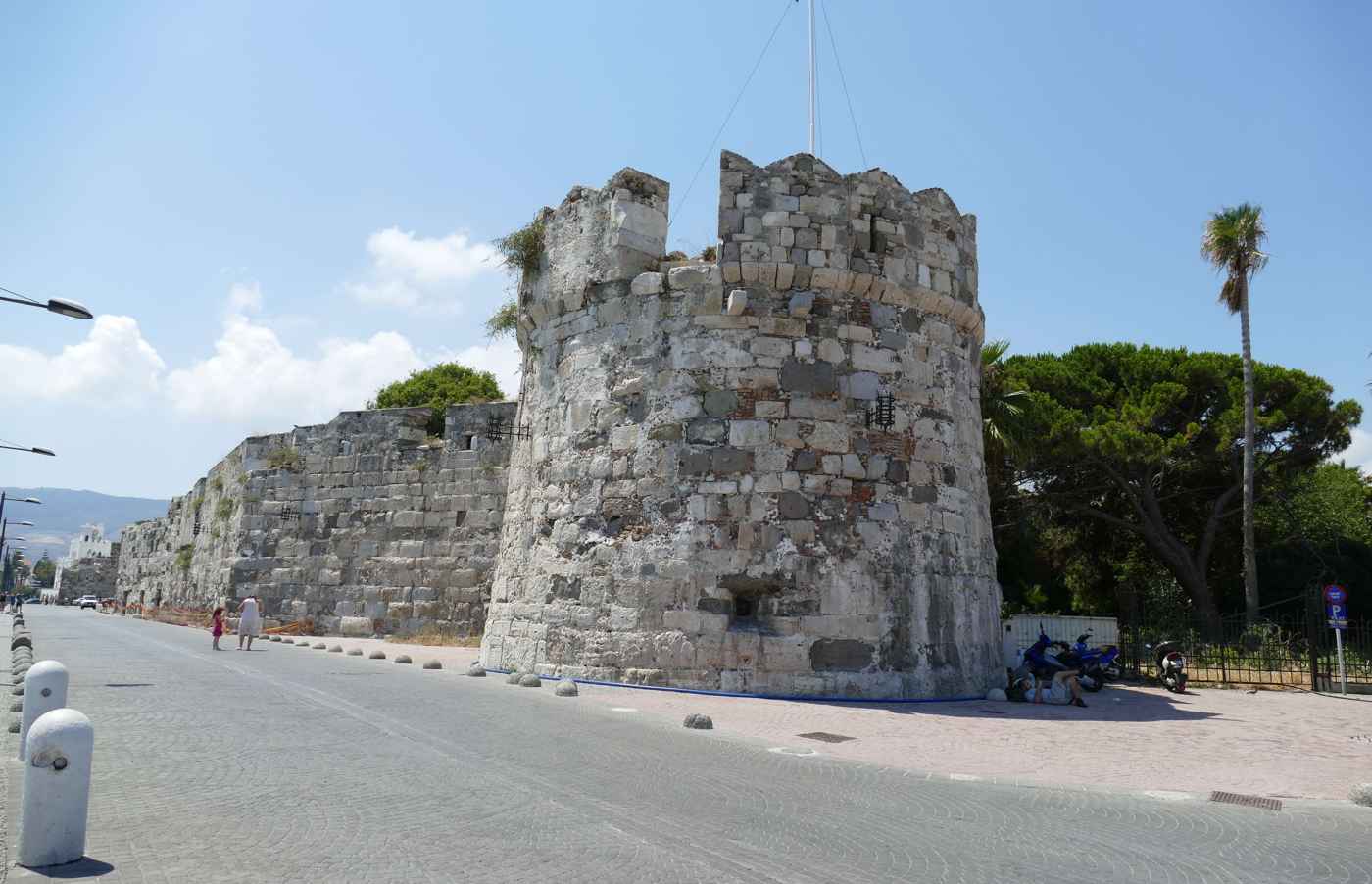
The flat grid of streets radiating from the harbour makes orientation simple. With the Castle of Nerantzia guarding the port entrance and the Plane Tree of Hippocrates marking the waterfront square where tradition places the father of medicine’s teaching spot. Ancient agora ruins occupy the town centre alongside the restored Casa Romana villa and a small odeon theatre, all within walking distance of hotels along the seafront promenades. Italian-era administrative buildings from the early twentieth century line Eleftherias Square, adding architectural variety to the archaeological layers. Bicycle rental shops cluster near the harbour, reflecting the island’s reputation as the flattest and most cycle-friendly destination in the Greek islands.
Hotels and apartments spread along two main coastal strips: Lambi beach extends northwest from the harbour for about 3 kilometres, while Psalidi beach runs southeast for roughly the same distance. Lambi attracts families with its shallow entry and organised sunbed zones, though the town’s main nightlife concentrates in the streets behind this beach. Psalidi offers a quieter alternative with pebble-and-sand stretches and views across the strait to the Turkish coast near Bodrum, just 4 nautical miles away. Both waterfronts feature dedicated cycling lanes connecting to the town centre, making car-free exploration practical for guests staying in either direction.
The capital serves as the natural base for visitors planning things to do in Kos that involve ancient sites, museum visits and day-trip ferries to Nisyros, Kalymnos, Pserimos or Turkish Bodrum. Supermarkets, pharmacies, car-hire offices and the main hospital all operate within the town boundaries, providing practical infrastructure absent from smaller resorts. Evening entertainment ranges from harbourfront cocktail bars to club venues in the Lambi district, with live-music tavernas occupying the streets around the ancient agora. The town’s size means noise levels vary significantly between the quiet residential blocks inland and the bar-heavy zones near Lambi beach.
Booking timing for Kos Town follows standard Greek island patterns. With July and August requiring advance reservations of around 8 to 12 weeks, while May, June, September and October offer more flexibility. Properties along Lambi command higher rates than equivalent Psalidi hotels, reflecting proximity to nightlife and the harbour. The shoulder months of April and late October see hotels close entirely, though a core of year-round properties serves the off-season trickle of visitors drawn by mild winter temperatures and empty archaeological sites. Families with school-age children face the highest prices during the final two weeks of August, when northern European holidays peak.
What makes Tigaki and Marmari popular with families staying on Kos?
Tigaki and Marmari beaches stretch for roughly 10 kilometres along the north coast just west of Kos Town, offering shallow water that extends 30 to 50 metres from shore and fine pale sand backed by dunes and a protected salt-pan.
Tigaki village sits 11 kilometres west of the capital, with a compact resort centre of tavernas, minimarkets and souvenir shops serving the beachfront hotel zone. The beach itself runs for about 5 kilometres, wide enough to absorb summer crowds without feeling packed, and organised into sunbed zones interspersed with free-access stretches. Shallow water persists for the entire length, with depths rarely exceeding 1 metre within 40 metres of the waterline. Windsurfers and kitesurfers favour the western end near the Alikes salt lake, where afternoon thermal winds blow reliably from June through September. The lake itself attracts flamingos and wading birds during spring and autumn migration periods, adding a nature-watching dimension absent from more developed resorts.
Marmari lies 4 kilometres further west, smaller and quieter than Tigaki but sharing the same beach characteristics of shallow entry and pale sand. The village centres on a single main street running parallel to the shore. With around a dozen tavernas and a handful of minimarkets serving the low-rise apartment blocks and small hotels. Marmari’s beach extends roughly 3 kilometres, backed by tamarisk trees that provide natural shade at the eastern end. The resort attracts a higher proportion of independent travellers and couples than Tigaki, which skews more heavily toward package-holiday families.
Both villages sit within easy reach of Kos Town for evening excursions, with local buses running hourly during summer and the flat coastal road ideal for cycling.
Accommodation in both resorts consists primarily of three-star hotels and self-catering apartment complexes, with very few luxury properties. Room rates typically run 15 to 20 per cent below equivalent Kos Town hotels, reflecting the quieter atmosphere and distance from the capital’s nightlife and ancient sites. All-inclusive packages dominate Tigaki, while Marmari retains a higher proportion of room-only and bed-and-breakfast properties. Neither village offers significant historical attractions, making them pure beach-and-relaxation bases rather than cultural touring hubs. The salt-pan lagoon behind the beaches prohibits construction, ensuring the resorts remain low-rise and preserving open views inland toward the slopes of Mount Dikeos.
Families planning extended stays often choose Tigaki or Marmari for the combination of safe swimming, proximity to the capital and lower costs than beachfront Kos Town hotels. The shallow water means parents can relax while children play in depths that remain waist-high for adults even 40 metres offshore. Evening entertainment stays low-key, with tavernas offering the main diversion and no significant club scene in either village. Booking windows follow the same patterns as Kos Town, with July and August requiring advance planning while June and September offer walk-in availability at properties. The resorts close almost entirely from November through March, with only a handful of year-round hotels remaining open.
How does Kardamena differ from other resorts on Kos?
Kardamena on the south coast 28 kilometres from Kos Town combines a purpose-built resort strip with a working fishing harbour, delivering both organised beach tourism and daily ferry connections to Nisyros volcano island.
The resort stretches for roughly 3 kilometres along a south-facing bay, with the fishing harbour and ferry dock at the eastern end and hotel zones extending west along the beach. Kardamena’s main street runs parallel to the shore one block inland, lined with around 60 bars, restaurants, souvenir shops and minimarkets creating a continuous commercial strip. The beach itself consists of dark sand mixed with pebbles, organised into sunbed zones managed by individual hotels and beach-bar operators. Water depth increases more rapidly than at Tigaki or Marmari, reaching 2 metres within 15 to 20 metres of the waterline. Making it less ideal for very young children but suitable for confident swimmers and snorkellers.
Nightlife defines Kardamena’s character more than any other Kos resort, with club venues opening around midnight and continuing until dawn during July and August. The main street transforms into a pedestrian zone each evening, with music spilling from open-fronted bars and promotional staff offering drink deals to passing tourists. This atmosphere attracts a younger demographic than Kos Town, with groups of friends in their twenties and early thirties forming the core clientele. Families with teenagers often choose Kardamena for the combination of beach access and evening entertainment, though parents with young children typically find the noise levels and late-night activity unsuitable. The resort’s reputation for partying means room rates stay competitive despite the long beach and ferry connections.
Ferry services to Nisyros depart from Kardamena harbour daily during summer, with the crossing to the volcanic island taking around 45 minutes. Day-trip boats also run to the tiny island of Pserimos and occasionally to Kalymnos, making Kardamena a practical base for island-hopping without returning to Kos Town. The harbour retains its fishing-village character at the eastern end, with traditional tavernas serving the morning’s catch and local families maintaining homes among the tourist infrastructure. This blend of authentic Greek life and resort development gives Kardamena more texture than purely purpose-built destinations, though the balance tips heavily toward tourism during peak season.
The village sits roughly equidistant from Kos Town and Kefalos, making it a central base for exploring Kos beaches in both directions.
Booking patterns for Kardamena show strong demand from British and Scandinavian package operators, with hotels operating on allocation systems that reserve blocks of rooms for tour companies. Independent travellers booking directly often find better availability in June and September than in August, when package allocations fill the larger properties. Room rates peak during the first two weeks of August, then drop noticeably after the twentieth of the month as northern European school holidays end. The resort closes more gradually than Tigaki or Marmari, with around 30 per cent of properties remaining open through October to serve late-season visitors. Kardamena suits visitors prioritising nightlife, ferry access and beach proximity over historical sightseeing or tranquil relaxation.
Why do visitors choose Kefalos and Kamari for beach-focused stays on Kos?
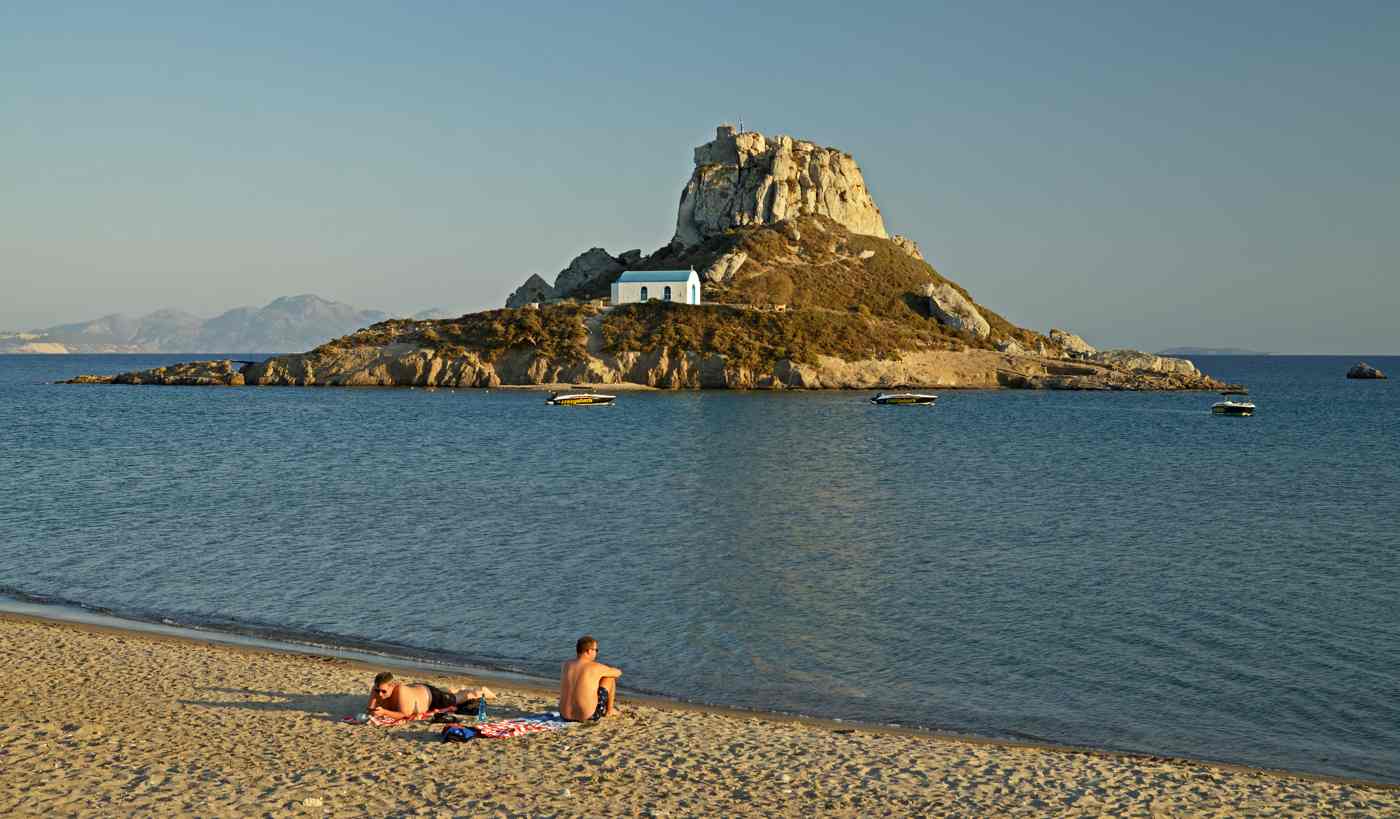
Kefalos village and its coastal extension Kamari occupy the southwestern peninsula 43 kilometres from Kos Town, fronting a sweeping bay with pale sand, turquoise water and the photogenic Kastri islet chapel offshore.
Kefalos village sits on a hillside roughly 2 kilometres inland from the coast, with whitewashed houses climbing the slope and a traditional plateia square lined with kafeneions and tavernas. The village retains a working Greek character, with local families outnumbering tourists and daily life continuing independent of the beach tourism below. Kamari beach stretches along the bay at sea level, a ribbon of hotels, apartments and beach tavernas extending for about 4 kilometres along the sand. The beach itself ranks among the finest on Kos, with soft pale sand. Clear water and views across to the ruins of Agios Stefanos basilica at the northern end of the bay.
The twin columns of the fifth-century church stand directly on the shore, creating a distinctive landmark visible from the entire beach length.
Paradise Beach, also called Bubble Beach for the volcanic gas bubbles rising through the sand underwater, lies at the southern end of the bay about 6 kilometres from Kamari village. The beach attracts day-trippers and independent travellers to its mix of organised sunbed zones and free-access stretches, with several beach-bar tavernas providing facilities. Camel Beach and Magic Beach occupy adjacent coves further south, accessible by dirt track or on foot, offering more seclusion at the cost of basic facilities. The entire southwestern peninsula delivers a beach-first experience, with historical sites limited to the Agios Stefanos ruins and a small archaeological museum in Kefalos village.
Visitors prioritising ancient monuments over sand and sea typically choose Kos Town or combine a Kefalos beach stay with day trips to the Kos capital and Asklepion.
Accommodation spreads between hillside Kefalos village and beachfront Kamari, with the choice determining atmosphere and convenience. Kefalos village properties offer lower rates, traditional architecture and evening breezes at altitude, but require a car or scooter for beach access down the winding 2-kilometre road. Kamari hotels and apartments deliver direct beach access and sea views, with prices reflecting the waterfront location. The area attracts couples, independent travellers and families seeking a quieter alternative to Kardamena, with nightlife limited to taverna dining and a handful of low-key bars.
The distance from Kos Town and the airport makes Kefalos the least convenient base for day trips to other parts of the island, though the striking bay scenery and relaxed pace compensate for the remote location.
Local buses connect Kefalos and Kamari to Kos Town three to four times daily during summer, with the journey taking around 75 minutes along the winding coastal road. Most visitors staying in this area hire a car or scooter for the duration of their stay. Using the vehicle to explore the southwestern beaches and make occasional trips to the capital or Asklepion. Booking timing follows the same summer peak patterns as other resorts, though Kefalos and Kamari see slightly lower occupancy rates in July than Kardamena or Kos Town, reflecting the distance from the airport and main port.
September offers excellent value, with warm sea temperatures, reduced crowds and room rates dropping 20 to 30 per cent below August levels. The area suits visitors who prioritise beach quality and tranquillity over nightlife and cultural sightseeing.
What attracts visitors to stay in Mastichari on Kos?
Mastichari sits on the north coast 30 kilometres west of Kos Town as a working fishing harbour with daily ferries to Kalymnos island, offering a low-key village atmosphere, a long sandy beach and tavernas serving fresh seafood.
The village centres on a small harbour where fishing boats moor alongside the Kalymnos ferry dock, with a compact waterfront lined by around a dozen traditional tavernas and caf\u00e9s. Mastichari retains a genuine Greek character, with local families operating most businesses and village life continuing independent of the summer tourist season. The beach extends for roughly 4 kilometres west from the harbour, a mix of pale sand and occasional pebble patches backed by low dunes and agricultural land. Water depth increases gradually, reaching waist height within 20 metres of shore, making the beach suitable for families while avoiding the extreme shallows of Tigaki.
Organised sunbed zones occupy the stretches nearest the village, while the western end remains largely undeveloped and accessed by a dirt track running behind the dunes.
Accommodation consists of small hotels, family-run pensions and self-catering studios, with no large resort complexes or all-inclusive properties. The village attracts independent travellers, couples and older visitors who value tranquillity over entertainment, with evening activity limited to taverna dining and waterfront strolls. Mastichari’s fishing heritage means seafood quality exceeds most Kos resorts, with octopus, squid and daily catches grilled in the harbour tavernas each evening. The absence of bars and clubs creates a peaceful atmosphere that appeals to visitors escaping the busier resorts, though families with teenagers seeking entertainment typically find Mastichari too quiet. The village sits roughly midway between Kos Town and Kefalos.
Making it a practical base for exploring the island with a hire car while returning each evening to a calm setting.
Ferry connections to Kalymnos depart daily during summer, with the crossing taking around 30 minutes to Pothia, the sponge-diving capital’s main port. Day-trip boats also run to Pserimos, a tiny island with a single sandy beach and a handful of tavernas, popular with visitors seeking even greater seclusion. Mastichari’s harbour gives the village a functional purpose beyond tourism, with local fishermen and inter-island commuters using the facilities year-round. This working character distinguishes Mastichari from purpose-built resorts like Kardamena, creating an atmosphere closer to traditional Greek island life. Visitors planning to explore how to get to Kos and then island-hop to Kalymnos often choose Mastichari for the direct ferry access and authentic village setting.
Booking windows for Mastichari show less advance demand than Kos Town or Kardamena, with properties accepting reservations just two to four weeks ahead even during August. The village’s small scale and limited nightlife mean it never reaches the saturation levels of larger resorts, though the best waterfront tavernas fill quickly on summer evenings. Room rates run 10 to 15 per cent below equivalent Kos Town properties, reflecting the quieter atmosphere and distance from the capital’s attractions. The village maintains a longer season than purely beach-focused resorts, with hotels and tavernas remaining open through October and into November to serve ferry passengers and off-season visitors.
Mastichari suits travellers who prioritise authenticity, seafood quality and peaceful evenings over organised entertainment and proximity to ancient sites.
How does mountain village Zia differ from coastal bases on Kos?
Zia clings to the northern slopes of Mount Dikeos at around 320 metres elevation, 14 kilometres southwest of Kos Town, offering stone-built architecture, panoramic Aegean views and sunset-watching tavernas.
The village consists of a single main street winding uphill through stone houses, with around 20 tavernas, caf\u00e9s and souvenir shops occupying restored buildings and terraced gardens. Zia’s elevation delivers temperatures around 3 to 5 degrees cooler than the coast during summer, with evening breezes making outdoor dining comfortable even in August. Sunset views from the upper tavernas stretch across the northern coastal plain to the Turkish mountains beyond, drawing coach-loads of day-trippers who arrive around 90 minutes before dusk. This influx transforms the quiet village into a crowded tourist hub between and 2100 hours during summer, with the main street packed and taverna terraces filled.
Visitors staying overnight experience a different Zia, with the village returning to tranquillity after the tour buses depart and local families reclaiming the streets.
Accommodation options remain limited, with around six small hotels and guesthouses offering a total of fewer than 100 beds. Properties feature traditional stone architecture, terraced gardens and views across the island to the sea, with room rates comparable to mid-range Kos Town hotels despite the basic facilities. Zia suits walkers and nature enthusiasts who use the village as a base for hiking trails that climb Mount Dikeos to the summit at 846 metres, the island’s highest point. The ascent takes around 90 minutes from Zia, following a marked path through pine forest and rocky terrain to a peak offering 360-degree views across the Dodecanese.
The trail continues down the southern slopes to Pyli village, creating a through-hike option for fit walkers with transport arranged at both ends.
The village’s mountain setting means no beach access without descending to the coast, making Zia impractical as a sole base for visitors prioritising swimming and sunbathing. Most overnight guests combine nights in Zia with a longer coastal stay, using the mountain interlude for walking, cooler temperatures and a change of atmosphere. The village sits roughly equidistant from Kos Town and the central airport, with the winding mountain road taking around 25 minutes by car from the capital. Local buses serve Zia twice daily during summer, though the limited schedule makes a hire car essential for visitors staying overnight.
The village offers no nightlife beyond taverna dining, with the last customers typically leaving by 2200 hours and the streets falling silent soon after.
Booking patterns for Zia show minimal advance demand outside the handful of peak August weeks, with most properties accepting same-day reservations during shoulder months. The village’s small accommodation capacity means it fills during the final two weeks of August, when coastal resorts reach saturation and visitors seek alternative bases. Room rates stay stable throughout the season, with none of the dynamic pricing seen in larger resorts. Zia closes almost entirely from November through March, with only two tavernas and one guesthouse remaining open for the handful of winter walkers and off-season visitors. The village suits active travellers who value mountain scenery, traditional architecture and walking trails over beach access and coastal convenience.
Functioning best as a short addition to a longer coastal stay rather than a standalone base.
Which areas of Kos offer the best access to ancient sites and historical attractions?
Kos Town provides walking access to the ancient agora, Casa Romana villa, odeon theatre and Plane Tree of Hippocrates, with the Asklepion healing sanctuary 4 kilometres southwest reached by bus, taxi or bicycle.
The Asklepion terraced sanctuary dedicated to Asclepius, god of healing, ranks as the island’s premier ancient site. Built on three levels overlooking the sea with temples, treatment rooms and a medical school where Hippocrates’ followers practised. The site sits on a hillside 4 kilometres southwest of Kos Town. Accessible by local bus that departs hourly during summer or by bicycle along a dedicated cycle path that climbs gently through farmland. Visitors staying in Kos Town reach the Asklepion within 20 minutes by bus or 30 minutes by bike, making day trips simple without requiring a hire car.
The site opens daily from 0800 to 1500 hours during summer, with no artificial shade and temperatures often exceeding 35 degrees Celsius by midday, making early-morning visits advisable. The three terraces climb the hillside, connected by monumental staircases, with the upper level offering panoramic views across the strait to Turkey.
Kos Town’s ancient agora occupies a large excavated area in the town centre, with column stumps, mosaic fragments and foundation walls spread across several city blocks. The Casa Romana, a restored Roman villa with floor mosaics and frescoed walls, sits adjacent to the agora. Offering a glimpse of wealthy domestic life during the second and third centuries. The small odeon theatre nearby seats around 750 spectators and hosts occasional summer concerts, with 14 rows of marble seating surviving in good condition. The Castle of Nerantzia guards the harbour entrance, built by the Knights of St John during the fourteenth and fifteenth centuries using stones quarried from ancient buildings.
The castle opens to visitors, with rampart walks offering harbour views and a small museum displaying medieval armour and pottery. All these sites lie within a 15-minute walk of each other, making Kos Town the only base offering concentrated historical attractions on foot.
Antimachia village sits 4 kilometres from the airport in the island’s centre, with a Venetian castle crowning a hill above the modern settlement. The fortress walls enclose a large area containing ruined houses, two churches and cisterns, with rampart walks providing views across the island’s narrow waist to both north and south coasts. The castle sees fewer visitors than the Asklepion despite its impressive scale, with most tourists passing through Antimachia only for airport transfers. Pyli village 14 kilometres southwest of Kos Town splits between a modern settlement in the valley and abandoned Palio Pyli on the hillside above. Where Byzantine church ruins and a castle occupy a dramatic clifftop site.
The climb to Palio Pyli takes around 30 minutes on foot from the modern village, following a rough path through scrub vegetation to the atmospheric ruins. Neither Antimachia nor Pyli offers significant accommodation, making them day-trip destinations rather than overnight bases.
Visitors prioritising ancient sites and historical attractions choose Kos Town as their base. Accepting higher costs and busier beaches in exchange for walking access to the main monuments and easy Asklepion trips. Staying in coastal resorts like Kardamena, Kefalos or Mastichari means dedicating full days to historical sightseeing, with the round-trip distances and limited bus schedules making casual visits impractical. The island’s long, narrow shape works against multi-centre touring, with the 43-kilometre distance from Kos Town to Kefalos taking around 75 minutes by car along winding coastal roads. Most visitors choose a single base and make day trips by hire car or organised coach tours, rather than moving accommodation mid-stay.
The concentration of ancient sites near Kos Town makes the capital the logical choice for history-focused visits, while beach-priority travellers accept the trade-off of distance from monuments in exchange for superior sand and quieter settings.
What practical factors affect choosing where to stay on Kos?
Transport logistics dominate base selection on this 40-kilometre-long island, with hire-car availability, bus frequency, cycling infrastructure and airport transfer distances varying significantly between resorts.
Kos International Airport sits near Antimachia village in the island’s centre, creating transfer distances that range from 24 kilometres to Kos Town. 8 kilometres to Kardamena, 28 kilometres to Mastichari and 31 kilometres to Kefalos. Taxi fares reflect these distances, with Kos Town transfers costing around double the Kardamena rate and Kefalos commanding the highest fares. Pre-booked shuttle buses serve all main resorts, with per-person rates often undercutting taxis for couples and families. Visitors staying in Kos Town benefit from the shortest transfer and the option to skip car hire entirely. Using buses and bicycles for local trips and organised tours for distant beaches.
Guests in Kardamena, Kefalos or Mastichari face longer transfers but gain proximity to specific beaches and ferry ports, with the trade-off depending on individual priorities.
Bus services radiate from Kos Town to all main resorts during summer, with Tigaki and Marmari receiving hourly departures. Kardamena served four to six times daily. Kefalos and Mastichari connected three to four times daily. Frequencies drop sharply outside July and August, with routes reducing to two departures daily in May, June and September. The bus network makes car-free exploration feasible for visitors staying in Kos Town who plan beach days and village visits at a relaxed pace, though the limited schedules mean missing a return bus can strand travellers for hours. Hire cars and scooters offer freedom at the cost of parking challenges in Kos Town and higher daily rates during August.
The island’s compact size means even the longest journey from Kos Town to Kefalos takes under 90 minutes, making day trips practical despite the distances.
Cycling infrastructure concentrates around Kos Town, with dedicated lanes running along the Lambi and Psalidi waterfronts and a paved path climbing to the Asklepion. Flat terrain extends west to Tigaki and Marmari, making bicycle touring practical along the north coast for around 15 kilometres from the capital. The rest of the island features hilly terrain and narrow roads without cycle lanes, limiting safe cycling to confident riders comfortable with motor traffic. Kos Town’s bicycle-friendly reputation applies primarily to the immediate area around the capital, not the island as a whole. Visitors planning cycling-focused stays choose Kos Town or the Tigaki-Marmari strip, while those staying in Kardamena, Kefalos or Mastichari rely on cars or scooters for transport.
The island’s cycling culture means rental shops cluster in Kos Town, with limited availability in smaller resorts.
Supermarket access, medical facilities and banking services concentrate in Kos Town, with smaller resorts offering basic minimarkets and pharmacies but lacking full-service infrastructure. Visitors with specific dietary requirements, prescription medications or banking needs find Kos Town the most practical base, while healthy travellers content with taverna dining and basic shopping manage easily in any resort. The capital’s hospital provides the island’s main emergency medical services, with health centres in Kardamena and Kefalos handling minor issues. ATMs operate in all main resorts, though Kefalos and Mastichari each have only two machines that occasionally run dry during peak August weeks.
These practical considerations rarely dominate base selection but can affect day-to-day convenience, particularly for families with young children or visitors with medical conditions requiring regular pharmacy access.
How do seasonal patterns affect accommodation availability and rates across Kos?
Peak season from mid-July through August sees occupancy rates above 90 per cent in all main resorts, with advance booking essential and rates reaching annual highs.
July and August dominate the Kos tourism calendar, with northern European school holidays driving demand during the final two weeks of July and first three weeks of August. Room rates peak during this window, often running 40 to 50 per cent above June levels, with minimum-stay requirements of seven nights common in package-oriented properties. Independent travellers booking directly face limited availability, with the best-value properties and sea-view rooms typically reserved months ahead. Kos Town and Kardamena fill first, followed by Tigaki and Kefalos, while Mastichari and Zia retain slightly better availability due to their quieter character.
Temperatures during peak season regularly exceed 32 degrees Celsius, with sea temperatures reaching 25 to 26 degrees, ideal for swimming but challenging for visitors uncomfortable with heat. Beaches reach maximum crowding, with organised sunbed zones filling by mid-morning and free-access stretches becoming packed by midday.
June and September offer the best balance of weather, availability and value for visitors with flexible travel dates. June temperatures average 28 to 30 degrees Celsius, with sea temperatures around 22 to 23 degrees, warm enough for comfortable swimming without the intensity of high summer. September maintains similar conditions, with sea temperatures peaking at 24 to 25 degrees after the summer heat and air temperatures gradually declining through the month. Room rates during these shoulder months run 20 to 30 per cent below August peaks, with booking windows shortening to two to four weeks for most properties. Beaches feel noticeably less crowded, with space available even on popular stretches like Tigaki and Kamari.
Bus frequencies remain high through mid-September, then begin reducing as the month progresses and hotels start closing for the season.
May and October mark the season edges, with May offering spring wildflowers. Green hillsides and temperatures around 24 to 26 degrees but cooler sea temperatures of 19 to 20 degrees that deter swimmers. October reverses the pattern, with sea temperatures holding at 22 to 23 degrees while air temperatures drop to 24 to 26 degrees and the landscape turns brown after the dry summer. Both months see significant hotel closures, with around 40 per cent of properties shutting in May and 60 per cent closed by late October. Visitors during these months find excellent room rates, often 50 per cent below August levels, but face limited taverna choices and reduced bus services.
The quieter atmosphere appeals to couples and older travellers seeking relaxation over entertainment, with beaches nearly empty and ancient sites accessible without crowds.
November through April sees the island enter low season, with most hotels, tavernas and tourist infrastructure closed. Kos Town retains a core of year-round hotels and restaurants serving the local population and handful of off-season visitors, while resorts like Kardamena, Tigaki and Kefalos become ghost towns with shuttered properties and deserted streets. Winter temperatures average 14 to 18 degrees Celsius, mild by northern European standards but too cool for beach tourism, with occasional rain between December and February. The visitors during these months come for walking, cycling and cultural touring, staying in Kos Town and using the quiet roads for exploration. Ferry services reduce to skeleton schedules, with some island connections suspended entirely until spring.
The off-season offers insights into authentic Greek island life beyond tourism, with local families reclaiming the towns and traditional rhythms resuming, but requires accepting limited facilities and weather uncertainty.
What distinguishes package-holiday bases from independent-traveller areas on Kos?
Kardamena and Tigaki attract the highest concentration of package-holiday operators, with all-inclusive hotels, organised entertainment and tour-company allocations dominating the accommodation stock.
Package-holiday infrastructure concentrates in resorts with long beaches, large hotels and purpose-built entertainment facilities. Kardamena exemplifies this model, with around 70 per cent of beds allocated to British, German and Scandinavian tour operators who block-book properties for the entire summer season. All-inclusive hotels dominate the resort, offering buffet meals, poolside bars and organised activities that keep guests on-property for most of their stay. This model creates a self-contained tourism bubble, with visitors rarely venturing beyond their hotel complex and the adjacent beach. Tigaki follows a similar pattern, though with a slightly lower all-inclusive percentage and more family-oriented properties.
Both resorts feature evening entertainment programmes, kids’ clubs and poolside animation teams, delivering a standardised holiday experience that appeals to families seeking predictability and convenience.
Independent travellers booking directly often find better value and more authentic experiences in resorts less dominated by package operators. Mastichari’s small-scale properties and working-harbour character attract visitors seeking traditional Greek atmosphere, with family-run hotels and studios offering room-only or bed-and-breakfast rates. The absence of large all-inclusive complexes means guests eat in village tavernas, supporting local businesses and experiencing more varied cuisine than buffet dining provides. Kefalos and Kamari occupy middle ground, with package properties concentrated along the beachfront while the hillside village retains independent guesthouses and traditional pensions. Kos Town’s diverse accommodation stock serves both markets, with seafront hotels selling allocations to tour operators while backstreet pensions and boutique properties cater to independent bookers.
Pricing structures differ significantly between package and independent properties. All-inclusive hotels quote per-person rates covering accommodation, meals and drinks, with children often staying free or at reduced rates when sharing parent rooms. This model delivers budget certainty and appeals to families watching spending, though the per-person cost often exceeds room-only rates for couples without children. Independent properties quote room rates, leaving guests free to choose dining options and control food budgets. Taverna meals typically cost less than the daily supplement for all-inclusive upgrades, particularly for couples who eat light lunches and share dishes at dinner.
The trade-off involves convenience versus flexibility, with all-inclusive guests avoiding meal planning while independent travellers gain freedom to explore village tavernas and beach restaurants.
Atmosphere varies sharply between package-dominated and independent-traveller resorts. Kardamena’s main street fills with British and German voices, with bars showing Premier League football and menus offering familiar northern European dishes alongside Greek options. Mastichari tavernas serve primarily Greek customers and independent travellers, with menus focused on local seafood and traditional recipes. Neither model suits all visitors, with the choice depending on comfort with unfamiliar environments and desire for cultural immersion versus holiday familiarity. Families with young children often prefer package resorts for the kids’ clubs, shallow pools and organised activities, while couples and older travellers gravitate toward quieter independent bases.
Kos Town offers both atmospheres in different zones, with the Lambi strip delivering package-holiday energy while backstreet neighbourhoods retain local character.
Frequently Asked Questions
How far in advance do I book accommodation on Kos?
August accommodation requires booking 8 to 12 weeks ahead. Particularly for the final two weeks of the month when northern European school holidays peak and occupancy rates exceed 90 per cent across all main resorts. July sees similar demand during its second half, with advance windows of 6 to 10 weeks advisable for preferred properties and sea-view rooms. June and September offer more flexibility, with booking windows of 2 to 4 weeks sufficient for most hotels and apartments, though the best-value properties in popular areas like Kos Town and Kefalos still fill early. May and October require minimal advance planning, with properties accepting reservations just days ahead as visitor numbers drop and hotels begin seasonal closures.
Package-holiday properties selling allocations to tour operators often release unsold rooms to direct bookers around 4 to 6 weeks before arrival, creating last-minute opportunities during peak season. Independent hotels and family-run pensions maintain more consistent availability, accepting direct bookings throughout the season without the allocation complications of package-oriented properties.
Do I need a hire car when staying on Kos?
Visitors staying in Kos Town manage without a car using the local bus network, bicycles and organised tours. With hourly buses reaching Tigaki and Marmari and multiple daily departures to Kardamena, Kefalos and Mastichari. The capital’s flat cycling infrastructure and concentrated ancient sites make car-free exploration practical for guests prioritising the Asklepion, town beaches and nearby attractions. Guests in Kardamena, Kefalos or Mastichari find a hire car or scooter essential for exploring beyond their immediate resort. With bus frequencies of just 3 to 4 daily departures limiting spontaneous trips and creating long waits for return journeys.
The island’s 40-kilometre length means even the longest drive from Kos Town to Kefalos takes under 90 minutes, making day trips practical across the entire island with personal transport. Hire costs vary from around 25 to 45 euros daily for a small car depending on season and booking timing. With August commanding peak rates and shoulder months offering better value. Scooters cost roughly 60 per cent of car-hire rates but require confidence with two-wheeled transport on winding coastal roads shared with tour buses and trucks.
Which Kos resort offers the best beaches for families with young children?
Tigaki and Marmari deliver the shallowest water on Kos. With depths remaining under 1 metre for 30 to 50 metres from shore along 10 kilometres of pale sand backed by dunes and a protected salt-pan lagoon. The gentle gradient allows toddlers and young swimmers to play safely while parents relax nearby, with the absence of rocks and the soft sand adding to the child-friendly environment. Both resorts feature organised sunbed zones with lifeguard supervision during summer, interspersed with free-access stretches where families spread their own umbrellas and beach equipment.
Tigaki offers more facilities, with around 20 tavernas, minimarkets and ice-cream shops serving the beachfront hotel zone, while Marmari stays quieter with a dozen businesses along its single main street. Kamari beach in the Kefalos area provides another excellent family option, with pale sand and clear water in a scenic bay, though depths increase more quickly than at Tigaki and the 43-kilometre distance from Kos Town makes it less convenient for visitors planning cultural day trips. Kardamena’s beach sees faster depth increase, reaching 2 metres within 15 to 20 metres of shore, making it better suited to confident swimmers than very young children.
What is the quietest area to stay on Kos?
Mastichari on the north coast offers the most tranquil resort atmosphere, with a working fishing harbour, traditional tavernas and no significant nightlife beyond waterfront dining. The village attracts couples, older travellers and independent visitors seeking authentic Greek character over organised entertainment, with evening activity limited to harbour strolls and seafood dinners. Kefalos village on its hillside 2 kilometres inland from Kamari beach retains a traditional mountain settlement feel, with whitewashed houses. A plateia square and local families outnumbering tourists, though the beachfront Kamari zone below sees more development and summer activity. Marmari delivers quiet beach access just 15 kilometres from Kos Town, smaller and less developed than neighbouring Tigaki.
With low-rise apartments and a single main street serving a 3-kilometre sandy beach. Mountain village Zia offers altitude and traditional stone architecture but fills with day-tripping tour groups between and 2100 hours during summer, returning to tranquillity only after the coaches depart. Visitors prioritising complete peace choose Mastichari or hillside Kefalos, accepting the distance from Kos Town’s attractions and the need for personal transport to explore the island.
Can I stay on Kos outside the main summer season?
May and October mark the practical season edges, with around 60 per cent of hotels remaining open in May and 40 per cent operating through October before widespread closures begin. May offers spring wildflowers, green hillsides and air temperatures around 24 to 26 degrees Celsius, though sea temperatures of 19 to 20 degrees feel cool for extended swimming. October reverses the pattern, with sea temperatures holding at 22 to 23 degrees after the summer heat while air temperatures decline to 24 to 26 degrees and the landscape turns brown. Both months deliver excellent room rates, often 50 per cent below August levels, with booking flexibility and nearly empty beaches compensating for reduced taverna choices and lower bus frequencies.
November through April sees most resorts close entirely, with Kos Town retaining around a dozen year-round hotels and restaurants serving the local population and handful of off-season visitors. Winter temperatures average 14 to 18 degrees Celsius, mild for walking and cycling but too cool for beach tourism, with occasional rain between December and February. Ferry services reduce to skeleton schedules, some island connections suspend entirely, and the quiet roads offer insights into authentic Greek island life beyond the tourism season.
How does Kos Town compare to beach resorts for a first visit?
Kos Town delivers the broadest experience for first-time visitors, combining walking access to the ancient agora, Casa Romana villa. Odeon theatre and Plane Tree of Hippocrates with easy trips to the Asklepion healing sanctuary 4 kilometres southwest. The capital’s harbour receives ferries from Athens, Rhodes and neighbouring islands, making day trips to Nisyros, Kalymnos and Pserimos practical without changing accommodation base. Town beaches along the Lambi and Psalidi waterfronts provide swimming options within cycling distance, though the sand quality and water clarity fall short of southwestern beaches around Kefalos and Kamari.
Nightlife concentrates in Kos Town, with harbourfront cocktail bars, club venues in the Lambi district and live-music tavernas around the ancient agora offering the island’s widest evening entertainment. The flat cycling grid and dedicated bike lanes make car-free exploration feasible, with bicycle rental shops clustering near the harbour. Beach-focused resorts like Kefalos, Kardamena and Tigaki deliver superior sand and shallower water but require full-day commitments for historical sightseeing. With round-trip distances and limited bus schedules making casual ancient-site visits impractical. First-timers balancing culture, beaches and convenience typically choose Kos Town, while return visitors often select beach-priority bases having already toured the main monuments.
What accommodation options exist beyond standard hotels on Kos?
Self-catering studios and apartments dominate Tigaki, Marmari and Kefalos, offering kitchenettes, separate bedrooms and lower costs than equivalent hotel rooms, particularly for families and groups staying a week or longer. These properties typically provide daily cleaning, linen changes and basic breakfast provisions, operating as hybrid accommodation between full-service hotels and pure self-catering rentals. Traditional guesthouses and pensions survive in Mastichari, hillside Kefalos and backstreet Kos Town, often family-run with fewer than 10 rooms, simple furnishings and personal service that larger hotels cannot match. Villas with private pools scatter across the island, concentrated in the hills above Kefalos and around Pyli village, appealing to families and groups seeking privacy and space at premium rates.
These properties require advance booking of 12 to 16 weeks for August, with minimum stays of seven nights standard during peak season. Budget options remain limited on Kos, with just two hostels operating in Kos Town and basic pensions offering the lowest rates. Typically 40 to 50 per cent below mid-range hotel prices. Camping exists at one official site near Psalidi beach east of Kos Town, with basic facilities and direct beach access attracting backpackers and budget-conscious families during summer months.