
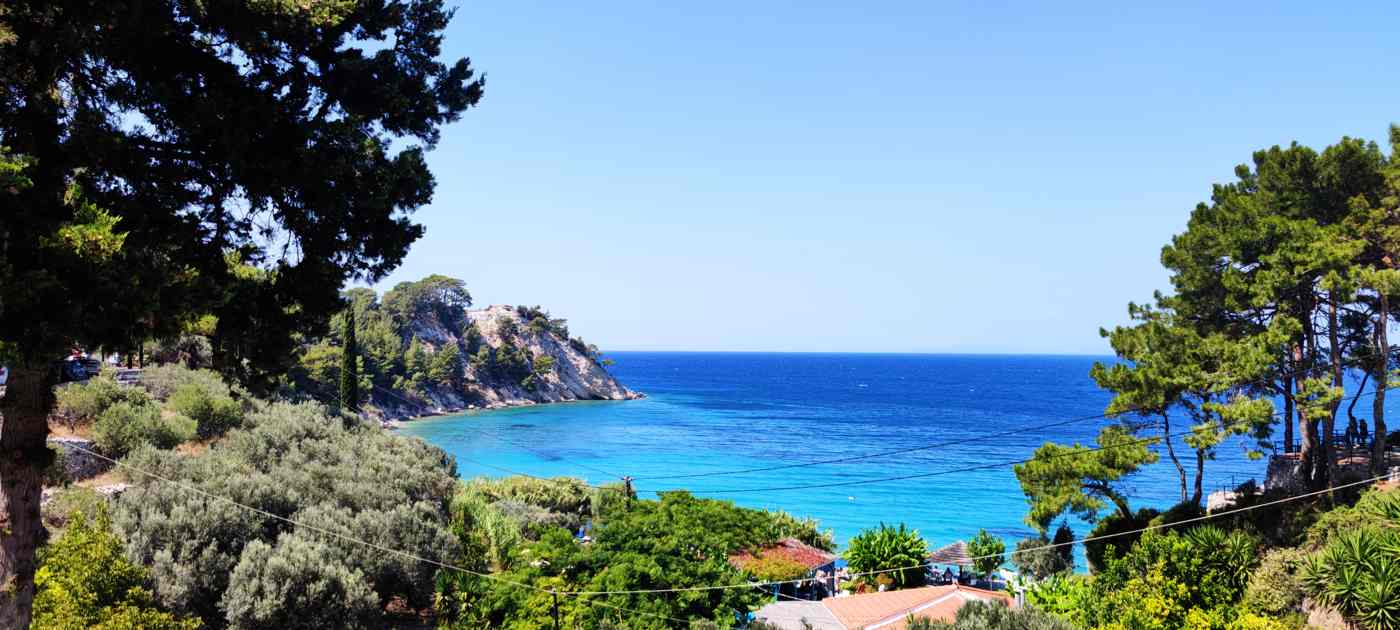
Tsabou is a small pebble cove on the north coast of Samos, tucked below the coast road about 9 km west of Vathy. It sits between the fishing village of Kokkari to the east and the better-known beaches of Lemonakia and Tsamadou to the west. Clear, deep water and pale grey pebbles define the beach, backed by green hills rather than buildings. A short track and a small parking area lead down from the road to the shore. Plan the whole trip with Greece Tours.
The cove keeps a quiet, natural feel that sets it apart from its busier neighbours. A seasonal canteen and a small number of sunbeds provide modest comfort in peak summer, but there is no resort strip here. The open north coast catches the meltemi wind, so mornings stay calm and afternoons often turn choppy. Snorkelling over the pale pebbles and rocky ends, swimming in the deep clear water. Easy hops to Kokkari. Lemonakia and Tsamadou make Tsabou a rewarding stop on a north-coast beach circuit.
Where is Tsabou beach on Samos, between Kokkari and Lemonakia and Tsamadou?
Tsabou sits on the north coast of Samos, about 9 km west of Vathy, tucked below the coast road between the village of Kokkari to the east and the beaches of Lemonakia and Tsamadou to the west.
The cove lies along the green northern shore of Samos, where the mountain of Ampelos drops toward the Aegean in a run of small pebble bays. Tsabou is one of these, set about 9 km from Vathy and only minutes from Pythagorio’s road network by car. Drivers reach it on the main north-coast road that links Vathy with Kokkari and Karlovasi. A short marked track leaves the asphalt and drops to the shore, with a small parking area near the top. The beach faces open water toward the Turkish coast across the Mycale strait. Green hills rise directly behind the pebbles, so the setting stays quiet and framed by slopes rather than buildings or a resort strip.
Signposts along the road mark the turn down to Tsabou beach.
Kokkari lies just east of Tsabou, a fishing and windsurf village strung around two headlands and a pebble waterfront. The drive between the two takes about five minutes along the coast road. West of Tsabou the road continues to Lemonakia and then Tsamadou, two curved bays backed by pines and greenery. This short northern stretch holds the island’s best-known swimming spots within about three kilometres of each other. The beaches sit close together, so visitors often base themselves near Kokkari and move along the shore by car or on foot.
The compact spacing makes Tsabou an easy stop on a north-coast beach circuit rather than a separate day-trip destination on its own, and returning drivers reach it in minutes. Signs on the road point toward Tsabou and the neighbouring bays.
Tsabou belongs to a run of north-facing coves that rank among the island’s most photographed Samos beaches. The three neighbours, Tsabou, Lemonakia and Tsamadou, share the same pale pebbles, clear water and green backdrop, and lie within a two-kilometre span. Vathy, the capital and main ferry port, sits about 9 km east, so day visitors reach Tsabou quickly from the town. Pythagorio and the airport lie on the south coast, around 20 km away by road across the island’s low central saddle. The position on the exposed north shore shapes the beach, since it catches the summer meltemi wind, which builds afternoon waves and keeps the water fresh.
Morning hours stay calmer, so early swimmers find the flattest sea and the quietest pebbles along this stretch.
Access to Tsabou stays simple but modest, matching its low-key character. The turn off the coast road drops through a short track to a small parking area above the pebbles. From there a brief walk on a path leads down to the shore, an easy descent for most visitors. The cove has no village behind it and no built-up frontage, only the hillside and the road above. This setting keeps arrivals steady rather than crowded, even in high summer when Kokkari fills. Reaching the beach by scooter or car works best, since the stop sits between villages rather than inside one. The lack of a resort strip is part of the appeal, giving Tsabou a plainer.
More natural feel than the busier bays a short drive on either side of the cove.
What is the pebble cove and clear deep water at Tsabou beach like?
Tsabou is a compact pebble cove where clear water deepens quickly a short way from shore. Pale grey and white stones line the beach, and the seabed stays clean, giving strong visibility across the swimming area.
The beach at Tsabou runs as a short curve of pebbles between two low rocky points. The stones range from pea-sized gravel at the waterline to larger cobbles higher up the bank. Underfoot the surface stays firm and clean, without the mud or weed common on sheltered bays. The water reads pale turquoise over the pebble shallows and turns deep blue where the seabed drops. That depth arrives close in, so swimmers reach proper swimming water within a short swim of the shore. The clarity comes from the pebble bed and the open, wave-washed position, which keeps fine sand from clouding the sea.
On calm mornings the surface lies almost flat, and the bottom stays visible well below the surface, a picture that draws swimmers back to this cove.
Deep water sits close to the shoreline at Tsabou, which suits confident swimmers more than small children. The gradient steepens within the first metres, so the sea reaches chest height quickly after entry. Cooler currents move along this north coast, keeping the water crisp even in high summer heat. The pebble bank produces a clean edge rather than a wide shallow flat, so there is little wading space before the drop. Snorkellers and swimmers who want depth close in find this convenient, while families with toddlers often prefer the gentler entries at Tsamadou. The exposed aspect means the sea state changes through the day, glassy at dawn and choppier once the meltemi rises.
Reading the wind before entering helps, and the cove stays safest for swimming in the calmer morning hours.
Colour is a defining feature of the cove, drawn from the pale stones and the clean seabed. Sunlight passes through the shallow water and reflects off the light pebbles, producing bright bands of green and blue. Away from the shore the floor falls into darker blue, marking the deeper channel where larger fish pass. The clarity holds because no river or marsh feeds sediment into this stretch of coast. Rocky shoulders at each end of the beach add texture, with weed and stone that draw small marine life. These edges give the cove more to explore than a plain sandy bay, and reward a slow swim along the margins.
The overall picture stays natural and unpolished, a pebble beach shaped by the sea rather than by development along the shore.
Comfort on the pebbles depends on a little preparation, as bare stones can feel hard and hot. Water shoes ease the walk to the water and protect feet on the coarser cobbles near the back of the beach. A mat or thick towel makes the pebble bank easier to rest on than a thin sheet. Shade is limited, since the hillside behind offers little cover and trees do not reach the waterline. Bringing a sun umbrella helps on the open bank, where the midday sun is strong and direct. The trade for this plain setup is water quality, since the pebble bed keeps the sea clear and cool through the season.
Swimmers who value clean, deep water over soft sand rate Tsabou highly among the north-coast coves of Samos.
Is Tsabou beach good for snorkelling over its pale pebbles?
Tsabou suits snorkelling well, thanks to clear water, a clean pebble bed and rocky ends that shelter small fish. Visibility stays strong over the pale stones, and the rocky shoulders hold most of the marine life.
Snorkelling works best along the rocky points that close each end of the Tsabou cove. Over the open pebble floor the view is bright but sparse, since bare stones hold little cover for fish. Near the rocks the picture changes, as weed, crevices and boulders shelter wrasse, bream and small schooling fish. Sea urchins cling to the shaded stone, so gloves and care help around the sharpest edges. The water stays clear enough to track fish across the pale bed, and the light bottom brightens the whole scene. Starting from the beach and swimming slowly toward either headland gives the richest route for a mask and snorkel.
Keeping close to the rock line, where depth changes and shadow gather life, rewards patience more than crossing the open middle of the bay.
The pale pebbles that give Tsabou its look also shape the snorkelling light beneath the surface. Ground smooth by the waves, the grey and white stones reflect sunlight upward and lift visibility across the shallows. Divers see their own shadow clearly on the bright floor, and passing fish stand out against the light stone. The pebble grade shifts with depth, as fine gravel near the shore gives way to larger cobbles and then to rock ledges further out. This range creates small habitats where different fish feed and shelter within a short swim. The absence of sand means the water clouds slowly, even when swimmers stir the bottom near the edge.
On a calm day the combination of clear sea and pale bed makes the cove one of the brighter north-coast spots for snorkelling.
Marine life at Tsabou stays modest but steady, typical of an open Aegean pebble cove. Small wrasse pick over the rocks, saddled bream drift in loose groups, and gobies rest on the stones near the bottom. Closer to the surface, shoals of tiny fish flicker where sunlight meets the shallow water. Octopus shelter in the rock cracks at the cove’s edges, though spotting one takes a slow, quiet approach. The richest life gathers at the boundary between pebble and rock, where structure and food overlap along the margins. Bringing a mask and fins turns a routine swim into a longer explore of these edges.
The open position keeps the water fresh and well mixed, which supports the clarity that makes the fish easy to follow across the bright pebble floor.
Timing and conditions decide how good the snorkelling feels on any given day at Tsabou. Calm mornings before the meltemi rises give the flattest water and the sharpest view down to the seabed. Once the wind builds in the afternoon, waves stir the surface and cut visibility along the exposed shore. Bringing your own gear matters, since the cove has no dive shop and no equipment to rent on the beach. A short entry from the pebble bank puts snorkellers over interesting ground within a minute of the shore. Staying aware of the wind and any current keeps the swim safe along the rocky ends of the cove.
For a plain, unspoiled snorkel over pale pebbles and clear water, Tsabou rewards visitors who arrive early and read the sea before setting out.
How does Tsabou beach compare with its famous neighbours Lemonakia and Tsamadou?
Tsabou stays quieter and more natural than its neighbours, with fewer facilities and a plainer setting. Lemonakia and Tsamadou draw larger crowds and offer more organised sunbeds, while Tsabou keeps a low-key, undeveloped feel.
Tsabou sits between two of the island’s most popular bays, yet draws far smaller crowds than either. Just west lies Lemonakia beach, a curved cove with organised sunbeds, a taverna and steady summer traffic. Beyond it, Tsamadou spreads under pines with more facilities and a well-known naturist end. Against these busier neighbours, Tsabou keeps a plainer profile, with less parking, a smaller run of sunbeds and a quieter shore. The difference shows most in high summer, when Lemonakia and Tsamadou fill by midday while Tsabou stays comparatively open. Visitors who want the same pale pebbles and clear water without the crowd choose Tsabou for exactly this reason.
Its position between the two makes it easy to compare all three in a single afternoon along the coast road.
The natural character of Tsabou comes from what it lacks rather than what it offers. There is no beach bar strip, no long row of loungers and no built frontage behind the pebbles. Green hillside rises straight from the back of the beach, so the outlook stays on the sea and the slopes. This restraint keeps noise low and the setting simple, closer to a wild cove than a managed resort beach. Families and swimmers who find Kokkari’s waterfront busy often move here for a calmer base by the water. The trade is fewer services, since shade, food and sunbeds are limited, so visitors bring more of their own kit.
For most the plainness is the point, offering a quieter stretch of the same north coast that the famous bays share.
Crowd levels at Tsabou stay lower partly because the beach is easy to pass on the coast road. Drivers heading for the signposted names of Lemonakia and Tsamadou often overlook the smaller turn to Tsabou. That quiet suits swimmers who value space on the pebbles over a full range of services. Even in peak season the cove rarely fills the way its neighbours do by early afternoon. Couples, snorkellers and readers seeking a calm base gravitate here, while sunbed-and-taverna visitors continue west. The cove works well as a first or last stop on a north-coast beach run, before or after the busier bays.
Arriving early secures both parking and a clear patch of pebbles, since the small space fills faster once the wind drops and swimmers arrive.
Choosing between Tsabou and its neighbours depends on the kind of beach day wanted. Tsabou fits swimmers, snorkellers and those after a quiet, natural cove with clear, deep water. Lemonakia suits visitors who want an organised beach with sunbeds, a taverna and easy comfort. Tsamadou draws a mixed crowd, including a naturist section, under a broad band of pines. The three beaches lie within about two kilometres of each other, so a single day by car can take in all of them without a long drive. Plenty of visitors swim at the busier bays for facilities, then finish at Tsabou for a calmer late-afternoon dip.
This mix-and-match approach makes the north coast rewarding, with Tsabou serving as the plain, peaceful counterpoint to its better-known and busier neighbours along the shore.
Does Tsabou beach have a canteen and sunbeds in summer?
Tsabou offers modest summer facilities, with a seasonal canteen and a small number of sunbeds rather than a full resort setup. Services run mainly in peak months and thin out early and late in the season.
Facilities at Tsabou stay basic and seasonal, in keeping with the cove’s low-key character. A small canteen usually operates through the peak summer months, serving cold drinks, coffee and light snacks. Its opening depends on the season and the weather, so it runs mainly from late spring into early autumn. Outside those months the beach often has no service at all, and visitors bring their own food and water. A small number of sunbeds and umbrellas appear near the canteen in high summer, set on the pebble bank. Beyond these there is no wider beach organisation, no long lounger rows and no watersports base on the shore.
This restraint keeps Tsabou closer to a natural cove than a serviced beach, so planning ahead for supplies makes the visit easier.
Bringing your own kit matters more at Tsabou than at the organised bays nearby. Water, snacks and shade cannot be assumed outside the short peak window when the canteen operates. A sun umbrella helps on the open pebble bank, where natural shade is limited to the odd tamarisk at the back. Reef shoes ease movement over the stones, both on land and when entering the water. Cash is worth carrying, since the seasonal canteen is small and card payment cannot be counted on. Toilets and other amenities are minimal, so visitors often use facilities in Kokkari before driving out to the cove.
Planning around this modest setup lets swimmers enjoy the clear water and quiet setting without relying on services the small cove does not provide through most of the year.
Timing a visit around the seasons shapes what Tsabou offers on the day. In peak summer the canteen and the small run of sunbeds give a little comfort on an otherwise plain beach. In spring and autumn the cove stands quieter still, often empty of service but calm and clear for swimming. Winter leaves it deserted, exposed to the north wind and the swell that rolls onto the pebbles. The best window for facilities matches the warm months, when the water is warmest and the canteen most reliable. Visitors chasing solitude often prefer the shoulder season, accepting the lack of service for near-empty pebbles.
Reading the season alongside the daily wind gives the clearest picture of what to expect from this compact north-coast cove on Samos.
Parking and access round out the practical picture at Tsabou, and both stay small in scale. A short track drops from the coast road to a modest parking area above the beach. Space there is limited, so arriving early in peak season secures a spot before the cove fills. From the parking a brief walk on a path leads down to the pebbles, an easy descent for most visitors. There is no paved promenade and no vehicle access to the shore itself, which keeps the beach quiet. Combined with the seasonal canteen and the small number of sunbeds, this simple setup defines Tsabou as a plain, natural stop.
Visitors who plan for the modest facilities gain a clear, quiet cove between the busier beaches of the north coast.
How do you reach Tsabou beach and where do you park on Samos?
Tsabou sits below the north-coast road about 9 km west of Vathy on Samos. A short signed track drops from the tarmac to a small gravel parking area beside the pebbles.
The turn-off to Tsabou breaks from the main Vathy–Kokkari road, roughly 2 km before Kokkari when driving from the capital. Drivers watch for a small brown sign and a break in the roadside crash barrier, since the cove stays hidden below the tarmac. The access track runs about 150 metres down a moderate slope of packed gravel and loose stone. Standard hire cars manage it in dry conditions at walking pace, though the surface rewards slow, careful driving. The lane ends at a flat clearing where cars line up under tamarisk and pine. Space fits around 20 vehicles, and the clearing fills by late morning in July and August.
Early arrival secures both shade for the car and a level spot near the short path down.
The descent on foot takes about three minutes from the clearing to the shoreline. A worn dirt path threads between low scrub and tamarisk, dropping steadily toward the pale pebbles. The route stays unpaved, so grippy sandals or trainers beat flip-flops on the loose surface. No steps or handrails break the slope, and the last stretch runs across rounded stones that shift underfoot. Visitors carrying coolers, umbrellas and children pace the walk and rest halfway where the path levels. The same track serves as the only land route in and out, since no road reaches the cove itself.
Return climbs demand a little effort in afternoon heat, so swimmers often carry water for the walk back up to the parked car under the trees above the cove.
Motorbikes and scooters reach the same clearing and slot easily into gaps between cars. Riders find the gravel track manageable at low speed, though loose stone on the slope calls for steady braking. Bus services do not run directly to Tsabou, so the beach depends on private transport for most visitors. Taxis from Vathy or Kokkari drop passengers at the roadside, from where the foot descent begins. Cyclists tackling the coastal route often pause at the sign, then wheel down the track on foot rather than ride the stones. The parking clearing carries no barrier, ticket booth or attendant, and use stays free.
Drivers reverse back onto the main road with care, since the exit meets fast coastal traffic on a curve near the crest.
Signposting stays modest, so first-time visitors save the turn-off on a map before setting out from Vathy or Kokkari. The cove reads clearly from the sea, yet from the road only the sign and a gap in the guardrail mark it. Drivers approaching from Kokkari watch the odometer, since the entrance follows soon after the village edge. Those coming from the capital pass the Tsamadou and Lemonakia turns first, then reach Tsabou a little further east. The whole trip from Vathy covers about 9 km and takes roughly 15 minutes by car on the winding coast road.
Petrol stations and shops cluster in Kokkari and Vathy, so drivers refuel and stock supplies before the descent, because the cove itself sells only drinks and light snacks.
How does the meltemi wind affect Tsabou beach on Samos?
Tsabou faces the open north Aegean, so the summer meltemi drives swell straight into the cove. Mornings often stay calm and glassy, while wind and chop build from midday through the afternoon.
The meltemi blows from the north and northwest across the Aegean through the core summer months of July and August. Samos sits in the wind’s path, and the north coast takes the brunt while the south stays sheltered. Tsabou opens directly onto this exposure, so its water shifts from mirror-flat at dawn to lively by early afternoon. Wind strength climbs through the middle of the day, then often eases after sunset as the land cools. Swimmers reading the forecast plan north-coast beaches for the morning and switch south when the gusts strengthen. The pattern repeats across most summer days, giving a reliable rhythm rather than a random one.
Locals and regular visitors time their swims around this daily cycle of calm mornings and breezy afternoons.
Afternoon waves at Tsabou stay short and choppy rather than long ocean rollers, since the fetch runs across the Aegean not an open ocean. Whitecaps appear offshore first, then sets reach the pebble shore and stir the shallows. Swimming remains possible for confident adults on moderate days, though the wash tugs at footing on the loose stones. Stronger meltemi days push the sea up the beach and drag pebbles in the backwash, which unsettles less able swimmers. Snorkellers lose visibility as churned water clouds the shallows and hides the rocky edges. Parents watch children closely once the chop builds, and families often leave by mid-afternoon.
The same wind that cools the air also raises the sea, so shade and swimming trade against each other after lunch.
A wind check before arrival saves a wasted trip on rough days. Forecasts for Samos flag the meltemi one to two days ahead, marking wind speed in Beaufort or knots. Days rated force 5 or above on the north coast usually mean strong chop at Tsabou by afternoon. Calmer readings of force 2 to 3 keep the cove swimmable through most of the day. Flags and moored boats in nearby Kokkari harbour offer a live gauge, since visible whitecaps beyond the breakwater warn of building wind. The open sea beyond the cove darkens and ruffles as gusts spread across the surface.
Watching these signs, swimmers judge whether to settle in for the day or plan a mid-morning swim before the wind fills in from the north.
The exposure that raises afternoon waves also keeps Tsabou fresh and clear on calm mornings. North-coast water off Samos runs cooler and cleaner than sheltered southern bays, since the open Aegean flushes the cove constantly. Early swimmers meet flat, transparent water above pale pebbles, with visibility stretching about six metres down. The wind later drops the air temperature by two or three degrees, which eases the midday heat on the exposed shore. Shade sits under tamarisk and the low cliff at the back, so beating the sun matters as much as beating the wind. Regulars treat the meltemi as a trade-off rather than a fault, planning around it.
A calm dawn swim, a shaded rest and an early exit sidestep the roughest hours on this open north coast.
What does Kokkari offer near Tsabou beach on Samos?
Kokkari lies about 2 km east of Tsabou, a former fishing village turned resort with a curved pebble seafront. Its windy bay draws windsurfers, while tavernas, shops and rooms line the harbour lanes.
Kokkari anchors the north coast as the main village near Tsabou, roughly a five-minute drive east along the shore road. Whitewashed houses with blue and red shutters climb the slope above a working harbour, where fishing boats still tie up beside pleasure craft. Narrow lanes behind the waterfront hold bakeries, mini-markets, car-hire desks and rooms to rent. Two pebble beaches flank the village core, and a small church on the point marks the eastern edge. The setting keeps a village feel despite the summer crowds, since the old harbour stays the heart of daily life. Visitors basing at Tsabou reach Kokkari in minutes for supplies, meals or an evening stroll along the front once the beach day ends.
Frequent buses and taxis also connect the village to Vathy and Pythagorio.
The bay at Kokkari ranks among the best windsurf spots on Samos, driven by the same meltemi that stirs Tsabou. Side-shore and cross-shore wind funnels along the coast, giving steady conditions through July and August afternoons. A watersports base on the village beach rents boards, sails and wetsuits and runs lessons for beginners. Flat water near the shore suits first-timers, while stronger gusts and chop offshore reward experienced sailors. Colourful sails cut across the bay on breezy days, a sight visible from the Tsabou road above. The wind that drives the windsurfers matches the pattern swimmers track, so the two groups favour opposite conditions.
Kite and paddle gear also appear on calmer mornings, spreading activity across the day beside the harbour. Rental gear and lesson times vary through the season.
Tavernas and cafes concentrate in Kokkari, giving Tsabou visitors a ready lunch or dinner option minutes away. Fish tavernas line the harbour, serving the day’s catch alongside Samos Muscat wine and local mezes. Cafes and bars along the front fill at sunset, when the light turns the pebble bay gold. Prices sit at typical resort levels, higher than inland villages yet matched by the waterfront setting. A supermarket and bakeries supply picnic food for those preferring to eat on the beach. The village also holds pharmacies, an ATM and a medical point, useful backups for a day on the remote cove.
Choosing Kokkari as a base puts services, food and a livelier evening within a short hop of Tsabou’s quiet shore. Buses stop in the centre, linking the village to Vathy in about twenty minutes.
Kokkari makes a natural pairing with Tsabou for a full day on the north coast. Morning swims at the quiet cove precede an afternoon in the village once the wind rises. The short drive between the two takes about five minutes, or a coastal walk of roughly half an hour for the energetic. Watching windsurfers from a harbour cafe fills the breezy hours that push swimmers off the open beach. Evening brings the village to life as day-trippers leave and the tavernas fill for dinner. The contrast defines the area: Tsabou for solitude and clear water, Kokkari for food, gear and company.
Together they give a varied north-coast day without a long drive, since barely 2 km separates cove from harbour. Regular visitors settle at Tsabou first, then finish the day in Kokkari at dusk.


How do you combine Tsabou with Lemonakia and Tsamadou beaches on Samos?
Tsabou, Lemonakia and Tsamadou sit within about 2 km along the same north-coast road west of Kokkari. A short drive links all three, so beach-hoppers sample each cove in a single day.
The three coves line up along a 2 km stretch of the north coast, each reached by its own track from the road. Tsabou sits furthest west of the trio, Lemonakia in the middle, and Tsamadou closest to Kokkari. All three share pale pebbles, clear deep water and a backdrop of green hills, so the family resemblance runs strong. Lemonakia curves in a sheltered arc below a hillside of pines, with sunbeds and a canteen on the shore. Each cove takes a short signed turn-off and a walk down to the water, mirroring the access at Tsabou.
Driving between them takes only about five minutes, since the entrances follow one after another along the same coastal road east toward Kokkari. A single half-day covers the whole trio at an unhurried pace.
Tsamadou beach ranks as the most famous of the three, a broad pebble bay backed by pines about 1 km west of Kokkari. Sunbeds, umbrellas and a canteen serve the main shore, while a screened section at one end draws naturists. Its size and facilities pull the biggest crowds of the trio, so it fills first on summer mornings. Tsabou, by contrast, stays smaller and quieter, which suits visitors leaving Tsamadou once its sunbeds book out. Snorkelling over the rocky flanks rewards swimmers at both, with clear water and fish along the edges. Pairing the two lets a group split the day between Tsamadou’s buzz and Tsabou’s calm.
The short hop between them makes swapping coves effortless when wind, crowds or shade shift the balance.
A practical circuit starts early at Tsabou for the quietest swim before crowds and wind arrive. Mid-morning shifts to Lemonakia, where the sheltered arc and pines hold calm water a little longer. Lunch fits at the Lemonakia or Tsamadou canteen, or back in Kokkari for a wider choice of tavernas. Afternoon suits Tsamadou if its sunbeds free up, or a retreat inland once the meltemi builds. Parking at each cove stays limited, so moving between them early beats the midday rush for spaces. Carrying water, snacks and reef shoes covers all three, since facilities stay basic away from Tsamadou.
This loop packs the north coast’s best pebble beaches into one relaxed day, with short drives and clear water throughout the morning hours. Boats from Kokkari also pass these coves along the same shore.
Mood and conditions on the day decide between the three. Tsamadou delivers facilities, space and a lively shore for those wanting sunbeds and a canteen. Lemonakia offers a sheltered middle ground, calmer in wind thanks to its curved, pine-backed bay. Tsabou gives the quietest, most natural setting, best for swimmers content with little more than pebbles and clear water. Wind tips the balance too, since Lemonakia’s arc holds calm longer than exposed Tsabou on breezy days. Families often favour Tsamadou’s easier access and services, while couples and solitude-seekers lean toward Tsabou.
Sampling all three across a morning settles the choice by experience, and most visitors return to whichever cove matched their pace, whether the busy bay or the empty one. Together they make the Kokkari coast the pebble-beach core of north Samos.
Who does Tsabou beach on Samos suit, and when you visit?
Tsabou suits swimmers, couples and small groups seeking a quiet, natural cove over resort comforts. Early morning brings the calmest water and easiest parking, before the meltemi and midday crowds arrive.
Tsabou fits travellers who value quiet and clear water above sunbeds and beach bars. Couples seeking a calm swim, snorkellers chasing clear shallows and walkers pausing on the coast road all find the cove rewarding. The small scale and limited facilities keep numbers down, so the beach stays peaceful even in high summer mornings. Independent visitors with a hire car or scooter reach it most easily, since no bus serves the turn-off. Confident swimmers handle the deep water and afternoon chop, while the pebbles and slope suit steady feet. The setting rewards those content to bring their own shade, water and snacks rather than expecting a full resort.
For a natural, unspoilt north-coast cove close to Kokkari, Tsabou answers the brief. Families with older children who swim well also enjoy it.
Early morning marks the best window at Tsabou, when the sea lies flat and the light stays soft. Arriving by 9 am secures a parking spot, first pick of shade under the tamarisk and calm water for swimming or snorkelling. The meltemi usually holds off until late morning, so the first hours give the clearest, stillest conditions. Temperatures stay comfortable before the midday sun peaks, easing the walk down and back up the track. Fewer visitors share the pebbles at this hour, keeping the natural quiet the cove is known for. Photographers catch the pale stones and turquoise shallows in even morning light without harsh shadows.
A dawn-to-lunch visit captures Tsabou at its calmest, before both wind and heat build through the afternoon. Late afternoon often calms again as the wind drops toward sunset.
Season shapes the visit as much as time of day. July and August bring the warmest sea, the strongest meltemi and the busiest mornings across the north coast. June and September offer calmer wind, thinner crowds and water still warm from summer, which regulars often prefer. Spring greens the surrounding hills and fills the roadside with wildflowers, though the sea stays cool for swimming. Autumn holds warmth into October, with quiet beaches once the main season fades. The canteen and sunbeds operate mainly through the peak months, so shoulder-season visitors bring their own supplies. Weekdays stay quieter than weekends, when Samos residents join the beach crowds.
Matching the visit to shoulder-season weekdays and early mornings delivers Tsabou at its most peaceful and clear. Sea temperatures reach about 24 degrees in high summer.
A plan around the cove’s rhythm turns a good visit into a smooth one. A morning arrival, reef shoes for the pebbles, and packed water and shade cover the basics Tsabou lacks. Checking the wind forecast the night before decides whether the cove or a sheltered south beach suits the day. Combining the swim with Kokkari for lunch or Lemonakia and Tsamadou for variety fills the hours the meltemi claims. Leaving by early afternoon on windy days sidesteps the roughest water and the climb back in full heat. This simple plan matches Tsabou’s strengths, quiet mornings and clear water, against its limits of exposure and limited services.
Visitors who follow the cove’s daily and seasonal rhythm come away with the calm, natural beach day it does best.
Frequently Asked Questions
Is Tsabou beach on Samos good for young children?
Tsabou suits families with older children who swim well, but it challenges toddlers and weak swimmers. The beach drops off quickly into deep water, and pebbles rather than sand cover the shore and shallows. A short walk down an unpaved track from the parking clearing reaches the beach, so pushchairs and heavy gear prove awkward. On calm mornings the water stays clear and gentle enough for confident young swimmers under close watch. Afternoon meltemi chop pushes waves up the pebbles, which unsettles small children, so families with toddlers often choose sheltered south-coast beaches instead. Reef shoes help little feet on the stones, and packed shade, water and snacks cover the cove’s basic facilities.
Older children who snorkel enjoy the clear shallows and rocky edges. Families wanting sunbeds, sand and easy access lean toward nearby Tsamadou, while Tsabou rewards those content with a quiet, natural pebble cove and a morning swim. The lack of lifeguards means parents supervise children at all times in the deep water.
Where do you park at Tsabou beach on Samos?
Parking at Tsabou uses a small gravel clearing at the foot of the access track, about 150 metres below the coast road. Space fits around 20 vehicles under tamarisk and pine, and no barrier, ticket or attendant controls it, so use stays free. The clearing fills by late morning in July and August, when early arrival by 9 am secures both a spot and shade for the car. A short brown sign and a gap in the roadside barrier mark the turn-off, roughly 2 km west of Kokkari on the road from Vathy. The access track runs down a moderate gravel slope, which standard hire cars manage slowly in dry conditions.
Motorbikes and scooters slot into gaps easily, adding capacity on busy days. No overflow parking exists on the narrow coast road, so latecomers on peak days sometimes drive on to Lemonakia or Kokkari instead. Reversing back onto the fast coastal road demands care near the crest.
Does Tsabou beach on Samos have sunbeds and a canteen?
Tsabou offers limited sunbeds and umbrellas in the main season, far fewer than the full rows at neighbouring Tsamadou. A seasonal canteen typically runs the loungers and sells cold drinks and light snacks through July and August. The number stays small, so the beds book out on busy mornings, and latecomers spread towels on the open pebbles instead. Bringing a mat or padded towel matters, since the pale pebbles press hard underfoot and under the body. Shade beyond the umbrellas comes from tamarisk trees and the low cliff at the back of the cove. Outside peak months the sunbeds and canteen often close, so shoulder-season visitors carry their own umbrella, water and food.
The limited setup fits the cove’s quiet, natural character rather than a resort beach. Visitors wanting guaranteed sunbeds, a full canteen and organised facilities find them 2 km east at Tsamadou or in Kokkari. The seasonal setup means facilities vary from year to year, so checking on arrival avoids surprises.
Is Tsabou beach on Samos good for snorkelling?
Snorkelling at Tsabou rewards swimmers with clear water and rocky edges along both flanks of the cove. The pebble seabed keeps the water clean and transparent, with visibility reaching about six metres on calm mornings. Rocks at each end of the beach hold small fish, sea urchins and patches of weed, drawing snorkellers toward the sides rather than the open middle. Bringing your own mask, snorkel and fins matters, since the cove sells no equipment and facilities stay basic. Reef shoes protect feet on the pebbles and rocks when entering and leaving the water. Morning offers the best conditions, before the afternoon meltemi churns the shallows and cuts visibility to little.
Deep water drops off quickly from the shore, so confident swimmers gain the most from exploring the rocky margins. The same clear water that suits snorkelling makes Tsabou popular with swimmers who value a clean, natural cove over organised beach facilities. No lifeguard watches the cove, so snorkellers stay within their depth and swim with a partner.
What are wind days like at Tsabou beach on Samos?
Wind days at Tsabou bring afternoon chop as the meltemi drives swell into the exposed north-coast cove. Mornings usually stay calm, so an early swim beats the rising wind that builds from midday onward. On stronger meltemi days, whitecaps and backwash make swimming harder, and snorkelling visibility drops as the shallows cloud over. Checking the forecast the night before helps, since Samos wind reports flag the meltemi one to two days ahead in Beaufort or knots. Days rated force 5 or above on the north coast usually mean rough water at Tsabou by afternoon. Sheltered alternatives on such days include the curved arc of Lemonakia, which holds calm a little longer, or south-coast beaches out of the wind.
Leaving by early afternoon sidesteps the roughest hours and the climb back up the track in full sun. The same wind cools the air, so shade under the tamarisk still gives relief on breezy days. Boats and windsurf sails in nearby Kokkari harbour offer a quick live gauge of the wind strength.
What beaches are near Tsabou on Samos?
Nearby beaches around Tsabou line the north coast within a short drive along the same road. Lemonakia sits just east, a sheltered pine-backed arc with sunbeds and a canteen, calmer than Tsabou in wind. Tsamadou follows closer to Kokkari, the largest and busiest of the trio, with full facilities and a naturist section at one end. Kokkari itself, about 2 km east, holds two village beaches, a windsurf bay and a harbour lined with tavernas and shops. All three coves share pale pebbles, clear deep water and green hillsides, so beach-hoppers sample all three in one day. Further west toward Karlovasi lie Potami and the walk-in Seitani bays, larger and wilder than the Kokkari coves.
To the east near Vathy, Psili Ammos and Kerveli offer sheltered swimming out of the meltemi. The cluster around Tsabou makes the Kokkari coast the pebble-beach core of northern Samos. A hire car or scooter reaches all of them easily, since no bus serves the small north-coast coves directly.
When is Tsabou beach on Samos quietest?
Quiet times at Tsabou fall in the early morning and outside the July-and-August peak. Arriving before 9 am gives the calmest water, the emptiest pebbles and first pick of parking and shade. The meltemi and the crowds both build later, so the first hours hold the natural quiet the cove is known for. June and September bring thinner crowds than high summer, with calmer wind and water still warm from the season. Weekdays stay quieter than weekends, when Samos residents join the beach. The small scale and limited facilities keep numbers lower than at neighbouring Tsamadou even at busy times. Late afternoon often calms again as the wind drops toward sunset, offering a second quiet window before dusk.
Visitors seeking solitude combine an early or late arrival with a shoulder-season weekday, which delivers Tsabou at its most peaceful. The cove’s quiet character defines it against the busier resort beaches nearby. Photographers and swimmers who want empty pebbles simply come at dawn, well before the day-trippers arrive.