
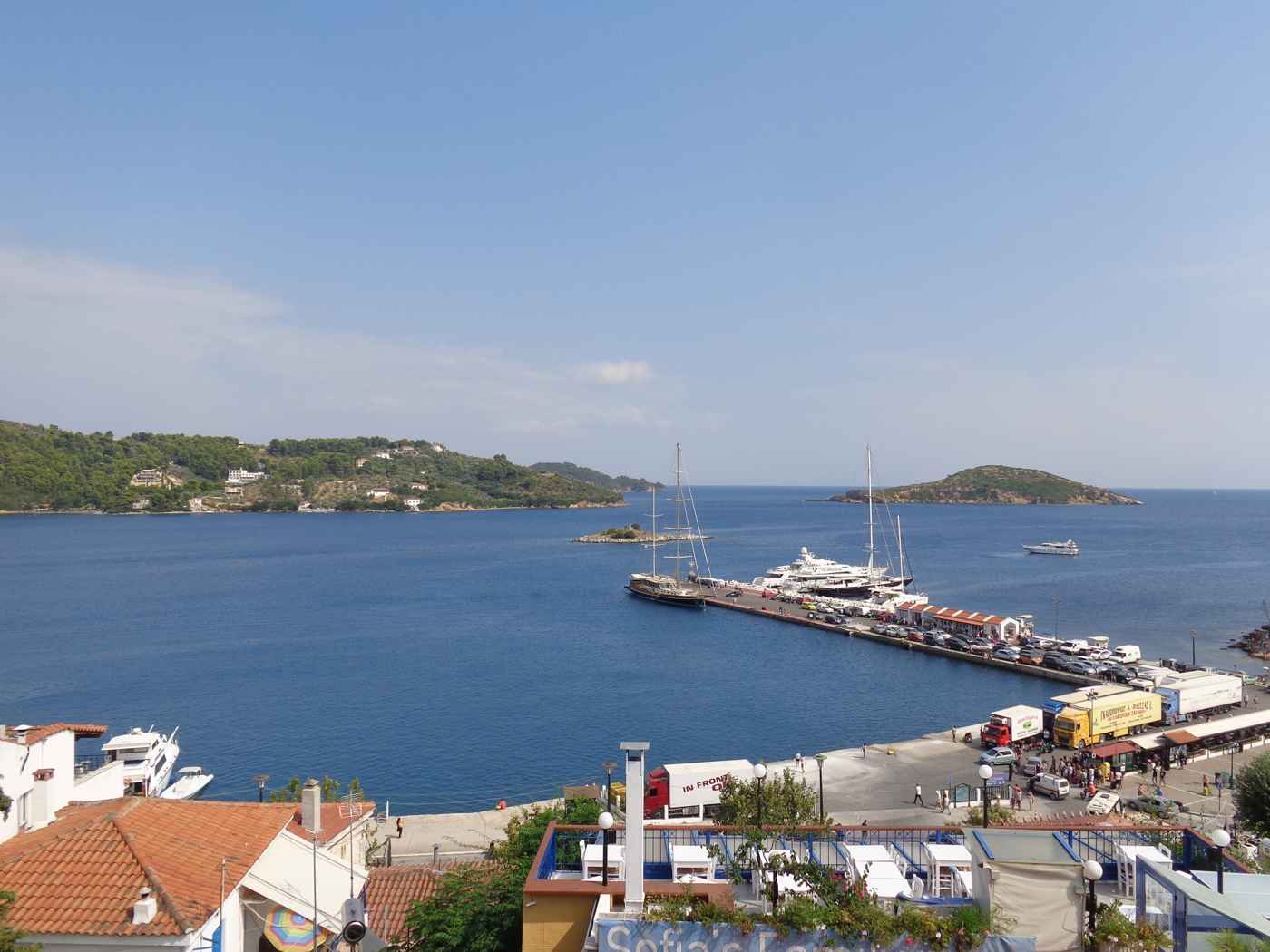
Troulos beach fills a sheltered, sandy bay midway along the south coast of Skiathos, about 9 km west of Skiathos Town on the island’s single coastal road. Soft sand shelves gently into calm, clear water, sunbeds and tavernas back the shore, and the small pine-topped Troulos islet stands at the mouth of the bay. Plan the whole trip with Greece Tours.
This guide explains where Troulos sits on the island, why families rate it, how the bus and road reach it. What facilities operate in season, where the inland junction leads, which beaches lie nearby. Which months serve the bay best.
Where exactly is Troulos beach on Skiathos?
Troulos beach occupies a sheltered bay midway along the south coast of Skiathos, about 9 km west of Skiathos Town and about 3 km east of Koukounaries, with the pine-topped Troulos islet marking the mouth of the bay.
Skiathos is the westernmost island of the Northern Sporades, about 12 km long and 6 km wide, with more than 60 beaches around its coast. Troulos occupies the middle of the developed south shore, roughly 9 km from the port and about 3 km short of Koukounaries at the road’s end. The single paved coastal road passes directly above the bay, so the beach anchors one of the island’s main resort pockets. Travellers researching Skiathos meet Troulos early in any planning, since the bay combines swimming, food and transport in one compact stop. Pine-covered slopes rise behind the sand, and the shoreline curves between two low headlands that keep the water inside noticeably flat.
Bus stops, tavernas and studios sit within a five-minute walk of the water.
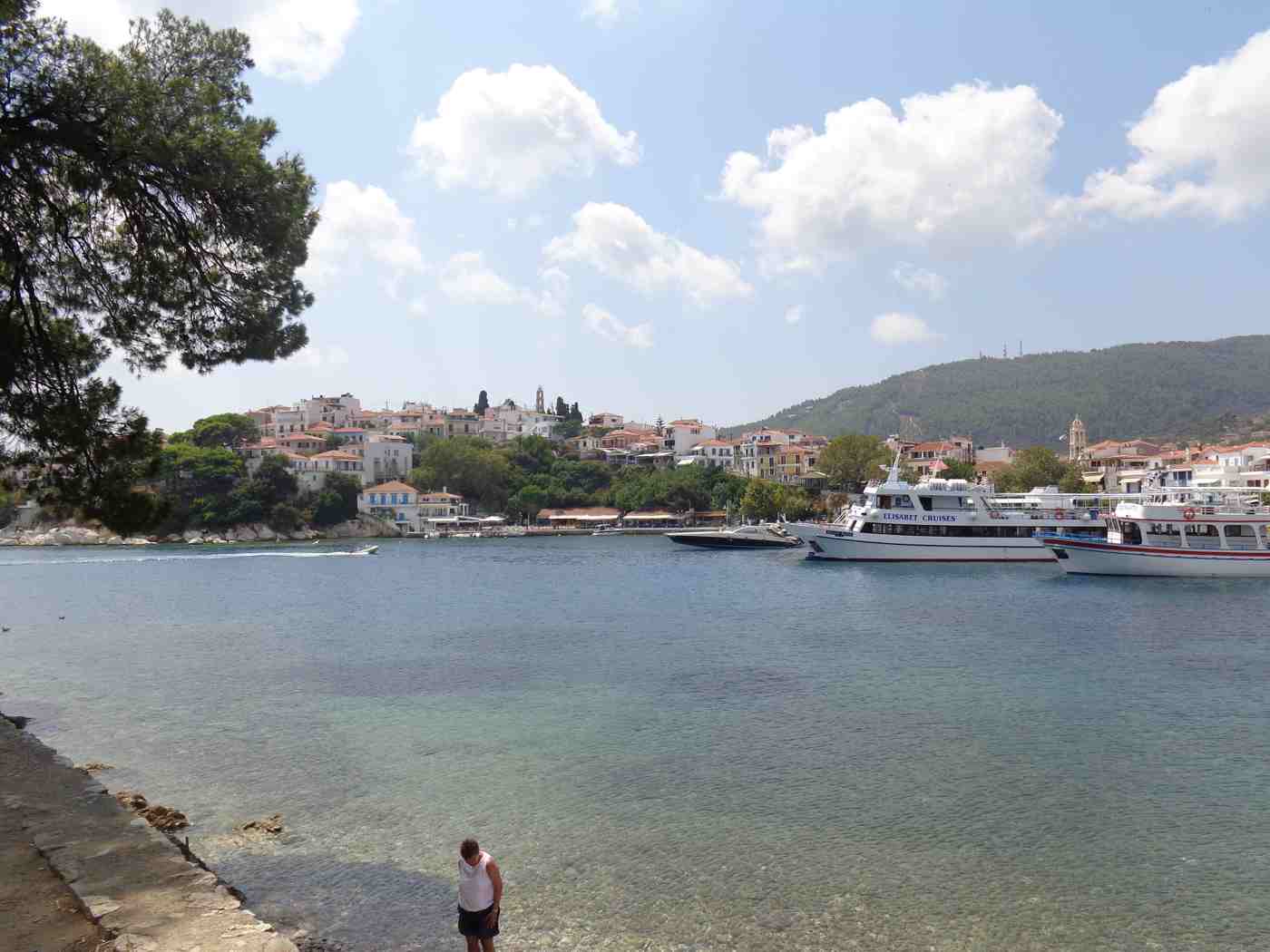
The bay opens toward the south between two pine-clad headlands that pinch the entrance and flatten the swell inside. The small Troulos islet rises just offshore at the mouth, a rounded rock capped with pines that gives the beach its most recognisable landmark. The sand forms a gentle arc of about 250 metres, soft underfoot and pale gold, backed by a low strip of tamarisks and taverna terraces. Shallow water extends well out from the shoreline, and the seabed stays sandy across the main swimming zone. The headland on the eastern side separates Troulos from the neighbouring cove of Maratha, while the western rise carries the coastal road onward toward Koukounaries.
The whole bay reads as one contained, easily supervised swimming space with clear natural boundaries.
Troulos also marks the island’s most important road junction outside town. The main south-coast road crosses the slope directly above the beach, and a signed side road climbs north from the Troulos junction into the pine interior. That inland road reaches the Kounistra monastery after a steady climb and then continues as a partly unpaved track down to the north coast. Drivers heading for Megas Aselinos, Mikros Aselinos or the Kounistra chapel all pass the Troulos crossroads, which turns the bay into a natural staging point for north-coast excursions. Distances stay short in every direction: Skiathos Town lies about 9 km east, Koukounaries about 3 km west.
The monastery about 4 km up the inland road through the forest. Signposting at the junction keeps first-time drivers oriented.
Development around the bay stays low-rise and spread out. Hotels, studios and rented rooms climb the slopes on both sides of the main road, screened by pines rather than stacked along the waterfront. Tavernas cluster behind the sand and along the junction, serving the beach crowd at lunch and the resident guests in the evening. The atmosphere sits closer to a quiet resort hamlet than a village: there is no old centre. No harbour and no nightlife strip, only the beach, the food and the hillside accommodation. That restraint keeps evenings calm and mornings quiet.
Guests who want livelier nights ride the bus east to Skiathos Town, then return to a bay where the loudest sound after dark is the water on the sand. The bay stays residential in feel year-round.
What makes Troulos beach good for families?
Troulos suits families because the sand shelves gently, the enclosed bay keeps waves small, sunbeds and tavernas sit steps from the water, and the bus stop on the main road lies a short, safe walk above the beach.
Shallow water defines the family appeal. The sandy bottom drops so gradually that adults wade a long way out before the water passes waist height, which gives small children a wide, supervised paddling zone. Waves inside the bay rarely rise above ankle height on a settled day. The two headlands plus the offshore islet break up any chop that the open channel sends in. Parents sit on sunbeds within metres of the waterline and keep every swimmer in view, since the compact arc of sand leaves no hidden corners. The gentle gradient also means no sudden drop-offs in the main swimming zone.
A genuine difference from steeper beaches on the island where the seabed falls away within steps of the shore. The shallow shelf runs the full width of the arc.
Practical support sits close at hand. Tavernas directly behind the sand handle long family lunches without a car journey, and toilets come with the taverna stops in the usual Greek-beach arrangement. Sunbed sections alternate with free sand, so families carrying their own umbrella find space at the quieter ends of the arc. The walk from the roadside bus stop down to the beach takes about five minutes on a paved lane, manageable with a pushchair and beach bags. Parking spreads along the lane and the junction for drivers. Studios and family hotels on the slopes above put accommodation within a ten-minute walk of the water.
Which shortens the daily logistics that decide whether a beach day with children actually succeeds. Shade from the tamarisk line covers the rearmost sunbed rows through the hottest hours.
Children find more here than swimming. The islet at the bay’s mouth gives older kids a visual target for supervised snorkelling along the calmer eastern rocks, where the clear water shows sand, seagrass and small fish. Sandcastle material is genuinely good, since the sand packs firm near the waterline. Guides covering Skiathos with kids consistently place Troulos among the island’s easiest beaches for young families, alongside Koukounaries, Agia Eleni and Achladies. The bus ride itself entertains, with numbered stops turning the journey into a counting game, and the plane-spotting fence near the airport adds a free spectacle on a town day. Short distances keep every family outing under half an hour door to door.
Pedalos and paddleboards give older children an extra option once swimming loses its novelty in the second week.
Atmosphere separates Troulos from the party beaches further east. Vromolimnos runs water-ski sessions and beach-bar playlists, and Banana draws a young crowd to its bars, while Troulos keeps the volume low and the pace slow. Music stays at background level in the tavernas, the crowd skews toward parents and grandparents, and evenings end early. Families with toddlers value the timetable this creates: quiet mornings on an uncrowded arc. A taverna lunch in the shade, an afternoon rest back at the studio. A return swim before dinner. High summer fills the sunbeds by late morning, yet the bay never develops the towel-to-towel density of Koukounaries in August. The scale stays human, and the day stays unhurried.
Grandparents rate the flat lane, nearby toilets and short distances between shade, food and water.
How do you get to Troulos beach from Skiathos Town?
The island bus runs from Skiathos Town along the south-coast road to the Troulos stop in about 20-25 minutes, and drivers cover the same 9 km in about 15 minutes before parking near the junction.
The bus is the simplest option. One line serves the whole south coast, running between Skiathos Town and Koukounaries with stops numbered roughly 1 to 26 along the single road. Troulos sits in the final third of the route, so the ride from the town terminus beside the port takes about 20-25 minutes depending on season and traffic. Buses run frequently through the summer day, from early morning into the night at peak season, and conductors call the stops. The Troulos stop stands on the main road directly above the bay, and a paved lane drops to the sand in about five minutes.
Return buses toward town pass the same stop, and the numbered-stop system makes it hard to get lost. Tickets stay inexpensive, paid on board in the island fashion.
Drivers follow the only south-coast road west out of Skiathos Town, passing the turn-offs for Megali Ammos, Achladies, Kanapitsa and Vromolimnos before the road swings down toward the Troulos junction. The 9 km take about 15 minutes with no traffic, longer in the late-morning beach rush of July and August. Parking gathers along the beach lane and around the junction; spaces fill by late morning in high summer, so early arrival pays. Scooters and quads, the island’s other favoured rentals, cover the route just as easily and park more flexibly.
The route is fully paved and gently graded the whole way, and fuel stations operate along the road closer to town, so a topped-up tank covers the day comfortably. Quads handle the beach lane’s gravel edge better than low-slung cars.
Taxis wait at the rank beside the port in Skiathos Town and reach Troulos in about 15 minutes. The fleet is small for an island this busy. Pre-arranging a return ride in August avoids a long wait. Water taxis and small excursion boats also shuttle along the south coast from the old port in summer. Dropping swimmers at beaches along the strip, an option that turns the transfer itself into part of the day. Guests staying mid-coast at Kanapitsa or Agia Paraskevi walk sections of the coast or hop two bus stops west.
The single-road geography removes navigation decisions entirely: every land option follows the same shoreline, with the sea on the left heading west and pines rising on the right. Cyclists use the same road, though summer traffic demands care.
Arrivals from the airport reach Troulos quickly. Alexandros Papadiamantis airport lies about 2 km from Skiathos Town on the isthmus. Which puts the total transfer at about 11 km and roughly 20 minutes by taxi or pre-booked minibus. Package transfers drop guests directly at the hotels on the Troulos slopes. Independent travellers ride into town first and change to the coastal bus, adding about half an hour to the journey. Ferry arrivals from Volos or Agios Konstantinos dock beside the Bourtzi in Skiathos Town and follow the same bus or taxi route west.
The short distances are a real advantage of the island, since no transfer to Troulos exceeds half an hour even in peak-season traffic on the coastal road. Luggage-laden arrivals do best booking the direct transfer in advance.
What facilities does Troulos beach offer?
Troulos beach operates organised sunbed-and-umbrella sections through the summer season, with tavernas directly behind the sand, free space at both ends of the arc, and studios, hotels and parking on the slope above.
Sunbeds and umbrellas cover the central stretch of the arc from late spring to early autumn, arranged in rows by the tavernas and beach operators behind the sand. Rates stay in the normal Skiathos range, and a taverna order often offsets the cost in the usual island arrangement. Both ends of the beach keep free sand for visitors who bring their own shade, and the eastern corner under the headland holds the most natural shelter in the afternoon. The setup opens gradually with the season: full service runs through July and August, thinner rows in June and September, bare sand outside those months.
Showers and changing points operate with the organised sections at the height of the season, close to the taverna terraces. Front-row beds by the waterline go first each morning.
Tavernas form the second layer of the beach. A handful of family-run places sit directly behind the sand and along the lane, serving grilled fish, horiatiki. Pies and slow-cooked oven dishes at lunch, then a calmer dinner service for guests staying on the slopes. Terraces look straight over the water, so parents eat while watching swimmers. The kitchens keep long summer hours, roughly late morning to late evening, and the pace suits unhurried meals rather than quick counters. More options gather at the Troulos junction on the main road, including places aimed at the evening trade from surrounding hotels.
Menus stay classic Greek, and travellers wanting broader dining variety ride the bus into Skiathos Town for the harbour restaurants. Breakfast service at the hotel side covers guests who skip the taverna mornings.
Accommodation and daily supplies sit within walking distance. Hotels, aparthotels and studio blocks spread across the slopes on both sides of the coastal road, most within a ten-minute walk of the sand. A mini-market near the junction covers water, snacks, sunscreen and beach basics through the season, which saves the trip into town for small needs. Car, scooter and quad rental desks operate seasonally along this stretch of coast, so a vehicle for the north-coast tracks is arranged locally rather than at the port. The bus stop doubles as the local meeting point.
What the area lacks is deliberate: no pharmacy, no bank and no supermarket of real size, all of which remain in Skiathos Town about 9 km east. Bakery vans and fruit sellers pass along the main road in high season.
Water sports stay modest by Skiathos standards. Operators put out paddleboards, canoes and pedalos in high season rather than the towed rides and wakeboard boats that concentrate at Vromolimnos and Koukounaries, since the sheltered bay favours quiet paddling toward the islet over engine noise. That restraint is part of the appeal for families and for swimmers doing laps across the calm arc. Snorkelling gear earns its space in the bag here, because the rocks under both headlands hold fish in clear water. Sun protection matters more than at tree-lined beaches: the tamarisk line gives patchy shade, and the open sand bakes through the middle of the day.
Umbrella hire or an early claim on the shaded eastern corner solves the problem. Beach toys and masks sell at the mini-market by the junction.
How calm is the sea at Troulos compared with other Skiathos beaches?
Troulos holds calm water through most of the summer because the bay faces south, away from the meltemi, and its two headlands plus the offshore islet block the chop that reaches more open south-coast beaches.
The meltemi, the dry north wind of the Aegean summer, sets the rules for swimming on Skiathos. It blows hardest in July and August, piling waves onto the north coast while the island’s pine spine shelters the south. Troulos gains a double layer of protection: the south-facing aspect shields it from the wind’s direct fetch. The narrow bay mouth. Part-blocked by the islet, filters the leftover swell that wraps around the island. On days when whitecaps cover the channel toward Pelion, the water inside the bay usually stays flat near the shore.
This reliability is why families book the Troulos slopes for a full week rather than chasing the calmest beach each morning by bus along the coastal road. The forecast matters less here than almost anywhere on the island.
The contrast with the north coast is stark. Megas Aselinos, over the hill from the Troulos junction, takes real surf in the same conditions that leave Troulos flat. Boat trips to Lalaria cancel outright when northern swell builds. Kastro beach and Mandraki face the same exposure. Swimmers who want waves drive the inland track north on a windy day, and swimmers who want stillness stay in the bay. The two sides of the island lie about 15 minutes apart by road here. Which makes Troulos one of the only bases on Skiathos where the daily sea choice between calm south and wild north is a short drive rather than a full relocation to another part of the island.
That flexibility turns windy days into an attraction rather than a lost beach day.
Skiathos counts more than 60 beaches on a coastline of roughly 44 km, and the sheltered south-coast arcs form the calm core of that inventory. Comparisons across Skiathos beaches put Troulos alongside Megali Ammos and Achladies for reliably flat water, ahead of the more exposed western sweep at Koukounaries, which picks up more movement on channel-wind days. Vromolimnos shares the sheltered profile but trades quiet for water-ski traffic. Within that field, Troulos wins on the combination that matters for careful swimmers: flat surface, sandy bottom, gradual depth and no engine lanes across the swimming zone. Lap swimmers cross the bay end to end without a motor lane in sight.
Families comparing the strip beach by beach usually settle the argument on wind shelter alone, and Troulos holds that card in every July comparison.
Water quality holds up through the season. The sandy bottom keeps the shallows clear rather than churned, and the bay’s gentle circulation prevents the stagnant feel of fully enclosed coves. Visibility rewards a mask on the rocky flanks, where the seabed shifts from sand to weed and stone. The sea warms steadily from June, peaks in August and stays swimmable well into October, following the broad Aegean pattern. Jellyfish appearances remain occasional and short-lived, as across the Sporades. On rare southerly blows the geometry reverses: the bay takes chop directly while northern coves flatten, and the tavernas stack the sunbeds until it passes. Those days are the exception in a season otherwise defined by stillness inside the bay.
Morning swims give the clearest water, before boat wakes and bathers stir the shallows.
What is the Troulos islet at the mouth of the bay?
The Troulos islet is a small, rounded, pine-topped rock standing in the mouth of the bay, named after the Greek word for dome; it shelters the beach, frames the view and marks the swimming horizon.
The islet rises a short distance beyond the bay mouth, a dome of grey rock softened by a cap of pines that survive on almost no soil. Its rounded profile explains the name: troulos is the Greek word for dome, the same word used for church cupolas, and the shape reads clearly from the sand. No structures stand on it, no boats moor at it, and gulls own the summit. From the beach it functions as the composition’s focal point, the object every photograph organises itself around and the marker that tells returning visitors they have arrived.
Late light turns the rock amber while the pines go black against the water, which makes the last hour of sun the bay’s most photographed minute. The islet also gives the resort area its name.
Function matches form on this small rock. The islet sits across the bay’s entrance like a plug, splitting incoming swell so that waves lose their line before reaching the sand. Together with the enclosing headlands it turns Troulos into one of the most protected pockets on the south coast, flat when neighbouring arcs ripple. The channel between islet and headland stays passable for kayaks and paddleboards, and small local boats thread it on their way along the coast. Depths around the rock drop quicker than inside the bay, attracting fish that the shallow arc never holds.
The islet also carries practical weather information: spray breaking white on its seaward face signals wind outside long before the bay itself feels anything. Local caique skippers read the same signal before committing to the channel.
Strong swimmers treat the islet as the bay’s natural finish line, though the crossing belongs to confident adults on calm days rather than children, since the distance deceives and small craft use the gap. Paddleboarders and kayakers circle it comfortably in under half an hour from the sand, the best short outing the bay offers. Snorkellers work the rock’s flanks, where visibility opens onto stone, weed and shoals that graze the drop-off. Fishermen cast from small boats on the seaward side at dawn. The islet is not a landing destination, because the rock rises steeply and holds no beach. The reward is the circuit itself and the view back at the full arc of Troulos from the water.
Calm early mornings give the safest window for the full circuit.
Views work in both directions. From the sand, the islet anchors every sunset frame as the sun drops toward the Pelion peninsula across the channel to the west. From the water beside the rock, the whole amphitheatre of Troulos opens up: the arc of sand. The taverna line, the studio-dotted slopes and the pine ridge behind them rising toward Kounistra. Photographers get their strongest material in the first and last hour of light, when the low sun models the dome and the water turns metallic. Even on crowded August afternoons the islet keeps its distance from the noise.
A fixed wild point in an otherwise domesticated bay and the detail that keeps Troulos from feeling generic among south-coast beaches. Tripods appear on the eastern headland in the last minutes before sunset.
Where does the road from the Troulos junction lead inland?
The inland road from the Troulos junction climbs through pine forest to the Kounistra monastery in about 4 km, then continues as a partly unpaved track down to Megas Aselinos and Mikros Aselinos on the north coast.
The Troulos junction is the island’s inland gateway. The turning leaves the coastal road beside the bay and climbs immediately into stone-pine forest, the canopy closing over the asphalt within the first kilometre. Traffic thins to rental jeeps, quads and the occasional taverna supply van. The gradient stays steady rather than steep. Gaps in the trees open views back over the bay. The islet and the channel toward Pelion, a photograph-worthy pullout inside five minutes of the beach. This is the only road crossing of the island’s western half.
Which concentrates every north-coast journey through the same crossroads and makes Troulos the natural base for travellers splitting time between calm southern swimming and the wilder northern shore of the island. Cyclists and runners use the climb as the area’s fitness route.
The Kounistra monastery rewards the climb. The small monastery of Panagia Kounistra stands in the pines about 4 km up the road, built where, by island tradition. Monks found the icon of the Virgin hanging in a pine tree. The name kounistra refers to the icon swinging from the branch. The icon itself now resides in the cathedral of Skiathos Town and returns here in procession for the island’s feast, while the chapel keeps frescoes and a carved iconostasis in a quiet forest clearing. Panagia Kounistra is honoured as the island’s patron. Visits stay simple: an open chapel, shaded benches and forest silence a ten-minute drive from the sunbeds.
Modest dress applies, as at the island’s other religious houses. The forecourt spring and the shaded benches make it a natural walkers’ rest stop.
The track past the monastery drops toward the north coast, losing its asphalt in stages as it descends through farmland to the sea. It ends behind Aselinos beach, the long wild sand of Megas Aselinos, where northern swell delivers real waves and the crowds thin to a fraction of the southern arcs. A separate branch reaches Mikros Aselinos, the smaller cove below the monastery road, quieter still. The surface suits quads, jeeps and careful scooters rather than low hire cars, and dust replaces sea spray as the journey’s texture. The round trip from Troulos, with the climb, the monastery stop and the beach descent, runs about 30 minutes of driving in each direction.
Drivers check fuel before the descent, since no services exist beyond the junction.
Combining the pieces builds the island’s best short inland day. Morning swimmers leave the Troulos sunbeds mid-morning, climb to Kounistra for the chapel and the forest shade. Continue down for waves and space at Megas Aselinos, then roll back over the ridge for a late taverna lunch above their own bay. Walkers do a slower version: signed trails through this section of forest link the monastery with the coast. Part of the island’s marked path network, with spring and autumn the comfortable seasons underfoot. The junction’s simplicity, one turning, one road and two destinations, removes navigation stress.
No other beach on Skiathos puts a monastery, a wild northern beach and a sheltered family bay inside one 10 km triangle. The full loop fits between a morning swim and a late lunch.
Is Troulos a good base for staying on Skiathos?
Troulos works as a base for visitors who prioritise beach mornings, taverna evenings and quiet nights, with the bus line covering trips to Skiathos Town and Koukounaries and the inland road opening the north coast.
Accommodation around the bay spans family hotels, aparthotels and studio blocks scattered across the pine slopes, most within a ten-minute walk of the sand. Buildings stay low and set back, so rooms trade waterfront immediacy for green outlooks and quiet. The style leans practical rather than boutique: pools, kitchenettes, family rooms and half-board options dominate, matched to guests who spend whole days on the beach below. Demand peaks hard in July and August, when the area’s limited stock sells out well ahead, while June and September leave breathing room.
Guests choosing between coast pockets weigh Troulos against Achladies and Kanapitsa closer to town, and against Koukounaries further west, with the mid-coast position usually the deciding argument for staying here. Ground-floor rooms with terraces suit families hauling beach kit twice a day.
Daily life runs on a simple loop. The beach fills the day, tavernas at the sand and the junction cover lunch and dinner, the mini-market handles basics, and the bus stop above the bay connects everything else. Town lies about 20-25 minutes east by bus for shopping, ferries and the evening promenade, while Koukounaries and Banana wait two or three stops west for beach variety. Drivers add the north coast through the inland junction. Nothing about the routine requires planning ahead beyond a taverna booking in August. The location also spares the daily traffic of town-based stays, since guests here start on the sand while day-trippers from Skiathos Town are still queueing for the morning bus heading west.
Laundry, bakery runs and pharmacy trips fold into one town visit a week.
The fit is specific. Families with young children get the calm bay, short walks and early-evening quiet that town cannot offer. Couples seeking slow days without full isolation get tavernas and the bus without the bar noise of Megali Ammos or the resort density of Koukounaries. Returning visitors, and Troulos runs high on repeat guests, value the predictability: the same calm water, the same taverna tables, the same islet view each morning. Walkers use the trailheads on the inland road.
The base serves anyone whose ideal evening peaks at a long dinner and a waterfront stroll rather than cocktails, while the island’s nightlife stays a bus ride away by design, close enough to sample and far enough to sleep. Repeat bookings for the same week each summer are common here.
Trade-offs are real and worth naming. Nightlife is absent, so travellers built around late bars pick Skiathos Town or Megali Ammos instead. Evening buses back from town run late in peak season but thin at the edges of summer, making a scooter or car useful for night owls in June or September. Dining, while solid, repeats over a two-week stay without trips elsewhere. The beach itself, compact by design, fills its central rows on August afternoons. None of these constraints surprises anyone who chose the bay deliberately; they only sting visitors who wanted a resort town and booked a quiet slope.
Matching expectation to place is the entire decision at Troulos, and the bay delivers exactly what it shows. Honest expectations make Troulos one of the island’s most contented bases.
Which beaches lie near Troulos beach?
Maratha adjoins Troulos across the eastern headland, Koukounaries lies about 3 km west, Agia Eleni and Banana sit beyond it, and Vromolimnos, Kolios and Agia Paraskevi line the coast back toward Skiathos Town.
Maratha sits directly over the eastern headland, a smaller sandy cove with its own sunbed rows and a quieter rhythm than Troulos itself. The short hop between the two bays gives Troulos-based visitors an instant change of scene without transport, since walkers cross via the road in about ten minutes. East again, the coast folds into Kolios, Agia Paraskevi and Vromolimnos, each with sand, tavernas and its own bus stop on the numbered line. Vromolimnos adds water-ski and wakeboard stations plus beach bars, the energetic counterpoint to Troulos calm, about two stops and a short walk away. The density is the point: within 4 km of the Troulos junction, six distinct organised beaches share one coastal road.
Each cove keeps its own character, which rewards an early walking survey.
West, the road ends at the island’s headline stretch. Koukounaries beach runs about 1,200 metres of fine golden sand backed by a protected stone-pine forest and the Strofilia lagoon, about 3 km and two or three bus stops from Troulos. It out-scales the home bay in every direction: longer sand, bigger crowds, more water sports, more bars, plus the wetland birdlife behind the beach. Troulos-based families treat it as the day-trip default when the compact arc feels small, riding the bus out in about ten minutes. The return contrast is instructive, because visitors come back to Troulos appreciating the shorter walk to dinner and the sunbeds that held space past mid-morning.
The lagoon path behind the big beach adds a flat nature walk, with herons among the payoff in quieter months.
Footpaths continue where the bus route ends at the Koukounaries terminus. Banana and Little Banana occupy the next headland, with golden sand, beach bars. A young crowd and a naturist tradition at the smaller cove, reached by a signed 10-15 minute walk over the hill. Agia Eleni, the westernmost road-accessible beach, faces the Pelion peninsula and delivers the area’s best road-reached sunsets, again about 15 minutes on foot from the final stop. Both make natural bus-plus-walk missions from Troulos, timed for the late-afternoon light. Mandraki and Elia, the undeveloped dune beaches of the northwest. Require a longer pine-forest walk from the Koukounaries side and reward it with near-empty sand even in the fullest weeks of August.
Water and hats matter on the exposed hill sections, where shade disappears between the pine stands.
Choosing between them becomes the holiday’s pleasant daily question. Flat water and short logistics keep families at Troulos or Maratha, scale and forest scenery argue for Koukounaries, sunset chasing points to Agia Eleni. Wave-hunting on a meltemi day sends drivers over the ridge to Megas Aselinos. A livelier soundtrack waits at Vromolimnos or Banana. Every option lies within about 15 minutes of the Troulos junction by bus, car or foot-plus-bus combination, which is the practical meaning of a mid-coast base. Beach-a-day itineraries assemble themselves here. The bay works as the anchor: calm, fed and connected, the place the day starts and ends regardless of which stretch of sand fills the hours in between.
Bus tickets, a beach bag and the numbered-stop map cover the whole rotation without a hire car.
When is the best time to visit Troulos beach?
June and September give Troulos its best balance of warm sea, open tavernas, working sunbeds and light crowds, while July and August bring peak heat and full rows, and late spring or October turn the bay quiet.
June and September form the bay’s sweet spot. The sea holds swimming warmth in both months, building through June and peaking in early September, while the sunbed rows keep space, the tavernas serve without waits and the bus runs its full summer timetable. Families outside school-holiday constraints and couples get the beach at its most comfortable: warm, open and unhurried. Accommodation on the slopes prices below the August peak and books with less lead time. Evenings stay warm enough for the walk over to Maratha or a sunset bus run out to Agia Eleni.
The light softens at both ends of the season, flattering the islet and the pine ridge in photographs and stretching the golden hour across the whole bay. Sea temperature outpaces air temperature in September, the swimmers’ month.
July and August run at full throttle. The central sunbed rows fill by late morning, parking tightens around the junction, taverna dinners reward a booking, and the bus arrives busy from the town end. Heat peaks with long rainless days, and the meltemi blows hardest, which flatters Troulos because the sheltered bay stays flat while exposed coasts churn. This is also the season of maximum life: every facility open, water toys out, boats threading the islet channel, the full island machine at work. Families tied to school holidays still find the bay gentler than Koukounaries or the town beaches in the same weeks.
Early mornings and late afternoons hold their calm even through the peak fortnight of the summer. Sunbed reservations through the adjacent tavernas ease the late-morning scramble.
Late spring and October trade services for solitude. The sea runs cool in late spring and cools again through October, still swimmable for the determined, while sunbeds thin to bare sand and the taverna line drops to a skeleton of open kitchens. Walkers inherit the season: the Kounistra trail smells of pine and wet earth. Wildflowers edge the inland road. The beach turns into a place for long empty walks rather than swimming days. Hotels on the slopes taper their openings at both edges of the season, so accommodation needs checking rather than assuming.
The reward is the bay’s geometry without its crowds, with the islet, the arc and the headlands standing in silence for the visitors who make the trip. Photographers rate these months above the summer.
Winter closes the show almost completely. The island quietens, seasonal businesses shut, charter flights stop and ferries carry the connection to the mainland, so Troulos becomes a local shoreline with an empty lane and shuttered tavernas. The pattern reverses in late spring with painting, stacking and re-opening along the whole strip. Within any summer day the rhythm repeats in miniature: flat glassy water and empty sand before mid-morning. The fullest hours either side of mid-afternoon, then a slow emptying into the golden-hour swim that regulars treat as the day’s real event. Visitors who plan around that daily curve.
Early or late on the sand and inland or at lunch through the crowded middle, get the best of the bay in any month. The bay rewards planning around light, not dates.
Frequently Asked Questions
How far is Troulos beach from Skiathos Town?
Troulos beach lies about 9 km west of Skiathos Town along the island’s single south-coast road. The bus covers the distance in about 20-25 minutes, running between the town terminus beside the port and Koukounaries on the route with stops numbered roughly 1 to 26. The Troulos stop stands on the main road directly above the bay. With a paved lane dropping to the sand in about five minutes. Drivers make the trip in about 15 minutes outside the late-morning rush and park along the beach lane or near the junction. Taxis from the port rank take the same quarter of an hour.
The airport adds about 2 km to the journey, putting arrival transfers at roughly 20 minutes door to door. Koukounaries continues about 3 km further west. Troulos sits about two-thirds of the way along the developed strip. Close enough for town evenings and far enough to escape the town noise. The mid-coast position is the bay’s core selling point.
Does the island bus stop at Troulos beach?
The Skiathos bus stops at Troulos on every run of its single south-coast line. One route serves the whole strip between Skiathos Town and Koukounaries. With stops numbered roughly 1 to 26. The Troulos stop sits on the main road on the slope above the bay. Buses run frequently through the summer day, from early morning until late at night in peak season. Thinning at the edges of the season and stopping in winter along with the rest of the tourist infrastructure. The walk from the stop down the paved lane to the sand takes about five minutes and manages pushchairs and cool bags without trouble.
Return services toward town pass the same stop, and conductors announce the stops, so the numbered system stays simple for first-time visitors. Travellers bound for Koukounaries, Banana or Agia Eleni stay on for another two or three stops to the western terminus, while town-bound passengers ride about 20-25 minutes the other way.
Is Troulos beach sandy, and is the water shallow?
Troulos beach is fully sandy, a soft pale-gold arc of about 250 metres with a seabed that stays sand across the entire main swimming zone. The bottom shelves so gently that adults wade far out before losing their footing, which creates a broad safe paddling zone for small children close to the sunbeds. Waves stay minimal inside the bay: the south-facing aspect avoids the meltemi’s direct force. The two headlands plus the pine-topped islet at the mouth break up leftover swell before it reaches the shore. Water clarity holds through the season because the sandy bottom resists churning, and the rocky flanks under both headlands add snorkelling ground with fish, weed and stone in clear view.
Depth increases gradually rather than in sudden drops, so confident swimmers heading toward the islet notice the change only well offshore. The combination of sand, shallows and shelter is exactly what places Troulos among the island’s most family-suited beaches.
Are there tavernas and sunbeds at Troulos beach?
Tavernas and organised sunbeds both operate at Troulos through the summer season. Family-run tavernas sit directly behind the sand and along the lane to the junction, serving grilled fish, salads. Pies and oven dishes from late morning until late evening, with terraces overlooking the water so parents eat within sight of swimming children. Sunbed-and-umbrella rows cover the central stretch of the arc from late spring to early autumn. With free sand kept at both ends for visitors carrying their own shade. The eastern corner under the headland holds the most natural afternoon shelter. Showers and changing points run with the organised sections at the height of the season.
A mini-market near the junction covers water, snacks and beach basics, and more dining gathers along the main road serving the surrounding hotels. Service peaks in July and August, thins through June and September, and closes almost entirely outside the season, when the bay returns to bare sand and local walkers.
Can you visit the Kounistra monastery and Aselinos beach from Troulos?
The Troulos junction is the starting point for both trips. A signed inland road leaves the coastal road beside the bay and climbs through stone-pine forest to the Kounistra monastery in about 4 km. Where island tradition places the discovery of the icon of Panagia Kounistra, the patron of Skiathos, found hanging in a pine tree. The chapel keeps frescoes and forest quiet, with modest dress expected. Past the monastery the road loses its asphalt and descends to Megas Aselinos. The long wild sandy beach of the north coast, with a branch to the smaller Mikros Aselinos cove. The track suits quads, jeeps and careful scooters more than low hire cars.
Driving time runs about 30 minutes each way including the descent, which makes the monastery-plus-beach loop the island’s easiest half-day inland excursion: calm southern swimming in the morning. Northern waves and forest by afternoon. A taverna lunch back above the home bay to close the day.
Is Troulos beach sheltered when the meltemi blows?
Troulos stays sheltered through most meltemi conditions. The meltemi, the dry north wind of the Aegean summer. Blows hardest in July and August and piles waves onto the north coast of Skiathos while the island’s pine spine protects the south. Troulos adds two extra layers to that basic shelter: the bay faces south, away from the wind’s fetch. Its narrow mouth. Part-blocked by the pine-topped islet and framed by two headlands, filters the residual swell that wraps around the island. Days that cancel Lalaria boat trips and put surf on Megas Aselinos leave the water inside the bay flat enough for children and lap swimmers.
The exception is a southerly blow, uncommon in summer, when the geometry reverses and the bay takes chop directly while northern coves calm down. Sunbed operators simply stack the rows until it passes. Season-long, Troulos ranks with Megali Ammos and Achladies among the island’s most reliably calm swimming water.
How does Troulos compare with Koukounaries beach?
Troulos and Koukounaries solve different briefs about 3 km apart. Koukounaries runs about 1,200 metres of celebrated golden sand backed by a protected stone-pine forest and the Strofilia lagoon. With the island’s biggest crowds, fullest water-sports lineup and busiest beach bars, the headline experience scaled up. Troulos offers a compact arc of about 250 metres with calmer water, thinner crowds, shorter walks and a quieter taverna scene. Plus the sheltering islet that keeps the bay flat when the bigger beach picks up channel chop. Families with young children usually swim easier at Troulos and day-trip to Koukounaries for variety, two or three bus stops west on the same numbered line.
Sunbeds at Troulos hold space later into the morning in August, while Koukounaries fills early. Accommodation follows the same split, with resort hotels beside the forest at Koukounaries and smaller family hotels and studios on the Troulos slopes. Strong itineraries use both beaches. Both share the same calm southern aspect and the same bus line.