
Thessaloniki eats on its feet. The city carries a street-food culture built over centuries as a port and a crossroads, where Greek, Balkan, and Ottoman tastes met on the same pavement. Vendors sell filo pastry from marble counters, sesame rings from wheeled carts, and grilled meat wrapped in flatbread from open windows. Roasted chestnuts scent the winter squares, and syrup pastries travel down from the hill suburbs to the patisserie cases of the centre. Walk the food streets, learn what each snack is made of, and place the tastes in the fabric of the city with My Greece Tours.
The handheld foods of Thessaloniki reward a slow graze through the markets rather than a single sit-down meal. The city’s snacks carry its history as a Mediterranean port and its reputation as the eating capital of Greece. The sections below cover what Thessaloniki street food is, which savoury and sweet items define it, and where the carts and counters stand. The later parts turn to the market lanes that anchor the food streets and to how you fold a tasting route into the guided Thessaloniki tours.
What is Thessaloniki street food?
Thessaloniki street food is the tradition of handheld snacks sold from carts, market stalls, and small counters across the city. It spans filo pastries, sesame bread rings, grilled meat wraps, roasted nuts, and syrup-soaked sweets.
The tradition grows from the city’s role as a port where traders, refugees, and farmers all fed the same streets. Merchants from the markets needed a quick bite between deals, and the vendors answered with food that a walker could hold in one hand. Sellers still work from wheeled carts, from windows cut into the wall, and from marble counters open to the pavement. The food stays cheap, fast, and rooted in local grain, cheese, and meat rather than imported fashion. Each snack ties to a moment of the day, the sesame ring to the morning commute, the pastry to a mid-morning break, and the grilled wrap to the late night. This rhythm turns the pavement into a table for the city.
Thessaloniki wears its mixed past in every bite of its street food. The city drew Sephardic Jews, Anatolian Greeks, Slavs, and Ottoman Turks, and each group left a recipe on the counter. Filo pastry, sesame paste, and syrup sweets carry the Ottoman and eastern Mediterranean thread most clearly. The refugees who arrived from Asia Minor in the early twentieth century deepened the range with new pies, spices, and sweets. That layered heritage gives the city a snack culture richer than the Greek average, which is why food writers rank it the eating capital of the country. The street is the first place a visitor meets that reputation, long before a restaurant table.
Street food in Thessaloniki clusters around the open markets and the squares of the historic centre. The lanes of the Kapani and Modiano markets hold the densest run of stalls, counters, and cart pitches in the city. A short circuit on foot links the pastry counters, the koulouri carts, and the grill windows without a long walk between them. The compact core lets a visitor graze through a string of snacks in a single morning. A guided Thessaloniki food tour builds the route and reads the history behind each stall. The tastings pair well with the wider walk through the monuments and the seafront of the city centre.
What savoury handheld foods define Thessaloniki’s streets?
Thessaloniki’s savoury street food centres on bougatsa filo pastry, the koulouri sesame ring, and gyros and souvlaki wraps. Cheese pies, sausage rolls, and small spinach pastries round out the handheld savoury range sold across the centre.
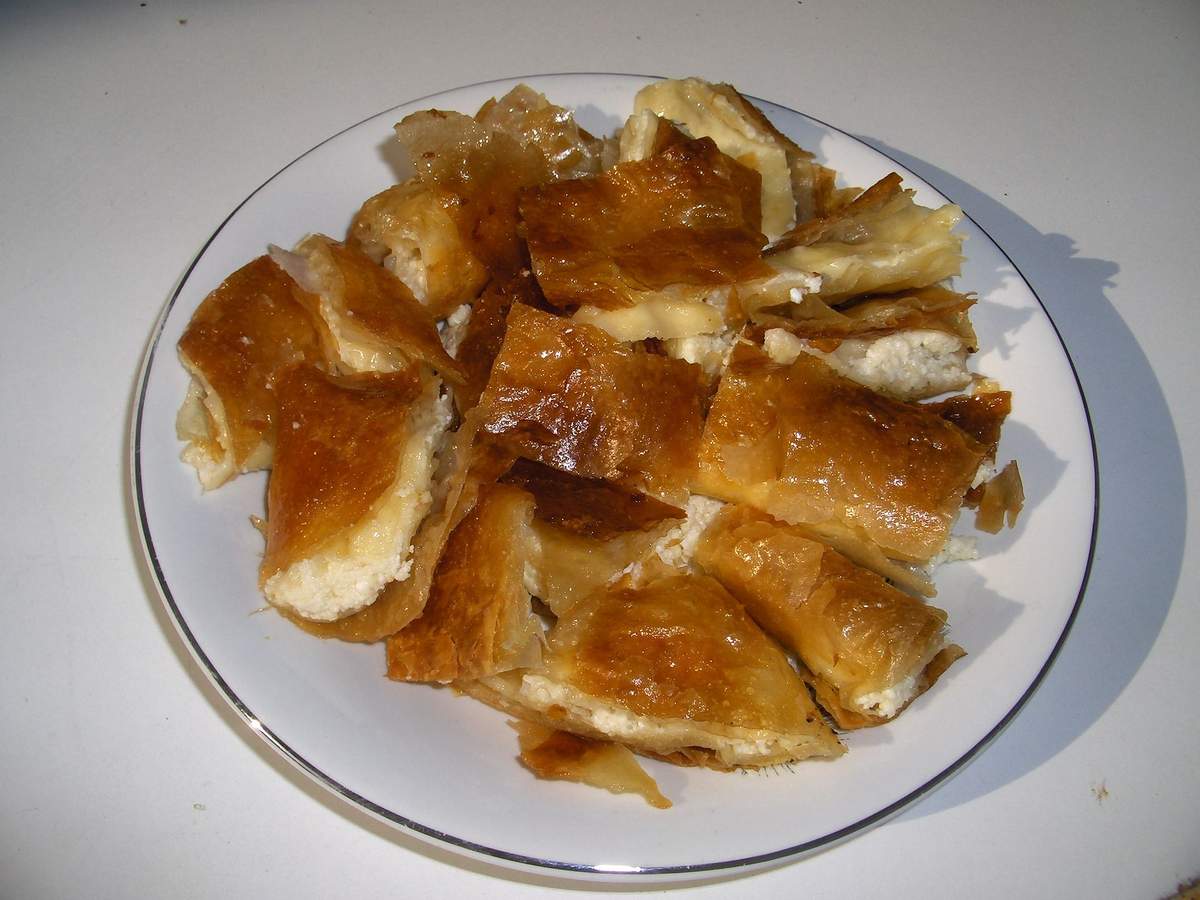
Bougatsa leads the savoury street food of Thessaloniki, a pastry of thin filo layers baked to a crisp golden sheet. Bakers fill it with semolina custard, with local cheese, or with minced meat, then cut it into squares on the counter and dust the sweet version with sugar and cinnamon. The pastry travels in a paper wrap, eaten warm on the walk from the shop. Long-standing bougatsa houses, among them the historic makers of Ano Poli, have shaped the craft over generations. The dish carries its own deep tradition, traced in full on the guide to bougatsa in Thessaloniki. A morning bougatsa ranks among the surest first tastes of the city’s street kitchen.
The koulouri Thessalonikis rings the morning streets as the city’s signature bread snack. Vendors sell the sesame-crusted bread ring from glass-fronted carts parked at the corners and the market gates. The ring bakes crisp on the outside and stays soft within, coated in a heavy layer of toasted sesame seeds. Commuters buy one on the way to work, and the low price keeps it the everyday bread of the pavement. The cart form spread from Thessaloniki across Greece, yet the city keeps the ring tied to its own name. A koulouri pairs naturally with a takeaway coffee, a match rooted in the strong Thessaloniki coffee culture. The seeds and the crust mark it apart from a plain bread roll.
Grilled meat wraps hold the savoury street food through the afternoon and the late night. Cooks carve gyros from a vertical spit and pack it into a warm pita with tomato, onion, and a spoon of tzatziki. Souvlaki threads small cubes of pork or chicken onto a skewer, grilled over coals and folded into the same flatbread. The wrap travels well, which makes it the standard fast meal after a market graze or a night out. Bakeries add to the savoury range with cheese pies, spinach pastries, and sausage rolls sold by the piece. These baked snacks fill the gap between the pastry counter of the morning and the grill window of the evening.
What street snacks come from carts and braziers?
Thessaloniki’s carts and street braziers sell roasted chestnuts and corn through the cold months, koulouri sesame rings year round, and loukoumades honey doughnuts from small stalls. The braziers scent the central squares in winter.
Charcoal braziers appear on the central squares as the weather turns cold. Vendors roast chestnuts over the coals until the shells split, then sell them hot in paper cones for the walk. The same carts grill ears of corn beside the chestnuts, turning them over the fire and salting them to order. The smoke and the sweet scent mark the arrival of winter in the city as surely as the calendar. Shoppers warm their hands on the cones between stops in the markets and the squares. The brazier trade runs strongest around Aristotelous Square and the open spaces near the seafront, where the foot traffic gathers. These roasted snacks belong to the cold season and fade with the spring.
Loukoumades round out the fried street sweets sold from small stalls and shop windows. Cooks drop spoonfuls of yeast batter into hot oil, where they puff into light golden balls. The doughnuts drain, then soak in honey syrup and take a dusting of cinnamon or crushed walnut. Sellers hand them over hot in a bowl or a paper tray, best eaten before the syrup cools. The sweet has roots deep in the eastern Mediterranean and appears at fairs, festivals, and permanent stalls alike. A batch cooks to order, so the queue moves with the rhythm of the fryer. The honey and the warm dough make loukoumades a natural close to a market walk.
Roasted seeds and nuts fill out the cart trade beyond the chestnut brazier. Vendors sell paper twists of salted pumpkin seeds, the snack Greeks call passatempo, along with roasted almonds and peanuts. Buyers crack the seeds on the move, a slow snack for a walk along the promenade or through a square. Dried fruit and nut stalls line the edges of the covered markets, where the trade runs all year rather than by season. The stalls of the Thessaloniki markets hold the widest choice of these loose snacks by weight. The habit of grazing on seeds and nuts ties the street trade to the slow pace of the seafront walk.
What sweet street foods should you try in Thessaloniki?
Thessaloniki’s sweet street food centres on trigona Panoramatos, the cream-filled syrup pastry cones from the Panorama suburb. Halva, tsoureki brioche, and the sweet cheese-and-custard bougatsa round out the sweets sold across the city’s counters.
Trigona Panoramatos stand as the signature sweet of Thessaloniki’s street counters. Bakers roll filo into small cones, bake them crisp, then fill them with a thick vanilla custard cream and dip the shells in syrup. The sweet takes its name from Panorama, the hill suburb east of the city where the recipe grew famous. The cones travel in a box, sold by the piece from patisserie windows across the centre and the suburbs. The crisp syrup shell against the cool cream gives the sweet its pull, a contrast built into every bite. The pastry has spread well beyond its home suburb, yet the Panorama name still marks the classic form. A trigono closes a street-food graze on a rich note.
Halva and tsoureki carry the older sweet tradition of the city onto the street. Halva comes in two forms, the semolina pudding cut fresh and the dense sesame-paste block sold by the slice from market stalls. The sesame version keeps well and travels in a wedge, a firm sweet for the pocket on a market walk. Tsoureki braids sweet enriched dough with the scent of mahleb and mastic, glazed and studded with almonds. Bakeries sell the brioche by the loaf or the slice through the year, with a peak around the spring feasts. Both sweets root in the eastern Mediterranean pantry that shaped the city’s baking. They sit beside the pastries and the fried sweets on the same counters.
The sweet bougatsa doubles as a street dessert as much as a breakfast pastry. Bakers dust the custard-filled filo with icing sugar and cinnamon, then cut it warm for the counter. The pastry works as a mid-morning treat or an after-lunch sweet, eaten from the paper on a bench. Patisseries across the centre keep a case of syrup sweets, cream cakes, and chocolate pastries beside the traditional forms. A traveller who wants a slower sweet course can move from the street counter to a table at one of the sit-down Thessaloniki restaurants. The range of sweets, from the cart to the patisserie, shows the depth the city gives to its baking.
Where do you find street food in Thessaloniki?
Thessaloniki’s street food clusters in the central markets and squares. The Kapani and Modiano market lanes, the Ladadika quarter, and the cart pitches around Aristotelous Square and Panagia Faneromeni hold the densest run of stalls and counters.
The Kapani market, known also as Vlali, forms the oldest food quarter of the city. Its covered lanes pack butchers, fishmongers, cheese sellers, and spice stalls into a tight grid off the main avenue. Cart vendors and small counters ring the market gates, so a walker meets koulouri, pastry, and grilled snacks at the edge of the fresh trade. The Modiano market stands a short walk away under an iron-and-glass roof, a covered hall of stalls and tavernas. Both markets mix raw ingredients with ready food, which lets a visitor watch the supply chain and eat from it in one place. The Kapani and Modiano halls anchor the whole street-food map of the centre.
The Ladadika quarter fills the old warehouse district between the market and the port. Its name recalls the oil merchants who once stored their goods in the low stone buildings along the lanes. The quarter now runs on tavernas, mezze bars, and small grills set into the restored warehouses. Evening brings the crowd that eats and drinks through the pedestrian streets, a scene tuned to small plates rather than carts. The grill windows and the souvlaki counters here feed the late trade after the markets close. A walk through Ladadika links the daytime market food to the nightlife of the waterfront. The quarter marks the shift from the cart snack to the sit-down mezze.
Cart vendors gather around the open squares and the busy church corners of the centre. The area of Panagia Faneromeni draws a run of pitches, pulled in by the foot traffic between the university, the market, and the seafront. Aristotelous Square, the grand civic space that opens to the water, holds chestnut braziers and koulouri carts through the day. The pavements of the main avenue carry a steady line of sesame-ring sellers at the busier corners. These street pitches feed the walker who wants a bite on the move rather than a table. The squares tie the street food to the daily life of the city, where the snack fits between errands and a walk along the front.
How do you plan a street-food walk in Thessaloniki?
A Thessaloniki street-food walk starts with a morning bougatsa and koulouri near the markets, moves through the Kapani and Modiano stalls at midday, and ends with trigona or loukoumades. A guided food tour reads the history behind each stop.
A street-food graze in Thessaloniki works best across the arc of a single day. The morning opens with a warm bougatsa and a sesame koulouri near the market gates, the classic first bite of the city. Midday suits a slow loop through the Kapani and Modiano lanes, where the stalls sell cheese, olives, and ready snacks side by side. The afternoon calls for a grilled wrap from a souvlaki window, eaten on a bench in a square. Evening turns to the tavernas and mezze bars of Ladadika for a slower table. A sweet trigono or a bowl of loukoumades closes the day on the syrup and cream that the city bakes so well.
Simple habits make the walk run smoothly through the centre. Carry small cash, since carts and counters trade quicker in coins than by card. Eat the pastry and the loukoumades warm, close to the counter, rather than carrying them far. Check the day of the week, as the covered markets keep their own rhythm and a share of stalls close early. Wear shoes for the cobbles and the slopes, since the market lanes and the upper streets run uneven. Pace the snacks across the day, given the richness of the filo, the syrup, and the grilled meat. The compact centre keeps every stop within a short walk, so the route asks for appetite rather than stamina.
A guided walk turns the graze into a reading of the city’s history. A local guide points out which counter bakes the older recipe, why the refugees shaped the pie, and how the market grew from the port. A structured food tour of Thessaloniki strings the pastry, the market, and the sweet into one route with the story attached. The tasting fits neatly into a wider day among the monuments, the churches, and the seafront of the centre. Travellers who want the food and the sights together can fold the graze into the broader Thessaloniki tours. The street kitchen then reads as one thread of the city rather than a set of separate snacks.
Frequently Asked Questions
What is Thessaloniki street food?
Thessaloniki street food is the tradition of handheld snacks sold from carts, market stalls, and small counters. It covers savoury items such as bougatsa pastry, the koulouri sesame ring, and gyros wraps, along with sweets such as trigona cones and loukoumades. The trade centres on the markets and squares of the historic centre.
What is the most famous street food in Thessaloniki?
Bougatsa ranks as the most famous street food of Thessaloniki. The pastry layers thin filo around a filling of semolina custard, cheese, or minced meat, baked crisp and cut on the counter. The koulouri sesame ring and the trigona Panoramatos syrup cones follow it as the city’s other signature street foods.
What is koulouri Thessalonikis?
Koulouri Thessalonikis is a ring of bread crusted heavily in toasted sesame seeds, sold from glass-fronted carts across the city. The ring bakes crisp outside and stays soft within, and commuters buy it as a cheap morning bread. The cart trade spread from Thessaloniki across Greece, yet the ring keeps the city’s name.
What are trigona Panoramatos?
Trigona Panoramatos are cone-shaped filo pastries filled with vanilla custard cream and dipped in syrup. The sweet takes its name from Panorama, the hill suburb east of Thessaloniki where the recipe grew famous. Patisseries across the city sell the cones by the piece, and the crisp syrup shell against the cool cream defines the treat.
Where can you eat street food in Thessaloniki?
Street food gathers in the central markets and squares of Thessaloniki. The Kapani market, known also as Vlali, and the covered Modiano market hold the densest run of stalls and counters. Cart vendors ring Aristotelous Square, the area of Panagia Faneromeni, and the main avenue, while Ladadika feeds the evening trade.
When are roasted chestnuts sold in Thessaloniki?
Roasted chestnuts and corn appear on the street braziers of Thessaloniki through the cold months of autumn and winter. Vendors set up charcoal carts around Aristotelous Square and the open spaces near the seafront. The smoke and the sweet scent mark the winter season, and the brazier trade fades with the arrival of spring.