
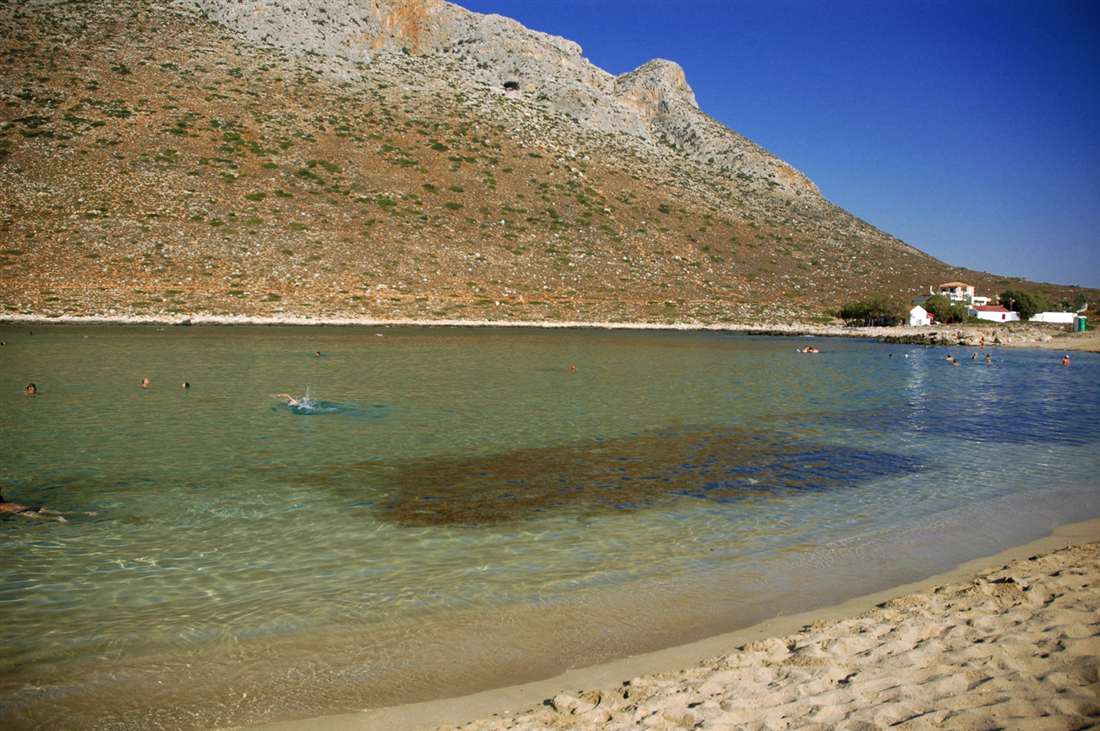
Stavros beach is a round, sheltered lagoon-like bay under a steep bare mountain on the Akrotiri peninsula, 15 kilometres north-east of Chania in western Crete, with shallow calm water and fame as the dance-finale filming location of Zorba the Greek. Plan the whole trip with Greece Tours.
This guide covers Stavros beach in full: what and where it is, why it is famous for Zorba the Greek, the shallow lagoon water and the second open beach, whether it is organised or wild, the family swimming, the mountain and its cave, the tavernas, where to eat and stay, how to get there from Chania, and the best time to visit.
What is Stavros beach in Crete?
Stavros beach is a round, sheltered bay on the Akrotiri peninsula near Chania in north-west Crete. A steep bare mountain wraps the shallow lagoon-like cove, holding the water calm, warm and clear against a strip of pale sand and fine pebbles.
The bay sits at the northern tip of Akrotiri, where the coastline curls inward to form a near-circular pool of sea. The mountain rises straight from the shore on the western side, and its wall of grey rock blocks the wind and traps the sun, so the surface of the water stays flat through most of the day. The colour shifts from pale turquoise over the sand near the shore to deeper blue where the seabed drops away.
Stavros marks the end of the road on this stretch of the peninsula, which keeps it apart from the busy resort strips west of Chania. The setting pairs a natural swimming pool with a backdrop of stark, treeless stone, and that contrast between soft water and hard rock defines the place. A small village of low houses, apartments and tavernas fronts the sand, and the pace stays slow.
Where is Stavros beach and how far is it from Chania?
Stavros lies at the far north of the Akrotiri peninsula, about 15 km north-east of Chania town. The drive covers 20 to 25 minutes on a single sealed road that climbs across the plateau of Akrotiri and drops to the coast at the bay.
The route leaves Chania to the east, passes the turn for Chania International Airport, and continues north through the villages of the Akrotiri peninsula. Beyond the airport the landscape opens into dry grazing land, low stone walls and scattered chapels, and the road narrows as it approaches the coast. Stavros is the terminus, so the tarmac ends at the beach car park with the mountain directly ahead.
The short distance makes Stavros a half-day trip from the Chania old town and harbour. Drivers reach it before the morning heat builds, swim through the calm hours, and return to the town for the evening. The proximity to the airport also puts the bay within a few minutes of arrival, which suits a first or last swim on either side of a flight.
Why is Stavros beach famous for Zorba the Greek?
Stavros is the filming location of the closing dance in the classic film Zorba the Greek. The final scene, where the two lead characters dance the sirtaki on the sand, was shot on this beach with the bare mountain rising behind them as the backdrop.
The production chose the round bay for its enclosed, theatrical setting: the wall of rock frames the shore like a natural amphitheatre, and the flat, sheltered strip of sand gave the actors a clear stage for the slow-building dance. That single sequence turned the sirtaki into a symbol recognised worldwide, and it fixed the image of the mountain-backed beach in the memory of film audiences.
Visitors still stand on the same sand and look up at the same rock face that appears in the film. The village trades on the connection, and the name of the dance and the film reaches the tavernas and signposts around the bay. For travellers who trace cinema locations, Stavros ranks among the defining film sites of Crete, and the scene draws people who pair the swim with the story.
What is the water and sand like at Stavros?
The main bay holds shallow, calm, warm water over a floor of pale sand and small pebbles. The depth increases slowly from the shore, so the swimming zone stays gentle. A second, open beach beside it faces the sea directly and carries light waves and a broader stretch of sand.
In the enclosed cove the seabed shelves so gradually that a swimmer walks out a long way while the water stays at waist height. The mountain shields the pool from the north wind, which keeps the surface still and the temperature high through summer. The clarity runs to the far side of the bay, and the pale bottom lifts the colour to a bright turquoise near the shore.
The neighbouring beach sits a short walk to the east, past a low ridge, and opens to the wider sea. Its water carries more movement, its sand runs wider and flatter, and it draws swimmers who prefer open water to the sheltered pool. Together the two shores give a choice between a still lagoon and an open bay within a few steps of each other.
Is Stavros beach organised or wild?
Stavros is a part-organised beach. The round bay carries rows of sunbeds and straw umbrellas for hire, a beach bar and tavernas along the shore, while the second, open beach beside it stays plainer and quieter with fewer facilities and more free sand.
On the main cove a taverna and a beach bar sit right at the water, and the front strip fills with paying loungers through the peak hours. Toilets, showers and parking back the sand, so a family arrives with little more than towels. The organised section trades comfort for company, since the beds pack close together during the middle of the day.
Anyone who wants space walks the short distance to the adjoining open beach, where the sand runs free and the crowd thins. The two coves suit different visitors from the same car park: one offers service and shade, the other offers room and quiet. This split lets Stavros hold both a relaxed lagoon scene and a plainer stretch of shore within the same bay.
Is Stavros beach good for families and children?
Stavros ranks among the safest family beaches near Chania. The main bay stays shallow far from the shore, the mountain blocks the wind, and the water holds calm and warm with a gentle slope and a soft sand floor, so young children paddle in still, waist-deep water.
The enclosed shape of the cove removes the currents and swell that unsettle small swimmers on open coasts. Parents watch from the sand while children wade across a wide, flat shallows, and the pale seabed keeps the water clear enough to see the bottom. Sunbeds, umbrellas and a taverna sit within a few steps, which shortens the walk for snacks, shade and changing.
The car park lies close to the sand, so families carry gear a short distance. The gradual depth and the still surface make Stavros a fixture for local families with young children, alongside travellers who compare it against the busier organised strands listed among the Chania beaches. For a day with toddlers, the sheltered pool answers the main worries of wind, waves and sudden depth.
What is the mountain at Stavros and how do you climb it?
The mountain at Stavros is a steep, bare mass of grey rock that rises straight from the western side of the bay. A rough footpath climbs its lower slope to a cave in the rock face, and a harder scramble reaches the ridge above for a view over the coast.
The rock stands treeless and sun-bleached, and its sheer wall gives the beach its dramatic backdrop and its shade in the late afternoon. A cave opens in the face partway up, reached by a marked but stony path that starts near the shore. The route runs over loose scree, so walkers wear firm shoes and start early to avoid the midday heat on the exposed slope.
From the higher ground the peninsula spreads out, with the round bay below, the open sea to the north, and the coastline of Akrotiri curving away to the east. The climb rewards the effort with a wide outlook, but the terrain stays rough throughout and carries no railings or water, so climbers bring supplies and turn back in strong sun.
What is there to do around Stavros?
Around Stavros the day fills with swimming in the sheltered bay, snorkelling along the rocky edges, walking the mountain path, and eating at the shore tavernas. The historic monasteries of Akrotiri sit a short drive inland, and the open beach next door adds a second swim.
The clear, still water of the cove suits snorkelling near the base of the mountain, where the rock meets the sand and small fish gather. Swimmers cross the flat pool, walkers take the footpath to the cave, and the second beach draws those who want open water. The two tavernas on the shore serve Cretan dishes through the day, and the beach bar keeps the front supplied.
Inland, the road back across Akrotiri passes the Agia Triada monastery with its ochre stone church, and beyond it the older monasteries of Gouverneto and the ruined Katholiko in the gorge. The airport plateau, the chapels and the grazing land fill the drive between the beach and Chania, so a Stavros day pairs the swim with the quiet religious sites of the peninsula.
Where do you eat and stay at Stavros?
Stavros holds tavernas on the beachfront and a scatter of apartments, studios and small hotels in the village behind. The tavernas serve grilled fish, Cretan meze and local dishes at the water, and the rooms give a quiet base within a short walk of both beaches.
The shore tavernas front the round bay, with tables set close to the sand for lunch after a swim and for dinner as the rock face falls into shade. The menus run to fresh fish, lamb, horta greens, dakos and the staples of Cretan cooking. The beach bar between them pours drinks through the afternoon, and a village bakery and mini-market cover simple supplies.
Accommodation clusters in the low houses set back from the sand: self-catering studios, family apartments and small guesthouses that fill through the summer. The village stays quiet after dark, since the road ends here and passing traffic stops. Guests who base at Stavros trade the nightlife of Chania town for still mornings on an empty beach and a short drive to the sights of Akrotiri.
How do you get to Stavros beach from Chania?
Drivers reach Stavros from Chania in 20 to 25 minutes on the single Akrotiri road, past the airport turn, to the car park at the beach. The KTEL local bus runs from Chania to Stavros through the season. Free parking sits behind the sand at the road’s end.
By car the route heads east out of Chania, follows the signs for the airport and Akrotiri, then continues north on the main peninsula road until it ends at the bay. The road stays sealed the whole way and narrows near the coast, and the car park lies directly behind the beach, so the walk from vehicle to water runs a short distance.
The public bus links Chania KTEL station with Stavros on a fixed timetable, which serves travellers without a car and matches the swim to the daylight hours. Taxis cover the trip from the town or the airport in the same time as a private car. Since Stavros is the end of the line, the drive returns by the same road across Akrotiri to Chania.
What does the second, open beach at Stavros offer?
The second beach sits a short walk east of the round bay, past a low ridge, and faces the open sea. It runs wider and flatter than the cove, carries light waves and more space, and holds fewer sunbeds, so swimmers who prefer open water and room settle here.
Where the enclosed cove gives a still pool under the mountain, the open beach trades shelter for a broader shore and a sea that moves. Its sand stretches in a long, level band, the crowd thins away from the organised front, and the outlook opens north across the water rather than closing against the rock.
Families split their day between the two: young children paddle the sheltered lagoon in the morning, while stronger swimmers cross to the open bay for a longer stretch. The walk between them runs a few minutes over the ridge, so a single visit takes in both the calm pool and the open shore from one car park.
What is the snorkelling like at Stavros beach?
Snorkelling at Stavros runs along the rocky western edge of the bay, where the mountain meets the sea. The clear, still water and the pale sand floor give strong visibility, and the boulders at the base of the rock shelter small fish, sea urchins and patches of weed.
The sheltered shape of the cove keeps the surface flat and the water clear, which suits snorkellers who follow the shoreline rock rather than the open sand. The seabed near the mountain drops into shaded ledges and crevices that hold marine life, and the calm conditions let a swimmer float above them without fighting current or swell.
Snorkellers enter from the sand and cross the shallows before reaching the deeper, rockier ground on the western flank. Firm swimming shoes protect against sea urchins on the boulders, and the early hours give the stillest, clearest water before the crowd stirs the sand. The second, open beach carries more movement, so the enclosed cove holds the better conditions for a slow snorkel.
What facilities does Stavros beach have?
Stavros carries the core facilities of an organised Cretan beach: sunbeds and straw umbrellas for hire on the main bay, a beach bar, two tavernas, toilets and showers, and a free car park behind the sand. A mini-market and bakery in the village cover simple supplies.
The paying front of the round cove rents loungers in paired rows under fixed umbrellas, and the beach bar serves cold drinks and light food to the sand. Freshwater showers and toilets back the shore, and the tavernas at each end of the bay handle full meals. The setup answers a family that arrives with towels alone and stays through the day.
Behind the beach the village adds a bakery, a small market and rental studios within a short walk of the water. The second, open beach carries fewer services and more free sand for anyone who leaves the organised strip. The end-of-road position keeps the facilities compact and clustered around the single bay rather than spread along a resort front.
How busy does Stavros beach get?
Stavros fills through the middle of the summer day, when tour traffic and Chania visitors reach the bay and the organised sunbeds pack close together. The early morning and the late afternoon stay calm and open, and the second, plainer beach holds space through the peak hours.
The fame of the film location and the short drive from Chania draw a steady flow of day visitors from mid-morning onward. Through the hottest hours the loungers on the round cove crowd together and the car park fills, so the enclosed bay trades its quiet for company. The pressure eases as the sun moves behind the mountain and the day-trippers head back to town.
Arriving at sunrise secures an empty beach, a free stretch of sand and the calmest water before the crowd builds. The adjoining open beach absorbs the overflow with its wider shore, and the shoulder months of spring and autumn hold the bay near-empty. Timing the visit to the early or late hours turns a packed midday scene into a still, private swim.
When is the best time to visit Stavros beach?
Late spring through early autumn gives warm water and reliable sun at Stavros, with the clearest swimming from June to September. The early morning brings the calmest, emptiest bay, while the midday hours pack the sunbeds. A late-afternoon return catches shade from the mountain and a thinner crowd.
Through the peak summer months the sheltered pool warms to a high temperature and the surface stays flat, which favours long swims and snorkelling. Arriving soon after sunrise secures a free spot on the sand, a quiet cove and the softest light on the rock, all before the tour traffic climbs the peninsula. The morning also holds the coolest air for the walk to the cave.
The middle of the day fills the organised strip and heats the exposed slope, so families with young children favour the early hours for paddling. As the sun drops behind the mountain, its shadow reaches the beach and the front cools, drawing evening swimmers and diners to the tavernas. Spring and autumn trade a degree of warmth for space, with a near-empty bay and mild water on either side of the high season.
Frequently Asked Questions
What is Stavros beach in Crete?
Stavros beach is a round, sheltered bay on the Akrotiri peninsula 15 kilometres north-east of Chania, ringed by a steep bare mountain. Its shallow, calm, lagoon-like water and its fame as the Zorba the Greek filming location draw families and film fans alike.
Why is Stavros beach famous?
Stavros beach is famous as the location of the dance finale in the classic film Zorba the Greek, shot on the sand beneath the towering bare mountain. The dramatic backdrop and the calm lagoon water keep it a landmark of western Crete.
Is Stavros beach good for families?
Stavros suits families well. The round bay stays shallow and calm far out, sheltered by the mountain and the headland, with sunbeds and tavernas on the sand. A second, more open beach next door adds room to spread out.