
Chania vs Rethymno pits Crete’s grandest Venetian town, with the finest old town, the best beaches and the Samaria Gorge, against smaller, cheaper, more laid-back Rethymno and its huge Fortezza, 60 kilometres east along the north coast. Plan the whole trip with Greece Tours.
This guide compares Chania and Rethymno in full: the old towns, the harbours and lighthouses, the beaches, the history and sights, the food and nightlife, the cost, who each suits for families and couples, which is the stronger first-visit base, which is easier to reach, the day trips from each, whether to visit both, the crowds, and a clear verdict on where to stay.
Chania vs Rethymno: which do you visit?
Choose Chania for the grandest old town, the finest beaches and the Samaria Gorge. Choose Rethymno for a smaller, cheaper, more relaxed Venetian town crowned by a colossal fortress. Both towns sit on the north coast of western Crete, about 60 km apart.
Chania wins on scale and scenery. Its Venetian harbour ranks as the largest and most photographed on the island, its old town spreads across a labyrinth of Venetian and Ottoman lanes, and the beaches west of the town \u2014 Balos, Elafonisi and Falassarna \u2014 draw travellers from across Europe. The Samaria Gorge, the longest walking gorge in Europe, starts an hour south of the city. Chania delivers the fuller, richer version of western Crete, and it carries the crowds and prices that follow.
Rethymno answers with intimacy and value. The old town packs its Venetian arches, minarets and timber-balconied houses into a compact grid that a visitor crosses on foot in fifteen minutes. The Fortezza, the vast Venetian citadel on the headland, dominates the skyline and delivers the single biggest monument of either town. Rooms, tavernas and car hire run lower here than in Chania, and the pace stays calmer even at the height of the season. Rethymno suits a first Crete trip built on walking, swimming and eating without the density of Chania’s harbour front.
Distance decides nothing on its own: the 60 km between the two towns take under an hour by car on the E75 national road, so a base in either reaches the other as a day trip. The honest split is character. Chania is the headline act of the west; Rethymno is the quieter, cheaper, equally handsome alternative next door. Read the full picture of the larger town on the Chania guide.
Access tilts the practical decision. Chania Airport on the Akrotiri peninsula receives direct flights from across Europe through the summer, and the port at Souda takes the overnight ferries from Piraeus, so most western-Crete trips land in Chania first. Rethymno has no airport of its own and reaches the outside world through Chania to the west or Heraklion, 80 km east, giving Chania the edge for a fly-in, fly-out itinerary and handing Rethymno the role of the mid-island base between the two big towns.
How do Chania and Rethymno compare on the old town?
Chania’s old town is larger and more maze-like, a sprawl of Venetian, Ottoman and Jewish quarters around the harbour. Rethymno’s is smaller and more concentrated, a walkable grid of arched lanes beneath the Fortezza with its Venetian and Turkish layers close together.
Chania’s old town rewards getting lost. Behind the harbour front, the Topanas and Splantzia quarters wind through narrow streets of Venetian mansions, a restored synagogue, minarets, hammams and courtyards draped in bougainvillea. The Venetian walls and the Schiavo bastion still trace the old perimeter, and the covered market at the edge of the district anchors the town’s food life. The sheer size of the maze means a first walk takes half a day, and the layers of Venetian, Ottoman and Jewish Chania stack on top of one another street by street. The detail of these quarters fills the Chania old town guide.
Rethymno’s old town trades scale for density. The Venetian core survives almost intact \u2014 one of the best-preserved old towns in Greece \u2014 and the walk from the harbour to the Fortezza passes the Rimondi Fountain with its lion-head spouts, the Neratze Mosque with its slender minaret, the Venetian Loggia, and rows of houses whose carved doorways and wooden Turkish balconies overhang the lanes. Nothing is far from anything else, and the entire quarter reads as a single open-air museum on foot.
Crowd density parts the two most sharply on a summer evening. Chania’s harbour front funnels the day-trippers, cruise arrivals and hotel guests onto a single quay, and the press thickens after sunset. Rethymno’s old town disperses its visitors through a wider grid of equally handsome lanes, so the same number of people feels thinner on the ground. A traveller who reacts against crowds finds Rethymno the calmer walk after dark.
The verdict on the old towns splits by taste. Chania offers more ground, more monuments and a bigger harbour to frame it, at the cost of denser crowds. Rethymno offers a tighter, gentler, better-preserved Venetian core where the historic fabric is uninterrupted by modern intrusion. For a traveller who prizes atmosphere over size, Rethymno’s compact old town competes squarely with Chania’s grander one.
Which has the better Venetian harbour, Chania or Rethymno?
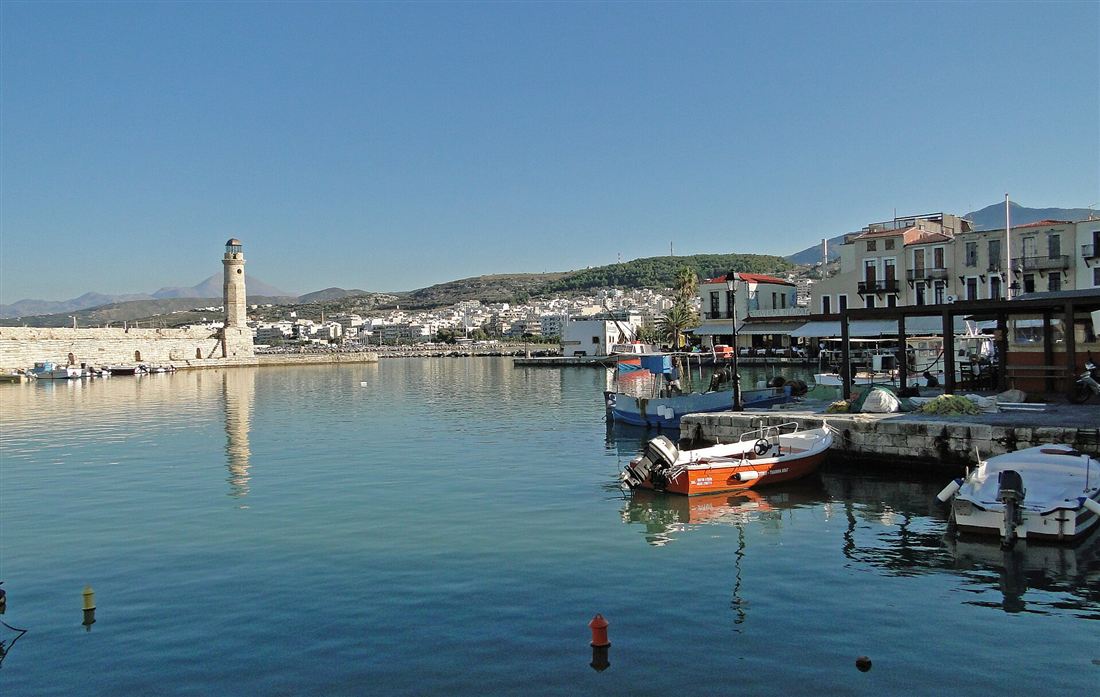
Chania has the better harbour. Its wide Venetian basin, arc of pastel houses and Egyptian-built lighthouse form the most striking waterfront in Crete. Rethymno’s harbour is smaller and quieter, a snug fishing port with its own stone lighthouse and a ring of tavernas.
Chania’s harbour is the image that sells western Crete. The long stone mole curves out to a lighthouse first raised by the Venetians and rebuilt in Egyptian style, and the walk to its base delivers the classic view back across the water to the arc of tall Venetian and Ottoman fa\u00e7ades. The Firkas Fortress guards the harbour mouth, the domed K\u00fc\u00e7\u00fck Hasan Mosque sits on the quay, and the old Venetian arsenali \u2014 the vaulted boat sheds \u2014 line the eastern side. The scale of the basin and the theatre of the lighthouse walk put Chania ahead on the waterfront.
Rethymno’s harbour charms on a smaller register. The Venetian inner port shelters fishing boats and pleasure craft behind a curved breakwater, and the squat stone lighthouse at its tip dates from the Ottoman rebuilding of the town. Tavernas crowd the quay edge, tables almost touching the water, and the whole port fits inside a single glance. It lacks the grandeur of Chania’s basin, and it lacks the crowds too.
For photography, sunset walks and sheer spectacle, Chania’s harbour is the clear winner. For an unhurried evening meal beside moored fishing boats without a wall of visitors, Rethymno’s smaller port holds its own. The two lighthouses bookend the choice: Chania’s long ceremonial mole against Rethymno’s intimate quayside.
Chania vs Rethymno for beaches?
Chania wins decisively on beaches. Balos lagoon, pink-sand Elafonisi and the long strand of Falassarna rank among the best in Greece, all west of the town. Rethymno counters with a huge sandy town beach on its doorstep and quieter south-coast bays over the mountains.
The beaches west of Chania are the reason travellers pick the town at all. Balos is a shallow turquoise lagoon reached by boat from Kissamos or a rough track, Elafonisi spreads pink-tinged sand across a shallow crossing to an islet, and Falassarna runs a broad open strand famed for its sunsets. Stavros, the cove of the Zorba the Greek finale, and the sands of the Akrotiri peninsula sit closer to the city. This concentration of headline beaches, mapped in full on the Chania beaches guide, has no equal on the Rethymno side.
Rethymno’s advantage is proximity, not spectacle. The town beach starts at the edge of the old town and runs east for kilometres of organised sand, sunbeds and shallow water \u2014 a beach a visitor walks to from a harbour-front room. For wilder swimming, the south coast lies across the mountains: Preveli, where a palm-lined river meets the sea beneath a gorge, and the quieter bays around Plakias and Agios Pavlos reward the drive.
Access shapes the beach day too. Chania’s western trio demands a drive: Balos and Elafonisi each sit over an hour from the city on winding roads, and the boat trip from Kissamos adds time, so a beach day there fills the whole day. Rethymno’s town beach removes the logistics entirely \u2014 a towel, a short walk, and the sea. That contrast defines the two: Chania trades effort for the most famous sand in Greece, Rethymno trades spectacle for a beach at the end of the street.
The split is clear. A trip built around famous beaches points to Chania and the far west. A trip that wants sand within a five-minute walk of dinner points to Rethymno and its town beach. Both towns reach the south coast, but Chania’s western lagoons are the beaches travellers cross Crete to see.
Which is better for history and sights, Chania or Rethymno?
Rethymno concentrates its history in one monument \u2014 the Fortezza, the largest Venetian castle on Crete. Chania spreads its history across museums, the Venizelos graves and the Samaria Gorge, giving it more sights overall but no single fortress to rival Rethymno’s.
The Fortezza is Rethymno’s headline. The star-shaped Venetian citadel crowns the headland above the old town, its ramparts enclosing the domed Sultan Ibrahim Mosque, a chapel, storerooms and sweeping views over the sea and the terracotta roofs below. A walk of the walls fills a morning, and the fortress doubles as the town’s outdoor concert and festival stage. No monument in Chania matches its bulk or its command of the skyline. The Archaeological Museum of Rethymno and the small Venetian Loggia round out the historic core.
Chania answers with breadth. The Archaeological Museum, the Maritime Museum inside the Firkas Fortress, and the restored synagogue trace Minoan, Venetian, Ottoman and Jewish Chania. The graves of Eleftherios Venizelos and his son Sofoklis stand on the Akrotiri hill above the city, a national pilgrimage site with a panorama over the whole bay. South of the city, the Samaria Gorge cuts 16 km through the White Mountains to the Libyan Sea, the standout day walk of western Crete, with the shorter Imbros Gorge as an easier alternative.
The choice turns on format. Rethymno delivers one commanding fortress and a tight museum quarter. Chania delivers more museums, the Venizelos memorials and direct access to Europe’s longest walking gorge. For a single unforgettable monument, Rethymno’s Fortezza leads; for the wider spread of history and landscape, Chania holds more.
Chania vs Rethymno for food and nightlife?
Both towns eat superbly on Cretan cooking, and both drink late. Chania runs the larger, louder scene with harbour-front bars and a broad restaurant spread. Rethymno keeps a compact, student-fuelled nightlife around its old-town squares and a food culture every bit as strong.
Cretan food carries both towns. Dakos rusks piled with tomato and mizithra cheese, slow-cooked lamb with stamnagkathi greens, snails, gamopilafo wedding rice and boureki courgette pie appear on menus in each old town, washed down with raki and local wine from the Kydonia and Rethymno vineyards. Chania’s covered market and its harbour tavernas give it depth and choice, from quayside seafood to backstreet mageireia serving the day’s pots. Rethymno matches the quality in a smaller compass, with family tavernas tucked under the Venetian arches and a food identity built on the same Cretan staples.
Nightlife diverges by size. Chania spreads bars along the harbour and through the Splantzia quarter, from cocktail terraces to late live-music cellars, and the crowd runs international through the warm months. Rethymno concentrates its night around the old-town squares and the bars off the Rimondi Fountain, where the University of Crete campus keeps a younger, cheaper, year-round energy that Chania’s more tourist-driven scene lacks in the off months.
Both towns pour Cretan raki as a matter of course \u2014 the clear pomace spirit arrives free at the end of most meals \u2014 and both sit within reach of working vineyards and olive groves that supply the tavernas direct. Chania draws on the Kydonia wine country and the mountain villages of Apokoronas for its produce; Rethymno leans on the Amari valley and the Psiloritis foothills. The farm-to-table thread runs through both, and a food-led trip loses nothing by choosing either base.
Neither town loses on eating. The decision rests on the kind of night: Chania for a bigger, more cosmopolitan harbour-front spread, Rethymno for a tighter, livelier, student-priced cluster of bars a short stagger from bed. Both put Cretan cooking at the centre of the table.
Which is cheaper, Chania or Rethymno?
Rethymno edges cheaper across the board. Rooms, tavernas, car hire and coffee run lower than Chania’s, where the fame of the harbour lifts prices. The gap is real but narrow, and both towns cost less than Santorini or Mykonos.
Rethymno’s lower profile keeps its prices down. Accommodation in and around the old town undercuts equivalent rooms in Chania, especially on the harbour front, where Chania charges a premium for the view. Tavernas, bars and car hire follow the same pattern, and the student presence sustains a supply of cheaper everyday eating and drinking that a heavily touristed town loses. A budget traveller stretches a daily allowance further in Rethymno.
Chania costs more because demand runs higher. The harbour is one of the most sought-after settings in Greece, peak-season rooms with a water view command top rates, and the restaurants along the quay price to their location. Away from the waterfront, in the Splantzia backstreets and the market, Chania offers value that closes much of the gap \u2014 the premium concentrates on the postcard-perfect harbour edge rather than the whole town.
Car hire and fuel factor into the total. Chania as a base pushes travellers toward the far-western beaches and the gorge, adding kilometres and a rented car to the bill. Rethymno’s central position shortens the drives to its town beach and the south coast, trimming fuel and hire days. A traveller pricing the whole trip, not the room alone, finds the geography of Rethymno quietly reinforces its lower headline rates.
The honest picture: Rethymno is the cheaper base, and the saving shows most on rooms and harbour-side meals. The difference amounts to a modest daily margin, not a different league. A traveller on a tight budget leans to Rethymno; a traveller set on Chania absorbs the premium by staying and eating a few streets back from the water.
Which suits families better, Chania or Rethymno?
Rethymno wins for families with young children. Its town beach runs straight off the promenade in a wide band of soft sand, with shallow, gently shelving water for hundreds of metres. Chania families drive 15 minutes west to Agioi Apostoloi for equivalent shallow coves.
Rethymno places the sand at the doorstep. Parents walk from a harbour-side room to the shore in five minutes, park a pushchair beside a sunbed, and watch toddlers paddle in warm, calm shallows. A single seafront line of tavernas, ice-cream counters and beach bars stretches east for kilometres behind that sand, so lunch, shade and a nappy change stay within sight of the towels. The resort belt of Platanias and Adelianos Kampos to the east packs family hotels with pools and kids’ clubs onto the same coastline. Lifeguards patrol the central stretch through the summer season, sun umbrellas line the sand in tidy rows, and a paved promenade lets a pushchair roll the full length of the beach without touching a road.
Chania keeps its best family swimming outside the centre. The Old Town harbour carries deep water and stone quays with no beach, so families base themselves west of the port. Agioi Apostoloi and Kalamaki fold the sea into a series of rocky-armed coves that break the waves and hold shallow, clear pools, a short bus or taxi ride from the Venetian streets. Golden Beach and the long sands toward Agia Marina give the same shallow entry as Rethymno once you reach them. Families who want sand under the hotel and old-town charm in one place lean toward Rethymno; families happy to split beach days from town days find Chania delivers both. The full spread of family bases sits on the where to stay in Chania guide.
Which suits couples better, Chania or Rethymno?
Chania edges ahead for couples. Its Venetian harbour, ringed by pastel houses and crowned by the lighthouse, delivers the most photographed sunset in Crete, and its restored mansions house the island’s densest cluster of boutique hotels. Rethymno answers with quieter lanes and lower prices for a near-equal romance.
Chania stages romance on a grand curve. Couples walk the full sweep of the harbour arm at dusk, reach the Egyptian lighthouse as the sky turns, and return to candlelit tables set against floodlit Venetian stone. Inside the old town, roofless bombed mansions reborn as suite hotels put four-poster beds under exposed timber and Venetian arches, with rooftop plunge pools that frame the White Mountains. The scale of the harbour and the density of design hotels give couples a wide field of settings.
Rethymno trades spectacle for intimacy. Its harbour is smaller and its lighthouse squatter, yet the fishing boats, the tight ring of tavernas and the low evening hum create a scene that feels private rather than staged. The Venetian and Ottoman quarter behind it hides courtyard hotels inside old town houses, with wooden balconies, stone fountains and jasmine-hung walls, at prices below Chania’s headline rates. Couples who want the postcard sunset and the deepest choice of boutique rooms choose Chania; couples who prize calm streets, lower spend and a harbour they share with fewer people choose Rethymno.
Which is the stronger choice for a first visit to Crete?
Chania is the stronger all-rounder for a first visit. It combines the island’s most complete Venetian old town, an international airport, a ferry port, and the trailheads for Samaria, Balos and Elafonisi, so a newcomer sees the headline sights of western Crete from one base with the least backtracking.
A first trip to Crete rewards range within reach. Chania puts a maze of Venetian and Ottoman streets, a working harbour, a covered market and museum-grade sights inside a compact centre a traveller explores on foot. It then feeds the three set-piece day trips of the west, the Samaria Gorge walk, the pink lagoon of Balos and the turquoise shallows of Elafonisi, from doorstep departure points. First-timers who want the essence of Crete on one holiday find the widest menu here, mapped on the Chania hub.
Rethymno serves a first visit that leans toward relaxation. The old town matches Chania’s atmosphere at a smaller scale, the beach sits in front of the town, and the central position shortens drives to both ends of the island. A newcomer who ranks a sandy town beach and a slower pace above the Samaria and Balos headliners finds Rethymno the better fit. For the traveller who wants to tick the famous western sights and the classic old-town scene on a single introductory trip, Chania carries more of Crete’s signature experiences within a short radius.
Which is easier to reach, Chania or Rethymno?
Chania is markedly easier to reach. Chania Airport on the Akrotiri peninsula takes direct flights from across Europe, and Souda port receives overnight ferries from Piraeus. Rethymno has no airport and no long-haul ferry line, so every visitor arrives through Chania or Heraklion and drives in.
Chania holds the transport keys of western Crete. Its airport sits 15 kilometres from the old town, a 25-minute transfer, and handles both domestic hops from Athens and seasonal international arrivals. Souda, 7 kilometres east of the centre, docks the nightly ferries from Piraeus, so a traveller boards in Athens in the evening and steps into Chania at breakfast. This dual gateway status removes a connecting leg for most itineraries.
Rethymno depends entirely on its neighbours. The nearest airports are Chania, 60 kilometres west, and Heraklion, 80 kilometres east, and the town’s own harbour handles fishing boats and small craft rather than the Piraeus ferry lines. A visitor flies into Chania or Heraklion, then covers the final stretch by rental car, KTEL bus or transfer along the north-coast national road, adding an hour to ninety minutes to the journey. Travellers who value the shortest, simplest arrival choose Chania; those content to add a road leg gain Rethymno’s central position in exchange.
Which works better as a base for day trips?
Chania bases the marquee western excursions; Rethymno bases the widest spread. Chania stands closest to Samaria, Balos and Elafonisi. Rethymno’s mid-island position reaches Preveli, Arkadi and both the Chania and Heraklion sights on drives of equal length, splitting the difference across Crete.
Chania anchors the west’s greatest hits. The Samaria Gorge bus leaves the town for Omalos before dawn, the Balos boats sail from Kissamos a short drive away, and Elafonisi’s pink sand lies within a morning’s reach along the south-west road. Kournas Lake, the Akrotiri monasteries and the Therisos gorge round out a base that keeps the famous landscapes of western Crete close. The full roster sits on the day trips from Chania guide.
Rethymno trades peak proximity for reach in every direction. From the town a driver reaches the palm-fringed Preveli beach and the Kourtaliotiko gorge to the south, the historic Arkadi Monastery in the hills behind, and the Amari valley’s Byzantine villages, while Chania’s old town and Heraklion’s Knossos both sit within a 60-to-80-kilometre drive. A traveller who wants Samaria and Balos as easy morning departures bases in Chania; a traveller who wants a single base that touches both halves of the island bases in Rethymno. Rethymno’s drivers reach Spili’s Venetian fountain, the Melidoni cave and the Margarites pottery villages within half an hour, filling the days between the headline excursions with the hill country of the island’s centre.
Can you visit both Chania and Rethymno?
Yes. The two towns sit 60 kilometres apart on the north-coast national road, a 50-minute drive or a one-hour KTEL bus ride. Visitors pair them as a day trip from either base or as a two-base holiday that gives each old town its own evenings.
The road between them runs fast and straight. Frequent KTEL buses link the two bus stations through the day, and a rental car covers the distance in under an hour, so a traveller staying in Chania spends a full day wandering Rethymno’s fortress and old town and returns for dinner, or the reverse. The proximity turns the Chania-versus-Rethymno decision into a soft one, since the loser of the base contest stays a half-day excursion away.
A two-base split extracts more from each. Three nights in Chania cover the Venetian harbour, the western day trips and the old-town evenings; three nights in Rethymno add the town beach, the Fortezza, and the central excursions to Preveli and Arkadi, with the drive between them as a stop at Georgioupolis or Kournas Lake. Splitting the stay removes the daily backtrack and lets each town’s night-time atmosphere register on its own terms.
Which is less crowded, Chania or Rethymno?
Rethymno is the quieter of the two. Chania draws the larger volume of coach tours, cruise excursions and flight arrivals through its airport and port, so its harbour front fills earlier and stays busier. Rethymno’s old town and beach hold a calmer rhythm through the day.
Chania pays for its fame in footfall. The Venetian harbour ranks among the most visited spots in Crete, and the combination of an on-site airport, cruise calls at Souda and the Samaria and Balos day-trip traffic funnels crowds through the old town from mid-morning. The narrow lanes and the harbour arm press together at sunset, when the day-trippers and the residents converge on the same quay.
Rethymno breathes more easily. Without an airport of its own and off the main cruise circuit, the town receives a thinner stream of visitors, and its old-town lanes and long beach absorb them across a wider area. The Fortezza rarely queues, and side streets stay walkable at noon. The honest picture holds a caveat: Rethymno’s beach resorts to the east draw their own summer crowds, and both towns thin out sharply in the shoulder months. Travellers who prioritise calm choose Rethymno; those who accept crowds for the bigger harbour spectacle choose Chania.
Where do you stay, Chania or Rethymno?
Base in Chania for the fullest first trip, the boutique hotels and the western day trips. Base in Rethymno for a sandy town beach, lower prices, a calmer old town and a central launchpad to both ends of Crete. The right answer follows the traveller’s priorities, not a single winner.
Chania suits the first-timer, the couple and the day-tripper. A newcomer covering Crete’s western headliners, a couple after the lighthouse sunset and the deepest pool of design hotels, and a hiker aiming at Samaria all gain from Chania’s gateway position and old-town density. The price runs higher and the crowds run thicker, and both buy a wider menu of experiences within a short radius.
Rethymno suits the family, the returning visitor and the budget-minded. A family wanting sand at the doorstep, a repeat visitor who has seen the west and wants a calmer base, and a traveller watching the nightly rate all find Rethymno delivers. Its central position rewards drivers who tour the whole island, and its quieter streets reward those who rank atmosphere over headline sights. Travellers who cannot choose split the stay across both.
How long do you need for Chania and Rethymno?
Allow five to seven days to do both towns justice. Three nights in Chania cover its old town, harbour and one western day trip; two to three nights in Rethymno add its beach, Fortezza and a central excursion. A seven-day week absorbs the drive between them without rushing.
A tight trip fits into five days. Two nights in Chania secure the Venetian harbour, the covered market and the old-town lanes, plus a single big day trip to Samaria, Balos or Elafonisi. Three nights in Rethymno then add the town beach, the walk up to the Fortezza, and one drive to Preveli or Arkadi, with the 60-kilometre transfer between the bases as the hinge of the itinerary.
A fuller week unlocks the region. Seven days give Chania three nights for two western day trips and unhurried evenings, and Rethymno four nights for the beach, the Amari valley and the Heraklion-side sights within reach. Travellers with a fortnight on Crete extend the split east toward Heraklion and Agios Nikolaos, using Chania and Rethymno as the western anchor of a full-island loop. The two towns reward whatever time a visitor gives them, and a week marks the point where neither feels shortchanged.
Chania vs Rethymno: what is the final verdict?
Chania takes the overall verdict as the richer, more complete base, and Rethymno takes the value verdict as the calmer, cheaper, more family-ready town. A first-time visitor books Chania; a returning, budget-conscious or beach-first traveller books Rethymno; the visitor with a week books both.
Chania wins the contest of scale and range. It holds the grander Venetian harbour, the denser cluster of boutique hotels, the on-site airport and ferry port, and the trailheads for the western landmarks that define a Crete holiday. That completeness costs more money and more elbow room at sunset, and it delivers the widest single-base experience in the west of the island.
Rethymno wins the contest of ease and value. It puts soft sand in front of the old town, keeps the lanes and the harbour calmer, charges less per night, and sits central enough to tour both ends of Crete from one bed. The final call rests on the traveller: choose Chania for the headline first trip, choose Rethymno for the relaxed and economical stay, and, since 60 kilometres separate them, choose both when the calendar allows.
Frequently Asked Questions
Chania or Rethymno: which is better?
Chania is the stronger all-rounder, with the grandest old town, the best western beaches and the Samaria Gorge. Rethymno wins for a smaller, cheaper, more relaxed Venetian town crowned by a huge Fortezza. Chania suits a first trip to Crete best.
Is Chania or Rethymno cheaper?
Rethymno edges cheaper for accommodation and dining, being smaller and less headline than Chania. Both offer good-value backstreet tavernas, and prices in each rise on the harbour front and through the July-August peak.
Can you visit both Chania and Rethymno?
Yes. Chania and Rethymno sit about 60 kilometres apart on the north-coast national road, a 45-minute drive or a frequent KTEL bus. Each works as a day trip from the other, or split a Crete trip between the two as twin bases.