
A Skiathos itinerary rewards structure over length. The island spans about 47 square kilometres, one bus line links the town to Koukounaries at stop 26, and water taxis plus excursion boats cover every coast the road misses. Three well-ordered days therefore capture more here than a scattered week captures on a larger island. This guide builds the plan day by day, from a single perfect day to a full week. Plan the whole trip with Greece Tours.
The logic stays constant at every length: mornings for lanes, monasteries and boats, afternoons for sand, evenings above the old harbour. Each day below names its transport, its beaches and its swap options for windy weather, so the plan survives contact with the meltemi. Distances appear in kilometres and minutes, and every stop sits on the public bus line, the water-taxi routes or the standard boat circuits.
How do you plan a Skiathos itinerary around the island’s compact size?
A Skiathos itinerary works around one compact frame: the island measures about 12 kilometres long and 6 kilometres wide. Base yourself once, use the single bus line and water taxis, and reach every highlight without changing hotels.
Skiathos measures about 12 kilometres from east to west and about 6 kilometres from north to south, the smallest of the three main Northern Sporades. One base covers the whole island, because every beach, monastery and viewpoint sits within a 30-minute ride of Skiathos Town. The paved coastal road runs roughly 13 kilometres along the south shore, linking the port to Koukounaries at the far western end. Visitors treating Skiathos as a single hub skip the hotel-hopping that larger islands demand and spend the saved hours in the water. Pick lodging near the old port or along the first numbered bus stops, and the day plans below unfold without a single suitcase repack.
Short distances mean late starts still deliver complete days, and no drive on the island exceeds half an hour.
The single public bus line forms the island’s spine, running from Skiathos Town along the south coast to Koukounaries at stop 26. Each stop carries a number, so directions on Skiathos sound like coordinates: Kanapitsa sits at stop 12, Vromolimnos near stop 13, Troulos around stop 20. Drivers announce the numbers, so riders track progress easily. The end-to-end ride takes about 30 minutes outside peak weeks and noticeably longer in August traffic. Buses follow each other closely through summer mornings and evenings, which keeps a car unnecessary for south-coast days. Plan bus-based days around the numbered stops, and hold a rental for the one or two days that target Aselinos, Kechria or the northern dirt roads.
This division keeps costs down while still opening every corner of the island across a week.
Water taxis leave the old port for Achladies, Kanapitsa and the pine-covered islet of Tsougria, covering the eastern bays the bus bypasses. Boats replace roads entirely on the north coast, where cliffs block construction and Lalaria remains reachable only by sea. Round-the-island excursions and beach shuttles both depart from the old port in the morning, so the harbour front works as the island’s second transport terminal. A three-day plan uses the harbour twice: once for the full circumnavigation and once for a slow Tsougria swim day. Longer stays add a morning crossing to neighbouring Skopelos from the same stone quays.
Treat the old port as your timetable board, walk its length on arrival evening, and note the departure signs before fixing the order of the week ahead.
Day allocation follows a simple ladder. One day belongs to Skiathos Town, Koukounaries and an Agia Eleni sunset. Three days add the boat circuit past Lalaria and Kastro plus a southwest beach day at Banana and Vromolimnos. Five to seven days bring the Evangelistria monastery, the Mandraki dune walk, a Kechria or Kounistra hike, plane-spotting beside the airport runway fence and a full-day Skopelos crossing. Each extra day slots in without reshuffling the core, which is the structural advantage of a compact island. Families load the ladder with beach repeats, while walkers trade one beach day for two monastery trails.
The structure stays fixed while the fillings change, so a single plan serves couples, groups and returning visitors alike across every length of stay on the island.
What does one perfect day on Skiathos look like?
One perfect day on Skiathos starts among the old-port alleys and the Bourtzi peninsula, moves by bus to Koukounaries after lunch, catches the Agia Eleni sunset, and ends with dinner above the harbour in Skiathos Town.
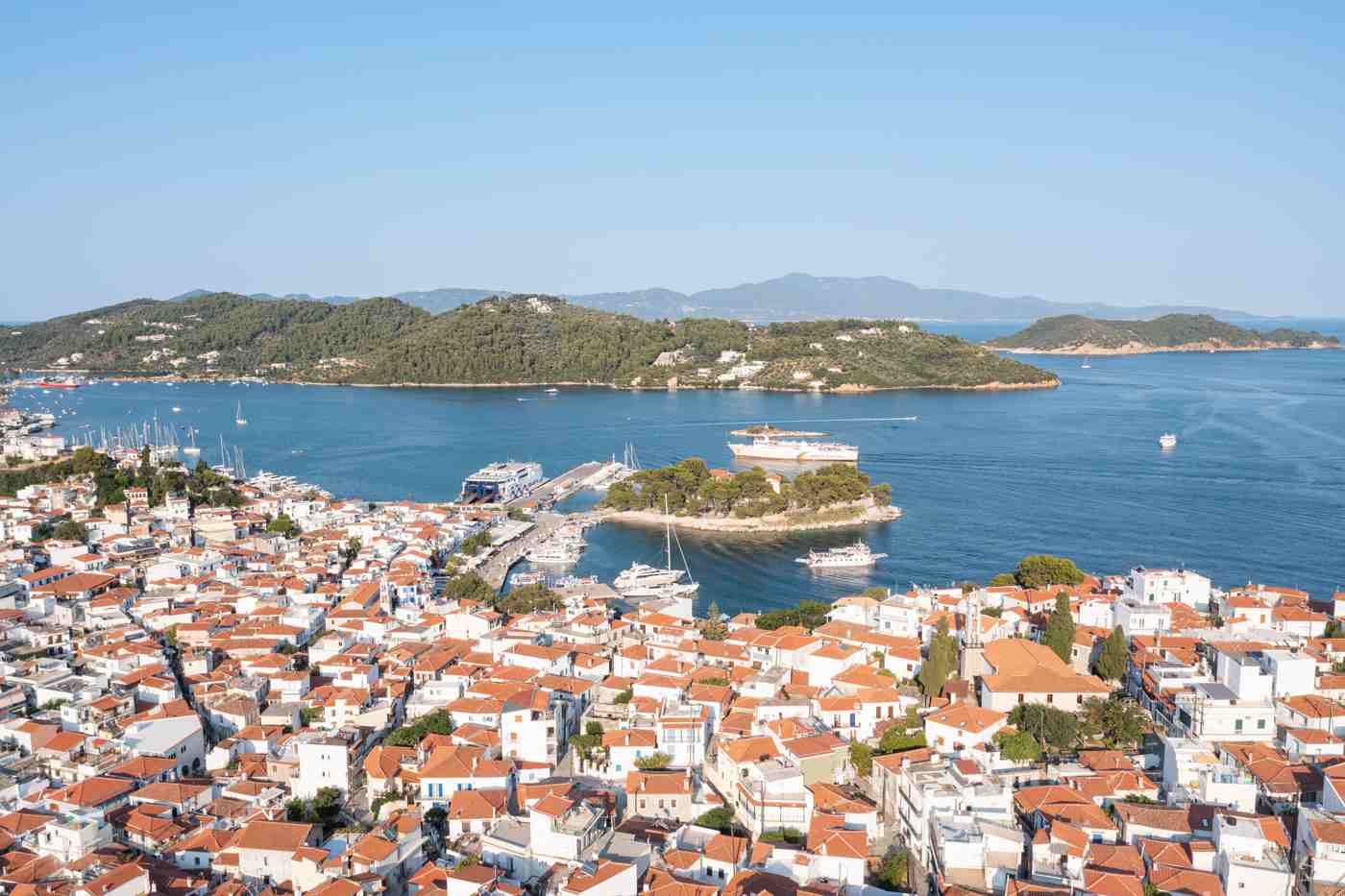
Morning belongs to Skiathos Town before the day boats return. Walk the old port and cross the short causeway to the Bourtzi, the pine-topped peninsula that splits the harbour in two. Climb afterwards toward the Agios Nikolaos clock tower for the full roofline view. The Papadiamantis House, home of the island’s novelist Alexandros Papadiamantis, opens as a small biographical museum two lanes behind the waterfront. Whitewashed lanes around the Plakes quarter hold family bakeries and shaded coffee stops for a slow breakfast. Two hours cover the full circuit at an easy pace, since the town core spans under one square kilometre.
Finish at the new-port end to watch the ferry traffic, then board the Koukounaries bus from the terminus beside the harbour for the afternoon leg.
Midday moves west to Koukounaries, stop 26 and the end of the bus line, about 30 minutes from town. The beach curves for roughly 1,200 metres of fine pale sand backed by a protected stone-pine forest and the Strofilia lagoon. Walk the forest path between the lagoon and the dunes to reach quieter sand at the western tip. Rental sunbeds, tavernas and watersport stations line the central stretch, so lunch happens on the spot without backtracking. Shade under the pines stays free for towel visitors. Swimmers get shallow, clear water that stays calm on north-wind days thanks to the south-facing bay.
Give the beach three full hours at minimum; the day’s remaining stops sit within a 20-minute walk over the western headland, so no bus connection interrupts the afternoon.
Late afternoon crosses the western headland to Agia Eleni, a west-facing bay about a 15-minute walk from the Koukounaries bus terminus. The beach looks straight toward the Pelion peninsula on the mainland, which places the setting sun directly over open water. Low rocks at the southern end shelter shallow pools that occupy children while the light fades. Arrive an hour early to claim sand near the northern rocks, where the sightline stays unblocked. A seasonal beach bar serves drinks through dusk, so the pause costs nothing in logistics. Alternatives exist for wind-shifted evenings: Banana beach, one cove south, faces the same horizon and keeps its bar open later.
Watch the sun drop behind Pelion, then walk back to stop 26 for the return bus, which continues into the evening through the high-season weeks.
Evening returns to Skiathos Town for dinner above the old harbour. Tavernas along the old port grill the day’s catch, while the lanes behind Papadiamantis Street hide quieter courtyard tables. The Bourtzi, lit after dark, anchors the view from every waterfront seat. Night extends without effort, because bars around the old port and the Plakes quarter serve past midnight in season. The compact grid keeps every venue within a ten-minute walk of the harbour. A harbour-edge table at dusk catches the last light on the water. One day built this way touches the island’s three registers — town lanes, forest beach and sunset bay — using nothing beyond the public bus.
Travellers with a single port call between ferries follow the identical route and still reach the quay with time to spare.
How does the day-two boat trip around Skiathos work, from Lalaria to Kastro?
Day two circles the island by excursion boat from the old port. The route runs the north coast to Lalaria beach, enters three sea caves, and lands below Kastro, the clifftop medieval settlement, before returning south.
Round-the-island boats depart the old port in the morning and complete the circuit in about six to seven hours. Wooden caiques and larger excursion vessels run the same loop, differing mainly in group size, shade and deck space. Booking happens at the harbour kiosks the evening before, which is when skippers confirm whether the north-coast sea allows the full route. Comparing Skiathos boat tours before committing pays off, since itineraries vary in swim-stop length and whether lunch comes aboard. The clockwise version reaches Lalaria before the midday arrivals, while the counter-clockwise run saves the caves for calmer afternoon water. Either direction covers the identical coastline, so choose by departure hour rather than by route map.
Bring cash for the kiosks, water and a hat, since shade runs short on the open decks.
Lalaria justifies the whole excursion. The beach lies on the northeast coast beneath grey limestone cliffs and remains unreachable by road or footpath, so boats provide the only access. Rounded white marble pebbles cover the shore and turn the shallows a pale electric blue under direct sun. Trypia Petra, a natural rock arch pierced through the cliff at the beach’s edge, frames swimmers who pass beneath it. Boats anchor offshore and allow about 45 minutes to an hour on the pebbles. Removing pebbles is banned and fines apply, a rule crews announce before landing. Wear swim shoes, because the stones grow hot by late morning and the seabed drops quickly.
North winds cancel the stop outright, so build one spare day into the plan for a second attempt.
Three sea caves punctuate the north-coast run between the town and Lalaria. Galazia Spilia, the Blue Cave, admits small boats through a narrow opening where reflected light colours the water a deep saturated blue. Skotini, the Dark Cave, cuts about 20 metres into the rock and needs the skipper’s lamp at its far end. Halkini, the Copper Cave, takes its name from the metallic streaks across its walls. Smaller caiques enter the openings directly, while larger vessels hold position outside and let confident swimmers stroke in through the entrance. Sea state decides everything here, because even a low swell closes the entrances on otherwise sunny days.
Crews time the caves for the calmest hour of the circuit, one reason the full loop beats a shortened north-coast taster trip.
Kastro closes the day’s cultural chapter. The fortified settlement crowns a sheer promontory on the island’s northern tip, joined to the land by a restored bridge where a drawbridge once stood. Islanders lived up there for centuries to escape pirate raids, and the site held about 20 churches at its peak. The Church of the Nativity survives with its frescoes and iconostasis intact. Boats land at the pebble cove below, and a stepped path climbs to the stone gate in about 15 minutes. A small clifftop taverna operates near the landing cove in season. Kastro’s story explains the modern town, because residents abandoned the rock once raids ended and rebuilt around the safer southern harbour.
Combine the ruins with a swim off the landing beach before reboarding.
Why does day three on Skiathos belong to Koukounaries, Banana and the southwest beaches?
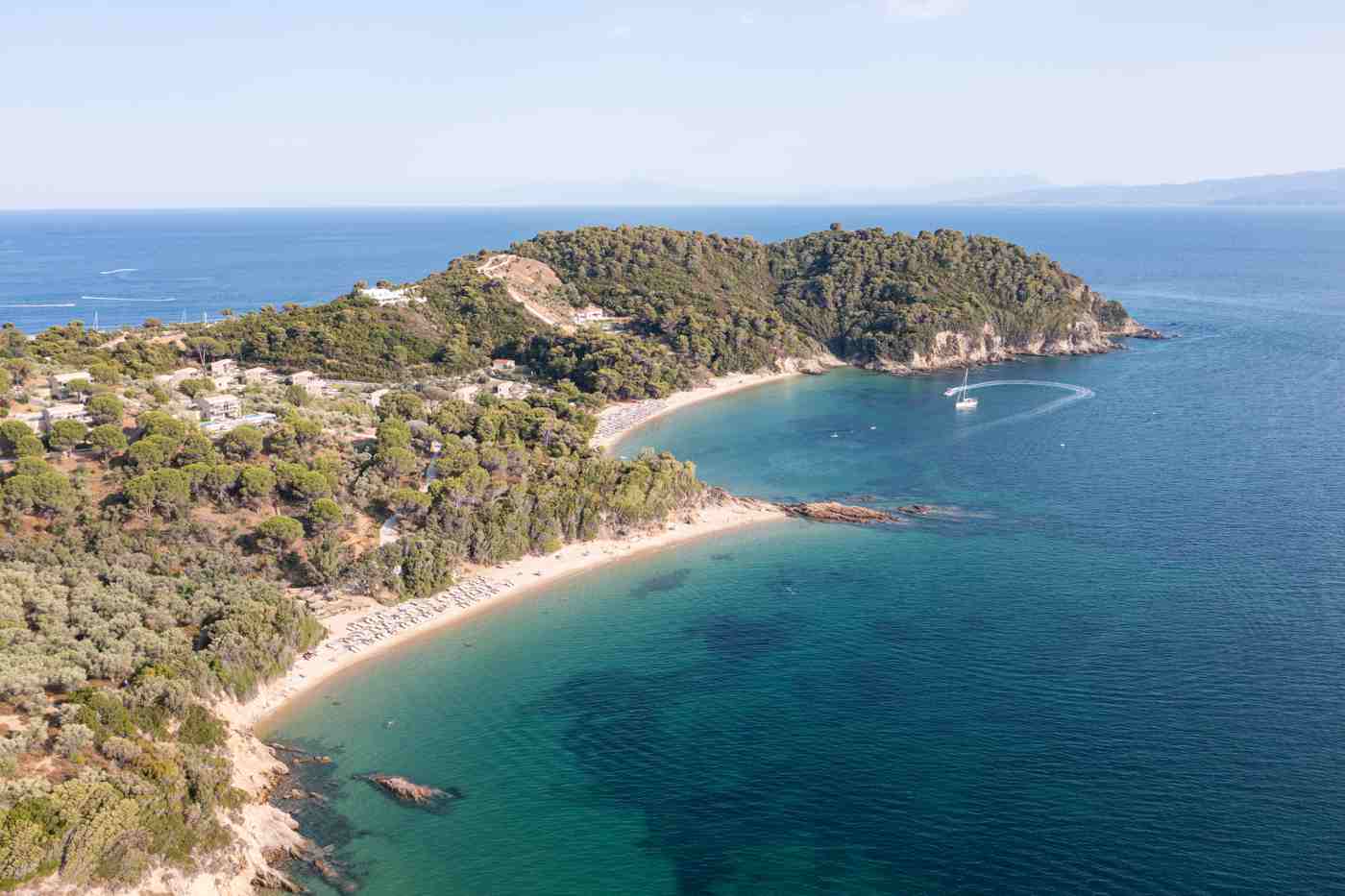
Day three concentrates on the southwest corner, where Koukounaries, Banana, Little Banana and Agia Eleni cluster within one walkable headland. A single bus ride to stop 26 unlocks four distinct beaches plus the Strofilia lagoon biotope.
Koukounaries anchors the day and deserves the first, cooler hours. The 1,200-metre crescent ranks among Greece’s most photographed beaches for its pale sand and the wall of stone pines behind it. The Strofilia lagoon sits directly inland, a protected wetland where herons and migrating birds feed in spring and autumn. A flat sandy trail loops the lagoon in about 40 minutes. Morning light angles across the bay before the sunbed rows fill, and the western end stays quietest throughout the day. Watersport stations open mid-morning for wakeboarding, ringos and paddleboards. Walkers who arrive on the first bus get a near-private forest beach for a full hour. No other south-coast stop repays early rising so directly.
Lifeguards watch the central stretch of the beach through the peak weeks.
Banana beach lies a 15-minute walk north over the headland from the Koukounaries bus stop, signposted from the road. The main cove, also called Krassa, curves in a shallow banana-shaped arc of golden sand with two beach bars and a young crowd. Little Banana, one rocky spur further along, operates as the island’s recognised naturist beach and stays calmer in every sense. Both coves face west-southwest and hold direct sun late into the evening after Koukounaries falls into pine shadow. Rock platforms between the two coves give snorkellers the clearest water of the day.
Music from the bars builds through the afternoon, so time Banana for the hours when you want energy and retreat to quieter sand once the volume rises. Loungers fill by noon in the peak weeks.
Agia Eleni holds the headland’s western face, a ten-minute walk from the bus terminus along a paved lane. The bay opens toward the Pelion peninsula, and its sand shelves gently enough for children while the rocky edges suit snorkelling. Walkers with reserve energy continue north from the Strofilia lagoon on a sandy forest track to Mandraki and Elia. These dune-backed beaches lie about 30 minutes away and carry a fraction of the Koukounaries crowd. Carry water for the pine track. The dunes there rise behind wide grey-gold sand, and pines keep the path shaded for most of the route. This northwest extension turns a beach day into a light hike without any transport change.
Return the same way, and the loop back to stop 26 closes in under 90 minutes.
The return trip east converts into a beach crawl using the numbered stops. Vromolimnos, near stop 13 on the Kalamaki peninsula, runs the island’s liveliest watersports scene, with waterskiing and a bar that carries the afternoon into evening. Kolios, two coves along, keeps families happy with its shallow entry and tavernas at sand level. Troulos and Agia Paraskevi offer broader, calmer stretches for travellers who prefer space over volume. Hop off, swim, and flag the next bus onward, since services follow each other closely through the summer core. Maratha, one cove before Koukounaries, stays the quietest option on the whole strip. Day three finishes with the full southwest catalogue sampled.
The sampling sharpens later repeat visits toward the two or three bays that genuinely fit your pace and party.
How do you pace beach time against culture across a Skiathos stay?
Pacing on Skiathos follows a two-register rhythm: culture in the cool morning hours, sand from noon onward. Monastery courtyards and Kastro’s bare rock heat hard by midday, while south-coast beaches only improve as the afternoon builds.
Evangelistria monastery sets the model for culture mornings. The complex stands about four kilometres north of town on the Kechria road, wrapped in pines. Taxis wait at the old port for the short run uphill. Its museum documents island monastic life alongside the loom where the first Greek flag was woven. Arrive before the heat and the tour vans, walk the courtyard under the plane trees, and taste the monastery’s own wine at the small shop. The visit fills about 90 minutes including the drive or taxi each way. Pair it with the Papadiamantis House back in town and the morning still ends before beach hours begin.
Dress codes apply, meaning covered shoulders and knees, and the gate pauses at midday, which is one more argument for the early start.
Wind decides the daily split more than any written plan. The meltemi blows from the north in high summer, flattening the south-coast bays while it churns Lalaria and the caves. Boat crews cancel the north loop on those days. The pattern repeats often enough to plan around. Reverse logic applies in a southerly blow, when Megali Ammos chops up and the northern coves at Aselinos or Elia sit oddly calm. Check the harbour flags each morning and swap days without hesitation: the boat circuit, the monastery drive and the Skopelos crossing all slide one slot with no loss. Travellers who lock a rigid order lose their Lalaria stop to a single windy morning.
Flexibility costs nothing on an island where every activity starts within 15 minutes of the same harbour.
Families and couples pace the same island differently. Children handle one culture block per stay, and Kastro from the boat counts, since the climb reads as an adventure rather than a museum. Shallow entries at Koukounaries, Kolios and Agia Paraskevi fill the remaining days. Teenagers rate the Vromolimnos watersports over any ruin. Couples reverse the ratio, trading beach repeats for the Kounistra monastery trail, the Kechria track and long harbour evenings. Mixed groups split at the bus stop: one half rides to stop 26, the other stays for lanes and museums, and both halves reunite for the sunset. The island’s scale makes the split painless, because nobody sits more than 30 minutes from anyone else.
Build the stay’s rhythm around the group’s slowest member, not its keenest.
A full week settles into a stable ratio: four beach days, two culture-led mornings and one boat day. Slot the round-the-island circuit early so a wind cancellation leaves room to retry. Keep the final day unplanned and spend it on the bay that won the week, a choice the list of things to do in Skiathos makes easier to rank. Shorter stays compress the same proportions rather than cutting registers entirely, and even a two-night visit fits one town morning plus one full beach afternoon. The island rewards this balance because its cultural sites are compact and its beaches are the headline. The ratio flexes by one day either way without breaking.
Leave two or three coves deliberately unvisited; the gap is what brings people back on the next ferry.
Which monasteries and hikes fill days four and five of a Skiathos itinerary?
Days four and five move inland and north: Evangelistria monastery above town, the Kounistra monastery in the western pines, the Kechria trail down to its twin coves, and the dune-backed walk from Koukounaries to Mandraki.
Evangelistria monastery sits about 4 km north of Skiathos Town, a 15-minute drive or a 90-minute uphill walk through olive terraces. Monks founded it in the eighteenth century, and the courtyard still centers on a Byzantine-style katholikon shaded by a plane tree. The complex houses a small museum of icons, manuscripts and looms, plus a shop selling monastery wine and olive oil. Greek fighters wove an early version of the national flag here, which gives the site weight beyond its architecture. Morning visits between 9 am and noon catch the light on the bell tower and beat the excursion buses. Dress covers shoulders and knees; wraps hang at the entrance.
The terrace overlooks vineyards and the wooded gorge below. Allow about 90 minutes on site, then continue north toward Kastro on the same road.
Kounistra monastery anchors day five in the island’s western pines, about 4 km uphill from Troulos on a paved side road. The chapel honors Panagia Eikonistria, the island’s patron, whose icon a monk found swinging from a pine branch; the name derives from the Greek verb for swinging. Faded frescoes cover the barrel vault, and a tiny courtyard terrace looks over pine ridges toward the south coast. A taverna beside the gate serves lunch in summer, which makes the stop an easy midday anchor. Drivers continue 3 km beyond the monastery to Agia Eleni or drop back to Troulos for a swim.
Walkers reach it on a signed dirt track from Koukounaries in about one hour, climbing 200 vertical meters through forest. Carry water; the trail has no springs.
Kechria rewards walkers who want the island’s quieter north on day five afternoon. The route leaves the ring road near the Panagia Kechria monastery, a small whitewashed complex with smoke-darkened frescoes. Then drops through pine forest to two pebble-and-sand coves, Kechria and neighboring Ligaries. The descent covers about 3 km and loses roughly 250 meters of height; sturdy shoes handle the loose gravel better than sandals. Both coves keep clear, calm water on south-wind days and stay empty outside July and August. One seasonal canteen operates at Ligaries; Kechria has none, so carry supplies. Drivers with a small jeep or scooter manage the dirt road directly to the shore.
The climb back takes about one hour, so start the return before the light fades. Snorkelers find octopus along the eastern rocks.
Mandraki closes the two-day inland block with the island’s best dune landscape. The sandy trail starts behind Koukounaries beach at the Strofilia lagoon bridge and runs about 30 minutes north through pines and juniper to Mandraki bay, also called Xerxes’ anchorage after the Persian fleet that sheltered here. Elias beach sits one cove east along the same path, with a summer canteen and sunbeds on soft sand. Waves build here on north wind, so pick a calm day. The walk stays flat and shaded for most of its length, which suits families with children over five. Combine the morning walk with an afternoon back at the lagoon watching herons, then ride the bus home from stop 26.
Bring cash for the canteen and water for the return leg.
How do days six and seven of a Skiathos itinerary use Tsougria, the runway and Skopelos?
Day six splits between a Tsougria islet swim morning and plane-spotting at the runway fence in the afternoon. Day seven crosses the strait to Skopelos for Chora, Panormos and the Mamma Mia chapel at Agios Ioannis.
Tsougria islet lies about 3 km off the old port, a 20-minute water-taxi hop that turns day six into a small expedition. Boats leave the old harbor through the morning and return through the afternoon on a posted rotation. The main beach faces Skiathos Town across the strait with shallow turquoise water over sand, a single taverna and pine shade behind the sunbeds. A second, unorganized cove sits a ten-minute walk over the headland for travelers who want silence. The islet has no roads and no permanent residents, so the swim day feels farther from town than the distance suggests. Pack snorkel gear; the rocks on the northern edge hold the clearest water.
Return by mid-afternoon to reposition for the runway. Cash covers the taverna; cards rarely work offshore.
Plane-spotting fills the late afternoon of day six at the northern end of the runway. Skiathos airport squeezes a short strip between two bays, and the public road passes directly behind the threshold, so arriving jets cross about 15 meters overhead. Spotters compare the scene to St Maarten, and summer schedules bring a steady run of arrivals between late afternoon and dusk. Stand behind the fence line marked by airport signage and keep clear of the jet-blast zone when aircraft turn for departure; the blast knocks adults off their feet. Xanemos beach sits beside the runway for a swim between landings. A flight-tracker app tells you the next arrival, which saves standing in the sun.
Scooter parking lines the road above the fence. Photographers favor the golden hour for shots against the strait.
Skopelos anchors day seven with the shortest inter-island hop in the Sporades. Ferries and summer excursion boats leave the new port beside Skiathos Town and reach Skopelos in about one hour, calling at Glossa or the main harbor depending on the sailing. Chora climbs its amphitheater of slate roofs and bougainvillea lanes above the waterfront. Allow two hours for the kastro. The folklore museum and a bakery stop for the local cheese pie. Excursion itineraries add a swim at Panormos or Stafylos and a photo stop below the Agios Ioannis chapel. The wedding church from the Mamma Mia film, perched on its 100-step rock.
Check the last return sailing before committing to a beach; the strait crossing closes the day. Book the crossing one day ahead in July and August.
Sequencing matters across the final two days because both depend on sea conditions. Run Tsougria on the calmer of the two forecasts and hold Skopelos for the day with lighter wind, since the strait crossing gets rough above 5 Beaufort. Travelers flying out on the morning after day seven keep the last evening in town: a final swim at Megali Ammos, a harbor dinner and packing done early. Anyone extending beyond one week repeats the boat-day formula with a different operator route, or adds the Kastro overland approach skipped earlier.
The two-day block also flips wholesale with days four and five when the forecast demands it; the itinerary bends without breaking because every anchor sits within 12 km of town. Keep one restaurant reservation flexible for the same reason.
What does a Skiathos itinerary swap in when the meltemi wind blows?
Meltemi days push the plan south and indoors: sheltered swims at Vromolimnos, Achladies and Megali Ammos, the Papadiamantis House and Bourtzi in town, Evangelistria’s museum, and a taverna lunch instead of the exposed north-coast coves.
The meltemi arrives from the north between June and September and sorts the island’s coasts into usable and unusable halves. North-facing beaches including Lalaria, Kechria, Ligaries, Mandraki, Elias and both Aselinos bays take the full swell, with breaking waves and airborne sand. The south coast from Megali Ammos through Achladies, Vromolimnos and Troulos to Koukounaries sits in the island’s lee and often stays swimmable in a strong blow. Boat operators cancel the round-the-island route on the roughest days because Lalaria becomes unlandable. Check the marine forecast each evening and slot beach days accordingly rather than following a fixed order.
Wind runs in cycles of two to four days, so a seven-day stay absorbs one blow without losing its anchors. Gusts peak in the early afternoon and ease near sunset.
Town absorbs a windy morning better than any beach. The Papadiamantis House, birthplace of the island’s novelist, packs its two floors with original furniture and manuscripts and takes about 30 minutes to view. The Bourtzi peninsula between the two harbors carries a pine park, the old fortress walls and a café terrace where the wind reads as drama rather than nuisance. Shaded shopping lanes off Papadiamantis Street hold ceramics workshops, olive-wood carvers and two bakeries worth a detour. The old port fish tavernas serve lunch behind glass screens on rough days. Photographers get the strongest harbor light in wind-scoured air after the gusts strip the haze.
Cap the swap with a sheltered late swim at Megali Ammos, five minutes’ walk from the town center. Rain rarely joins the meltemi, so walking stays comfortable.
Sheltered swims keep the beach habit alive during a blow. Vromolimnos on the Kanapitsa peninsula faces southwest, holds flat water in a northerly and runs a beach bar with sunbeds through the season. Achladies stretches long and shallow below its hotels, reached by numbered bus stops on the coast road, and suits families riding out a windy spell. Troulos and Maratha keep gentler surf than the headline coves farther west. Koukounaries itself curves enough that its eastern end stays calmer than the center. Kanapitsa’s small coves also host the island’s water-sports bases, which operate on wind days when the sea state allows.
Pick the beach after the morning forecast rather than the night before; direction shifts of 20 degrees change which corners stay flat. Wind also drops the humidity, so afternoons feel cooler.
Reshuffling beats cancelling on a meltemi day. Move the Evangelistria and Kounistra visits into the blow, since monasteries, museums and forest trails lose nothing to wind. Bank the boat trip and Tsougria for the calm that follows. Inland walking trails through the Skiathos pine interior stay protected below the ridgelines; the Kechria monastery track and the path network above town both work in a northerly. Kastro from the land side turns dramatic in wind, with spray bursting over the rocks below the church, though the descent stairs demand care in gusts. Tavernas in Troulos and town fill at lunch on blow days, so book a table by late morning.
One wind day per week is the planning norm in high summer; two arrive on unlucky weeks.
How does a Skiathos itinerary change for families versus couples?
Families anchor on the shallow south coast, short walks and the bus; couples trade midday beach hours for Kastro sunsets, old-port dinners and the quieter northern coves. The skeleton stays identical; the daily rhythm and beach picks change.
Family plans favor beaches with shallow entries and facilities within reach. Achladies, Vromolimnos, Troulos and the eastern end of Koukounaries all shelve gently, keep lifeguards in peak season and put a canteen within 100 meters of the towel. The bus removes car-seat logistics; children track the numbered stops as a game. Swap the full round-the-island boat day for a shorter Tsougria run, since two hours afloat suits young children better than six. The Mandraki dune walk works from age five with hats and water. Evenings run early: gelato on the old port, harbor-watching from the Bourtzi pines, dinner by seven. Slot the Skopelos crossing only for children over eight; the double ferry day exhausts younger ones.
Book ground-floor rooms near a pool for the midday retreat between beach sessions.
Couples restructure the same week around light and quiet rather than facilities. Mornings start at emptier coves such as Kechria, Ligaries or Little Banana before the boats arrive, with the main beaches saved for organized afternoons. Kastro at sunset replaces the mid-afternoon town wander; the golden hour on the rock and the drive back through the pines outclass any beach bar. Dinner shifts to the old port after nine, when the day boats leave and the harbor calms. The Kounistra route gains a wine stop at a hillside taverna above Troulos. Plane-spotting turns into an aperitif ritual with the last arrivals crossing at dusk.
A two-day scooter rental covers the western viewpoints that the bus never reaches, ending each loop at a different sunset terrace. Late-morning starts replace the alarm clock entirely.
The core skeleton survives both variants because Skiathos concentrates its anchors. Day one in town, a boat day, a Koukounaries day, the monastery-and-north block and a Skopelos option appear in every version; only the hour-by-hour execution shifts. Families compress each outing into the 9 am to 5 pm window, while couples stretch the same map across early mornings and late evenings and skip the midday peak entirely. Accommodation choice reinforces the split: families cluster in Achladies and Troulos for beach proximity, couples in town or on Kanapitsa for the evening scene. Both groups keep the wind-day swap list from the previous section in reserve.
Mixed groups run a hybrid, splitting after breakfast and reuniting for dinner, which the small island distances make painless. No anchor sits more than 30 minutes from another.
Concrete swaps illustrate the split on the beach days. Banana beach hosts a lively bar scene and a naturist section at Little Banana, so families shift to neighboring Agia Eleni while couples stay put. Lalaria on the boat day thrills both, but families pick operators with longer swim stops and shade on deck. On the monastery day, families cut Kounistra and keep Evangelistria plus a pool afternoon; couples run both monasteries and add the Kechria descent. The Skopelos day gives families a beach-first route via Panormos and couples a Chora-first route ending with dinner before the return sailing.
Teen-led families borrow from the couples column, adding the plane-spotting fence and the Kastro sunset once bedtimes stop dictating the schedule. Both variants end the week rested rather than rushed.
Which transport works on each day of a Skiathos itinerary?
The single bus line handles town-to-Koukounaries days, a scooter or small car unlocks the monastery-and-north block for two to three days, and water taxis cover Tsougria, Lalaria access and the beach hops without parking stress.
The bus carries the first three days on its own. One line runs from the harbor to Koukounaries along the south coast with numbered stops. Terminus at stop 26 by the Strofilia lagoon. Departures about every 15 to 30 minutes in high season. Boards at each stop list the numbers. Beach targets translate directly: Megali Ammos sits at the low numbers. Achladies and Vromolimnos mid-route, Troulos and Maratha near the top of the line. Buses fill by mid-morning in August; ride before 10 am or stand. The last evening departures let beach days end with dinner in town without a car. Tickets sell on board from a conductor.
The line never crosses to the north coast, which defines the rental days later. Drivers announce Koukounaries as the final stop.
A rental earns its keep on days four and five only. Book a scooter, quad or small car for the monastery block: Evangelistria, Kounistra, the Kechria dirt road and the Aselinos bays all sit off the bus line. Island distances stay tiny; the longest useful drive, town to Mikros Aselinos, covers about 12 km. Concrete gives way to graded dirt on the northern tracks, so a quad or small SUV handles Kechria and Aselinos with less drama than a low scooter. Parking in town stays tight through summer evenings; return the vehicle before dinner or park above the ring road and walk down.
Two rental days cover every inland anchor, which keeps the transport budget lean without cutting a single site from the plan. Helmets come with the machine; wear them on dirt.
Water taxis fill the gaps the road network leaves. Boats from the old port run to Tsougria, Kanapitsa and Achladies through the day, and separate taxi boats shuttle from Koukounaries toward Banana and Agia Eleni when seas stay calm. The round-the-island excursions remain the only practical route to Lalaria, since no road reaches the beach and the cliff path does not exist. Day-six logistics lean entirely on the water: taxi boat out to the islet in the morning, return mid-afternoon, then bus or scooter to the runway fence. Skopelos ferries leave from the new port on the opposite side of the Bourtzi.
Buy water-taxi returns as you board and confirm the last run back aloud with the skipper, not from a poster. Morning departures beat the chop that builds after lunch.
Feet handle everything inside town, and matching mode to day keeps costs proportional. Days one and two run on walking plus the bus, day three’s excursion boat does its own transport, and days four and five belong to the rental. Day six pairs a water taxi with a short ride to the runway fence; day seven means the ferry, with feet again on Skopelos. Taxis wait as a backup rank on the new port, useful for a late airport run or a night return from Kanapitsa, and drivers quote the fare before departure. Luggage transfers on arrival day work by taxi rather than bus, since cases and crowded aisles mix badly.
The pattern spends on wheels only when the day’s geography demands it, which keeps a week’s transport lean.
Frequently Asked Questions
How days are enough for a Skiathos itinerary?
Five days cover Skiathos comfortably; seven turn the trip unhurried. Three days capture the essentials: Skiathos Town with the Bourtzi and Papadiamantis House, the round-the-island boat to Lalaria and Kastro, and one full Koukounaries day with the Strofilia lagoon. Five days add the Evangelistria and Kounistra monasteries, the Kechria descent and a second beach block on the Kanapitsa side. Seven days bring the Tsougria swim day, plane-spotting at the runway and the Skopelos crossing without squeezing anything. A weekend visit works as a town-plus-one-beach sampler but leaves the boat day out, and the boat day defines the island more than any single beach.
Travelers on a wider Sporades route give Skiathos three nights minimum, since the arrival and departure half-days consume real time. Two full weeks stretch thin unless slow beach repetition is the goal. Day-length variety runs out around day ten. The strongest use of extra nights is a Skopelos overnight rather than more Skiathos.
What deserves priority on a first Skiathos itinerary?
The round-the-island boat trip ranks first for a first visit because it stacks Lalaria, the sea caves and Kastro into one day that no road replicates. Koukounaries with the Strofilia lagoon takes second place as the island’s signature beach. Skiathos Town takes third: the Bourtzi between the two harbors. The Papadiamantis House and an evening on the old port. A first-timer with four days adds Evangelistria monastery for the flag history and the strait view. Tsougria, plane-spotting, the northern coves and the Skopelos crossing belong to longer stays or return visits.
Prioritize by weather rather than by list order: lock the boat trip onto the calmest forecast day the moment you arrive, since operators cancel in a strong northerly and the trip anchors the whole itinerary. Beaches tolerate schedule shuffling; the boat does not. First-timers who protect that one day report the rest of the plan falling into place around it. Book it on arrival evening at the old-port kiosks.
How does a Skiathos itinerary avoid the August crowds?
Timing inside the day beats changing the itinerary itself. Beaches fill between 11 am and 5 pm in August. Swim before 10 am or after 6 pm and hold the middle hours for lunch. The monasteries or a shaded pool. Ride the first bus of the morning to Koukounaries and claim the western end before the coaches arrive. Book the round-the-island boat for early in the week; weekend departures carry the heaviest loads. Choose the smaller coves over the headliners: Kechria, Ligaries and Mikros Aselinos stay workable even in peak weeks because access filters the numbers. Eat dinner after nine or before seven; the old port jams in between. The Skopelos crossing thins mid-week.
Tsougria absorbs crowds poorly on weekends when local boats join in, so slot it Monday to Thursday. Accommodation outside town, around Achladies or Troulos, trades nightlife access for quieter mornings, and the bus bridges the gap. June and September deliver the same itinerary with half the bodies on the sand.
What does a Skiathos itinerary offer on a rainy day?
Rain redirects the plan into town and under monastery roofs without wrecking it. The Papadiamantis House museum, the Bourtzi exhibitions and the shops along Papadiamantis Street absorb a wet morning, and the old-port tavernas stretch lunch across the worst of a front. Evangelistria monastery works in rain: the katholikon, the icon museum and the shop sit under cover, and the drive up takes 15 minutes. Storms in the Sporades pass fast; fronts typically clear within half a day outside winter, so plan a floating half-day rather than writing off the date. Swimming continues in warm rain when lightning stays away; the sea temperature holds and beaches empty.
Bakeries and cafés around the flat part of town serve as waiting rooms with better pastry than any lobby. Reslot the boat day, Tsougria and plane-spotting to the next clear slot, exactly as with a wind day. Summer rain days on Skiathos number one or two per month at most.
How does budget pacing work across a Skiathos week?
Alternating spend-heavy and spend-light days keeps a Skiathos week affordable without cutting anchors. The boat day, the Skopelos crossing and the rental block carry the main costs. Separate them with bus-and-beach days where the ticket. A bakery lunch and a free sunset make up the whole outlay. Free anchors carry real weight here: the Mandraki dune walk, the Kastro visit, plane-spotting at the fence, the lagoon birdlife and every unorganized cove cost nothing beyond transport. Tavernas one street back from the old port price mains noticeably below the waterfront rows, and bakeries cover breakfast for a fraction of a hotel buffet.
Sunbeds add up fastest; a towel on the free sand halves a beach day’s cost at most organized beaches. Book the rental for two consecutive days rather than the whole week, since the bus already covers the south coast. Water taxis cost more per kilometer than any land option, so reserve them for the islet day.
What happens to the itinerary after a late arrival on Skiathos?
A late arrival converts day one into an evening-only unit and pushes the town walk to first position. Drop bags, then walk the old port. The Bourtzi headland and the lanes above the harbor. The loop takes about 90 minutes at night pace and the town lights carry it. Eat at the old port, where kitchens serve late through the season. Book the round-the-island boat for day three rather than day two at the harbor kiosks the same evening, buying one full recovery day. Shift the original day-one beach block to the following morning: Megali Ammos sits ten minutes’ walk from most town lodgings and opens the swimming account before breakfast ends.
Airport transfers at night run by taxi from the rank; the distance into town covers about 2 km, so the ride stays short. The full itinerary loses nothing; every element slides one slot later, and the seventh-day margin absorbs the shift. Confirm breakfast hours on check-in.
How does a Skiathos itinerary combine with Skopelos?
A day trip covers Skopelos highlights; an overnight split serves travelers chasing depth. The crossing from the new port takes about one hour, which makes a Chora-plus-one-beach day trip realistic on day seven of a week. Travelers with ten days or more split the stay instead: five nights on Skiathos for beaches and the boat day. Then three to four on Skopelos for Chora, the Agios Ioannis chapel rock and the pine-road drives, returning to Skiathos only for the flight. Skiathos holds the airport, so the split always starts and ends there. Luggage moves with you on the ferry without extra arrangement.
Book the inter-island leg one day ahead in August; sailings outside peak weeks carry space on the day. Keep the final night on Skiathos rather than gambling on a morning crossing before a flight, since a cancelled sailing in a northerly strands you one island away from the departure gate. The two islands share weather, so the wind rules travel with you.