
Samos International Airport, named Aristarchos of Samos after the ancient astronomer, is the island’s single air gateway and carries the code SMI. It sits on the southeast coast about 3 km from Pythagorio and roughly 14 km from Vathy, the capital. The airport handles domestic flights from Athens and Thessaloniki plus seasonal charter and scheduled flights from across Europe through summer. Plan the whole trip with Greece Tours.
One compact terminal manages every arrival and departure, and a single runway runs along a narrow coastal strip beside the sea and the Alyki wetland. This guide explains the airport’s name and code, its location and distances. The domestic and European flight network. The terminal and runway, so travellers know what to expect on landing at Samos.
What is Samos Airport and why is it named Aristarchos of Samos?
Samos International Airport is the island’s only commercial airport, named Aristarchos of Samos after the ancient Greek astronomer. It carries the IATA code SMI and handles Greek domestic and seasonal European traffic.
Samos International Airport serves as the primary air gateway to Samos, a large green island in the eastern Aegean off the Turkish coast. Authorities named the airport Aristarchos of Samos, honouring the astronomer Aristarchus, who was born on the island and proposed a sun-centred model of the cosmos. The choice ties the modern airport to the island’s ancient reputation for science and mathematics, the same heritage that produced Pythagoras. The airport ranks among the busier regional gateways in the eastern Aegean during the warm season. Its single field concentrates all scheduled and charter arrivals for the island in one compact location near the southeast coast.
Most visitors flying to Samos land here rather than arriving by the long ferry routes from the mainland ports of Piraeus.
The airport carries the IATA code SMI, the three-letter identifier printed on boarding passes and luggage tags for Samos flights. Its ICAO code is LGSM, the format used by air-traffic control across Greece. Aristarchus of Samos, the man behind the name, worked in the third century before the common era and calculated relative distances to the sun and moon. He argued that the earth turns on its axis and orbits the sun, an idea far ahead of its time. Linking the airport to this thinker places arriving travellers within a lineage of Samian astronomers and mathematicians. The name also distinguishes Samos from other Greek island airports that honour saints, local heroes or nearby towns rather than ancient scientists.
Travellers often notice the unusual name on their tickets.
The airport concentrates almost the entire flow of visitors reaching the island by air. Travellers planning a trip to Samos compare this quick flight against the slower ferry crossing from Piraeus. A flight from Athens covers the distance in about an hour, while the sea route runs for roughly eight to thirteen hours overnight. The airport therefore shapes how the island fills through the season, with arrivals peaking in the warm months. Airlines base their schedules on tourist demand, adding frequency as summer builds and trimming it in winter. The compact site handles this rhythm from a single terminal and one runway.
Its position near Pythagorio puts most southeast resorts within a short drive of the arrivals hall, a convenience that supports the island’s tourism.
The airport anchors the island’s connection to the rest of Greece and to Europe. Its runway, apron and terminal sit together on a narrow coastal strip, giving it a small footprint compared with mainland hubs. Passenger numbers swing sharply between the quiet winter and the busy summer, a pattern common to Greek island airports. A control tower, fuel supply and ground-handling crews keep the field operating through daylight hours in the main season. The airport also serves residents flying to Athens for work, study or medical care, not only holiday visitors. Cargo and mail move through the same terminal on passenger aircraft.
This single site therefore ties a remote Aegean island to national and international networks, cutting a multi-hour sea journey down to a short flight.
Where is Samos Airport located on the island?
Samos Airport sits on the southeast coast of the island, about 3 km from the harbour town of Pythagorio and roughly 14 km from Vathy, the capital, also called Samos Town. The coastal position places it beside the sea.
Samos Airport occupies a flat coastal shelf on the southeast corner of the island, the sunniest and driest part of Samos. The runway runs close to the shoreline, so aircraft on approach cross the water before touching down. The nearest town is Pythagorio, the historic harbour and UNESCO site about 3 km to the west along the coast road. The capital, Vathy, lies roughly 14 km to the northeast over a low ridge, a drive of about twenty minutes. This southeast placement puts the airport near the island’s densest cluster of resorts, ancient sites and beaches. Arriving travellers reach Pythagorio’s marina, the Eupalinos Tunnel and the Heraion within a short drive of the terminal.
Which concentrates the main sights close to the runway and the arrivals hall.
The airport’s southeast location shapes transfer times to every base on Samos. Pythagorio stands minutes away, so guests staying there reach their rooms almost immediately after landing. Vathy, on the northeast coast, sits about 14 km off, a drive of around twenty minutes across the island’s neck. Kokkari, the north-coast resort, lies roughly 25 km away, close to forty minutes by road. The southwest beaches under Mount Kerkis, such as Votsalakia, stretch far across the island, an hour or more by car. Karlovasi, the northwest town, sits about 45 km from the runway. These gaps reflect the size of Samos, which covers about 476 square kilometres.
Travellers therefore match their choice of base and transport to the distance from the southeast airport when they plan an arrival.
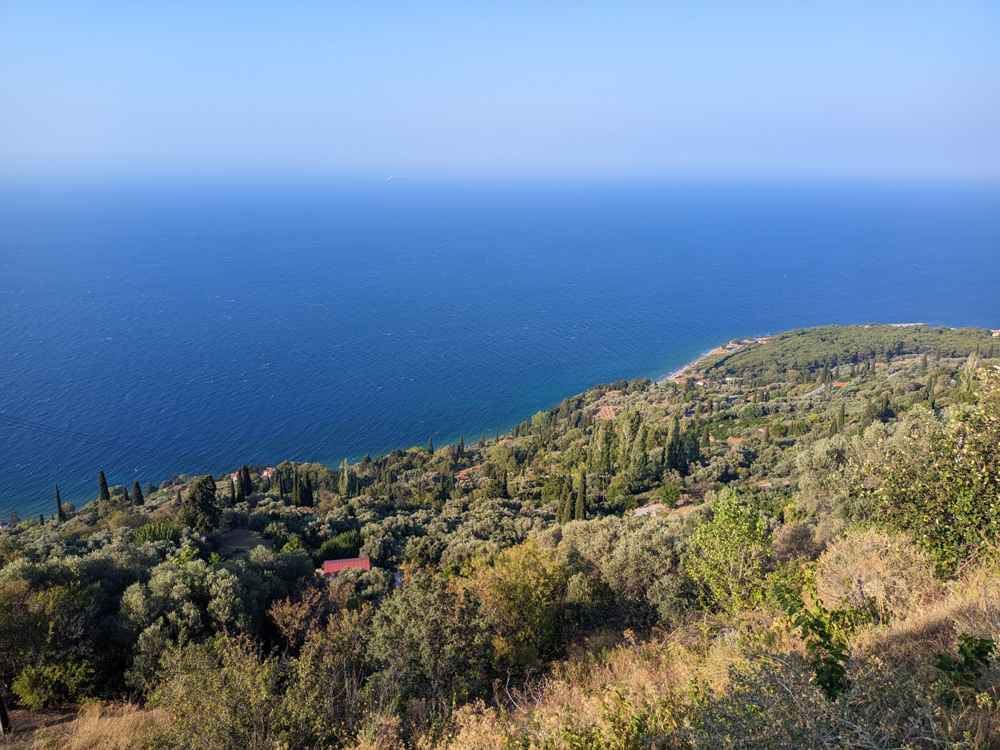
Aircraft approaching Samos Airport follow the line of the coast, giving window passengers a view of the strait toward Turkey. The Turkish mainland lies only about 1.2 km across the Mycale strait at the narrowest point, so the neighbouring coast fills the horizon. The runway’s coastal setting means crosswinds off the sea sometimes affect landings on this exposed strip. Behind the airport rise low hills, while the Alyki wetland spreads on the flat ground beside the runway. The site’s compact footprint fits between the sea and these hills, leaving little room to expand. This tight geography explains the single runway and the small terminal.
The southeast coast around the airport stays warm and dry, the reason the island’s earliest tourism grew first around nearby Pythagorio.
A single coast road links Samos Airport westward to Pythagorio and eastward toward Vathy, forming the backbone of transfers. From the terminal, drivers turn onto this road and reach Pythagorio’s edge within about five minutes. The route to Vathy climbs over a low saddle between the southeast plain and the deep northern bay. Signs at the airport exit point toward Pythagorio, Vathy and the island’s main resorts. Public buses, taxis and rental cars all use this same road network out of the airport gate. The flat land immediately around the runway carries the wetland, salt pans and a scatter of tavernas and rooms.
The drive from the airport gives arriving visitors an early view of the southeast shoreline and its beaches.
Which domestic flights use Samos Airport?
Samos Airport handles domestic flights linking the island with Athens and Thessaloniki, Greece’s two largest cities.
The Athens route forms the core of Samos Airport’s domestic schedule, connecting the island to the national hub at Athens International Airport. A flight covers the distance in about an hour, far quicker than the overnight ferry from Piraeus. Athens acts as the gateway for most international passengers, who change there from long-haul or European flights onto a Samos service. This makes the Athens link the busiest single connection at the airport across the year. Travellers weighing their options often study a guide on how to get to Samos before choosing between the flight and the ferry.
Greek carriers add seats and frequencies on the Athens route through summer, then thin the timetable in the quiet winter months when island demand falls sharply. Booking early helps in peak weeks.
The Thessaloniki route links Samos with the largest city of northern Greece, sparing northern travellers a transfer through Athens. This connection runs mainly in the warm season, when tourist demand from the north builds toward the islands. A direct flight lets passengers from Macedonia and Thrace reach Samos without backtracking south to the capital. The service carries both holidaymakers and Samians with family or business ties to Thessaloniki. Flight time from Thessaloniki runs a little longer than from Athens, reflecting the greater distance north. Seasonal scheduling means the Thessaloniki link appears on the timetable through summer, then largely disappears in winter.
For northern Greece, this seasonal route widens the airport’s domestic reach beyond the single dominant Athens connection, spreading arrivals across two mainland gateways during the island’s busiest months.
Domestic flights turn Samos Airport into a one-stop destination from most of Europe through the Athens hub. A traveller from London, Paris or Frankfurt flies to Athens, then boards a short connecting service south to Samos. This routing keeps the island reachable year-round even when direct international flights pause outside summer. Greek carriers coordinate their island schedules with arrival banks at Athens, easing the transfer for connecting passengers. Baggage often checks through to Samos on a single ticket, so travellers collect it only at the island terminal. The domestic network therefore extends the airport’s usefulness well beyond the summer charter season.
Winter visitors, off-season walkers and returning residents rely on these Athens connections when the direct European flights that fill the runway in July have stopped for the year.
Domestic services into Samos use narrow-body jets and turboprops sized for regional routes and the airport’s runway. Greek carriers deploy these aircraft on short hops that link the island to the mainland in about an hour. The short flight time and frequent Athens rotations let the airport turn planes around quickly through the day. Ground crews handle check-in, security and boarding for domestic passengers in the same compact terminal used by international flights. Domestic travellers face lighter document checks than those crossing the external border, since these routes stay within Greece. The mix of jets and turboprops matches capacity to demand, with larger aircraft added on peak summer days.
This flexible domestic operation keeps Samos tied to Athens and Thessaloniki across every season of the year.
What international flights reach Samos in summer?
Samos Airport receives seasonal charter and scheduled flights from across Europe during summer.
Direct European flights transform Samos Airport through the summer, filling the runway with arrivals from northern and central Europe. Charter and scheduled carriers connect the island with cities across Britain, Germany, the Netherlands, Scandinavia, Austria and beyond. These flights carry package tourists booked with tour operators alongside independent travellers who buy seat-only tickets. A direct service saves the mainland transfer, delivering visitors from a northern European city to the southeast coast in a single hop. The pattern is firmly seasonal, concentrated in the warm months when the island’s hotels and beaches fill. Demand from cooler northern countries drives this summer surge toward the Aegean sun.
Airlines announce their Samos programmes ahead of each season, then withdraw the routes once autumn ends and the island’s tourism winds down for winter.
Package tourism drives a large share of Samos Airport’s summer traffic, with tour operators block-booking seats on charter flights. These operators pair the flights with hotel beds, transfers and reps, selling complete holidays from northern European markets. Charter aircraft often run larger than the domestic turboprops, arriving full on fixed weekly rotations through the season. A single charter can deliver a planeload of guests bound for the resorts around Pythagorio, Kokkari and the southwest beaches. The airport’s ground handlers schedule these arrivals in waves, clustering coaches and rental pick-ups outside the terminal. Because charters land on set days, transfer companies plan their week around the flight timetable.
This block-booked model has long shaped Aegean island tourism, and Samos follows the same rhythm, its summer arrivals rising and falling with the charter calendar.
Summer international flights bring border and customs procedures into play at Samos Airport. Passengers arriving from outside the Schengen Area, such as British travellers, clear passport control on landing. The compact terminal processes these arrivals through a small immigration hall before releasing them to baggage reclaim. Flights from within Schengen face lighter checks, speeding the flow from apron to arrivals. The airport’s border staff scale up for the summer season, when European arrivals peak week after week. Queues can build when two or three arrivals land close together on a busy changeover day. Travellers connecting onward to their resorts meet transfer reps and rental desks just beyond the exit.
This border function marks the difference between the summer European operation and the simpler domestic flow from Athens and Thessaloniki that runs all year.
The seasonal shape of Samos Airport’s traffic stands out sharply across the calendar. Through summer, European charters and scheduled flights crowd the apron alongside the year-round Athens service. Once autumn closes, the foreign routes fall away, and the airport returns to a quiet domestic rhythm. Winter arrivals shrink to the Athens link and reduced Thessaloniki flights, serving residents more than tourists. This swing mirrors the island’s tourism, which lives on the warm months from late spring to mid-autumn. Airlines and operators publish their summer Samos schedules in advance, letting travellers book direct European flights ahead of the season.
Planning around this calendar matters, because a direct northern flight that runs weekly in August has no counterpart in January, when the ferry and the Athens connection carry the load.
What is the terminal and runway at Samos Airport like?
Samos Airport works from one compact terminal handling arrivals and departures under a single roof. Its single runway runs along a narrow coastal strip beside the sea, next to the Alyki wetland, a salt-marsh lagoon that draws migrating birds.
The passenger terminal at Samos Airport is a single compact building that manages the whole journey through the airport. Check-in desks, security, a small departure lounge and the baggage hall sit close together under one roof. The scale suits an island airport whose traffic swells in summer and empties in winter. Basic services line the terminal, including a café, a kiosk, car-hire desks and space for transfer reps to meet arriving guests. The building can feel crowded when two or three summer flights overlap, then quiet on a winter afternoon with only the Athens service. Its modest size keeps walking distances short, so passengers move from the door to the gate in minutes.
This compact design mirrors the airport’s tight coastal plot, where there is little room for a sprawling terminal complex.
The runway at Samos Airport stretches along a flat coastal strip with the sea on one side. Aircraft on final approach descend over the water before crossing the threshold, a sight familiar to island passengers. The single runway handles the narrow-body jets and turboprops that serve the island, sized for regional and short European routes. Its coastal position exposes the strip to sea breezes, and crosswinds off the Aegean shape landings on gusty days. Beyond the runway, low hills rise inland, hemming the airport onto its slim shelf of level ground. The apron and taxiways sit tight against the terminal, matching the compact layout.
This shoreline runway ranks among the more scenic approaches in the Aegean, giving arriving travellers a first close view of the Samos coast and the strait toward Turkey.
The Alyki wetland lies immediately beside Samos Airport, a coastal salt marsh and lagoon on the flat land by the runway. This protected habitat draws flamingos, herons and other migrating birds that pause on their journeys across the Aegean. The mix of salt pans, reeds and shallow water creates one of the island’s important birdwatching spots, set right against the airfield. Passengers waiting near the terminal sometimes glimpse waterbirds feeding on the marsh a short distance away. The wetland’s presence underlines how tightly the airport fits between the sea, the hills and this fragile lagoon. Environmental rules protect the marsh, adding another limit on any expansion of the coastal strip.
The pairing of a working runway and a bird-rich wetland gives Samos Airport an unusual setting among Greek island airports.
Operations at Samos Airport run on a scale matched to its compact terminal and single coastal runway. A control tower manages the traffic, and ground crews turn aircraft around between the tight arrival and departure windows. Facilities cover the essentials rather than the range of a mainland hub, with car-hire desks, a café and taxi ranks outside the door. Daylight tends to frame the flying schedule on this island field, where the runway sits open to the sea and the wetland. During the summer peak, the small terminal stretches to absorb charter crowds arriving within a narrow window. In winter, the same building falls quiet, waiting on the daily Athens link.
This lean setup lets a modest airport, hemmed by sea, hills and the Alyki marsh, keep Samos firmly connected.
How do taxis and the seasonal bus run from Samos Airport?
Taxis wait outside Samos Airport arrivals and reach Pythagorio in minutes and Vathy in about 20 minutes. A seasonal bus links the terminal with nearby towns during the summer months, running limited daily services.
Taxis form the quickest link from Samos Airport to the surrounding towns. The rank sits directly outside the arrivals door, and drivers meet most incoming flights during the day. The ride to Pythagorio covers about 3 km and takes roughly five minutes along the coastal road. Vathy, the island capital, lies about 14 km north and needs around 20 minutes. Kokkari on the north coast sits farther, near 25 km from the terminal. Fares follow the national island tariff, with a surcharge for luggage and late-night arrivals. Cash remains the safest payment method, since card readers are not universal. Drivers know the southeast resorts well, so naming your hotel is enough.
Travellers reaching the island on late summer charters find the rank busiest, so a short queue forms after each large arrival.
The seasonal bus offers a budget alternative to the taxi during the warmer months. KTEL Samos, the island bus company, runs limited services that connect the airport area with Pythagorio and Vathy. Buses call at the main road near the terminal rather than a dedicated airport bay, so a short walk with luggage is common. Frequency stays low, with limited departures across the day and none late at night. Fares remain modest and get paid in cash to the conductor on board. Schedules shrink outside the peak season, and winter service disappears entirely. The stop stands within easy sight of the terminal exit. Passengers on early or delayed flights often miss the last connection.
Checking the current KTEL timetable before landing prevents a wasted wait at the roadside stop.
Booking a taxi ahead removes the risk of an empty rank after a late arrival. Local firms and hotels arrange a driver who waits inside the terminal holding a name board. This service suits families with young children and travellers carrying heavy bags. Confirming your flight number lets the driver track delays and adjust the pickup. Choosing your base first shapes the transfer, and the guide to where to stay in Samos compares Pythagorio, Vathy, Kokkari and the western beaches. Pythagorio keeps the shortest ride and the liveliest harbour evenings. Vathy delivers the fullest range of shops, ferries and services. Kokkari draws windsurfers and north-coast beach visitors.
Naming the resort at booking secures a fixed price and a smoother arrival after a long travel day.
The choice between bus and taxi turns on budget, luggage and timing. The taxi wins on speed and door-to-door convenience, dropping you at the hotel entrance within minutes. The bus saves money but demands flexibility, a walk to the road and patience with sparse departures. Groups of three or four split a taxi fare and match the bus on cost while keeping the comfort. Solo travellers on a tight budget gain most from the seasonal service. Arrival timing decides much, since the last bus leaves well before the final evening flights land. A midday touchdown gives the widest choice, while a night landing leaves the taxi as the only option.
Weighing these factors before departure keeps the first travel hours on Samos calm and predictable.
Where can I hire a car at Samos Airport?
Car hire desks operate inside Samos Airport, where international and local agencies hand over pre-booked vehicles at arrivals. Booking online ahead of a summer flight secures the best rates and guarantees a car despite the compact fleet on the island.
Renting a car turns Samos into an easy island to explore beyond the resorts. Desks for both global brands and family-run local firms line the small arrivals hall. Pickup happens steps from the terminal, since the car park sits directly outside the exit. The full guide to Samos car rental explains the paperwork, insurance choices and pickup routine at the airport. A driving licence, a passport or identity card and a credit card in the main driver’s name complete every hire. Local firms accept younger drivers more readily than the global chains. The compact island fleet sells out fast in high summer, so an early reservation matters.
Collecting the keys on arrival removes any dependence on buses or costly repeat taxi rides across the week.
Fuel policy and insurance shape the true cost of a Samos hire. Most local agencies use a full-to-full policy, handing over a full tank and expecting the same on return. The airport sits about 3 km from Pythagorio, where the nearest petrol stations line the approach road. Basic cover comes bundled, yet the excess on damage runs high without an upgrade. Adding full waiver cover or buying a standalone policy before travel caps the risk. Inspecting the car for scratches and photographing each panel at pickup protects the deposit. Smaller cars suit the narrow lanes of the mountain villages such as Manolates and Vourliotes. A compact hatchback handles the climbs toward Mt Ampelos while sipping little fuel.
Matching the vehicle to the planned routes keeps both the budget and the driving stress low.
Parking at the airport stays simple thanks to the open lot beside the terminal. Returning the car mirrors the pickup, with a quick walk from the lot to the departures door. Drop-off closes the loop early, so drivers reach check-in without a separate transfer. The road network radiates from the airport toward Pythagorio, Vathy and the north coast within a single coastal loop. A car unlocks the western beaches under Mt Kerkis, including Votsalakia and Balos, which buses barely reach. It also reaches the Heraion sanctuary and the Eupalinos Tunnel near Pythagorio in minutes. Mountain roads to Manolates climb through pine forest and demand a steady low gear.
Planning the return with a fuel stop near Pythagorio avoids the extra refuelling charge at the desk.
Timing the reservation makes the difference between a wide choice and an empty lot. High summer strains the island fleet, when charter flights fill every resort at once. Booking weeks ahead locks a rate and a category before the popular automatics vanish. Manual gearboxes dominate the local fleet, so an automatic needs an early request. Prepaid online rates usually undercut the walk-up desk price by a clear margin. Reading the terms for mileage limits and cross-island restrictions prevents a surprise on return. Samos hire stays confined to the island, since car ferries to other islands cost more than a fresh local rental.
Collecting the vehicle at the airport rather than in town saves a taxi leg on both arrival and departure, tightening the whole trip budget.
How long do transfers from Samos Airport take to Pythagorio, Vathy and Kokkari?
Transfers from Samos Airport reach Pythagorio in about five minutes, Vathy in around 20 minutes and Kokkari in roughly 30 minutes. Pre-booked shuttles, taxis and hire cars all cover these routes along the island’s coastal and mountain roads.
Pythagorio sits closest to the airport, about 3 km along the southeast coast. The transfer takes roughly five minutes by taxi or hire car on a flat coastal road. This proximity makes the harbour town the natural first base for late arrivals. The UNESCO site wraps the waterfront, with the ancient mole, the Eupalinos Tunnel and the castle within a short walk. Tavernas and hotels crowd the quay, so an evening flight still meets an open kitchen. The short hop keeps taxi fares modest and lets families reach the room before tired children fade. Walking becomes the main transport once settled, since the old town packs its sights tightly.
A base here suits travellers who want the shortest transfer and a lively harbour on the first night.
Vathy, the island capital, lies about 14 km north of the airport. The drive takes around 20 minutes on a good road that climbs over a low ridge before dropping to the deep bay. Samos Town wraps this horseshoe harbour and holds the main ferry port, the bus station and the biggest choice of shops. The Archaeological Museum guards the giant Kouros statue near the central square. A transfer here suits travellers linking a flight with an onward ferry to Chios or the mainland. The extra distance nudges the taxi fare above the Pythagorio ride, yet stays reasonable for a group. Buses from the airport area feed into Vathy during the season, though timings stay sparse.
Choosing the capital gives the fullest services and the widest ferry connections for a longer Aegean trip.
Kokkari lines the north coast about 25 km from the airport, a drive of roughly 30 minutes. The route passes through Vathy before turning west along the shore toward the beach villages. Kokkari built its name on windsurfing, its pebble bay and the nearby beaches of Tsamadou, Lemonakia and Tsabou. The old fishing harbour anchors a strip of tavernas beneath the tamarisk trees. Transfers here cost more than the southern runs, reflecting the added distance and time. A hire car pays off quickly for a north-coast base, since it opens the mountain villages of Manolates and Vourliotes above. Pre-booked shuttles serve the larger resorts, dropping guests at the hotel door.
Basing here rewards beach lovers and windsurfers who accept a longer transfer for the calmer northern shore and green backdrop.
The western resorts under Mt Kerkis sit farthest from the airport, near 50 km away. Votsalakia, Kampos and Balos gather beneath the island’s highest peak on the quiet southwest coast. The drive stretches to about an hour, crossing the island on a road that winds past Pythagorio. A hire car makes the most sense for this remote corner, since transfers grow costly over the distance. Karlovasi, the northwest town and second ferry port, lies a similar reach along the north road. Pre-booked private transfers still serve these areas for travellers without a car, arranged before the flight. The longer haul rewards visitors seeking emptier beaches and dramatic mountain scenery.
Matching the transfer mode to the resort distance keeps the arrival smooth, whether the base sits five minutes or an hour from the runway.
What facilities does the Samos Airport terminal offer?
The single terminal at Samos Airport stays compact, with one passenger building handling arrivals and departures. Basic facilities cover check-in desks, a small cafe, car hire counters, toilets and a modest duty-free area serving the summer flight peaks.
The terminal ranks among the smaller Greek island airports, built for seasonal peaks rather than constant traffic. One compact building holds check-in, security and the gates under a single roof. Arrivals and departures share the same concourse, so the walk from plane to car park stays short. Facilities cover the essentials, with check-in desks, a cafe-bar, toilets and the car hire counters near the exit. A modest duty-free and a news kiosk serve departing passengers past security. Seating stays limited, and a full summer charter fills the small hall quickly. The scale keeps procedures fast, since queues rarely stretch far even at busy hours.
This simplicity suits travellers who value a quick, simple exit over the shops and lounges of a larger commercial hub airport.
Check-in and security follow a straightforward routine at this scale. Desks open ahead of each departure, since airlines cluster flights around the summer schedule. Security screening handles one queue, so peak charters bunch passengers into a tight wait. Arriving early still matters, because the small hall struggles when three flights depart close together. The baggage hall delivers cases onto a single belt, and the wait after landing stays brief. Passport control applies for arrivals from outside the Schengen Area, adding a step for non-Schengen routes. Car hire desks and the taxi rank sit steps from the exit, easing the final stage.
Knowing that the terminal favours speed over comfort helps travellers pack patience for the busy midsummer departure waves. The broad lounges of a mainland hub are absent here.
Food and drink options stay limited but functional at the airport. A cafe-bar serves coffee, cold drinks, sandwiches and snacks on both the landside and airside portions. Prices sit above the town rate, so travellers often eat in Pythagorio before the drive to check-in. The duty-free shop past security stocks Samos Muscat wine, spirits, tobacco and a small souvenir range. Bottles of the sweet PDO wine make a common last purchase before boarding. A cash machine and toilets round out the passenger services inside the hall. Free wireless internet covers the terminal, useful for a last message before the flight home. Stocking water and a snack for a delayed summer departure remains wise.
The single cafe sells out during a busy evening rush of charter flights.
Accessibility and arrival flow work smoothly given the terminal’s size. Level floors, ramps and assistance on request help passengers with reduced mobility across the short distances. The runway edges the sea on a narrow coastal strip near the Alyki wetland, giving arrivals a view over the water. Landing approaches cross the Mycale strait, with the Turkish coast visible about 1.2 km away. The short taxi to the stand and the quick walk indoors ease the transfer for families. Ground staff cluster around each flight, since the schedule concentrates traffic into set summer windows. Signage stays simple, and the single exit guides everyone toward transport within moments.
This human scale turns arrival into a fast, low-stress start, letting visitors reach a Pythagorio or Vathy base soon after touchdown.
How do flights through Samos Airport change across the year?
Flights through Samos Airport peak in summer, when charter and scheduled services from across Europe join the year-round domestic links. Winter strips the schedule back to Athens and Thessaloniki connections, so the terminal quietens sharply between the seasons.
Summer transforms Samos Airport into a busy seasonal gateway. The warm months draw charter and scheduled flights from Britain, Germany, the Netherlands, France, Italy and the Nordic countries. Direct services let holidaymakers reach the island without changing at Athens, filling the resorts along the south and north coasts. The terminal handles arrivals a day at the peak, and the car hire fleet books out early. Beach weather runs long through this stretch, with hot, dry days and warm seas around the whole coast. The busiest weeks pack the small hall, so early check-in and a booked transfer smooth the departure.
This peak marks the natural window for a first Samos trip, when flight choice, resort options and warm swimming all align across the island.
The shoulder months either side of summer offer a quieter middle ground. Late spring and early autumn keep warm days, calmer resorts and a thinner but workable flight schedule. Charter routes taper as the peak fades, though the core European links hold into the early autumn. The island stays green in spring, when wildflowers cover the slopes of Mt Ampelos and Mt Kerkis. Autumn brings the Muscat grape harvest on the terraced vineyards above the coast. Sea temperatures stay warm enough for swimming well past the height of summer. Flight prices ease against the peak weeks, and the airport handles fewer daily movements.
Choosing a shoulder-season flight rewards travellers who prefer mild heat, open tavernas and lower crowds over the fullest timetable and the hottest midsummer beaches.
Winter reduces Samos Airport to its year-round domestic core. Athens and Thessaloniki flights carry islanders, workers and off-season visitors through the cold months. The European charters vanish entirely, so foreign arrivals route through the mainland hubs. Daily movements drop sharply, and the terminal falls quiet between the sparse flights. The island turns cooler and greener, with rain feeding the streams at Potami and the Seitani gorges. Ferries thin out too, leaving the plane as the fastest mainland link in winter. Car hire desks scale back their staff and fleet during this low period. Travelling in winter suits visitors chasing empty trails, working olive and citrus groves and low prices.
These travellers accept the reduced timetable and the connection through Athens rather than a direct European flight.
Planning the flight around the season shapes the whole trip cost and feel. Summer delivers the widest choice and direct European routes, yet the highest fares and busiest resorts. Booking early locks the best summer seats before the charters fill through the peak weeks. Shoulder travel trades a slimmer timetable for softer prices and calmer beaches on both coasts. Winter demands a connection through Athens but rewards the flexible with the quietest island and lowest rates. Matching the travel dates to the flight pattern prevents a scramble for a scarce off-peak seat. Checking current routes months ahead confirms whether a direct link runs from your city. This seasonal rhythm defines access to Samos.
Aligning the booking window with the schedule keeps the journey smooth from the first search to touchdown.
Frequently Asked Questions
How far is Samos Airport from Pythagorio and Vathy?
Samos Airport sits about 3 km from Pythagorio and roughly 14 km from Vathy, the island capital. The short run to Pythagorio takes around five minutes by taxi or hire car along a flat coastal road. The drive to Vathy stretches to about 20 minutes, climbing over a low ridge before dropping to the deep northern bay. Pythagorio therefore makes the natural base for late arrivals, since the harbour town, its tavernas and its UNESCO monuments sit minutes from the runway. Vathy holds the main ferry port, the bus station and the fullest range of shops, rewarding the slightly longer transfer. Both towns lie on good roads, so neither transfer feels long after a flight.
Taxis, hire cars and pre-booked shuttles all cover the two routes from arrivals. Choosing between them comes down to your travel priority. One traveller wants the shortest hop to a lively harbour town; another prefers the widest services and ferry links of the capital.
Is there a bus from Samos Airport?
A seasonal bus links Samos Airport with Pythagorio and Vathy during the warmer months, run by KTEL Samos, the island bus company. Services run infrequently, with only limited departures across the day and none late at night. Buses stop on the main road near the terminal rather than at a dedicated airport bus bay. A short walk with luggage is part of the trip. Fares stay low and get paid in cash to the conductor on board. The schedule shrinks outside the peak, and the winter service largely disappears, leaving taxis and hire cars as the main options. Passengers on early or delayed flights often miss the last connection, since the timetable does not track flight arrivals.
Checking the current KTEL timetable before landing prevents a wasted wait at the roadside stop. The bus suits budget travellers with light bags and flexible timing, while families and late arrivals prefer a taxi or a pre-booked transfer.
Should I take a taxi or a pre-booked transfer from Samos Airport?
Taxis and pre-booked transfers both cover the routes from Samos Airport, and the right pick depends on your group, luggage and arrival time. Taxis wait outside arrivals during the day and need no booking, charging the national island tariff with a luggage surcharge. A pre-booked transfer guarantees a driver holding a name board inside the terminal, which suits families, large groups and late-night landings. The fixed price agreed in advance removes any worry about the meter or a missing car. Taxis win for a quick, flexible ride when the rank is busy and the destination is close, such as Pythagorio.
Transfers pull ahead for the western resorts and the north coast, where distance and cost make a set fare clearer. Late summer charters empty the rank after a delayed arrival, so booking ahead protects a night landing. Confirming your flight number with a transfer firm lets the driver track delays and adjust the pickup accordingly.
Can I rent a car at Samos Airport on arrival?
Car hire desks operate inside the Samos Airport arrivals hall, so collecting a vehicle on arrival is straightforward. Both global brands and family-run local firms run counters steps from the exit, with the car park directly outside. A pre-booked reservation is the safest route, since the compact island fleet sells out fast in high summer and walk-up cars grow scarce. Bringing a driving licence, a passport or identity card and a credit card in the main driver’s name completes the hire. Manual gearboxes dominate the fleet, so an automatic needs an early request when you book online. Most local agencies use a full-to-full fuel policy, handing over a full tank and expecting the same on return.
Inspecting the car and photographing each panel at pickup protects the deposit against unfair damage claims. A car pays off quickly on Samos. It unlocks the western beaches under Mt Kerkis and the mountain villages of Manolates and Vourliotes that buses barely reach.
Are there flights from Athens to Samos Airport?
Athens connects to Samos Airport year-round with daily domestic flights, the island’s core air link. The hop from Athens takes under an hour, crossing the Aegean to the eastern edge near the Turkish coast. Greek carriers run these routes, and frequency rises in summer to match the tourist demand before easing back in winter. Thessaloniki adds a second domestic link in the warmer months, opening the island to northern Greece without a change at Athens. Athens flights carry islanders, workers and off-season visitors when the European charters stop for winter. Foreign travellers outside the summer charter window usually route through Athens, combining an international arrival with a domestic connection onward.
Booking the two legs on a single ticket eases the baggage transfer at Athens. The short flight makes Samos reachable in a morning from most of Europe through the capital. The Athens link therefore anchors access to the island across every season of the year.
What summer charter flights reach Samos Airport?
Summer charter and scheduled flights connect Samos Airport directly with much of northern and western Europe. Routes run from Britain, Germany, the Netherlands, France, Italy and the Nordic countries during the warm season, letting holidaymakers skip a change at Athens. These direct services fill the resorts along the south and north coasts through the peak weeks. The charter season builds from late spring, holds through high summer and tapers in the early autumn as demand fades. The terminal handles arrivals a day at the height of the season, and the car hire fleet books out early against this surge. Direct flights make Samos reachable within hours from much of Europe, a strong pull for a beach holiday.
The exact routes shift by year and operator, so checking current schedules from your city months ahead confirms whether a direct link runs. Outside this window, the mainland connection through Athens fills the gap for European visitors.
What I know about Samos Airport’s small terminal?
Samos Airport runs from a single compact terminal built for seasonal peaks rather than constant traffic, so travellers benefit from planning around its scale. One building holds check-in, security and the gates, and arrivals share the concourse with departures for a short walk to the car park. Facilities cover the essentials: check-in desks, a cafe-bar, toilets, car hire counters and a modest duty-free stocking Samos Muscat wine. Seating stays limited, and a full summer charter fills the small hall quickly, so arriving early for departure eases the crush. Prices at the cafe sit above the town rate, making a snack bought in Pythagorio a smarter choice. Free wireless internet and a cash machine round out the services inside.
Passport control applies for arrivals from outside the Schengen Area, adding a step on those international routes. The compact scale keeps queues short and the exit close. This rewards travellers who value a fast arrival over the shops and lounges of a mainland hub.