
Pyli is an inland village on the green lower slopes of Mount Dikeos, near the centre of Kos, about 15 km from Kos Town. It stands apart from the beach resorts, built around a natural spring shaded by old plane trees, where a stone fountain and tavernas mark the village square. Above the modern village, on a steep rock crag, lie the ruins of Palio, or Old, Pyli, an abandoned medieval town crowned by a Byzantine and Knights-era castle. Plan the whole trip with Greece Tours.
This guide covers Pyli in full: the modern village with its spring, plane trees and fountain. The climb to Old Pyli on the crag. The castle ruins with their rock-cut cisterns and three restored chapels holding fragments of old frescoes. It sets out the wide views over central Kos from the ramparts, the nearby Harmyllio monument. The Mount Dikeos setting and walks, access from Kos Town. Who the inland visit suits best.
What is Pyli, the inland village on the lower slopes of Mount Dikeos on Kos?
Pyli is an inland farming village on the green lower slopes of Mount Dikeos, near the centre of Kos, about 15 km from Kos Town, built above springs among plane trees and orchards.
Pyli sits inland in the fertile centre of Kos, roughly 15 km southwest of the capital and main port. The village occupies the lower slopes of Mount Dikeos, the island’s highest ridge at about 846 metres, where springs feed gardens and small farms. A road climbs gently from the northern coast road through orchards and vineyards to reach it. Visitors touring Kos often pair Pyli with the nearby mountain villages on the same drive. The surrounding plain grows figs, olives, citrus and grapes, and grazing land spreads across the foothills. Pyli forms one of the island’s older inland communities, set back from the tourist beaches of the north coast and the resorts of the far southwest.
Farmers here have worked the terraces for centuries, and the modern settlement keeps a quiet, working character.
The name Pyli attaches to two places on the same hillside. The modern village stands lower down beside its spring, while the ruined medieval town of Palio, or Old, Pyli clings to a rock crag higher up the slope. A short road and then a footpath link the two. From Kos Town the drive takes roughly 20 minutes, passing Zipari and turning inland toward the mountain. Antimachia and the island airport lie to the southwest, while the beach resorts of Tigaki and Marmari sit on the coast to the north. Pyli therefore makes an easy half-day stop for drivers crossing the island.
Its central position places it within reach of both the northern salt-pan lagoon and the western capes, and the mountain villages rise directly above.
Pyli belongs to the group of inland villages that grew where water was reliable and the coast was exposed to raiders. During the medieval centuries islanders moved uphill to the fortified crag for safety, and later returned to the plain once the seas grew calmer. The modern village reflects that shift downhill toward the spring and the fields. Its houses spread along quiet lanes, with a church, a school and a small square at the centre. Farming still anchors daily life, and produce from the Pyli plain reaches markets across the island.
Anyone weighing up things to do in Kos beyond the beaches finds the village a calm inland contrast to the busy northern shore and Kos Town’s harbour. The pace here stays slow through the year.
Mount Dikeos forms the backdrop to everything at Pyli. The ridge climbs to about 846 metres at its peak of Christos, and marked paths lead from the villages up through pine and cypress toward the summit chapels. Pyli sits among the lower foothills, so walkers often start their climbs from here or from neighbouring hamlets. The mountain traps cloud and rain, which keeps the Pyli slopes greener than the arid capes of the west. Springs emerge along this band of hillside, and Pyli grew precisely where one of the strongest springs surfaces. The combination of water, shade and farmland has shaped the village for generations.
Drivers reach it on a well-signed road, and the final approach opens wide views back across the plain toward the northern sea.
What are the spring, plane trees and fountain in Pyli village?
The village spring feeds a stone fountain in the heart of Pyli, where water runs year-round beneath old plane trees. Tavernas gather around this shaded square, making the spring the social centre of the modern village.
Water defines the modern village of Pyli. A natural spring rises at the foot of the slope and feeds a stone fountain, or krini, set into a wall in the village centre. The flow runs through the year, cool and clear even in the dry summer months, and villagers have long drawn on it here for drinking and irrigation. Channels carry the overflow down to gardens and orchards on the plain below. This dependable water explains why people settled here rather than on the drier ground nearby. The fountain stands as the practical heart of Pyli, a gathering point where the road, the square and the tavernas all meet.
Its steady supply supports the citrus, figs and vegetables that the surrounding farms have grown for generations.
Plane trees shade the spring and the square at Pyli. These broad-leaved trees, the platanos of Greek villages, thrive where groundwater sits near the surface, and their canopy drops the temperature sharply on hot afternoons. Their trunks grow thick with age, and the deep shade makes the fountain area comfortable through the summer. The same tree marks village centres across the Dodecanese, including the mountain settlement of Zia higher on Mount Dikeos. At Pyli the planes frame the water, the benches and the taverna tables in one continuous green ceiling. Birds shelter in the branches, and the leaf litter feeds the soil around the roots.
This union of spring and old plane tree gives the village its cool, settled character in the island’s warm interior.
The fountain at Pyli follows a pattern common to Greek mountain villages. Carved stone spouts and pipes feed water into a basin, and a low trough once served animals and washing. Islanders still fill bottles here, valuing the taste of the spring over piped supply. Around the basin the square works as an open-air living room, busiest in the early evening when the heat eases. Older residents gather on the benches, and children play under the trees while the tavernas set out their tables. The sound of the cold running water carries across the square all day. This everyday scene, unhurried and shaded, shows village Kos away from the coastal resorts.
The spring square rewards a slow stop far more than a quick photograph from the road.
The spring and its plane trees give Pyli its main appeal at ground level. Tavernas cluster in the shade beside the fountain, serving grilled meat, mezedes and local produce from the plain in a setting cooled by the water. Visitors usually pause here before or after climbing to the ruined castle above, treating the square as the natural base for the village. The green enclosure feels distinct from the open, sunlit resorts of the coast. Parking sits close to the centre, and the walk to the fountain is short and level. Families, cyclists and drivers crossing the island all find an easy stop under the trees.
This lower village, built around dependable water, remains the working core of Pyli, while the older town waits on the crag above.
What is Palio (Old) Pyli, the abandoned medieval settlement above Pyli?
Palio Pyli, or Old Pyli, is the abandoned medieval town that clings to a rock crag above the modern village. Stone houses, cisterns and chapels survive among the ruins, reached by a steep footpath from the road below.
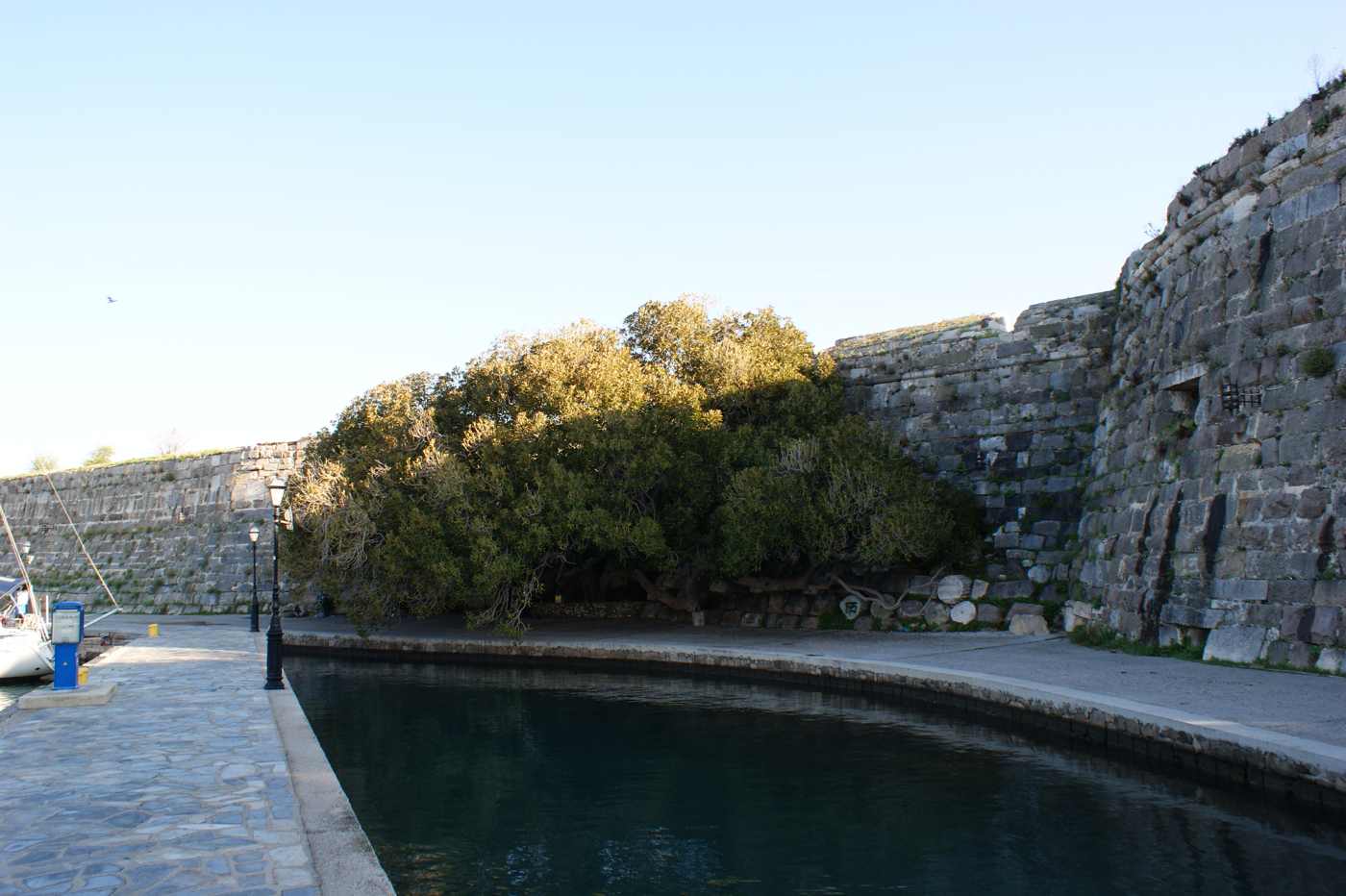
Old Pyli occupies a natural rock crag rising above the modern village toward Mount Dikeos. Islanders built the town here during the Byzantine centuries, choosing height and cliff for defence against raiders who struck the low coast. The site sits well above the spring, reached first by a winding road and then a steep stone path. Ruined houses, arched doorways and dividing walls cover the slope beneath the castle, layered up the rock in tight terraces. The whole settlement was abandoned generations ago when residents moved down to the plain and the safer modern village.
What remains is a ghost town of stone, open to the sky, with the mountain rising sharply behind and the plain spread out far below. Only the wind and the ruins occupy the crag today.
The ruins of Old Pyli climb the hillside in dense clusters below the castle rock. Narrow lanes thread between roofless houses, and stone arches still span the old doorways and passages. Builders used the local grey stone, fitting walls directly onto the bedrock and cutting terraces to hold each level. Vaulted ground floors survive in places, once used as storerooms and stables beneath living quarters. Fig trees and wild shrubs now root in the abandoned rooms, splitting walls as they grow. Three restored chapels stand among the houses, marking where the town’s churches once served the community.
The scale shows a real settlement, not a mere fort, with lanes, homes and shrines packed onto the defensible slope beneath the crowning castle. The path winds up through them to the summit.
Reaching Old Pyli takes effort on foot. A road climbs from the modern village toward the ruins, but the final stretch is a steep stone path that rises through the terraces to the castle gate. Sturdy shoes help on the loose, uneven surface, and the exposed slope grows hot by midday. Walkers pass roofless houses and the restored chapels on the way up, gaining height with every turn. The climb from the road takes roughly 20 to 30 minutes at a steady pace, depending on stops. Water and a hat matter in summer, since shade thins near the top.
The reward comes with the castle ruins and the wide views, but the ascent itself, threading a dead medieval town, forms much of the experience at Old Pyli.
The abandonment of Old Pyli followed the broader story of the Dodecanese. Islanders lived on the fortified crag through the Byzantine period and the rule of the Knights of Saint John, when pirate raids made the coast dangerous. As the seas grew safer under later powers, the reason for perching a town on a cliff faded. Families drifted down to the spring and the fertile plain, and the modern village of Pyli grew there instead. The old town emptied over generations until only stone, chapels and cisterns remained. This pattern repeated across the islands, where hilltop refuges gave way to lowland villages once security returned.
Old Pyli stands as one of the clearest surviving examples on Kos, a whole medieval settlement left almost intact in ruin on its rock.
What survives of the Byzantine and Knights-era castle at Old Pyli?
The castle of Old Pyli crowns the crag with ruined walls, towers and gates from the Byzantine and Knights of Saint John eras. Rock-cut cisterns held rainwater, and three restored chapels inside keep fragments of old frescoes.
The castle crowns the highest point of the Old Pyli crag. Its walls follow the natural rock, using the cliff itself as part of the defence and closing the gaps with masonry. A gateway leads up through the fortifications into the enclosure, where the bases of towers and ramparts still stand. The Byzantines raised the first fortress here, and the Knights of Saint John, rulers of Kos and Rhodes, strengthened it during their long tenure in the Dodecanese. Stone stairways and passages climb between the levels, and the outer walls drop straight to the slope below. From the ramparts the ground falls away on every side, showing why the builders chose this crag.
The castle formed the strongpoint that protected the medieval town packed on the slope beneath.
Water storage kept the castle of Old Pyli able to withstand a siege. Cisterns cut into the rock collected rainwater from roofs and paved surfaces, channelling it into vaulted underground tanks. These reservoirs let the defenders hold out on the waterless crag, far above the spring in the village below. Plastered walls lined the cisterns to stop the water seeping away through the porous stone. The rock-cut tanks survive among the ruins, their openings set into the ground within and around the fortress. This careful management of rainfall was standard in island castles, where wells were impossible on high dry rock.
The cisterns of Old Pyli show the same engineering that let hilltop strongholds function across the Dodecanese, turning winter rain into a year-round supply for the garrison and townspeople.
Three chapels stand restored among the ruins of Old Pyli, and their walls keep fragments of old frescoes. Byzantine builders raised these small stone churches to serve the fortified town, dedicating them to figures such as the Archangels and the Virgin. Inside, patches of painted plaster survive on the vaults and walls, showing saints and scenes in the faded colours of medieval island art. The restored roofs now shelter what remains from rain and sun. These chapels give Old Pyli a spiritual dimension beyond its military stone, marking where the townspeople worshipped on the crag. Their frescoes, though worn, connect the ruin to the wider tradition of Byzantine painting across the Dodecanese and the Aegean.
Walkers reach them along the path that climbs through the houses to the castle above.
The Knights of Saint John held Kos as an outer bastion of their base at Rhodes, and the castle of Old Pyli guarded the island’s mountainous interior. Their masons reinforced the older Byzantine walls with the military design used across their Dodecanese fortresses. When the Knights lost the islands to the Ottomans, the strongpoint gradually lost its purpose along with the town it protected. Below the crag, on the approach from the modern village, stands the Harmyllio, a vaulted medieval monument built over an earlier tomb. This barrel-vaulted chamber marks the long human presence around Pyli, layered from antiquity through the medieval centuries.
Together the castle, the chapels, the cisterns and the Harmyllio make the Pyli hillside a dense record of the island’s past, set within a short walk of the spring.
What views over Kos open from Old Pyli?
The ramparts of Old Pyli open wide views across central Kos. The fertile plain, the north coast, the salt-pan lagoon and the sea toward Turkey spread below, while Mount Dikeos rises behind the ruined crag.
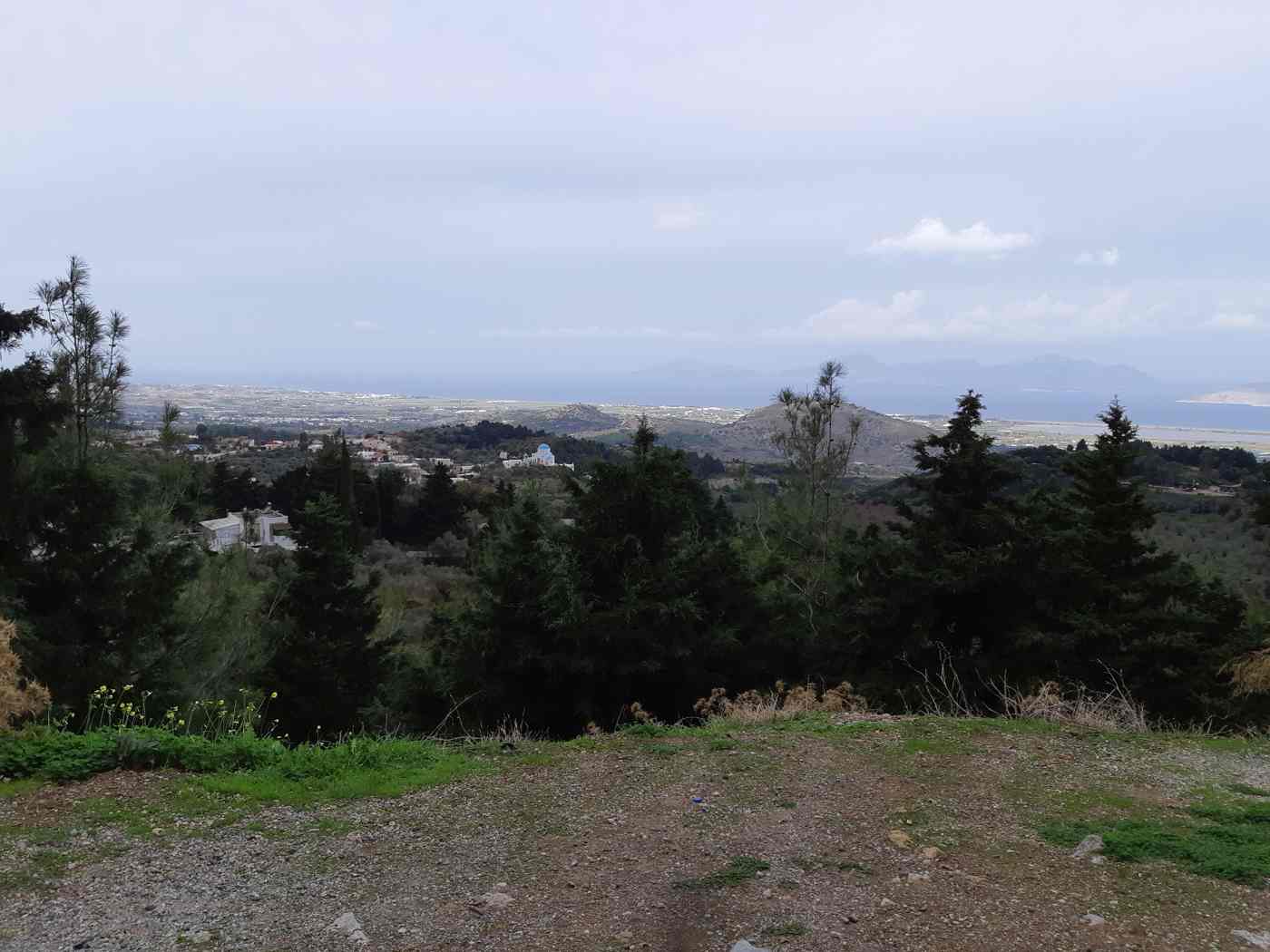
The climb to Old Pyli pays off with a broad panorama from the castle rock. Height and open ground combine to reveal much of central Kos in one sweep. The green Pyli plain lies directly below, patterned with orchards, fields and the modern village around its spring. Beyond it the land runs north to the coast at Tigaki and Marmari, where the salt-pan lagoon shows as a pale sheet behind the beaches. The sea fills the horizon, and on clear days the Turkish coast rises across the strait to the northeast. This wide outlook explains the site’s military value, since watchmen tracked ships and movement long before they reached the shore.
The same view now rewards walkers who reach the ruined ramparts on foot today.
Mount Dikeos rises directly behind Old Pyli, closing the view to the south. The ridge climbs to about 846 metres, its upper slopes cloaked in pine above the ruined town. From the castle the mountain fills the sky, while the plain and sea spread the other way toward the north. Marked trails link this side of Dikeos with the higher paths to the summit chapels and the village of Zia on the far shoulder. Walkers with time can combine the Old Pyli ruins with longer routes across the mountain, moving between the medieval town and the pine forest above. The contrast is sharp: bare defensive stone on the crag, dense green forest on the peak.
This mountain setting gives the ruins a dramatic backdrop that flat coastal sites on Kos cannot match.
Light shapes the view from Old Pyli through the day. Morning sun strikes the plain and coast from the east, picking out the fields, the lagoon and the far Turkish shore in clear detail. By late afternoon the angle softens, and the ruined walls and the mountain behind them warm to gold as the sun drops toward the west. The exposed crag catches any breeze, a relief after the hot climb through the terraces. From this height the layout of central Kos reads plainly: mountain, foothills, farmed plain, coast and sea in ordered bands. Walkers often linger on the ramparts to take in the full sweep before descending.
The combination of ruin and outlook makes the summit of Old Pyli the natural high point of any visit to Pyli.
The views from Old Pyli suit visitors willing to trade a short climb for a broad reward. Walkers, history-minded travellers and drivers touring the interior gain the most, pairing the ruins with the spring and tavernas in the modern village below. The site asks for sturdy shoes, water and a start outside the midday heat, but the effort stays modest. Families with older children manage the path, while very young children find the steep, uneven stone hard going. From the ramparts the whole shape of central Kos lies open, from Mount Dikeos to the sea. This blend of medieval ruin, mountain setting and island panorama makes Old Pyli one of the strongest inland stops on the island.
A clear contrast to the beaches and resorts of the coast.
What is the vaulted Harmyllio monument near Pyli on Kos?
The Harmyllio is an ancient vaulted burial monument standing on the plain below Pyli, a low stone chamber tomb built into a mound, marking a hero shrine that later ages turned into a small chapel.
The Harmyllio sits on flat ground a short walk from modern Pyli, set among fields at the foot of Mount Dikeos. Builders cut a rectangular chamber from stone blocks and roofed it with a barrel vault, then heaped earth over the top to form a low tumulus. The structure dates from the Hellenistic era and honoured a local hero named Harmylos, whose family cult drew offerings. Rows of small niches line the inner walls, cut to hold urns and votive gifts. A later community adapted the tomb into the chapel of Stavros, adding Christian frescoes over the pagan shrine.
The monument stands close to the road, so drivers reach it easily on the way up toward Pyli and Zia. The vault survives largely intact, a rare complete example of the island’s ancient tomb architecture.
Visitors approach the Harmyllio across open farmland, where the mound rises only two metres above the fields. A low doorway opens into the vaulted chamber, cool and dim, where the barrel roof curves overhead in dressed stone. The wall niches remain clearly visible, and faint traces of the later Christian paintwork cling to the plaster near the entrance. No ticket booth or fence guards the site, so the monument stays open and free to enter. Farmers work the surrounding plots of vines and vegetables, and the setting keeps a rural calm well away from the coastal resorts.
The Harmyllio pairs naturally with a stop in Pyli village, adding an ancient layer to a trip built around the medieval castle above. A hire car or scooter reaches it in minutes from the village road.
Ancient Kos honoured local heroes with tomb shrines, and the Harmyllio counts among the best-preserved on the island. The hero Harmylos led a family that held land on this fertile plain, and descendants tended the tomb across generations. The vaulted design shows the engineering the Koans applied to their public monuments, the same masonry tradition seen at the Asklepion nearby. Christian villagers later reused the sturdy chamber, a common fate for pagan structures once the old cults faded. The whitewashed chapel walls carry the dedication to the Holy Cross. The site rewards travellers who enjoy quiet archaeology over crowded ruins, and it slots easily into a half-day around Pyli, the castle crag and the mountain road toward Zia.
Interpretive signs are sparse, so a short read beforehand helps make sense of the stonework.
Reaching the Harmyllio takes little planning, since it lies just off the road that climbs from the Kos plain toward Pyli. Signposts for Pyli mark the turn off the plain road. A rough track and a small clearing let a car or two park beside the mound. The best light falls in the morning or late afternoon, when low sun rakes the stone and the surrounding fields. Sturdy shoes handle the uneven ground and the low, dark entrance. The monument suits history-minded travellers, families with older children and anyone touring the island’s interior by car. Combined with Old Pyli castle three kilometres on, the Harmyllio anchors a compact route through ancient.
Byzantine and medieval Kos, all within a green inland pocket far from the beach crowds of the north and southwest coasts.
What does the fertile plain around Pyli on Kos grow?
The plain around Pyli grows the bulk of the island’s produce, its spring-fed soil yielding vines, olives, figs, tomatoes, wheat and market vegetables, while grazing flocks supply the milk for local Koan cheeses.
The Pyli plain spreads across the centre of Kos, watered by springs that flow off Mount Dikeos into the fields below the village. This steady water makes the interior the island’s farming heartland, greener than the dry beach fringes. Olive groves cover the lower slopes, and vineyards stretch across the flat ground, feeding a wine tradition that runs back to antiquity. Rows of tomatoes, peppers, aubergines and melons fill the summer plots, while wheat and barley ripen on the open fields. Fig and almond trees edge the tracks between the holdings. Small dairy flocks of sheep and goats graze the margins, and their milk goes into the soft island cheeses sold at village shops.
The landscape shows a working Kos far from the resort strip.
Koan produce carries real reputation, and the Pyli plain supplies much of it to the island’s tables. Local tomatoes ripen intensely in the summer heat and flavour the village salads and sauces. The vineyards yield both white and red wines, and small producers press olive oil from the surrounding groves. Honey from mountain thyme and herbs, plus almonds and figs, rounds out the harvest. Village tavernas cook this bounty in season, so a plate of stuffed vegetables or grilled meat here tastes of the fields outside. Weekly markets and roadside stalls sell fruit, vegetables, oil, cheese and honey straight from the growers.
The farming rhythm shapes the calendar, from the spring greens through the summer glut to the autumn olive and grape harvest. Buying direct supports the growers who keep the plain productive.
Water defines the Pyli plain, and the village fountain still runs from the mountain springs that feed the farms. An old aqueduct and channels once carried this water down to the fields and the settlements. The abundance of water explains why people farmed and lived here from ancient times, when the plain fed the city-states of Kos. The green belt runs from the foot of Mount Dikeos out toward the north and south coasts, a wide band of cultivation across the island’s waist. Dirt tracks thread the groves and vineyards, good for a slow drive or a gentle walk among the trees. Cypresses and eucalyptus mark the field boundaries.
In spring the plain turns bright with wildflowers, poppies and blossom before the summer dries the ground.
Driving the Pyli plain gives travellers a different Kos, one of farms and villages rather than sunbeds and bars. The route up from the coast slowly passes olive terraces, vineyards and grazing land before reaching the village and the castle crag. Small chapels and old wells dot the fields, remnants of the rural life that shaped this corner. A stop at a village taverna lets visitors taste the produce grown steps away. The plain also frames the approach to Old Pyli, the Harmyllio and the mountain road toward Zia, so the farmland ties the inland sights together. Photographers find strong contrasts here between green cultivation and the bare grey ridge of Mount Dikeos.
The landscape rewards a slow, curious pace over a rush between beaches.
What are the tavernas by the spring in Pyli on Kos like?
Tavernas cluster around the Pyli spring under old plane trees, serving Greek village cooking beside running water and shade. Grilled meats, garden vegetables, local cheese and wine fill the tables, and the cool setting draws locals and visitors alike.
The spring at Pyli feeds a shaded square where water runs from stone spouts into a basin below the plane trees. Tavernas set their tables around this fountain, so diners eat within the sound and cool of the running water. The plane trees throw deep shade over the terrace through the hottest hours, and the temperature drops noticeably below the sun-baked plain. This spring square, sometimes called the Pigi, forms the social heart of the modern village. Locals gather here for coffee in the day and long meals in the evening, and the water draws families escaping the coastal heat. The setting turns a simple lunch into a lingering stop.
The greenery, the moving water and the village calm give the place a rhythm the busy resorts lack.
Village tavernas here cook the plain Greek food of the Kos interior, built on the produce and meat of the surrounding farms. Menus turn on grilled lamb, pork and chicken, slow-cooked stews, and meze plates of dips, cheese and vegetables. Garden tomatoes, peppers and greens, local olive oil, and village bread anchor the table. Stuffed vegetables, cheese pies and grilled halloumi-style cheese appear often, alongside the day’s catch trucked up from the coast. House wine from the plain’s vineyards and cold water from the spring wash it down. Prices in the interior tend to run gentler than the seafront, and portions stay generous.
Cooking follows the season, so the summer plates lean on ripe vegetables while cooler months bring heartier meat and pulse dishes to the tables.
The spring tavernas fill mainly at lunch and through the evening, and the shade makes midday a comfortable time to eat despite the summer heat. Families settle in for hours, children play by the water, and the pace stays unhurried. The inland setting draws a crowd more local and Greek than the international seafront strips. Tour groups pause here on the way up to Old Pyli or across to Zia, so a mid-afternoon lull often gives the quietest tables. The tavernas keep a simple, traditional look, with wooden chairs under the trees and views over the plain. Evenings cool quickly once the sun drops behind Mount Dikeos.
A meal by the spring pairs naturally with the short climb to the castle ruins or a wander through the old village lanes.
The plane trees over the Pyli spring grow large and old, their broad canopies a natural roof over the square. Plane trees mark spring sites across Greece, since they thrive on constant water, and the Kos interior keeps other such green oases. The Pyli spring has drawn settlement for centuries, watering both people and fields. Kitchen gardens behind the tavernas supply herbs and vegetables for the daily menu. The sound of the fountain, the birdsong in the branches and the shade combine into a cool retreat from the beaches a short drive away. Visitors often pair the stop with a bottle of local wine or a jar of village honey to take home.
The spring square shows the older, agricultural Kos that shaped the island before tourism arrived.
What walks on Mount Dikeos start from Pyli on Kos?
Marked trails climb from Pyli up the slopes of Mount Dikeos, the island’s highest ridge at about 846 metres, passing Old Pyli, chapels and springs toward the summit chapel of Christos and its wide Aegean views.
Mount Dikeos rises directly above Pyli, its long grey ridge forming the spine of central Kos and its highest ground at about 846 metres. The village sits on the green lower slopes, so trails begin almost at the doorstep and climb through olive terraces into open mountainside. A well-known route leads up to Old Pyli, then continues on rougher ground toward the summit, marked in places and steep near the top. The summit chapel of Metamorphosis tou Christos, the Transfiguration, crowns the ridge, and walkers reach it after a demanding ascent. From the heights the view spreads over the whole island, the north and south coasts, and across the sea to the Turkish mainland and nearby islands.
The mountain shows a wild Kos above the farmed plain.
The classic Dikeos walk starts in Pyli or at Old Pyli and climbs steadily toward the ridge over roughly two hours to the top. The path passes abandoned chapels, old cisterns and spring troughs left from the days when herders and monks used the mountain. Higher up the trees thin to scrub, thyme and bare rock, and the gradient steepens on loose stone. The final push to the summit chapel demands sure footing and a head for the exposed ridge. Walkers carry water, since the springs run low in summer, and wear proper boots for the rough ground. Early morning offers the coolest, clearest conditions before the midday heat and any afternoon haze.
The round trip fills a half day, and the summit view repays the effort.
Not every visitor tackles the full summit, and the lower slopes above Pyli offer gentler walks among the groves and past Old Pyli. Short strolls from the village reach the castle crag, the chapels and viewpoints without the hard climb to the ridge. The mountainside carries wild herbs, thyme, sage and oregano, which scent the air in the heat, along with pine and cypress lower down. Goats graze the open ground, and birds of prey circle the crags above. Spring brings green slopes and wildflowers, while autumn cools the walking after the summer heat. The bare limestone ridge catches the last light at sunset, glowing above the darkening plain.
These easier routes suit families and casual walkers who want the mountain scenery and views without a full ascent.
The Dikeos ridge links Pyli with Zia, the mountain village on the same slopes a short drive to the west. Both sit in the green upland belt, and walkers sometimes trace old paths between the villages across the mountainside. Zia draws the sunset crowds, while Pyli keeps a quieter, more agricultural feel on the eastern flank. The mountain forms a natural spine for exploring inland Kos, tying together the villages, springs, chapels and ancient ruins away from the coast. Drivers reach trailheads at Pyli and Zia on the same mountain road that loops back toward the plain.
The high ground richly rewards anyone who trades a beach day for cooler air, long views and a taste of the island’s wild, herb-scented interior above the farms.
How do you reach Pyli on Kos, and who suits the visit?
Pyli lies about 15 kilometres southwest of Kos Town, reached by car, scooter or the island bus in around 20 to 30 minutes. The inland village suits history lovers, walkers, food-focused travellers and families touring beyond the beaches.
Most visitors reach Pyli by road from Kos Town, driving about 15 kilometres southwest into the interior in roughly half an hour. The route runs inland off the north coast highway, climbing gently through the plain toward the foot of Mount Dikeos. A hire car or scooter gives the most freedom, since the village, the Harmyllio, Old Pyli and Zia all lie close together on the mountain road. The island bus network serves Pyli from the town, though services run less often than to the coastal resorts, so checking the return times matters. Roads are paved and signposted, and parking sits near the village square and the spring.
The drive itself shows the green farmed interior, a contrast to the busy seafront the buses usually follow along the coast.
Pyli suits travellers who want more than a beach holiday, drawn to history, walking, food and village life. History lovers get the ancient Harmyllio, the Byzantine and Knights-era castle of Old Pyli and the frescoed chapels in one compact area. Walkers use the village as a springboard onto Mount Dikeos and the marked mountain trails. Food-focused visitors come for the spring-side tavernas and the produce of the surrounding plain. Families with older children enjoy the castle climb, the shaded square and the running water, though the steep crag path suits sure-footed walkers over toddlers. Cyclists tackle the climb from the plain as a challenge off the flat coast.
The village rewards a relaxed half-day or a lunch stop rather than a full beach day, and it deepens any Kos trip.
Few travellers base themselves in Pyli itself, since most stay on the coast and visit the village on a day out. The inland setting means no beach on the doorstep, so choosing a base weighs sights and quiet against sea access. The guide to where to stay in Kos lays out the coastal and mountain options. Kos Town, the north beach resorts and the southwest bay all put Pyli within a short drive for a half-day trip. Visitors staying in the mountain village of Zia sit closest of all, sharing the same slopes. A car makes the interior easy to reach from any base, turning Pyli into a simple add-on.
The village works best slotted into a wider itinerary of ancient sites, mountain villages and inland drives across Kos.
A visit to Pyli fits neatly into a wider inland loop with Zia, the Asklepion and the interior villages. Morning suits the castle climb and the mountain walks, before the midday heat builds on the exposed crag. Midday and early afternoon fit a long, shaded lunch by the spring under the plane trees. Late afternoon draws travellers on toward Zia for the sunset over the west coast. Combining Pyli with Zia makes the most of one drive up the mountain, pairing the castle and the sunset village. Spring and autumn bring the best walking weather, while summer favours the shaded square and early starts.
Half a day covers the village, the castle and a meal, leaving time for a beach or the coast road back to town.


Where does Old Pyli fit in the history of Kos?
Old Pyli holds the medieval, inland chapter of Kos history. The classical story of Hippocrates and the Asklepion centres on Kos Town and its harbour. The Byzantine and Knights’ centuries moved people uphill to refuges such as Old Pyli.
Ancient Kos is best known for Hippocrates, the physician born on the island. The Asklepion, a healing sanctuary, stands on a hillside outside Kos Town. The harbour town traded across the Aegean. This classical story faces the sea.
The medieval story turns inland. Raids made the open coast unsafe. Islanders built on high ground that attackers had to climb. Read together, the harbour and the mountain ridge tell one island story in the history of Kos: trade by the sea in calm times, retreat uphill in dangerous ones.
Which other Knights’ castles guarded Kos?
The Knights of Saint John held the harbour castle of Nerantzia at Kos Town and a castle at Antimachia in the centre of the island. With Old Pyli watching the northern plain, these strongholds formed a chain of defence across Kos.
The castle of Nerantzia guards the harbour of Kos Town. The Knights built it with stone taken from buildings of the ancient city. It controlled the port and the sea channel toward the Turkish coast.
The castle of Antimachia stands on the central plateau near the island airport. The Knights raised it in the fourteenth century. Its walls enclose a wide area of flat ground.
Each site covered a different part of the island. Nerantzia held the port. Antimachia held the centre. Old Pyli watched the northern plain and its fields. Together the three gave Kos defence in depth.
Is Old Pyli open to visitors all year?
Old Pyli stands on open ground with no gate, no ticket booth and no set opening hours. Visitors reach it in every season. Spring and autumn suit the climb best, while summer calls for an early start.
Wildflowers, thyme and asphodel colour the slopes of Mount Dikeos in spring. The air stays mild for the walk. Autumn brings clear light after the summer heat.
Winter days turn cool and windy on the exposed crag. Rain leaves the stone path slick. The castle and the chapels stay open to walkers in every month.
The frescoes inside the chapels are fragile. Visitors keep their hands off the painted walls and use no flash near the paintings. Quiet behaviour respects the chapels as places of worship.
Frequently Asked Questions
Is Pyli worth visiting on Kos?
Pyli is worth visiting for travellers who want history, mountain scenery and village life beyond the beaches. The inland village packs its distinct attractions into a small area on the slopes of Mount Dikeos. The abandoned medieval settlement of Old Pyli crowns a rocky crag above the modern village. With the ruins of a Byzantine and Knights-era castle, cisterns and restored chapels holding old frescoes. Down on the plain stands the ancient vaulted Harmyllio monument, a rare and well-preserved hero tomb. The modern village centres on a shaded spring where tavernas serve the produce of the fertile surrounding plain. Marked trails climb from here toward the summit of Mount Dikeos and its wide Aegean views.
Pyli rewards history lovers, walkers and food-focused visitors more than sun-seekers chasing sand. A relaxed half-day or a long lunch stop shows a working, agricultural Kos far from the coastal resorts, and it deepens any island itinerary with a genuine inland experience.
How hard is the climb to Old Pyli?
The climb to Old Pyli is short but steep, following a rough stone path up a rocky crag above the modern village. The abandoned settlement and its ruined castle sit high on the rock, and reaching them takes a stiff uphill walk on uneven, sometimes loose ground. Most reasonably fit visitors manage it in well under an hour, stopping at the restored chapels and viewpoints along the way. The path climbs past cisterns and old walls to the castle remains, where wide views open over the plain and the coasts. Sturdy shoes or trainers with grip matter, since the rock can be slick and the footing irregular.
Water, a hat and sun cover help, as the crag offers little shade in the heat. The steep, exposed sections suit sure-footed walkers and older children rather than toddlers or anyone unsteady. Taken slowly, the ascent rewards the effort with the ruins and one of the best inland viewpoints on Kos.
Is Pyli good to visit with kids?
Pyli visits well with kids, though the terrain shapes what younger children manage. The shaded spring square in the modern village gives families a cool, safe spot, with running water, plane-tree shade and tavernas serving simple food. Older children enjoy the climb to Old Pyli, exploring the ruined castle, the chapels and the wide views from the crag like a small adventure. The steep, uneven path to the ruins suits sure-footed kids rather than toddlers, and adults keep a close hold near the drops. The flat plain around the village works for a gentle stroll or a picnic among the fields.
The ancient Harmyllio tomb, a stone chamber under a mound, adds a curiosity for children who like history. Bring water, sun hats and proper shoes for the rocky ground. A half-day mixing the shaded square, a taverna lunch and the castle climb keeps most families content, offering a break from the busy beach resorts along the coast.
What you wear and bring to Pyli?
Sturdy footwear tops the list for Pyli, since the path to Old Pyli climbs a rough, rocky crag with loose stones and uneven ground. Trainers with grip or light hiking shoes handle the ascent far better than sandals or flip-flops. Water is essential, especially in summer, as the climb and the mountain walks are hot and shade is thin above the village. A hat, sunglasses and sun cream guard against the strong Aegean sun on the exposed rock. Light, breathable clothing suits the heat, with a layer for cooler mornings, higher ground or evenings. A small daypack carries water, snacks and a camera for the wide views.
Those planning the longer Mount Dikeos walk pack extra water, proper boots and enough food for a half day. Down in the shaded spring square the demands ease, and casual clothes suit a taverna lunch. Matching what you bring to the climb you plan keeps the visit comfortable and safe.
How do you get to Pyli on Kos?
Pyli sits about 15 kilometres southwest of Kos Town, reached by car, scooter, bicycle or the island bus. Driving is the simplest way, taking roughly 20 to 30 minutes inland from the town along paved, signposted roads that climb gently across the plain toward Mount Dikeos. A hire car or scooter gives the freedom to combine Pyli with the Harmyllio, Old Pyli and the mountain village of Zia on the same trip. The public bus network serves Pyli from Kos Town, though buses run less frequently than to the coastal resorts, so checking the timetable and return times avoids a long wait.
Strong cyclists ride out from the coast and tackle the climb into the interior as a challenge off the flat routes. Parking sits near the village square and the spring. From the northern beach resorts and the southwest bay the village lies within an easy drive, making it a straightforward half-day trip from most bases on the island.
Can you combine Pyli with Zia?
Pyli combines easily with Zia, since both mountain villages sit on the slopes of Mount Dikeos a short drive apart. The same mountain road links them, so travellers reach both in one inland loop from the coast without backtracking. A common plan takes Pyli first, exploring the ruined castle of Old Pyli, the Harmyllio and a lunch by the spring, then drives on to Zia. Zia, higher on the ridge to the west, is famous for its car-free lane of craft and taverna and its wide sunset views over the island toward the Turkish coast. Timing the day around late afternoon lets visitors reach Zia for sunset after the Pyli sights.
Both villages share the green upland scenery, the mountain air and the walking trails onto Dikeos. Pairing them makes the most of a single drive into the interior. The loop suits a full day mixing history, mountain villages, food and views away from the beaches.
What is the best time of day to visit Pyli?
Morning and late afternoon give the best times of day to visit Pyli, avoiding the peak midday heat on the exposed castle crag. Early morning suits the steep climb to Old Pyli and the mountain trails, when the air is cool, the light clear and the rock not yet baking. Midday and early afternoon fit a long, shaded lunch at the spring-side tavernas, where the plane trees and running water keep the square cool through the hottest hours. Late afternoon works for the climb again as the heat eases, and it sets up an onward drive to Zia for sunset over the west coast.
Photographers find the low morning and evening light best on the ruins and the plain. Spring and autumn stay comfortable through the day, while high summer rewards early starts and shaded midday breaks. Planning the visit around the cooler hours and a shaded lunch makes the inland heat easy to manage.