
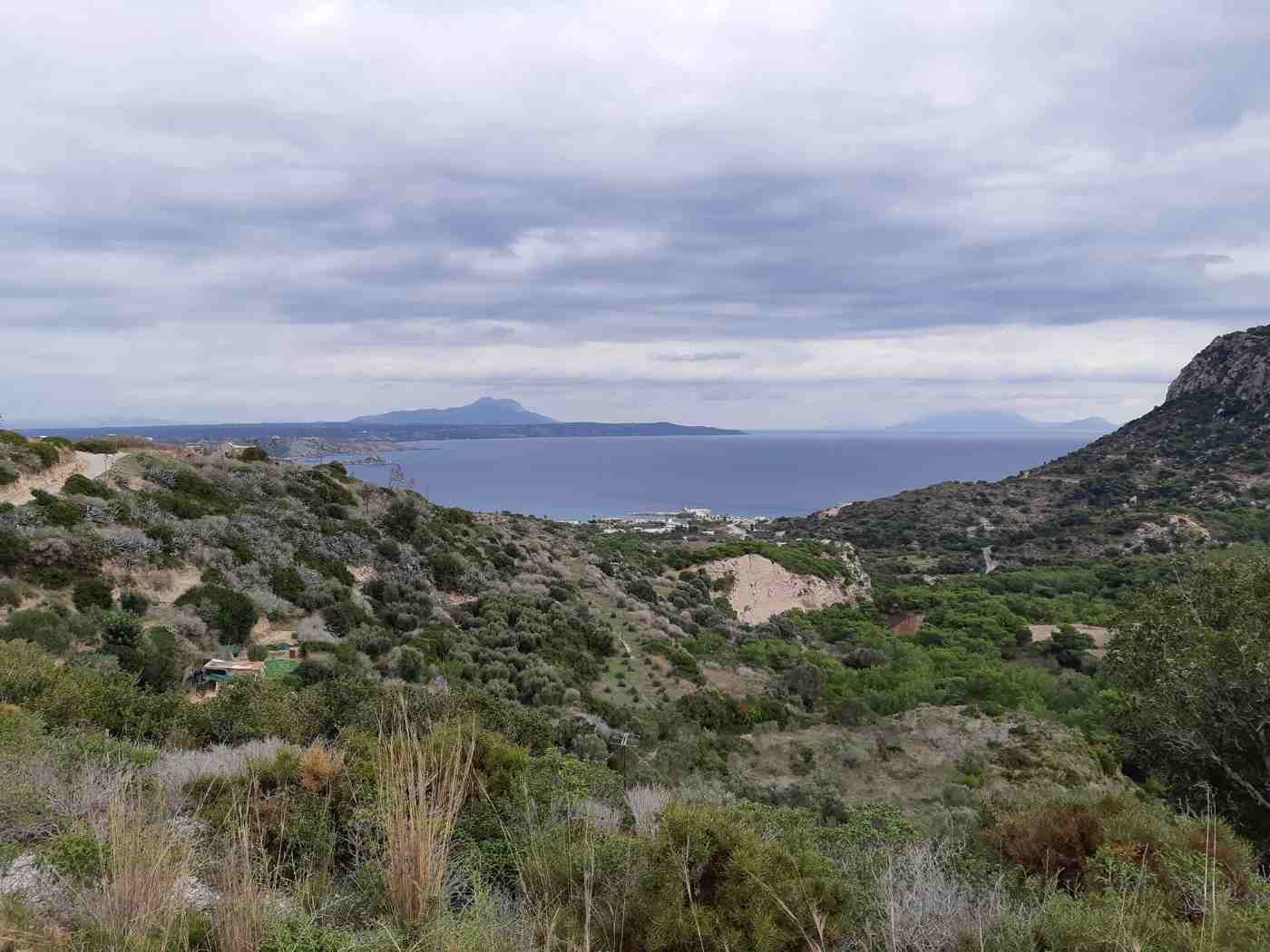
Antimachia spreads across the central plateau of Kos, a large inland village minutes from the island’s international airport and equidistant from the north and south coasts. The settlement takes its name from a fortified hilltop that dominates the skyline: the triangular castle of the Knights of St John. Built to shelter islanders during pirate raids and Ottoman incursions. Inside the tall stone walls stand two Byzantine churches and the carved coat of arms of a Grand Master, while the ramparts command sweeping views across the Aegean to neighbouring islands. Below the fortress, the village preserves a restored working windmill that grinds grain using centuries-old millstones, a living reminder of the plateau’s agricultural heritage. Plan the whole trip with Greece Tours.
The fertile plain surrounding Antimachia produces the island’s sweetest watermelons, tomatoes, and vegetables, irrigated by underground wells and seasonal rains. White-painted houses line narrow streets where older residents still speak the local dialect and bake bread in outdoor ovens. A small folklore museum displays traditional tools, costumes, and photographs of rural life before tourism transformed the coast. The village serves as a practical hub for visitors arriving at the nearby airport and a quiet alternative to the beach resorts. Offering a glimpse of inland Kos where farming rhythms and medieval fortifications shape daily life.
What makes the Knights’ castle of Antimachia historically significant on Kos?
The castle of Antimachia served as a refuge fortress for the island’s population during the medieval period, built by the Knights of St John to protect against pirate raids and Ottoman attacks.
The Knights of St John constructed the fortress during the fourteenth and fifteenth centuries on a natural rise that commands views across the entire central plateau and out to the surrounding sea. The triangular plan follows the contours of the hilltop, with thick stone walls rising more than eight metres in places and three bastions anchoring the corners. A single fortified gate pierces the southern wall, carved with the coat of arms of Grand Master Pierre d’Aubusson, who oversaw major renovations and strengthening of the defences. The castle’s elevated position allowed sentries to spot approaching vessels hours before they reached the coast, giving villagers time to gather livestock and belongings and retreat behind the walls.
Inside the perimeter walls, two Byzantine churches survive in varying states of preservation, their frescoed interiors now open to the sky but their stone apses and arched doorways intact. The larger church dedicated to Agios Nikolaos retains fragments of wall paintings depicting saints and biblical scenes, while the smaller chapel near the eastern bastion shows simpler architectural lines. Cisterns carved into the bedrock collected rainwater to sustain the population during prolonged sieges, and storage rooms built into the thickness of the walls held grain and supplies. The fortress never fell to direct assault, though the Knights surrendered Kos to the Ottomans through treaty in the sixteenth century after the fall of Rhodes.
The castle’s strategic importance declined after the Ottoman conquest, but villagers continued to use it as a refuge during pirate raids well into the eighteenth century. Families maintained small houses and animal pens within the walls, and the churches hosted services on feast days. The Italian administration in the early twentieth century conducted archaeological surveys and stabilised the crumbling sections of wall, clearing centuries of accumulated debris from the interior courtyards. Today the fortress stands as the most visible landmark on the central plateau, its honey-coloured stone walls glowing in the afternoon sun and its silhouette recognisable from both the north and south coasts of the island.
Visitors enter through the original gate, passing beneath the carved coat of arms and into a vast open courtyard where wildflowers and grasses grow among the ruins of domestic buildings. Stone staircases lead to the ramparts. Where the walkway offers panoramic views extending to the Turkish coast on clear days and across to the islands of Nisyros and Tilos to the south. The site remains unfenced and accessible throughout the day, with no formal facilities or interpretation panels, preserving the atmosphere of a working medieval fortress rather than a curated museum. The walk from the village centre to the castle gate takes about fifteen minutes along a paved road that climbs steadily through olive groves and dry-stone terraces.
How does the traditional windmill in Antimachia demonstrate Kos’s agricultural past?
The restored stone windmill in Antimachia operates as a working grain mill, using wind power to turn millstones that grind wheat and barley into flour exactly as they did for generations of island farmers.
The windmill stands at the edge of the village on a slight rise where prevailing winds from the north and west turn the four triangular sails mounted on a horizontal wooden axle. The cylindrical stone tower rises about ten metres, its walls tapering slightly toward the conical roof that rotates to face the sails into the wind. Inside, a vertical wooden shaft transfers the rotational energy from the sails down to the grinding floor, where a pair of circular millstones crushes grain between their grooved surfaces. The upper stone, called the runner, spins above the stationary lower stone, and grain fed through a central hole emerges as flour at the rim.
The miller adjusts the gap between the stones using a wooden lever to control the fineness of the grind.
Local volunteers and the village cultural association restored the windmill to working condition, replacing rotted timbers. Repairing the stone walls. Sewing new canvas sails based on photographs and measurements from abandoned mills elsewhere on the plateau. The restoration preserved traditional construction methods, using wooden pegs instead of metal fasteners and natural fibre ropes to tension the sail frames. On demonstration days the mill grinds small batches of wheat grown on nearby farms. Visitors watch the entire process from pouring grain into the hopper to collecting flour in cloth sacks. The mechanical simplicity of the system, relying entirely on wind speed and the miller’s skill, contrasts sharply with the electric mills that now process the island’s grain harvest.
A small folklore display occupies the ground floor of the windmill, showcasing agricultural tools, ceramic storage jars, woven baskets, and black-and-white photographs of plateau life in the early twentieth century. Hand-written labels in Greek and English identify threshing boards studded with flint chips, wooden ploughs, sickles, and the distinctive woven panniers used to transport grain on donkeys. Traditional costumes worn during harvest festivals hang on the walls alongside embroidered textiles and examples of the coarse linen fabric woven from local flax. The collection, donated by village families, documents the self-sufficient farming culture that defined Antimachia before the airport and tourism brought wage employment and imported goods to the plateau.
The windmill operates on an irregular schedule depending on wind conditions and volunteer availability, but the exterior and folklore display remain accessible throughout the week. The site sits along the main road through the village. Easily combined with a visit to the castle or a meal at one of the traditional tavernas that serve plateau-grown vegetables and locally raised lamb. The working mill attracts photographers drawn to the contrast between the white stone tower and blue sky. The slow rotation of the canvas sails provides a meditative counterpoint to the jet engines roaring overhead from the nearby airport.
Those interested in things to do in Kos beyond the beaches find the windmill a tangible link to the island’s pre-tourism economy.
What role does Antimachia’s plateau location play in Kos’s agriculture?
Antimachia occupies the centre of Kos’s most productive agricultural plateau, where deep alluvial soil, underground aquifers, and a slightly cooler microclimate support intensive cultivation of watermelons, tomatoes, potatoes, and grain.
The central plateau extends roughly eight kilometres east to west and four kilometres north to south, sitting at an average elevation of about one hundred metres above sea level. Seasonal streams drain from the slopes of Mount Dikeos to the east, depositing fertile sediment across the plain before disappearing into the porous limestone bedrock. Farmers tap this underground water through wells drilled to depths of thirty to fifty metres, using electric pumps to irrigate fields during the dry summer months when rainfall ceases entirely. The combination of deep soil, reliable water. Moderate temperatures allows three growing seasons per year for fast-maturing crops like lettuce, cucumbers, and courgettes that supply the island’s hotels and restaurants.
Watermelon cultivation defines the plateau’s agricultural identity, with fields of sprawling vines covering hundreds of hectares from late spring through summer. The melons grown around Antimachia develop exceptional sweetness due to the long hours of sunshine, warm days, and cool nights that concentrate sugars in the fruit. Farmers harvest the crop in waves from June through September, loading the striped green melons onto trucks for distribution across the island and export to Athens and other Greek markets. Roadside stands along the main highway sell melons directly to passing motorists. The village celebrates the harvest with a watermelon festival featuring tastings. Traditional music, and competitions for the largest fruit.
Tomato production ranks second in economic importance, with both open-field plantings and plastic-covered greenhouses extending the growing season into late autumn. The plateau’s tomatoes supply the island’s tavernas and also go to small-scale processing operations that produce sun-dried tomatoes, tomato paste, and bottled sauces sold in village shops. Potato fields occupy the cooler northern edge of the plateau, where slightly higher elevation and proximity to the sea moderate summer heat. Wheat and barley, once the dominant crops, now cover only scattered parcels. Grown mainly by older farmers who maintain traditional rotations and sell grain to the few remaining livestock keepers for animal feed.
The agricultural landscape shows a patchwork of field sizes and cultivation methods, from small family plots worked with hand tools to larger mechanised operations using tractors and irrigation systems. Dry-stone walls divide older parcels, while newer fields spread across open ground cleared of stones and levelled for efficient irrigation. Olive groves and fig trees line field margins and cluster around abandoned stone farmhouses, remnants of a more dispersed settlement pattern before families consolidated in the village centre. The plateau’s productivity supports about a dozen full-time farming families and provides seasonal employment for workers from the coast. Maintaining an agricultural economy that coexists with the airport and tourism infrastructure spreading from the beaches.
Which churches and religious sites exist in and around Antimachia?
Antimachia contains several active churches serving the village community, including the parish church of Agia Paraskevi in the village centre and the two Byzantine chapels preserved within the castle walls.
The parish church of Agia Paraskevi occupies a prominent position on the village’s central square, its whitewashed walls and blue-domed bell tower visible from the main road. The church dates from the nineteenth century, built on the foundations of an earlier Byzantine chapel destroyed during Ottoman rule. Inside, the iconostasis displays icons painted by Dodecanese artists in the traditional Byzantine style, with gold-leaf halos and rich pigments depicting Christ, the Virgin, and the patron saint. The church celebrates its feast day on the twenty-sixth of July with a liturgy, procession, and evening festival in the square featuring live music and communal dining.
Older women maintain the church, polishing the brass candlestands and embroidering altar cloths during weekly gatherings in the adjacent community hall.
Within the castle walls, the larger church of Agios Nikolaos retains its stone apse and sections of frescoed plaster despite centuries of exposure to weather. The paintings, executed in the fourteenth or fifteenth century, show the characteristic red ochre and blue pigments of late Byzantine art. With fragments of inscriptions in Greek identifying scenes from the life of Christ and the saints. The smaller chapel near the eastern bastion lacks interior decoration but preserves its barrel-vaulted ceiling and carved stone doorframe. Neither castle church hosts regular services. Villagers occasionally light candles and leave flowers on the feast days of their patron saints. Maintaining a spiritual connection to the fortified refuge their ancestors used.
Roadside shrines appear at intervals along the roads radiating from Antimachia, small structures resembling miniature churches with glass-fronted niches holding icons, oil lamps, and votive offerings. Families erect these shrines to commemorate accidents, give thanks for answered prayers, or honour a particular saint associated with healing or protection. The shrines receive regular attention, with fresh flowers, clean lamp oil, and new candles appearing weekly. Some mark natural springs where shepherds water their flocks, while others stand at dangerous curves or intersections where traffic accidents occurred. The tradition of roadside shrines, common throughout Greece, takes on particular density on the plateau.
Where the scattered farmsteads and relative isolation of rural life reinforce the importance of personal devotion and divine protection.
A small chapel dedicated to Agios Ioannis sits about two kilometres west of the village on the road toward the coast. Surrounded by olive trees and accessible via a dirt track. The single-room structure, built from local stone and whitewashed annually before Easter, serves families farming the western plateau and hosts a liturgy once or twice per year. The interior holds a simple wooden iconostasis and a dozen chairs, with space for twenty worshippers during the saint’s feast day celebration. These outlying chapels, scattered across the agricultural landscape, reflect the dispersed settlement pattern that predated the concentration of population in the fortified village and the modern nucleated settlement.
Visitors exploring the plateau roads encounter these small sacred sites as reminders of the deep interweaving of faith, agriculture, and daily life in rural Kos.
How far is Antimachia from Kos Town and the island’s main beaches?
Antimachia lies approximately twenty-five kilometres southwest of Kos Town along the main island highway, a drive of about thirty minutes by car or bus.
The main highway connecting Kos Town to the southwestern peninsula passes directly through Antimachia, making the village an unavoidable landmark for anyone travelling the length of the island. Buses operated by the island’s public transport system stop in the village centre on their runs between the capital and the southwestern resorts. With departures roughly every hour during summer and reduced frequency in winter. The journey from Kos Town takes between thirty and forty minutes depending on stops, passing through the coastal settlements of Zipari and Pyli before climbing onto the plateau. Rental cars and scooters offer more flexibility, and the well-maintained highway presents no particular challenges for drivers, with clear signage and minimal traffic outside peak summer weeks.
The international airport sits just three kilometres east of Antimachia village, close enough that jet engines create a constant background rumble during daylight hours when flights arrive and depart. A paved road connects the village to the airport terminal, and taxis wait at both locations to ferry passengers and luggage. The proximity to the airport makes Antimachia a practical first or last stop for visitors interested in the castle or windmill, easily combined with arrival or departure logistics. Some travellers arriving on early flights or facing long layovers before evening departures use the village as a place to stretch legs. Eat a meal at a traditional taverna.
Explore a non-touristy corner of the island before returning to the terminal.
North coast beaches at Tigaki and Marmari lie about ten kilometres from Antimachia via a road that descends gradually from the plateau through fields and scattered farmhouses. The drive takes fifteen to twenty minutes, emerging at the coast near the salt-pan lagoon that attracts flamingos and wading birds. South coast access to Kardamena follows a similar distance and travel time, with the road dropping more steeply through terraced hillsides before reaching the resort strip. The village thus serves as a hub for visitors staying on either coast who want to explore inland Kos. Its central location makes day trips to both shorelines feasible without backtracking to the capital.
The southwestern peninsula, including the villages of Kefalos and the beaches of Paradise and Agios Stefanos. Extends another fifteen kilometres beyond Antimachia along a winding road that climbs over low hills before descending to the coast. That leg adds another twenty to thirty minutes of driving, making the total journey from Kos Town to the far southwest about an hour. Cyclists tackling the island’s main highway often stop in Antimachia for water and rest, taking advantage of the caf\u00e9s and bakeries in the village centre. The relatively flat terrain of the plateau offers easier pedalling than the coastal hills. The village marks the approximate midpoint of the island’s length, a natural break in longer rides.
What views and landscape features surround the castle of Antimachia?
The castle ramparts command panoramic views extending north to the Aegean coast and the islands of Kalymnos and Pserimos, south to the Kos coastline and Nisyros volcano, and east toward the slopes of Mount Dikeos.
From the northern bastion, the view encompasses the entire north coast of Kos. A narrow strip of white sand beaches backed by hotels and greenhouses that give way to the blue expanse of the Aegean. The islands of Kalymnos and Pserimos rise from the sea about fifteen kilometres offshore, their rocky profiles distinct against the horizon. On exceptionally clear days the mountains of the Turkish coast appear as a faint blue line beyond Kalymnos. Reminding observers of the proximity of Asia Minor and the strategic importance of this fortress in guarding the sea lanes between Greece and Turkey.
The coastal settlements of Tigaki, Marmari, and Mastichari appear as clusters of white buildings along the shore, connected by the pale line of the coast road.
The southern rampart overlooks the descent toward the south coast and the open sea beyond, where the volcanic cone of Nisyros dominates the view about twenty kilometres distant. The island’s distinctive circular shape and the dark lava flows on its flanks stand out clearly. On calm days the plume of sulphur steam from the active crater becomes visible. Closer to the castle, the land drops through terraced hillsides planted with olives and almonds toward the resort town of Kardamena, its harbour breakwater and beachfront hotels miniaturised by distance. The view south also takes in the southwestern peninsula of Kos, a rugged finger of land pointing toward Nisyros and ending at Cape Krikelos, the island’s southernmost point.
Eastward, the castle looks directly at Mount Dikeos, the island’s highest peak rising to eight hundred forty-six metres and often dusted with snow during winter months. The mountain’s forested slopes contrast with the bare plateau. The village of Zia clings to the hillside about halfway up, identifiable by the white houses scattered among dark cypress trees. The eastern view also encompasses the airport, its single runway stretching across the plateau less than three kilometres away. Aircraft taking off and landing pass almost at eye level with the castle ramparts. A jarring juxtaposition of medieval stone and modern aviation that defines the contemporary character of the plateau.
Beyond the airport, the land rises gradually toward the mountain, a progression from flat agricultural plain to rolling foothills to steep forested slopes.
The western vista extends across the plateau toward the coast and the open Aegean. With the village of Antimachia spread below the castle in a dense cluster of white houses and narrow streets. Fields of watermelon, tomato, and grain create a geometric pattern of greens and browns, divided by stone walls and dirt tracks. Scattered farmhouses, many abandoned and roofless, dot the landscape, and windmills in states of repair punctuate the skyline. The sunset view from the western rampart draws photographers and couples. Who watch the sun drop toward the sea while the castle walls glow orange and the plateau fades into shadow. The three-hundred-sixty-degree panorama available from the ramparts provides a comprehensive understanding of Kos’s geography.
Showing the island’s narrow width, the dominance of the central plateau. The strategic position that made this fortress essential to the island’s defence.
What dining and accommodation options exist in Antimachia village?
Antimachia offers traditional tavernas serving plateau-grown vegetables, grilled meats, and home-style Greek cooking, frequented mainly by local residents and visitors exploring the interior.
The village centre hosts three or four traditional tavernas clustered around the main square and along the highway, their outdoor tables shaded by grapevines and canvas awnings. Menus emphasise local ingredients, with salads built from plateau-grown tomatoes, cucumbers, and peppers, grilled lamb and pork from nearby farms, and vegetable dishes like stuffed tomatoes and baked courgettes. The tavernas prepare food in the home-cooking style rather than the tourist-oriented menus of coastal restaurants, with larger portions, simpler presentation, and lower prices. Lunch service runs from midday until mid-afternoon, and dinner begins around seven in the evening, continuing until the last customers leave.
The clientele includes farmers taking a break from fieldwork, airport employees, and travellers who detour from the highway to eat where locals eat.
One taverna near the windmill specialises in traditional oven-baked dishes, using a wood-fired oven to prepare lamb kleftiko, moussaka, and the slow-cooked bean stews that characterise plateau cuisine. The kitchen bakes its own bread daily, and the house wine comes from barrels filled with bulk wine from Cretan producers. Another establishment on the square offers a wider menu including fresh fish trucked up from the coast and grilled over charcoal, though the seafood selection remains limited compared to harbourside restaurants. Breakfast service exists only sporadically, with most tavernas opening for lunch rather than morning trade, though the village bakery sells fresh bread, cheese pies. Sweet pastries from early morning for locals and workers heading to the airport.
Accommodation in Antimachia consists of half a dozen small guesthouses and rental apartments scattered through the village, typically family-run operations with fewer than ten rooms. These establishments cater primarily to independent travellers seeking quiet, budget-conscious lodging away from the beach crowds, and to workers on temporary contracts at the airport or nearby farms. Rooms offer basic amenities, clean linens, and sometimes access to a shared kitchen or courtyard, but lack the pools, bars, and organised activities of coastal hotels. Booking ahead becomes essential during peak summer weeks, though vacancies usually exist in spring and autumn when the village sees minimal tourist traffic.
The guesthouses provide no formal reception or concierge services, with owners often managing properties while working other jobs, so communication via phone or email establishes arrival times and payment arrangements.
The village contains a small supermarket stocking essentials, a bakery, a butcher shop, and a couple of caf\u00e9s where older men gather for coffee and backgammon. These businesses serve the local population rather than visitors, and opening hours follow village rhythms, with long afternoon closures and limited weekend service. A petrol station on the highway offers fuel and basic automotive supplies, convenient for travellers crossing the island. The absence of tourist infrastructure, souvenir shops, and English-language signage reinforces Antimachia’s character as a working agricultural village where tourism remains incidental rather than central to the local economy.
Visitors seeking authentic village life and willing to forgo resort amenities find the simplicity appealing, while those expecting tourist services and English-speaking staff encounter frustration. Those planning how to get to Kos and where to stay typically choose coastal bases and visit Antimachia as a half-day excursion.
Who finds a visit to Antimachia and its castle most rewarding?
History enthusiasts interested in medieval fortifications and the Knights of St John, photographers seeking traditional Greek landscapes away from tourist crowds, and travellers curious about rural island life find Antimachia rewarding.
The castle attracts visitors fascinated by military architecture and the history of the Crusader states in the eastern Mediterranean. The well-preserved walls, defensive bastions, and strategic hilltop position illustrate medieval fortress design, while the carved coat of arms and Byzantine churches add layers of historical complexity. Unlike more famous Crusader castles that have been heavily restored or converted into museums, Antimachia retains a raw. Unpolished character that appeals to those who prefer ruins explored independently rather than guided tours through sanitised monuments. The lack of crowds, entrance fees, and interpretive signage creates an atmosphere of discovery, though it also means visitors need background knowledge to fully appreciate what they see.
History readers familiar with the Knights of St John and their island strongholds gain the most from walking the ramparts and imagining the fortress in active use.
Photographers find compelling subjects in the contrast between the ancient stone castle and the modern airport, the working windmill against the sky, and the agricultural landscape of the plateau. The village streets, with their whitewashed houses, blue shutters, and elderly residents in traditional dress, offer authentic Greek island scenes increasingly rare in coastal tourist zones. The quality of light on the plateau, especially during the golden hours after sunrise and before sunset. Enhances the honey tones of the castle stone and the vivid greens of the fields. Drone operators capture dramatic aerial perspectives of the triangular fortress and the geometric patterns of cultivation, though flight restrictions near the airport require careful attention to regulations and no-fly zones.
Travellers interested in how Greeks live away from the tourism economy find Antimachia a revealing counterpoint to the beach resorts. Observing farmers at work in the fields. Shopping in the village market. Eating in tavernas where menus remain in Greek only provides insights into the rhythms and concerns of agricultural communities. The working windmill and folklore display offer tangible connections to pre-industrial life, while conversations with older villagers. For those with Greek language skills, reveal memories of harder times before electricity, paved roads. The economic boost from the airport. Cultural anthropologists and students of rural development see in Antimachia the tensions between traditional agriculture and modern infrastructure, between preservation and progress.
Cyclists tackling the main island highway appreciate Antimachia as a rest stop with caf\u00e9s, water sources, and shade, roughly midway between Kos Town and the southwestern peninsula. The relatively flat terrain of the plateau offers easier riding than the coastal hills, and the side trip to the castle adds only a short climb. Families with children find the castle an adventure, with ramparts to explore and space to run, though the lack of safety barriers on the walls requires supervision. The windmill demonstration engages younger visitors if the mill operates during their visit, showing a mechanical process simple enough to understand but exotic enough to fascinate.
Budget travellers appreciate the lower prices in village tavernas compared to coastal restaurants, and the authentic atmosphere compensates for the absence of sea views and sunset cocktails.
What practical information helps visitors plan a trip to Antimachia?
Antimachia sits on the main island highway twenty-five kilometres from Kos Town, accessible by public bus, rental car, or taxi.
Public buses running between Kos Town and the southwestern resorts stop in Antimachia village centre, with the bus stop marked by a simple sign on the main highway. Timetables vary by season, with hourly service during summer months and reduced frequency in winter. Schedules appear on the island transport authority website and at the Kos Town bus station. The fare from the capital costs around three to four euros, paid to the driver upon boarding. Buses continue beyond Antimachia to Kardamena and Kefalos, making it possible to combine a castle visit with a beach stop or a tour of the southwestern peninsula.
Return buses to Kos Town run until early evening, with the last departure around seven or eight, so day-trippers monitor the schedule to avoid being stranded.
Rental cars and scooters provide maximum flexibility, allowing visitors to explore the castle, windmill, and surrounding plateau at their own pace. The drive from Kos Town follows the main highway southwest, clearly signposted for Kardamena and the airport. Parking in the village centre presents no difficulty, with spaces along the main road and in the square near the tavernas. A paved road branches uphill from the village toward the castle, marked by a small brown sign. Leads to an informal parking area about fifty metres from the fortress gate. The road surface remains in good condition. Suitable for any vehicle.
The short distance makes walking from the village centre equally practical for those who prefer to leave their car in the square.
The castle and windmill charge no entrance fees and maintain no formal opening hours, gates, or ticket offices. Visitors walk freely into the castle courtyard and climb the ramparts at any time of day, though early morning and late afternoon offer the best light for photography and cooler temperatures for exploring the exposed hilltop. The windmill operates irregularly depending on wind conditions and volunteer availability, but the exterior and folklore display remain accessible even when the mill does not grind. A small donation box at the windmill accepts contributions to support maintenance and restoration work. Neither site offers facilities, shade, or water. Visitors bring their own supplies.
Especially during summer when temperatures on the plateau exceed thirty-five degrees Celsius and the castle ramparts provide no shelter from the sun.
The village centre contains a supermarket for snacks and drinks, a bakery for fresh bread and pastries, and public toilets near the main square. Mobile phone coverage remains strong throughout the plateau, and the village has wireless internet at the caf\u00e9s for those needing connectivity. The proximity to the airport means rental car return and flight check-in lie just minutes away. Making Antimachia a practical final stop before departure for visitors with afternoon or evening flights. Combining the castle and windmill visit with a meal at a village taverna fills about two to three hours. Sufficient for a half-day excursion from a coastal base or a leisurely break during a cross-island drive.
Those with deeper interest in rural architecture and agricultural heritage extend their visit to explore the plateau roads. Photograph abandoned farmhouses and roadside shrines. Observe the seasonal rhythms of planting and harvest that continue to define life in inland Kos.
How does Antimachia connect to the broader history and culture of Kos island?
Antimachia represents the inland agricultural tradition that sustained Kos for centuries before coastal tourism became the dominant economy.
The castle of Antimachia formed part of a defensive network the Knights of St John built across their Dodecanese territories. Complementing the larger fortress at Kos Town harbour and smaller watchtowers along the coast. This system allowed the Knights to control sea traffic, protect the agricultural interior from raids, and maintain their presence in the eastern Aegean despite pressure from Ottoman forces. The fortress sheltered not just soldiers but entire village populations, their livestock, and stored harvests during emergencies, making it a community refuge rather than purely a military installation. The survival of two Byzantine churches within the walls demonstrates the continuity of Christian worship through centuries of conflict.
The coat of arms of Grand Master d’Aubusson connects this remote hilltop to the wider politics of the Order and its struggles against Ottoman expansion.
The plateau’s agricultural productivity determined the island’s ability to support its population and resist sieges, making Antimachia’s farms as strategically important as its fortress. The deep soil and reliable water allowed cultivation of wheat, barley. Legumes that provided the caloric foundation of the island diet, while orchards and vegetable gardens supplied vitamins and variety. The windmills that dotted the plateau, of which the restored example in the village represents the last working survivor. Transformed grain into flour, the essential ingredient for bread that sustained everyone from Knights to peasants. The Ottoman administration that succeeded the Knights maintained the agricultural system, taxing production but allowing local farming practices to continue largely unchanged.
Italian occupation in the early twentieth century introduced new crops and irrigation techniques, but the fundamental pattern of small family farms persisted.
The construction of the airport in the mid-twentieth century transformed the plateau from agricultural heartland to transportation hub. Bringing wage employment, land sales. Urban influences to a previously isolated rural community. The noise, traffic, and development pressures that accompanied the airport challenged traditional village life. Yet farming continues around the runways and Antimachia retains its agricultural character more successfully than coastal settlements overwhelmed by tourism. The village represents a compromise between preservation and modernisation, where older residents maintain customs, language. Foodways while younger generations work at the airport, in coastal hotels, or in the capital. This tension between tradition and change, visible in the juxtaposition of castle and runway, defines contemporary rural Kos.
Antimachia’s cultural significance extends beyond its monuments to its role as a living example of inland Greek island life, a counterpoint to the beach-and-nightlife image that dominates tourism marketing. The village demonstrates that Kos possesses depth beyond its ancient sites and sandy shores. That agriculture and rural traditions remain vital to island identity even as tourism generates most economic activity. The working windmill, the harvest festivals. The dialect spoken by older villagers. The recipes prepared in taverna kitchens all contribute to a cultural continuity that links present-day Antimachia to its medieval and ancient past. Visitors who take time to explore the village and plateau gain a more complete understanding of Kos.
Seeing the island not as a collection of isolated attractions but as a complex landscape where history, agriculture. Modern development intersect in productive and sometimes contradictory ways.
Frequently Asked Questions
Can visitors enter the castle of Antimachia at any time?
The castle of Antimachia remains open to visitors throughout the day with no gates, entrance fees, or formal opening hours. The site operates as an unfenced archaeological monument accessible from sunrise to sunset, allowing travellers to explore the ramparts, courtyards, and Byzantine churches at their own pace. No staff, ticket office, or visitor centre exists on site. Visitors assume responsibility for their own safety while climbing the stone staircases and walking the ramparts, which lack modern safety barriers. The absence of formal management preserves the atmosphere of an authentic medieval ruin but means no facilities, interpretation panels, or guided tours are available.
Early morning visits offer cooler temperatures and softer light for photography, while late afternoon provides dramatic views as the sun sets over the Aegean. The castle’s hilltop position exposes visitors to full sun and wind. Bringing water, sun protection, and appropriate footwear for uneven stone surfaces becomes essential. Especially during summer when temperatures on the exposed plateau exceed thirty-five degrees Celsius.
Does the traditional windmill in Antimachia operate regularly?
The restored windmill in Antimachia operates intermittently rather than on a fixed schedule, grinding grain only when wind conditions prove suitable and volunteer millers are available to manage the machinery. The village cultural association maintains the mill and organises demonstration days during which visitors watch the entire milling process from pouring grain into the hopper to collecting flour from the millstones. These demonstrations typically occur on weekends during spring and autumn when moderate winds provide reliable power without the excessive force that makes operation dangerous. Even when the mill does not grind, the exterior remains accessible for photography and the ground-floor folklore display stays open, showcasing agricultural tools, traditional costumes, and photographs of plateau life.
No entrance fee applies, though a donation box accepts voluntary contributions to support ongoing restoration and maintenance work. Visitors interested in seeing the mill in operation can inquire at village tavernas or the local cultural centre about upcoming demonstration dates, though spontaneous visits often coincide with milling activity during favourable weather. The working mill represents a living museum of pre-industrial technology. Watching the canvas sails turn and the wooden gears transfer power to the grinding stones provides insights into the ingenuity and physical labour that sustained island agriculture for generations.
What makes Antimachia different from coastal villages on Kos?
Antimachia preserves an inland agricultural character largely untouched by the beach tourism that transformed coastal settlements. Offering visitors a glimpse of traditional Greek village life centred on farming rather than hospitality services. The village economy still depends significantly on plateau agriculture, with families cultivating watermelons, tomatoes, and grain rather than operating hotels, restaurants, and water-sports centres. The population includes multi-generational farming families who speak the local dialect, maintain traditional customs, and participate in religious festivals and harvest celebrations that follow the agricultural calendar. Architecture reflects this heritage, with older stone houses, narrow streets designed for donkey traffic, and functional buildings like the windmill and grain storage facilities rather than purpose-built tourist accommodations.
The proximity to the airport brings some modern influences and employment opportunities, but Antimachia lacks the souvenir shops, English-language menus, and international clientele that define coastal resorts. Visitors encounter authentic village rhythms, where shops close for afternoon rest, tavernas serve local customers rather than tourists. The pace of life follows seasonal farming tasks rather than charter-flight schedules. This authenticity appeals to travellers seeking cultural experiences beyond beaches and ancient ruins, though it also means fewer amenities, limited English communication. A need for self-sufficiency in planning and navigation.
How long does a typical visit to Antimachia and the castle take?
A comprehensive visit to Antimachia, including the castle, windmill. A meal in the village, typically requires two and a half to three and a half hours, though history enthusiasts and photographers often spend longer exploring the fortress and plateau landscape. Walking from the village centre to the castle takes about fifteen minutes up a paved road. Exploring the fortress interior. Climbing the ramparts, and photographing the views occupies another forty-five minutes to an hour. The windmill and folklore display add thirty to forty-five minutes, depending on whether the mill operates and how thoroughly visitors examine the agricultural tools and photographs. Lunch or dinner at a traditional taverna extends the visit by an hour to ninety minutes.
Wandering the village streets to observe daily life and photograph traditional architecture adds incremental time. Visitors on tight schedules, such as those with hours between flights at the nearby airport. Can complete a focused castle visit in about an hour, driving directly to the hilltop parking area and skipping the village centre. Those combining Antimachia with other inland sites like the mountain village of Zia or the beaches of the north coast allocate a half-day to the castle and village as part of a broader plateau exploration. The flexible, self-guided nature of the visit allows travellers to adjust their time investment based on interest level, weather conditions, and other itinerary commitments.
What visitors bring when exploring the castle and village?
Visitors to Antimachia and the castle need sun protection, water. Sturdy walking shoes, as the hilltop fortress offers no shade, facilities, or services and the stone surfaces require careful footing. A wide-brimmed hat, sunscreen, and sunglasses become essential during summer when the exposed ramparts and courtyards provide no relief from intense sun and temperatures often exceed thirty-five degrees Celsius. Bringing at least one litre of water per person prevents dehydration during the climb to the castle and exploration of the site. Especially since the nearest shops and caf\u00e9s lie back in the village centre.
Closed-toe shoes with good grip help navigate the uneven stone staircases, rubble-strewn courtyards, and rampart walkways, where loose stones and gaps in the paving create tripping hazards. A camera or smartphone captures the panoramic views and architectural details. A small flashlight or phone light helps examine the darker corners of the Byzantine churches and storage rooms built into the fortress walls. Binoculars enhance appreciation of the distant views to neighbouring islands and the Turkish coast. Visitors planning to eat in the village bring cash, as small tavernas and shops often do not accept credit cards. Having small-denomination euro notes facilitates purchases at the bakery and donations at the windmill.
A light jacket or long sleeves proves useful during spring and autumn when plateau winds create a chill despite sunny skies. During summer evenings when temperatures drop rapidly after sunset.
Can Antimachia serve as a base for exploring Kos island?
Antimachia functions adequately as a budget-conscious, quiet base for exploring Kos, offering central location and proximity to the airport, though limited accommodation options and the absence of beach access make coastal villages more practical for most visitors. The handful of small guesthouses and rental rooms in the village provide basic, inexpensive lodging for independent travellers who prioritise authenticity and tranquillity over resort amenities and seaside convenience. The central plateau position places both north and south coasts within ten to fifteen minutes by car. The main highway connection to Kos Town and the southwestern peninsula makes day trips straightforward.
Proximity to the airport benefits travellers with early-morning departures or late-night arrivals, eliminating the need for long pre-dawn drives from distant resorts. The village offers genuine immersion in local life, with opportunities to shop in traditional markets, eat where farmers and workers eat, and observe agricultural rhythms rarely visible in tourist zones. However, the lack of swimming beaches within walking distance, minimal evening entertainment, and scarcity of English-speaking services create challenges for visitors expecting typical holiday infrastructure. Families with children, beach-focused travellers, and those seeking nightlife, water sports, or organised excursions find coastal bases more suitable. Antimachia works best for self-sufficient travellers with rental cars. Flexible itineraries.
Interest in rural culture who view the village as a launching point for island-wide exploration rather than a destination in itself.
What other attractions exist near Antimachia on the central plateau?
The central plateau around Antimachia contains sites of interest within short driving distances, including the mountain village of Zia on the slopes of Mount Dikeos. The ruins of old Pyli with its Byzantine castle. The salt-pan lagoon near Tigaki that attracts migratory birds. Zia sits about twelve kilometres northeast of Antimachia, perched on the mountainside at about three hundred metres elevation and famous for sunset views. Traditional tavernas. Craft shops selling honey, herbs, and handwoven textiles. The village retains stone-paved streets and older architecture despite heavy tourist traffic during evening hours when tour buses arrive for the sunset spectacle.
Old Pyli, about eight kilometres north of Antimachia, preserves the ruins of a medieval village abandoned in the nineteenth century when residents moved to the coast. With a small Byzantine castle on a rocky outcrop and the remains of stone houses and churches scattered across the hillside. The salt-pan lagoon near Tigaki, roughly fifteen kilometres north, provides habitat for flamingos, herons. Other wading birds. Especially during spring and autumn migration periods, and a rough track allows birdwatchers to approach the water’s edge. The plateau roads also pass abandoned farmhouses, roadside shrines, and working farms where seasonal activities like watermelon harvest, olive picking, and grape pressing occur, offering spontaneous glimpses of agricultural life.
These sites combine easily with an Antimachia visit to create a full day exploring inland Kos away from the beaches and ancient monuments that dominate most itineraries.