
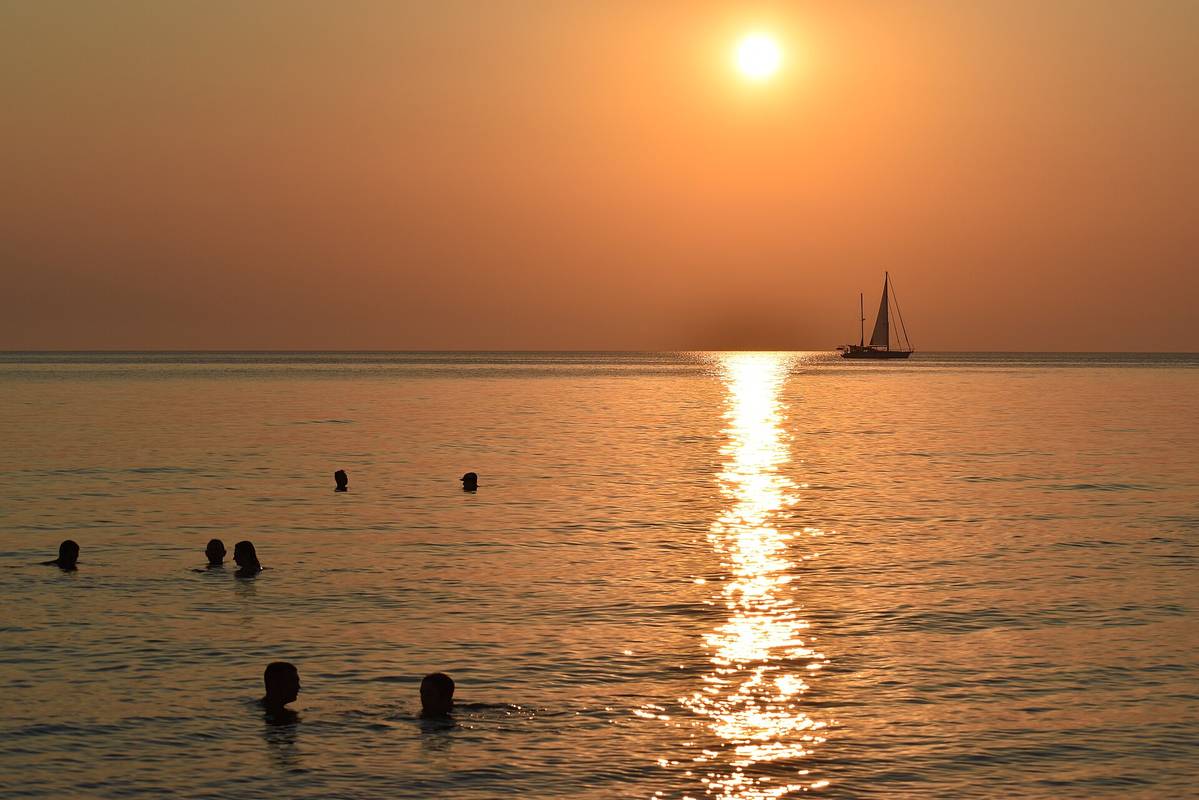
Naxos rewards evening travelers with more sunset stages than any single island day can hold. The largest Cycladic island turns its whole western flank toward the setting sun, so the marble Portara, the west-coast beaches and the mountain villages each frame the light differently. Golden hour here lasts long and shifts fast, painting the Aegean in copper before the sky cools to violet. Choosing where to stand becomes the pleasant problem of the trip. This guide maps the finest vantage points across the island, from sea-level icons to elevated ridgelines, and pairs each with practical timing. Plan the whole itinerary with My Greece Tours.
Our Naxos travel guide covers the wider island, but sunset deserves its own dedicated map. The right spot depends on your mood, your legs and how much you dislike a crowd. The sections below cover the marble Portara that everyone photographs, the old-town rooftops of the Kastro, the long west-coast beaches, the mountain elevations of Zas and the villages, and the boat cruises that put you on the water for the final glow. Each answer names a concrete place and the timing that makes it work.
Why is the Portara the most iconic sunset spot on Naxos?
The Portara is a giant marble doorway on the Palatia islet, aligned so the sun sets almost through its frame. This ancient temple gate turns golden hour into a living postcard, drawing crowds nightly.
The Portara stands as a lone marble threshold, all that remains of an unfinished temple to Apollo from the sixth century BC. A short causeway links it to the harbor of Naxos Town, so the walk out takes under ten minutes from the port. The doorway faces west, and for much of the year the sun drops close to its opening, framing the glowing disc between two upright marble slabs. Photographers arrive early to claim the low rocks on the seaward side. The islet holds a large evening crowd comfortably, spread across its flat top. Arrive forty minutes before the listed sunset time to watch the color build across the water toward the Portara itself.
The rocks around the monument grow slippery near the waterline, so wear grippy shoes rather than sandals. The best compositions place the sun just off-center inside the frame, not dead through it, which keeps the marble edges visible against the sky. Bring a wide lens to capture both uprights and the lintel above. The crowd thins the moment the sun vanishes, yet the afterglow behind the doorway often outshines the sunset itself, deepening to rose and violet for a further twenty minutes. Vendors sell cold drinks near the causeway entrance.
The return walk lands you straight in the old-town lanes, ideally placed for dinner once the light has gone and the harbor lamps begin to glow along the waterfront.
Where in Naxos Town can you watch the sunset from a rooftop?
The Kastro, the Venetian hilltop citadel above the old town, offers rooftop bars and terraces with clear western views over the harbor. Its narrow marble lanes and battlements catch the last light beautifully.
The Kastro crowns Naxos Town, a walled Venetian quarter of arched alleys, coats of arms and marble staircases. Climbing its lanes at dusk is a reward in itself, as the whitewashed walls turn amber and the passages glow. Several rooftop bars near the top open their terraces for the evening, pouring local Naxian wine while the harbor and the Portara sit framed below. The elevation lifts you above the port rooftops, so the horizon stays clean over the sea toward Paros. Tables fill fast, so a reservation or an early arrival secures a west-facing edge. The higher terraces near the old tower give the widest sweep across the water.
Down in the old-town lanes, the harborfront bars offer a lower, more intimate angle, with the sun sinking directly behind the moored boats. The paralia promenade lines up cafe tables along the water, and the reflected light stretches gold across the small harbor. Walk the sea wall toward the Portara causeway for an unobstructed view that costs nothing. The old town rewards wandering afterward, its bougainvillea-draped stairways lit by warm lamps. Photographers favor the moment the streetlights flicker on while the sky still holds color, a short window of balanced light.
Dinner tables on the upper squares keep the view going through the blue hour, when the sky above the citadel deepens and the first stars appear over the darkening Aegean sea. The golden light makes these spots a highlight of a Naxos honeymoon.
Which west-coast beaches are best for a Naxos beach sunset?
Plaka, Mikri Vigla and Alyko all face due west with open Aegean horizons and no headlands blocking the light. Their long sandy expanses turn mirror-bright as the sun drops into the sea.
Plaka beach runs for kilometers of pale sand backed by dunes and cedar, facing an open western horizon with nothing between the shore and the setting sun. Beach bars along its length set out loungers and cocktails, and the wet sand at the waterline mirrors the whole sky. The flat expanse spreads the evening crowd thin, so a private patch is easy to find even at peak color. Walk to the tideline for reflection shots that double the sunset. The southern end near the cedar forest of Alyko adds sculptural granite rocks and a wilder, quieter mood, with abandoned buildings turned into a street-art gallery catching the last rays.
Mikri Vigla sits on a rocky headland between two sandy bays, and its raised granite point gives a higher vantage than the flat beaches to the north. The kite-surfers who ride the afternoon wind here become dramatic silhouettes against the glowing sky. Climb the low rocks for a panorama that takes in both bays at once. The steady meltemi breeze keeps the air clear, sharpening the colors as the sun meets the horizon. Beach tavernas serve fresh fish just back from the water, so dinner follows the show without a drive.
The cedar dunes of Alyko, just south, offer the island’s most secluded sunset, where the twisted juniper trees frame the light and the beach stays empty long after the bars up north have filled. These viewpoints double as ceremony settings for a Naxos wedding at golden hour.
Can you get elevated mountain sunset views on Naxos?
Yes. Mount Zas, the Cyclades’ highest peak, and the mountain villages of Apeiranthos, Filoti and Halki deliver panoramic sunsets high above the coast, with the light spilling across valleys and distant islands.
Mount Zas rises to just over a thousand meters, the tallest summit in the Cyclades, and its western slopes open onto a vast panorama of the island’s interior and the sea beyond. The full hike to the top takes a few hours, so most sunset-seekers stop at the trailhead near the Aria spring or the chapel of Agia Marina, where the view already stretches for miles. From this height the coastal beaches shrink to bright ribbons and the far islands of Paros and Ios float on the horizon. The mountain air cools quickly after the sun drops, so pack a layer. A headlamp makes the walk back down safe once the trail falls into shadow.
Apeiranthos, the marble-paved village high on the eastern flank, faces its own valleys for a sunset of a different character, with the light raking across stone houses and terraced fields. The nearby villages of Filoti and Halki sit amid the Tragea valley’s olive groves, where church towers catch the last gold. A drive up the mountain road at dusk strings these hamlets together, each with a taverna terrace angled toward the west. The switchbacks reward slow travel, and pull-offs along the way frame the coast far below. The elevation trades the sea horizon for depth and layered ridgelines, a quieter and cooler alternative to the beach crowds down at the shore.
Are sunset boat cruises worth it on Naxos?
Yes. Evening cruises from the port put you on the water with the Portara, the coastline and neighboring islets all in view, often with the Small Cyclades as a backdrop and dinner or drinks aboard.
Sunset cruises depart from the harbor of Naxos Town in the late afternoon, sailing the west and south coasts as the light softens. From the water the island reveals a profile you never see from shore, with the Portara rising against the town and the beaches sliding past in golden bands. Many trips anchor off a quiet cove for a swim before the main event, then turn to face the open horizon as the sun descends. Catamarans and traditional wooden kaikia both run these routes, some serving mezze and Naxian wine on deck.
The Small Cyclades islets of Iraklia and Schinoussa often appear on the southern horizon, their silhouettes deepening as the color fades and the boat drifts on the calming evening swell.
Booking ahead secures a spot on the smaller, less crowded boats, which linger longer at the best angles than the large party vessels. The steadier catamarans suit travelers wary of motion, while a wooden kaiki carries more character. Bring a light jacket, as the breeze picks up once the sun is gone and the deck cools fast. Photographers get an unobstructed sea-level horizon with no crowds in the frame, plus the town lights glowing on the return leg into the harbor. The cruise ends back at the illuminated waterfront, perfectly timed for a late dinner in the old town. Plan your visit and tours through our Naxos travel guide.
Frequently Asked Questions
What time is sunset on Naxos and when should I arrive?
Sunset on Naxos falls around 8:45 pm in midsummer and closer to 6:00 pm in midwinter, so check the exact time for your dates before heading out. Arrive at least forty minutes early at popular spots like the Portara, where the best rocks and rooftop tables fill quickly. The color show begins well before the sun touches the horizon, as the sky warms through gold and amber. The afterglow then lasts a further twenty to thirty minutes past the actual sunset, deepening to rose and violet, so there is no rush to leave. This extended window is one of the island’s quiet gifts.
Building in that early cushion also lets you find parking, walk the causeway or climb the Kastro lanes without hurrying. The light rewards patience more than punctuality, so settle in and let the evening unfold slowly across the Aegean.
How do I avoid the sunset crowds at the Portara?
The Portara draws the island’s largest evening crowd, yet the pressure eases with a few simple choices. Arrive early to claim the seaward rocks below the monument, away from the flat top where tour groups cluster. The far side of the Palatia islet, reached by a short scramble, stays quieter and frames the sun just as well. Trade the icon entirely for a west-coast beach like Plaka or the cedar dunes of Alyko, where the same sun sets over an open horizon with a fraction of the people. The mountain villages and the Mount Zas trailhead offer near-solitude at elevation. A sunset boat cruise removes the crowd problem altogether by putting you on open water.
Shoulder-season visits in spring or autumn thin the numbers everywhere. The Portara stays worth seeing once, but the island holds a dozen equally striking alternatives for anyone chasing calm over the classic photograph.
Do I need a car to reach the best Naxos sunset spots?
A car opens the widest range of sunset options, though not every great spot demands one. The Portara, the Kastro rooftops and the harborfront bars all sit within an easy walk of Naxos Town and the port, so car-free travelers still catch the island’s most famous views. Reaching the west-coast beaches at Plaka, Mikri Vigla and Alyko is far easier with wheels, as bus timetables thin out in the evening and rarely align with the sunset hour. The mountain villages and the Mount Zas trailhead effectively require a car or an organized tour, since the winding roads have limited late transport.
Renting a small car or quad bike gives full freedom to chase the light wherever it looks best on a given night. A guided sunset excursion or boat cruise removes the driving question entirely, handling logistics while you focus on the view over the darkening Aegean sea.