
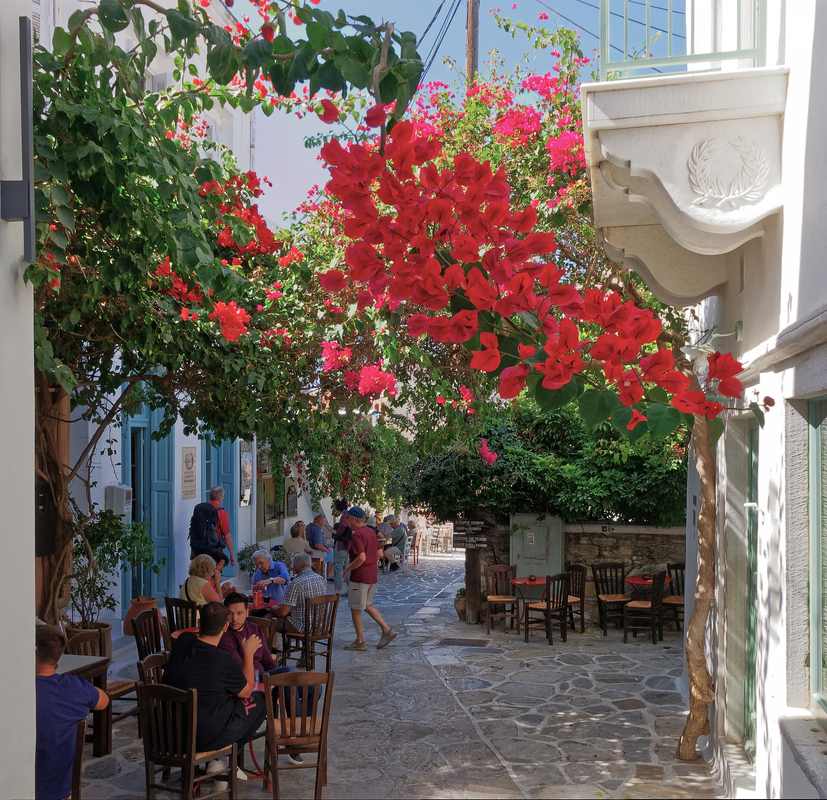
Apeiranthos is the most striking mountain village on Naxos, built almost entirely from local grey-white marble on the slopes of the island’s central massif. Its stepped lanes, stone archways and shaded passages give it a texture found nowhere else in the Cyclades, and its position high above the valleys delivers sweeping views across the Aegean. The village combines a strong sense of heritage, with settlers descended from Crete, alongside museums, Venetian towers and a warm, lived-in atmosphere. Visitors come for the architecture, the cool mountain air and the slow pace, and the surrounding roads reward a full day of exploring. A wealth of travellers reach it comfortably on a guided tour with My Greece Tours.
This page sits within our wider Naxos travel guide and focuses entirely on Apeiranthos, its fabric, its people and how to experience it well. The sections below cover what Apeiranthos is, why it is built of marble, what is special about its people and dialect, what museums and sights it holds, and how you actually visit the village on a mountain drive through the interior of Naxos.
What is Apeiranthos?
Apeiranthos is a marble-built mountain village in the interior of Naxos, sitting high on the slopes of the island’s central range. It is known for stepped marble lanes, stone archways, a cluster of small museums, Venetian towers and its distinct dialect and heritage.
Apeiranthos rises on the eastern flank of Naxos, roughly at the base of the island’s highest peaks, and it feels different the moment you arrive. Where the coastal resorts are white-cubed and bright, Apeiranthos is grey, dense and vertical, its houses stacked along a slope and knitted together by covered passages. The village grew as a refuge and a working settlement, protected by its height and its stone. Marble is everywhere underfoot and overhead, and the light plays across it in a way that changes through the day. This upland character, tied closely to the local stone, is exactly why the question of the village’s marble deserves its own explanation next.
Beyond its looks, Apeiranthos is a genuine living community rather than a museum piece, with cafes, small shops and residents who still speak in the village way. It ranks among the most memorable of the villages of Naxos. A wide range of travellers pair it with the drive up towards Mount Zas, the tallest mountain in the Cyclades. The altitude keeps summer temperatures gentler than on the coast, and the surrounding terraces, orchards and grazing land show how mountain life here has long depended on the land. It is a place to wander slowly, look up at the archways and let the layout of the lanes lead you.
Why is Apeiranthos built of marble?
Apeiranthos is built of marble because Naxos holds abundant, high-quality marble in its central mountains, and the villagers used the nearest and most durable material at hand. The result is stepped marble lanes, marble thresholds and lintels, and stone archways spanning the streets.
Naxos has quarried and worked marble since antiquity, and the interior of the island is rich in the stone. For a mountain community, marble was not a luxury import but the local building material, cheaper and stronger than anything that had to be carried up the slopes. So the houses, steps, courtyards and even street surfaces were shaped from it. Over generations this created the unified grey-white fabric that defines the village, worn smooth by centuries of footsteps. The stone also suits the climate, staying cooler in the mountain summer and standing firm through winter. Understanding this material helps explain the character of the people who built and maintained such a place, which the next section explores.
Walking through Apeiranthos, you notice how the marble is used with real craft rather than just for bulk. Steps are cut and fitted precisely, doorways are framed with clean lintels, and archways vault over the lanes to connect houses and shade the passages below. These arches are one of the village’s signatures, turning narrow streets into a covered, almost interior world. Balconies, benches and small squares are finished in the same stone, so the whole settlement reads as a single continuous surface. The effect is both practical and beautiful, a piece of vernacular architecture where the mountain has been quarried into a place to live. Limited Cycladic villages show this so completely.
What is special about its people and dialect?
Apeiranthos is famous for a population partly descended from settlers who came from Crete, which gave the village a distinct dialect, strong oral traditions and a proud, independent spirit. Local speech, songs and customs still set it apart from the rest of Naxos.
The village’s identity owes a great deal of to families that arrived from Crete generations ago, bringing their own way of speaking and their own traditions. Over time this blended with the island’s culture but never dissolved into it, leaving Apeiranthos with a recognisable dialect that older residents still use naturally. Visitors often notice the different rhythm and vocabulary of the local speech, a living trace of the settlement’s history. This distinctiveness extends to music, poetry and the improvised sung verses that have long been part of village gatherings. Such a strong sense of heritage naturally produced people who wanted to record and display it, which is why the village’s museums, described next, are so unusually rich.
Alongside language, Apeiranthos holds tightly to its customs, from festival days to the storytelling traditions that pass local history down through families. The village has produced notable scholars, teachers and collectors, and there is a clear pride in learning and in preserving the past. This intellectual streak is unusual for so small and remote a place, and it shapes the atmosphere you feel while walking the lanes. Community life still centres on the squares and the church, where residents gather and where the older generation keeps the dialect and the songs alive. For a traveller, part of the pleasure of Apeiranthos is sensing this continuity, a village that knows exactly who it is and where it came from.
What museums and sights does Apeiranthos have?
Apeiranthos has a series of small but respected museums, including archaeological, folklore and geological collections, along with Venetian-era towers, marble archways and churches. For its size it holds a remarkable concentration of things to see and learn.
The village is well known for its cluster of small museums, an unusual feature for a mountain settlement of this scale. The archaeological museum gathers finds from the surrounding area, including early Cycladic material, while the folklore museum preserves tools, textiles and objects of traditional mountain life. There is also a geological collection reflecting the mineral wealth of the region, and further small collections tied to natural history and local heritage. Together they show the village’s scholarly character in physical form. These indoor sights pair naturally with the outdoor ones, and knowing what to see helps you plan the practical visit that the final section sets out.
Beyond the museums, the built fabric itself is the main attraction. Venetian towers, remnants of the island’s medieval rule, still stand within and near the village, their solid stone forms rising above the marble houses. The lanes lead past churches, small chapels and shaded squares, and every archway frames another view of stone and sky. From the edges of the settlement the panorama opens across valleys and towards the sea, rewarding anyone who climbs to the higher streets. Simply following the marble steps wherever they go is one of the best things to do here, turning the whole village into an open-air sight rather than a checklist of monuments.
How do you visit Apeiranthos?
You visit Apeiranthos by driving up into the mountainous interior of Naxos, usually as part of a loop through the island’s inland villages. The village is best explored on foot, so park at the edge and wander the marble lanes and museums.
Apeiranthos sits high in the eastern interior, reached by a scenic mountain road that climbs steadily from the coast through terraced slopes and smaller settlements. Cars stay at the entrance and the village is walked from there because the lanes are stepped and narrow. A wide range of visitors combine it with a wider inland circuit, taking in the marble-working village of Halki and the trailhead area for Mount Zas, the highest peak in the Cyclades. Allow a couple of hours at least, more if you want to see the museums properly and pause for a coffee in one of the squares.
Timing and pacing make a real difference in Apeiranthos. Mornings and late afternoons bring softer light on the marble and cooler air for walking the stepped lanes, while midday can be bright and quiet. Comfortable shoes matter, as the steps are smooth and steep in places. Check museum opening hours before you go, since the small collections keep limited schedules. Take the mountain road slowly and enjoy the views, and if you prefer to relax, a guided tour handles the winding route and adds context to what you see if you are driving yourself. Either way, treat the village as a slow half-day rather than a quick stop, and let its atmosphere set the pace.
Plan your visit and tours through our Naxos travel guide.
Frequently Asked Questions
Where is Apeiranthos located on Naxos?
Apeiranthos lies in the mountainous interior of Naxos, on the eastern slopes of the island’s central massif and among its highest peaks. It is one of the highest inhabited villages on the island, set well above the coastal resorts. This gives it cooler air and sweeping views over the surrounding valleys and towards the Aegean. Reaching it means driving inland from the coast along a scenic, winding mountain road that climbs through terraced hillsides and passes other traditional settlements. The route is part of the experience, revealing the rugged inland landscape that most beach-focused visitors never see. Apeiranthos feels distinctly different from the whitewashed coastal towns.
It works well as the centrepiece of an inland driving loop across Naxos because of its height and its stone construction. A host of travellers pair it with nearby mountain villages and the trailhead area for the island’s tallest peak.
What is there to do in Apeiranthos?
The main thing to do in Apeiranthos is simply to walk its marble lanes, passing under stone archways, up stepped passages and through small squares that open onto wide mountain views. Beyond wandering, the village offers a cluster of small museums covering archaeology, folklore and geology. This is unusually rich for a settlement of this size and reflects its strong scholarly heritage. You can also see Venetian-era towers, visit churches and chapels, and pause in a cafe or taverna to enjoy the cool upland air. Photographers find endless subjects in the grey-white stone, the arches and the interplay of light and shadow. Exploring is unhurried and rewarding because the village is compact and pedestrian.
Most visitors treat Apeiranthos as a slow half-day, combining sightseeing with a relaxed meal, and often folding it into a broader tour of the mountainous interior and its neighbouring villages.
Is Apeiranthos worth visiting?
Apeiranthos is well worth visiting and is often ranked among the most beautiful and distinctive villages on Naxos. Its marble construction, stepped lanes and stone archways give it a character unlike the island’s coastal towns. Its heritage, including settlers descended from Crete and a distinct local dialect, adds real depth to a visit. The concentration of small museums is remarkable for such a place, and the Venetian towers and mountain panoramas reward the drive up. For travellers who want more than beaches, it offers architecture, history, culture and cooler mountain air in a single, walkable setting. It suits anyone interested in traditional Cycladic life, photography or simply escaping the summer heat of the coast.
Combined with nearby inland villages and the island’s highest peak, Apeiranthos makes an excellent focus for a day exploring the interior of Naxos. It consistently leaves visitors glad they made the journey inland rather than staying by the sea.