
Meteora wellness retreats come in four kinds: a six-night yoga hiking week in Kastraki, a hotel wellness club in Kalambaka, a booking-site listing and a calm-trip guide. The Kastraki week takes up to 12 guests and walks 3 to 9 miles a day. The hotel club holds an indoor pool, a sauna, a steam bath and a gym, and its page names no massage.
The 13 Meteora tours we checked are hikes, rides and sightseeing days, with no yoga session or massage among them. Autumn and winter are the calm months, say the sources we read, while summer brings crowds and heat. Planning a longer trip? The Greece Tours homepage groups our tours by island and mainland region.
What counts as one of the Meteora wellness retreats?
Four kinds of Meteora wellness retreats show up in the pages that rank for this search. They are a yoga-led hiking week, a hotel wellness club, a booking-site listing and a calm-trip guide. A monastery visit is not one of them.
We read nine pages that rank for Meteora wellness retreats. Eight gave full text. The ninth, a page for a stone suite in Kastraki, showed only a short description and a feature list. Wikipedia filled in the place itself. The kinds below come from those ten sources.
- Hiking and meditation week. Two yoga teachers sell Meteora wellness retreats of this kind. One is a six-night week in Kastraki built around daily walks. The other adds a three-night Meteora stop to a trip on Paros.
- Hotel wellness club. A hotel page in the Kalambaka area gathers an indoor pool, a steam bath, a sauna and a gym under one wellness club.
- Retreat-booking listing. A booking site lists a seven-day yoga and meditation week near Lake Plastiras in Karditsa. It is a Greece listing, not one of the Meteora wellness retreats.
- Calm-trip guides. An adventure operator’s guide counts slow travellers among Meteora’s visitors. It names retreats and silent walks among the reasons spiritual seekers come. An article for retreat hosts says a group can meditate among the rocks and do yoga with the view.
Monasteries are the fifth thing the pages mention, and they sit outside the list of Meteora wellness retreats. A guide to Holy Trinity calls it an active monastery. It is not a conventional meditation retreat with organised programmes or retreat packages. It sends guests who want a longer visit to stay in Kalambaka or Kastraki and go up from there.
Three of these kinds belong to Meteora itself: the Kastraki week, the three-night stop and the Kalambaka hotel club. The Karditsa listing and the host article speak for Greece as a whole. That article says boutique hotels and guesthouses cater to smaller groups. Wikipedia names hiking, trail running, mountain biking and climbing at Meteora and mentions no wellness product.
The pages on Meteora wellness retreats also leave gaps. The hotel wellness page names no massage and no treatment. The stone-suite page lists a fireplace and a spa-inspired bathroom, with no treatment either. The older teacher page lists a beauty treatment on request among its hotel services. Neither teacher page shows a weekly class timetable.
So Meteora wellness retreats, as these pages sell them, are single group weeks and hotel facilities. For the place itself, start with our Meteora travel guide, then come back here to compare the options.
What does a hiking and meditation week at Meteora look like?
A yoga school’s six-night hiking week in Kastraki is one of the Meteora wellness retreats. The group is capped at 12 guests. Each day holds a walk of three to nine miles at a talking pace. Two short practices frame it, one at first light and one in the evening.
Guests sleep in eco premium suites in Kastraki, each with its own bathroom and the rock towers close outside. The school runs the week only if at least six guests book. Kastraki sits at the foot of the towers, and the page says everything there is within reach on foot.
- Dawn. A short meditation on the terrace as the light comes up, then a simple breakfast with no rush.
- Midday. The walk: three to nine miles, depending on the day, at a pace where you can still hold a conversation. The trails pass monasteries on the rock and hermit caves. Stone steps appear on certain trails, and every trail has moderate climbs.
- Afternoon. Free time in Kastraki to rest, journal or wander the village.
- Evening. Gentle movement and meditation in the open air as the light turns gold, for anyone who wants it, with no mat needed. A long shared dinner follows.
Breakfast, trail snacks and a family-style dinner in the village are part of the week. Lunch is not. The food is simple Greek cooking, vegetarian and vegan at every meal. Flights, extra nights, alcohol, travel insurance and tips are extra.
Guided hikes and monastery entry fees are included. So is the transfer from Athens, a drive of about four to five hours. Two hosts run the days. One leads the walks and the meditation. The other looks after everything between arriving and leaving.
The hosts say they built the week around walking, breathing and silence. They did not build it around sightseeing. They also walked each trail before offering it. The page says monks climbed into these cliffs for centuries in search of quiet. Among Meteora wellness retreats, this week puts the trail first, and its page lists no spa treatment.
The older teacher page uses the place another way. It says Meteora is considered one of the Earth’s energetic vortexes. Each day opens with a 90-minute class of deep stretching, then meditation. The rest of the day is free: hike around Meteora or visit a monastery.
Guests stay in a hotel at the foot of a rock formation. The page lists transport to and from Meteora and the hotel breakfast as part of the trip.
Meteora wellness retreats have company elsewhere in Greece. A booking-site week in Karditsa, not at Meteora, shows a third pattern. Hatha yoga opens the early days and Vinyasa the later ones. One day holds a guided hike to an old bridge and waterfalls. Another ends with a gong bath, a sound session. Groups run from two to 15.
The yoga school says anyone who can walk comfortably for three hours can join. No meditation experience is needed. Solo guests are welcome. The page calls it the wrong week for a beach and a packed itinerary. By its account, Meteora wellness retreats like this one suit people open to walking and sitting.
The page lists the monastery dress code: skirts below the knee for women, long trousers for men, covered shoulders. Our page on the Meteora monasteries has the visiting details.
What do hotel wellness areas offer on Meteora wellness retreats?
Hotel pages for Meteora wellness retreats list an indoor pool with jacuzzi spots. They add a sauna, a steam bath and a fitness room. A stone house in Kastraki offers a fireplace and a spa-inspired bathroom instead. Neither business names a massage or a yoga room.
Three hotel pages carry the facts for Meteora wellness retreats that happen inside a building. Two describe a hotel at the entrance of Kalambaka. One describes a stone house in Kastraki village. The list groups what they name by type of facility.
- Water: an indoor pool with jacuzzi spots in the wellness club, plus an outdoor swimming pool on the hotel page. The wellness page notes that the indoor pool is at room temperature.
- Heat: a sauna and a steam bath, both in the same wellness club.
- Movement: a fitness room with Technogym machines. The page names lifts, treadmills and exercise bikes. The club opens from 08:00 to 21:00.
- In the room: at the stone house, a bathroom the page calls spa-inspired, with a rainfall shower and copper fixtures. The page also lists a private fireplace, Italian cotton linens and climate control.
For anyone planning Meteora wellness retreats around a massage, the wellness page’s search summary promises spa treatments. Its body text names none. It lists only the pool, the sauna, the steam bath and the fitness room. A traveller who wants a massage asks the hotel before booking.
The hotel gives its address on the national road between Trikala and Ioannina. Its page puts Kalambaka in the shadow of the rocks and lists a 24-minute drive to Trikala.
The stone house stands in Kastraki village, 2 km from Kalambaka town. Its page names tavernas, the Holy Spirit hiking trail and the Museum of Geological Formations within walking distance. Kalambaka and Kastraki are set against each other on the where to stay in Meteora page.
On quiet, the hotel page promises rooms and suites that bring tranquility and comfort. It also describes a serene atmosphere inside the hotel and says the rocks stay in view at all times. The stone house page calls itself an intimate retreat and lists rock views as a feature.
Both pages describe the calm in plain claims. Neither gives a sound level or a floor plan, so treat the quiet as a promise, not a measure.
Check-in and check-out set the pace of Meteora wellness retreats in a hotel. The stone house page gives check-in from 15:00 and check-out by 11:00, with flexible times on request. The wellness page pitches the sauna and steam bath as the way to wind down after exploring Meteora.
The two types suit two kinds of day. The hotel suits a day built around a pool and a sauna. The stone house suits an evening built around a fireplace and a view of the rocks. On Meteora wellness retreats that rely on a hotel, these are the facilities the pages actually name.
What makes the setting of Meteora wellness retreats a calm one?
Meteora wellness retreats happen on the northwest fringe of the Plain of Thessaly, between Kalambaka and Kastraki. Wikipedia counts three monks at the Great Meteoron and seven at Varlaam. The Pindus mountains and the Pineios river lie close by.
Start with the ground under Meteora wellness retreats. Wikipedia places Meteora close to the Pindus mountains and the Pineios river. The river flows from the Pindus across the Thessalian plain, and the article lists Kalambaka among the places along it.
The Pindus runs north to south along much of mainland Greece. Wikipedia says people call it the spine of Greece. Its highest peak, Mount Smolikas, stands at 2,637 metres.
Wikipedia counts 11,492 people in the municipal unit of Kalambaka, the town below the rocks. Of them, 8,573 live in the town proper. Kastraki, a community of Kalambaka, lies on the massif’s west side. The old Thessaly railway ends in Kalambaka, which the article calls its northwestern terminal.
At their peak in the 16th century, 24 monasteries stood on the rocks. Wikipedia says six still function, with four for men and two for women. It gives St Stephen, a convent since the 1960s, 28 nuns. These counts date from the mid-2010s, so read them as a guide, not a current census.
UNESCO added the six monasteries to the World Heritage List in the late 1980s, says Wikipedia. It cites outstanding architecture and beauty together with religious and cultural weight. A hotel page adds that the Meteora-Antichasia region is a protected area of the European Natura network.
An outdoor-tour operator’s guide says the Natura network protects the ecosystem from overdevelopment and industrial activity. By that account, the area around the rocks is shielded from heavy building.
For Meteora wellness retreats, the same guide points to solitude and serenity at Holy Trinity, which holds a small chapel. It calls St Stephen, now home to nuns, particularly peaceful. A Greek travel site calls Holy Trinity a haven of peace and serenity.
That travel page also says Holy Trinity is an active monastery. Visitors follow its rules, its dress requirements and respectful behavior.
The operator guide says visiting all six monasteries is ideal. Two or three, it adds, give a real view of the region’s heritage. A slow day on Meteora wellness retreats can stop at two and still follow that advice.
The guide counts around 300 stairs at the Great Meteoron. It says St Stephen needs no stairs, since a bridge leads to it. Those two numbers help you plan Meteora wellness retreats around your energy.
Heights depend on the rock and the source. Wikipedia puts the rock of St Nicholas Anapausas at about eighty metres. It says hermits lived in hollows as high as about 550 metres above the plain. A hotel page says the monasteries rise over 600 metres above the plain.
The name itself points up. Wikipedia glosses Meteora as lofty or elevated, and the operator guide reads it as suspended in air. How the pillars formed is the job of our Meteora geology page.
Which paths and quiet corners suit a slow walk on Meteora wellness retreats?
The monastery footpaths start in Kastraki and Kalambaka. A guide from one of the Meteora wellness retreats lists six routes around the two villages. They run from 1.1 km to 5.9 km and take 40 minutes to 2 hours 15 minutes.
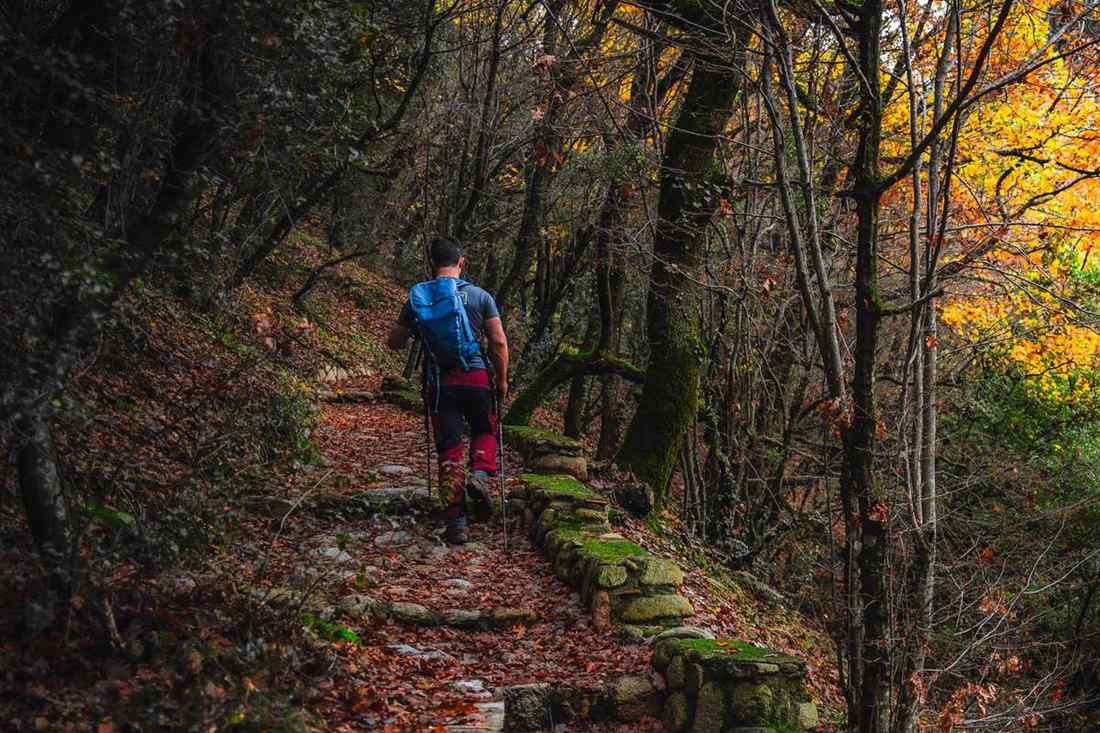
That guide belongs to a Meteora yoga retreat, and it covers the landscape the retreat walks. The old footpaths join the villages at the base of the rocks to the monasteries on top. Before roads reached the summits, people used them, along with ladders and rope-drawn nets.
The yoga guide gives distances and times one way, without stops. A tour operator’s guide gives its own figures. Six routes follow, for Meteora wellness retreats and for other walkers.
- Kastraki square to Great Meteoron and Varlaam: about 2.1 km, 45 minutes. It is a steady climb among the rocks, with rockfall visible on the lower slopes.
- Kalambaka town hall square to Holy Trinity: about 1.1 km with 200 m of climbing, 40 minutes. Yellow squares mark the way. The surface is paved apart from a short unpaved stretch near the top.
- Great Meteoron circular walk: 5.9 km, 2 hours 15 minutes. It runs through the woods and over rocky high points, with a short detour to a small chapel.
- Panagia Kanaliotissa loop from near the Varlaam road: 3.1 km, 1 hour 10 minutes. It crosses oak forest to a stone chapel, climbs once and returns along a stream.
- Holy Trinity trail past the Badovas hermit caves: 4.5 km, 2 to 2.5 hours. The operator’s guide calls the forest paths peaceful and the trail moderate to steep. It rates the walk for anyone wanting a meditative experience.
- Old mule-path trail: 7 km, 3 to 4 hours. The operator’s guide says monks used these mule paths and promises less foot traffic and more solitude.
For Meteora wellness retreats, Kastraki is the calmer of the two bases. The yoga guide calls it smaller and quieter than Kalambaka, with trailheads at its edge. Wikipedia lists a central plaza and a church in the village. The retreat behind the guide stays there for that reason.
Wikipedia gives a 20-minute walk between Kastraki and Kalambaka by the main road. The yoga guide gives about an hour for the route along the base of the rocks. The ground mixes quiet road, dirt track and shaded rocky trail. It warns that other guides give slightly different figures, depending on where each walk starts.
The operator’s guide names thyme, sage and oregano along the trails. It also names griffon vultures and golden eagles among the birds of prey. The Meteora wildlife page covers the birds in more detail.
Waymarking is patchy. Painted markers appear on certain routes, while junctions elsewhere have none. The yoga guide tells walkers to take an offline map, stay on the path and keep off the rocks. On the yoga retreat itself, every hike is guided.
For quiet paths, the yoga guide points to the morning. It says the air is cool, the light reaches the towers early and the paths are quiet. The same guide keeps the afternoon for rest and the evening for a slow walk through the village.
The shortest routes in the guides take 40 to 45 minutes. They are the Holy Trinity climb, the climb from Kastraki and the Psaropetra trail. All three fit a short outing on Meteora wellness retreats. The operator’s guide pairs the 2 km Psaropetra trail with sunset. It rates the walk easy and lists clear views of Roussanou and Varlaam.
Which healing and prayer traditions of Trikala and Kalambaka lie close to Meteora wellness retreats?
Three traditions meet around Meteora wellness retreats. Ancient Trikke held a temple of Asclepius, the Greek god of medicine. Kalambaka stands on the ancient settlement of Aiginion and was later the Byzantine bishopric of Stagoi. Hermits and monks lived in solitude in the Meteora rocks.
Wikipedia says Strabo placed the birthplace of Asclepius at ancient Tricca, today’s Trikala. The same article names Coronis, a princess of Tricca, as his mother in the earliest accounts.
Meteora wellness retreats sit in the Trikala regional unit, in Thessaly. Wikipedia’s Trikala article places the archaeological site of ancient Tricca next to St Nicholas Cathedral and the old town.
Wikipedia describes the cult of Asclepius in general, not Trikke alone. From the fifth century BC, pilgrims came to his temples. They went through ritual purification and made offerings. Then they spent the night in the holiest part of the sanctuary. Dreams went to a priest, who prescribed the therapy. No source here ties these rites to Meteora wellness retreats.
One of Kalambaka’s oldest churches, St John the Baptist, has a Greek inscription on its wall. It testifies to an ancient settlement called Aiginion. Wikipedia adds that relics of an ancient Greek temple, which Wikipedia ties to Apollo, sit in the wall of the oldest church. That church honours the Virgin Mary.
In the 10th century the town was Stagoi, a Byzantine fortress and bishopric. Today the Metropolis of Stagoi and Meteora has its seat in Kalambaka.
Meteora’s own tradition is solitude. Wikipedia says the first people documented there after the Neolithic were ascetic hermits. They lived in hollows and fissures in the rock towers. At first the hermits came together only on Sundays and special days. They prayed in a chapel at the foot of Dupiani rock.
The sources behind this page on Meteora wellness retreats lean on two words for the setting. The yoga page speaks of silence, and the operator’s guide speaks of solitude.
Wikipedia says monks occupied the caverns as early as the 11th century. Monasteries followed in the 14th century. In that century Athanasios came from Mount Athos with a group of followers and founded the Great Meteoron. The Meteora monasteries served monks and nuns who followed the Eastern Orthodox Church.
Stillness has its own word in that church. Hesychasm comes from the Greek hesychia, which means stillness, rest, quiet or silence. Wikipedia calls it a contemplative monastic tradition that seeks stillness through uninterrupted Jesus Prayer. It took its definitive form in the 14th century at Mount Athos.
Wikipedia’s hesychasm article does not name Meteora. This page therefore does not say that Meteora monks follow it, or that Meteora wellness retreats teach it.
All of this is history and belief. No source for this page claims a health effect from a modern visit to Trikala, Kalambaka or the monasteries. Treat it as background for Meteora wellness retreats. The Trikala tours page covers the town sights, including the Asclepius statue on a bridge.
Which short or small-group tours fit Meteora wellness retreats?
Six GetYourGuide listings give a short or small-group outing near Kalambaka. Four visit monasteries: a 4-hour morning tour, a small-group tour, a 4.5-hour sunset tour and an 8-hour day from Larissa. The other two are a truffle hunt and an e-bike ride.
The 13 listings in these two sections are tours. None of their frames sells a spa treatment or a yoga class. None of the six frames below uses the word quiet or slow. They list the length, the group type and the stops. For Meteora wellness retreats, those facts show how an outing fits into a stay.
- Morning tour, 4 hours, English. The abstract describes first light at dawn touching the rock formations. It carries the labels small group, private option and pickup.
- Small-group monastery tour, 4 hours. You go inside 3 monasteries with a local guide, photo stops and free cold water. The frame lists 13 languages and an optional audio guide.
- Sunset small-size tour, 4.5 hours. The listing names monasteries, the oldest church and hermit caves. Pickup and drop-off come from Kalabaka, and the frame lists 12 languages.
- Day from Larissa, 8 hours, English and Greek. Free time in Kalambaka or Kastraki is part of it, along with monastery visits, rock formations and panoramic views. Its title ends with Spiritual Escape.
- Truffle hunt, 3.5 hours, English and Greek. You walk in the woods below Meteora, on the fringes of the Pindos mountains, with a truffle hunter and his dogs.
- Morning e-bike tour, 3 to 4 hours, English and Greek. The title lists a guide, a snack and water. The frame labels it small group.
The Larissa day is the longest outing. It is the only one of the six whose abstract starts in another city. It also carries the new activity label.
On Meteora wellness retreats, the truffle hunt is a walk in the woods, not a monastery visit. The abstract says you search for rare kinds of truffle. Pasta is then made in front of you, and you eat the truffles with it. The title adds lunch and a museum visit.
Group wording differs. The morning tour, the monastery tour and the e-bike ride say small group. The sunset tour says small size in its title and small group in its abstract. The truffle hunt is a private group. The Larissa frame has no group label. Compare that line first on Meteora wellness retreats.
Free cancellation shows on all six frames. Pickup shows on four of them: the morning tour, the two small-group monastery tours and the Larissa day. Booking cut-offs run from 30 minutes for the sunset tour to 20 hours for the truffle hunt. If your plan for Meteora wellness retreats changes day by day, read the cut-off line first.
GetYourGuide files the morning tour, the sunset tour, the monastery tour and the truffle hunt under Kalabaka. It files the Larissa day and the e-bike ride under Kalambaka. The frames give no meeting point, only a place name and a pickup label.
The morning listing is the one that talks about dawn light. The Meteora sunrise guide names the viewpoints for that hour. Read the two together to plan one early outing on Meteora wellness retreats.
Which hikes, rides and bike tours add movement to Meteora wellness retreats?
Seven listings add movement to a stay. Four are hikes of 3 to 5 hours. Two are horseback rides of 1 and 1.5 hours, and one is a 4.5-hour e-bike tour. All seven offer free cancellation.
Wikipedia’s recreation section says climbers, mountain bikers, trail runners and hikers come to Meteora from around the world. The listings below sell the hiking, riding and cycling side of that list. Pick the length first when you plan Meteora wellness retreats around movement.
- Small-group hiking tour, 5 hours, English. The abstract describes a guided morning hike for views of the Eastern Orthodox monasteries. Pickup is listed. The frame bars children aged 5 and younger.
- Private circular hike, 4 hours, English and Greek. The abstract describes a circular 6 km trail among towering rocks and caves. The label says private group. The frame bars ages under 7 and over 86.
- Private hike to the Holy Spirit Rock and Monks’ Prison, 3 hours, English and Greek. A local guide leads it, as the abstract says. The frame bars ages under 7 and over 76.
- Sunset hike to caves, 4 hours, English. The abstract names hermit caves, trails, the monks’ prison and the sunset. Pickup is listed, and a private option is available.
Wikipedia describes the Monks’ Prison as perched on a rock cliff on the Holy Spirit Rock. Two hikes name the prison: the 3-hour private hike and the sunset hike. Hikers on Meteora wellness retreats can choose either one. The Meteora hiking page lists the main trails, hermit caves and viewpoints.
The two horseback listings are small group. The one-hour ride includes a 20-minute training session, photos and refreshments. Its label says wheelchair accessible. It is the shortest of the seven, so it fits into Meteora wellness retreats without taking a full day.
The Kastraki ride lasts 1.5 hours, and its title says for new riders. The abstract says the guide shares the history of Meteora while the monasteries glow gold at sunset. Of the two rides on Meteora wellness retreats, that one is the longer.
The e-bike tour lasts 4.5 hours, and its title names monasteries and hermit caves. The abstract says you cycle easy on very comfortable e-bikes among the giant rocks. The frame has no group-size label. The Meteora e-bike tour page covers the route and the bikes. Wikipedia adds that an annual mountain-bike race runs at Meteora.
Only three of the seven name a time of day. The hiking tour is a morning hike. The sunset hike and the Kastraki ride follow the sunset. The other four name none, so read the start time on the booking page. If your Meteora wellness retreats keep mornings free, the two sunset listings fit that gap.
The hiking tour and the sunset hike list English only. The other five list English and Greek. Cut-offs run from 1 hour for the e-bike tour to 10 hours for the sunset hike. The 5-hour hiking frame lists none.
GetYourGuide files the Kastraki ride under Kastraki. It files the two private hikes and the one-hour ride under Kalambaka, and the other three under Kalabaka. None of the seven frames gives a meeting point, so confirm it before you book. A booking for Meteora wellness retreats needs that line settled first.
Which months are calm for Meteora wellness retreats?
Autumn and winter are the quiet seasons for Meteora wellness retreats in the sources. A hiking-tour guide gives autumn fewer crowds and winter a quiet mood. A Greece-wide retreat article says the summer crowds thin out from September. No source calls spring quiet.
A hiking-tour guide for Meteora gives each season one line in a table. Spring has wildflowers and mild weather, good for hiking. Summer has long days and more tourists, so it advises early starts. Autumn has vivid foliage, clear skies and fewer crowds. Winter is quiet, with a mystical atmosphere and possible snow.
A retreat-planning article for the whole of Greece reads the year in four blocks. It runs spring from late April through June at 15 to 25°C. It lists Meteora among the mainland places that bloom with wildflowers. For July and August it names heat above 30°C as a drawback for strenuous outdoor wellness sessions.
The same article says the summer crowds thin out from September, with 20 to 28°C. It calls December through March the season for indoor meditation, workshops and spa treatments. Its verdict: spring and autumn suit a mix of indoor and outdoor work.
Wikipedia has no climate table for Kalabaka, so for Meteora wellness retreats the nearest one is the table for Trikala. It files Trikala under a Mediterranean climate with mild spring and autumn. Freezing nights are sporadic in winter, and snow is observed from time to time without being significant. The temperature figures rest on three years of readings.
Here is that table month by month for Meteora wellness retreats, with the remark each source adds.
- April: high 20.5°C, low 8.7°C, rain 43.2 mm. The hiking-tour guide calls spring mild and good for hiking.
- Late spring, the month before June: high 26.7°C, low 13.4°C, rain 41.8 mm. A yoga school lists daytime highs of 22 to 26°C and cool mornings of 10 to 13°C for its week, and says spring showers are common.
- September: high 30.6°C, low 17.3°C, rain 55.7 mm. A yoga teacher’s page places a three-night Meteora stop in this month.
- October: high 24.6°C, low 12.1°C, rain 73.1 mm. The hiking-tour guide gives autumn vivid foliage and clear skies.
- November: high 17.1°C, low 8.9°C, rain 75.6 mm. The Greece-wide article ends its autumn block here.
- December to February: highs from 10.7°C to 14.7°C, lows from 1.8°C to 5.9°C, rain from 58.6 to 80.2 mm. The hiking-tour guide calls winter quiet.
- March: high 17.3°C, low 5.7°C, rain 76.4 mm. The Greece-wide article ends its winter block here.
The sources do not match on every number. Read the Greece-wide ranges as rough when you plan Meteora wellness retreats. The article gives autumn as 20 to 28°C. Trikala’s table shows a September high of 30.6°C and a November high of 17.1°C. The article ends spring in June, but the table shows a June high of 32.8°C.
Winter is where the two agree. The article gives 10 to 15°C on the mainland. The table’s December to February highs sit between 10.7°C and 14.7°C, and its lowest low is 1.8°C in January.
Rain matters on a walking week of Meteora wellness retreats. The table puts October at 73.1 mm and November at 75.6 mm, against 43.2 mm for April. The fewer crowds of autumn come with more rain than spring brings.
Wikipedia says Meteora draws trail runners, mountain bikers, hikers and rock climbers from around the world, particularly in summer. The hiking-tour guide lists more tourists for summer. The table’s two hottest months, July and August, fall in the same season. For Meteora wellness retreats that value quiet, that season brings crowds and heat together.
A note in Wikipedia’s article on Meteora, flagged as needing a citation, says all six monasteries are open. It adds that in winter two of them close to visitors on each day of the week. The note quotes a staff member of the Kalambaka bus office.
Read our Meteora in winter page before you book Meteora wellness retreats for the cold months. Our best time to visit Meteora page ranks the seasons for sightseeing. A retreat guest reads the same notes with another aim: a slow week, not a full monastery list.
What do travellers ask about Meteora wellness retreats?
Is there a direct train to Kalambaka?
The sources disagree on the rail link to Meteora wellness retreats. A hiking-tour guide lists direct lines from Athens and Thessaloniki to Kalabaka. A yoga school’s travel note gives about five hours from Athens, with a change at Palaiofarsalos. It adds a connecting bus for the last leg during line works.
Do you need to be Orthodox to visit a monastery?
No. A travel guide to Holy Trinity says the monastery draws Orthodox pilgrims. It also draws visitors of other Christian traditions, other religions and other backgrounds. It asks every visitor to follow the monastery’s rules, its dress requirements and respectful behaviour.
What do you pack for a late-spring week at Meteora?
For Meteora wellness retreats in late spring, a yoga school’s note lists a light rain jacket and a small daypack. It adds trekking poles for the steps and a hat for the midday sun. It also asks guests to bring a plug adapter.
Did the Meteora monks use plants for healing?
A hiking-tour guide says monks have long used the area’s plants for healing salves, teas and traditional remedies. It names thyme, sage, oregano and arbutus among the wild plants on the trails. It makes no health claim for visitors.
Does a hiking week need special travel insurance?
A yoga school’s travel note says Meteora sits far below the altitude where policies normally start excluding cover. For Meteora wellness retreats with hiking weeks, it asks guests to check that guided hiking on marked trails is covered. Carriers differ on guided activity.
Can Meteora wellness retreats include a cooking class?
A hiking-tour guide suggests a cooking class or a wine-tasting tour in Trikala or Kalabaka. It lists trachanas soup and wild mushroom dishes among the local foods. It names no class and no schedule. Our one day in Meteora page covers a single-day visit.