
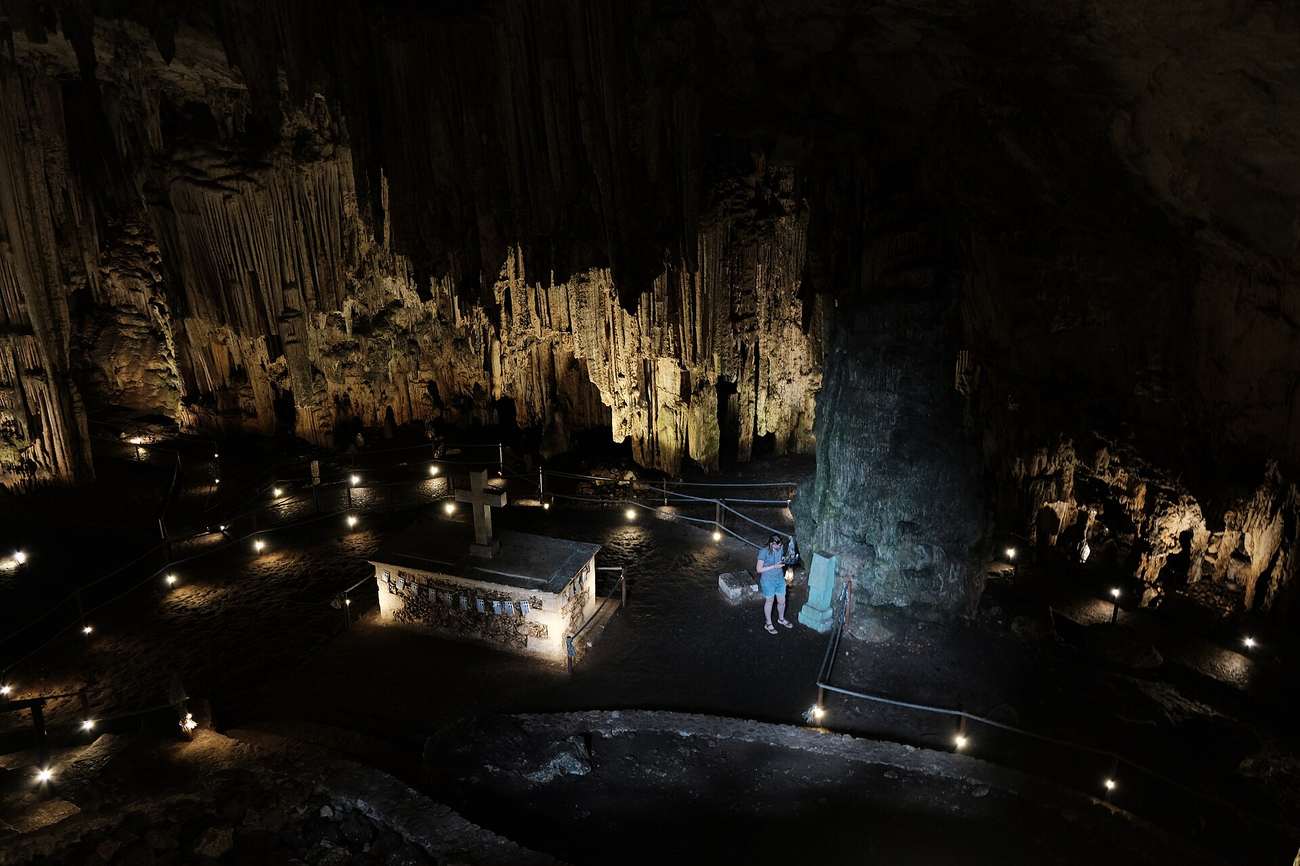
Melidoni Cave rises above the village of Melidoni in the Mylopotamos area of Rethymno, offering visitors a single vast chamber where geology and history intertwine. Known also as Gerontospilios, this cavern sheltered ancient worshippers and, according to legend, the bronze giant Talos who guarded Crete. Its most poignant chapter unfolded in the nineteenth century, when Ottoman forces sealed the entrance and lit fires, killing hundreds of villagers and resistance fighters inside. Today a stone altar and ossuary honour their memory beneath illuminated stalactites and stalagmites. Explore this profound site with My Greece Tours.
The cave lies inland from the north coast near Panormos, surrounded by traditional Mylopotamos villages that preserve Cretan mountain culture. Visitors descend into the great hall to witness dramatic formations and the memorial that transforms natural beauty into sacred space. The sections below cover the cave’s mythological roots, its role in ancient worship, the tragic events of the nineteenth century, practical visiting details, and its place among the island’s cultural landmarks. Plan your journey with our Crete travel guide to experience this moving testament to resilience and memory.
What legends connect Melidoni Cave to Crete’s mythology?
Melidoni Cave, or Gerontospilios, was believed to shelter Talos, the bronze giant who circled Crete three times daily to guard the island from invaders, hurling boulders at enemy ships approaching the coast.
Ancient Cretans wove the cave into their mythological landscape, imagining it as the dwelling of Talos, the automaton forged by Hephaestus to protect King Minos. This bronze guardian patrolled the island’s shores, his single vein of ichor sealed by a bronze nail at his ankle. The cavern’s imposing entrance and echoing interior made it a fitting home for such a formidable protector. Storytellers passed down tales of the giant’s vigilance, and the cave became a landmark where myth and landscape merged. The name Gerontospilios, meaning cave of the old man, may itself reference ancient guardians or deities. Visitors today walk through the same stone threshold that inspired generations of mythmakers, connecting modern exploration to Crete’s timeless narrative tradition.
The market town of Perama serves the surrounding Mylopotamos villages nearby.
The mythological association elevated Melidoni beyond a simple geological feature into a sacred space where divine and mortal realms touched. Talos represented the island’s fierce independence and the protective power attributed to natural strongholds. The cave’s single vast chamber, large enough to shelter hundreds, reinforced its legendary status as a giant’s lair. Cretan oral tradition kept these stories alive through centuries of foreign rule and cultural change. The bronze guardian’s image appears in ancient art and literature, cementing his place in Hellenic imagination. Modern visitors encounter this layered heritage, where stalactites and stalagmites frame not just mineral beauty but the enduring power of myth to shape how communities understand their landscape and identity.
How did ancient Cretans use the cave for worship?
Archaeological evidence shows Melidoni served as a sanctuary in antiquity, where worshippers left votive offerings and performed rituals. The cavern’s natural grandeur made it an ideal setting for ceremonies honouring deities and seeking divine protection.
Ancient Cretans recognized the cave’s spiritual power, transforming its vast chamber into a place of worship that bridged the human and divine worlds. Excavations have uncovered pottery fragments, bronze figurines, and other votive objects left by pilgrims seeking favour from the gods. The cave’s dramatic interior, with water dripping from stone formations and shadows dancing in lamplight, created an atmosphere of mystery and reverence. Priests likely conducted ceremonies in the echoing space, their chants amplified by natural acoustics. The site may have honoured chthonic deities associated with the earth’s depths, or protective spirits believed to dwell within the mountain.
This sacred function continued across centuries, linking Minoan, Classical, and later periods in a continuous thread of devotion and ritual practice.
The transition from mythological home of Talos to active sanctuary reflects how Cretans integrated legend into religious life. Worshippers approached the cave with offerings, climbing the slope to enter a realm set apart from everyday existence. The natural formations themselves became objects of veneration, seen as divine creations or petrified remnants of primordial events. Seasonal festivals may have drawn communities from surrounding villages, turning the cavern into a regional pilgrimage destination. The practice of cave worship appears throughout the Mediterranean, yet Melidoni’s combination of accessible location and impressive scale made it particularly significant.
Visitors exploring the illuminated chamber today follow paths worn by ancient feet, walking through a space that held spiritual meaning long before the tragic events that would later define its modern memorial function.
What happened at Melidoni Cave in the nineteenth century?
In the eighteen-twenties, hundreds of villagers and resistance fighters sheltering in the cave were killed by Ottoman forces who sealed the entrance and lit fires, suffocating those inside. A memorial altar and ossuary now honour the victims.
During the Cretan struggle for independence, Melidoni became a refuge for civilians and fighters fleeing Ottoman reprisals. The cave’s defensible entrance and vast interior made it seem like a safe haven where entire families could hide with their livestock and possessions. Ottoman troops discovered the hideout and demanded surrender, but those inside refused to yield. The soldiers then blocked the entrance with brush and timber, setting it ablaze to create deadly smoke that filled the sealed chamber. Estimates place the death toll at three hundred seventy or more men, women, and children who perished in the darkness. The tragedy shocked the island and became a rallying symbol of Cretan resistance and sacrifice.
Decades later, when Crete finally achieved union with Greece, the cave was consecrated as a memorial site to ensure the victims would never be forgotten.
The ossuary and stone altar installed in the great hall transform the geological wonder into a place of pilgrimage and remembrance. Bones of the victims rest in a glass reliquary, a stark reminder of the human cost of the independence struggle. Candles flicker before icons, and visitors maintain respectful silence as they pass the memorial. The juxtaposition of natural beauty and historical tragedy creates a profound emotional experience that distinguishes Melidoni from other things to do in Crete. Annual commemorations bring descendants and officials to honour the dead, keeping collective memory alive across generations.
The cave thus serves dual purposes: showcasing spectacular formations while bearing witness to courage and suffering that shaped modern Cretan identity and the island’s long journey toward self-determination.
How can visitors explore Melidoni Cave today?
The cave features a paved path descending into the single vast chamber, where lighting illuminates stalactites, stalagmites, and the memorial altar. The site is accessible year-round, with modest entrance fees and interpretive signage explaining its history.
Visitors reach Melidoni village via the road network connecting Rethymno to the inland Mylopotamos region, with clear signage directing them to the cave entrance above the settlement. Parking is available near the ticket booth, and the descent into the cavern follows a well-maintained path with handrails and steps. The single chamber stretches impressively, its ceiling soaring overhead and formations glowing under carefully positioned lights that highlight their mineral colours and intricate shapes. The memorial occupies a prominent position, and informational panels in multiple languages explain both the geological processes that created the cave and the historical events that made it sacred. The temperature inside remains cool throughout the year, making a light jacket advisable even in summer.
Photography is permitted, allowing visitors to document both natural wonders and the solemn memorial space.
The cave’s proximity to other Mylopotamos attractions makes it easy to combine with visits to traditional villages like Axos and Zoniana, creating a full day of cultural exploration. The coastal town of Panormos lies just north, offering beaches and tavernas for those balancing inland discovery with seaside relaxation. Tour operators based in Rethymno and Heraklion include Melidoni in itineraries focused on Cretan history and natural sites. Independent travellers appreciate the straightforward access and the self-guided nature of the visit, which allows time for reflection at the memorial. The site receives fewer crowds than major archaeological parks, offering a more intimate encounter with Crete’s layered past and the quiet power of spaces where beauty and tragedy coexist.
Why does Melidoni Cave matter to Crete’s cultural heritage?
Melidoni embodies the island’s continuous history from mythological imagination through ancient worship to modern struggle for freedom. The cave serves as both natural monument and memorial, preserving collective memory in stone and bone.
The cave represents the deep connection between Cretan identity and landscape, where mountains and caverns are never merely geological features but repositories of story and sacrifice. Its role in mythology established it as a landmark in the island’s imaginative geography, while ancient worship practices rooted spiritual life in the physical terrain. The nineteenth-century tragedy transformed it into a shrine of resistance, a place where the cost of freedom became tangible and undeniable. This layering of meanings across millennia makes Melidoni a microcosm of Cretan experience, where past and present remain in constant dialogue.
The decision to preserve the site as memorial rather than simply tourist attraction reflects the island’s commitment to honouring its dead and teaching younger generations about the struggles that shaped their heritage and political reality.
Melidoni stands among the hidden gems in Crete that reveal the island’s character beyond beach resorts and ancient palaces. The cave invites contemplation of how communities endure occupation, preserve memory, and sanctify spaces where ancestors suffered. Its accessibility makes these lessons available to visitors year-round, with the best time to visit Crete offering comfortable conditions for the descent into the cool chamber. Educational programmes bring Cretan students to learn their history in the place where it unfolded, creating personal connections to events that might otherwise remain abstract. The cave thus functions as living classroom, memorial chapel, and natural wonder simultaneously, demonstrating how heritage sites can serve multiple purposes while maintaining their essential dignity and truth.
Frequently Asked Questions
What should I know before visiting Melidoni Cave?
The cave requires descending steps into a single large chamber, so wear sturdy footwear with good grip on potentially damp surfaces. The interior temperature stays cool regardless of outside weather, making a light jacket or sweater advisable even during summer months. The site functions as both natural attraction and war memorial, so visitors should maintain respectful behaviour, keeping voices low near the ossuary and refraining from touching the memorial altar or reliquary. Photography is allowed, but flash may be restricted to protect formations and preserve the solemn atmosphere. The visit typically takes thirty to forty-five minutes, allowing time to appreciate both geological features and historical exhibits.
Facilities are basic, with restrooms near the entrance but limited food services, so plan accordingly. The cave is accessible year-round, though winter rains may occasionally affect the access path. Combining Melidoni with other Mylopotamos villages creates a richer cultural experience of inland Crete beyond coastal attractions.
How does Melidoni Cave compare to other caves in Crete?
Melidoni differs from purely geological show caves through its profound historical significance as a memorial site honouring victims of the independence struggle. The single vast chamber offers a different experience from multi-room cave systems, focusing attention on one impressive space rather than a sequence of formations. The memorial altar and ossuary create an emotional dimension absent from caves valued solely for stalactites and stalagmites. Compared to the Dikteon Cave associated with Zeus’s birth or the Sfendoni Cave known for extensive formations, Melidoni balances natural beauty with historical tragedy in unique proportion. Its location in the Mylopotamos region places it among traditional villages rather than major tourist zones, offering a more authentic encounter with rural Cretan culture.
The accessibility and modest scale make it suitable for visitors who want meaningful historical context alongside geological interest, without the physical demands of more challenging cave systems. Melidoni thus occupies a distinctive niche in Crete’s network of underground sites, where remembrance and natural wonder converge.
What other sites near Melidoni Cave are worth visiting?
The Mylopotamos region surrounding Melidoni offers traditional mountain villages that preserve authentic Cretan architecture and customs. Anogia, famous for weaving and music, lies southeast and carries its own history of resistance and destruction during the Second World War. The ancient site of Eleftherna, with ongoing excavations revealing a major city-state, sits nearby and provides archaeological context for the region’s deep history. Margarites village is renowned for its pottery workshops, where artisans continue ceramic traditions stretching back millennia. The Arkadi Monastery, another powerful symbol of Cretan sacrifice during the Ottoman period, stands west of Melidoni and complements the cave’s memorial function. Coastal Panormos offers beaches and seafood tavernas for those seeking seaside relaxation after inland exploration.
The route between these sites winds through olive groves and mountain landscapes that define rural Crete, creating opportunities for photography, hiking, and encounters with local shepherds and farmers. Together, these destinations form a circuit that reveals the island’s cultural depth beyond its famous Minoan palaces and resort beaches.