
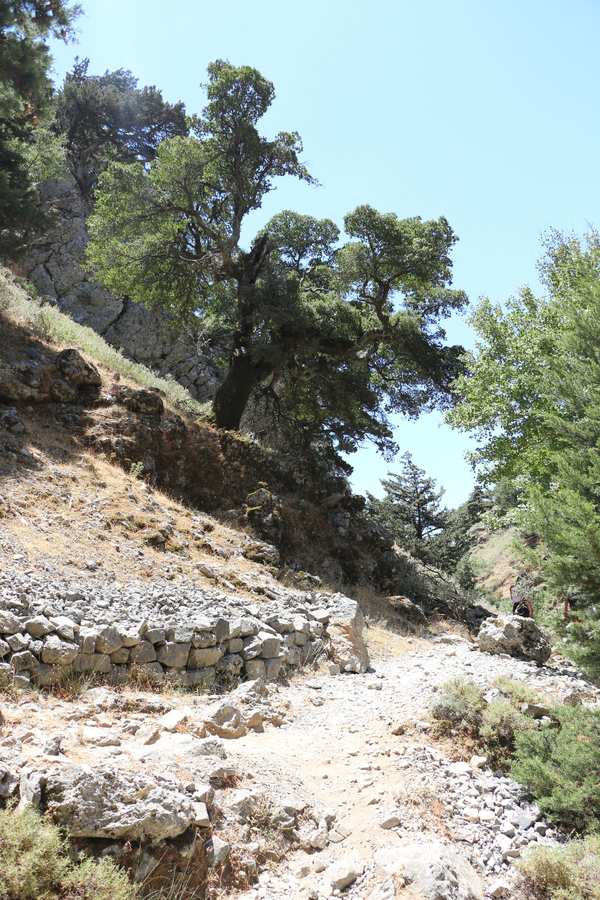
The Agia Irini Gorge cuts a green, shaded path through the mountains of south-west Crete, offering walkers a genuine canyon experience without the summer crowds. This seven-kilometre trail descends from the highland village of Agia Irini to the coast near Sougia, winding between high rock walls beneath pine and plane trees. Springs bubble along the streambed, rest benches punctuate the route, and a welcoming taverna waits at the lower gate. The gorge remains open most of the year and attracts walkers seeking wild beauty on a human scale. Plan your walk with My Greece Tours.
Agia Irini belongs to the Selino district, a remote corner of Crete where mountain ridges plunge toward the Libyan Sea. The trail drops steadily through mixed woodland, passing stone walls and old terraces that hint at centuries of pastoral life. Rare plants cling to the canyon walls, and birdsong echoes between the cliffs. The sections below cover the walk itself, practical details, the natural environment, and how Agia Irini compares to other gorges. Consult our Crete travel guide for broader island context and connections to nearby coastal villages and mountain trails.
What makes Agia Irini Gorge special among Crete’s canyon walks?
Agia Irini offers a full gorge experience with towering rock walls, dense shade, and rushing water, yet remains far quieter than Samaria. The trail suits confident walkers without demanding extreme fitness or battling crowds.
The gorge stretches seven kilometres from the mountain village of Agia Irini down to the coastal plain near Sougia, dropping through elevation zones that shift from highland pine forest to lowland plane groves. High limestone walls rise on both sides, narrowing in places to create dramatic passages where sunlight filters through the canopy. The path follows the streambed, crossing the water on stepping stones and small bridges, and the sound of running water accompanies walkers throughout. Stone rest benches appear at intervals, and wooden signposts mark the way. The trail surface varies from smooth dirt to rocky sections, but the route remains clear and well maintained. Wildflowers bloom in spring, and the air stays cool even in summer.
This combination of natural drama and manageable difficulty makes Agia Irini one of the most rewarding things to do in Crete for active travellers.
The gorge closes only after heavy winter rain, giving it a longer season than Samaria and other major canyons. Walkers encounter far fewer people, often sharing the trail with just a handful of others even in peak months. The taverna at the lower gate serves cold drinks, simple meals, and homemade sweets, providing a perfect finish to the descent. From there, a short walk leads to the village of Sougia, where a pebble beach and clear water invite a swim. Buses connect Sougia to Chania, and small ferries link the coast to other south-shore settlements.
The entire experience feels unhurried and authentic, a window into the wilder side of Crete without the logistical complexity or summer crush of the island’s most famous gorge.
How does Agia Irini compare to the Samaria Gorge in Crete?
Agia Irini is shorter, easier, and far less crowded than Samaria, yet delivers the same sense of wild mountain landscape. It suits walkers who want canyon scenery without the physical challenge or summer queues.
The Samaria Gorge runs sixteen kilometres and drops more than a thousand metres, demanding stamina and early starts to secure a place among thousands of daily visitors. Agia Irini covers seven kilometres with a gentler gradient, taking three to four hours at a relaxed pace. Both gorges share the same geological character—towering limestone cliffs, seasonal streams, and dense vegetation—but Agia Irini allows walkers to enjoy the scenery without the pressure of keeping pace with a crowd. The narrowest section of Samaria, the famous Iron Gates, draws photographers and bottlenecks; Agia Irini has its own tight passages but without the human traffic.
Both trails end near the coast, but Agia Irini finishes at the quieter village of Sougia rather than the busier Agia Roumeli.
Agia Irini stays open most of the year, while Samaria closes from late autumn through spring to protect the trail and wildlife. This extended season makes Agia Irini a practical choice for walkers visiting Crete outside the summer peak. The entrance fee is lower, facilities are simpler, and the overall experience feels more intimate. Walkers who complete Samaria often describe it as a bucket-list achievement; those who walk Agia Irini speak of discovery and solitude. Both gorges reward effort with natural beauty, but Agia Irini suits travellers who value quiet over spectacle and prefer a genuine encounter with the landscape to a ticked box on a crowded itinerary.
The choice depends on fitness, timing, and temperament rather than one being objectively better.
What practical details do walkers need for Agia Irini Gorge?
The walk starts at the village of Agia Irini and ends near Sougia. Buses run from Chania to both points. Walkers need sturdy shoes, water, sun protection, and a small entrance fee at the trailhead.
The trailhead lies in the mountain village of Agia Irini, reached by bus from Chania via the inland route to Sougia. Buses depart in the morning, allowing walkers to start the descent by mid-morning and finish in the early afternoon. The entrance gate collects a modest fee, and a small booth provides basic information. The path descends steadily, so walkers should wear shoes with good grip and ankle support; trail runners or light hiking boots work well. The gorge offers shade for most of the route, but sun hats and sunscreen remain essential for the open sections at the start and finish. Carry at least a litre of water per person, though springs along the way allow refills.
The trail has no shops or facilities until the taverna at the lower gate.
The walk ends at the lower gate, where the taverna offers refreshment and a chance to rest before the final kilometre to Sougia. The village has tavernas, a small supermarket, and rooms for those who wish to stay overnight. Afternoon buses return to Chania, and small ferries connect Sougia to Paleochora and other coastal points. Walkers should check bus and ferry timetables in advance, especially outside high summer. The gorge closes after heavy rain, so confirm conditions with local tourist offices or accommodation providers before setting out. Mobile phone coverage is patchy inside the canyon but reliable at both ends.
The entire route is well marked, and walkers of moderate fitness complete it comfortably, making Agia Irini an accessible introduction to hiking in Crete.
What wildlife and plants live in Agia Irini Gorge?
The gorge shelters rare Cretan plants, including endemic herbs and wildflowers. Birds such as griffon vultures and choughs nest on the cliffs, and the stream supports frogs, insects, and moisture-loving vegetation throughout the year.
The canyon’s microclimate creates pockets of high humidity and shade, allowing plants that struggle elsewhere on Crete to thrive. Plane trees line the streambed, their broad leaves forming a canopy that keeps the air cool. Pines cling to the upper slopes, and wild herbs—oregano, thyme, sage—scent the air in spring and early summer. Rock crevices host rare endemics, small flowering plants found nowhere else, and ferns sprout from damp ledges. The stream itself supports a web of life: frogs call from pools, dragonflies patrol the water, and small fish dart in the shallows. Birdwatchers scan the cliffs for griffon vultures, which nest on high ledges and soar on thermals above the gorge.
Choughs, black birds with red legs and curved beaks, forage along the trail and call to each other with sharp cries.
The gorge acts as a green corridor, linking highland and lowland habitats and allowing species to move between elevation zones. This connectivity makes Agia Irini important for biodiversity, even though it lacks the formal protection status of larger reserves. Walkers who move quietly and pause to observe often spot lizards basking on rocks, butterflies feeding on wildflowers, and birds flitting through the trees. The best time for wildlife watching is early morning or late afternoon, when animals are most active and the light slants low through the canyon. Spring brings the peak of flowering and bird activity, while autumn offers cooler temperatures and the rustle of falling leaves.
The gorge’s ecological richness adds depth to the walk, transforming it from a simple hike into one of the true hidden gems in Crete.
How should walkers plan a day around Agia Irini Gorge?
Take an early bus from Chania to Agia Irini village, walk the gorge in three to four hours, swim at Sougia beach, then catch an afternoon bus back. The rhythm suits a full but relaxed day.
The morning bus from Chania departs early enough to reach Agia Irini village by mid-morning, giving walkers the coolest hours for the descent. The trail takes three to four hours at a comfortable pace, with time for rest stops, photographs, and observation of plants and birds. Walkers emerge at the lower gate around midday or early afternoon, depending on start time and pace. The taverna there serves lunch—grilled meat, salads, local cheese—and cold beer or soft drinks. A short walk leads to Sougia, where the pebble beach and clear water provide the perfect reward for the morning’s effort. Swimmers can rinse off the dust and cool down before catching the afternoon bus back to Chania.
The bus journey takes about two hours, arriving in time for dinner.
Walkers who prefer a slower pace can overnight in Sougia, enjoying the village’s quiet atmosphere and waterfront tavernas. This option allows an early start from Chania, a leisurely walk, an afternoon swim, and a relaxed evening by the sea. The next morning, the return bus or a ferry to another coastal village continues the journey. Sougia has simple accommodation, from rooms to small hotels, and the village remains low-key even in summer. The combination of mountain and sea, exertion and rest, makes the Agia Irini walk a satisfying day or overnight trip.
Walkers leave with a sense of having touched something essential about Crete: the island’s vertical landscape, its hidden green places, and the enduring rhythm of trail, taverna, and tide.
Frequently Asked Questions
Can beginners walk Agia Irini Gorge?
Walkers with moderate fitness and no serious knee or ankle problems can complete Agia Irini comfortably. The trail descends steadily rather than dropping in steep steps, and the surface is mostly packed earth with some rocky sections that require attention but not technical skill. The route is well marked, with wooden signs and occasional paint blazes, so navigation is straightforward. Rest benches appear at intervals, allowing walkers to pause and catch their breath. The main challenge is the cumulative descent, which can tire the legs and strain the knees, so trekking poles help. The walk takes three to four hours, a manageable duration for anyone who walks regularly.
Families with older children often complete the trail, though very young children may struggle with the distance and uneven footing. The key is to start early, walk at a relaxed pace, and carry enough water and snacks to maintain energy. The taverna at the lower gate provides a welcome finish, and the knowledge that Sougia and a swim lie just ahead motivates tired legs for the final stretch.
What is the best time of year to walk Agia Irini Gorge?
Spring, from April through early June, offers the best conditions: wildflowers bloom, the stream runs full, temperatures stay comfortable, and the gorge feels lush and green. Autumn, from late September through November, provides cooler air, fewer visitors, and golden light, though the stream may run low after a dry summer. Summer remains possible but demands an early start to avoid midday heat, and the gorge can feel less dramatic when the water dwindles. Winter walking is feasible in dry spells, but the gorge closes after heavy rain when the stream swells and the trail becomes unsafe. Spring and autumn also coincide with better bus connections and open tavernas along the coast.
Bird activity peaks in spring, when migrants pass through and residents nest, and plant diversity is highest. Autumn offers the advantage of warm sea temperatures for post-hike swimming at Sougia. Walkers should check local conditions before setting out, especially outside high summer, and confirm that the gorge is open and buses are running to avoid disappointment.
How does Agia Irini fit into a broader Crete itinerary?
Agia Irini works well as a day trip from Chania or as part of a south-coast exploration that includes Sougia, Paleochora, and other villages. Walkers based in Chania can take the morning bus, complete the gorge, swim at Sougia, and return in the evening, fitting the experience into a single day without changing accommodation. Those touring the south coast can walk the gorge en route from Chania to Sougia, then continue by bus or ferry to Paleochora or Loutro, linking mountain and sea in a continuous journey. The gorge pairs naturally with other walking routes, such as the coastal path from Sougia to Lissos or the shorter trails around Paleochora, creating a hiking-focused itinerary.
It also complements cultural visits to Chania’s old town, Venetian harbour, and archaeological sites, offering a balance of history, landscape, and physical activity. Walkers who complete Samaria earlier in their trip often appreciate Agia Irini as a quieter counterpoint, while those who find Samaria too demanding discover that Agia Irini delivers canyon drama without the crowds or extreme effort.