
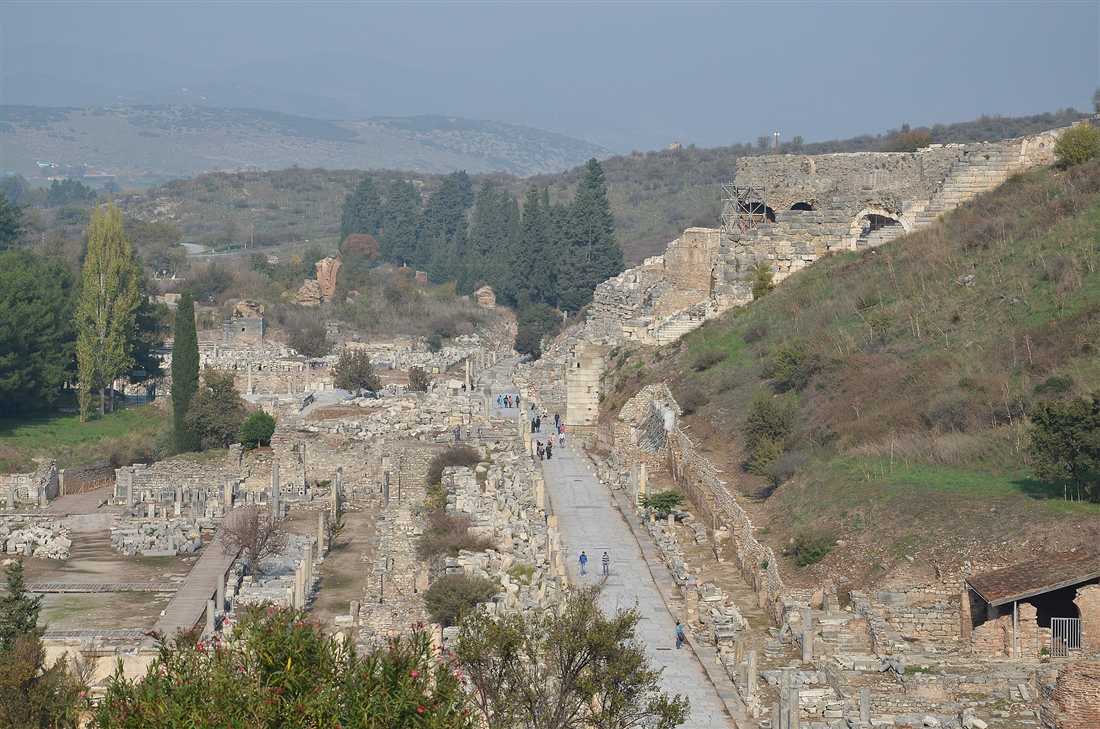
Marble Street in Ephesus is the paved marble avenue that runs from the Library of Celsus and the Gate of Hadrian north to the Great Theatre, a Roman-rebuilt stretch of the processional Sacred Way through the heart of Ephesus. Plan the whole trip with Greece Tours.
This guide covers Marble Street in full: what it is and where it runs, why it carries the name, the famous footprint carving pointing to the brothel, the cart ruts and the raised colonnaded walkway, what the street was used for, and what is left to see on the road today between the Library of Celsus and the Great Theatre.
What is Marble Street in Ephesus?
Marble Street is the paved marble avenue that runs through the heart of Ephesus, linking the Library of Celsus in the south to the Great Theatre in the north as part of the city’s Sacred Way.
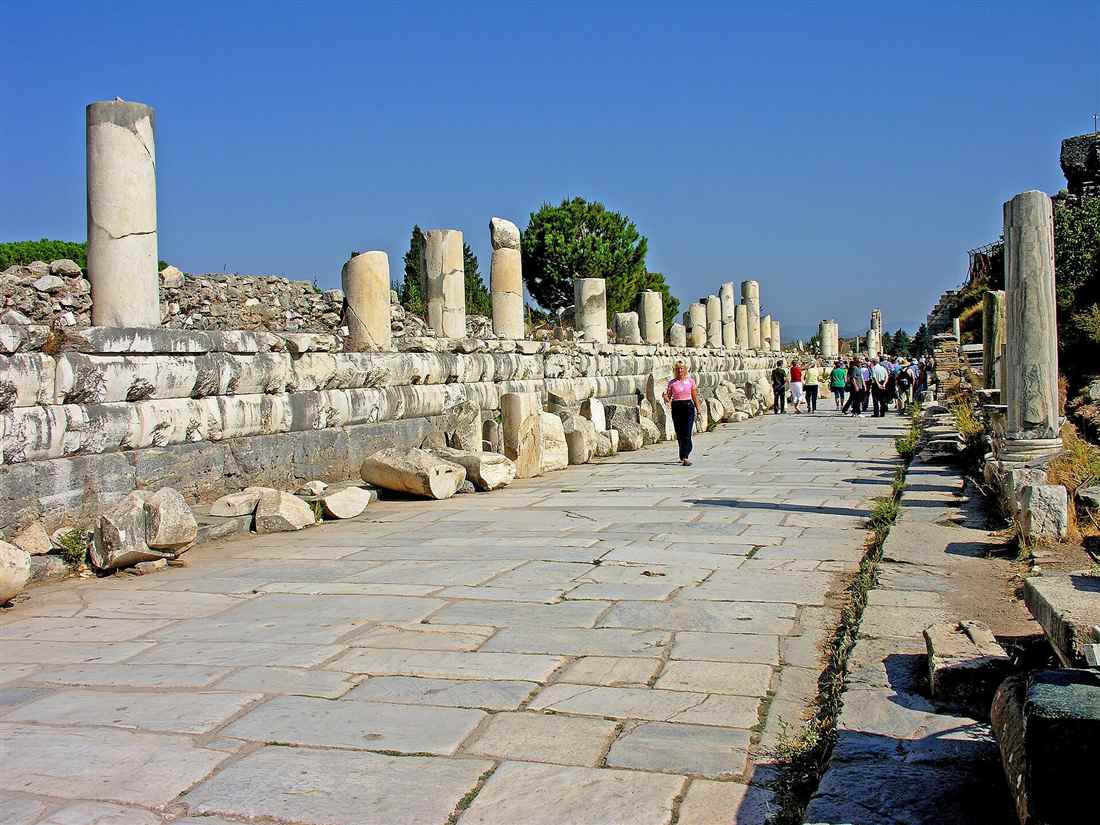
The street forms one of the two great processional axes of the Roman city. Its full name in the archaeology of the site is the Marble Road, and it carries the ceremonial route that priests, magistrates and crowds walked between the civic monuments of the lower city. The avenue is laid entirely in white marble slabs, which gives the street both its name and its polished, reflective surface.
Marble Street belongs to the same processional network as Curetes Street and Harbour Street, the three arteries that structure the excavated centre. It marks the transition from the monumental civic quarter around the Library and the Commercial Agora to the entertainment quarter dominated by the theatre. Walkers on the modern site tread the identical marble the Romans laid, worn smooth by two thousand years of feet, hooves and cart wheels.
Where does Marble Street run on the Ephesus site?
Marble Street runs north–south for roughly four hundred metres, beginning at the Gate of Hadrian beside the Library of Celsus and ending at the square in front of the Great Theatre, with the Commercial Agora bordering its western side along the whole length.
The southern end opens at the triple-arched Gate of Hadrian, the monumental entrance that connects Marble Street to Curetes Street and the Library forecourt. From there the road climbs gently and straight along the eastern wall of the Commercial Agora, the vast square market enclosure that supplied the harbour trade. The western colonnade of the street doubled as the outer façade of that agora.
At its northern terminus Marble Street reaches the theatre square, the open plaza where it meets Harbour Street, the colonnaded avenue that led west toward the ancient port. This junction placed the traveller at the foot of the Great Theatre’s towering cavea. To trace the exact line of the street between these monuments, consult the Ephesus map, which plots each landmark along the route.
Why is it called Marble Street?
The street earns its name from the large rectangular marble slabs that pave its entire surface, a Roman rebuild that replaced the earlier road and raised a colonnaded marble walkway along its edge to carry pedestrians above the traffic.
The paving slabs are cut from local marble quarried in the hills around the city, fitted tight to form a hard-wearing carriageway wide enough for wheeled vehicles. The Roman engineers set the road on a raised bed and flanked it with stepped kerbs, marble column bases and a covered gallery. The result presented a gleaming avenue that announced the wealth of the metropolis to every visitor arriving from the harbour.
The rebuild in white marble dates to the Roman imperial rebuilding of the city under the emperors, when Ephesus served as the capital of the province of Asia. The choice of marble over the standard basalt or limestone of ordinary Roman roads marks Marble Street as a showpiece thoroughfare rather than a utilitarian one, the polished spine of a city of a quarter of a million people.
What is the footprint carving on Marble Street?
The footprint carving is a set of shapes cut into a paving slab on Marble Street — the outline of a left foot, a woman’s head, a heart and a rectangle read as a purse — interpreted as an advertisement pointing the way to the brothel of Ephesus.
The carving sits on the western side of the road, near the northern stretch of the street. The foot points in the direction a walker turns to reach the brothel, which stood at the corner of Marble Street and Curetes Street near the Baths of Scholastica. The accompanying head depicts a woman, the heart signals the trade on offer, and the rectangle carries the fee.
The mark is one of the most photographed features of the whole city, a rare survival of ancient street advertising cut straight into the public pavement. It draws crowds who bend to trace the foot with a fingertip. The carving fixes the human, commercial texture of the Roman street onto the same marble that carried religious processions, a reminder that the avenue served the whole life of the port.
What are the cart ruts and the covered walkway?
Deep parallel grooves worn into the marble slabs record the passage of wheeled carts along the carriageway, while a raised colonnaded gallery ran beside the road, its roof carried on marble columns and its floor set with mosaic to shelter pedestrians from sun and wheels.
The ruts cut into the paving prove the intensity of the traffic that crossed the street between the harbour warehouses and the agora. Loaded ox-carts pressed the same wheel lines into the marble day after day until the stone yielded twin channels. These grooves remain sharply visible along the surface and give a direct measure of the volume of goods moving through the commercial heart of the city.
Alongside the open carriageway the Roman builders raised a covered footway on the western edge, one step above the road. Marble columns lined the walkway and supported a tiled roof, and patches of the mosaic paving that carpeted this gallery survive between the column bases. The arrangement separated foot traffic from carts, a deliberate piece of civic planning that placed the pedestrian in shade and safety above the working roadway.
What was Marble Street used for?
Marble Street served as the main north–south thoroughfare of lower Ephesus and as a processional route, carrying trade, crowds and religious ceremony between the Great Theatre, the Commercial Agora and the Library of Celsus.
As a working street it channelled the flow of goods unloaded at the harbour into the market square that lined its western side. Carts, porters and merchants used the marble carriageway to reach the agora, and shoppers filled the sheltered gallery. The wheel ruts and the density of shops confirm the street as a live artery of the port economy.
As a processional way the avenue formed a link in the Sacred Way, the ceremonial circuit that priests and citizens followed on festival days. Processions passed from the theatre square down the marble carriageway to the Library forecourt and the Gate of Hadrian, binding the entertainment, civic and commercial quarters into a single ritual and social spine that every arriving traveller walked.
What is there to see on Marble Street today?
Today the street presents its original marble paving, the deep cart ruts, the famous footprint advertisement, the marble column bases of the covered gallery and, at the northern end, the sweep of the Great Theatre rising above the road.
Visitors walk the same polished slabs the Romans laid, tracing the wheel grooves underfoot and pausing at the footprint carving on the western verge. The stepped kerbs, column bases and surviving mosaic fragments outline where the roofed pedestrian gallery once stood. The eastern wall of the Commercial Agora frames the walk along its full length.
At the head of the street the Great Theatre fills the view, its stacked tiers cut into the slope of Mount Pion and its stage building facing the square where Marble Street meets Harbour Street. The combination of the intact carriageway, the ancient graffiti and the monumental backdrop makes the walk one of the defining experiences of the whole archaeological site.
How does Marble Street fit an Ephesus walk?
Marble Street forms the central hinge of the standard route through Ephesus, joining the Library of Celsus at its southern end to the Great Theatre and Harbour Street at its northern end, so most visitors cross it midway through the descent from the upper gate.
A walk that starts at the Magnesian Gate descends Curetes Street past the terraced houses and fountains to the Library of Celsus. From the Library forecourt the visitor passes through the Gate of Hadrian and turns onto Marble Street, following the marble carriageway north past the agora and the footprint carving to the theatre square.
At the northern terminus the route reaches the Great Theatre and turns west along Harbour Street toward the ancient port and the modern exit. Planning the sequence in advance keeps the descent one-directional and downhill, and the Ephesus map sets Marble Street in its exact place between the Library of Celsus, the agora and the theatre.
Frequently Asked Questions
What is Marble Street in Ephesus?
Marble Street is the paved marble avenue from the Library of Celsus to the Great Theatre in Ephesus, part of the processional Sacred Way. A raised colonnaded walkway ran along its east side, and cart ruts scar its slabs.
What is the footprint on Marble Street?
A carving in the paving of Marble Street shows a left foot, a woman’s head and a heart-shaped purse, read as a sign pointing across to the brothel opposite the Library of Celsus.
Where is Marble Street on the Ephesus map?
Marble Street runs north from the Library of Celsus and the Gate of Hadrian, past the Commercial Agora, to the foot of the Great Theatre, where it meets Harbour Street toward the old harbour.