
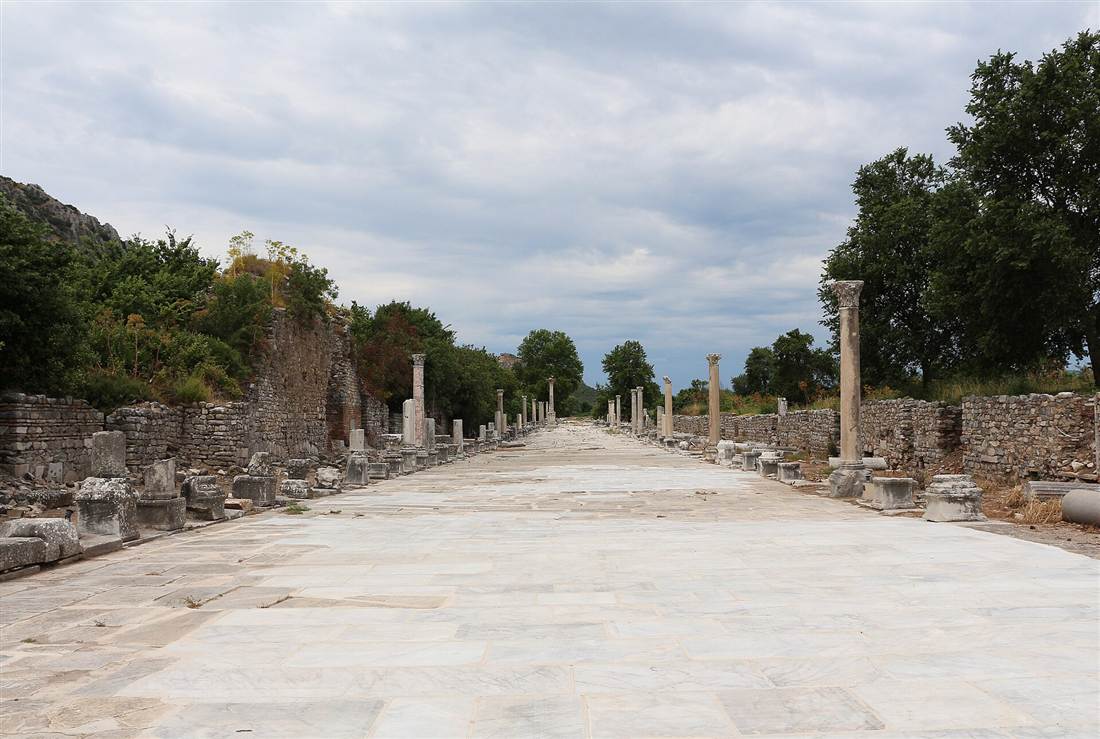
The Arcadian Way of Ephesus, also called the Arcadiane or Harbour Street, is the grand colonnaded avenue that ran about 500 metres from the Great Theatre to the ancient harbour of Ephesus, rebuilt in late Roman splendour and lit by lamps at night. Plan the whole trip with Greece Tours.
This guide covers the Arcadian Way in full: what it is and where it runs, who rebuilt and named it, its size and grandeur, the record of its street lighting, the Four Evangelists columns, the grand approach from the sea, the silting of the harbour, and what is left to see on the avenue below the Great Theatre today.
What is the Arcadian Way in Ephesus?
The Arcadian Way is the grand colonnaded avenue of Ephesus that runs from the foot of the Great Theatre west to the ancient harbour. Ancient sources call it the Arcadiane, and modern guides label it Harbour Street, the ceremonial spine of the port city.
The avenue formed the first and last impression of Ephesus for every traveller who reached the city by ship. A visitor stepped off the quay, entered a monumental gate, and looked straight down a marble-paved corridor toward the vast bowl of the theatre carved into Mount Panayir. Marble colonnades framed the roadway on both sides, and roofed porticoes sheltered pedestrians from sun and rain. Shops lined the porticoes behind the columns, turning the street into a commercial artery as well as a processional route.
The Arcadian Way anchored the western edge of the ancient city plan. It joined the network of paved thoroughfares that threaded through Ephesus, connecting the harbour district to the entertainment quarter and, beyond, to the civic and commercial heart around the Library of Celsus. The street embodied the wealth of a metropolis that served as the chief port of the Roman province of Asia and the seat of its proconsul.
The avenue took its shape from the classic colonnaded-street plan of the Roman east, a paved central roadway flanked by symmetrical porticoes. Statue bases, honorific inscriptions, and fountains punctuated the route at intervals. The design served three functions at once: a processional axis for ceremony, a commercial arcade for trade, and a sheltered promenade for daily life. Ephesians used the Arcadian Way as the stage on which the port city presented itself to the wider Mediterranean world, from the emperors of Constantinople to the sailors of Alexandria and Rome.
Where does the Arcadian Way run?
The Arcadian Way runs east to west across the harbour quarter of Ephesus. Its eastern end meets the foot of the Great Theatre, and its western end reaches the site of the ancient harbour, a straight paved course of about 500 metres.
At the eastern terminus, the avenue opens onto the wide plaza below the Great Theatre of Ephesus, the largest theatre of the ancient world with seating for twenty-five thousand spectators. Crowds spilling out of performances flowed directly onto the street and toward the docks. At the western terminus stood the harbour gate, the threshold between the city and the sea, beyond which merchant vessels and passenger ships moored at stone quays.
The straight alignment gave the street a clear sightline the whole way. A person standing at the harbour gate looked east and saw the theatre framed at the end of the colonnade; a person leaving the theatre looked west and saw the masts of ships. The route ran level across reclaimed ground at the mouth of the Cayster valley. The Ephesus map plots this axis at the far western reach of the excavated city, where the paved surface now ends at a flat green plain.
Who built and named the Arcadian Way?
The Arcadian Way carries the name of the emperor Arcadius, who ruled the eastern Roman world at the turn of the fifth century. A comprehensive rebuild of the harbour avenue in his reign gave the street its late Roman splendour and its enduring title, the Arcadiane.
Arcadius reigned as the first emperor of the eastern half after the empire divided, governing from Constantinople. The reconstruction under his administration replaced and enriched an earlier harbour road that dated to the high Roman city. Builders relaid the roadway in marble, renewed the flanking colonnades, and set up new porticoes and shops. The scale of the work marked Ephesus as a favoured city of the eastern court and a showcase of imperial patronage on the Aegean coast.
The naming followed a long custom of tying a great public monument to the ruler who financed it. Ephesians engraved and remembered the Arcadiane as the emperor’s street, a permanent link between the port and the throne. The rebuild stands among the last great construction campaigns of the ancient city, undertaken as classical urban life entered its final centuries and Christian Ephesus rose around the older pagan monuments.
How big and grand was the Arcadian Way?
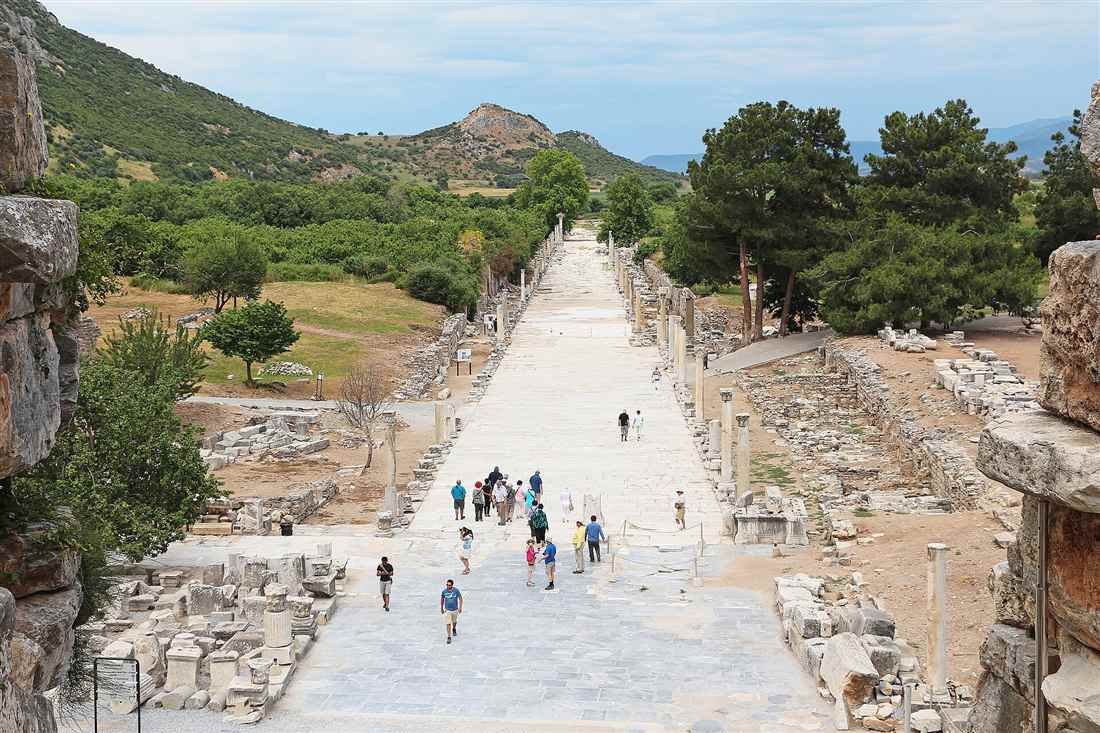
The Arcadian Way stretched about 500 metres in length and about 11 metres in width. Marble slabs paved the central roadway, colonnades of tall columns rose on both flanks, and rows of shops stood behind the porticoes, making it the widest and most richly finished street of Ephesus.
The 11-metre carriageway carried wheeled traffic and processions down its marble surface, while the roofed porticoes on either side added further width for pedestrians. The columns supported entablatures and tiled roofs that shaded the walkways along the entire half-kilometre run. Behind the colonnades, a continuous line of shopfronts opened onto the street, where merchants sold goods to arriving travellers and to citizens strolling toward the theatre.
The materials announced the ambition of the project. Marble paving, marble columns, and carved capitals reflected the light off a surface polished by traffic. Drainage channels ran beneath the slabs to carry rainwater away from the level ground. The dimensions place the Arcadian Way among the grandest colonnaded avenues of the eastern Mediterranean, a rival to the great streets of Antioch and Palmyra and a fitting front door for a city of a quarter of a million residents.
The proportions gave the street its theatrical effect. The 11-metre width held a straight, uninterrupted line of sight across the full 500 metres, and the flanking columns marched in even ranks toward the distant theatre. Repeated bays of columns, each carrying its stretch of roof and shopfront, built a rhythm that drew the eye down the avenue. The engineering matched the display: a graded surface, sealed joints, and covered drains kept the marble dry and the traffic moving through the wet Aegean winters.
Was the Arcadian Way lit at night?
The Arcadian Way carried street lighting, a rarity in the ancient world. An inscription records lamps set along the colonnade, ranking Ephesus with Antioch and Rome as one of the few cities to illuminate a public street after dark.
The lamps hung between the columns of the porticoes, casting light across the marble roadway through the night hours. Oil-fed fixtures lined the route from the harbour gate to the theatre plaza, so a traveller arriving by ship after sunset walked a lit corridor into the city rather than groping through darkness. The expense of fuel and attendants made such lighting a mark of extraordinary civic wealth and a source of local pride.
The record of illumination reinforces the ceremonial function of the avenue. A lit harbour street welcomed dignitaries, merchants, and pilgrims at any hour, and it signalled the security and prosperity of the port to every crew that dropped anchor. Contemporary writers named the small circle of ancient cities that maintained night lighting, and Ephesus stood in that company on the strength of the Arcadian Way.
The lighting demanded a permanent municipal effort. Attendants filled and trimmed the lamps, replenished the oil, and tended the flames through the dark hours, a service funded from civic revenue and private benefaction. The inscription that records the arrangement fixes the memory of a street that shone from the harbour to the theatre. In an age when most cities went black at dusk, the glowing colonnade of Ephesus advertised the reach of its trade and the confidence of its magistrates to every mariner who watched the coast from the deck of an incoming ship.
What were the Four Evangelists columns?
The Four Evangelists columns are four tall marble columns raised in the middle of the Arcadian Way during the Byzantine period. Each column bore a statue of one of the four evangelists, Matthew, Mark, Luke, and John, marking the Christianisation of the ancient avenue.
The four columns stood together in a group along the central stretch of the street, set on high bases and topped with capitals that supported the standing figures. Their placement in a row transformed the pagan-built colonnade into a Christian monument, projecting the faith of the later city onto its principal thoroughfare. The four evangelists, authors of the gospels, formed a fixed set in Byzantine art, and their statues turned the harbour road into a declaration of belief for arriving Christians and pilgrims bound for the shrines of Ephesus.
The monument dates to the Christian centuries of the city, when Ephesus held rank as a great see of the eastern Church and a destination for pilgrimage. The bases of the four columns survive on the avenue, and the group records how a Roman port street entered a second life under a new religion. The evangelist columns stand as one of the defining features that set the Arcadian Way apart from the older streets of the upper city.
The raising of Christian statues on an imperial Roman avenue captures a turning point in the life of Ephesus. The city that once centred its identity on the Temple of Artemis reoriented itself around the Church, hosting a great ecumenical council within its walls and drawing pilgrims to the tomb of Saint John and the House of the Virgin on the hills above. The four evangelists on the harbour street greeted these pilgrims at the water’s edge, the first monument they met on stepping ashore and a sign that they had reached a Christian holy city.
What did visitors see arriving by sea?
A visitor arriving by sea disembarked at the harbour quay, passed through a monumental gate, and faced the full length of the Arcadian Way rising toward the Great Theatre. The colonnades, shops, and the theatre bowl at the far end delivered a staged, theatrical welcome to the metropolis.
The harbour gate framed the entry point, a triple-arched structure that separated the working docks from the marble avenue. Once through the gate, the traveller looked along a straight corridor of columns half a kilometre long, with the tiered seats of the theatre climbing the hillside at the vanishing point. Shopfronts and porticoes lined the route, and by night the hanging lamps turned the whole approach into a lit processional.
The arrangement was a deliberate exercise in civic display. Ephesus greeted ambassadors, traders, and pilgrims with a sightline engineered to impress, funnelling them from ship to city along an axis that showcased the wealth and order of the port. The grand approach set the tone for a visit that continued up Marble Street toward the Library of Celsus and the civic centre. The sequence of harbour, gate, colonnade, and theatre made the first steps ashore a demonstration of imperial power.
What happened to the harbour and the street?
The harbour silted up as the Cayster river deposited sediment across the bay, and the coastline retreated west by kilometres. The docks turned to marsh, the port that fed the Arcadian Way died, and the avenue lost its purpose as ships anchored ever farther away.
The Cayster carried silt down from the hinterland and dropped it where the river met the sea, filling the harbour basin year after year. Ephesian engineers dredged the channel and built moles to hold back the mud, but the river won. The waterline that once lapped the western gate withdrew until open water lay far beyond reach of the quays. A city built on maritime trade found itself stranded on a plain.
The retreat of the sea drained the wealth that had sustained the harbour quarter. Trade shifted, the population contracted, and the marble avenue that had welcomed the ships of the empire emptied of traffic. The decline of the port drove the decline of the whole city, and the Arcadian Way stood as a monument to a harbour that no longer existed. Today the ruins of Ephesus lie kilometres inland from the modern shore, a measure of how far the coast moved.
The silting reshaped the entire history of the region. Ephesus stood as one in a line of Cayster harbours that the river killed in turn, each port abandoned as the delta pushed the coastline seaward. The residents drifted to higher ground and, in the end, to the hill of Ayasuluk to the north, the site that grew into the town of Selçuk. The Arcadian Way, once the busiest quarter of the metropolis, became the emptiest, its marble stranded far from any water and its harbour gate opening onto fields.
What is there to see on the Arcadian Way today?
Visitors walk the paved marble avenue, trace the column bases and the stumps of the colonnades, and view the Great Theatre rising at the eastern end. The western end fades into a flat, marshy green plain where the ancient harbour once opened to the sea.
The excavated roadway runs clear and level, its marble slabs worn smooth and its drainage channels visible beneath. Rows of column bases mark where the porticoes stood, and the foundations of the Four Evangelists columns survive along the central stretch. Fallen column drums and fragments of entablature lie beside the paving, and the outlines of the flanking shops read on the ground behind the colonnade line.
The contrast between the two ends of the street defines the experience. At the east, the vast theatre fills the hillside and crowds gather at the top of the avenue. At the west, the marble surface stops at the edge of a green flood plain, silent and empty, where reeds and grass now cover the vanished docks. The walk down the Arcadian Way toward that quiet plain traces the exact path that sea-borne travellers took into ancient Ephesus.
The site rewards a slow pass along the paving. The worn grooves of ancient cart wheels show in the marble, the manhole covers of the drainage system sit flush in the surface, and the tumbled column drums record the scale of the vanished colonnade. Wildflowers grow between the stones in spring, and the plain to the west stretches flat toward the distant modern coast. Standing at the harbour end, a visitor faces the theatre framed at the head of the avenue and reads, in one view, the full arc of the street from imperial splendour to silent ruin.
How does the Arcadian Way fit an Ephesus visit?
The Arcadian Way sits at the western end of the main walking route through Ephesus, meeting the foot of the Great Theatre where Marble Street ends. It leads visitors down toward the Lower Gate, forming the last stretch of a walk that begins at the upper city.
Most tours enter through the Upper Gate near the state agora and descend past the Odeon, the Temple of Hadrian, and the terraced houses to the Library of Celsus. From the library the route turns north along Marble Street, which runs beneath the seats of the Great Theatre. Marble Street ends at the theatre plaza, and the Arcadian Way opens straight ahead to the west, carrying the walk down to the harbour district and the Lower Gate exit.
Walking the avenue as the final leg follows the ancient sequence in reverse, ending at the point where sea travellers once began. A visitor who plots the route on the Ephesus map sees the Arcadian Way as the western spine that closes the circuit, linking the theatre to the vanished port. The street rewards the walk to its far end, where the marble stops at the green plain and the shape of the lost harbour reveals itself.
Frequently Asked Questions
What is the Arcadian Way in Ephesus?
The Arcadian Way is the grand colonnaded avenue from the Great Theatre to the harbour of Ephesus, about 500 metres long and 11 metres wide. Rebuilt under the emperor Arcadius, it carried marble paving and lamps at night.
Was the Arcadian Way lit at night?
The Arcadian Way was lit by lamps along its colonnades, one of the few street-lit avenues of the ancient world. The lighting marked the grand approach from the harbour to the theatre and the city.
What are the Four Evangelists columns?
Four tall columns rose in the middle of the Arcadian Way in the Byzantine period, bearing statues of the four evangelists, Matthew, Mark, Luke and John. Their bases stand along the avenue today.