
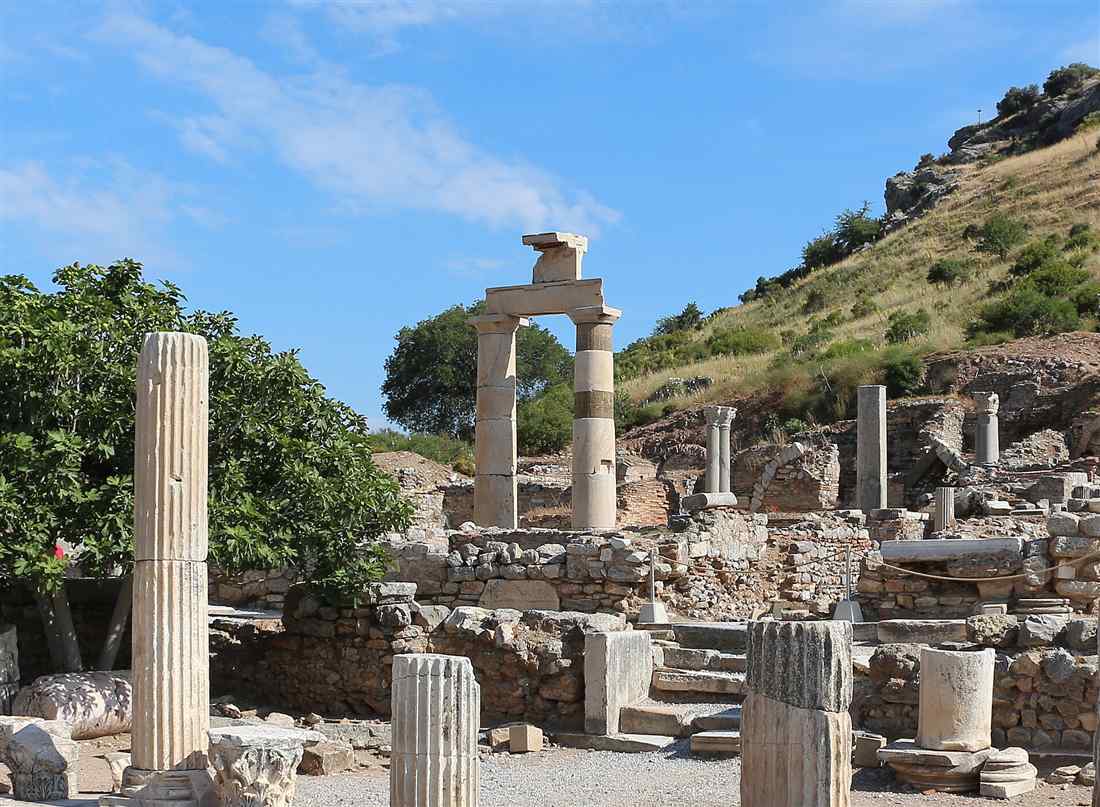
The Prytaneion of Ephesus was the town hall of the upper city, the civic hearth where the eternal flame of Hestia Boulaia burned, tended by the Curetes priests. It stood on the State Agora of Ephesus and yielded the famous Artemis statues. Plan the whole trip with Greece Tours.
This guide covers the Prytaneion of Ephesus in full: what the building was and where it stood, the sacred flame of Hestia Boulaia, the Curetes priests and their inscribed lists, the Beautiful Artemis and Great Artemis statues found here, what the hall looked like, what it was used for, and what is left to see beside the State Agora today.
What is the Prytaneion of Ephesus?
The Prytaneion of Ephesus is the town hall of the ancient city, the administrative and religious heart of the upper city where the chief magistrates governed, envoys dined, and the eternal sacred flame of the goddess Hestia Boulaia burned inside its hearth without pause.
The building served as the official seat of the prytaneis, the presiding officials who directed the civic life of Ephesus. Within its walls the city kept its most sacred possession: the perpetual fire that stood for the continuous existence of the community. The Prytaneion combined the functions of a government office, a state dining hall, and a shrine in one monumental complex.
Roman-era Ephesus rebuilt and enlarged the Prytaneion during the reign of Augustus, giving it the marble form whose columns rise on the site today. The structure fused Greek civic tradition with Roman imperial architecture, expressing the pride of a metropolis that ranked among the four greatest cities of the eastern Roman world alongside Rome, Alexandria and Antioch.
The name comes from the Greek word prytanis, the title of the senior official who presided over the council. Every self-governing Greek city built a prytaneion as the constitutional centre of its public life, and Ephesus raised one of the grandest examples. The building outranked ordinary offices because it held the flame that no rival institution shared.
Where is the Prytaneion on the Ephesus site?
The Prytaneion stands in the upper city on the north side of the State Agora, set between the Odeon and the Temple of Domitian. It anchors the civic quarter that opens the standard walk down through the ruins toward the Library of Celsus.
Visitors who enter through the Upper Gate reach the Prytaneion early on the route, directly after the State Agora and the Odeon of Ephesus. The complex sits at the administrative core of the city, grouped with the Basilica Stoa, the Temple of Domitian and the fountain houses that framed public affairs.
The position places the Prytaneion at the head of the sloping boulevard that becomes Curetes Street. A glance at the Ephesus map shows the town hall as the pivot between the formal civic square above and the residential and commercial districts that descend to the harbour below.
What was the sacred flame of Hestia Boulaia?
The sacred flame was the eternal fire of Hestia Boulaia, goddess of the civic hearth, kept burning inside the Prytaneion by the priestly college of the Curetes. The city forbade the flame to die, treating it as the living symbol of the survival of Ephesus itself.
Hestia Boulaia embodied the hearth of the council and the state. Her fire linked every citizen to a shared centre, and its endurance stood for the unbroken life of the community across generations. The priests fed and guarded the flame through ritual duty, and its extinction represented a public catastrophe.
Two statues of the goddess Artemis flanked the hearth, uniting the protector of Ephesus with the fire of the state. The cult of the eternal flame reached back to the Greek Prytaneion tradition, in which colonists carried fire from the mother-city hearth to kindle the hearth of each new foundation, binding the daughter city to its origin.
Who were the Curetes and the priests of the Prytaneion?
The Curetes were the college of priests attached to the Prytaneion who tended the sacred flame and performed the mystery rites of Artemis. Their names appear inscribed in ordered lists on the marble columns of the building, recording the men who held the office year by year.
In the founding myth the Curetes struck their shields and weapons to drown out the cries of the goddess Leto as she gave birth to Artemis and Apollo near Ephesus. The historic priesthood carried that mythic name into the Roman city, where the Curetes ranked among the honoured religious officers of the state.
The inscribed columns turn the Prytaneion into an archive in stone. Each list records the Curetes of a term together with subordinate temple servants, so the marble preserves the succession of the priesthood across the imperial centuries. The street that runs from the civic quarter down through the city takes its modern name, Curetes Street, from these very inscriptions.
What statues were found at the Prytaneion?
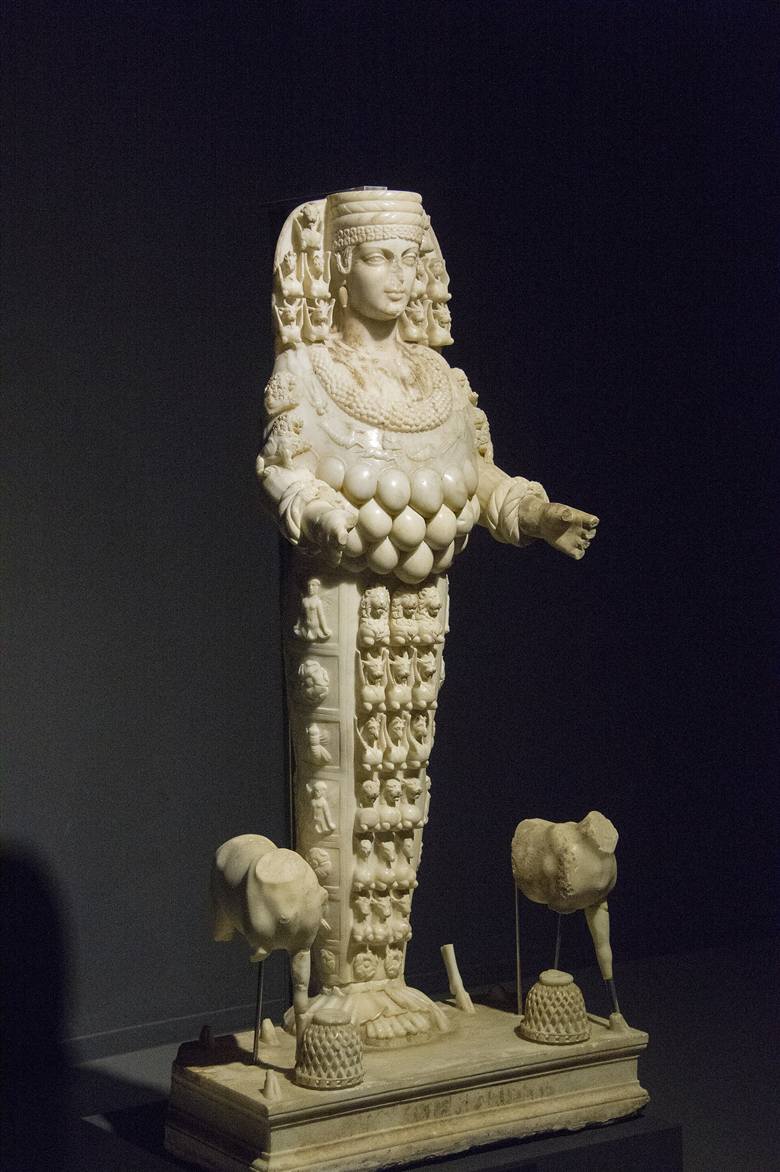
Excavation of the Prytaneion uncovered the two celebrated cult statues of the city goddess: the Beautiful Artemis and the Great Artemis. Both marble figures now stand as the central treasures of the Ephesus Archaeological Museum in Selçuk, each showing the goddess covered in her rows of emblems.
The two statues portray Artemis of Ephesus in her distinctive form, the body sheathed in tiers of relief and the chest laden with rounded protrusions read as symbols of fertility and abundance. Rows of animals, bees, sphinxes and rosettes ornament the garment, and a tall crown frames the head. The figures once flanked the sacred hearth inside the town hall.
Diggers found the statues buried within the Prytaneion, hidden when the cult of Artemis ended and the building fell out of religious use. That concealment preserved them from destruction, and today they draw visitors to the Ephesus Archaeological Museum. The wider cult centred on the Temple of Artemis, one of the Seven Wonders of the ancient world.
What did the Prytaneion look like?
The Prytaneion presented a colonnaded courtyard leading into the main hall that housed the sacred hearth and its altar. Doric columns carrying the inscribed Curetes lists lined the interior, and a section of these columns stands re-erected on the site, marking the shape of the vanished building.
A visitor passed from the open court through the entrance into the hall of the hearth, the ritual focus where the eternal flame burned before the statues of Artemis. The plan set religious space at the core and wrapped administrative and dining rooms around it, so worship and government shared a single roof.
The re-erected Doric columns give the ruin its recognisable profile today. Their surfaces still carry the priestly inscriptions, and the altar base and hearth foundations mark the sacred centre. The marble fabric belongs to the Augustan rebuilding, which raised the Prytaneion to a scale fitting the capital of the Roman province of Asia.
Builders of a later age reused blocks and columns from the town hall in other structures across the city, and archaeologists recovered these scattered pieces to reconstruct the standing colonnade. The excavated plan reveals the entrance porch, the paved courtyard and the deep hearth room, together with side chambers that housed the dining and administrative work of the magistrates.
What was the Prytaneion used for?
The Prytaneion functioned as the seat of civic government, the venue for official banquets and the reception hall for foreign envoys, all bound to the religious duty of guarding the eternal flame. It joined the practical work of ruling the city to the sacred maintenance of the hearth.
The prytaneis dined at public expense within the hall, and the city extended the honour of a meal at the civic hearth to ambassadors, victors and distinguished guests. These banquets carried diplomatic weight, expressing the hospitality and standing of Ephesus toward the wider Roman world.
Religious ceremony ran through every function. The magistrates opened proceedings before the flame of Hestia Boulaia, sacrifices marked the civic calendar, and the Curetes performed their rites within the same walls. The Prytaneion thus concentrated the sovereignty, the diplomacy and the state religion of Ephesus in one address.
What is there to see at the Prytaneion today?
The Prytaneion today shows the re-erected Doric columns with their Curetes inscriptions, the foundations of the sacred hall and altar, and its setting beside the State Agora in the upper city. The Beautiful Artemis and Great Artemis statues from the building fill a gallery of the Ephesus Museum.
On the archaeological site the standing columns mark the civic hall, and the surrounding stonework outlines the courtyard and the position of the hearth. The ruin sits among the monuments of the upper city, so the town hall reads together with the State Agora, the Basilica Stoa and the Temple of Domitian as a single governmental quarter.
The finest survivals travel a short distance to Selçuk. The two Artemis statues, together with reliefs and fittings recovered from the town hall, form a highlight of the museum collection. Pairing a walk through the ruined Prytaneion with a visit to the museum reunites the architecture and the cult objects that once stood inside it.
How does the Prytaneion fit an Ephesus visit?
The Prytaneion opens the upper-city stretch of an Ephesus visit, standing beside the Odeon and the State Agora at the point where Curetes Street begins its descent. Entering through the Upper Gate places the town hall among the first monuments on the walk downhill through the ruins.
A route from the top links the Odeon, the State Agora and the Prytaneion in a tight cluster before Curetes Street carries the visitor past the Temple of Hadrian, the terrace houses and the Library of Celsus toward the Great Theatre. The town hall thus frames the civic prologue to the grand boulevard.
Setting the Prytaneion in this sequence connects the seat of government to the wider story of the city, from the hearth of the state at the summit to the harbour district below. The town hall, the museum statues and the sanctuary of Artemis together record how religion and civic power shaped Ephesus across its Greek and Roman centuries.
Frequently Asked Questions
What is the Prytaneion of Ephesus?
The Prytaneion of Ephesus was the town hall of the upper city, the seat of the city officials and the home of the eternal sacred flame of Hestia Boulaia. It stood on the north side of the State Agora.
What statues were found at the Prytaneion?
The Beautiful Artemis and the Great Artemis, the two celebrated statues of Artemis of Ephesus, were found at the Prytaneion. Both stand today among the treasures of the Ephesus Archaeological Museum in Selcuk.
What was the sacred flame of the Prytaneion?
The Prytaneion held the eternal flame of Hestia Boulaia, tended by the Curetes priests and never allowed to die. The fire stood for the life of the city and burned in the hall of the hearth.