
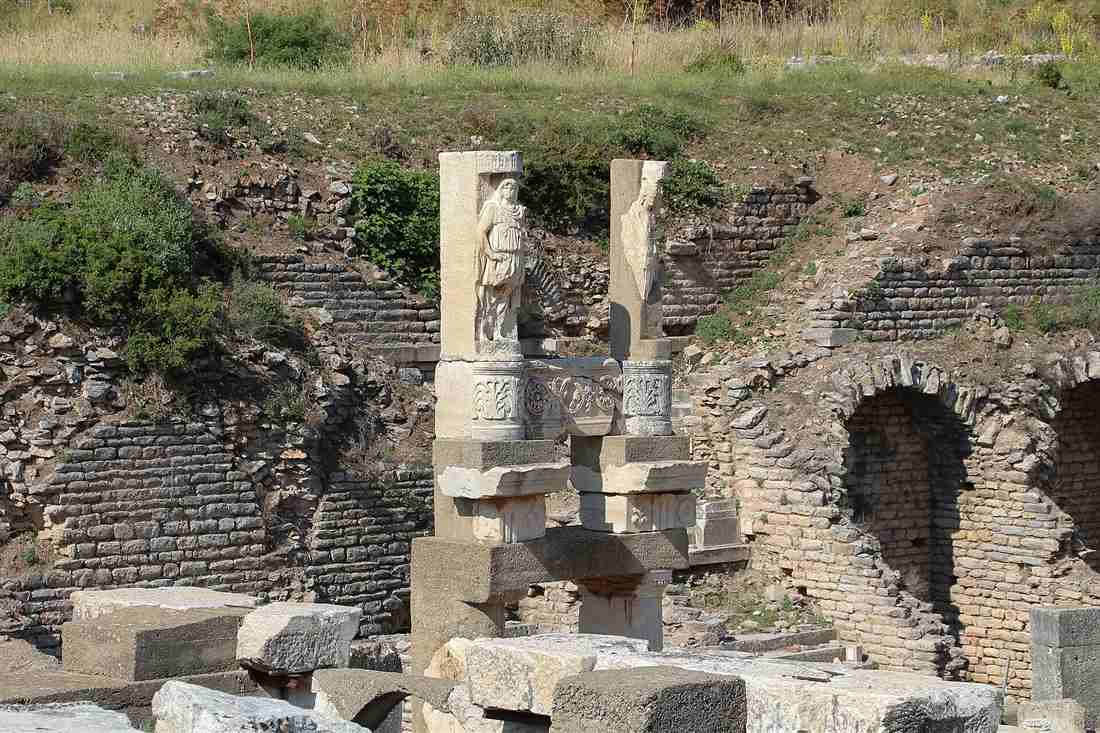
The Temple of Domitian at Ephesus was the first imperial cult temple of the city, the Temple of the Sebastoi raised on a terrace above Domitian Square in the upper city of Ephesus, near the Odeon and the start of Curetes Street. Plan the whole trip with Greece Tours.
This guide covers the Temple of Domitian in full: what the temple is and where it stands, who it honoured and why, what it looked like, what became of it after Domitian, the colossal cult statue now in the museum, what is left to see today, and how it fits a walk through the upper city.
What is the Temple of Domitian at Ephesus?
The Temple of Domitian is the first imperial cult temple of Ephesus, dedicated to the Flavian emperors and known as the Temple of the Sebastoi. It stood on Domitian Square in the upper city, raised on a vaulted terrace above Curetes Street.
The temple marks the moment Ephesus won the right to host the worship of a living Roman emperor for the entire province of Asia. The dedication honoured Domitian and the wider Flavian house, and the Greek term Sebastoi renders the Latin title Augusti, the collective name for the deified emperors of the dynasty.
The structure sits at the heart of the administrative quarter of ancient Ephesus, alongside the State Agora, the Prytaneion and the civic buildings of the upper city. Its construction announced the political rank of Ephesus among the great cities of Roman Asia, and the temple gave its name to the whole square. A visit to the wider site of Ephesus begins in this monumental precinct.
Where is the Temple of Domitian on the Ephesus site?
The Temple of Domitian occupies the terrace on the south side of Domitian Square, in the upper city of Ephesus. It stands off the top of Curetes Street, close to the Pollio Fountain, the State Agora and the Memmius Monument.
Visitors who enter through the Magnesia Gate reach the square early in their walk, before the descent toward the Library of Celsus. The terrace of the temple forms the southern edge of the open plaza, and the vaulted substructures below it face the street that skirts the State Agora.
The square knits together the political monuments of the city. The Pollio Fountain and the water works of the upper city lie a short walk to the west, and the paved route down to the commercial quarter runs past the Hercules Gate to the start of Curetes Street. The position places the imperial temple at the civic summit of Ephesus.
Who was the temple dedicated to and why?
The temple was dedicated to the emperor Domitian and the Flavian dynasty. In return, Ephesus received the title of neokoros, temple-warden of the imperial cult, the first such grant to the city and a mark of high standing in the province of Asia.
The imperial cult bound the cities of the Roman east to the emperor through public worship, sacrifice and festival. A provincial temple of this rank served the whole assembly of Asia, not the city alone, and the office of neokoros conferred prestige, pilgrimage traffic and the right to stage games in the emperor’s honour.
Domitian, the younger son of Vespasian, ruled at the close of the first century AD. Ephesus competed with Pergamon and Smyrna for the honour of hosting the cult, and the award of the Sebastoi temple placed it at the front of that rivalry. The neokoros title appears on the coins and inscriptions of the city as a badge of imperial favour.
What did the Temple of Domitian look like?
The temple rose on a raised terrace built over vaulted substructures that levelled the sloping ground. It followed a pseudodipteral plan, ringed by a colonnade of eight columns across the front and thirteen along each flank, and housed a colossal cult statue of the emperor.
The terrace measured roughly one hundred metres by fifty metres, a broad platform carried on two storeys of vaulted galleries. The lower gallery supported the weight of the sanctuary and created a monumental facade of arches toward the street below, while the temple itself stood on the level upper surface.
The pseudodipteral design set a single row of columns at the distance of a double colonnade, opening a wide covered walkway around the cult chamber. The building faced the square across an altar court, and fragments of the entablature, the column bases and the marble revetment survive among the ruins. The scale of the cult statue matched the ambition of the whole precinct.
What happened to the temple after Domitian?
After the murder of Domitian, the Roman senate condemned his memory in a damnatio memoriae. Ephesus rededicated the sanctuary to his father Vespasian and the Flavian house, preserving its neokoros rank, and the temple fell to ruin in late antiquity.
The damnatio memoriae erased Domitian’s name from public monuments across the empire. Ephesus kept the prestige of its imperial temple by shifting the dedication to the founder of the dynasty, so the sanctuary continued as the Temple of the Sebastoi under a safer patron. This rescue of the honour shows how much the city valued its temple-warden status.
In the centuries that followed, earthquakes and the decline of the pagan cult stripped the sanctuary of its function. Builders quarried its blocks for later structures, and the superstructure collapsed, leaving the terrace and the vaulted galleries as the principal remains. The altar and sculptural fragments passed into the archaeological record.
What is the colossal statue of Domitian?
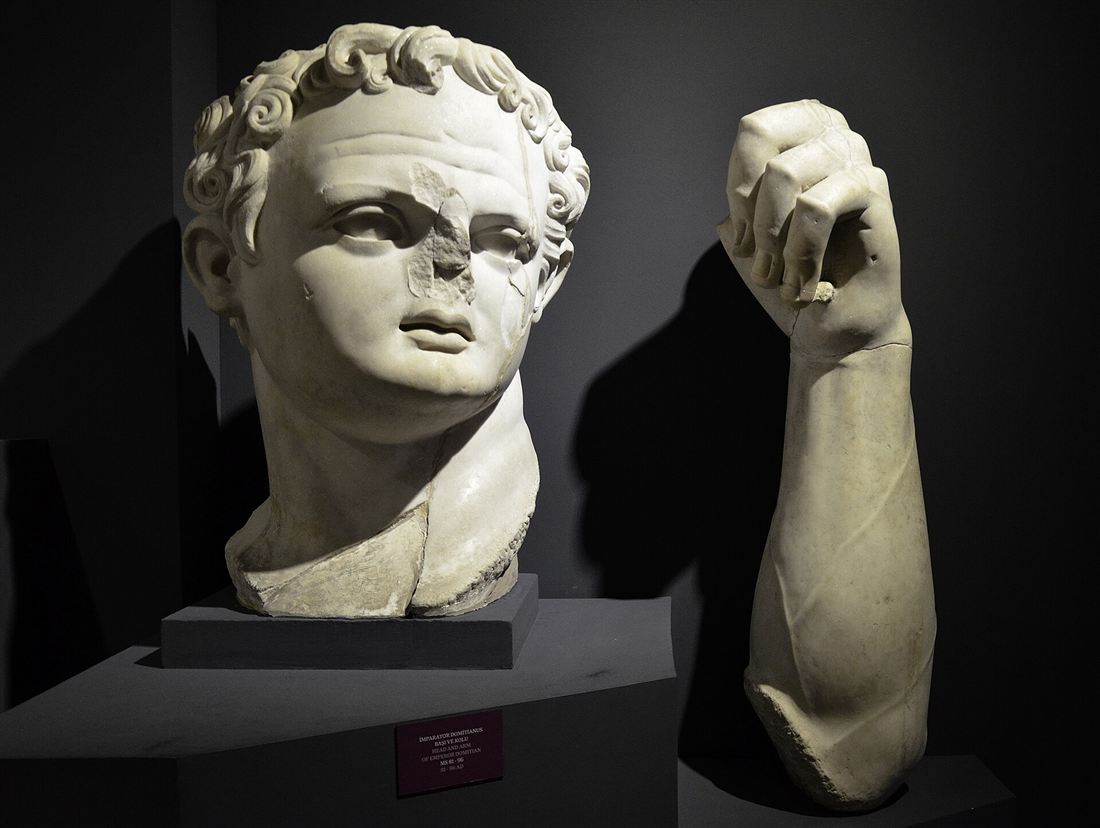
The colossal statue of Domitian was a giant marble cult image that towered inside the sanctuary. The surviving fragments — a head and a forearm — stand in the Ephesus Archaeological Museum and point to a seated or standing figure over seven metres tall.
The head alone measures more than a metre in height, and the huge forearm confirms the vast scale of the complete image. The proportions place the statue among the largest imperial portraits of Roman Asia, a deliberate assertion of the emperor’s divine presence within the temple.
The fragments now anchor the display of upper-city sculpture in the museum at Selçuk. Because the dedication passed to the Flavian dynasty after the fall of Domitian, scholarship debates whether the image portrays Domitian himself or another Flavian emperor. The pieces reward a stop at the Ephesus Archaeological Museum after the walk through the ruins.
What is there to see at the Temple of Domitian today?
Today the site presents the great terrace, the two-storey vaulted basement gallery beneath it, the reused and scattered marble blocks, and the open expanse of Domitian Square. The arches of the substructure form the most complete surviving element of the sanctuary.
The vaulted gallery under the terrace stands as a run of stone arches that once carried the temple platform. Visitors walk beside these substructures at street level and read the engineering that levelled the hillside. Column drums, capitals and cornice blocks lie across the terrace, marking the footprint of the colonnade.
On the square itself, the altar foundations and the inscribed statue bases record the honours paid to the emperors. Panels and the on-site museum of inscriptions explain the neokoros grant and the layout of the precinct. The remains reward a careful pause rather than a passing glance, and they set the scene for the monuments downhill.
How does the temple fit an Ephesus visit?
The Temple of Domitian sits at the top of the city, within the cluster of upper monuments beside the Odeon, the State Agora and the Hercules Gate that opens the descent down Curetes Street. It forms one of the first major stops on a walk through Ephesus.
Most routes begin at the upper entrance and reach Domitian Square within minutes. The concert hall of the Odeon of Ephesus stands across the political quarter, and the Memmius Monument and Pollio Fountain frame the western approach. Together these buildings present the civic and religious heart of the Roman city before the street drops toward the marble avenue.
From the square, the Hercules Gate narrows the path and marks the head of Curetes Street, the ceremonial descent that leads past the Temple of Hadrian and the terrace houses to the Library of Celsus. Setting the imperial temple first in the itinerary places the emperor cult at the summit and lets the visit unfold downhill through the trading and residential quarters of Ephesus.
Frequently Asked Questions
What is the Temple of Domitian at Ephesus?
The Temple of Domitian is the first imperial cult temple of Ephesus, the Temple of the Sebastoi dedicated to the Flavian emperors. It stood on a terrace above Domitian Square in the upper city and won Ephesus the neokoros title.
Where is the Temple of Domitian in Ephesus?
The Temple of Domitian stands on the south side of Domitian Square in the upper city, off Curetes Street near the Pollio Fountain and the State Agora, close to the Hercules Gate and the Odeon.
What is left of the Temple of Domitian?
The terrace and its vaulted substructure survive, along with reused blocks and the square. The colossal marble statue of Domitian, its head and forearm, stands in the Ephesus Archaeological Museum in Selcuk.