
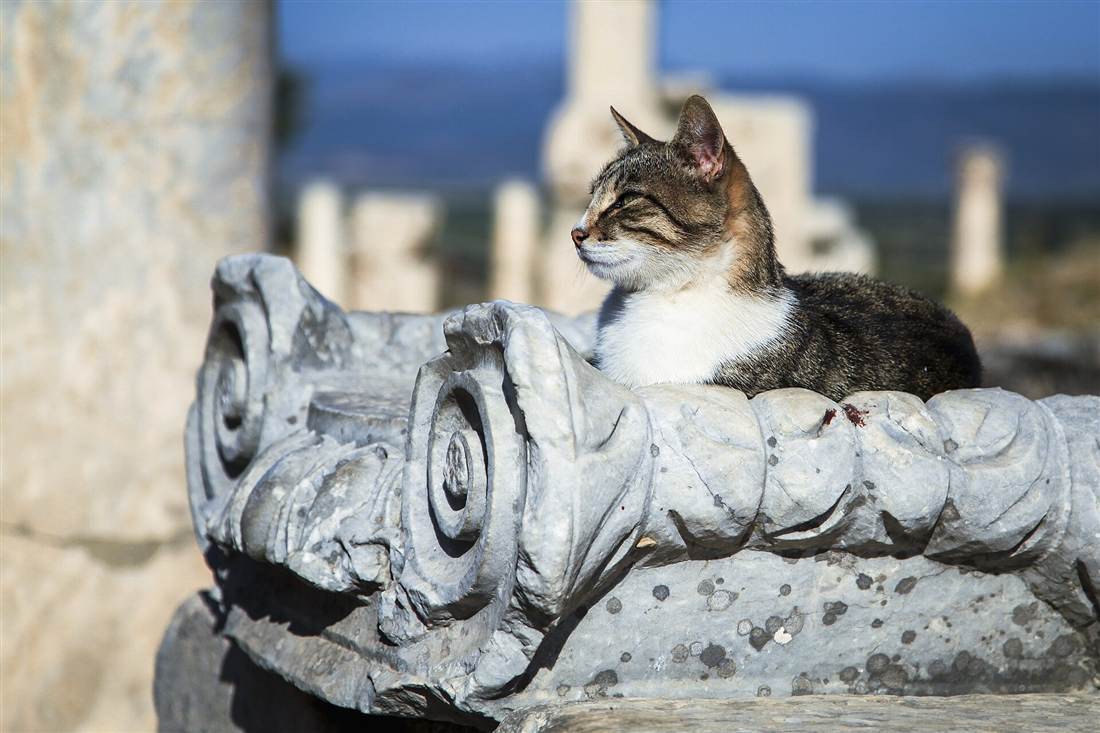
The cats of Ephesus are a community of about 150 stray cats that live among the marble ruins of Ephesus, greeting visitors at the gates, dozing on warm stone by the Library of Celsus, and following walkers along the ancient streets. Plan the whole trip with Greece Tours.
This guide covers the cats of Ephesus in full: what they are and where they gather, why they thrive among the ruins, the best spots to meet them, whether they are friendly and healthy, who feeds and cares for them, the etiquette for petting and photographing them, and how they fit Turkey’s love of street cats.
What are the cats of Ephesus?
The cats of Ephesus are the resident community of stray cats that live permanently among the marble ruins of the ancient city, greeting visitors on the paths, dozing on fallen columns and following footsteps between the monuments.
Around 150 cats make their home across the archaeological site near Selcuk in western Turkey. They are not pets in the ordinary sense and they are not wild animals that flee from people. They occupy a middle ground: free-roaming residents born and raised inside the ruins, entirely at ease with the daily flow of visitors who walk the ancient streets.
These cats belong to the experience of Ephesus as fully as the standing colonnades. A tabby stretched across a warm slab beside the Library of Celsus, a ginger tom trotting ahead along the marble road, a mother cat with kittens tucked into the shade of a broken capital — each is part of the living present of a two-thousand-year-old city. Visitors leave remembering the cats alongside the temples, and photographs of them travel around the world.
Their number holds steady near 150 through the turning of the seasons. Kittens arrive in spring, older cats hold their favourite sun-spots, and newcomers settle into the territory of the ruins. The community has its regulars — a striped cat that patrols the entrance, a white-and-tabby pair that share the Library steps — recognised by the staff who see them every day. To walk the ancient road is to move among these small residents at every turn.
Why does Ephesus have such a large cat population?
Ephesus holds a large cat population because the ruins offer everything a cat needs: sun-warmed marble to sleep on, deep shade and countless nooks for shelter, a steady stream of visitors who feed them, and a Turkish culture that welcomes street cats rather than driving them away.
The physical site suits cats perfectly. Pale marble absorbs the western Anatolian sun and holds its heat, giving the cats warm beds through the cooler hours. Collapsed walls, hollow column drums, arches and the honeycomb of ancient rooms provide hidden dens, safe from wind and rain. The open ground stays clear of large predators, so kittens survive to raise litters of their own.
Human generosity does the rest. Tens of thousands of visitors pass through in the warm season, and a share of them arrives carrying treats or buys food nearby. Site workers put down water and scraps. Above all, Turkey treats street cats as neighbours to be fed and protected, a tradition that turns a ruined city into a reliable home. The result is a stable, well-nourished population that renews itself year after year.
The layout of the ancient city adds to the appeal. Wide open plazas give cats room to roam and hunt insects and small prey, while the maze of ruined rooms behind the main streets keeps rivals at a distance and lets territories settle. Fountains and drainage channels hold water in the hotter months. Ephesus, in short, works as a ready-made cat sanctuary — food, warmth, water, shelter and safety gathered inside a single walled site — which is why the population thrives where a bare landscape leaves cats scattered and thin.
Where do you see the cats in Ephesus?
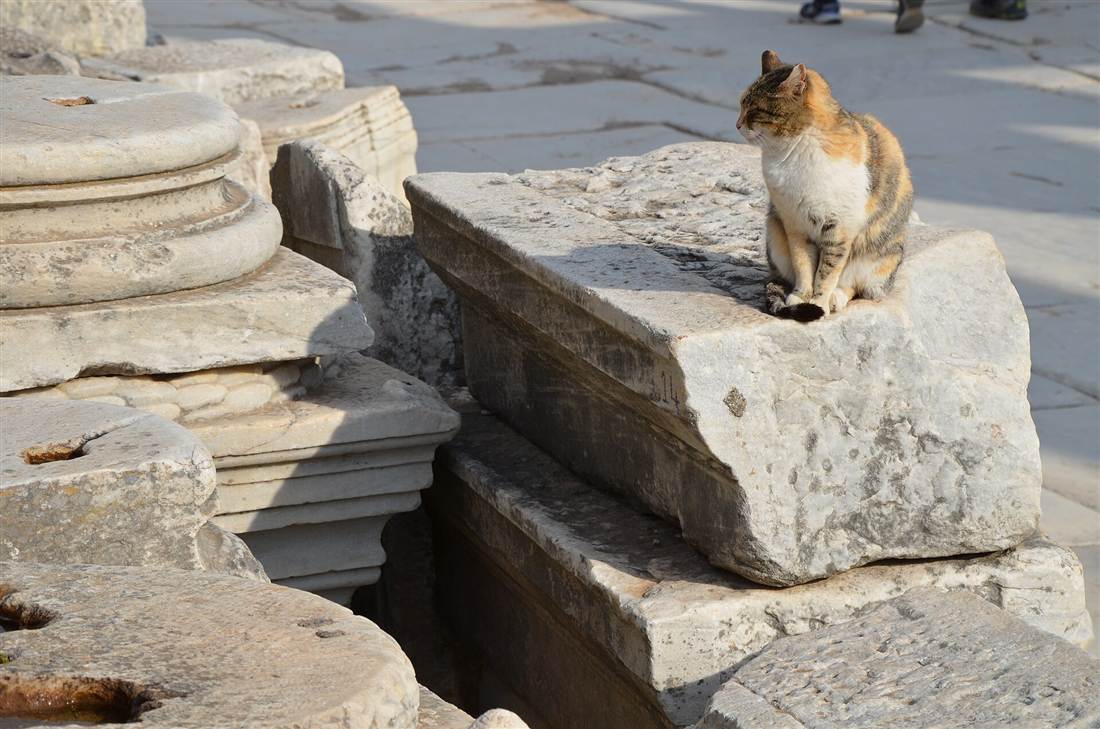
Cats appear across the whole site, concentrated at the two entrances, on the sun-warmed steps of the Library of Celsus, around the Terrace Houses, in the Great Theatre and along the marble Curetes Street, where they stretch out on flat stone in full view.
The entrance gates are the first meeting point. Cats gather where visitors pause with tickets and bags, and a friendly tail greets arrivals before the first monument comes into view. From there the marble road draws them downhill, past fountains and temple fronts, each warm surface a possible resting place.
The Library of Celsus is the most photographed backdrop, and cats settle on its broad steps as though posing beneath the two-storey facade. The Terrace Houses, with their sheltered walkways and mosaic floors, hold their own quiet residents, while the vast Great Theatre gives cats a stone amphitheatre to roam. Explore the full route across the Ephesus site and a cat is never far from the path.
Are the cats of Ephesus friendly and healthy?
The cats of Ephesus are notably relaxed and approachable, thoroughly used to people after lifetimes among crowds. Regular feeding, water points and local care programmes keep the population fed, watered and, through neutering efforts, controlled in number and steadier in health.
Because these cats grow up surrounded by gentle strangers, they show little fear. A cat rolls onto warm marble beside a bench, accepts a slow stroke behind the ears and settles down to sleep within reach of passing feet. Kittens learn the same calm from their mothers, and the trust passes down the generations.
Their condition reflects the attention they receive. Full stomachs come from staff, guides and visitors; fresh water sits at shaded points around the site. Animal-welfare volunteers from Selcuk and further afield run neutering and vaccination drives that steady the numbers and reduce disease. The care is not perfect and the cats remain free-living animals exposed to weather and age, yet the resident community stays visibly in good order compared with truly abandoned strays.
Who looks after the cats of Ephesus?
A partnership of site staff, local animal lovers from Selcuk, welfare volunteers and everyday visitors looks after the cats of Ephesus, maintaining water and food points, running neutering and vaccination programmes, and keeping a watchful eye on kittens and elderly cats.
The people who work at the site form the first line of care. Ticket staff, guards and cleaners know individual cats by sight, refill water bowls in the heat and leave food where the animals gather. Their daily presence means a sick or injured cat is noticed quickly.
Beyond the gates, animal-welfare groups based in the town organise the larger tasks. Neutering keeps litters in check, vaccinations guard against disease, and volunteers arrange treatment for cats that need it. Guides and travellers add the rest, sharing food and reporting anything amiss. This loose, willing network — nobody paid to run it as a whole — is what carries the resident population through each turning season.
Donations keep the effort alive. Welfare groups fund food, medicine and veterinary bills through gifts from residents and travellers touched by the cats they met. A visitor who leaves a contribution at a local shelter, buys a bag of food for the site’s bowls or shares the cats’ story online adds to the same cause. The care of the cats of Ephesus, then, reaches beyond the gates and the town to everyone who chooses to help the small residents of the ruins.
Is feeding or petting the cats allowed at Ephesus?
Gentle feeding and calm petting are welcomed at Ephesus, and the cats invite both. The etiquette is simple: offer plain cat-friendly food and water, stroke a willing cat quietly, keep walkways clear, and let any cat that turns away rest undisturbed.
Visitors bring small pouches of cat food or dry biscuits, and a shared treat draws an instant, purring audience. Water matters as much as food in the western Anatolian heat, so a splash poured into a shaded hollow is a real kindness. Rich human snacks, chocolate and heavily salted scraps harm cats, so plain fare is the rule.
Petting follows the cat’s lead. A cat that leans in, tail upright, accepts a slow stroke along the back or a scratch behind the ears; a cat that stiffens or moves off wants to be left alone. Feeding stops well clear of the narrow marble passages so that a cluster of hungry cats never blocks the flow of visitors or crowds the fragile stone. Respectful interaction keeps both the animals and the ancient site at ease.
The cats reward this courtesy in kind. A cat that trusts the crowd curls up beside a resting traveller, purrs under a light hand and follows a gentle group along the marble for a stretch of the walk. Children meet the cats with delight, and a calm introduction teaches a small visitor to stroke softly and read the animal’s mood. The unwritten code — offer, wait, respect the answer — turns a chance meeting into one of the warmest moments of a day at Ephesus.
How do the cats fit Turkey’s love of cats?
The cats of Ephesus sit squarely within Turkey’s deep affection for street cats, a tradition that treats free-roaming felines as cherished members of the community, feeds and shelters them in towns and cities nationwide, and grants them the run of public spaces.
Across Turkey, street cats live openly and cared for. Istanbul is famous for its thousands of neighbourhood cats, fed by shopkeepers, curled in mosque courtyards and riding ferries across the Bosphorus. Residents leave out bowls of food and water, build small wooden shelters against the cold and regard the cats as belonging to everyone and no one.
This warmth carries a long cultural memory, including a respect for cats rooted in Islamic tradition, where kindness to animals stands as a virtue. Ephesus draws on that same spirit. The ancient city simply gives Turkey’s cat-friendly culture a spectacular stage, where the everyday tenderness shown to a street cat plays out among marble temples and Roman streets. The visiting traveller meets a national love of cats in one of its most memorable settings.
What is the best way to photograph the cats of Ephesus?
The finest cat photographs at Ephesus come from the soft early-morning light, the pale marble backdrops of the Library steps and Curetes Street, and quiet patience — kneeling to the cat’s eye level and waiting for the animal to settle into a natural pose against the ruins.
Light shapes the shot. The first hour after opening brings low, golden sun that warms the marble and flatters a cat’s coat, while the crowds stay thin and the cats stretch out in the calm. Late afternoon offers the same gentle glow as the day cools. Kneel or crouch to meet the cat at its own height, and the ancient columns rise behind it as a natural frame.
Patience earns the picture. A cat washing on the Library steps, a kitten peering from a hollow column, a tabby silhouetted in a theatre arch — each rewards the photographer who waits without rushing. A slow hand and a soft voice keep the cat relaxed and in place. The pale stone of the Library of Celsus and the long marble road give backdrops that turn an ordinary cat portrait into a scene from a living ancient city.
A phone camera captures these moments as readily as a long lens. Frame the cat against a doorway or column to give the shot depth, keep the low sun behind you to light the fur, and hold still until the animal blinks slow and relaxed. The best frames catch the cat mid-yawn, paw raised, or gazing down the marble road, small and unhurried against the grandeur of the ruins.
What is there to know before visiting the cats of Ephesus?
Before visiting the cats of Ephesus, plan around the site’s daylight opening hours, carry water for the cats as well as yourself, handle every cat gently, feed only plain food clear of the paths, and leave the ruins spotless so the animals and the monuments both stay well.
Timing rewards preparation. The archaeological site opens through daylight, with longer hours in the warm season and shorter ones in winter, and the early slot brings cooler air, calmer cats and thinner crowds. Sturdy shoes suit the uneven marble, and a hat and sunscreen matter under the Anatolian sun. A refillable bottle serves double duty, quenching your thirst and the cats’ at the shaded water points.
Kindness and care travel together. Approach cats slowly, let them come to you, and never lift a kitten from its mother. Offer plain cat food away from the narrow passages so no crowd forms on the fragile stone. Take every wrapper and scrap back out with you, since litter harms both the cats and the ancient marble. Wander the wider Ephesus ruins with the same gentle attention, and the resident cats greet the next traveller exactly as they greeted you.
Frequently Asked Questions
Why do cats gather at Ephesus?
About 150 cats live at Ephesus because the warm marble, the shade of the ruins and the steady stream of visitors who feed them make the site a haven. Turkey’s cat-friendly culture keeps the colony fed and cared for.
Where do you see the cats in Ephesus?
The cats gather at the entrances, on the steps of the Library of Celsus, around the terrace houses and in the shade of the Great Theatre, sunning on warm marble and greeting visitors along Curetes Street.
Are the cats of Ephesus friendly?
The cats of Ephesus are relaxed and used to people. Site staff and visitors feed and water them, and animal-welfare groups run neutering and care, so the cats approach walkers for gentle attention along the ruins.