
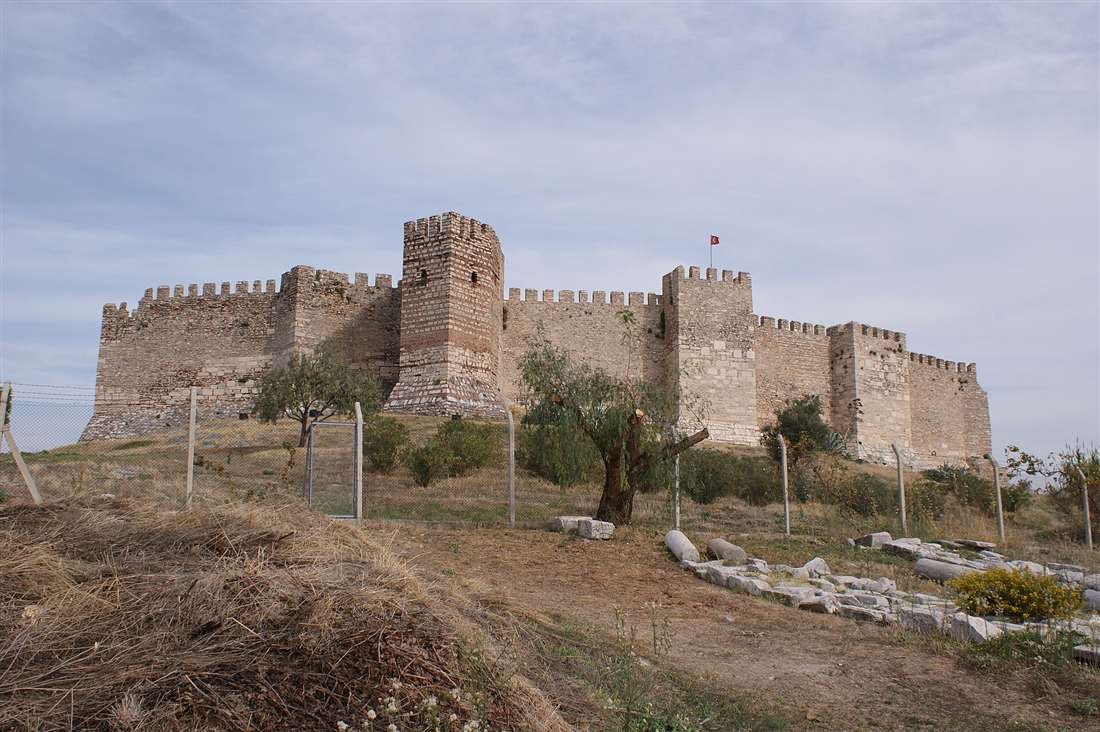
Ayasuluk Castle is the fortress crowning Ayasoluk Hill above Selcuk, a stone circuit of about 1.5 kilometres with fifteen towers, entered through the same site as the Basilica of St John and looking out over the plain to Ephesus. Plan the whole trip with Greece Tours.
This guide covers Ayasuluk Castle in full: what the fortress is and where it stands, how to reach it, who built it and when, the walls and towers, what lies inside the circuit, its link to the Basilica of St John, the history of Ayasoluk Hill, the view from the ramparts, the origin of the name, and what is left to see on a Selcuk visit.
What is Ayasuluk Castle?
Ayasuluk Castle is the hilltop citadel crowning Ayasoluk Hill above the town of Selçuk in western Turkey. A stone circuit of about 1.5 kilometres wraps the summit, reinforced by fifteen towers, and it stands beside the ruined Basilica of St John.
The castle sits on the highest ground of the ridge that rises directly north of modern Selçuk, in Izmir Province, a short distance inland from the Aegean coast. The fortress encloses the crown of the hill within a continuous curtain wall of dressed and rubble stone. Its towers project outward at intervals along the circuit, mixing square and rounded plans, and the whole enceinte forms an irregular oval that follows the natural contour of the summit.
Ayasuluk Castle is the fortified heart of a wider archaeological zone that also holds the Basilica of St John, the tomb of the Apostle John, cisterns, a ruined mosque, and the remains of a small medieval settlement. The citadel and the basilica share one enclosure and one entrance, so a visit to the hill delivers both monuments together. The site overlooks the ancient city of Ephesus, the marble stump of the Temple of Artemis, and the Isa Bey Mosque on the slope below.
The fortress marks the point where settlement in this district moved uphill during the medieval centuries, away from the silting harbour of Ephesus and onto defensible high ground. The name Ayasuluk, later softened to Ayasoluk, derives from the Greek Hagios Theologos, “the Holy Theologian”, the epithet attached to St John. The castle therefore carries in its very name the memory of the apostle whose shrine crowns the same hill.
Where is Ayasuluk Castle and how do you get up to it?
Ayasuluk Castle stands on Ayasoluk Hill on the northern edge of Selçuk, Izmir Province, western Turkey. Visitors enter through the Basilica of St John gate on Saint Jean Caddesi, then climb a paved path through the basilica grounds to the fortified summit above.
Selçuk lies about three kilometres from the ruins of Ephesus and roughly seventy-five kilometres south of Izmir. The town centre sits at the foot of the hill, and the castle rises immediately to its north, so the walk to the entrance from the main square is a matter of minutes. The gate that serves the whole hill is the Basilica of St John entrance, reached from Saint Jean Caddesi, and one ticket admits the visitor to both the basilica and the castle above it.
From the ticket gate the route ascends through the Byzantine complex, passing the reconstructed columns of the basilica and the marble tomb of the apostle. Beyond the church the ground continues to rise toward the crown of the hill, where the outer wall and the great gate of the citadel stand. The climb from the entrance to the summit covers a modest vertical gain over paved and gravel ground, and the surface is uneven where old paving meets bare rock.
Selçuk stands on the main road and rail line between Izmir and the southern Aegean resorts, and the town has its own railway station, so the hill is reached without private transport. The Isa Bey Mosque sits on the western slope directly below the castle, and the Ephesus Archaeological Museum lies in the town centre nearby, which places three monuments within a short walk of one another. Ayasuluk Castle therefore anchors a compact cluster of sites at the top of any list of things to do in Selçuk.
Who built Ayasuluk Castle and when?
Byzantine engineers raised the first fortification on Ayasoluk Hill during the early medieval centuries, from the sixth and seventh centuries onward. The Aydinid and Seljuk Turks rebuilt and enlarged the circuit in the fourteenth century, and the Ottomans held and repaired the castle after they absorbed the region.
The earliest defensive walls on the summit belong to the Byzantine phase, when the population of Ephesus withdrew from the exposed lowland and the silting harbour toward the higher, drier ground of the hill. The fortress protected the shrine of St John and the shrinking town that gathered around it. Byzantine builders drew stone from the abandoned monuments of Ephesus below, and blocks of ancient marble sit reused throughout the fabric of the walls.
In the fourteenth century the hill passed to the Aydinids, the Turkish beylik that ruled this stretch of the Aegean coast from its seat at Birgi and its port at Ayasuluk. Under Aydinid rule the citadel gained much of its present form, and the beylik added the mosque of Isa Bey on the slope below the castle in the same period. The Seljuk architectural tradition shaped the reworked towers and gates of this phase, and the reused antique masonry continued to bind the new work to the old.
The Ottomans took control of the district at the end of the fourteenth century and again in the early fifteenth century after the interlude of Tamerlane’s campaign. They kept the castle in service as a fortified point and repaired its walls, while the town at the foot of the hill declined as the coast retreated and the harbour vanished under alluvium. The layered fabric that survives today therefore records Byzantine foundations, Aydinid and Seljuk reconstruction, and Ottoman maintenance, one phase built upon the last.
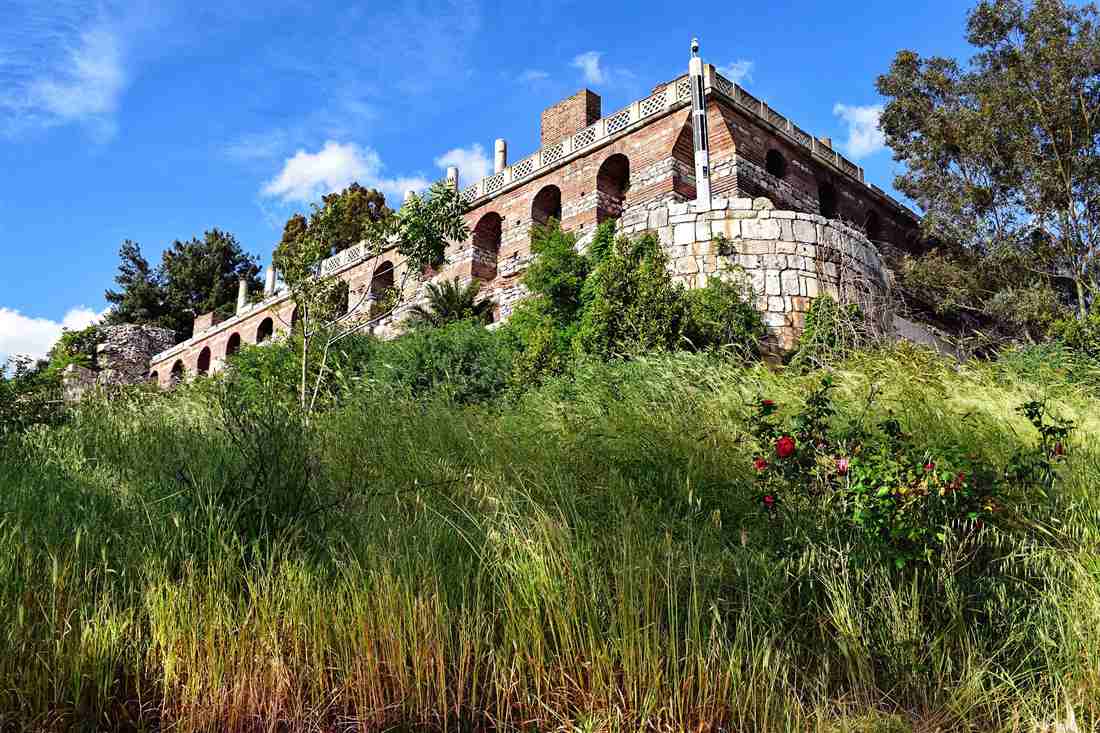
What are the walls and towers of Ayasuluk Castle like?
The castle presents a continuous curtain wall of about 1.5 kilometres, strengthened by fifteen towers of square and rounded plan. Gates pierce the circuit at the approach from the basilica, and blocks of marble spolia carried up from Ephesus sit set into the masonry throughout.
The enceinte follows the edge of the summit, rising and falling with the rock so that the wall-head traces the natural crown of the hill. The construction mixes cut ashlar in the facing with a core of rubble and mortar, and the two building materials meet where later Turkish repairs abut the older Byzantine fabric. The towers project from the line of the curtain at intervals, giving the defenders angles of fire along the face of the wall and covering the ground before each stretch of the circuit.
Of the fifteen towers, part stand on a square plan and part on a rounded one, a distinction that marks different building phases along the enceinte. The rectangular towers belong largely to the earlier work, while the rounded forms reflect the reconstruction under the Aydinids and the Seljuk building tradition. The main gate stands at the point where the path from the basilica reaches the crest, framed by masonry that gathers the strongest defensive effort of the whole circuit.
Spolia, the reused stone of earlier monuments, defines the character of the walls. Column drums, cornice fragments, inscribed blocks, and slabs of marble quarried centuries earlier for the buildings of Ephesus lie built horizontally into the fabric, their carved faces turned into the wall or left exposed. This reuse of antique material bound the medieval fortress physically to the classical city on the plain below and spared the builders the labour of fresh quarrying. The same practice of drawing stone from the ruins of Ephesus shaped the neighbouring Basilica of St John and the Isa Bey Mosque.
What is inside the castle walls?
Within the circuit lie the remains of a small ruined mosque, stone-lined cisterns for water storage, the foundations of houses, and the traces of a compact settlement that sheltered on the summit. The interior held a self-contained community behind the protection of the wall.
The mosque inside the castle dates to the Turkish phase of the hill and stands in ruin, its walls reduced but its plan legible on the ground. It served the garrison and the residents who lived within the fortification during the Aydinid and Ottoman centuries. Beside it, cisterns cut and lined to hold rainwater met the fundamental need of a hilltop stronghold, where no spring rises and every drop of water arrives from the sky or is carried up the slope.
The foundations of dwellings spread across the enclosed ground, marking a settlement that clustered inside the walls when the lowland town grew unsafe. Streets, house plots, and storage structures once filled the space between the curtain and the summit, a miniature fortified town rather than a bare military post. Excavation on the hill has recovered the outlines of these buildings and the layers of occupation that accumulated across the medieval centuries.
The interior also preserves the relationship between the castle and the sacred ground below it, since the fortified summit and the Basilica of St John form one continuous complex within the greater enclosure. The people who lived behind the walls drew their identity from the shrine of the apostle on the same hill, and the citadel existed in part to guard that shrine. The ruined mosque, the cisterns, and the house foundations together record centuries of continuous life on the crown of Ayasoluk Hill.
How is Ayasuluk Castle linked to the Basilica of St John?
The castle and the Basilica of St John crown the same Ayasoluk Hill and belong to one archaeological enclosure served by a single entrance and ticket. The basilica, built over the tomb of the Apostle John, forms the sacred core that the fortress above it was raised to protect.
The Basilica of St John rises on the slope just below the summit, a great cruciform church that the Emperor Justinian erected in the sixth century over the reputed grave of the apostle. Its six domes once covered a building of cathedral scale, and the marble tomb of St John still marks the centre of the nave, ringed today by re-erected columns. The Basilica of St John and the castle share the same ticket, the same gate, and the same paved approach, so the two monuments are experienced as one visit.
The fortress and the church grew together as the twin poles of medieval Ayasuluk. The shrine drew pilgrims and gave the hill its holiness, while the walls above gave the community its safety, and the name of the whole site, Hagios Theologos, honoured the same apostle whose bones lay in the crypt. The Byzantine complex therefore combined a place of worship, a place of refuge, and a place of settlement in a single fortified precinct.
Because the citadel and the basilica occupy one continuous slope, the walk up the hill passes directly from the church to the castle gate. The reconstructed columns of the nave, the baptistery, and the tomb chamber lie on the route between the ticket office and the summit wall, which makes the two monuments a single ascending itinerary rather than separate excursions. The tomb of the Apostle John remains the spiritual anchor of the entire hill, and the castle stands as its medieval guardian.
What is the history of Ayasoluk Hill before the castle?
Ayasoluk Hill carries a prehistoric settlement mound at its base, and the Temple of Artemis rises on the plain a short distance to the west. During the medieval centuries the population of Ephesus abandoned its silting harbour and moved uphill to this defensible ground, founding the town that became Selçuk.
The occupation of the hill reaches back into prehistory, and a settlement mound at its foot preserves layers of habitation from the Bronze Age and earlier. This deep past makes Ayasoluk one of the longest-inhabited spots in the district, occupied long before the classical city of Ephesus reached its height on the plain to the west. The hill thus predates the monuments that give it fame and formed the original nucleus of settlement in the valley.
On the plain below stands the Temple of Artemis, one of the Seven Wonders of the ancient world, its vast marble colonnade reduced now to a single re-erected column above a marshy foundation. The Temple of Artemis anchored the religious life of Ephesus for centuries, and its ruin lies within sight of the castle wall, linking the classical sanctuary on the flat ground to the medieval citadel on the height. The temple’s precinct and the harbour city flourished while the hill served as a modest satellite.
The great shift came as the harbour of Ephesus silted with alluvium carried down by the Cayster river, cutting the city off from the sea that had made it rich. As the lowland grew unhealthy and indefensible, the inhabitants withdrew to Ayasoluk Hill, where the shrine of St John and the higher ground offered safety and holiness together. The medieval town of Ayasuluk, and after it the modern town of Selçuk, grew directly out of that retreat from the plain to the hill.
What is the view from Ayasuluk Castle?
From the summit the walls command a wide prospect over the roofs of Selçuk, the Temple of Artemis on the plain, the ruins of Ephesus beyond, and the flat valley of the Cayster river running west toward the line of the Aegean coast.
Standing at the wall-head, the visitor looks down first onto the town of Selçuk directly below, its streets, its railway station, and the Isa Bey Mosque clinging to the western slope of the same hill. The vantage gathers the whole cluster of monuments into a single frame, so the relationship between castle, basilica, mosque, and town reads clearly from above rather than as scattered points on the ground.
To the west and south the eye follows the plain toward the site of Ephesus, three kilometres distant, where the marble streets and the theatre of the ancient city spread across the lower ground. The lone standing column of the Temple of Artemis marks the middle distance, a thin vertical against the flat fields, and the whole sweep of the valley opens toward the horizon. On a clear day the flat land continues west to the fringe of the Aegean, where the silted harbour of Ephesus once opened to the sea.
The elevation that made the hill defensible in the medieval centuries produces the same commanding outlook for the visitor today. The fortress was sited precisely to survey the approaches across the plain, and that military logic now translates into a panorama over the layered landscape of ancient, medieval, and modern settlement. The view binds together every phase of the district’s history in one wide horizon seen from the crown of Ayasoluk Hill.
Ayasuluk or Ayasoluk — what is the name and its origin?
The name derives from the Greek Hagios Theologos, “the Holy Theologian”, the title given to St John the Evangelist. Byzantine usage produced Hagios Theologos, Turkish speech reshaped it to Ayasuluk, and the modern spelling Ayasoluk preserves the same root honouring the apostle.
St John held the epithet “the Theologian” in the Eastern Church, a title recognising him as the author of the fourth Gospel and the theologian of the divine Word. His shrine on the hill was the Church of the Holy Theologian, Hagios Theologos in Greek, and the whole settlement took its name from that dedication. The place-name therefore records the identity of the apostle whose tomb lies at the centre of the basilica below the castle.
As Turkish became the language of the district after the fourteenth century, the Greek phrase passed through the mouths of new speakers and contracted into Ayasuluk. The sequence Hagios Theologos lost its Greek grammar and gained a Turkish shape, and the town that grew beneath the citadel carried this reworked form as its official name for centuries. The Aydinid port and the fortress alike were known as Ayasuluk throughout the medieval and Ottoman periods.
The modern town took the name Selçuk in the twentieth century, honouring the Seljuk Turks whose architecture shaped the hill, while the hill itself and its castle kept the older name in the spelling Ayasoluk. The two names now sit side by side, Selçuk for the living town and Ayasoluk for the historic height above it. The survival of Hagios Theologos in Ayasoluk Castle preserves, in a single word, the thread that runs from the Byzantine shrine through the Turkish beylik to the present day.
Why did the fortress grow important during the Aydinid period?
Under the Aydinid beylik of the fourteenth century, Ayasuluk served as the coastal port and market of a Turkish principality seated inland at Birgi. The castle guarded the trade that flowed through the harbour, and the beylik rebuilt the walls and raised the Isa Bey Mosque on the same hill.
The Aydinids ruled the Aegean seaboard of Anatolia from their capital at Birgi, and Ayasuluk was their window on the sea and their commercial hub. Genoese and Venetian merchants traded at the harbour beneath the hill, exchanging the produce of the interior for the goods of the Mediterranean, and the town prospered as an emporium at the meeting of land and water. The fortress on the summit oversaw this traffic and secured the wealth that passed through the port.
The beylik invested the profits of trade in the fabric of the hill. Isa Bey, the Aydinid ruler, endowed the mosque that carries his name on the western slope in the fourteenth century, one of the earliest large mosques of the Anatolian beyliks and a monument in its own right. The reconstruction of the castle walls and the rounded towers belongs to the same burst of building, when Turkish patronage reshaped a Byzantine height into the stronghold of a Muslim principality.
Naval raids by the Aydinid fleet ranged across the Aegean from this coast, and the port of Ayasuluk supplied the ships and the men. The strategic weight of the hill during these decades explains the scale of the fortification that survives, since the castle protected not a backwater but the maritime front of an ambitious state. The decline set in only as the harbour silted and the coastline retreated, draining the port of its purpose and the town of its trade.
What construction materials and techniques shaped the castle walls?
The walls combine cut ashlar facing with a rubble-and-mortar core, bonded by courses of reused antique marble and, in stretches, bands of brick. Builders drew column drums, cornices, and inscribed blocks from the ruins of Ephesus and set them horizontally into the medieval masonry.
The Byzantine phase relied on a technique standard across the empire, a two-skin wall with faces of squared stone enclosing a hearting of broken rubble bound in lime mortar. This method produced a thick, resilient curtain from modest materials and the abundant spoil of the classical city below. Where brick appears in levelling courses, it stabilised the wall-head and marked the building rhythm of the masons who raised each stretch.
The reused marble is the defining material of the enceinte. Antique column drums lie built into the wall on their sides, their fluted or drum-shaped profiles jutting from the face, and slabs bearing Greek and Latin inscriptions turn up throughout the circuit, their letters half-hidden in the mortar. This spolia spared the effort of quarrying and gave the walls a density of worked stone beyond the reach of fresh cutting, while binding the fortress materially to the vanished monuments of the plain.
The Aydinid and Seljuk repairs introduced their own hand, visible in the rounded towers and in stretches where the coursing and the mortar differ from the older work. The interface between the phases records the long life of the wall, patched and strengthened across the medieval centuries as need dictated. The result is a fabric that reads as a stratigraphy of building, each era legible in the stone to a visitor who studies the face of the curtain.
How was Ayasuluk Castle defended?
The defence rested on the natural height of the hill, the continuous curtain wall, and the fifteen projecting towers that flanked every stretch of the circuit. A fortified main gate controlled the single practicable approach from the basilica, and cisterns inside the walls secured the water that a siege demanded.
The primary strength of the site is its elevation, since the summit rises above the surrounding plain and forces an attacker to climb toward the defenders. The curtain wall closes the crown of the hill in an unbroken ring, and the towers step forward from its line to give the garrison enfilading fire along the base of the wall, striking any assault that reached the foot of the masonry. This combination of height, curtain, and flanking towers is the classic geometry of medieval fortification, executed here in reused stone.
The main gate concentrated the defensive effort at the one point where the ground allowed an easy approach, the paved route rising from the Basilica of St John. Massive masonry framed the entrance, and the position of the towers to either side brought the gateway under converging cover. An attacker forced to funnel toward this gate met the strongest part of the whole circuit, a deliberate channelling of the assault onto prepared ground.
A hilltop fortress lives or dies by its water, and the cisterns cut inside the walls answered that need by storing the rainfall of the wet season against the dry months and the pressure of a blockade. The enclosed settlement, its houses and its mosque, meant the summit held a resident population able to man the walls and endure a siege. The defensive scheme therefore worked as a whole, height and wall and tower and water and garrison combining to hold the crown of Ayasoluk Hill.
What have excavation and restoration revealed on the hill?
Archaeological work on Ayasoluk Hill has traced occupation from the prehistoric mound through the Byzantine and Turkish phases, uncovering the plan of the interior settlement, the ruined mosque, and the cisterns. Restoration has consolidated the curtain wall and re-raised sections of the towers to present a legible circuit.
Excavation at the foot and on the crown of the hill has exposed the depth of its history, from the Bronze Age mound at the base to the medieval town within the walls. The layers of occupation record a settlement that endured across three thousand years, shifting up the slope as the harbour of the plain failed. This long stratigraphy makes the hill a document of the whole valley’s history, from prehistory to the Ottoman centuries.
Within the walls, the work has recovered the plan of the medieval community, the outlines of houses, the line of streets, the position of the ruined mosque, and the mouths of the cisterns. These finds turn the enclosed summit from a bare ruin into a readable town, where the daily life of the garrison and residents leaves its trace in stone foundations and packed floors. The material culture drawn from these levels now enters the collections of the district’s museum in the town below.
Restoration has addressed the fabric of the defences, stabilising the curtain where centuries of weather loosened the masonry and rebuilding parts of the towers to their original height. The reconstruction follows the surviving evidence so that the visitor reads a coherent circuit rather than a scatter of stumps. The paved paths, the consolidated walls, and the interpreted interior together open the fortress to a public that walks the same ground the medieval garrison held.
What does a visit to Ayasuluk Castle involve on the ground?
A visit combines the Basilica of St John and the castle in one climb of about an hour, entered on a single ticket from Saint Jean Caddesi. The route runs on paved and gravel paths over uneven ground, rising from the tomb of the apostle to the fortified summit and its wide outlook.
The ascent starts at the basilica gate in the town, passes the re-erected columns and the marble tomb of St John, and continues up the slope to the great gate of the citadel. The paths mix old paving, gravel, and stretches of bare rock, and the gradient steepens toward the crown, so the walk rewards sturdy footwear and a measured pace in the heat of the western Anatolian summer. Shade on the open hill is scarce, and the exposed summit meets the full sun and the sea wind alike.
Once inside the walls the visitor follows the circuit past the towers, the ruined mosque, and the cisterns, reading the interior settlement in its stone foundations and pausing at the wall-head for the panorama over Selçuk, the Temple of Artemis, and the plain toward Ephesus. The combined monument fills the better part of a morning or a late afternoon, and the low light at either end of the day rakes across the walls and the valley to the finest effect. The single ticket, the compact route, and the joined monuments make the hill an efficient centrepiece of a day in the town.
What is there to see at Ayasuluk Castle today and how does it fit a Selçuk visit?
Today the restored walls and towers, the ruined interior mosque, the cisterns, and the settlement traces stand open to visitors on one ticket with the Basilica of St John. The castle joins the Isa Bey Mosque, the Temple of Artemis, and the Ephesus Museum to form a compact circuit through Selçuk.
Restoration work on the enceinte has consolidated long stretches of the curtain wall and re-raised parts of the towers, so the circuit reads as a continuous defence rather than a scatter of ruins. Inside the walls the ground preserves the ruined mosque, the stone-lined cisterns, and the outlines of medieval houses, while the spolia set into the masonry rewards close inspection with fragments of ancient Ephesus. The single entrance shared with the basilica means the ascent delivers the tomb of St John and the fortified summit in one continuous walk.
Directly below the western slope stands the Isa Bey Mosque, the fourteenth-century Aydinid mosque whose courtyard columns of grey and pink granite came, like the castle’s spolia, from the ruins on the plain. The Isa Bey Mosque pairs naturally with the castle above it, since both belong to the Turkish rebuilding of the hill, and the short walk between the two links the sacred and the defensive faces of medieval Ayasuluk. The mosque, the basilica, and the citadel together tell the layered story of Byzantine and Turkish rule on one slope.
Beyond the hill, the Temple of Artemis lies a short walk to the west, the Ephesus Archaeological Museum stands in the town centre with the finds from the whole valley, and the great ruins of Ephesus spread three kilometres to the south-west. A visit that begins at the Basilica of St John and climbs to Ayasuluk Castle sets the crown on a day among the monuments of Selçuk, and the fortress offers the high vantage from which the entire ancient and medieval landscape falls into view. The castle earns its place near the top of any list of things to do in Selçuk, the medieval keystone in a district built from three thousand years of stone.
Frequently Asked Questions
What is Ayasuluk Castle?
Ayasuluk Castle is the hilltop fortress above Selcuk, a stone circuit of about 1.5 kilometres with fifteen towers on Ayasoluk Hill. It rose in the Byzantine centuries, was rebuilt by the Aydinids and stands beside the Basilica of St John.
How do you visit Ayasuluk Castle?
Ayasuluk Castle sits on the hill above Selcuk town, entered through the Basilica of St John site off St Jean Street. The walk up from the town centre takes about ten minutes to the gate.
Where does the name Ayasuluk come from?
The name Ayasuluk comes from the Greek Hagios Theologos, “the Holy Theologian”, the title of the Apostle John, whose tomb and basilica stand on the same hill. Ayasoluk is the older form of the name.