
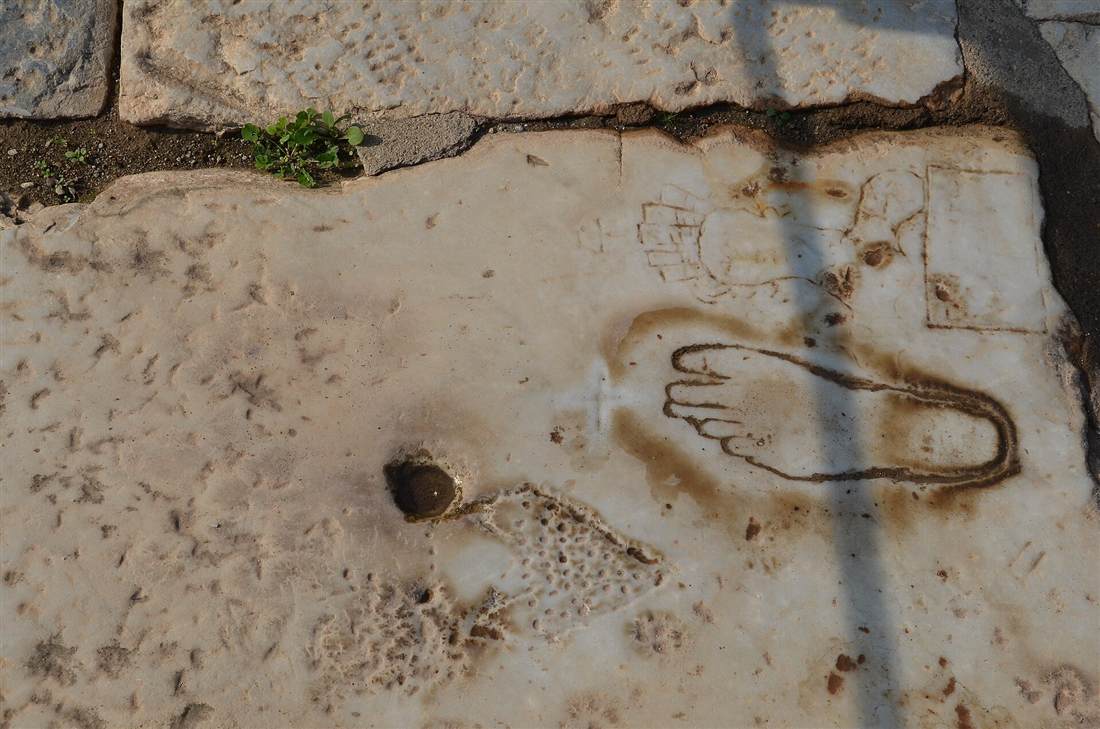
The brothel of Ephesus is a Roman peristyle house on the corner of Marble Street and Curetes Street, opposite the Library of Celsus and beside the Scholastica Baths, famous for the footprint advertisement carved into the paving of Ephesus. Plan the whole trip with Greece Tours.
This guide covers the brothel of Ephesus in full: what the building is and where it stands, the celebrated footprint carving and how scholars read it, the courtyard and mosaics, its link to the baths and latrines, the sex trade of a Roman port, the debate over the identification, what survives on the site, and where it falls on the Ephesus walking route.
What is the brothel of Ephesus?
The brothel of Ephesus is a Roman-era peristyle house at the heart of the ancient city, standing at the junction of Marble Street and Curetes Street, beside the Scholastica Baths and directly across from the Library of Celsus.
Tour guides name the structure the “love house,” and the label reflects a long tradition that reads the building as a public establishment for paid sex in the Roman imperial period. The house occupies a prime commercial corner of Ephesus, a spot that funnelled foot traffic between the civic centre on Curetes Street, the harbour district reached by Marble Street, and the great open plaza in front of the Library of Celsus. That position placed the building at a crossing point used by residents, sailors, merchants and worshippers moving through the metropolis.
The building follows the standard plan of a wealthy Roman townhouse: rooms arranged around a central colonnaded courtyard, a water feature at the core, mosaic floors, and a service link to the adjoining bath block. Archaeologists documented a pool in the courtyard, patterned mosaic pavements, and small chambers along the perimeter. The identification as a brothel rests on the building’s location, its internal fittings, the objects recovered nearby, and the celebrated footprint carving cut into the marble slabs of the street outside.
Ephesus itself framed the monument. The city served as the capital of the Roman province of Asia, held the rank of a leading metropolis of the eastern Mediterranean, and drew enormous crowds to the Temple of Artemis and the harbour trade. A pleasure house at the exact centre of such a city fits the economic reality of a busy Roman port, where commerce, travel and the sex trade shared the same streets.
Where is the brothel located in Ephesus?
The brothel stands at the corner where Marble Street meets Curetes Street, on the north-eastern edge of the Scholastica Baths, opposite the Library of Celsus and next to the great public latrines. This central block anchors the busiest intersection of the ancient street grid.
Marble Street runs north from the Library plaza toward the Great Theatre and the harbour. Curetes Street descends south-east from the upper city and the civic agora down to the same plaza. The two thoroughfares form an L-shaped route that carried the main pedestrian flow of Ephesus, and the brothel sits inside the angle of that L. A visitor walking down Curetes Street passes the Temple of Hadrian, the terrace houses and the public fountains before arriving at this corner block.
The immediate neighbours define the character of the spot. To the south sits the Scholastica Baths, a multi-storey bathing complex named after the woman whose statue and inscription record a restoration of the building in late antiquity. West of the baths stand the public latrines, a rectangular hall lined with stone bench seats above a running water channel. Across the plaza rises the two-storey marble facade of the Library of Celsus, one of the most photographed monuments of the ancient world. The clustering of baths, latrines, a library and a pleasure house within a few steps of one another shows how Roman urban life packed intimate, hygienic, intellectual and commercial functions into a single dense quarter.
The elevation of the site matters as well. The brothel block sits slightly below the terrace houses on the opposite side of Curetes Street, so the building drew on the same gravity-fed water system that supplied the baths and latrines. Underground channels and terracotta pipes threaded through the quarter, feeding the courtyard pool of the house and the flushing channel of the neighbouring toilets from the city aqueduct network.
What is the famous footprint advertisement at Ephesus?
The footprint advertisement is a set of symbols cut into a marble paving slab of Marble Street: the outline of a left foot, the head of a woman, a rectangular shape read as a plan or a coin, and a heart-or-purse motif. Guides present it as the oldest surviving advertisement of its kind.
The carving survives in the pavement on the western edge of Marble Street, near the corner block, at the point where a pedestrian heading toward the harbour passes the Library and the Scholastica quarter. The relief groups four elements on a single worn slab. The foot points forward along the street. The female head, dressed with styled hair, sits within or beside the foot. A hollow rectangle accompanies the pair, and a rounded shape read as a heart or a money purse completes the group. Centuries of foot traffic have polished and blurred the lines, yet the outline of the foot and the head remain legible on the stone.
The popular reading treats the carving as a directional sign pointing the way to the house of pleasure. In this account the foot indicates the direction of travel, the woman’s head advertises the service on offer, the rectangle marks the building or a payment tablet, and the heart-or-purse names the price. The relief works as a piece of street signage aimed at travellers arriving from the harbour who read no local language, since a picture communicates across the mixed tongues spoken in a cosmopolitan port of the eastern Mediterranean trade network.
The footprint stands as the single most repeated story of the site, printed in guidebooks and retold at the pavement by every guide who leads a group down Marble Street. Its fame rests on the vividness of the image rather than on any inscription, because the slab carries no text that fixes its meaning beyond dispute.
How is the footprint carving interpreted?
Interpreters read the footprint as a route marker to the brothel, and a widespread claim adds a foot-size rule: a visitor whose own foot matched or exceeded the carved outline counted as old enough for entry. Archaeologists treat the age-test story as folklore rather than proven fact.
The directional reading holds the strongest support. The foot points north along Marble Street toward the corner house, so a newcomer stepping off a ship and walking up from the harbour followed the toe of the carving straight to the door. The paired female head reinforces the message, naming the trade without a word. The heart-or-purse and the rectangle enter the reading as symbols of payment, with the purse standing for the fee and the rectangle standing for a coin, a name plaque, or the ground plan of the establishment.
The age-test story circulates widely at the site: a boy whose bare foot fitted inside the carved outline counted as too young, while a larger foot marked an adult admitted to the house. This charming account rests on no ancient source and appears in no inscription. It survives as a guide’s tale that fixes the memory of the carving for visitors, and archaeologists flag it as unverified tradition rather than documented Roman practice.
Scholarly caution runs deeper than the age test alone. The four symbols carry no accompanying text, the slab has suffered heavy wear, and comparable “advertisement” carvings from other Roman cities remain contested in meaning. A minority of researchers read the group as a votive mark, a game board, or an idle scratching rather than commercial signage. The directional-advertisement interpretation stays the leading account precisely because it fits the position of the slab, the trade of the neighbouring house, and the international traffic of the port, yet the reading rests on inference from image and place rather than on hard epigraphic proof.
What did the brothel building look like?
The brothel building took the form of a Roman peristyle house: a rectangular block wrapped around a central courtyard ringed by columns, with a water pool at its core, mosaic floors, and small chambers along the sides. Excavators recovered patterned pavements and statuary that colour the reconstruction.
The courtyard formed the social heart of the house. A colonnade of columns framed an open space, and a pool set into the paving caught light and cooled the air. Rooms opened off the surrounding portico on the ground floor, and a staircase led to an upper storey now lost. The plan matches the domestic architecture of the terrace houses across the street, which underlines how closely a commercial pleasure house resembled a rich private residence in its layout and decoration.
The floors carried the finest surviving detail. Excavation exposed mosaic pavements, including a celebrated “Four Seasons” panel that personifies spring, summer, autumn and winter as figures or emblems set in geometric borders. Fragments of black-and-white and polychrome mosaic line the corridors and rooms. The mosaic quality places the building among the well-appointed structures of central Ephesus, decorated to a standard that drew a paying clientele rather than a rough back-street establishment.
Sculpture from the vicinity feeds the brothel reading. Archaeologists recovered a small statue of Priapus, the fertility deity marked by an exaggerated phallus, together with figures linked to the household deity Bes, a protective dwarf-god associated with fertility, childbirth and the bedchamber. Terracotta lamps and figurines of an erotic character surfaced in the same quarter. Objects of this kind, grouped with the mosaics and the courtyard pool, form the artefact basis on which the identification as a house of pleasure rests, alongside the location and the street carving outside.
How was the brothel connected to the Scholastica Baths and latrines?
The brothel shared a party wall and a water supply with the Scholastica Baths, and stood a step from the public latrines. The three structures formed a single hygienic and social circuit fed by the same aqueduct channels, so bathing, the toilets and the house of pleasure sat within one connected block.
The Scholastica Baths rose over three storeys and drew crowds for hot, warm and cold bathing halls heated by a hypocaust of raised floors and flue tiles. A doorway and internal passage tie the bath complex to the corner house, and reconstructions place a direct link between the two so that a bather passed from the warm rooms into the adjoining establishment. The shared wall and the connecting passage give the brothel reading a functional logic, since Roman baths served as centres of leisure, business and physical intimacy across the empire.
The public latrines completed the block. The rectangular toilet hall held rows of stone bench seats pierced with keyhole openings above a continuous water channel that flushed waste toward the drains beneath the street. A second shallow channel ran along the floor at the feet of the seated users for washing. The latrines charged an entry fee, drew a steady crowd, and served as a place of conversation as much as necessity. Their position beside the baths and the pleasure house shows the Roman habit of grouping the body’s needs, comforts and pleasures in one quarter.
Water bound the three buildings together. The city aqueduct delivered a constant flow through masonry channels and terracotta pipes into the bath furnaces and pools, the latrine flushing channels, and the courtyard pool of the house. A network of drains carried the used water down beneath Marble Street toward the harbour. The engineering that supplied the baths and toilets supplied the pleasure house at the same time, which is why the three structures read as one integrated complex rather than three separate monuments.
Who ran and used the brothel in Roman Ephesus?
Enslaved workers staffed the brothel under a keeper who leased or owned them, and the clientele drew on the transient population of a great Roman port: sailors, traders, travellers and soldiers passing through the harbour. Roman law taxed and licensed the trade rather than banning it.
Prostitution formed a regulated part of the Roman economy. The state levied a tax on the trade, magistrates registered practitioners, and the business operated in the open within the commercial fabric of the city. A brothel-keeper, the leno or lena, controlled the workers, most of whom entered the trade through enslavement, captivity or poverty rather than free choice. The workers held a low legal and social status, marked as infames under Roman law, a category that stripped them of the civic honour granted to respectable citizens.
Ephesus supplied a natural clientele. The harbour landed cargo and passengers from across the eastern Mediterranean, the Temple of Artemis drew pilgrims from far provinces, and the provincial capital hosted officials, merchants and crews with money to spend and no household of their own in the city. A pleasure house at the meeting point of Marble Street and Curetes Street stood exactly where these travellers walked, midway between the harbour road and the civic centre. The street carving aimed its picture-message at precisely this multilingual, mobile crowd.
The human reality behind the monument stays sober. The mosaics, the courtyard pool and the erotic figurines document a profitable business, yet the labour rested on coerced and enslaved people whose names and lives went unrecorded. A visit to the site carries that context: the “love house” of the guidebooks names a commercial operation built on the unfree labour typical of the Roman urban economy, not a romantic institution.
What is the “love house” name and is the brothel identification certain?
“Love house” is a modern nickname applied by guides and guidebooks, not an ancient title. The brothel identification rests on strong circumstantial evidence, yet a body of scholarship reads the same building as a private mansion or a bath annexe, so the label stays debated.
No ancient inscription names the building a brothel. The identification grew from a cluster of clues: the prime commercial corner, the direct link to the baths, the erotic statuary and lamps recovered nearby, the courtyard pool and fine mosaics fit for entertaining, and above all the footprint carving on the street outside. Read together, these features build a persuasive case that the corner house served as a public establishment for paid sex, and that reading entered the standard tour narrative of Ephesus.
A cautious counter-reading exists. The plan of the building matches an ordinary wealthy townhouse so closely that the architecture alone proves nothing, since a rich private residence carried the same peristyle courtyard, pool and mosaic floors. The Priapus and Bes figures appear in respectable homes as protective and fertility charms, not solely in brothels. The footprint carving sits on a public street open to any building, so it points toward the neighbourhood rather than tying to one address by proof. On these grounds a strand of scholarship prefers to call the structure a private house, a reception suite of the baths, or a service building of the complex.
The honest position holds both threads. The brothel reading remains the leading and best-supported interpretation, favoured by the location, the artefacts and the street sign, and it stays the account told at the site. The identification rests on inference rather than a naming inscription, and responsible presentation of Ephesus states the case as strong tradition supported by evidence rather than as settled certainty.
What do the artefacts from the brothel reveal about Roman Ephesus?
The artefacts from the brothel quarter document the material culture of a working Roman pleasure house: erotic oil lamps, terracotta figurines of Priapus and Bes, mosaic floor panels, glass and pottery vessels, and coins that fix the building’s life to the Roman imperial centuries.
The lamps carry the clearest signal. Excavators recovered terracotta oil lamps moulded with erotic scenes, a class of object produced across the Roman world for private and commercial use. Grouped in the corner house, these lamps supplied light for the interior and advertised the trade of the establishment through their imagery. Alongside them surfaced small figurines of fertility deities, chief among them Priapus with his emphatic phallus and the dwarf-god Bes, a guardian of the bedchamber and of childbirth carried into Ephesus through the city’s deep contact with Egypt and the Near East.
The floor art places the house among the decorated buildings of the centre. The Four Seasons mosaic personifies the yearly cycle in framed panels, and further pavements of geometric and figural design line the rooms and passages. Mosaic of this standard demanded skilled craftsmen and a paying owner, which fixes the brothel among the well-funded structures of the Curetes-and-Marble quarter rather than a makeshift back-lane operation. The panels now protect the story of the building inside the Ephesus Archaeological Museum at Selçuk.
The everyday finds fill out the picture. Pottery jars, glass flasks, bone pins and bronze fittings from the block record the domestic apparatus of a house that fed, lit and furnished a resident staff and a stream of clients. Coins from the deposits tie the active life of the building to the Roman imperial period and the run of late antiquity that followed. Read as a group, the artefacts turn a corner of ruined walls into evidence for the commerce, religion and daily routine of a Roman metropolis at the height of its harbour trade.
How does the Ephesus brothel compare with other Roman brothels?
The Ephesus brothel compares closely with the documented lupanar of Pompeii and the pleasure quarters of other Roman cities: a central location, a link to bathing, erotic imagery on the walls or floors, and small chambers for the trade. Ephesus stands out for its street-level footprint carving.
Pompeii supplies the best-preserved parallel. The lupanar of Pompeii, buried by the eruption of Vesuvius, survives with its brick beds, its wall paintings of erotic scenes, and graffiti scratched by clients and workers naming prices and encounters. That building sat on a busy side street near the forum and the baths, in the same commercial heart-of-the-city pattern seen at Ephesus. The Pompeian evidence, fixed by the eruption and confirmed by inscriptions, gives archaeologists a secure model of a Roman brothel against which the Ephesus corner house reads as a grander, better-appointed version of the same institution.
The differences sharpen the comparison. Ephesus offers no surviving erotic wall paintings and no client graffiti of the Pompeian kind, so the identification leans harder on location, statuary and the street carving. In return Ephesus presents finer mosaic floors, a full peristyle courtyard with a pool, and the direct architectural link to a monumental multi-storey bath, which mark the corner house as a luxury establishment serving a wealthy provincial capital rather than the compact, plain rooms of the Pompeian lupanar. The footprint advertisement on Marble Street has no close match at Pompeii and stands as the signature feature of the Ephesus site.
The wider Roman pattern frames both. Pleasure houses across the empire clustered near harbours, baths, theatres and forums, taxed and registered by the state, staffed by enslaved and low-status workers, and marked by fertility imagery and phallic charms understood as protective as much as commercial. Ephesus, Pompeii and their peers share this template, so the corner house at the Library junction reads as a regional expression of an institution woven through the fabric of every large Roman city.
What remains on view at the brothel site today?
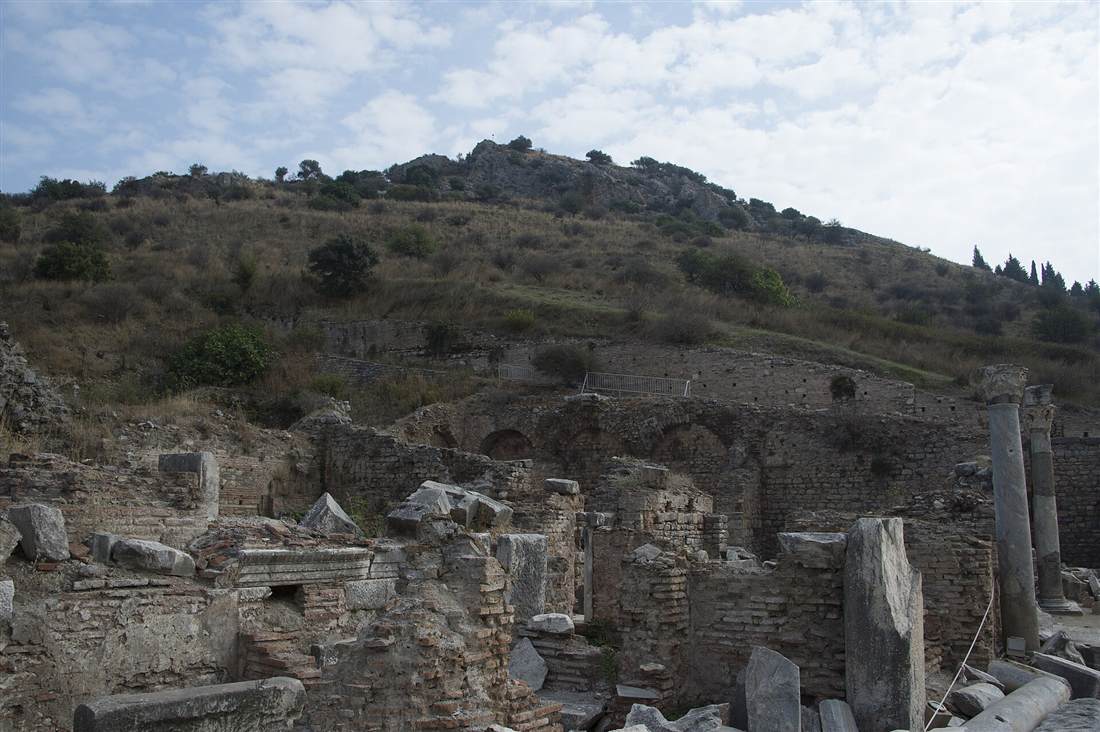
Today the brothel site presents ruined walls at knee to waist height, remnants of mosaic pavement in the rooms and corridors, the outline of the courtyard and its pool, and the worn footprint carving on the marble slab of the street outside, with the terrace houses rising on the slope opposite.
The standing remains define the ground plan rather than the elevation. Low walls of stone and brick trace the rooms around the central court, and the pool basin survives as a sunken rectangle in the paving. Sections of mosaic floor lie exposed within the block, and the finest recovered panels, including figures from the Four Seasons pavement, moved to the Ephesus Archaeological Museum in the nearby town of Selçuk for protection and display. The museum also holds erotic lamps and figurines from the quarter that flesh out the story on site.
The footprint slab draws the crowds. It rests in the pavement of Marble Street beside the corner block, and guides gather groups over it to trace the foot, the head and the accompanying symbols with a pointing stick. Heavy wear from centuries of feet and modern visitors has softened the lines, so a low raking light at the start or end of the day reads the carving best. Ropes and barriers restrict access to the mosaic areas while the street carving stays open to view underfoot.
The setting completes the visit. Across Curetes Street the terrace houses climb the hillside behind a modern protective roof, their painted walls and mosaic floors preserved to a standard that lets a visitor picture the domestic luxury of the same era as the brothel. The towering facade of the Library of Celsus stands a short walk to the south, and the columns of the Scholastica Baths and the bench-lined latrines survive immediately beside the corner house, so the whole hygienic-and-pleasure quarter reads as one connected group of ruins.
How does the brothel fit into a visit to Ephesus?
The brothel sits at the natural midpoint of the main walking route through Ephesus, on the corner between the Library of Celsus, the terrace houses and the Great Theatre. A standard tour reaches it after Curetes Street and before turning up Marble Street toward the theatre and the harbour gate.
The classic descent begins at the upper entrance by the state agora and the Odeon, then runs down Curetes Street past the Temple of Hadrian, the fountains and the terrace houses. The route arrives at the Library plaza, where the marble facade of the Library of Celsus and the adjoining Gate of Mazeus and Mithridates form the visual climax of the site. The brothel corner stands at the junction here, so a walker steps from the Library plaza to the footprint slab in moments and inspects the baths and latrines alongside.
From the corner the route turns north up Marble Street. This colonnaded avenue leads to the Great Theatre, the largest structure of Ephesus with a seating capacity in the tens of thousands, carved into the slope of Mount Panayır. Beyond the theatre the Arcadian Way once ran straight to the ancient harbour, now silted into a plain. Placing the brothel on this axis explains its commercial success in antiquity and its role in a modern visit alike, since the same central crossing that drew Roman traffic draws the visitor circuit today.
Practical planning frames the stop. The footprint carving and the corner house take a short pause within a half-day walk through the site, best combined with the terrace houses opposite, which carry a separate ticket, and with the Ephesus Archaeological Museum in Selçuk that holds the mosaics and figurines from the quarter. Early morning and late afternoon reward the visit with softer light on the marble and thinner crowds over the footprint slab, and sturdy footwear suits the worn, uneven paving of Marble Street and Curetes Street. Shade stays scarce along the open avenues, so water and sun protection matter through the warmer months, and a guide or an audio commentary at the corner turns the ruined walls and the carved slab into a readable chapter of the city’s story. Set within the walk between the Library, the terrace houses and the theatre, the brothel of Ephesus rounds out a portrait of Roman urban life in which commerce, hygiene, learning and pleasure shared one dense and busy quarter.
Frequently Asked Questions
What is the brothel of Ephesus?
The brothel of Ephesus is a Roman peristyle house beside the Scholastica Baths, at the corner of Marble Street and Curetes Street opposite the Library of Celsus. Its courtyard, pool and mosaic floors mark it as a bath-and-pleasure complex of the imperial city.
What is the footprint at Ephesus?
The footprint is a carving in the marble paving of Marble Street: a left foot, a woman’s head, a heart-shaped purse and a rectangle. Guides read it as a sign pointing to the love house across the street.
Where is the brothel on the Ephesus route?
The brothel stands at the foot of Curetes Street where it meets Marble Street, opposite the Library of Celsus. It sits on the walking route between the terrace houses, the library and the Great Theatre.