
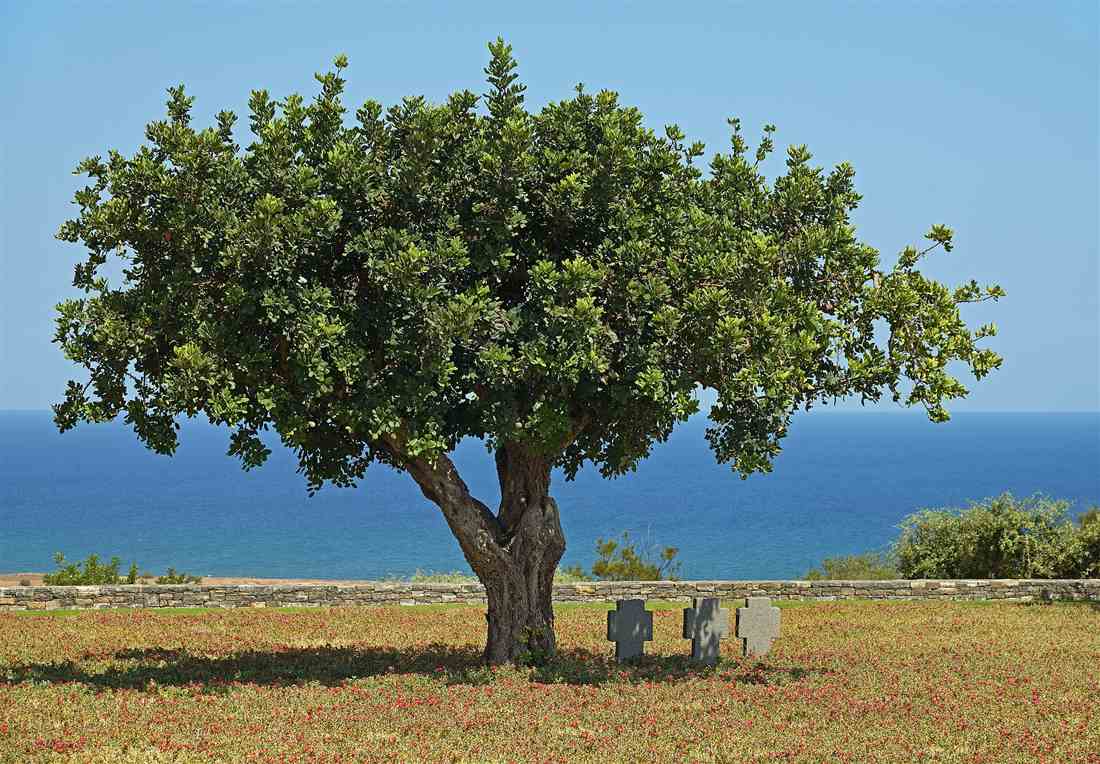
Maleme is a coastal village about 16 kilometres west of Chania in Crete, famous as the decisive site of the Battle of Crete, with its wartime airfield, Hill 107, the German war cemetery, and a long quiet beach. Plan the whole trip with Greece Tours.
This guide covers Maleme in full: what and where it is, the Battle of Crete and the airborne invasion, Hill 107 and the airfield, the German war cemetery, the wider war memory and the Souda Bay cemetery, the Minoan tholos tomb, the beach, the tavernas, where to stay, the Gonia monastery at Kolymbari, how to get there from Chania, the best time, and whether Maleme is worth visiting.
What is Maleme in Crete?
Maleme is a coastal village about 16 km west of Chania on the north coast of Crete, famous as the decisive site of the Battle of Crete. It holds a wartime airfield, a long sand-and-shingle beach and the German War Cemetery on Hill 107.
Maleme sits on the Kydonia coastal plain of western Crete, where the mountains draw back from the sea and leave a flat shelf of olive groves, citrus orchards and market gardens. The village strings along the old national road that runs west from Chania towards Kissamos, with a beach zone on the seaward side and farmland climbing towards the foothills of the Lefka Ori inland. The name reaches back into antiquity, and the ground beneath the modern settlement carries a Minoan tholos tomb that predates the wartime events by more than three thousand years.
The identity of Maleme rests on three anchors. The first is the beach, a broad stretch of open coast that joins the run of resort sand between Platanias and Kolymbari. The second is the airfield, laid on the flat ground beside the sea, which drew the fiercest fighting of the wartime airborne invasion and remains a Hellenic Air Force installation. The third is memory: Hill 107 above the runway holds the German War Cemetery, and the whole district reads as an open-air record of the Battle of Crete. Travellers reach it as a half-day trip from Chania, pairing the history with a swim.
Maleme forms part of the municipality of Platanias, the coastal belt that carries most of western Crete’s beach tourism. The village keeps a working-Cretan character rather than a resort-strip one: tavernas serve the farmers and fishermen alongside travellers, the church and cemetery sit close to family plots, and the airfield fence runs behind the seafront hotels. The plain grows tomatoes, avocados, oranges and olives, and the greenhouse rows glint white against the grey-green hills. This mix of farmland, open beach and battlefield gives Maleme a texture distinct from the packaged resorts a short way east.
Where is Maleme and how far is it from Chania?
Maleme lies about 16 km west of Chania on the north coast of Crete, a drive of roughly 20 to 25 minutes along the coastal road towards Kissamos. Frequent KTEL buses on the Chania-Kastelli line stop at the village, and Chania International Airport at Akrotiri is about 30 km east.
The route from Chania runs west out of the city, past the resort belt of Agia Marina and Platanias, and continues along the old national road that hugs the coastal plain. The distance measures close to 16 km, and the driving time holds near 20 minutes outside the summer traffic peak and closer to half an hour when the Platanias strip fills. A newer high-speed section of the north-coast road runs parallel inland and shortens the approach for drivers heading straight from the Chania bypass towards Kolymbari and Kissamos.
Public transport reaches Maleme without difficulty. The KTEL Chania buses that serve the Kastelli-Kissamos line run through the village throughout the day, departing from the central bus station in Chania and stopping on the main road beside the seafront. The ride takes about 30 minutes. Taxis from Chania cover the trip in around 20 minutes, and rental cars give the freedom to combine Maleme with the beaches further west at Falassarna and Balos in one loop.
For arrivals by air, Chania International Airport sits on the Akrotiri peninsula east of the city, about 30 km from Maleme by road. Souda, the port that receives the overnight ferries from Piraeus, lies a similar distance to the east. From either gateway the drive crosses Chania and follows the same coastal corridor west. Maleme therefore works both as a day trip from a Chania base and as a quiet coastal stay in its own right, within easy reach of the city’s Venetian harbour and the beaches strung along the western shore.
What happened at Maleme in the Battle of Crete?
Maleme was the decisive battleground of the wartime airborne invasion of Crete. German paratroopers and glider troops landed to seize the airfield and Hill 107 above it. The defenders held the high ground at first, and the loss of that hill opened the gate for reinforcement aircraft and turned the whole campaign.
In the Second World War, Crete became the target of the largest airborne assault attempted to that point. German parachute and glider forces descended on the north-coast airfields at Maleme, Rethymno and Heraklion, with Maleme as the western prize. The airfield beside the sea offered the invaders a landing ground for transport aircraft carrying mountain troops, artillery and supplies. New Zealand infantry, supported by Greek soldiers and Cretan civilians who took up arms, held the airfield perimeter and the commanding slope of Hill 107 that overlooks the runway.
The first day of the assault cost the airborne troops dearly. Gliders crashed under fire in the dry riverbed of the Tavronitis, paratroopers dropped into defended positions, and losses among the attackers ran high across the Maleme sector. The defenders held the hill through the night. A withdrawal from the crest, ordered under the confusion of broken communications and the belief that the position had become untenable, handed the high ground to the invaders without a renewed fight for it.
Control of Hill 107 gave the attackers observation over the airfield and cover for the transport aircraft that then poured in mountain troops. Once the reinforcement flow opened, the balance shifted west of Chania and the Allied line along the north coast unravelled. The defenders fell back over the White Mountains towards the south coast, and the evacuation from Sfakia followed. The fight for Maleme therefore stands as the hinge of the entire Battle of Crete: the western airfield decided the island, and the loss of one hillside decided the western airfield.
The wider campaign carried a heavier meaning than the ground it covered. The airborne force suffered such losses over Crete that the mass parachute drop was never repeated on that scale. The Cretan population resisted with a ferocity that fed a long occupation-era struggle, and the memory of the wartime invasion still shapes how the villages of the plain present their past to travellers.
What is Hill 107 at Maleme?
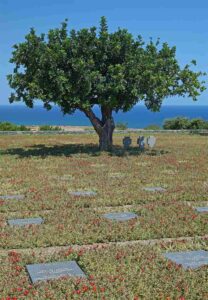
Hill 107 is the low, commanding rise directly above the Maleme airfield, named for its height in metres. Its slopes carried the fiercest fighting of the wartime battle, and its crest now holds the German War Cemetery. From the top the view spans the runway, the Tavronitis mouth and the open sea.
The hill takes its plain name from its elevation, a marker used on wartime maps. In tactical terms it dominates everything below: whoever holds the crest observes the airfield, the coast road, the riverbed of the Tavronitis and the approaches from every side. That command is the reason the airborne assault fixed on it, and the reason its defenders understood that the airfield stood or fell with the high ground. The struggle for these slopes decided the western sector of the Battle of Crete.
Today the hill reads as a place of quiet. The graded paths of the cemetery climb the terraced ground where the trenches and gun pits once lay, and interpretive markers trace the lines of the fighting. The summit gives a wide, level view over the airfield fence to the sea, the arc of the beach curving east towards Platanias and the grey ridges of the Lefka Ori standing behind the plain. Standing on the crest makes the ground legible in a way no map achieves: the flatness of the airfield, the exposure of the beach and the reach of the observation all fall into place at once.
Visitors reach Hill 107 by the signed road that turns inland off the coastal route at Maleme and climbs to the cemetery car park. The walk from the gate to the summit crosses the graves in their terraced rows and ends at the upper terrace. The hill rewards a slow visit, read together with the airfield below and the German War Cemetery that now covers its face.
What is the German War Cemetery at Maleme?
The German War Cemetery at Maleme covers the terraced slope of Hill 107 above the airfield and holds the graves of the paratroopers and airborne soldiers who fell in the wartime battle. Flat stone markers set in the grass name the dead, and the hilltop looks out over the runway and the sea.
The cemetery gathers the German dead of the airborne invasion onto the very ground they fought to take. The graves lie under low, flat plaques of grey stone laid flush with the terraced lawns, each naming the soldiers buried beneath. The design keeps the slope open and severe, without upright headstones, so the eye travels across the terraces to the airfield and the coast beyond. Cypresses and low planting frame the terraces, and a small entrance building carries the register and an account of the battle.
The setting gives the place its weight. The cemetery occupies the crest and upper face of Hill 107, the position whose loss opened the airfield to the invaders, so the ground and the graves tell one story. From the upper terrace the airfield lies flat below the fence line, the Tavronitis riverbed runs to the sea on the left, and the beach curves away to the east. The plaques record how young the dead were, and the number of them fixes the cost of the assault on the ground where it fell.
Visiting is free and the gate stays open through the day. The site asks for the quiet a cemetery deserves: level walking on graded paths, shade near the entrance and a register for those tracing a name. The German War Cemetery pairs naturally with the Commonwealth graves at Souda Bay to the east, and the two together frame both sides of the Battle of Crete for travellers following the wartime trail across the north coast.
What is the Maleme airfield today?
The Maleme airfield remains a Hellenic Air Force installation on the flat coastal ground beside the sea, on the site the wartime airborne assault fought to seize. It stays closed to the public as an active military base, though its runway and perimeter read clearly from Hill 107 and the coast road above.
The airfield holds the same strategic logic that drew the invaders: a level shelf of ground hard against the shore, west of Chania, with open approaches from the sea and the plain. The wartime landing ground grew into a permanent military aerodrome, and the site now serves the Hellenic Air Force. The fence runs behind the seafront, and the base stays off-limits to visitors, so the airfield is read from outside rather than entered.
The best vantage is Hill 107 directly above. From the cemetery terraces the whole airfield lies open below, and the relationship between the high ground and the flat runway that decided the battle becomes plain to the eye. The dry bed of the Tavronitis, where gliders crashed under fire during the assault, runs to the sea at the western edge of the field, and the old iron bridge that carried the coast road across the river survives as a wartime landmark near the airfield’s edge.
For travellers the airfield works as a fixed point in the landscape rather than a site to tour. Read together with the cemetery above and the beach alongside, it completes the picture of the Maleme sector: the sea on one side, the flat ground the invaders needed in the middle, and the commanding hill that decided who held it standing over both. The active status keeps the ground intact and closes the loop between the wartime map and the view on the ground.
Is there a Commonwealth or Allied memorial near Maleme?
Yes. The Souda Bay War Cemetery, about 20 km east of Maleme near the port of Souda, holds the Commonwealth graves of the Battle of Crete. It rests on a green terrace at the head of the bay and forms the Allied counterpart to the German cemetery on Hill 107.
The Souda Bay War Cemetery is maintained by the Commonwealth War Graves Commission and gathers the British, New Zealand, Australian and other Allied dead of the Crete campaign and the wider Mediterranean theatre. The graves stand in ranks of upright white headstones on a level lawn at the sheltered head of Souda Bay, backed by hills and looking across the water. The Cross of Sacrifice rises above the rows, and the register at the entrance lists the names for those following a family connection to the battle.
The setting contrasts with the German cemetery on its exposed hillside: Souda lies low and green by the water, calm and enclosed, where the other stands high and open over the airfield. Together the two sites frame the Battle of Crete from both sides, and travellers on the wartime trail read them as a pair. The drive between them follows the coast road east through Chania and out to Souda, about 20 km in total.
The wartime memory reaches beyond these two cemeteries into the villages of the plain. Monuments to the Cretan resistance, plaques marking drop zones and the old Tavronitis bridge all mark the western sector. Combined with the Allied graves at Souda and the German graves at Maleme, they let a visitor follow the whole airborne campaign across the north coast west of Chania in a single day.
What is the Minoan tholos tomb at Maleme?
The Minoan tholos tomb at Maleme is a large vaulted stone burial chamber near the village, built in the Late Bronze Age of the Minoan civilisation. Its corbelled dome and long entrance passage predate the wartime battle by more than three thousand years and mark the deep antiquity of the site.
The tholos is a beehive-shaped tomb: a circular chamber roofed by rings of stone that step inward until they close at the top, entered through a straight passage called a dromos. This form belongs to the Minoan and wider Aegean Bronze Age, when leading families were laid in monumental vaulted tombs. The Maleme example is among the substantial tholos tombs of western Crete, and its scale points to a settlement of standing on this stretch of the coastal plain long before Chania rose to prominence.
The tomb sits close to the modern village, a short distance from the sea and the airfield, so the Bronze Age monument and the wartime battlefield share the same ground. The stonework of the chamber survives well enough to read the corbelled construction and the line of the entrance passage, and the setting among olive groves keeps the antiquity legible. It records a Minoan presence on the Kydonia plain that runs parallel to the great palace sites of central Crete.
For travellers the tholos adds a further layer to Maleme. A visit that takes in the tomb, Hill 107, the cemetery and the airfield spans more than three thousand years on one coastal shelf, from Bronze Age burial to twentieth-century battlefield. The whole plain west of Chania carries this depth, and it pairs naturally with a swim along the run of open sand catalogued among the Chania beaches that stretch either side of the village.
What is Maleme beach like?
Maleme beach is a long, wide strip of pale sand and fine shingle that runs for nearly two kilometres along the Gulf of Chania, backed by tamarisk trees, edged by shallow warm water, and lined with organised sunbed rows beside long open stretches of empty shore.
The sand darkens towards the waterline where fine grey shingle mixes into it, and the seabed shelves out slowly, so the water stays waist-deep for a stretch before it drops. Tamarisk trees throw pools of shade across the back of the beach, and a paved seafront path threads behind the sunbeds past the tavernas. The Aegean here faces open north, so a light afternoon breeze lifts off the gulf and cools the sand through the hottest hours.
Two moods sit side by side on this shore. In front of the hotels and beach bars, straw parasols and paired loungers line up in tidy rows, with a small fee that a drink covers. A short walk in either direction the sunbeds thin out and the beach turns quiet and unstructured, a bare run of sand where a towel and an umbrella are the whole setup. That quiet stretch is Maleme’s signature: broad, uncrowded, and framed by the green ridge of Hill 107 rising behind the coast road.
The water reads clear and turquoise over the pale seabed, and the north exposure keeps it fresh through August. Beach bars rent paddle-boards and kayaks, a taverna or two puts tables right onto the sand, and a beach shower rinses the salt at the end of the day. The Tavronitis river mouth closes the beach at its western end, where the sand meets a spit of reed and pebble and the coast turns quiet enough for a long solitary walk at dusk.
What is there to do in Maleme today?
Maleme pairs a long quiet beach with dense Battle of Crete history: swim and sunbathe on the sand, walk the war sites on the ridge behind the village, follow the coast path to neighbouring beaches, and eat grilled fish and Cretan mezze at the seafront tavernas.
The beach fills the daylight hours. Swimming in the shallow warm gulf, an hour under a tamarisk, a paddle-board rented from a beach bar, and a slow lunch at a taverna make an easy full day. The seafront path links the sunbed rows to the open sand, and a short cycle west reaches the mouth of the Tavronitis river where the coast turns wild and birds work the shallows.
The history sits directly behind the sand. The green ridge over the village carries the ground where the airborne assault opened the Battle of Crete, and the coast holds the memorials that mark it. A morning on the beach and an afternoon walking the slopes turns a beach stop into something with weight. For a wider circuit of the region’s outings, the day trips from Chania reach west to Balos and Falassarna and south across the island from a base this close to the city.
Is Maleme good for families?
Maleme suits families well: the beach shelves out gently into shallow calm water safe for small children, the sand is wide with room to spread out, the village stays quiet and low-key after dark, and the tavernas serve simple plates children eat without fuss.
The gradient of the seabed is the deciding factor for young families. The water stays shallow well out from the shore, and on a still morning the gulf lies flat and clear, so toddlers paddle safely within sight of a parasol. The wide back of the beach gives space for sandcastles, ball games and a shaded base, without the crush of a resort strand.
Off the sand, Maleme keeps a slow rhythm that parents value. There is no loud nightlife strip and no traffic-choked promenade, just a scatter of tavernas, a mini-market or two, and the coast road. Apartments with kitchenettes and self-catering studios make the village practical for a family week, and the resort at the edge of the beach adds pools and organised activities for households that want them. The calm, the shade and the shallow water carry the family case.
Older children fold the war history into the trip as an outdoor history lesson. The ridge walk, the memorials and the bridge over the Tavronitis turn an afternoon into a lasting memory, and the flat coast road makes an easy family cycle west towards the river mouth. A day divided between the beach in the morning and the historic ground in the cooler late afternoon holds every age of a family through a full day at Maleme.
Where do you eat in Maleme?
You eat at the seafront fish tavernas on the beach road and the family-run village tavernas inland, where the tables carry grilled sea bream, fried calamari, Cretan dakos, wild greens, slow-cooked lamb and boiled goat, finished with raki and a plate of fruit that the kitchen sends out unasked.
The beachfront tavernas put the sea a few metres from the table. Grilled fish weighed at the counter, octopus dried on a line and charred over coals, prawns in tomato and feta, and a cold Cretan salad heaped with barley rusk, tomato and myzithra cheese make the standard seafront lunch. A carafe of village wine or a cold Mythos beer sits alongside, and the meal runs long into the afternoon shade.
Inland, the village kitchens lean on the Cretan mountain table. Antikristo lamb roasted upright by the fire, gamopilafo cooked in meat stock, snails in rosemary, stuffed courgette flowers and hand-rolled kalitsounia cheese pastries fill the menus, and the raki arrives free at the close of the meal. Prices inland run below the seafront, and the welcome is the plain, generous Cretan kind that keeps travellers coming back to the same table twice in a week.
Cretan olive oil sits at the heart of every plate, poured green and peppery over the dakos and the greens, pressed from the groves that climb the slopes behind the coast. Local honey with thyme, sheep’s-milk graviera cheese and the village bread round out the table, and a bowl of yoghurt with walnuts and honey closes the meal. The seafront and the village between them cover the full range of the western Cretan kitchen within a short walk of the sand.
Where do you stay in Maleme?
You stay in beachfront hotels along the coast road, in self-catering apartments and studios through the village, or at the large resort at the western end of the beach, using Maleme as a quiet, well-priced base a fifteen-minute drive west of Chania town.
The accommodation splits into three tiers. Small family-run hotels and pensions sit close to the sand with sea-view balconies and pools, priced below the equivalent in Platanias or Chania. Self-catering apartments and studios spread back through the village, the practical pick for a family or a longer stay, with a kitchenette, a car parked outside and the beach a short walk down. The resort at the edge of the beach anchors the top tier with pools, gardens and full board for travellers who want everything on site.
Maleme’s real draw as a base is its quiet and its position. The village stays calm after dark while Chania’s restaurants, harbour and old town wait sixteen kilometres east down a fast coast road. For a wider read of the region’s bases and how the coast compares with the town and the villages, the guide to where to stay in Chania sets Maleme against its neighbours along the gulf.
What is near Maleme to visit?
Near Maleme sit Platanias with its beaches and nightlife four kilometres east, Kolymbari and the Gonia Monastery a short drive west, the Balos lagoon out on the Gramvousa peninsula, and Chania old town with its Venetian harbour sixteen kilometres east.
East of Maleme the coast strings together the resort villages. Platanias rises on its rock four kilometres along, backed by a long beach and the liveliest strip of bars and tavernas west of the city. Agia Marina and its offshore islet of Theodorou follow, and the coast road runs on into Chania, where the Venetian harbour, the Egyptian lighthouse, the covered market and the maze of the old town fill a full day. The city hub at Chania lays out that ground in full.
West and south the landscape turns dramatic. Kolymbari marks the start of the Rodopos peninsula, the Gonia Monastery stands over the water on its edge, and beyond it the road climbs to the turning for Balos, the white-sand lagoon of turquoise shallows reached by boat from Kissamos or by a rough track and a walk. Falassarna’s sunset beach lies further west, and the gorge country of the White Mountains opens to the south. Maleme sits at the hinge of all of it.
What is the Gonia Monastery and Kolymbari near Maleme?
The Gonia Monastery is a fortified seventeenth-century Orthodox monastery set on the shore at Kolymbari, a fishing village and headland eleven kilometres west of Maleme where the Rodopos peninsula meets the gulf, home also to the Orthodox Academy of Crete beside it.
Gonia stands right at the water’s edge, its stone walls and red-tiled roofs facing the open sea, a working monastery with a church of the Panagia, an icon collection and a courtyard of cypress and flowers. Cannonball scars in the seaward wall record raids from the water in the centuries of its history. The Orthodox Academy of Crete rises on the slope beside it, a study and conference centre with gardens and a viewing terrace over the gulf. Modest dress covers shoulders and knees for entry to the church.
Kolymbari itself is a quiet fishing and beach village at the root of the Rodopos peninsula, with a pebble beach, a small harbour, tavernas over the water and a long stone jetty. It marks the western end of the string of coastal villages that runs from Chania through Maleme, and the turning point for the wild peninsula road to the church of Agios Ioannis and the track towards Balos. The drive from Maleme runs a straight quarter of an hour west along the coast.
How do you get to Maleme from Chania and the airport?
Maleme lies sixteen kilometres west of Chania town, a fifteen-to-twenty-minute drive on the coast road, and about thirty kilometres from Chania International Airport, a forty-minute drive east across the Akrotiri peninsula. Public buses, taxis and pre-booked transfers all serve the run.
By car the route is simple: the old national road hugs the coast west out of Chania through Kato Galatas, Agia Marina and Platanias straight into Maleme, and the newer highway runs parallel inland for a faster approach. A hire car is the freest way to reach the village and the base from which to work the beaches, monasteries and gorges of the west. Parking sits free along the beach road and through the village.
Without a car, the KTEL regional bus links Chania’s central station to Maleme on the frequent Kolymbari and Kastelli line, a low-cost ride that drops passengers on the coast road at the village. From the airport, a metered taxi or a fixed-price pre-booked transfer covers the forty-minute crossing to the coast, the smoothest door-to-door option with luggage. Transfers arranged ahead wait at arrivals and run straight to the accommodation.
The airport sits on the Akrotiri peninsula east of Chania, so the transfer skirts the edge of the city before joining the western coast road. The port of Souda, where the overnight ferries from Piraeus dock, lies a similar distance east, forty minutes from Maleme by road. Travellers arriving by sea pick up a hire car at the port or ride the KTEL bus into the Chania terminal and change onto the westbound coastal service.
When is the best time to visit Maleme?
Maleme peaks from June to September with hot, dry days, warm sea and every taverna and sunbed open. Late spring, early June and late September deliver the finest balance: warm water, thin crowds and lower prices, while the Battle of Crete commemorations fill the village and its cemetery in late spring.
High summer brings the classic Cretan beach conditions, daytime heat in the low thirties tempered by the north breeze off the gulf, a warm flat sea and long light evenings. July and August pull the largest crowds and the top prices, though Maleme’s long open sand absorbs them far better than the packed strands to the east. The shoulder months either side hold warm swimming water with more room on the beach and easier rates on rooms.
Late spring carries a distinct pull for this village. The commemoration of the Battle of Crete draws veterans’ families, delegations and pilgrims to Maleme’s ridge and the German war cemetery on the slope above the beach, and the ceremonies fill the calendar around the anniversary of the airborne assault. Travellers who come for the history time the visit to that week; travellers who come for the beach and the quiet aim for June or September and find the coast at its gentlest.
Is Maleme worth visiting?
Maleme is worth visiting for the traveller who wants Battle of Crete history and a long quiet beach in one place west of Chania. The dense war ground behind a wide uncrowded shore, cheap Cretan tavernas and an easy base near the city make it a rewarding stop.
The village earns its place on two counts. First, the history: nowhere on Crete concentrates the story of the airborne invasion as tightly as this ridge and coast, and standing on the ground behind the beach gives that story a weight no museum matches. Second, the beach: a broad, calm, shallow strand with room to breathe and shade at its back, the antidote to the crowded resort sand a few kilometres east.
As a base, Maleme balances quiet against reach. The village stays peaceful after dark, prices sit below the resort strip, and Chania’s harbour, the western beaches, the monasteries of the peninsula and the gorges of the White Mountains all lie within an easy drive. For a first Cretan visit built on beach and city, Chania town wins; for a traveller who wants history, calm sand and a genuine village, Maleme is a clear and rewarding choice.
The verdict lands firmly on the yes side. Few coastal villages on Crete fuse a landmark of twentieth-century history with a broad, gentle beach and an unspoilt village table, and fewer still put all of it a quarter of an hour from a city as complete as Chania. Maleme rewards the traveller who reads its ground as well as swims its water.
Frequently Asked Questions
What is Maleme in Crete?
Maleme is a coastal village about 16 kilometres west of Chania, Crete, best known as the decisive battleground of the Battle of Crete. Its airfield and Hill 107 saw the turning point of the airborne invasion, and the German war cemetery stands on the hillside above the sea.
What is there to see at Maleme?
Maleme holds the German war cemetery, Hill 107 and the historic airfield of the Battle of Crete, a Minoan tholos tomb, and a long quiet beach. The Gonia monastery at Kolymbari and the Platanias resorts lie a short drive away.
Is Maleme worth visiting?
Maleme rewards visitors drawn to the Battle of Crete, pairing the German war cemetery, Hill 107 and the airfield with a long quiet beach and the Gonia monastery nearby. It joins wartime history and a calm coast west of Chania.