
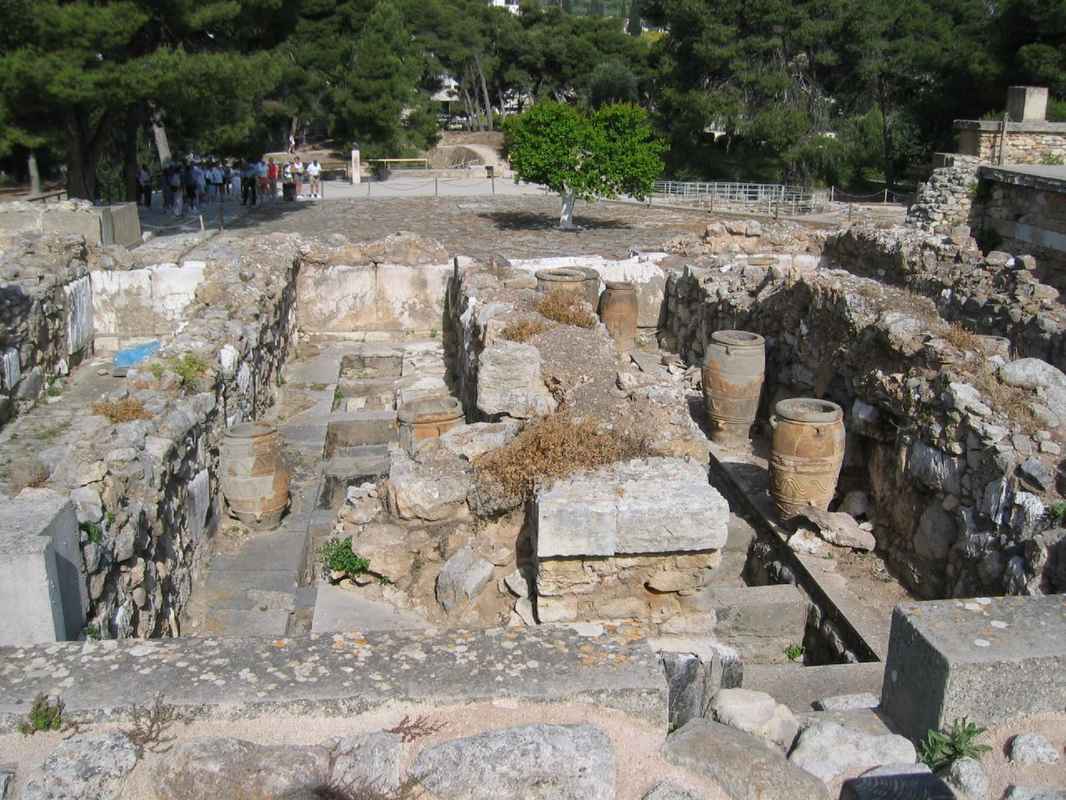
The pithoi of Knossos are the giant Minoan storage jars that filled the palace magazines with oil, wine and grain. Plan tickets and tours through My Greece Tours.
The pithoi and storage magazines are among the most telling features of the Palace of Knossos. The sections below cover what they are, what they held, where the magazines are, how the jars were made, how they were used in administration and how to see them.
What are the pithoi at Knossos?
The pithoi at Knossos are huge ceramic storage jars, the largest taller than a person, used by the Minoans to store the palace’s surplus of oil, wine, grain and other goods.
The pithoi at Knossos are large ceramic storage jars, among the most striking everyday objects to survive from the Minoan palace. Made of thick fired clay, the largest stand taller than an adult and could hold a great volume of liquid or grain. They were the principal containers in which the Palace of Knossos stored the agricultural surplus that underpinned its wealth and power, and rows of them once filled the palace’s storerooms. The word pithos, plural pithoi, is the Greek term for these outsized jars, and it is the name archaeologists still use for them across the Aegean.
These storerooms, known as magazines, were long narrow rooms lined with pithoi and with stone-lined pits in the floor for additional storage. Many pithoi survive in place at Knossos, still standing in the magazines where they were used thousands of years ago, which makes them one of the most evocative and tangible features of the site. They turn the abstract idea of a palace economy into something solid you can stand beside. They are one of the clearest reminders that Knossos was a working economic centre. It was that as much as a royal residence and a place of ceremony.
The jars vary widely in size and shape. The smallest are modest vessels that a single person could lift when empty. The giants were fixed installations, filled and emptied in place. A full jar of oil or grain would be far too heavy to move. Between these extremes sits a whole range of medium pithoi that made up the working stock of the magazines. This variety reflects the goods stored and the quantities the palace kept on hand. It also reflects a long tradition of jar-making on Crete. The pithos was one of the defining objects of the Minoan world. Our guide to the Knossos layout covers the storage wings, and the next section covers what the pithoi held.
What were the pithoi at Knossos used for?
The pithoi were used to store the agricultural surplus of the Minoan palace economy: olive oil, wine, grain, pulses and other produce.
The pithoi were the storage heart of the Minoan palace economy. Knossos operated a centralised system in which agricultural produce from the surrounding farms and estates, olive oil, wine, grain, pulses and other foodstuffs, was gathered into the palace, recorded by the administration and stored in bulk. The great pithoi were the main vessels for this, holding the oil and other goods that represented the wealth of the palace. Storage on this scale was not incidental to the palace; it was one of its central functions, alongside worship, craft production and government.
This stored surplus served a range of purposes. It fed the palace community and its workers, provided a reserve against poor harvests, supplied goods for trade and exchange, and gave the rulers the economic muscle that backed their authority. Olive oil in particular was hugely valuable, used as food, as fuel for lamps, and as a base for perfumes and ointments that were themselves traded across the eastern Mediterranean. Wine was both a staple and a prestige good, while grain and pulses were the everyday foundation of the diet.
The scale of the storage, hundreds of jars across the magazines, shows the sheer scale of the wealth that flowed through Knossos. Estimates based on the surviving jars and the length of the magazines suggest a storage capacity for oil alone large enough to have carried the palace and its dependent communities through periods of shortage. Controlling this surplus gave the palace real power over the surrounding region. It could feed workers and reward loyalty. It could fund building projects. It could trade for the raw materials Crete lacked, from metals to fine stone.
Different goods needed different jars. Oil and wine called for tall, narrow-mouthed pithoi that limited evaporation and spoilage. Grain and pulses suited wider vessels that were easy to fill and scoop from. Some jars had spouts or holes near the base to draw off liquid without lifting the whole vessel. The variety of shapes in the magazines reflects this careful matching of container to content. It shows a storage system worked out over generations, not thrown together. Our guide to Minoan trade covers the palace economy, and the next section covers where the magazines are.
Where are the storage magazines at Knossos?
The main storage magazines at Knossos run along the west side of the palace, behind the West Court, as a series of long, narrow parallel rooms opening off a corridor.
The principal storage magazines at Knossos are located along the west wing of the palace, behind the great West Court and the western facade. They take the form of a long series of narrow, parallel rooms opening off a north-south corridor, a layout designed to pack the maximum amount of storage into the palace. This west wing was one of the main economic zones of Knossos. It combined storage below with important ceremonial and administrative rooms above. The wealth of the palace was quite literally the foundation on which its government stood.
Within these magazines, rows of large pithoi stood along the walls, while the floors were often cut with stone-lined pits, known as kaselles, used to store additional goods, perhaps more valuable items, beneath movable covers. The west magazines are among the best-preserved and most atmospheric parts of the palace, giving a vivid sense of the scale of Minoan storage. Walking along the corridor, you look into room after room where the jars once stood in ordered ranks, a layout that speaks of careful planning and control rather than casual accumulation.
Storage was not confined to the west wing alone. There were further storage areas in other parts of the palace. Jars turn up across the site. Goods were kept close to where they were needed as well as in the central magazines. The position of the main magazines is telling. They stood beside the West Court, one of the great open gathering spaces of the palace. The surplus that fed the whole system was held at the symbolic and physical heart of Knossos. Our guide to the key features of Knossos covers the palace wings, and the next section covers how the pithoi were made.
How big are the pithoi and how were they made?
The largest pithoi at Knossos stand taller than an adult and were built up by hand in stages from coils of clay, then fired in sections or as a whole.
The pithoi of Knossos are remarkable feats of pottery, especially the largest examples, which stand taller than a person. Such giant jars could not be thrown on a wheel in one piece. Instead they were built up by hand in stages. The potter used thick coils or slabs of clay added in rings, left each to firm up before the next, then fired the whole. Producing and firing a jar of this size without it cracking was a real technical achievement. It demanded an experienced potter, a well-managed kiln and a good grasp of how thick clay behaves as it dries and bakes.
Many pithoi are decorated with raised bands modelled to look like ropes, along with other relief patterns and rows of handles. This rope-pattern decoration was partly practical: the ridges strengthened the thick walls and the bands echoed the real ropes that were slung around the jars to move and secure them. The handles, often arranged in horizontal rows around the body, allowed ropes to be threaded through for lifting, tilting or lashing the jar in place. Form and function ran together. A well-made pithos was both a sturdy container and a handsome object.
Keeping the contents safe mattered as much as the jar itself. The mouths were closed with lids of clay or stone, or sealed with clay to keep out air, moisture and pests. A sealed lid could be stamped, tying the jar to the palace records. Some jars sat in shallow settings or against low walls that held them upright and steady. Grain was often stored dry and shaded to slow spoilage. Rows of jars were arranged for easy access along the magazine walls. These small details show that storage at Knossos was a considered craft in its own right, not simply a matter of filling a pot.
The combination of huge size, sturdy construction and bold decoration makes the pithoi distinctive works of Minoan craft as well as functional containers. Their production points to specialist workshops able to make large vessels in quantity, and to a supply chain that could deliver them to the palace and keep the magazines stocked. In this sense the humble storage jar is evidence of a whole organised craft economy standing behind the palace, from the potters and their kilns to the labourers who filled and emptied the jars season after season.
The jars were also only one part of a wider system of storage and record-keeping. The palace administration tracked the goods that flowed into and out of the magazines. Scribes used clay tablets and small clay sealings stamped with engraved seals. These records let the palace know what it held, what it had received and what it had handed out. That turned the physical store of oil and grain into a managed reserve rather than a simple heap of goods.
Officials recorded quantities, monitored the harvest and issued rations and allocations. In this way, produce gathered from a wide area could be redistributed to feed workers, support craftsmen and back the authority of the rulers. The jars held the wealth; the records controlled it. Our guide to Minoan pottery covers the ceramics, and the next section covers how to see the pithoi today.
Can you see the pithoi at Knossos today?
Yes, you can see rows of pithoi at Knossos today, still standing in the west magazines and other storerooms where they were used.
The pithoi are one of the highlights you can see on a visit to Knossos. Many survive in place in the west magazines and other storage areas, standing in rows just as they did in the Minoan palace, which makes them one of the most tangible and memorable features of the site. Walking past these towering jars gives an immediate sense of the scale of the palace economy. Ruined walls alone cannot do that. It is one of the moments on a visit when the distant Bronze Age suddenly feels close and real.
For the finest decorated examples, and for smaller storage and transport jars, the Heraklion Archaeological Museum displays a superb collection, including beautifully patterned pithoi and other pottery from Knossos and across Minoan Crete. Seeing the jars in place at the palace and the decorated examples in the museum together gives the fullest picture. The site shows you where and how they stood. The museum lets you study the craft and decoration up close. A discounted combined ticket covers both the palace and the museum, so it is easy to see the two on one trip.
The storage system is central to understanding why Knossos was so wealthy and powerful. A guide or audio guide helps bring the magazines and their giant jars to life. It explains what the pithoi held, how the goods were recorded and why this mattered so much to the palace.
More than almost anything else at Knossos, the pithoi make the palace economy real. Frescoes and thrones speak of power and ceremony. Yet it was the contents of these towering jars, the oil, the wine and the grain, that paid for it all. Stand in the dim west magazines among rows of jars taller than yourself, and you sense the true engine of the palace. It was not conquest, but the patient gathering, storing and sharing out of a region’s harvest. Plan your visit and tours through our Palace of Knossos guide.
Frequently Asked Questions
What are the pithoi at Knossos?
The pithoi at Knossos are large ceramic storage jars, among the most striking everyday objects to survive from the Minoan palace. Made of thick fired clay, the largest stand taller than an adult and could hold a great volume of liquid or grain. They were the principal containers in which the palace stored the agricultural surplus, olive oil, wine, grain and other produce, that underpinned its wealth and power. Rows of pithoi once filled the palace’s storerooms, known as magazines, long narrow rooms lined with jars and with stone-lined pits in the floor for extra storage. Many survive in place today, making them one of the most tangible features of the site.
What were the pithoi used to store?
The pithoi were used to store the agricultural surplus of the Minoan palace economy: olive oil, wine, grain, pulses and other produce gathered from the farms and estates around Knossos. The palace ran a centralised system in which goods were collected, recorded by the administration and stored in bulk in the great jars, then redistributed. This stored surplus fed the palace community and its workers, provided a reserve against poor harvests, supplied goods for trade, and gave the rulers the economic power that backed their authority. Olive oil in particular was hugely valuable, used as food, as fuel for lamps and as a base for perfumes and ointments.
How were the giant pithoi made?
The giant pithoi of Knossos were too large to be thrown on a potter’s wheel in one piece, so they were built up by hand in stages. The potter used thick coils or slabs of clay added in rings, letting each section firm up before adding the next, gradually raising the towering jar, which was then carefully fired. Producing and firing a vessel of this size without it cracking was a real technical achievement of Minoan craft. Many pithoi are decorated with raised bands modelled to look like ropes, along with other relief patterns and rows of handles. This rope-pattern decoration was partly practical, since the ridges strengthened the thick walls and echoed the real ropes slung around the jars to move and secure them.
Where can you see the pithoi at Knossos?
You can see many pithoi in place at the Knossos site itself, especially in the west magazines, where rows of jars still stand where they were used in the Minoan palace. For the finest decorated examples and smaller storage and transport jars, the Heraklion Archaeological Museum in the nearby city displays a superb collection of pottery from Knossos and across Minoan Crete. Seeing both the jars in their setting at the palace and the decorated pieces in the museum gives the fullest picture of Minoan storage and craft. A discounted combined ticket covers both the site and the museum, and a guide or audio guide helps explain what the magazines and their jars reveal about the palace economy.
How much could the pithoi and magazines store?
The storage capacity of Knossos was large enough to hold the surplus of a wide surrounding region. The west magazines alone held rows of large pithoi. Estimates based on the surviving jars and the length of the storerooms suggest a large capacity for oil. It was substantial enough to have carried the palace and its dependent communities through lean years. Stone-lined pits in the magazine floors added still more space. This scale of storage was one of the foundations of the palace’s wealth and power. The stored oil alone represented a fortune, since oil served as food, fuel and the base for traded perfumes. Filling and guarding these magazines was, in effect, filling the treasury of Knossos.