
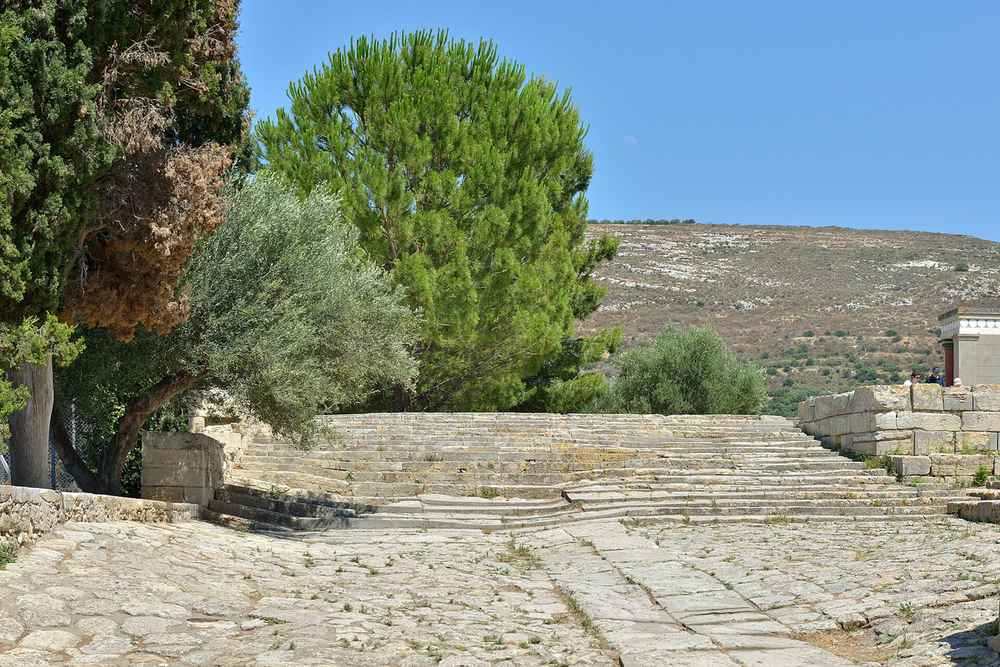
The Theatral Area at Knossos is a stepped open space at the end of the Royal Road, sometimes called the oldest theatre in Europe. Plan tickets and tours through My Greece Tours.
The Theatral Area is one of the distinctive public spaces of the Palace of Knossos. The sections below cover what it is, what it was used for, where it is, whether it was a true theatre and how to see it.
What is the Theatral Area at Knossos?
The Theatral Area at Knossos is a rectangular open paved space bordered on two sides by broad shallow steps that could hold standing spectators.
The Theatral Area sits at the northwest corner of the palace as a distinctive open-air court. It is a rectangular paved space, and two of its sides are lined with flights of broad, shallow stone steps. These steps are too wide and low to serve as comfortable seats, so scholars read them as tiers where spectators stood. The crowd looked down onto the paved area below, in the way visitors watch from the standing terraces of a stadium. A raised walkway and a small bastion-like structure also belong to the complex, framing one corner of the court.
This layout of a performance space overlooked by tiered standing room gives the Theatral Area its enduring nickname. Writers call it one of the oldest theatres, or theatre-like structures, in Europe, since it predates the famous Greek theatres by roughly a thousand years. The court sits at the end of the Royal Road, the ceremonial approach to the palace. That setting marks it clearly as a place of public gathering and display. Our guide to the Knossos layout covers the public spaces, and the next section covers what the area was used for.
What was the Theatral Area used for?
The Theatral Area is thought to have been used for public ceremonies, religious processions, ritual dances and performances, watched by crowds standing on the stepped tiers.
The Theatral Area is generally read as a place for public ceremonies rather than for everyday activity. Its plan pairs a paved performance space with tiered standing room, pointing to events that a crowd came to watch. Religious processions, ritual dances and formal ceremonies fit that setting well. Such display sat at the centre of the religious and social life of the Minoan palace. The court gave the community a fixed place to assemble, and the raised tiers let a wide crowd share the same view of the action.
Its position at the end of the Royal Road strengthens this reading. Processions and visitors approaching the palace along that ceremonial route arrived first at the Theatral Area. The court could then serve as a grand reception and assembly point, where the community gathered and important rituals or welcomes were staged. Minoan art, including frescoes, shows crowds watching dances and ceremonies, which matches the idea of the court as a stage for spectacle. The exact events are not recorded, yet the ceremonial, public role is widely accepted.
The link between the court and the wider palace supports this picture too. The Theatral Area faced the northern part of the complex, where formal entrances and storerooms lay close at hand. A gathering here could flow into the palace or spill out toward the town along the road. This made the court a threshold as much as a stage, a place where the world of the palace met the world of the settlement. Ceremony at such a threshold carried weight, marking arrivals, departures and the seasonal rites that bound the community together. Our guide to Minoan religion covers the rituals, and the next section covers where the area and the Royal Road are.
Where is the Theatral Area and the Royal Road?
The Theatral Area lies at the northwest corner of the Palace of Knossos, just outside the main building.
The Theatral Area is located just outside the northwest corner of the main palace building, on the approach to the complex. Leading away from it is the Royal Road, a remarkable paved Minoan street. Writers often describe this road as one of the oldest in Europe. It ran northwest from the palace area toward the Minoan town and the route that reached the harbour. The court and the road together mark the edge where the palace met the settlement around it.
The Royal Road is flanked by the stone foundations of houses and workshops. These remains give a clear sense of the busy Minoan settlement that surrounded and served the palace, not just the grand building itself. Walking the surviving stretch of the road toward the Theatral Area recreates, in part, the ceremonial approach that ancient visitors and processions once took. Together the Royal Road and the Theatral Area form a striking ensemble of Minoan public and civic space.
The road also carries wider significance for how we picture early Europe. Its careful paving and drainage show a society that planned its streets, not merely its palaces. A processional route running from the town to a stepped gathering court speaks of organised public life on a grand scale. This is why a great number of visitors find the road as memorable as the palace rooms themselves. It connects the ceremonial court to the daily rhythm of a working Minoan town.
Orientation on the ground is straightforward once you reach the northwest corner. The court opens where the palace wall steps back, and the road strikes out from it in a clear straight line. Following that line takes you past the house foundations toward the edge of the excavated area. Standing at the foot of the tiers, you face the paved court, with the palace rising behind you and the road running away ahead. Holding this simple layout in mind turns a scatter of low walls into a legible ceremonial space. Our guide to the key features of Knossos covers the surroundings, and the next section covers whether the area was a true theatre.
Was the Theatral Area really a theatre?
The Theatral Area was not a theatre in the later Greek sense, with a stage and curved seating for drama. It was an open ceremonial space with stepped standing tiers for watching processions and rituals.
The Theatral Area was not a theatre in the way we usually understand the word. The later Greek and Roman type used a semicircle of tiered seats facing a stage built for plays. Knossos predates Greek drama by around a thousand years, and no stage survives here. There is also no sign of seating designed for an audience watching theatrical performances. The label oldest theatre in Europe is therefore a popular description rather than a precise one, useful as a hook but loose in its detail.
What the Theatral Area shares with a theatre is the basic idea of a defined performance space overlooked by tiers. From those tiers an audience watched, standing on broad steps rather than sitting in rows of seats. The events they watched were ceremonial and religious, such as processions, dances and rituals, not scripted drama. So the court is best understood as a Minoan ceremonial viewing space whose form anticipates the theatre. Reading it that way makes the popular nickname more meaningful. Our guide to the Palace of Knossos covers the wider site, and the next section covers how to see the Theatral Area.
When was the Theatral Area at Knossos built?
The Theatral Area belongs to the Neopalatial period, the great palace age of Knossos in the mid-second millennium BC, though the site had been a place of gathering since earlier phases.
The Theatral Area took its known form during the Neopalatial period, the second great age of the Minoan palaces. That phase falls in the mid-second millennium BC, in the centuries around the sixteenth and fifteenth centuries BC. The palace of Knossos reached its fullest and most elaborate shape in this era, and its public spaces were laid out on a grand scale. The stepped court fits that ambitious building programme, matching the size and formality of the rest of the complex.
The area sits within a longer story of building and rebuilding at Knossos. Earlier palace phases had already shaped this corner of the site as a place of assembly, and later work refined it. Minoan builders often reworked older structures rather than clearing them away, so the court as visitors see it reflects several stages of construction. This long history explains why the Theatral Area feels woven into the fabric of the palace rather than added as a separate monument. It grew alongside the Royal Road and the northern entrance as the ceremonial face of Knossos.
The wider context helps fix the date in the mind. The Neopalatial period was the golden age of Minoan Crete, when the island held rich palaces at Knossos, Phaistos, Malia and Zakros. Trade, art and writing flourished, and the palaces coordinated the economy of their regions. A ceremonial court like the Theatral Area belongs naturally to that confident world. It expressed the power of the palace to gather its people and to stage the rites that held their society together. Set against this backdrop, the stepped court reads as a product of a mature and organised civilisation rather than a rough early experiment.
Dating the court precisely is difficult, as across most of Bronze Age Crete. The Minoans left no written records that name their monuments, so archaeologists rely on pottery styles and building layers to place the work in time. The stepped court belongs firmly to the palace age, when Knossos dominated central Crete and traded across the Aegean. Its scale and finish match the confidence of that period. Reading the court in this frame helps visitors see it not as an isolated ruin but as part of a flourishing palace at the height of Minoan power.
Who discovered the Theatral Area at Knossos?
The Theatral Area was uncovered by the British archaeologist Sir Arthur Evans during his excavation of Knossos, which began at the very start of the twentieth century, and it was Evans who gave it its name.
Sir Arthur Evans led the excavation that brought the Theatral Area back to light. He began digging at Knossos in the first year of the twentieth century, uncovering the palace over more than two decades of following seasons. Evans recognised the stepped court as a distinct public space and gave it the descriptive name Theatral Area. His choice of word reflected how the tiers reminded him of later theatres, even though he knew the court was far older than Greek drama.
Evans shaped how the world sees Knossos, and his interpretations still colour the popular story of the site. He reconstructed parts of the palace and named its spaces, from the throne room to this stepped court. Some of his readings remain debated among scholars, yet his labels have largely stuck. The name Theatral Area is one of the most durable of them, carrying his sense that the Minoans had created a place for watching public ceremony centuries before the classical theatre appeared.
Evans worked alongside a wider team that recorded and drew the discoveries in careful detail. Architects, artists and local workers helped map the palace and restore its fallen walls. The stepped court was cleared, planned and published as part of this effort, which fixed its place in the story of European archaeology. Because of that work, the Theatral Area became a fixed point in guidebooks and scholarship rather than a forgotten ruin. Its enduring fame owes as much to how it was excavated and presented as to the ancient builders who first laid its steps.
Can you see the Theatral Area at Knossos today?
Yes, you can see the Theatral Area and the Royal Road at Knossos today, at the northwest corner of the site.
Yes, the Theatral Area is one of the features you can see on a visit to Knossos, at the northwest corner of the site. The rectangular paved court and its two flights of broad steps survive well. It is easy to picture spectators standing on the tiers to watch processions and ceremonies in the space below. The adjoining stretch of the Royal Road can also be walked, with the foundations of houses and workshops still visible alongside it. Together these features let you read the corner as a living piece of the Minoan town.
Sitting a little away from the central court, the Theatral Area and Royal Road are often quieter than the heart of the palace. That makes them a calmer and quite atmospheric corner of the visit, especially welcome when the main rooms are busy. To get the most from them, it helps to understand their ceremonial role and the debate over the oldest-theatre label. A guide or audio guide adds a great deal here, giving the steps and the road their meaning. Together they round out the picture of Knossos as a living town as well as a palace. Plan your visit and tours through our Palace of Knossos guide.
Frequently Asked Questions
What is the Theatral Area at Knossos?
The Theatral Area at Knossos is a distinctive open-air space at the northwest corner of the palace: a rectangular paved court bordered along two of its sides by flights of broad, shallow stone steps. These steps were too wide and low to be comfortable seats, so they are usually understood as tiers on which spectators stood to watch whatever took place in the paved area below. This arrangement of a performance space overlooked by tiered standing room means the Theatral Area is often called one of the oldest theatres, or theatre-like structures, in Europe, predating the famous Greek theatres by many centuries.
What was the Theatral Area used for?
The Theatral Area is generally interpreted as a place for public ceremonies and gatherings rather than everyday activity. The arrangement of a paved performance space overlooked by tiered standing room points to events that a crowd came to watch: religious processions, ritual dances, ceremonies and other forms of public display central to the religious and social life of the Minoan palace. Its position at the end of the Royal Road strengthens this reading, because processions and visitors approaching along that ceremonial route would arrive at the Theatral Area, which could serve as a grand reception and assembly point where the community gathered and important rituals or welcomes were staged. Minoan art, including frescoes showing crowds watching dances and ceremonies, fits this idea.
Is the Theatral Area the oldest theatre in Europe?
The Theatral Area at Knossos is often called one of the oldest theatres in Europe, but the label is a popular description rather than a precise one. It was not a theatre in the later Greek or Roman sense, with a semicircle of tiered seats facing a stage built for plays, and Knossos predates Greek drama by around a thousand years. What the Theatral Area shares with a theatre is the basic idea of a defined performance space overlooked by tiers from which an audience watched, in this case broad steps for standing spectators rather than seats for a seated audience. The events watched were ceremonial and religious, such as processions and ritual dances, not drama.
What is the Royal Road at Knossos?
The Royal Road is a paved Minoan street that leads away from the Theatral Area at the northwest corner of the palace, often described as one of the oldest roads in Europe. It ran northwest from the palace area toward the Minoan town and the route that reached the harbour, linking the ceremonial heart of Knossos with the settlement and the sea beyond. Stone foundations of houses and workshops flank the surviving stretch, giving a vivid sense of the busy Minoan community that surrounded the palace. Processions approaching along this road would have arrived at the Theatral Area, so the two features are best understood together as a single ceremonial approach and gathering space.
How big is the Theatral Area at Knossos?
The Theatral Area is a modest but carefully planned court rather than a vast arena, with its two flights of broad steps meeting at a corner to frame a rectangular paved space. Estimates for how large a crowd the stepped tiers could hold vary, but a figure of roughly five hundred standing spectators is often given as a reasonable sense of its capacity. That scale suits a place meant for community ceremony and reception rather than for mass entertainment. The steps were designed for standing rather than seating, so the court could gather a sizeable crowd in a compact footprint, letting a wide crowd share a clear view of processions and rituals in the paved area below.