
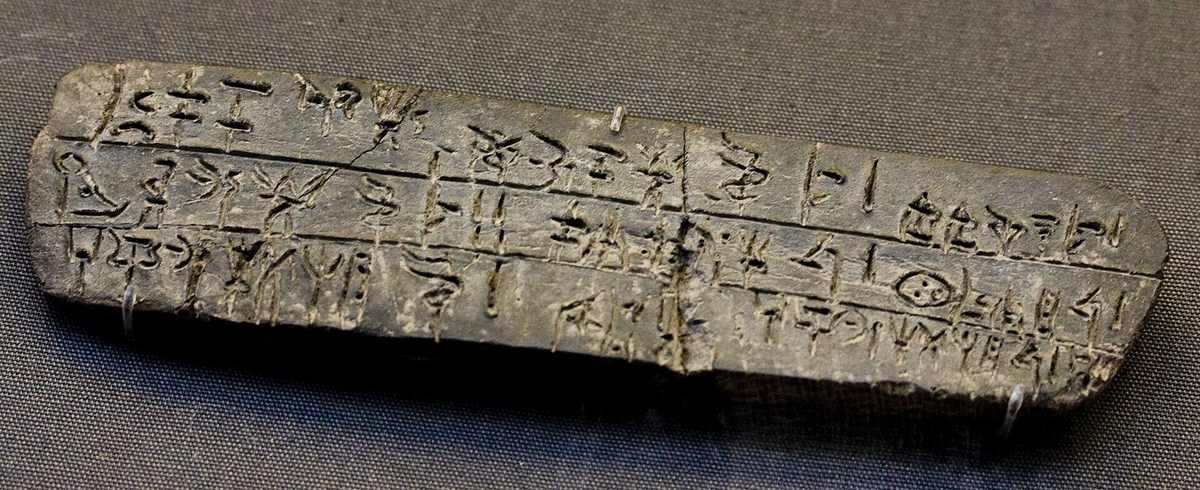
Linear A is the undeciphered writing system of the Minoans, used at Knossos and across Crete to record an unknown language. Plan tickets and tours through My Greece Tours.
Linear A is one of the great mysteries connected with the Palace of Knossos and Minoan civilisation. The sections below cover what it is, what it recorded, how many signs it has, who discovered it, what language it wrote, why the words stay unread, how it differs from Linear B and where it has been found.
What is Linear A?
Linear A is the main writing system of the Minoan civilisation, a Bronze Age script used on Crete to record an unknown language now called Minoan.
Linear A is the principal writing system of the Minoan civilisation, the Bronze Age culture centred on Crete that built the Palace of Knossos. It is called linear because its signs are drawn as lines, scratched or written rather than pressed in as wedges, and it was the everyday script of the Minoans during the height of their palace civilisation. The system is a mixed one: it combines linear signs that stand for syllables with separate ideograms that stand for commodities or goods, and with its own signs for numbers and fractions. This makes it a syllabary supported by logograms and a numerical notation, the standard shape of an administrative script.
Linear A survives mainly on clay tablets, but also on a range of other objects, from stone offering tables and dedicatory vessels to pottery, seals and metal items. It records an unknown language, usually called Minoan or Eteocretan, which is not Greek and has no proven relatives. Despite more than a century of scholarly effort since its discovery at Knossos, Linear A remains undeciphered: scholars can identify and even sound out many signs, but cannot understand the language they spell. Our guide to Linear B at Knossos covers the related later script, and the next section covers what Linear A recorded.
What was Linear A used for?
Linear A was used mainly for administration: the Minoan palaces recorded goods, produce, livestock and transactions on clay tablets. It also appears on religious objects, but the surviving texts are dominated by economic accounting.
Linear A was used above all for administration and record-keeping by the Minoan palace economy. The surviving clay tablets are mostly economic documents: lists and accounts recording quantities of goods, agricultural produce, livestock, textiles and other commodities, alongside the numbers and the ideograms for the goods being counted. The palaces, including Knossos, ran complex centralised economies. Linear A was the tool that tracked the flow of goods in and out of their great storerooms. It tallied what came in, what was stored and what was distributed to workers and workshops.
Beyond the account tablets, Linear A also appears on religious and dedicatory items such as stone offering tables and vessels. There the short inscriptions suggest a ceremonial or votive use, perhaps naming a deity, a dedicator or an offering. Even so, the bulk of the surviving corpus is administrative. That both reflects how the script was mainly used and, frustratingly, limits the kind of text available for decipherment. There are no long narratives, laws or letters, only short economic entries. Our guide to Minoan trade covers the palace economy, and the next section explains how many signs the script contains.
How many signs does Linear A have?
Linear A has roughly ninety syllabic signs, plus a set of ideograms for commodities and separate signs for numbers and fractions. It was written from left to right, the same direction as its descendant Linear B.
Linear A is a syllabary of about ninety core signs, each standing for a syllable rather than a single letter or a whole word. On top of this syllabic core sit two further categories of sign. The first is a group of ideograms, or logograms, that stand directly for commodities such as grain, oil, wine, animals or vessels, so a scribe could mark what was being counted without spelling it out. The second is a numerical system, with signs for units, tens, hundreds and thousands, together with a distinctive set of fraction signs.
This structure, a modest inventory of syllabic signs supported by ideograms and numbers, is typical of the Aegean and Near Eastern administrative scripts of the Bronze Age. Because there are only around ninety syllabic signs, Linear A cannot be an alphabet, which would need far fewer. Nor is it a purely logographic system, which would need hundreds or thousands of signs. Writing runs from left to right. The same broad sign shapes and directional habit carry over into Linear B, one of the clearest hints that the two scripts belong to a single family. The next section covers who first discovered and named Linear A.
Who discovered and named Linear A?
Sir Arthur Evans discovered Linear A during his excavations at Knossos, alongside the later Linear B. It was Evans who named both scripts, calling them linear to distinguish them from an earlier Cretan picture writing.
Linear A was first identified by the British archaeologist Sir Arthur Evans while he was excavating the Palace of Knossos. Among the tablets and inscribed objects he uncovered, Evans recognised more than one system of writing and set out to classify them. He distinguished an earlier pictographic or hieroglyphic Cretan script from two later systems of linear signs, which he labelled Linear A and Linear B. The word linear captured the essential character of both: signs made of drawn lines rather than pictures or wedge-shaped strokes.
Evans understood that Linear A was the older of the two linear scripts and that Linear B developed from it, though in his lifetime neither could be read. His classification has held up remarkably well and is still the framework scholars use today. The tablets he found at Knossos, together with material from other Cretan sites, form the foundation of the surviving corpus, and a large part of it is now displayed in the Heraklion Archaeological Museum. Evans thus gave the world both the names and the first large body of evidence for Minoan writing. The next section covers what language Linear A actually recorded.
What language did Linear A record?
Linear A recorded an unknown language, usually called Minoan or Eteocretan. It is not Greek and has no proven relatives among known language families, which is the core reason the script cannot be understood.
Linear A recorded the language of the Minoans, a tongue that scholars call Minoan or, in its later survivals, Eteocretan, meaning true or original Cretan. Crucially, this is not Greek. When the Mycenaean Greeks later adapted the script into Linear B, the underlying language changed to an early form of Greek, but Linear A itself preserves the speech of the pre-Greek population of Crete. Because that language died out and left almost no other trace, we have no dictionary, grammar or living descendant to compare it against.
Attempts have been made to link Minoan to a range of known language families, but none has won general acceptance, and the honest scholarly position is that it remains unclassified. This is very different from the situation with Linear B, where the recovered words turned out to be recognisable Greek and could be checked against everything already known about the Greek language. With Linear A there is no such anchor: even where signs can be sounded out, the resulting words connect to nothing familiar. The unknown language, more than the script itself, is the true obstacle, as the next section explains.
Traces of the pre-Greek tongue seem to survive into later periods in the form scholars call Eteocretan, written in the Greek alphabet on inscriptions from eastern Crete but still not understood. If Eteocretan is indeed a late descendant of the Minoan language, it confirms that a non-Greek speech held on in pockets of the island long after the palaces fell. Even so, those later texts are too short and too few to unlock Linear A. The Minoan language remains an isolate for now, a tongue known only through the silent signs on the tablets and the puzzle it leaves behind.
Why can scholars read the signs but not the words?
Scholars can sound out many Linear A signs by borrowing values from the deciphered Linear B, and can read its numbers, but the underlying Minoan language is unknown and there is no bilingual text, so the words carry no meaning.
The strange position of Linear A is that its signs can be pronounced but not understood. Linear A and Linear B share sign shapes, and Linear B has been read as Greek. So scholars can transfer probable sound values from B back to A and effectively say the Minoan words aloud. The numbers, the fractions and the accounting structure are also clear. We can therefore see that a tablet lists quantities of something. What we cannot do is grasp what the sounded-out words mean, because the language behind them is unknown.
Several factors keep Linear A unread even after more than a century of study. The surviving corpus is relatively small and dominated by short administrative lists rather than long, varied texts that would reveal grammar and vocabulary. There is no bilingual inscription, no Rosetta Stone pairing Minoan with a known language to unlock it. And the Minoan tongue has no proven relatives to supply comparisons. Until a longer text, a bilingual, or a firm language identification appears, Linear A is likely to keep its secret. Our guide to Minoan civilisation covers the wider culture, and the next section covers how Linear A differs from Linear B.
How does Linear A differ from Linear B?
Linear A is the older Minoan script that records an unknown language and remains undeciphered, while Linear B is a later adaptation used by the Mycenaean Greeks to write early Greek, and it was deciphered in the twentieth century.
Linear A and Linear B are closely related but importantly different scripts. Linear A is the older system, the writing of the Minoans, used during the height of their palace civilisation to record their own unknown language. Linear B is a later script that developed out of Linear A when the Mycenaean Greeks took control of Knossos and Crete. They adapted the existing Minoan signs to write their own language, an early form of Greek. They kept most of the sign inventory but bent it to a new tongue. The two therefore look alike on the tablet, yet speak two different languages.
The crucial difference lies in decipherment. Linear B was famously deciphered in the twentieth century by Michael Ventris and John Chadwick, who showed that it recorded Greek and opened a window onto Mycenaean palace administration. Linear A, by contrast, remains undeciphered, because the Minoan language it records is unknown, even though the two scripts share a large part of their sign inventory. So the same broad system of writing spans two civilisations and two languages: one read, one still silent. The relationship between them is central to understanding both the Minoans and the Mycenaeans at Knossos. Our guide to the Minoans and Mycenaeans covers the two peoples, and the next section covers where Linear A has been found.
Where has Linear A been found?
Linear A was first found at Knossos and has since been discovered across Minoan Crete, at palaces, villas and sanctuaries, and beyond the island on Aegean islands and around the eastern Mediterranean through Minoan trade.
Linear A was first discovered at Knossos by Sir Arthur Evans during his excavations of the palace, alongside the later Linear B. Since then, Linear A has been found across Minoan Crete, at the other palaces such as Phaistos, and at villas, towns and rural sanctuaries, confirming that it was the standard script of the Minoan world during the palace period. The Cretan finds range from administrative clay tablets in the palace archives to inscribed offering tables, vessels and small objects at religious sites, showing the script in both economic and ceremonial use.
Inscribed objects in Linear A have also been found beyond Crete, on Aegean islands such as Thera and Kea and at sites around the eastern Mediterranean, reflecting the wide reach of Minoan trade and influence. Even so, the total surviving corpus remains relatively modest and scattered, which is one of the reasons the script has resisted decipherment. The genuine inscribed objects are displayed in museums, above all the Heraklion Archaeological Museum, which holds the richest collection of Minoan writing. Plan your visit and tours through our Palace of Knossos guide.
Linear A is, in the end, the silence at the centre of Knossos. We can walk the courts, admire the frescoes and read the later Greek of the Mycenaeans in Linear B, yet the Minoans own voice, the language of the people who built and decorated this palace, stays just out of reach on their unread tablets. That silence is part of what gives the Minoans their lasting fascination: a brilliant, sophisticated civilisation that wrote, traded and worshipped, but whose words we cannot yet understand. Seeing the genuine Linear A tablets in the Heraklion museum, after exploring the palace, brings that mystery home as vividly as anything at Knossos.
Frequently Asked Questions
What is Linear A?
Linear A is the principal writing system of the Minoan civilisation, the Bronze Age culture centred on Crete that built the Palace of Knossos. It is called linear because its signs are drawn as lines rather than pressed in as wedges. It combines about ninety syllabic signs with separate ideograms for commodities and with its own signs for numbers and fractions, and writing runs from left to right. Linear A survives mainly on clay tablets, but also on stone offering tables, pottery, seals and metal items across the Minoan world. It records an unknown language, usually called Minoan or Eteocretan, which is not Greek and has no proven relatives, and it remains undeciphered. The genuine inscribed objects are displayed above all in the Heraklion Archaeological Museum on Crete.
How many signs does Linear A have?
Linear A has roughly ninety core syllabic signs, each standing for a syllable rather than a single sound or a whole word. Alongside this syllabary sit two further sets of signs. The first is a group of ideograms, or logograms, that stand directly for goods such as grain, oil, wine, animals or vessels. The second is a numerical system with signs for units, tens, hundreds and thousands, together with a distinctive set of fraction signs. Because there are only about ninety syllabic signs, Linear A is neither an alphabet, which needs far fewer, nor a picture-based script, which needs hundreds. This mixed shape of syllabary, ideograms and numbers is typical of the Aegean administrative scripts of the Bronze Age, and it carries into the later Linear B.
Why has Linear A not been deciphered?
Linear A has not been deciphered mainly because the language it records is unknown. Unusually, scholars can assign probable sound values to many Linear A signs, borrowed from the deciphered Linear B, and can read the numbers and accounting structure. But when the words are sounded out, they do not match Greek or any known language, so the meaning stays hidden. Three factors keep the script unread. The surviving corpus is relatively small and dominated by short administrative lists. There is no bilingual inscription pairing Minoan with a known language. And the Minoan tongue has no proven relatives. This is unlike Linear B, whose recovered words turned out to be recognisable Greek. Until a longer text or a bilingual is found, Linear A is likely to remain silent.
What is the difference between Linear A and Linear B?
Linear A and Linear B are closely related but different scripts. Linear A is the older system, the writing of the Minoans, used to record their own unknown language, and it remains undeciphered. Linear B developed out of Linear A when the Mycenaean Greeks took control of Knossos and Crete; they adapted the Minoan signs to write an early form of Greek. The two share a large part of their sign inventory and both run from left to right, so they look alike, yet carry different languages. The decisive difference is decipherment: Linear B was read in the twentieth century by Michael Ventris and John Chadwick, who showed it recorded Greek, while Linear A stays unread. Both were first identified and named by Sir Arthur Evans at Knossos.