
A Knossos map helps you navigate the sprawling palace, arranged around a great central court with wings of royal rooms, storerooms and shrines. Plan tickets and tours through My Greece Tours.
Understanding the layout makes a visit to the Palace of Knossos far less confusing. The sections below cover the overall plan, the central and west courts, the royal apartments and storerooms, the theatre and Royal Road, and a suggested route.
What is the layout of the palace of Knossos?
The palace of Knossos is arranged around a large rectangular central court, with wings of rooms on all sides: ceremonial and religious rooms to the west, royal apartments to the east, and storerooms and workshops between them.
The palace of Knossos is organised around a large, rectangular central court, the open heart of the complex, with ranges of rooms arranged in wings on all four sides. This central court was the focus of palace life and ceremony. From it the various functional areas of the palace radiated outward, connected by a network of corridors, staircases and light-wells across what was once a multi-storey building. Reading the site from the court outward is the key to making sense of an otherwise bewildering plan.
The west wing contained ceremonial, religious and administrative rooms, including the famous throne room and long rows of storerooms. The east wing, built into the slope, held the royal apartments and domestic quarters. Workshops, more storerooms and grand staircases filled out the plan across several levels. The sheer size and complexity of this arrangement, with hundreds of interconnected rooms, is what gave rise to the legend of the labyrinth. Our guide to the key features of Knossos Palace covers the highlights, and the next section covers the central and west courts.
What is the central court at Knossos?
The central court is the large open rectangle at the heart of Knossos, a paved space open to the sky around which the whole palace is arranged and from which its wings radiate.
The central court is the great open space at the very heart of the palace of Knossos, a large paved rectangle around which all the wings of the building are arranged. It was the organising feature of the whole complex and the focus of palace life, a ceremonial and gathering space open to the sky. From it the surrounding rooms and corridors could be reached, so the court worked as both a stage and a crossroads. Its long axis runs roughly north to south, in line with the pattern seen in the other Minoan palaces of Crete.
Standing in the central court today gives you the best sense of the scale and plan of the palace, with the wings rising around you on all sides. Scholars believe it was used for important ceremonies and possibly for the ritual sport of bull-leaping depicted in the frescoes, given its size and central position. It is the natural orientation point for navigating the site, and a good place to pause and take in the layout before moving into the wings. Our guide to Knossos bull-leaping covers the ritual, and the next section covers the royal apartments and storerooms.
Where are the royal apartments and storerooms at Knossos?
The royal apartments are in the east wing of Knossos, built into the slope and reached by the grand staircase, while the storerooms run in long lines along the west wing behind the ceremonial rooms.
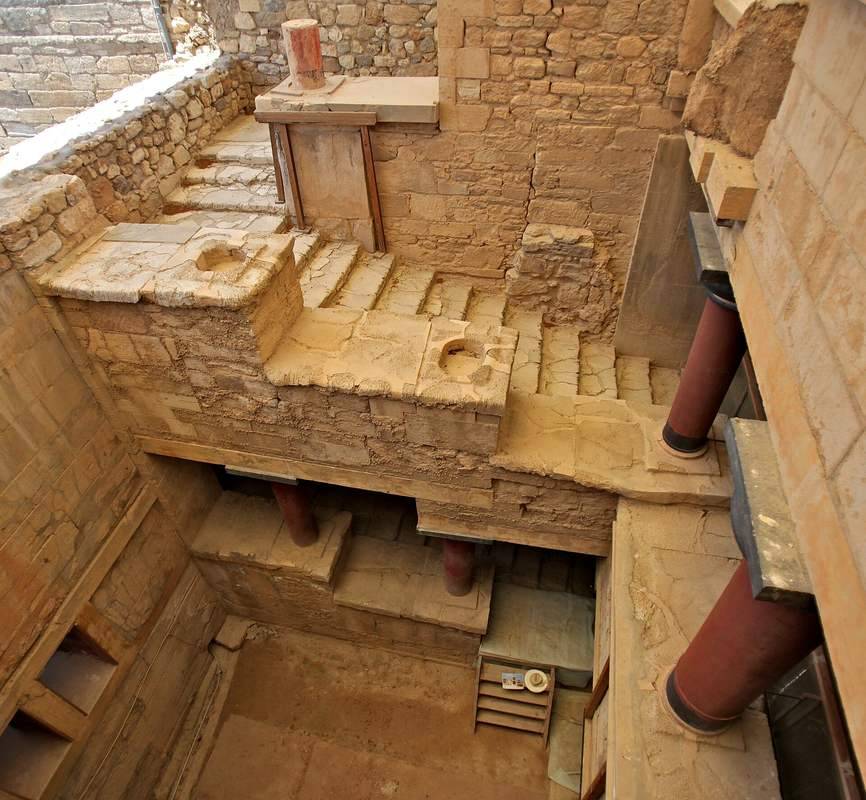
The royal apartments occupy the east wing of the palace, built cleverly into the slope of the hill and reached by the impressive grand staircase. That stairway is a multi-flight stone structure set around a light-well, and it is one of the engineering marvels of the site. Here were the private domestic quarters, including the rooms the excavators identified as the king’s hall, the Hall of the Double Axes, and the queen’s quarters, or queen’s megaron. The queen’s rooms are famous for their charming dolphin fresco and an adjoining bathroom with a clay bathtub.
The storerooms, by contrast, run in long lines along the west wing, behind the ceremonial rooms and the throne room. These narrow magazines once held rows of giant storage jars, the pithoi, in which the palace stored its wealth of olive oil, wine, grain and other goods. That concentration of stored produce reflects the palace’s role as an economic and administrative centre for the surrounding region. Together these areas show both the private life and the economic power of Minoan Knossos. Our guide to the queen’s megaron covers the royal quarters, and the next section covers the theatre and Royal Road.
What are the theatre and Royal Road at Knossos?
The theatre at Knossos is a stepped open area at the northwest of the palace, thought to have hosted performances or ceremonies, from which the paved Royal Road led toward the surrounding Minoan town.
At the northwest corner of the palace lies the so-called theatre, a rectangular open area bordered by tiers of shallow stone steps that could have served as seating. Its exact use is debated, but it is thought to have hosted performances, ceremonies, processions or public gatherings, with the steps accommodating spectators around the paved space. The theatre marks the point where the palace met the wider settlement, so it reads as a threshold between the private complex and the public town beyond it.
Leading away from the theatre is the Royal Road, a paved processional way that ran toward the surrounding Minoan town and other important buildings such as the Little Palace. It is sometimes described as the oldest road in Europe, and it would have formed a grand approach to the palace, perhaps used for ceremonial processions. These features, on the edge of the main complex, remind visitors that Knossos was the centre of a substantial town, not just an isolated palace. Our guide to the history of the Palace of Knossos covers the wider settlement, and the next section covers the west court and entrances.
What are the west court and entrances at Knossos?
The west court is the broad paved forecourt on the western side of Knossos, crossed by raised walkways and dotted with round pits, and it leads to the west and north entrances into the palace.
The west court is the large paved forecourt that spreads out along the western facade of the palace, and for many visitors it is the first major space they meet. Raised stone walkways, often called processional causeways, cross the court in straight lines, and set into it are the round pits known as kouloures, which were used to store grain or to hold ritual offerings. The court gave the palace a formal, public approach on its western side, a place where processions could gather before entering.
Knossos had several entrances rather than one grand doorway, which adds to the maze-like feel of the plan. From the west court, the west porch and the Corridor of the Procession led inward toward the central court, past walls that once carried the procession frescoes. The north entrance, on the opposite side, formed a monumental passage flanked by the restored bastion that carries the charging bull relief. Understanding these approaches helps a map make sense, because the entrances set the direction from which the wings unfold. Our guide to the key features of Knossos covers these approaches, and the next section gives a suggested route.
What is a good route around the Knossos site?
A good route around Knossos starts at the west court and theatre, enters the central court past the throne room, then visits the royal apartments and grand staircase in the east wing, following the signed one-way path.
Knossos is large and maze-like, so having a route in mind helps you take in the highlights without getting lost or missing anything. A sensible approach is to begin at the west court and the nearby theatre, then move through the west wing past the famous throne room, and into the great central court, the orientation point of the whole site. From there you can explore the east wing with its royal apartments, grand staircase and queen’s quarters with the dolphin fresco. Working from the court outward keeps your bearings clear.
Along the way, look out for the long storerooms, the reconstructed frescoes such as the bull-leaping and the prince of the lilies, and the engineering details like the light-wells and drainage. The site is partly signed with a suggested one-way path, which is worth following, especially when it is busy. A guide, an audio guide or a site map makes navigation easier and ensures you understand and find the key features. Keeping the central court fixed as your reference point, and returning to it between wings, keeps you oriented across the whole visit. Plan your visit and tours through our Palace of Knossos guide.
How long does it take to walk the Knossos layout?
Walking the main Knossos layout takes about one and a half to two hours at a comfortable pace, enough to follow the signed route through the west court, throne room, central court and east wing.
The size of the plan sets the pace of a visit. A steady walk through the highlights, following the one-way route from the west court to the throne room, the central court and the east wing, usually takes about one and a half to two hours. That window allows time to pause at the reconstructed frescoes, look down into the grand staircase and read the layout from the central court without feeling rushed. A quicker highlights loop is possible in around an hour if time is short, though it skips the quieter corners and leaves little time to study the frescoes or the layout in detail.
Two things stretch the time on the ground. The first is the crowds, since narrow corridors and the popular throne room can create bottlenecks in the middle of the day. The second is the terrain and heat, because the site runs across a slope with steps and little shade, which slows the walk in summer. Starting early keeps both in check and lets you move through the layout while it is cool and quiet. A map or guide also saves time by pointing you along the intended path rather than doubling back.
Why is the Knossos layout so confusing to navigate?
The Knossos layout confuses visitors because the palace was a dense, multi-storey complex of hundreds of rooms with many entrances, few straight corridors and partial reconstruction that mixes ancient stone with modern rebuilding.
Several features combine to make the plan hard to read on the ground. Knossos was not laid out on a simple grid but grew as a cluster of wings packed around the central court, with rooms opening into rooms and corridors that turn and double back. The building once rose through several storeys, so what survives is often the ground floor of a taller structure, and stairs and light-wells hint at levels that are no longer there. Add several entrances rather than one main door, and the site quickly disorients a first-time visitor.
The reconstruction adds a further layer of confusion. Arthur Evans rebuilt sections of the palace in concrete and repainted frescoes, so ancient walls, restored walls and modern additions sit side by side without obvious labels. This is exactly why a map, a guide or an audio guide pays off so clearly here. Fixing the central court in mind as the anchor, then treating the west wing, the east wing, the storerooms and the theatre as districts around it, turns the labyrinth into a readable plan. The very complexity that confuses visitors is also what gave rise to the ancient legend of the labyrinth.
Frequently Asked Questions
How is the palace of Knossos laid out?
The palace of Knossos is laid out around a large rectangular central court, the open heart of the complex, with ranges of rooms arranged in wings on all four sides and connected by corridors, staircases and light-wells across what was once a multi-storey building. The west wing held ceremonial, religious and administrative rooms, including the throne room and long storerooms lined with giant jars, while the east wing, built into the slope and reached by the grand staircase, held the royal apartments, including the queen’s quarters with the dolphin fresco. Workshops and more storerooms filled out the plan. This vast, complex arrangement of hundreds of rooms inspired the legend of the labyrinth.
Is there a map of the Knossos site?
Yes, the Knossos site has signage and a suggested route to help visitors navigate the complex, and site maps and plans are widely available in guidebooks, on information boards and through guides and audio guides. Because the palace is large and maze-like, a map or plan is genuinely useful for orientation and for finding the key features such as the central court, the throne room, the royal apartments, the grand staircase and the storerooms. The central court is the best orientation point, as the whole palace is arranged around it. A guide or audio guide is the easiest way to navigate while also understanding what you are seeing.
What are the main areas to see at Knossos?
The main areas to see at Knossos are the central court, the great open rectangle at the heart of the palace; the throne room, with its alabaster throne and griffin frescoes; the royal apartments in the east wing, including the queen’s quarters with the dolphin fresco; the grand staircase, an engineering marvel built around a light-well; the long storerooms lined with giant storage jars; and the reconstructed frescoes such as the bull-leaping and the prince of the lilies. On the edges of the complex are the theatre, the west court and the Royal Road. Following the signed one-way route, ideally with a guide or map, helps you take in all these highlights.
What is the difference between the west court and the central court at Knossos?
The west court and the central court are two different open spaces at Knossos with distinct roles. The central court is the large paved rectangle at the very heart of the palace, enclosed on all sides by the wings and open to the sky, and it was the organising space around which the whole complex was arranged. The west court, by contrast, is the broad forecourt outside the western facade, crossed by raised processional walkways and dotted with the round grain pits called kouloures. The central court is the inner heart of the palace, while the west court is its formal outer approach. On a map the central court sits in the middle and the west court lies along the outer western edge.
Where is the central court on the Knossos map?
The central court sits at the very middle of the Knossos map, and it is the point every other space is arranged around. On a plan of the palace it appears as a large rectangle, with the west wing and its throne room and storerooms on one long side, and the east wing with the royal apartments and grand staircase on the other. Because the court is the organising feature of the whole complex, finding it first on the map makes the rest of the plan far easier to read. On the ground it is also the best place to stop, look around and match what you see to the map before exploring the wings.