
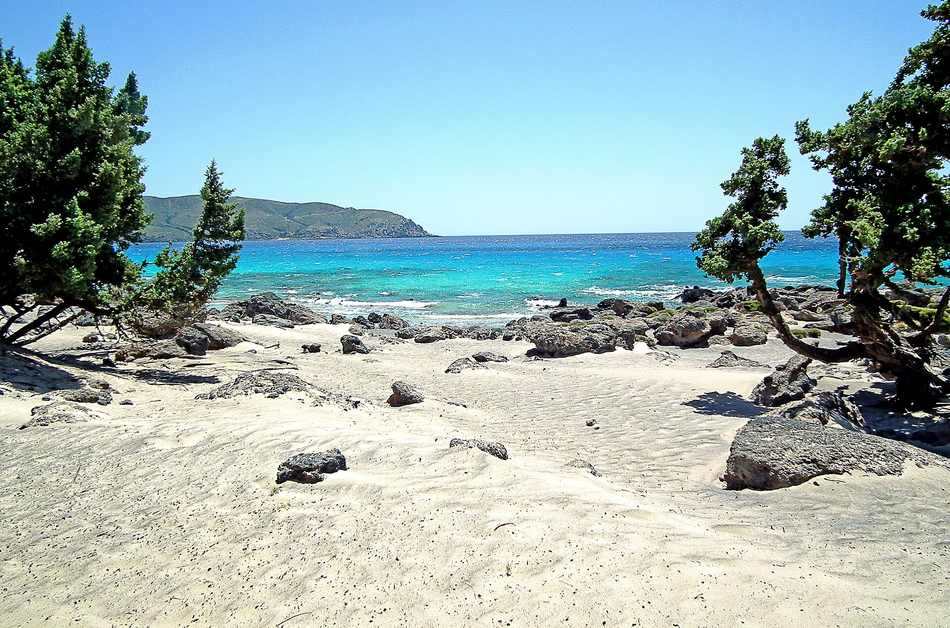
Kedrodasos sits on the far southwest coast of Crete, in the Chania district, just east of the pink-sand lagoon of Elafonisi. Its name means cedar forest, and a grove of low, ancient juniper trees grows across the dunes right down to the sand. Pale sand, smooth flat rock and shallow turquoise water make it a quiet, scenic alternative to its crowded neighbour, with no sunbeds, tavernas or organised facilities of any kind. The junipers give the natural shade found on few Greek beaches. This guide covers what to expect, how to reach the shore and how to plan your visit with My Greece Tours.
The sections below cover the setting of Kedrodasos, its rare juniper shade, the rough track that leads to the sand, the swimming conditions and the empty beaches nearby. You will read why visitors carry in their own water and shade, how free camping under the trees shaped the relaxed character of the place, and why the fragile dunes deserve a careful step. For the wider region, from the White Mountains to the south coast, our Crete travel guide gathers the practical detail. This page keeps its focus on one wild, undeveloped shore and the cedar forest that gives it a name.
Where is Kedrodasos beach on Crete?
Kedrodasos lies on the far southwest coast of Crete, in the Chania district, just east of the pink-sand lagoon of Elafonisi. Rough track and a short walk from the Elafonisi road reach this wild, undeveloped shore well beyond the resorts.
The far southwest corner of Crete holds a run of empty shores, and Kedrodasos sits at the heart of them, in the Chania district. The beach opens just east of Elafonisi, the famous pink-sand lagoon, yet it draws a fraction of the crowd. A rough track branches off the Elafonisi road, and a short walk over rock and dune brings you to the sand. No sign posts a car park, and no kiosk marks the entrance. The White Mountains stand inland, the open sea runs west, and the clifftop monastery of Chrysoskalitissa watches the coast to the north. This is the edge of the island, far from the resorts and the busy north.
The landscape stays raw, and the shore stays as quiet as the hills behind it. Planning your route through Chania makes the long drive simpler.
Distance keeps Kedrodasos quiet. The drive from the city of Chania runs west and south across the district, past hill villages and olive groves, before the paved road narrows toward Elafonisi. Travellers who reach this coast come on purpose, not by accident, and the effort filters out the casual day crowd. The last stretch demands care, since the track is rough and the walk crosses fragile dune. The reward waits at the end of it, a shore with pale sand, flat rock and clear water, and the natural shade of the junipers overhead. The heat of the southwest coast makes that shade welcome, and the flat rock gives easy footing.
The setting rewards travellers after unspoilt nature and calm swimming, and it pairs naturally with the other things to do in Crete across the western district and its southern coast.
What makes the cedar forest at Kedrodasos special?
A grove of low, ancient juniper trees, commonly called cedars, grows across the dunes right down to the sand. This natural shade is found on few Greek beaches, and the slow-growing trees give the beach its name and bohemian character.
The name Kedrodasos means cedar forest, and the trees explain the draw. Low, ancient junipers, commonly called cedars, spread across the dunes and reach right down to the sand. Their twisted branches throw a natural shade found on few Greek beaches, where umbrellas and rented sunbeds normally do that job. Here the trees do it for free, and travellers spread a towel beneath the canopy rather than under a hired parasol. The junipers grow slowly, so the grove has taken generations to form, and each tree marks long decades of coastal weather. Visitors are asked to tread carefully to protect the fragile dunes and the trees, since a careless step undoes work that no season can repair.
This living forest sets Kedrodasos apart from the serviced beaches that rely on built shade and rows of rented loungers.
Free camping under the junipers has long shaped the relaxed, bohemian character of Kedrodasos. Travellers pitch beneath the trees, wake to the sound of the sea, and share a shore that carries no fees and no schedule. That tradition draws a particular crowd, one that values quiet, clear water and open sky over sunbeds and taverna tables. The shade lets visitors linger through the hottest hours without shelter of their own, and the dunes hold the heat of the day into the evening. Respect keeps the place intact, so campers carry out what they carry in and step around the roots that anchor the sand.
For travellers hunting the quiet corners of the island, Kedrodasos ranks among the true hidden gems in Crete, earned by the walk and kept by the care of those who visit.
How do you reach Kedrodasos and what should you bring?
The beach is reached by a rough track and a short walk from the Elafonisi road. No facilities wait here, so visitors carry in their own water and shade and tread carefully to protect the fragile dunes and trees.
Getting to Kedrodasos takes planning, since the shore has no tavernas, no sunbeds and no organised facilities of any kind. The beach is reached by a rough track that leaves the Elafonisi road, followed by a short walk over rock and dune to the sand. A car handles the track with care, though the surface is uneven and slow, and the final approach is on foot. The shore at the end offers only what nature provides, so visitors carry in their own water and shade. The junipers help on the shade front, yet a full water supply is essential on a hot southwest coast with no kiosk in sight.
Pack out every scrap of rubbish, since no service clears the beach. The empty, undeveloped feel is exactly the reward for the effort.
Care for the ground matters as much as your own supplies. Visitors are asked to tread carefully to protect the fragile dunes and the slow-growing trees, keeping to bare rock and open sand where possible and avoiding the roots that hold the dunes together. Firm footwear helps on the rough track, and an early start beats both the heat and the thin day crowd. Travellers pair Kedrodasos with its famous neighbour, walking the short distance from Elafonisi beach to trade the lagoon crowds for the quiet of the cedar forest.
Bring sturdy sandals for the flat rock, a hat for the walk and enough water for the day, and the wild shore repays every ounce you carry across the dunes with shade, calm water and quiet.
What is swimming at Kedrodasos like?
Shallow turquoise water over pale sand and smooth flat rock makes calm, clear swimming the highlight of Kedrodasos. The scenic, quiet shore suits travellers after unspoilt nature and calm water rather than facilities or organised beach service.
The water at Kedrodasos is the reason travellers cross the dunes. Shallow turquoise sea runs over pale sand and smooth flat rock, and the clarity lets you read the bottom well past your depth. The shallow entry suits a long, slow swim, and the flat rock gives easy footing where the sand thins. Calm, clear swimming defines the shore, since the beach faces a sheltered stretch of the southwest coast away from the strongest swell. The scene stays scenic and quiet, with no boat traffic, no marked lanes and no crowds pressing the waterline. Travellers after unspoilt nature and calm water find exactly that here, and the natural shade lets them rest between swims without a rented parasol.
The setting rivals the celebrated lagoon next door while keeping its own wild, undeveloped calm.
Conditions reward a full day rather than a quick dip. The turquoise shallows warm through the morning, and the flat rock holds pools that children explore in safety. Snorkelling over the pale sand and rock reveals a clear, quiet underwater world, undisturbed by the churn of a busy resort beach. Between swims, the junipers offer shade for a rest, and the smooth rock makes a natural place to dry off. A visit here pairs easily with the clifftop Chrysoskalitissa monastery to the north, so a single trip to the far southwest can hold both a wild swim and a landmark view.
The empty beaches of this corner of Crete share the same clear water, and Kedrodasos stands among the calmest and most scenic of them all.
What lies near Kedrodasos in southwest Crete?
Kedrodasos lies near Elafonisi, the clifftop monastery of Chrysoskalitissa and the empty beaches of the far southwest, well beyond the reach of the resorts. The corner rewards travellers after unspoilt nature, natural shade and calm swimming.
Kedrodasos anchors a corner of Crete rich in quiet landmarks. Elafonisi, the pink-sand lagoon, sits just to the west, and its shallow, warm water draws the day crowds that Kedrodasos escapes. The clifftop monastery of Chrysoskalitissa stands to the north, a white building perched above the sea and reached by a climb of stone steps. Beyond both run the empty beaches of the southwest, a string of undeveloped shores well beyond the reach of the resorts. This whole stretch rewards travellers after unspoilt nature, natural shade and calm swimming, and it keeps the raw feel that the busier north coast has traded for development.
A day here can move from lagoon to forest to monastery, each within a short drive of the last across the far edge of the island.
The region works best as a single, unhurried trip rather than a rushed stop. Travellers base themselves in the wider Chania district and drive out to the coast, trading the crowds of the popular beaches for the quiet of the junipers. The empty shores share the same clear water and the same sense of distance from the resorts, so a full day here feels like a step off the tourist map. Kedrodasos, with its cedar forest and calm swimming, makes a natural centrepiece for that day. Planning the loop with a good overview of the island helps, and the wider Crete beaches network shows how the southwest fits the larger coast.
For unspoilt nature, natural shade and calm, clear swimming, this remote corner of the island has few equals anywhere on Crete.
Frequently Asked Questions
Are there any facilities at Kedrodasos beach?
Kedrodasos has no sunbeds, tavernas or organised facilities of any kind. The shore is wild and undeveloped, and the only shade comes from the grove of low, ancient junipers that grows across the dunes right down to the sand. Visitors carry in their own water and shade, since no kiosk, no service and no rented parasol wait on this stretch of the southwest coast. That absence of facilities is the point, and it keeps the beach quiet and scenic when its famous neighbour fills. Pack a full water supply, a hat and firm footwear for the rough track and the flat rock. Plan to carry out every scrap of rubbish, since no one clears the shore behind you.
Compared with the serviced resort beaches of the north coast, Kedrodasos asks more of the visitor and gives back a raw, calm shore in return, shaded by a living cedar forest and washed by clear, shallow turquoise water and a wide, quiet sky.
Can you camp at Kedrodasos?
Free camping under the junipers has long shaped the relaxed, bohemian character of Kedrodasos, and that tradition still colours the beach today. Travellers pitch beneath the low, ancient trees, wake to the sound of the sea and share a shore with no fees and no schedule. The natural shade of the grove makes the dunes comfortable through the hottest hours, and the quiet suits those who want open sky over organised campsites. Care keeps the place intact, so campers tread carefully to protect the fragile dunes and the slow-growing trees, keep to open sand and rock, and carry out everything they carry in. A careless step can undo growth that no single season repairs.
The bohemian feel draws a particular crowd, one that values unspoilt nature and calm swimming over comfort and service. For travellers hunting the quiet side of the island, this shore ranks among its truest hidden treasures, earned by respect and kept by the light footprint of everyone who stays beneath the trees.
Is Kedrodasos worth visiting over Elafonisi?
Kedrodasos and Elafonisi sit side by side on the far southwest coast, yet they offer different days. Elafonisi is the famous pink-sand lagoon, shallow, warm and busy, with the crowds that fame brings. Kedrodasos, just to the east, trades that fame for quiet, offering pale sand, smooth flat rock, shallow turquoise water and the natural shade of an ancient cedar forest. The reward is calm, clear swimming and a scenic, undeveloped shore well beyond the reach of the resorts. Travellers visit both in one trip, walking the short distance from the pink-sand lagoon east to the junipers to swap the crowds for calm. Bring your own water and shade, since Kedrodasos has no facilities of any kind.
For travellers after unspoilt nature, natural shade and calm swimming, the wild shore rewards the rough track and short walk, and it stands as the quieter, more scenic half of a single day on this remote corner of Crete.