
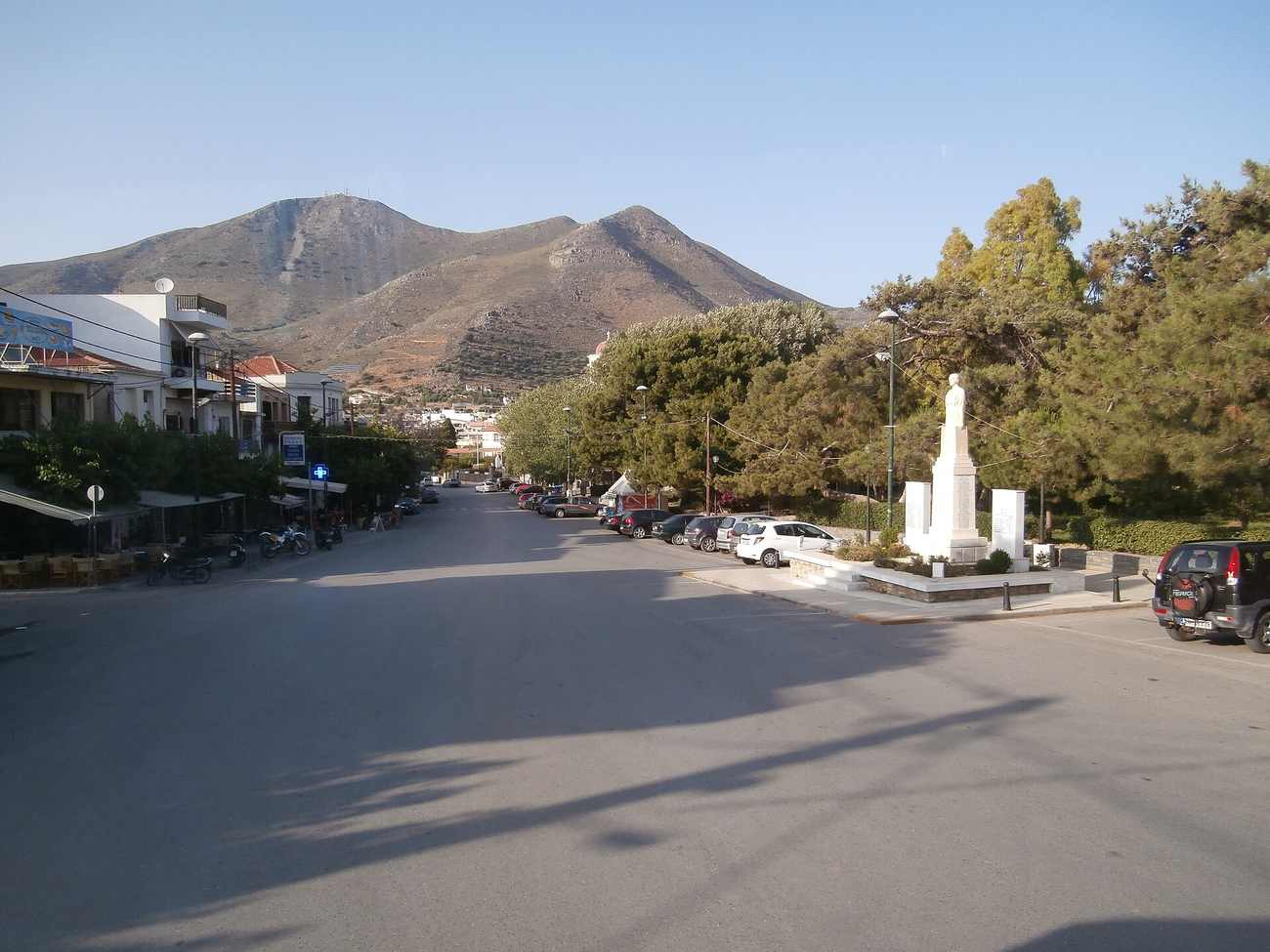
Neapoli sits inland in the hills of the Lasithi district of eastern Crete, the administrative capital of the region and a working town rather than a resort. The main road between Agios Nikolaos and the Selena mountains runs straight through it, past a broad central square shaded by plane trees, the grand church of the Megali Panagia, neoclassical houses, cafes and a small museum. Vineyards, olive groves and almond orchards wrap the town on every side. Travellers who want an authentic, unhurried Cretan town, and a base for the eastern hills rather than a beach holiday, will find their footing here. Plan your eastern Crete trip with My Greece Tours.
Neapoli rewards travellers who slow down and settle into the rhythm of a Cretan town. The Wednesday market fills the streets, bakeries turn out fresh loaves, and tavernas serve everyday Cretan cooking without ceremony. The town is also the birthplace of Petros Philargos, the only Cretan ever elected pope, which lends its quiet square a surprising historical weight. The sections below cover the town itself, its famous almond drink soumada, the sights within a short drive, and why this hillside capital makes a strong eastern base. For wider context, the full Crete travel guide maps out how Neapoli fits into the island.
Where is Neapoli in Crete and what defines the town?
Neapoli is an inland town in the hills of the Lasithi district of eastern Crete, the administrative capital of the region. It sits on the main road between Agios Nikolaos and the Selena mountains, ringed by vineyards and olive groves.
Neapoli occupies the hills of the Lasithi district in eastern Crete, and it carries the role of administrative capital for the region. The town straddles the main road linking Agios Nikolaos on the coast with the Selena mountains inland, so traffic and daily life pass right through its heart. A broad central square, shaded by plane trees, forms the social centre, and neoclassical houses line the streets around it. The grand church of the Megali Panagia rises above the rooftops, cafes cluster under the trees, and a small museum records the local past. This is a working Cretan town, not a resort built for visitors.
For a broader picture of the island beyond the coast, the range of things to do in Crete reaches far past the beaches.
Vineyards, olive groves and almond orchards surround Neapoli on every side, feeding the town’s kitchens and its reputation for produce. The setting in the hills keeps summers cooler than the coast and gives the town long views across the Lasithi countryside. Neapoli keeps its own festivals, its bakeries and its tavernas serving everyday Cretan cooking, so the calendar follows local life rather than the tourist season. The coast at Agios Nikolaos lies within a short drive, which makes the town a practical inland counterpoint to the resorts. Travellers who base themselves here trade sea views for authenticity, and gain a genuine sense of how eastern Crete lives away from the shoreline crowds.
The pace stays measured, the square stays busy with residents rather than tour groups, and the farmland feeds the tavernas with produce grown within sight of the town.
What is soumada and why is Neapoli known for it?
Soumada is a local drink made from almonds, and Neapoli is known for it across the island. The town’s almond orchards supply the ingredient, tying the drink directly to the surrounding hills and their harvest.
Soumada is the drink that carries Neapoli’s name across the island, a sweet cordial made from almonds and served diluted with water. The almond orchards that surround the town provide the raw ingredient, so the drink grows straight out of the local landscape rather than arriving from elsewhere. Families and tavernas prepare it, and it appears at celebrations and everyday tables alike. Ordering a glass in a cafe on the plane-shaded square is one of the simplest ways to taste the town’s identity. The connection between the orchards, the harvest and the drink shows how tightly Neapoli ties its food culture to its own soil, a thread that runs through wider Cretan food traditions.
The sweet glass cuts the heat of an afternoon and gives visitors a memory tied to this town.
The lively Wednesday market gives travellers a direct route into this produce culture. Stalls fill the streets with almonds, olives, cheeses, honey and vegetables from the farms around the town, and the crowd is local rather than staged for visitors. Bakeries sell fresh loaves and pastries, and tavernas plate up everyday Cretan cooking drawn from the same ingredients on sale outside. A traveller who times a visit for market day sees Neapoli at its most animated, with the square and side streets busy from morning. This is the town’s authenticity made tangible: soumada, market produce and taverna cooking all spring from the vineyards, olive groves and almond orchards that ring the settlement on every side.
The market crowd, the taverna plates and the cordial in the glass form a single unbroken chain from the surrounding fields to the table.
What can you visit near Neapoli?
The Lasithi Plateau, the cave of Milatos and the coast at Agios Nikolaos all lie within a short drive of Neapoli. This spread of mountain, cave and shoreline makes the town a practical base for eastern Crete.
Neapoli sits within a short drive of a genuine spread of eastern sights, which is what gives the town its value as a base. The high, ringed farmland of the Lasithi Plateau lies up in the mountains, a fertile bowl of fields and villages set against the peaks. The town’s position on the road toward the Selena mountains puts this landscape within easy reach for a day out. Travellers who stay in Neapoli rather than on the coast wake up already inland, closer to the plateau and the hill villages than any beach resort would place them. That head start turns a single base into a launch point for the whole eastern interior, from farmland to coastline.
The climb up to the plateau threads through hill villages and terraced fields, so the drive itself becomes part of the day out.
The coast and the caves round out the reach. The seaside town of Agios Nikolaos sits a short drive down the road, giving Neapoli’s guests quick access to harbour, water and resort amenities whenever they want them. In the other direction, the Milatos Cave draws travellers with its history and its dramatic setting in the hills near the north coast. Between the plateau above, the cave to the north and the shoreline nearby, Neapoli anchors a compact circuit of eastern Crete. A traveller can spend one day in the mountains, another at the coast and a third exploring caves, returning each evening to the same plane-shaded square and its everyday town life.
Few bases in eastern Crete pack mountain, cave and shore into such short drives, which is why careful planners choose Neapoli as their fixed point for the trip.
Who was Petros Philargos and how does he connect to Neapoli?
Petros Philargos was born in Neapoli and rose to become Pope Alexander the Fifth, the only Cretan ever elected pope. His birthplace ties this quiet hillside town in Lasithi to a remarkable and unexpected chapter of church history.
Petros Philargos gives Neapoli a claim that few Cretan towns can match: he was born here and rose to become Pope Alexander the Fifth, the only Cretan ever elected pope. That single fact lends the plane-shaded square and its neoclassical houses a weight out of proportion to the town’s quiet size. A traveller standing in the centre of Neapoli is standing in the birthplace of a pope, a detail that reframes an ordinary working town as a site of real historical significance. The small museum and the grand church of the Megali Panagia give the town places to reflect on this heritage, and the story surfaces readily in conversation with residents who take pride in the connection.
The elevation of a hometown boy to the papacy remains a point of local identity, woven into how the town sees its history.
The Philargos link fits the wider character of a town that keeps its own history close. Neapoli guards its festivals, its church calendar and its everyday traditions, and the memory of its most famous son sits comfortably among them. Travellers who seek out the quieter, less obvious corners of the island, the hidden gems in Crete that rarely reach the guidebooks, find Neapoli a natural fit. It offers no beaches and no resort glamour, only an authentic hillside town with a pope in its past, a famous almond drink on its tables and a working square at its heart. That honesty is precisely what draws travellers looking past the coast.
The town asks visitors to meet it on its own terms, and those who do come away with a clearer sense of the real, lived-in Crete that resorts rarely show.
Is Neapoli a good base for exploring eastern Crete?
Neapoli suits travellers wanting an authentic, unhurried Cretan town and a base for the eastern hills rather than a beach holiday. Its central position and short drives to plateau, cave and coast make it practical.
Neapoli earns its place as a base through position and character rather than through sea views. The town suits travellers wanting an authentic, unhurried Cretan town and a foothold in the eastern hills rather than a beach holiday, and delivers exactly that. Its spot on the main road between Agios Nikolaos and the Selena mountains keeps the coast, plateau and interior all within a short drive. A traveller can range widely by day and return each evening to a square shaded by plane trees, with cafes and tavernas serving everyday Cretan cooking. The rhythm of the town, market, bakery, church and festival, becomes part of the stay rather than a backdrop to it.
Mornings begin with a coffee under the plane trees and end with a taverna dinner streets away, the day framed by a town on its own schedule.
The trade-off is clear and worth stating plainly: Neapoli offers no beach and no resort scene, so travellers set on sun-lounger days will look to the coast instead. What it offers in return is authenticity, a working town that lives its own life, and a practical launch point for the eastern interior. The vineyards, olive groves and almond orchards, the soumada, the Wednesday market and the pope born on its streets all give the place a depth that resort towns rarely reach.
For travellers who value character and an inland base over shoreline convenience, Neapoli stands as one of eastern Crete’s most rewarding and genuinely lived-in towns to settle into for an unhurried stay of three or four nights, using the days to reach the plateau, the cave and the coast in turn.
Frequently Asked Questions
Does Neapoli have beaches?
Neapoli has no beaches of its own, because it sits inland in the hills of the Lasithi district rather than on the shoreline. The town is an administrative capital and a working Cretan settlement, built around a plane-shaded square, the grand church of the Megali Panagia, neoclassical houses, cafes and a small museum rather than around the sea. Travellers who want a swim reach the coast at Agios Nikolaos within a short drive, so beach days remain easy to arrange from an inland base. The town’s appeal lies elsewhere: in its almond orchards and soumada, its lively Wednesday market, its tavernas serving everyday Cretan cooking, and its position as a launch point for the eastern hills.
Travellers set on staying beside the water will prefer a coastal resort, while those wanting an authentic hillside town with the beach a short drive away find Neapoli an unusually rewarding and honest place to base themselves for three or four unhurried nights.
When is the market in Neapoli?
The market in Neapoli takes place on Wednesday, and it is one of the town’s liveliest moments. Stalls fill the streets with produce from the vineyards, olive groves and almond orchards that surround the town, alongside cheeses, honey and other goods from the Lasithi countryside. The crowd is local rather than staged for visitors, which is part of the appeal for travellers seeking an authentic Cretan town. A visit timed for market day shows Neapoli at its most animated, with the plane-shaded central square and the side streets around it busy from morning onward.
Bakeries sell fresh loaves and pastries, cafes serve soumada, the local almond drink, and tavernas plate up everyday Cretan cooking drawn from the same ingredients on sale outside. Travellers who plan their route through eastern Crete around a Wednesday gain a direct, unfiltered window into how this working hillside town actually lives and eats through the week.
What is Neapoli famous for?
Neapoli is famous for three things above all: soumada, the local drink made from almonds; its position as the administrative capital of the Lasithi district of eastern Crete; and Petros Philargos, born here, who rose to become Pope Alexander the Fifth, the only Cretan ever elected pope. That combination gives the quiet hillside town a distinctive identity. The almond orchards that surround Neapoli supply the soumada, tying the drink to the landscape, while the lively Wednesday market spreads the town’s reputation for produce across the island. The grand church of the Megali Panagia, the neoclassical houses and the plane-shaded central square give the town its handsome, working character, and a small museum records its past.
Travellers know Neapoli as an authentic, unhurried Cretan town and a practical base for the eastern hills, the Lasithi Plateau and the cave of Milatos, rather than as a beach destination competing with the coastal resorts nearby.