
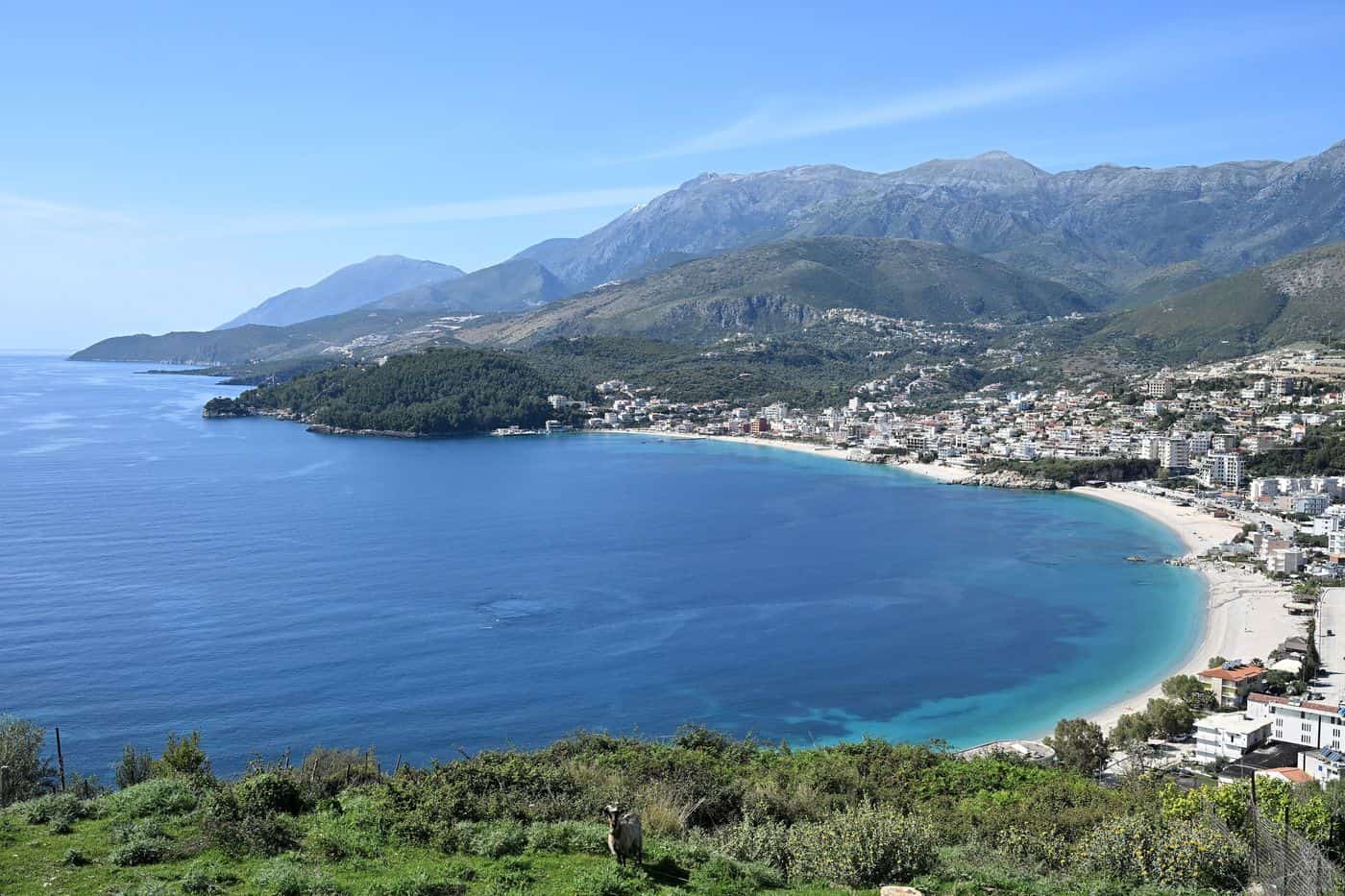
Himara tours start in Himara, the town of Vlorë County on the Albanian Riviera, between the Ceraunian Mountains and the sea north of Saranda. The routes cover the boat trips along the coast, Grama Bay, the sea caves, the beaches, Porto Palermo Castle, the old town, the villages and the Llogara Pass. Greece Tours lists the trips that cross to this coast from Corfu.
This page covers which boat trips and water sports Himara tours run from the harbour, which beaches, caves and castles they reach, what the old town and the villages hold, how visitors reach Himara from Corfu and Greece, and which season suits each route. The tours below are checked on GetYourGuide and Viator and leave from Himara and Porto Palermo.
What do Himara tours cover?
Himara tours cover the sea coast around Himara, the town of Vlorë County on the Albanian Riviera, with speedboat trips from Spile Beach to sea caves, boat-only bays and swim stops, north to Dhërmi and Karaburun and south to Porto Palermo Bay.
Himara is the Albanian definite form of Himarë. The Himara region is a strip about 20 km long and 5 km wide, between the 2,000-metre Ceraunian range and the Ionian Sea, and the seafront district of Spilea is the touristic and economic centre of the region. Himara tours start here: the boat booths stand on Spile Beach, and the boats leave the harbour in the morning.
- Pirate’s Cave half-day: about 3 hours north along the Dhërmi cliffs.
- Grama Bay full day: 5 to 6 hours north into the Karaburun Peninsula.
- Porto Palermo half-day: 3 to 4 hours south of the town.
- Sunset cruise: 2.5 to 3 hours in the late afternoon, timed for golden hour.
Himara tours keep to this coast and the Karaburun stretch. The remains of the ancient city of Butrint lie further south near Saranda and belong to separate Butrint tours.
Which Himara tours sail along the coast by boat?
Himara tours sail the coast in open speedboats from Spile Beach: the northbound routes pass Livadhi, Akuarium and Jale beaches on the way to Gjipe, Drymades and Palasa, and the southbound route runs past Filikuri and Llamani beaches to Porto Palermo Bay.
The Northern Exploration route takes 3 to 3.5 hours and reaches Palasa Beach, near the Llogara Pass. Gjipe Beach has no road for cars, only a rocky path of at least 20 minutes each way, so Himara tours give the easy view of the beach and its canyon from the sea.
The southbound Porto Palermo half-day takes 3 to 4 hours. The shape of the bay shelters it, so these Himara tours run on days when wind blows out the northern routes. Water taxis also make point-to-point runs to Filikuri Beach, which is easier to reach by water.
- Group boats: 11 to 24 passengers, fixed departure times and a set itinerary.
- Private boats: up to 5 people, with your own schedule and stops.
- On board: water, snorkeling masks and life jackets.
- Sea state: calm water in the early morning, a choppier ride with the afternoon wind.
Swim stops on Himara tours take place in anchored coves with water visibility of 10 metres and more. At points on the Himara shore the sea runs cold because of underground water, and it reaches normal temperature tens of metres out.
Which Himara tours reach Grama Bay?
The Grama Bay full day is the long-haul route among Himara tours: 5 to 6 hours past Dhërmi and Palasa to the Karaburun Peninsula, with about an hour at Grama Bay, a boat-only cove whose cliffs carry roughly 1,500 sailors’ inscriptions.
- Himara to Jale: 15 to 20 minutes, past Livadhi.
- Jale to Gjipe: 15 to 20 minutes, with the Pirate’s Cave.
- Gjipe to Saint Andrew’s Bay: 25 to 35 minutes, past Palasë.
- Saint Andrew’s Bay to Grama Bay: about 15 minutes.
The one-way run takes 75 to 90 minutes, depending on the sea. Saint Andrew’s Bay, the stop before Grama, is a quiet cove with a small chapel on the shore. In a heavy swell, Himara tours cut the route short and turn back from Grama Bay.
Grama, in Albanian Gjiri i Gramës, takes its name from the Greek word for ‘letter’; the bay is also called Grammata, the plural of Gramma. Greek, Roman and medieval sailors carved thanks into the cliffs in honour of the Dioscuri, Castor and Pollux, in Ancient Greek, Latin and Medieval Greek. The Byzantine emperor John V Palaiologos stopped here in 1369 on a journey to Venice.
Grama Bay lies inside the Karaburun-Sazan Marine Park, a national marine park of 125.70 square kilometres that takes in the Karaburun Peninsula and Sazan Island. The bay is a designated natural monument, and its sea caves give refuge to the Mediterranean monk seal, the rarest seal species in the world. Roads in the park are inaccessible, so Himara tours by sea are the practical way in.
Which Himara tours visit the Pirate’s Cave and the sea caves?
The Pirate’s Cave half-day is the standard short trip among Himara tours: about 3 hours to the karst sea caves under the Dhërmi cliffs, with the Pirate’s Cave as the main stop and Pigeon’s Cave and swim stops on the way.
The Pirate’s Cave lies about 12 km north of Himara by sea, on the same hill as the Monastery of Saint Theodore. The site is two sea caves on one cliff, 200 m and 800 m from the southern end of Dhërmi Beach. The main entrance is a semi-circular arch 10 to 12 m high with a skylight slit at the top, and a small speedboat can drive straight inside.
Legend says the cave was once a haven for pirates and ships, and it can only be reached by sea. Petro Marko (1913–1991), a writer born in Dhërmi, made it famous with his 1955 children’s novel Shpella e Piratëve (The Pirates’ Cave) and the film of the same title. Himara tours enter at idle speed, and in a rough sea the skipper holds the boat at the entrance.
- Pigeon’s Cave: Shpella e Pëllumbave, 9 km north of Himara between Jale and Gjipe, where wild rock pigeons nest above the entrance; a 20-minute swim stop.
- Blue Cave: Shpella e Kaltër, a karst sea cave on the Karaburun Peninsula, reached only on the Grama Bay full day; its interior glows blue in calm, sunny weather.
- Spile Cave: a natural monument on the Himara coast, carved by waves in limestone; local myth sets the meeting of Odysseus and the Cyclops here.
The Blue Cave stop lasts about 30 minutes, and in a choppy sea the operator stops at the entrance or skips the cave. Light inside the Pirate’s Cave is best from mid-morning to early afternoon. Put on insect repellent before entering, since the damp cave interiors fill with mosquitoes.
Which Himara tours go snorkeling, kayaking and paddleboarding?
Himara tours on the water include full-day kayak and paddleboard rentals, a jet ski safari with snorkeling, and boat trips with snorkeling stops. Rental desks sit on the town beach, Livadh and Potam, and the clearest snorkeling water lies at Filikuri and Akuarium.
Kayak and paddleboard Himara tours start at the beach concessions on the town beach and the Spile promenade. The kayaks are stable sit-on-top models, the paddleboards come with a paddle and leash, and no licence or experience is needed. GetYourGuide lists a full-day kayak rental in Himarë with a waterproof bag and life jackets included.
Morning paddles work best on Himara tours. A sea breeze builds from around 14:00, so local paddlers launch by 9:00 and turn back by noon. The paddle routes run as follows:
- Town beach to Filikuri: about 1.5 km one way.
- Town beach to Llamani: about 2 km one way.
- Potam to Porto Palermo bay: about 3 km one way.
- Himara to Gjipe: 7 to 8 km one way.
Snorkeling Himara tours rely on the Ionian Sea, known for its exceptional clarity, deep blue colour and steeply descending seabed. Surface water ranges from about 14 °C in winter to 25 °C in summer. Underground springs keep the water cold at points along the Himara shore, and the sea returns to normal temperatures tens of metres away.
The guide himara.net ranks Filikuri first for snorkeling, with fish among boulders, rock shelves and sand patches. Akuarium, a small cove 1.5 km on foot from Livadh along red trail markings, has water as clear as a swimming pool. Llamani suits confident swimmers with deep water over large rocks, while the rocky ends of Livadh suit beginners.
Motorised Himara tours run from June through September. GetYourGuide lists a Himara jet ski safari with snorkeling, and Jetski.al rents jet skis in Himara with instructors for all skill levels. Scuba diving runs through regional operators, and Wikivoyage names the Porto Palermo Cave, near the former submarine base, as a site for exploration and diving.


Which beaches do Himara tours reach?
Himara tours reach the town beaches of Spile, Potam and Livadh, the coves of Filikuri and Llamani to the south, and the northern beaches of Jalë, Gjipe, Dhërmi and Palasë. The coast mixes long pebble beaches with stretches of fine white sand.
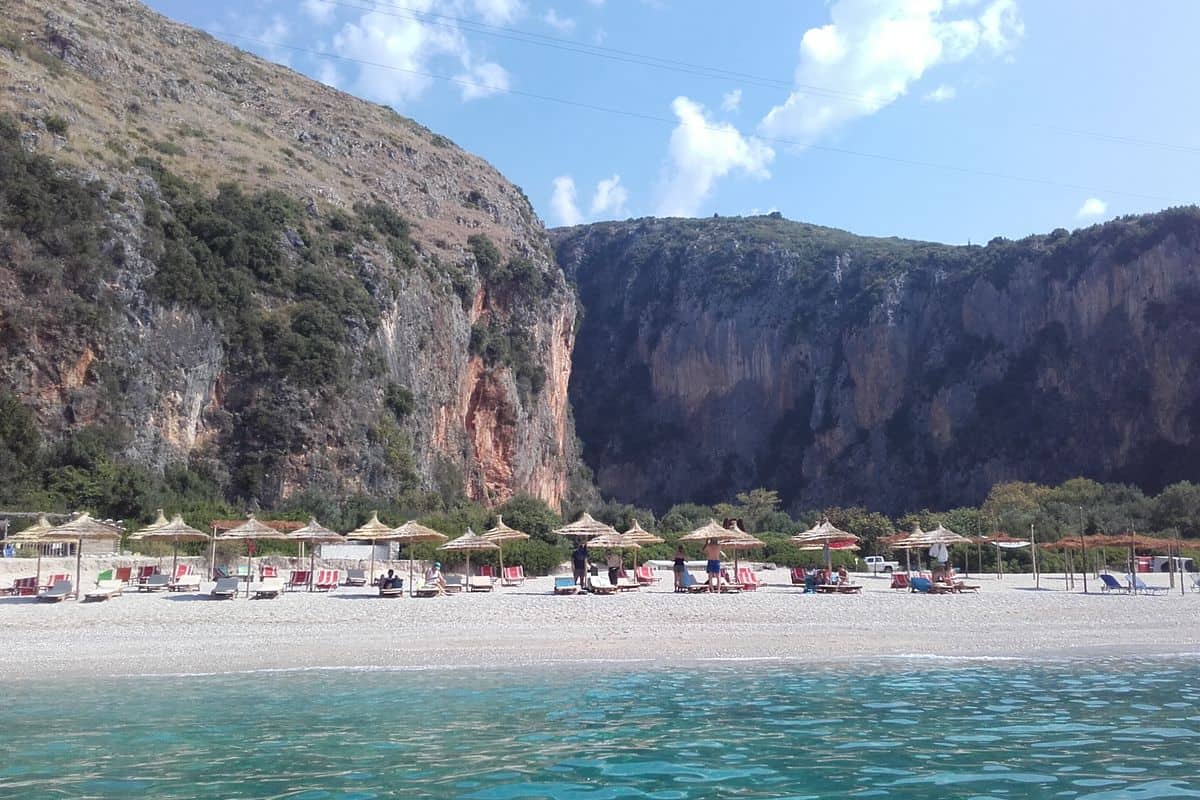
Beach Himara tours start at Spile, the central beach and the front of the modern town, which grew up after the Second World War. Potam and Livadh are districts of Himara with beaches of their own, and Livadh lies north of Spile, below Himara Castle.
South of town, Himara tours reach Filikuri, a 100 m beach with rich underwater life that boats reach with ease, and GetYourGuide lists a Filikuri boat taxi from Himarë. Llamani lies about 5 km from town between two rocky sides, with cold patches fed by underground springs. The New York Times ran a photo of Llamani as its photo of the week.
North of town, Himara tours reach Jalë, the beach of Vuno, with four beach areas, the secluded Akuarium cove and Kampingu Jal, the oldest campsite in Albania. Gjipe has fine, clean sand at the mouth of its canyon, reached by sea or by a road past the Monastery of Saint Theodore.
Road Himara tours also reach both ends of the coast. Palasë sits at the northern start of the Riviera, and Borsh, past Qeparo on the coast road, is lined by orange, lemon and olive groves. The beach lengths run as follows:
- Livadh: about 1.2 km long and 100 m wide.
- Llamani: 200 m long, with gravel and deep, clear water.
- Dhërmi: 5 km long, ending at the hill of the Saint Theodore monastery.
- Palasë: 1.5 km long, below the Llogara Pass.
- Borsh: 7 km long, the largest beach on the Ionian Sea.
Which Himara tours go to Porto Palermo Castle?
Himara tours reach Porto Palermo Castle by road or by sea. The castle stands on a small peninsula in the bay of Porto Palermo, 8 km south of Himara, and GetYourGuide lists a Porto Palermo cruise with 16 stops, sea caves and 4 swim breaks.
Ali Pasha of Tepelena built the castle in the early 19th century, and an inscription above the entrance credits French engineers with the work in 1804. Ali Pasha ruled his pashalik from Ioannina, today the capital of Epirus in northwestern Greece and the base for Ioannina tours. Porto Palermo is the best-preserved garrison he built in the region.
In 1803 Ali Pasha offered the castle and port to the British Royal Navy, when the fort held only four or five cannon. The traveller William Martin Leake found a garrison of 10 men with two four-pounder guns, and the Greek poet Ioannis Vilaras, a member of Ali Pasha’s court, praised the building of the castle.
The bay is ancient Panormos, a harbour for Himara because Spile and Livadh lie in an open bay that gives ships no shelter in storms. Ali Pasha built the largest church in the region opposite the castle. The Albanian military used the fortress in the communist period, and today its dark vaults lead visitors up to the roof.
From the castle, Himara tours look across to a former submarine base at the northern end of the bay. Work on its tunnel began with Chinese help in the late 1960s, and Albania finished it alone after China withdrew. The tunnel runs more than 650 m into the mountain, stands 12 m high and had space for four Whiskey-class submarines, each 75 m long. It remains a restricted military zone, hidden from the sea.
The Huffington Post ranked Porto Palermo first among 15 Undiscovered European Destinations, and the Albanian Government plans Protected Landscape status for the bay together with Llamani beach. Himara tours find the fortress laid out as follows:
- Site: a former island about 30 m off shore, joined to land by landfill.
- Plan: three sides, with a large gun bastion at each corner.
- Core: a hexagonal chamber with a domed ceiling and six pillars.
- Walls: up to 20 m high, with an open terrace to the south.
What do Himara tours see in the old town and Himara Castle?
Himara tours climb to Kastro, the old town on a rocky hill above the Ionian Sea. Himara Castle has stood there since at least the mid-4th century BC, and its walls enclose Orthodox churches, the Spyromilios family mansion and the old Greek school.
Himara tours cover a town of two parts. Kastro, also called Fshat, stands on and around the castle, on the site of the ancient settlement of Chimarra. The modern town grew on the coast at Spilë in the socialist era after the Second World War.
The castle, also known as Barbaka, sits between two canyons: Visha to the northwest and the Kole Midhari stream to the southeast. It had two gates, one in the north and one in the south, closed at the end of each day. The English scholar N. Hammond listed it among the fortified sites of Epirus, with circuit walls 500 to 1,000 metres long. On Himara tours, sections of the Hellenistic wall still show large polygonal blocks, like the walls of ancient Phoenice.
Himara tours pass five churches in and around the castle:
- Panagia Kassopitra: keeps part of the western ancient wall inside it, and its icon of the Virgin came from Kassiopi on Corfu.
- Episkopi: stands inside the Hellenistic walls, on the site of an ancient temple of Apollo.
- Saint Sergios and Bakchos: dates from the 11th century.
- Saint Michael: dates from the 13th century and stands in the north of the castle.
- All Saints: stands at the castle entrance and first served in 1775.
Inside the citadel, Himara tours also reach the old mansion of the Spyromilios family, one of the town’s main attractions, although abandoned today. The Greek school inside the castle was built in the 18th century with the care of Saint Cosmas of Aetolia.
Which villages do Himara tours visit?
Himara tours visit the villages of the old Himara region: Qeparo to the south, Vuno, Ilias, Dhërmi and Palasë to the north, and Pilur and Kudhës in the mountains. The villages keep stone houses, Orthodox churches and local dialects of Greek and Albanian.
Qeparo lies on the western slope of Mount Gjivlash. After 1957, when the state built the main coastal road, it split into Old Qeparo on the hill and New Qeparo on the coast. Himara tours climb from the coast to the old village, built with stone houses and narrow alleys. Qeparo’s church of Saint Demetrius, dated 1760, is one of nine churches in Albania dedicated to that saint, and its early 19th-century Greek school still stands.
Vuno sits on the road from Himara to Dhërmi, on hills that rise to about 300 metres; its name comes from the Greek vouno, “mountain”. The churches of St. Spyridon (1778) and St. Mary (1783) remain relatively well preserved, and local legend says settlers from Shkodër built St. Mary as a Catholic church. Himara tours walk its stone houses and narrow alleys.
Dhërmi, Drymades in Greek, stands on a slope of the Ceraunian Mountains at about 200 metres. Its old village keeps traditional stone architecture and the churches of St. Mary and St. Stephen. Northwest of Dhërmi, Himara tours reach Palasë, with narrow stone roads, white houses and a 400-year-old plane tree at the center of village life.
Ilias (Iljas) is home to an Eastern Orthodox Albanian population. An unpaved road from the village leads to the Stravidhi monastery of the Theotokos, where people from the whole area gather every 15 August for the feast of St. Mary. Himara tours reach Pilur, on a ridge above Himara, known across Albania for its Lab polyphonic singing. Kudhës takes its name from the Albanian kudh, “pot”, and appears as Kudes in an Ottoman register of 1431. Stone building also defines Gjirokastër inland, “a city in stone”, covered by our Gjirokaster tours.
What history do Himara tours tell?
Himara tours tell the story of ancient Chimaira on the Chaonian shore, a Byzantine fortress and diocese, the self-government the Ottomans granted after 1537, a bilingual Greek-speaking community, and the autonomy that the Himara-born officer Spyros Spyromilios proclaimed in 1914.
In antiquity the Chaonians held this coast; with the Thesprotians and the Molossians they formed the three principal Greek-speaking tribes of Epirus. The name Chimaira goes back to a Chaonian trading outpost, while another theory traces it to the Greek cheimarros, “torrent”. The story on Himara tours starts with an oracle tablet from Dodona, written in Doric Greek in the first half of the 4th century BC, in which the people of Himara ask whether to settle there.
For Himara tours, the Byzantine chapter rests on two records: Procopius of Caesarea named Chimaeriae in his Buildings (544) and noted a new fortress there, and a Byzantine Taktikon of 972-976 lists a diocese of Cheimara under the Metropolitan of Nicopolis.
In 1431 Himara became a nahiye of the Sanjak of Albania. Sultan Suleiman the Magnificent led an expedition in 1537 that did not subdue the area, so the Ottomans granted privileges, later inscribed on bronze tablets now kept in the Topkapi Palace museum in Istanbul. Himara tours explain four of them:
- Self-government: the region ran its own local affairs.
- Arms: residents kept the right to bear arms.
- Taxes: residents were exempt from taxes.
- Flag: Himariots sailed under their own flag into any Ottoman port.
Language runs through Himara tours as well. The town of Himara, Dhërmi and Palasë speak a local Greek dialect with archaic features no longer found in standard Modern Greek, while Ilias, Vuno, Qeparo, Kudhës and Pilur speak the Lab dialect of Albanian. Locals call themselves Horiani, “locals”, and are bilingual in Greek and Albanian.
Himara tours close with the 20th century. In November 1912, during the First Balkan War, the town revolted under Spyros Spyromilios, a Himara-born Gendarmerie officer, and expelled the Ottoman forces. In 1914 he proclaimed the town’s autonomy, and Himara became part of the Autonomous Republic of Northern Epirus; the Protocol of Corfu renewed its Ottoman-era privileges and provided for a foreign “captain” for 10 years. Himara’s delegates at the Delvinë assembly argued that union with Greece was the only viable solution. In 1921 the region came under the control of the Albanian state.
Which Himara tours cross the Llogara Pass?
Himara tours that cross the Llogara Pass drive the SH8 over the Ceraunian Mountains at 1,027 m, between the Dukat Valley and Himara. Stops include Llogara National Park, the wind-bent Flag Pine, Caesar’s Pass and a paragliding site south of the park.
The Llogara Pass, Qafa e Llogarasë in Albanian, connects the Dukat Valley in the north with Himara in the south, and Orikum is the nearest city on its northern side. Himara tours from Vlorë follow the SH8 through Orikum and over the pass, a road distance of 70 km.
The pass forms the watershed between the Adriatic Sea to the north and the Ionian Sea to the south. On the southern side the slope falls to a coast only three kilometers away but more than 1,000 m below. Himara tours stop at the top for panoramic views over the Albanian Riviera and the Greek island of Corfu.
The pass lies inside Llogara National Park, founded in 1966. Its Flag Pine, Pisha e Flamurit, owes its flag form to strong southeast winds: a black pine at 910 m, about 20 m tall, with a trunk 75 cm across. Himara tours also stop at the roadside stalls, where local vendors sell honey and mountain tea.
Caesar’s Pass, near the Llogara Pass, takes its name from Julius Caesar, who landed at Palasë on 4 January 48 BCE in pursuit of Pompey and marched on to this spot. A paragliding site south of the park has served as the venue of the 9th FAI World Paragliding Accuracy Championship, and Himara tours add paragliding flights.
- Road: the pass road has narrow sections, steep inclines, tight curves and stretches without barriers.
- Buses: minibuses from Tirana or Vlorë to Dhërmi and Himara drop passengers at the Llogara tourist village.
- Climate: a Mediterranean climate covers the park, and an alpine climate prevails at Maja e Çikës.
Which Himara tours go hiking?
Himara tours that go hiking follow the coastal trail from Himara past Livadhi and Jalë to Gjipe and Dhërmi, the canyon path from the Monastery of St. Theodore, the inland paths to Pilur and St. Mary, and the Llogara trails around Mount Çika.
The coastal trail starts behind the soccer field in Himara. The first kilometer runs inland, and the path reaches the shore after 15 minutes. Himara tours walk it in stages on a trail that is only partly marked:
- Livadhi: 1 hour from the start in Himara.
- Jalë: 2 hours, by way of Aquarium and Guma.
- Gjipe: 4 hours, at the beach beside the canyon.
- Dhërmi: 6 hours, at the end of the coastal trail.
The Canyon of Gjipe, between Dhërmi and Vuno, runs 800 m long and 10 to 20 m wide. Hikers reach it on foot from the Monastery of St. Theodore, between Ilias and Dhërmi. A walk of around 4 km up the canyon leads to the Petasma waterfall, 75 m high.
In the narrow passage, Himara tours for active travellers add scrambling, canyoning and rock climbing. The walls are badly cracked, which makes rope descents hard, and rockfall threatens the route along the floor.
A second path follows the dry bank of the Gjipe stream east from Ilias to the Monastery of St. Mary, where the stream begins at the foot of the mountain. The site held a shrine of the goddess Artemis in pre-Christian times, and Himara tours reach it on foot only. Inland, another trail climbs from Himara to Pilur, a mountain village with a view over the Riviera, though the path is not always easy to spot.
Higher up, trails leave the Llogara tourist village for the surrounding mountains: the shortest is a 4-hour hike there and back, and 2-day hikes are also possible. The Çika massif, or Lady’s mountain, reaches 2,045 m at Maja e Çikës and dominates the coast above Himara. Himara tours on its slopes pass maquis up to 600 to 800 m and low scrub and meadow grass above 1,600 m.
Which local food do Himara tours taste?
Himara tours taste olive oil from the terraced hills, oranges and lemons from the coastal groves, whole fish dressed with lemon juice, local honey and raki rigoni, the oregano spirit of southern Albania, served in the tavernas and fish restaurants of the town centre.
Farming in Himara centres on olive growing, and the hills closest to the sea are terraced and planted with olive and citrus trees. Olive oil, produced along the Albanian coasts since antiquity, is the oldest fat in Albanian cooking. Himara tours that reach Qeparo, south of the town, pass centennial olive trees, and Napoleon’s consul François Pouqueville recorded the village’s olives in the early 19th century.
Along the Upper Coast, from Palasë to Qeparo, the mild climate supports citrus fruits, olives, figs, almonds and pomegranates. Further south, a 150-ha field of orange, lemon and olive plantations surrounds the beach of Borsh. Himara tours that stop in Dhërmi shop for local produce:
- Olive oil: homemade, with an olive mill at the Gjikopulli house.
- Fruit: oranges and lemons picked from the trees, fresh figs and small local bananas.
- Raki: homemade fruit brandy.
- Herbs: sea salt and herbal products from sage and oregano.
Southern Albanian cooking joins two sides: dairy products, citrus fruits and olive oil from the fields, and seafood from the coast. Fresh fish is served whole, grilled, boiled or fried, dressed only with freshly squeezed lemon juice. Popular seafood dishes include octopus, red mullet, sea bass and gilt-head bream, and Himara tours that stop at Porto Palermo eat freshly caught wrasse.
Tavernas and fish restaurants fill the centre of Himara. Albanian dishes built on these ingredients include fried sardele me limon, sardines with lemon; tarator of yoghurt, cucumber and garlic, served with grilled seafood; and fasulle plaqi, white beans baked in an earthen pot with peppermint and oregano. At Llogara, Himara tours try harapash and roasted lamb.
The Himara region, Dhërmi included, is famous for beekeeping, and a three-day honey fair, Mjalt Fest, takes place there every year. In the south, raki rigoni, made from white oregano cultivated in the region, is a popular spirit. Himara tours also find sage, prickly pears and dairy products from the inland villages of Kuç and Gjorme.
How do visitors reach Himara on Himara tours?
Himara tours start from a town on the SH8 coast road, 53 km north of Saranda, 70 km south of Vlorë and 220 km from Tirana. Visitors from Greece cross by ferry from Corfu to Saranda or drive through the Kakavia border crossing.
The daily ferry from Corfu lands at Saranda, which sits about 14 km east of the north end of the island, and our Corfu to Albania day trip page covers that crossing. From Saranda, Himara tours follow the SH8 north, and multiple buses a day link the two towns.
The SH8 carries every coastal leg of Himara tours. It is a 126 km national road, built in 1920, that links Fier and Vlorë with Saranda. The coastal road was reconstructed in 2009, and a Top Gear episode filmed a car chase along its winding curves.
Himara tours from Vlorë leave the city through Orikum and pass under the Llogara Pass in the Llogara Tunnel. The pass road, at 1,043 m, was the highest point of the SH8 until the tunnel opened. After the tunnel, the road reaches the Riviera near Dhërmi and runs on through Himara. Albania has no international train connections, and the closest railway station to the Riviera is at Vlorë.
Flights for Himara tours land at Tirana International Airport Nënë Tereza, also known as Rinas, 11 km northwest of the capital. It is the only airport in Albania with scheduled commercial passenger flights, and Vlora International Airport is listed as inactive. Drivers from the airport follow the SH60 to the SH2 Durrës–Tirana highway, then the SH4 south past Kavajë, Rrogozhinë and Lushnjë, and the A2 from Fier to Vlorë.
Himara tours from mainland Greece cross at Kakavia, a major road border crossing between northwestern Greece and southern Albania. The EO22, part of European route E853, links Kakavia with the EO20 at Kalpaki, and the main road from Ioannina to Saranda passes through the crossing. Qafë Botë, a mountain pass on the same border, holds a second crossing point, and Himara has daily connections with Athens and Elbasan.
- From Saranda: 1¼ hours by car, 1½ hours by bus.
- From Vlorë: 2 hours by car on the SH8.
- From Tirana: 4½ hours by car, about 5 hours by bus.
When do Himara tours run best?
Himara tours run best in the summer months, when the tourist season on the Albanian Ionian coast peaks and speedboats run trips along the shore near Spilë. Visitors still come all year round, but nearly 95% of the lowland rain in Albania falls in winter.
Himara tours run under a Mediterranean climate with considerable differences in temperature and rainfall between the seasons. In Vlorë, summers are dry and hot, winters are mild and rainy, and August is the warmest month, with an average of 26.8 °C.
Rain and wind set the calendar for Himara tours. Lowland rainfall in Albania runs from 1,000 mm to more than 1,500 mm a year, and rain grows rarer in summer. In the lowlands a sea wind blows by day and a land wind by night. From October to April, low pressure from the west brings the Sirocco, which pulls warm air from the Sahara, gathers moisture over the Mediterranean and turns the weather rainy and warm. In the mountains, local thunderstorms bring heavy downpours and strong local winds.
Both the sea and the mountains shape the weather on Himara tours, and the sunny, hot climate of the Albanian Ionian coast draws tourists from Albania and other countries. Spilë, the central beach of Himara, draws crowds in summer, and in high season Gjipe beach fills with boat trippers and loud music.
Summer Himara tours also meet the music festivals of the Riviera, such as Soundwave Albania, with electronic music, and Turtle Fest, while the village of Borsh is known for the South Outdoor Festival. DJ Tiësto brought a 2010 tour stop to Dhërmi.
- Summer heat: about 30 °C on average in the southern lowlands on the Ionian Sea.
- Sunshine: 2,745.2 hours a year in Vlorë.
- Rain days: 82 a year in Vlorë with more than 1 mm, in the 1961–1990 records.
Frequently Asked Questions
Do Himara tours run in the low season?
Yes. In the low season, visitors to Himara have the beaches all to themselves. January is the coldest month in Vlorë, with an average of 7.9 °C, and the mountains of the Albanian Ionian coast see frequent snow in winter. The number of daily buses from Tirana and Vlorë to Himara depends on the season.
Which Greek islands can visitors see on Himara tours?
Ereikoussa and Othonoi are visible from the Albanian coast, along with a portion of northern Corfu. They belong to the Diapontian Islands, a group northwest of Corfu that forms the westernmost point of Greece, and Mathraki is the third inhabited island. Othonoi, the largest, lies about 47 nautical miles from Santa Maria di Leuca cape in Italy.
Can cyclists and camper vans join Himara tours?
Yes. Himara lies on EuroVelo route 8, and cyclists ride the winding coastal road. Visitors also tour the coast in camper vans, rented cars or on foot, and the roads down to the beaches are mostly paved. Drivers meet elderly women carrying firewood, people riding donkeys, shepherds with flocks of sheep and cows grazing by the roadside.
Can visitors arrive for Himara tours by yacht or from Italy?
Yes. Yachts anchor at the only marina in Albania, in Orikum, south of Vlorë. Passenger ferries to and from Italy dock at Vlorë, and Italy lies just 80 km from the city. The Port of Vlorë, the SH8 and the A2 motorway together form part of the Adriatic–Ionian Corridor and the Pan-European Corridor VIII.
Where do buses drop visitors for Himara tours?
Himara has no official bus stop, but every bus stops at least at the Big Market, a red supermarket on the road behind the beach. Passengers tell the driver where they want to get off. Not every bus from Vlorë stops in Himara, especially a full one, and accommodation hosts give up-to-date bus details.