
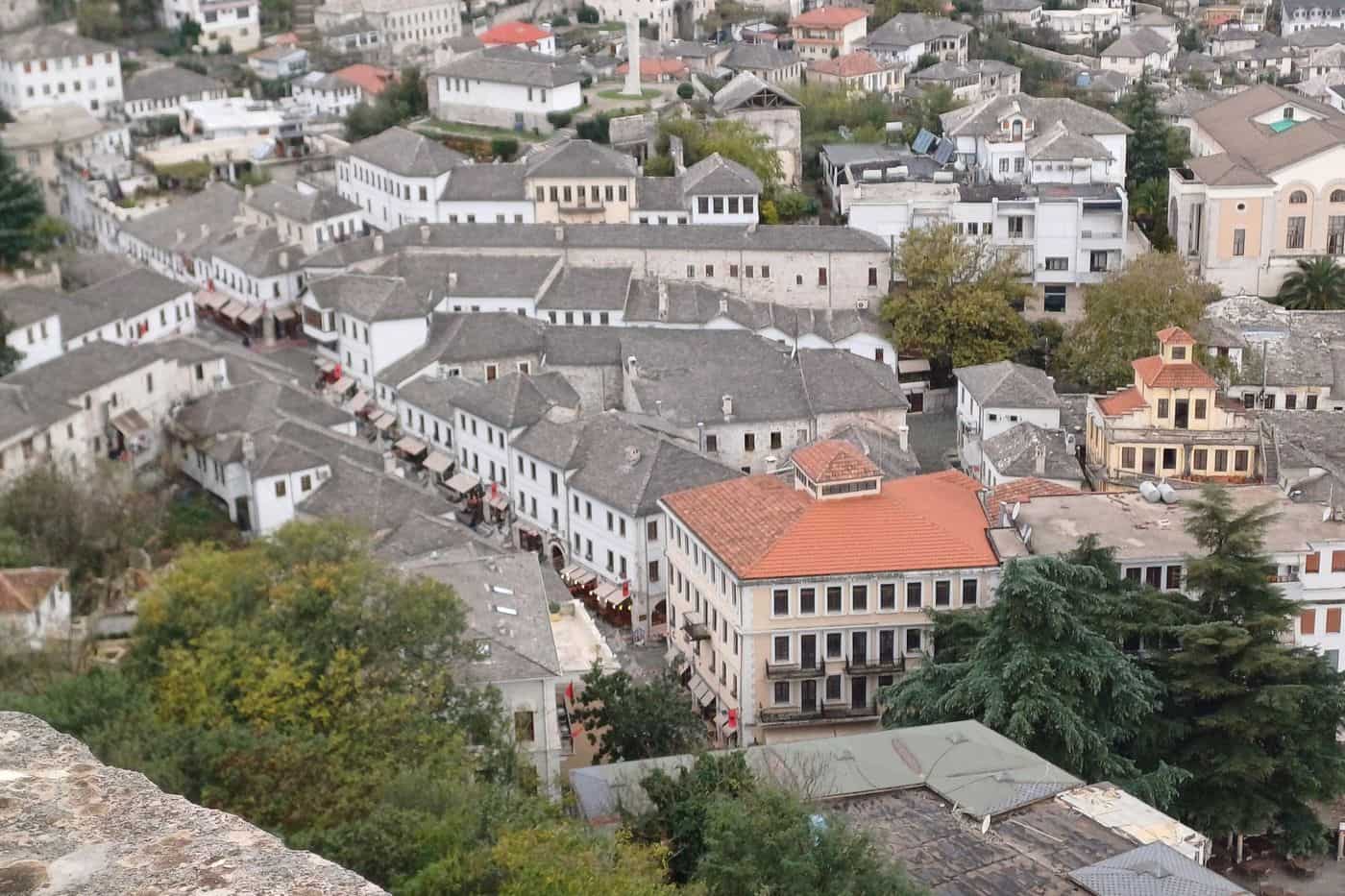
Gjirokaster tours start in Gjirokastër, the stone town of southern Albania on the slopes above the Drino valley, listed by UNESCO together with Berat for its Ottoman-era houses. The routes cover the castle, the old bazaar, the tower houses, the museums, Antigonea, the Drino valley, Përmet and Berat. Greece Tours lists the day trips that reach Gjirokastër from Corfu, Saranda and Ioannina.
This page covers what Gjirokaster tours see in the town and the valley, which trips continue to Përmet and Berat, how visitors reach Gjirokastër from Greece and Saranda, and which season suits each route. The tours below are checked on GetYourGuide and Viator and leave from Gjirokastër, Saranda and Tirana.
What do Gjirokaster tours cover?
Gjirokaster tours cover the UNESCO-listed old town of Gjirokastër in southern Albania: the hilltop castle with its armaments museum, the Old Bazaar, the Ottoman tower houses, the Ethnographic Museum, Ismail Kadare’s birth house and the Cold War tunnel under the castle hill.
Gjirokastër sits in a valley between the Gjerë mountains and the Drino river, 300 metres above sea level. The town divides into an old town on the hill and a new town in the valley below, and Gjirokaster tours spend their time on the steep cobbled streets of the old town.
The communist state gave Gjirokastër the status of a museum town, which spared it from the modern building programmes of the 1960s and 1970s. UNESCO listed the old town in 2005 and added Berat to the same listing in 2008. Butrint, a UNESCO World Heritage Site since 1992, lies 14 kilometres south of Saranda and has its own page of Butrint tours.
- Old town quarters: Palorto, Varosh, Dunavat, Manalat, Hazmurat, Meçite, Cfakë and the Old Bazaar radiate around the castle.
- Stone roofs: flat dressed stones on the old roofs give the town its nickname, the City of Stone.
- Listed homes: more than 500 houses are preserved as cultural monuments.
What do Gjirokaster tours see at Gjirokastër Castle?
Gjirokaster tours climb to Gjirokastër Castle, a fortress at a height of 336 metres with five towers, a clock tower, two Bektashi tekes, a cistern, the National Museum of Armaments and a United States Air Force T-33 jet forced down in 1957.
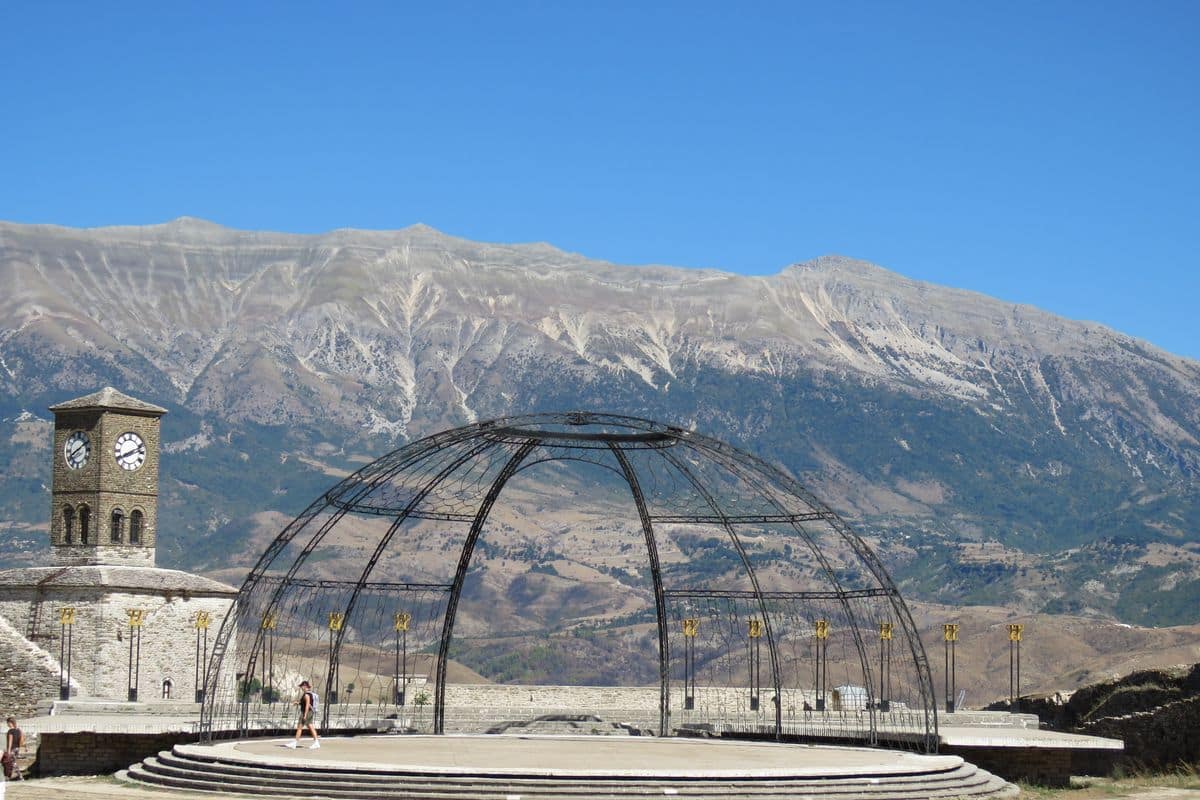
Ali Pasha of Tepelene renovated the citadel and built a westward addition after 1812, and the government of King Zog expanded the castle prison in 1932. The communist regime held political prisoners there until the prison closed in 1968. Gjirokaster tours enter the Museum of the Castle, which joins the arms museum, the former prison and the Museum of Gjirokastra.
The National Museum of Armaments opened in 1971 in part of the old prison. It displays Albanian arms from independence in 1912 to the end of World War II, and Gjirokaster tours pass two columns of German and Italian field guns from that war in its main gallery.
- T-33 jet: two MiG-15s from Kuçova Air Base forced it to land at Rinas on 23 December 1957, and Albania released its pilot, Major Howard J. Curran, on 11 January 1958.
- Prison walls: writings by communists and activists jailed under King Zog and the Italian and German occupation.
- Festival stage: the National Folk Festival, first held in 1968, returns to the castle every five years.
What do Gjirokaster tours see in the old bazaar and the stone houses?
Gjirokaster tours walk the Old Bazaar, the stone market quarter at the centre of the old town, then step inside Ottoman tower houses such as the Zekate House and the Skenduli House, where families lived above a ground floor of cisterns and stables.
Locals call the bazaar Qafa e Pazarit, the Bazaar Pass. It dates from the 17th century, burned in the third quarter of the 19th century and was rebuilt with two- and three-storey shops of the same design and a sidewalk in front, a rare feature in bazaars of that period. Gjirokaster tours still meet artisans working in the old way.
The Bazaar Mosque, also called the Memi Bey Mosque, dates from 1757 and became a Cultural Monument in 1973, which saved it when the regime demolished the town’s remaining 12 mosques. During the religion ban, circus acrobats trained inside and hung their trapezes from its high domed ceiling.
- Zekate House: built in 1811–1812 for Beqir Zeko, an administrator in Ali Pasha’s government, with three floors over two towers in the Palorto quarter.
- Zekate interiors: frescoed walls, a carved ceiling, a decorated fireplace and dry-stone walls laid without mortar.
- Skenduli House: 12 rooms, 44 doors, 64 windows, 9 fireplaces, 6 bathrooms and 4 hamams inside a 17-metre fortified wall.
- Skenduli host: owner Nasip Skenduli, a descendant of the builders, shows visitors the house that served as the original Ethnographic Museum under communism.
Which museums do Gjirokaster tours visit?
Gjirokaster tours visit three museums beyond the castle: the Ethnographic Museum on the site of Enver Hoxha’s birth house, the Ismail Kadare House where the novelist was born, and the Cold War Tunnel, an 800-metre shelter built in secret in the early 1970s.
Fire destroyed the house where Hoxha was born in 1908, and the present building rose in 1964–1966 as a model of a traditional Gjirokastër home. It served as the Anti-Fascist Museum from 1966 to 1991. Today Gjirokaster tours find nothing of Hoxha inside, only folk costumes, kitchenware and household items in rooms arranged like the finest 19th-century houses.
The Kadare house in the Palorto quarter dates from 1799. Kadare was born there on 28 January 1936 and described every corner of it in his novel Chronicle in Stone. After a fire in 1999, UNESCO and the Albanian government funded the rebuilding, and Gjirokaster tours see family objects such as a brazier, a chest and a helmet from the Vietnam War, where Kadare worked as a reporter.
The Cold War Tunnel reflects Hoxha’s fear of a foreign invasion after the break with the Soviet Union in the early 1960s. Gjirokaster tours walk its concrete corridors in their original state; looters took the furniture in 1990, but pieces remain.
- Size: 800 metres of tunnel and 59 rooms under the castle hill.
- Rooms: spaces for government ministries, local government, interrogators and party elites, plus sleeping quarters.
- Machinery: a decontamination room, an air filtration room and a generator room with a rusting Czechoslovak generator.


What history do Gjirokaster tours tell?
Gjirokaster tours tell how Byzantine Argyrokastro, recorded in 1336, fell to the Ottomans in 1418, joined the realm of Ali Pasha in 1811, served as capital of a Greek autonomous republic in 1914, raised Enver Hoxha and entered the UNESCO list in 2005.
The name joins the Medieval Greek words argyron, “silver”, and kastron, “castle”. John VI Kantakouzenos recorded the town in 1336 as part of the Despotate of Epirus. Gjirokaster tours then enter the Ottoman centuries, when the town carried the Turkish name Ergiri and became the seat of the Sanjak of Albania by 1419.
Between the 16th and the early 19th century, conversions to Islam turned a Christian town into a Muslim-majority one and a centre of the Bektashi Sufi order. Gjirokaster tours date the next turn to 1811, when Gjirokastër surrendered to Ali Pasha of Ioannina after an artillery show of force.
Greek troops took the town in the First Balkan War of 1912–1913, but the Protocol of Florence of 17 December 1913 awarded it to Albania. Local Greeks under Georgios Christakis-Zografos formed the Panepirotic Assembly, and in 1914 the town became capital of the Autonomous Republic of Northern Epirus. Gjirokaster tours still meet that community, in a town with a Greek consulate and the Greek-language newspaper Laiko Vima, founded in 1945.
The communist regime named Gjirokastër a “museum city” for its architecture. In August 1991 local Greeks pulled down the monumental statue of Hoxha, the last such statue to fall in Albania. First proposed in 1988, the old town joined the World Heritage list under criteria iii and iv, with Berat added in 2008.
Three names anchor Gjirokaster tours of this history:
- Gjon Zenebishi: the Albanian lord who made Gjirokastër his capital in 1417.
- Ali Pasha: the husband of Emine, daughter of Kaplan Pasha of Gjirokastër, who installed his 10-year-old son Selim in the town.
- Enver Hoxha: born in Gjirokastër in 1908, leader of Albania from 1944 until his death in 1985.
Which Gjirokaster tours visit Antigonea?
Gjirokaster tours that include Antigonea cross the Drino to a National Archaeological Park about 5 km from the town, on a hill at 600 metres above sea level, where the chief inland city of the ancient Chaonians rose in the 3rd century BC.
Historians favour Pyrrhus of Epirus over Antigonus II Gonatas as the founder. On that account, Pyrrhus named the city after his first wife Antigone, stepdaughter of Ptolemy I of Egypt. The ruins lie just south of the village of Saraqinisht, and the park has hosted an annual festival since 2007.
Walls about 4 km long ringed the whole hill and enclosed 450 stremmata, or 45 hectares; the best-preserved stretch runs along the southern end. On Gjirokaster tours the central hill shows a Hippodamian grid with an entire ancient street exposed, and a main street about 6 metres wide ran at least 1 km between the north and south gates.
Albanian archaeologist Dhimosten Budina and Greek professor Konstantinos Zachos identified the site with the help of bronze ballots inscribed “Antigoneon”. Their digs uncovered at least ten houses, paved streets with drains, a stoa of the agora and coins of Pyrrhus’s time and of Corfu. A bronze sphinx and a statue of Poseidon from the site are shown in Tirana.
Gjirokaster tours trace the life of the city through four dates:
- 230 BC: Illyrians under Scerdilaidas pass the straits near the city.
- 198 BC: Roman troops, guided by shepherds, destroy a Macedonian army of 2,000 men in the nearby passes.
- 167 BC: Consul Aemilius Paullus burns Antigonia among 70 towns of Epirus, and the city is never rebuilt.
- 6th century AD: Slavic raids destroy the early Christian church with its Saint Christopher mosaic.
Which Gjirokaster tours visit Libohovë and the Drino valley?
Gjirokaster tours of the Drino valley reach Libohovë, a small Bektashi centre under the castle Ali Pasha built for his sister, and Dropull, a chain of ethnic Greek villages that runs south along the river from Gjirokastër to the Greek border.
The 84.6 km Drino rises near Delvinaki in the Ioannina regional unit of Greece, enters Albania near Ktismata and flows north-west past Gjirokastër to the Vjosë near Tepelenë. Gjirokaster tours look down on its plain from the old town, which stands on the western side.
Libohovë sits at the foot of Bureto Mountain inside the Zagori Regional Nature Park. Evliya Çelebi found 200 houses, a mosque, an inn and a small bathhouse there in the late 17th century; between the world wars the town had 500 houses among olive groves. The house of Myfit Libohova, founder of the Bank of Albania, stands in the centre.
Ali Pasha built Libohovë Castle between 1796 and 1798 as a dowry for his sister Shainitza, who married into the Libohova family; her son Adem later governed the town. Gjirokaster tours find four polygonal corner towers and a wall around a large courtyard, while the inner residence stands empty.
South of Gjirokastër the valley becomes Dropull, where Leonidas Kallivretakis counted 34 villages, all of them ethnic Greek. Official documents there give place names and street addresses in Albanian and Greek, and the local dialect links those of Ioannina and Corfu. Gjirokaster tours that continue south reach these sites:
- Hadrianopolis: a Roman amphitheatre and baths near Sofratikë, 11 km south of Gjirokastër, found by local farmers in 1984.
- Peshkëpi: the fortification ruins, aqueduct and medieval church of the town Justinian I moved 4 km south-east in the 6th century.
- Derviçan: the 16th-century Monastery of the Taxiarchs Michael and Gabriel.
- Jorgucat: the Monastery of the Prophet Elias, founded before 1586.
Which Gjirokaster tours continue to Përmet and the Langarica canyon?
Gjirokaster tours that continue to Përmet reach a town on the Vjosa river known across Albania as the town of the roses, then the narrow, deep Langarica canyon near the village of Petran, with its caves and the thermal springs of Benjë.
Përmet is a town and municipality in Gjirokastër County. The Vjosë river flanks it, running between the Trebeshinë and Dhëmbel mountains and through the Këlcyrë Gorge. Gjirokaster tours that stop in Përmet reach its key highlights for travellers: rafting, kayaking, hiking, nature and wildlife tours, and extreme sports. The town is known for jams (reçel), kompot, local wine and raki, and as the hometown of clarinet folk artist Laver Bariu.
The Vjosa runs for about 272 kilometres: the first 80 kilometres in Greece and the remaining 192 kilometres in Albania, which it enters near Çarshovë. On 15 March 2023 the river became Europe’s first Wild River National Park. Gjirokaster tours that raft this stretch move through habitat for over 1,100 species of wildlife, including otters and the endangered Egyptian vulture.
The Vjosa forms the western edge of the Fir of Hotovë-Dangëlli National Park, the largest national park in Albania at 34,361 hectares, with 11 natural monuments. The park lists the Langarica canyon as a rafting route and pairs the Benja thermal waters with the Katiu Ottoman Bridge. Gjirokaster tours that drive deeper into the park reach Frashër, a village at its heart.
- Park tree: the Hotova fir, a Mediterranean plant relic that gives the park its name.
- Frashër museum: the Frashëri Brothers Tower House, rebuilt in the 1970s, on the family’s part in the Albanian Renaissance.
- Bënja cave: evidence of continuous habitation from the Eneolithic to the Iron Age.
- Park wildlife: roe deer, wild boar, Eurasian otter, brown bear and golden eagle.
Which Gjirokaster tours continue to Berat?
Gjirokaster tours that continue to Berat reach a city 71 kilometres north by air, the second town of the shared UNESCO listing. Its old centre has three parts: Kalaja on the castle hill, Mangalem below it and Gorica across the Osum.
Gjirokastër joined the UNESCO World Heritage list in 2005, and Berat was added as an extension in 2008; both are inscribed as rare examples of an architectural character typical of the Ottoman period. Berat’s traditional Balkan houses date to the late 18th and the 19th centuries. Gjirokaster tours that add Berat see the city of a thousand windows, which Albanians also call the City of Two Thousand Steps.
Gjirokaster tours that climb to Berat Castle find a fortress on a rocky hill on the right bank of the Osum, at 214 metres, dating mainly from the 13th century, when the Despot of Epirus, Michael I Komnenos Doukas, rebuilt its walls. Its Christian population built about 20 churches inside, against one mosque for the garrison. The castle appears on the reverse of the Albanian 10 lekë coin.
The cathedral of St. Nicholas is now a museum dedicated to Onufri, the 16th-century painter who founded a school of painting in Berat and was the first to use a shiny red that the French called Onufri’s Red. Gjirokaster tours that stop at the museum see works by Onufri, his son Nikolla and other painters, religious silverwork and copies of the Berat Gospels, whose originals are kept in the National Archives in Tirana.
- Gorica Bridge: seven arches and 129 metres over the Osum, rebuilt in stone in the 1920s.
- King Mosque: the oldest mosque in town, built in the reign of Bayazid II (1481–1512).
- Lead Mosque: built in 1555 and named after the lead covering of its domes.
- Bachelors’ Mosque: built in 1827 in the lower Mangalem quarter.
Which local food do Gjirokaster tours taste?
Gjirokaster tours taste three local dishes: qifqi, small fried balls of rice, eggs and dried mint that originated in the city; shapkat, a mix of sorrel and cornflour; and oshaf, a baked dairy pudding of sheep milk, dried figs, sugar and cinnamon.
Qifqi is a signature dish of the regional cuisine, cooked in the qifqi tigan, a copper or tinned aluminium pan with four to seven round molds; each ball is turned with a spoon until golden on both sides. Gjirokaster tours meet it hot, with white cheese, yogurt or dhallë, a yogurt drink. Local belief says it was once made for women who had just given birth; another story traces it to leftover pilaf from weddings.
Oshaf is baked in small heat-resistant bowls until the surface browns, then sprinkled with cinnamon and, at times, ground cloves; it is served warm, at room temperature or chilled. Local households have passed the recipe down for generations and serve it as a treat to visiting guests. Gjirokaster tours that end a meal with dessert also find Turkish-style bakllava and seasonal fruit.
Pastoral life in the nearby mountains supplies cheese from goat, sheep and cow’s milk, such as the soft white djathë i bardhë and the harder yellow kaçkavall. Gjirokaster tours that stop for lunch order grills from lamb shanks to intestines and offal, or stuffed eggplant and peppers. The Lunxheri region of Gjirokastër gave Albanian cuisine two more dishes, groshët and shqeto.
- Pasha qofte: a local dish of meatballs in rice soup.
- Sarma: vine leaves or zucchini flowers stuffed with rice and mint.
- Qahi: spinach pies served as a starter.
- Lakror: a southern pie of leek and gjizë, cooked on embers under a metal lid.
- Raki rigoni: a southern raki made with white oregano.
How do visitors reach Gjirokaster on Gjirokaster tours?
Gjirokaster tours reach the town by road on the SH4 highway, which links Durrës on the Adriatic with the Kakavijë border crossing to Greece. The town lies 232 km from Tirana and 31 km from Kakavijë, the main road crossing between Albania and Greece.
Gjirokaster tours from Tirana follow the SH4 south through Rrogozhinë, Fier and Tepelenë, and the stretch from Tepelenë to Gjirokastër is a superstradë on Route 2 of the European Core Road Network.
From Greece, Gjirokaster tours start in Ioannina, the capital of Epirus on the western shore of Lake Pamvotis, and follow the European route E853 north to the border. The E853 uses the EO20 road from Ioannina to Kalpaki and the EO22 road from Kalpaki to Kakavia. Travellers based in Epirus can pair the crossing with Ioannina tours on the Greek side.
- Albanian side: the village of Kakavijë, in the Dropull region of Gjirokastër County.
- Greek side: the village of Ktismata, in the Delvinaki municipality of the Ioannina regional unit.
- Through road: the main road from Sarandë and Gjirokastër to Ioannina passes this crossing.
- Border length: 282 km, from the strait east of Corfu to Lake Prespa.
Travellers without a car ride buses or furgons, the Albanian minibuses with yellow plates. Furgons keep no fixed timetable: each one leaves once every seat is full, and air conditioning is rare on board.
When do Gjirokaster tours run best?
Gjirokaster tours run best from April to October, when the town records between 1 and 7 rain days a month. July and August bring 1 rain day each and highs of 32 °C to 34 °C, while November and December bring the heaviest rain.
Gjirokaster tours meet a hot-summer Mediterranean climate with much heavier rainfall than usual for that climate type. December averages 305 mm of rain and November 233 mm, against 32 mm in July and 25 mm in August. The town’s weather station recorded 102 rain days and 4 snow days a year between 1961 and 1990.
July is the sunniest month, with 378 hours of sunshine against 115 hours in December. The town’s record high is 42.6 °C, set in July, and its record low is −17.4 °C, set in December.
- April: highs of 18 °C and 7 rain days.
- June: highs of 28 °C and 2 rain days.
- September: highs of 27 °C and 3 rain days.
- November: highs of 15 °C and 14 rain days.
The big cultural date for Gjirokaster tours is the National Folklore Festival, held every five years on the castle stage and regarded as the top event of Albanian culture. The first edition ran from 8 to 16 October 1968, and the festival showcases traditional music, dress and dance from Albania, the diaspora and Albanian-inhabited lands across the Balkans and southern Italy.
Recent editions ran in spring, in September and from late June into July, and one edition drew over 1,000 singers and dancers from eight countries.
Which Gjirokaster tours leave from Corfu and Saranda?
Gjirokaster tours from Saranda run as day trips of 7 to 9 hours with pickup, and they pair the old town with Lekursi Castle, the Blue Eye spring or Mesopotam Monastery. Corfu guests first cross the strait to Saranda by high-speed ferry.
Gjirokaster tours from Corfu begin on the water: traditional ferries and the high-speed Flying Dolphins sail from the island to Sarandë, on a ferry service that dates from 1988. The northeastern edge of Corfu lies off the Sarandë coast, across straits 3 to 23 km wide. Island guests who prefer the coast can book a Corfu to Albania day trip instead.
From the quay, Gjirokaster tours drive 56 km inland to the old town. Cruise passengers join from the same harbour: the Port of Sarandë is too small for cruise lines to dock, so a fast boat carries visitors between ship and shore.
- Town walks: 3-hour walking tours of the bazaar, the castle and the Zekate house.
- Quarter walks: 3-hour routes through the Old Bazaar, Cfake and Dunavat quarters.
- Tirana departures: 10-hour private UNESCO tours of the castle, the old bazaar and the museum.
- Winter hikes: 1-day small-group hikes in the Pylloi Mountains from Sarandë.
Frequently Asked Questions
Do Gjirokaster tours need cash?
Yes. The lek is the official currency of Albania, and the bulk of shops, hotels and restaurants in Gjirokastër also accept euros. Card payment is rare in the town, so visitors carry cash, which cash machines and licensed currency exchange shops supply both downtown and in the old town.
Which airports serve Gjirokaster tours?
Three airports serve the region. Tirana International Airport Nënë Tereza, 11 km northwest of Tirana, is the only Albanian airport with scheduled commercial passenger flights. Ioannina National Airport sits 4 km from central Ioannina in Greece, and Corfu’s Ioannis Kapodistrias International Airport sits about 3 km south of Kerkyra, the island’s town.
Which languages help on Gjirokaster tours?
Albanian and Greek both help. Gjirokastër is a centre of the Greek community in Albania, hosts a Greek consulate and publishes the Greek-language newspaper Laiko Vima, founded in 1945. Useful Albanian words for visitors include mirëdita for good day, faleminderit for thank you, po for yes and jo for no.
Which UNESCO-listed music links to Gjirokaster tours?
Albanian folk iso-polyphony does. UNESCO proclaimed it in 2005 and inscribed it in 2008 on its Representative List of the Intangible Cultural Heritage of Humanity. Gjirokastër is home to both Albanian and Greek polyphonic singing, and the iso, a term related to the ison of Byzantine church music, is the drone beneath the singers.