
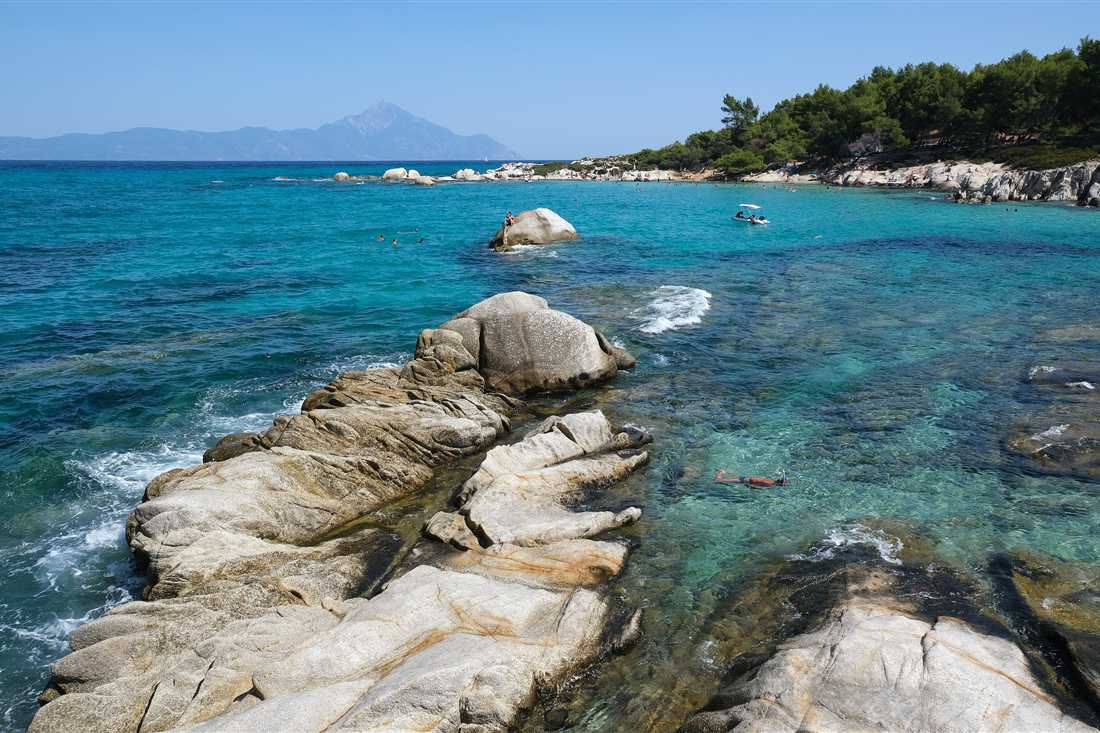
Halkidiki snorkeling means swimming face down at the surface of the clear sea around Halkidiki. Swimmers use a mask, a breathing tube and fins. Halkidiki is a peninsula in northern Greece with three long arms of land. Tours across the rest of the country are listed on Greece Tours.
The sections below cover the spots, the tours, the sea life and tips for beginners. They also cover boat trips, the season, timing and booking, with links into the Thessaloniki and Halkidiki pages. Every tour shown is checked on GetYourGuide and Viator.
What is Halkidiki snorkeling?
Halkidiki snorkeling means swimming face-down at the surface of the Aegean Sea in northern Greece. You wear a mask, a snorkel and fins to watch the seabed. A snorkel is a short tube that lets you breathe while your face stays in the water.
Halkidiki is a peninsula of 2,918 km² with three long arms: Kassandra, Sithonia and Athos. Two gulfs lie between them, the Toronean Gulf and the Singitic Gulf. Ammouliani and Diaporos sit in the Singitic Gulf, and uninhabited Kelyfos sits in the Toronean Gulf.
Halkidiki snorkeling suits beginners, because local dive centres report no currents and no dangerous species. The water is clear, so you see the seabed from the surface.
- First-timers: no certificate is needed, only the ability to swim.
- Families: guided shore trips accept children from age 6 or 7, depending on the dive centre.
- Non-divers: snorkelers stay at the surface and carry no air tank.
- Boat fans: shared cruises from Neos Marmaras stop at Kelyfos and Spalathronisia for a swim.
A Halkidiki snorkeling trip either follows the rocks near a beach or sails out to islets. Boat trips reach places like Kelyfos, which has no road and no residents. Shore trips start from a dive centre and drive a short way to the water.
Where are the top Halkidiki snorkeling spots?
The top Halkidiki snorkeling spots sit on all three arms of the peninsula. Sithonia has Kelyfos, Spalathronisia, Diaporos, Porto Koufo and the Nikiti beaches. Kassandra has west-coast reefs, caves and tunnels, and Athos has the six small Drenia islets near Ouranoupoli.
Sithonia, the middle arm, has Halkidiki snorkeling sites on both coasts. Its west side faces the Toronean Gulf, and its east side faces the Singitic Gulf. Kalogria beach near Nikiti adds schools of fish, and Sithonia tours covers the land side.
- Elia beach, Nikiti: a calm Toronean Gulf beach used by guided shore groups.
- Lagomandra beach: a sandy bottom with small reefs that suit beginners and children.
- Spalathronisia islets, near Neos Marmaras: tiny islets with natural arches, caves and rich sea life.
- Kelyfos, off Neos Marmaras: a turtle-shaped island of about 1 km², reached only by sea, with more than 10 dive entry points.
- Diaporos, off Vourvourou: a 4 km² pine-covered island with the Blue Lagoon, reefs and sea caves, reached on Vourvourou tours.
- Porto Koufo, in the far south: a natural harbour named by the ancient historian Thucydides, with underwater caves and shipwrecks.
On Kassandra, Halkidiki snorkeling centres on the rocky west coast and its tunnels. One shore site there includes a sea cave that guides call the bat cave. At Possidi cape, the water turns deep near the shore and the sea runs wilder.
On the Athos arm, the Drenia islets lie about 3.7 km (2 nautical miles) off Ouranoupoli. The group has six islets: Drenia, Tigani, Pontiki, Feti, Penna and Artemis. Their shallow water over golden sand makes easy Halkidiki snorkeling next to Ammouliani island.
Which Halkidiki snorkeling tours can you book?
Five Halkidiki snorkeling tours from local operators take bookings online. Two are guided shore trips, in Nikiti and on Kassandra, and one is a beginner lesson on Kassandra. Two go by boat, to Diaporos and along the Mount Athos coast.
- Chalkidiki: Snorkeling Adventure in Sithonia: a guided shore trip in a calm, shallow bay, run by Diversity Diving Center from Nikiti.
- Snorkeling for beginners in crystal clear sea of Halkidiki: a theory lesson, a practical lesson and a guided snorkel, run by Triton dive centre on Kassandra.
- Snorkeling trip: a guided shore trip through reefs, caves and tunnels, run by Dive Greece on Kassandra.
- Snorkeling Adventure with 600hp Speed Boat: a speed boat trip to the Diaporos lagoons, run by Oceanic Diving Center from Nikiti.
- Private Mount Athos Monasteries Cruise with Snorkeling: a private boat trip past the Athos monasteries, with a snorkel stop on the way.
Nikiti, the base for the Sithonia shore trip, sits on the west coast of Sithonia, facing the Toronean Gulf.
The speed boat’s Halkidiki snorkeling stops lie around Diaporos and its lagoons, in the Singitic Gulf. The private Athos cruise follows the monastery coast of the third arm instead.
On Kassandra, Triton runs dive bases at Pefkohori, Paliouri and Kallithea, with 7 dive sites in total. Dive Greece sits at Loutra Agias Paraskevis, about an hour’s drive from Thessaloniki airport. It collects guests from anywhere on the peninsula.

What does the Sithonia Halkidiki snorkeling adventure include?
The Sithonia Halkidiki snorkeling adventure is a 3-hour guided trip based in Nikiti. It includes a full gear set, pickup from your accommodation, and free photos and videos. An instructor gives a safety briefing and then swims beside you.
PADI, a diver training agency, rates the operator, Diversity Diving Center, as a 5 Star centre. It sits inside the Athena Pallas hotel at Elia Beach and welcomes guests from other hotels. Its team includes a PADI Course Director, the agency’s top instructor rank, and an underwater archaeologist.
This Halkidiki snorkeling trip uses a calm, shallow bay with clear water. That setting suits beginners, families and children who have never snorkeled before. The day follows six steps from start to finish:
- Pickup from your accommodation in Sithonia
- Gear fitting with a mask, snorkel, fins, boots and a wetsuit
- Short drive to the beach
- Safety briefing and snorkeling lesson at the water’s edge
- Guided swim along the rocky reefs
- Drive back and gear return
Instructors stay in the water with the group for the whole Halkidiki snorkeling session. They help you spot sea life and keep the pace slow, so nobody feels rushed. The operator sets the minimum age at 6, and every guest must know how to swim.
What sea life do you see on a Halkidiki snorkeling trip?
A Halkidiki snorkeling trip shows octopus, sea urchins, starfish, wrasse, groupers, jacks and mullets over rocky reefs. Meadows of Neptune grass grow on the sandy seabed between the rocks. Local dive centres also list sea anemones, lobsters and moray eels along the reefs.
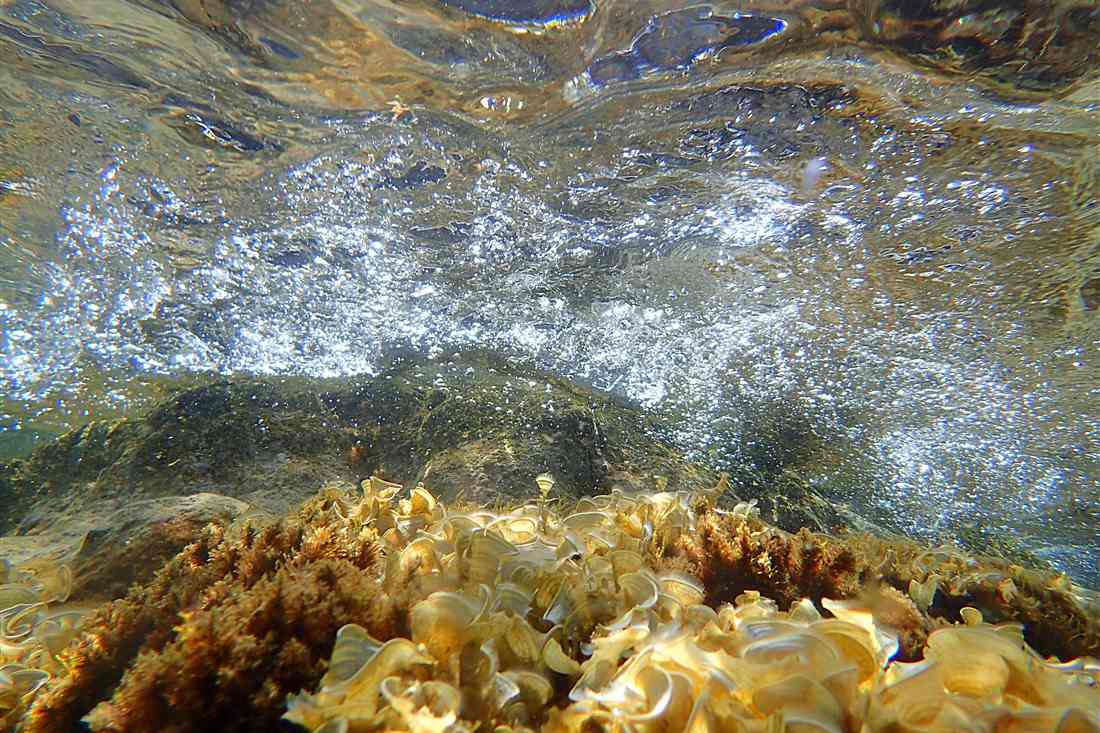
Neptune grass, or Posidonia oceanica, is a flowering seagrass, not a seaweed. Its ribbon leaves reach 1.5 metres long, and meadows grow from 1 to 35 metres deep. The meadows act as a nursery, a safe place where young fish feed and hide from bigger fish.
Halkidiki snorkeling guides point out the common octopus in rocky shallows near the shore. It hides in cracks, changes colour to blend in and hunts crabs and lobsters. Its eight arms reach up to 1 metre, yet it lives only 1 to 2 years.
The black sea urchin clings to bare rock down to 30 metres, and its spines are sharp. The purple sea urchin is never fully black and covers itself with shells and bits of weed. For deeper reefs, steep drop-offs and overhangs, look at Halkidiki scuba diving.
How does Halkidiki snorkeling work for beginners?
Halkidiki snorkeling for beginners starts on the shore with a guide’s briefing. You learn to fit a mask, breathe through a snorkel and kick with fins. Then you float face down in calm, shallow water while the guide watches you closely.
A snorkel is a short breathing tube that sticks up above the water. A mask covers your eyes and nose, so you see clearly under the surface. Fins are flat blades worn on your feet that push you forward with less effort.
The guide’s briefing covers five simple Halkidiki snorkeling skills for first-timers. Practise each one in shallow water, where your feet touch the sandy bottom, before you swim out:
- Fit the mask: press it to your face, sniff gently and check that it stays on
- Stop the fog: clean the lens with dish soap and add anti-fog liquid
- Hold the tube right: keep the snorkel at 45 degrees, half above the water
- Breathe slowly: take calm, deep breaths of 4 to 5 seconds through your mouth
- Clear the tube: blow out hard to push water out, then breathe in gently
Relax and trust your body to float, because flailing wastes energy. A wetsuit adds extra lift in the salty sea and keeps you warm. Never go Halkidiki snorkeling alone; the Sithonia operator’s PADI listing allows up to 4 snorkelers per guide.
Which Halkidiki snorkeling trips go by boat?
Boat-based Halkidiki snorkeling takes two forms in the listings. A speed boat runs to Diaporos island off Sithonia, and a private cruise sails past Mount Athos. Both stop at uninhabited islands that only boats reach, with snorkel gear on board.
Oceanic Diving Center runs the Halkidiki snorkeling speed boat from the port of Ormos Panagias to Diaporos. The boat is a military vessel with two 300-horsepower engines, 600 in total.
Guests arrive an hour early to fit the gear, and the boat leaves at 10:00. This Halkidiki snorkeling run spends 5 hours among the island’s lagoons, with fruit, water and snacks on board. Ages 8 to 65 can join, and guests reach the port on their own.
The private Athos cruise from Ouranoupoli follows the monastery coast 500 metres offshore. It lasts 5 hours, takes up to 7 guests and stops at the Drenia islets to snorkel. More sailings appear on the Ouranoupoli tours and Halkidiki boat tours pages.


When is the Halkidiki snorkeling season, and how warm is the sea?
The Halkidiki snorkeling season runs from late spring to October. The sea warms from 18°C in late spring to 26°C in August. Visibility, meaning how far you see under water, reaches 15 to 30 metres around Sithonia.
The list gives monthly sea averages for Pefkohori, a resort on the Kassandra peninsula. Each line adds the daily hours of sunshine from the same climate record.
- Late spring: sea at 18°C, 9 hours of sun a day
- June: sea at 23°C, 11 hours of sun a day
- July: sea at 25°C, 12 hours of sun a day
- August: sea at 26°C, 11 hours of sun a day
- September: sea at 24°C, 9 hours of sun a day
- October: sea at 21°C, 6 hours of sun a day
July, August and September bring only 4 rainy days each. Cooler water in late spring calls for a wetsuit, a stretchy rubber suit that keeps your body warm. Dive Greece hands out a short or a long wetsuit to match the season.
Summer also brings the meltemi, a strong, dry north wind over the Aegean Sea. It blows from June to September and peaks in July and August. The wind is strongest from mid-morning to around sunset, so an early Halkidiki snorkeling trip meets calmer water.
How long does a Halkidiki snorkeling tour last, what is included, and where does it meet?
A shore-based Halkidiki snorkeling tour lasts about 3 hours, with gear, a guide and hotel pickup included. The speed boat day around Diaporos lasts 5 hours. Meeting points sit in Nikiti, Ormos Panagias and across the Kassandra peninsula.
The 3 hours cover the drive, the safety briefing and the swim. On the Kassandra trip by Dive Greece, about 1 hour of that time is spent in the water. The shore tours include the items below.
- Mask, snorkel and full-foot fins, which slip on like a shoe
- A wetsuit when the water is cool
- A dive instructor who swims with the group
- Hotel pickup and drop-off in Sithonia or Kassandra
- Bottled water or light refreshments
Shore trips meet at the dive centres or collect guests from their hotels. Dive centres also work from Vourvourou and Neos Marmaras.
For a slower day on the water, compare the speed boat with a Sithonia sailing tour. Pickup on a Halkidiki snorkeling tour covers hotels inside Sithonia or Kassandra only.
Nikiti lies 100 kilometres south-east of Thessaloniki, and Neos Marmaras lies 125 kilometres away. The airport sits 90 kilometres from Nikiti, so book Halkidiki transfers to your hotel first. City-based guests can plan a Halkidiki day trip from Thessaloniki around the swim.
How do you book and cancel a Halkidiki snorkeling tour?
Book a Halkidiki snorkeling tour online through GetYourGuide or Viator, then keep the voucher on your phone. On listings with free cancellation, both sites refund you in full up to 24 hours before the start.
The Sithonia adventure on GetYourGuide takes bookings up to 2 hours before the start time. Every Halkidiki snorkeling booking then follows the same six steps on either site.
- Pick the date and the number of guests
- Check the pickup area or the meeting point
- Check the minimum age for any children
- Pay now, or reserve now and pay later
- Save the voucher on your phone
- Send the operator your hotel name for pickup
Cancel later than 24 hours before the start, or miss the trip, and GetYourGuide gives no refund. Refunds go back to the card you paid with in 3 to 5 working days. Viator’s Reserve Now, Pay Later option charges your card two days before the activity.
Bad weather can cancel a Halkidiki snorkeling outing too. Diversity Diving Center then offers a free new date or a full refund. GetYourGuide also lists the Sithonia adventure as wheelchair accessible, so ask the operator about access when you book.
Frequently Asked Questions
Do you need a diving licence for Halkidiki snorkeling?
No diving licence is needed for Halkidiki snorkeling, because you stay at the surface. You do need to swim. Diversity Diving Center asks every guest to know how to swim before the trip.
What do you pack for a Halkidiki snorkeling tour?
Pack a swimsuit, a towel, sunscreen and a bottle of water. Add a dry change of clothes for the ride back to your hotel. Wear comfortable clothes for the short drive to the beach. Diversity Diving Center lists these six items for its shore trip near Nikiti.
Who can join a Halkidiki snorkeling trip?
Dive Greece in Kassandra takes children from 7, with an adult alongside. The Diaporos speed boat suits every fitness level. Its listing advises against the trip for pregnant guests, spine injuries and poor heart health.
Which languages do Halkidiki snorkeling guides speak?
Diversity Diving Center guides in English, German, Polish, Greek and Serbian. Dive Greece guides in English, French and Greek. Halkidiki has more than 25 diving centres in total, from beginner lessons up to instructor courses.