
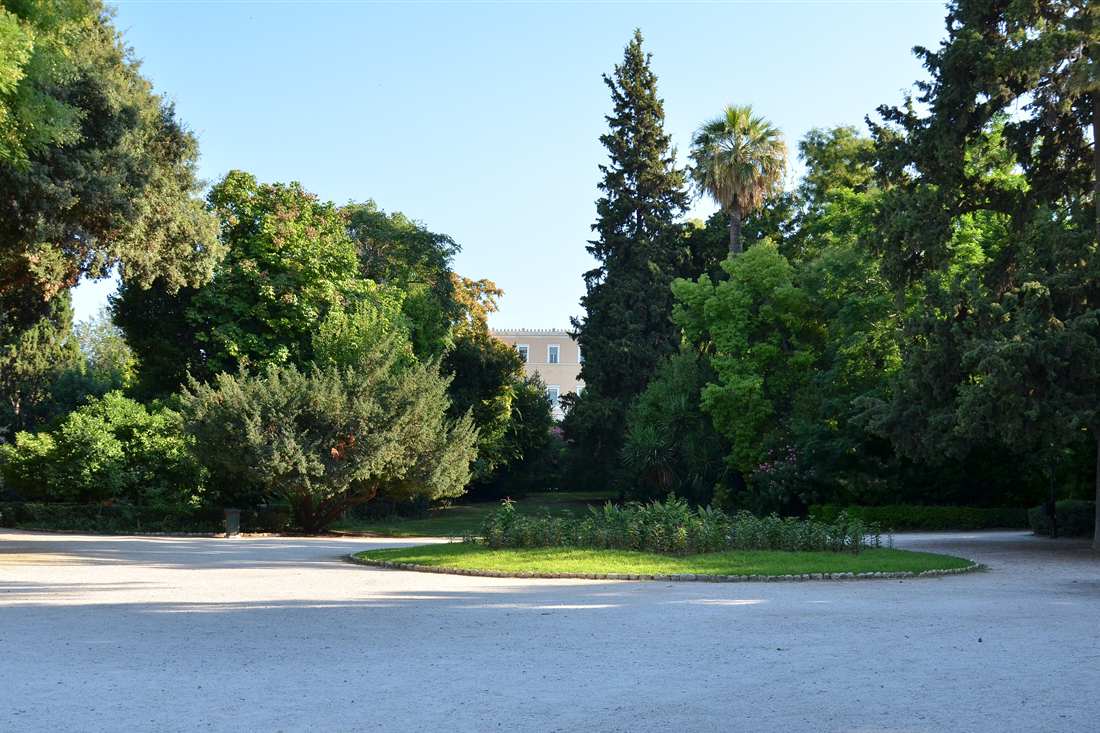
Six free gardens in Athens let you walk in without paying: the National Garden, the Zappeion Gardens, Pedion tou Areos, the Stavros Niarchos Park, Eleftherias Park and the Diomedes Botanical Garden. The National Garden opens every day from sunrise to sunset, and Pedion tou Areos spreads over 27.7 hectares, according to Wikipedia.
Two of these gardens sit beside Syntagma metro station, and Pedion tou Areos is a few minutes’ walk from Victoria station on Line 1. Anyone comparing Athens with the Greek islands can find every destination we cover on the Greece Tours homepage.
Which free gardens in Athens can you enter without a ticket?
Six green spaces let you walk in with no payment at the gate. Pedion tou Areos, the National Garden and the Zappeion Gardens are the first three. The Stavros Niarchos Park, Eleftherias Park and the Diomedes Botanical Garden are the others. Free gardens in Athens come in two kinds, planted gardens and open parks.
A garden here has planted beds, paths and gates. A park is a wider open field with trees and lawns. The two kinds sit side by side in the city, and visitors ask about both, so this page covers both.
- The National Garden covers 15.5 hectares behind the Greek Parliament, according to Wikipedia.
- The Zappeion Gardens hold 83,000 square metres of planted area, as the Zappeion’s own page states.
- Pedion tou Areos spreads over 27.7 hectares and ranks as one of the largest public parks in Athens, says Wikipedia.
- Wikipedia gives the Stavros Niarchos Park an area of 210,000 square metres.
- Eleftherias Park stands on Vasilissis Sofias Avenue, with four stone buildings at its back.
- The Diomedes Botanical Garden in Haidari holds more than 2,500 plant species, says a travel site.
Free means the gate stands open and nobody asks you to pay. Wikipedia states that the National Garden is open to the public from sunrise to sunset. A travel guide says entry to the Stavros Niarchos Park is free for all.
The Diomedes garden works a little differently. A travel site says you book a free e-ticket on the official website before you go. The closest free gardens in Athens to Syntagma Square are the National Garden and the Zappeion Gardens.
Which free gardens in Athens sit in the city centre?
Two free gardens in Athens share the centre. The National Garden lies behind Parliament, and the Zappeion Gardens sit at its southern end, across from the Panathenaic Stadium. Syntagma metro station, where lines 2 and 3 meet, sits beside the National Garden.
The National Garden lies between Kolonaki and Pangrati, according to Wikipedia. Its main entrance faces Leoforos Amalias. Three more gates open on Vasilissis Sophias Avenue, Herodou Attikou Street and the Zappeion side.
One travel site counts seven entrances in all, so these free gardens in Athens open onto different streets. The same site counts 6,600 trees, 5,700 bushes and 18 bird species in the garden. Wikipedia adds that the Greek state gave the garden to the city of Athens for 90 years.
The same site lists a central pond and a goldfish pond, fountains and stone irrigation ditches. It counts four reptile types and three amphibian types. Wikipedia names a botanical museum and ancient ruins among the grounds, including the column drums of a Roman villa.
The Zappeion Gardens wrap around the Zappeion Hall. Their layout began in a French geometric style. Later designers redrew it with the free curved lines of an English garden. The Zappeion’s own page states both steps.
Those same free gardens in Athens carry old trees. The Zappeion’s page says planting began in the middle of the nineteenth century, with nearly 200 plane trees. The page also lists 41,000 square metres of paved surface and 2,400 square metres of patios.
A fountain stands at the centre of the garden square. The Zappeion’s page says an American company donated it when the Marathon Dam opened. Wikipedia notes that statues stand in the grounds. The gardeners use organic fertilisers and sprays only, the same page states.
Wikipedia adds that Parliament set aside 80,000 square metres of public land for the Olympic building works. The land lay between the Palace Gardens and the Temple of Olympian Zeus. A later restoration put 14,000 square metres of turf back, the Zappeion’s page says. These free gardens in Athens keep both green lawns and paved squares.
The Panathenaic Stadium faces the southern end of the gardens. Wikipedia places the stadium in Pangrati, east of the National Garden and the Zappeion. Two pine-covered hills close it in. The stadium itself is a monument and not a garden.
Syntagma Square holds a metro station, a tram terminal and bus stops. Wikipedia ranks that hub among the busiest in the country. For the free gardens in Athens at the centre, it is the first stop. Amalia Avenue borders the square on the east side, and the garden’s main entrance sits on Leoforos Amalias.
Which free gardens in Athens lie outside the centre?
Four free gardens in Athens lie beyond the Syntagma core. Pedion tou Areos is to the north, and Eleftherias Park stands on Vasilissis Sofias Avenue. The Stavros Niarchos Park is in Kallithea, and the Diomedes Botanical Garden is in Haidari. Each has its own entrance and its own layout.
Among the free gardens in Athens, Pedion tou Areos lies about 1 km north-east of Omonia Square, says Wikipedia. Mavromateon, Evelpidon, Pringiponisson and Alexandras Avenue surround it. Wikipedia lists Victoria station on Line 1 as a few minutes’ walk away.
The park honours the heroes of the Greek Revolution, and 21 marble busts stand along its paths. An equestrian statue of King Constantine I guards the main entrance. Near Alexandras Avenue a memorial topped by a statue of Athena remembers Allied soldiers of the Second World War.
Planting ran in the late 1930s, until Greece entered the Second World War. It put 46,000 trees and bushes in the ground. Deciduous trees give shade in summer and let the sun through in winter, Wikipedia explains.
After its renovation the park holds 1,200 trees, 50,000 flowers, 7,500 topiaries and 2,500 roses. The grounds also hold a playground, two churches and an open-air theatre. Free gardens in Athens do not stop at the old centre.
A fountain stands in the central square of Pedion tou Areos, ringed by plants that suit the Mediterranean climate. Wikipedia says the planners kept the Acropolis in view from the central points of the park.
Among free gardens in Athens, the Stavros Niarchos Park belongs to the Stavros Niarchos Foundation Cultural Center. A travel guide counts 1,400 trees and 28,000 bushes. It describes a Mediterranean garden of sage, oregano, thyme, rosemary and lavender, plus a wooded circular labyrinth. The guide says entry is free for everyone.
The park rises on a gentle slope. The guide says the summit gives 360-degree views of the sea and the Acropolis. A canal for sailing and kayaking lessons runs below. The guide lists tram, bus, shuttle bus and car as ways to arrive.
A running track follows the entrance, with outdoor fitness equipment just below it, the guide adds. Chess boards with life-sized pieces are set into the ground. Wikipedia states that the roof of the library is planted with Greek plants. The guide says the esplanade suits jogging and biking.
Eleftherias Park lies on Vasilissis Sofias Avenue. A travel site says Panagiotis Vokotopoulos designed it. A four-metre bronze statue of Eleftherios Venizelos stands on a marble pedestal reached by stairs. Infantry barracks of stone went up on this ground in the nineteenth century.
Four of those stone buildings at the back of the park are listed monuments, an Athens tourism site states. The Athens Municipality Art Centre also stands in the park. The park carries its name because pro-democracy activists suffered there during the dictatorship.
Of the free gardens in Athens, the Diomedes Botanical Garden sits in Haidari, beside the Monastery of Daphni. A travel site puts it 8 km from Omonia Square. It holds more than 2,500 plant species and opened to the public in the 1970s. The same site adds that undergraduate courses of the Agricultural University of Athens take place there.
What opening hours and rules apply in free gardens in Athens?
The National Garden opens every day from sunrise to sunset, and a national tourism page lists free entry. Plan around those hours for free gardens in Athens, and check city notices on windy or very hot days.
According to the garden’s own site, visitors can enter every day between sunrise and sunset. The hours follow the sun, so the gates stay open longer in summer than in winter. The same page adds that an emergency or a security issue can alter the hours. Notices go up at the entrances and on social media.
Closures do happen. A news report says the Municipality of Athens closed the National Garden as a safety step. The Civil Protection service had warned of gale-force winds up to 100 km/h. In a heatwave with fire risk, the Attica Region director shut Pedion tou Areos until further notice.
A short look at the city announcements saves a wasted walk on such a day. Wind and fire warnings change the plan for the free gardens in Athens faster than any timetable does.
The rules on movement are short. The National Garden bans all wheeled vehicles with riders, and the garden page names bicycles and electric skates. Public toilets stand inside the garden, and the page points to a map for their position.
Dogs follow one clear rule. The official Athens visitor guide says to clean up after your dog. It also says to keep the dog on a leash unless you are in a designated dog park. That leash rule covers free gardens in Athens like any other public space. For the wider pet rules, read about dog-friendly Athens before you travel with a dog.
Which free gardens in Athens suit children?
The National Garden, the Zappeion Gardens and Pedion tou Areos each have a playground. These three are the first free gardens in Athens to try with children. The National Garden adds ponds and a small zoo.

Wikipedia lists a playground, a children’s library, a duck pond, a small cafe and a Botanical Museum there. A travel site describes a small zoo with goats, peacocks and chickens. A national tourism page adds a pond with water lilies and a reading room that opens in the summer months.
The ponds have a long history with animals. Wikipedia says the first designer imported peacocks, ducks and turtles when the garden was laid out for Queen Amalia. A travel site shows a small lake with turtles in its photo gallery. Water and animals make these free gardens in Athens easy to enjoy with young children.
The Zappeion Gardens have a new playground, according to the Zappeion site. It has modern equipment that follows international safety standards. Special installations and toys are designed for children with disabilities.
The play areas are zoned off with pebbles, turf and other materials. A stone wall with an iron balustrade fences the playground. A ramp gives access, and the toilet block there is adapted for disabled visitors.
Pedion tou Areos covers 27.7 hectares, and Wikipedia says it holds a playground and an open theatre. After its renovation the park has 1,200 trees. Wikipedia adds that deciduous trees were planted to give shade in summer. For a full family plan around the city, read our guide to Athens with kids.
Disabled visitors can use the paths of the National Garden from every entrance except two. The garden page names them. The garden also bans wheeled vehicles with riders, so children can walk the paths without cyclists. Another of the free gardens in Athens, the Zappeion, adds a ramp to its playground.
How do the seasons change free gardens in Athens?
Late spring brings afternoons of 26.5 degrees Celsius, July and August reach 34.3 degrees, and December brings the highest rainfall. The seasons decide when each of the free gardens in Athens is comfortable.
Wikipedia gives a weather table for downtown Athens. In April the average high is 21.1 degrees Celsius with 27.6 millimetres of rain. In the fifth month the average high is 26.5, the average low is 17.0 and rainfall drops to 20.7 millimetres. The table lists 291.4 hours of sun that month. Spring stays well under the summer highs in the free gardens in Athens.
July and August are the hot months. The table puts the average daytime high at 34.3 degrees Celsius in both. The average low in July is 24.2. The record high for July is 42.8. Wikipedia ties the summer heat partly to the strong urban heat island effect. July has 10.7 millimetres of rain over 1.7 days.
Gardens answer the heat in different ways. The Zappeion site says its automatic watering system keeps the plants alive even in periods of high temperature. Pedion tou Areos was planted with deciduous trees for summer shade. The National Garden reading room opens in the summer months.
Walk in the morning, and read about Athens in summer for the full picture of the heat. The shade of the free gardens in Athens helps a great deal in July.
Autumn cools the air step by step. The table gives an average high of 29.6 degrees Celsius in September, 24.4 in October and 18.9 in November. Rain returns, with 38.6 millimetres in October and 70.8 in November.
Winter is mild but wet. December has the highest rainfall in the table at 76.3 millimetres. January has an average high of 13.3, an average low of 7.1 and 12.9 days of rain. Wikipedia calls snowfall in Athens relatively uncommon. The Wikipedia article on Pedion tou Areos says its deciduous trees were chosen to let sunlight through in winter.
What do travellers ask about free gardens in Athens?
Travellers ask about opening hours, the closest garden to Syntagma, the biggest area, dogs, metro stations and toilets. Each answer below comes from a stated source on free gardens in Athens.
Are the free gardens in Athens open at all hours?
No. The garden’s own site gives hours of every day from sunrise until sunset. The same page says emergencies or security can alter them, with notices at the entrances.
Which garden is closest to Syntagma?
The National Garden. Wikipedia places it directly behind the Greek Parliament building. It lists Syntagma station, with metro lines 2 and 3 and the tram, as its transit link.
Which of the free gardens in Athens has the biggest area?
Pedion tou Areos covers 27.7 hectares by the Wikipedia figure. Wikipedia gives 15.5 hectares for the National Garden. It calls Pedion tou Areos among the biggest public parks of the city.
Are dogs allowed?
The official Athens visitor guide says to keep a dog on a leash. Only a dog park set aside for dogs is an exception. It also says to clean up after it. That rule covers the free gardens in Athens like any public space.
Which metro station serves which garden?
Syntagma station serves the National Garden, according to Wikipedia. Wikipedia puts Pedion tou Areos 1 km to the north-east of Omonoia Square. Check the operator map for the station nearest to other free gardens in Athens.
Do the gardens have toilets?
Yes. The National Garden page says public toilets stand inside the garden and points to a map. The Zappeion site says its playground has a recently renovated toilet block adapted for disabled visitors.