
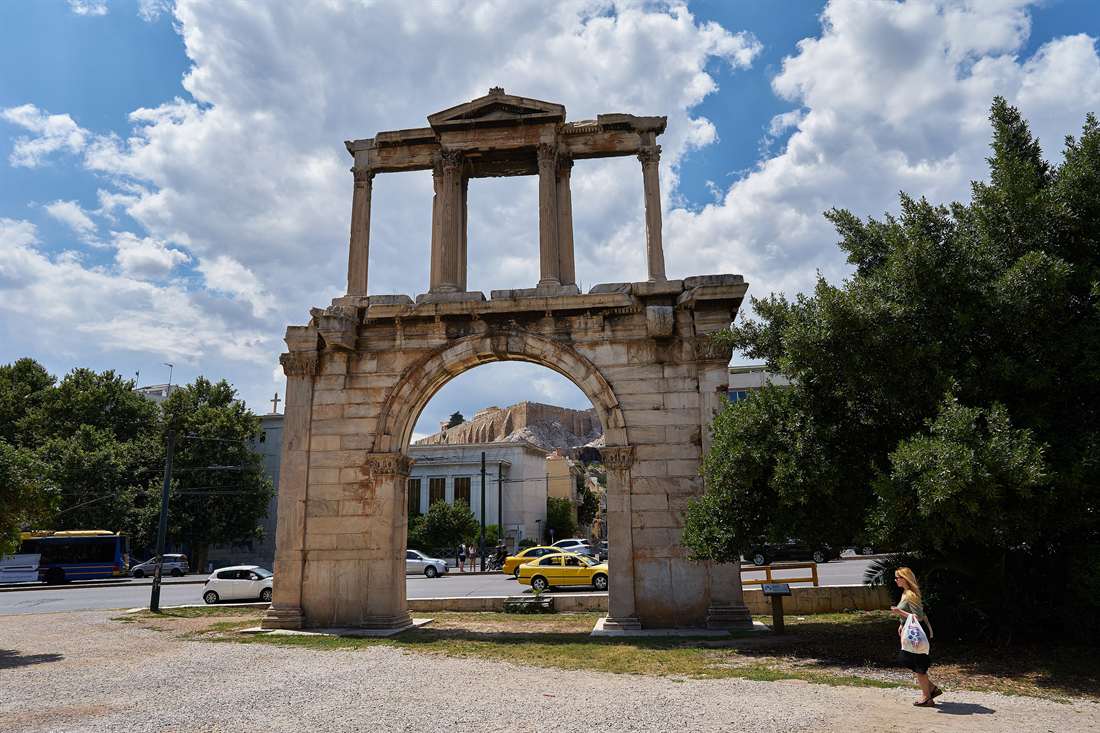
Free cultural sites Athens keeps open fall into three kinds: open-air archaeological areas such as Plato’s Academy, ancient monuments seen from the pavement such as Hadrian’s Arch, and libraries and galleries such as the Municipal Gallery of Athens, which lists free admission. The gated areas beside them, for example the Olympieion, close on six dates each year, while a street view stays open.
The street monuments sit within a short walk of Acropolis station, and the libraries cluster around Syntagma and Panepistimio stations. Visitors who plan to leave the capital after these stops can choose the next place on the Greece Tours homepage.
Which free cultural sites Athens keeps open without a ticket?
Free cultural sites Athens offers fall into three kinds. The first is the open-air archaeological area with no gate. The second is the ancient monument you see from a public street. The third is the library or cultural centre that anyone can enter.
Plato’s Academy is the clearest example of the first kind. A Greek travel directory tags it as a non-organised archaeological site that is always open, with free admission. The site sits in the Akadimia Platonos district.
Hadrian’s Arch shows the second kind. A travel blog says the arch and the Temple of Olympian Zeus are easily admired from just outside their fences. The rule is simple. You look from the pavement, and nobody asks for a ticket.
Libraries and cultural centres make up the third kind. The National Library of Greece is one of them. Wikipedia’s article says the library ensures equal access to its items based on the freedom of knowledge. The same article reports over 1.1 million items.
Kerameikos shows where the line falls. Wikipedia’s article on the area says it is enclosed. You enter through an entrance on the last block of Ermou Street. An entrance makes a gate. So Kerameikos is not on the list of free cultural sites Athens keeps open for passers-by.
The Ministry of Culture’s free-admission page adds one more rule. It lists dates when state archaeological sites, monuments and museums open at no charge. Those dates make a ticketed site free for one day. They do not make it free on other days, so this page leaves them out.
Which archaeological areas are free cultural sites Athens visitors can enter?
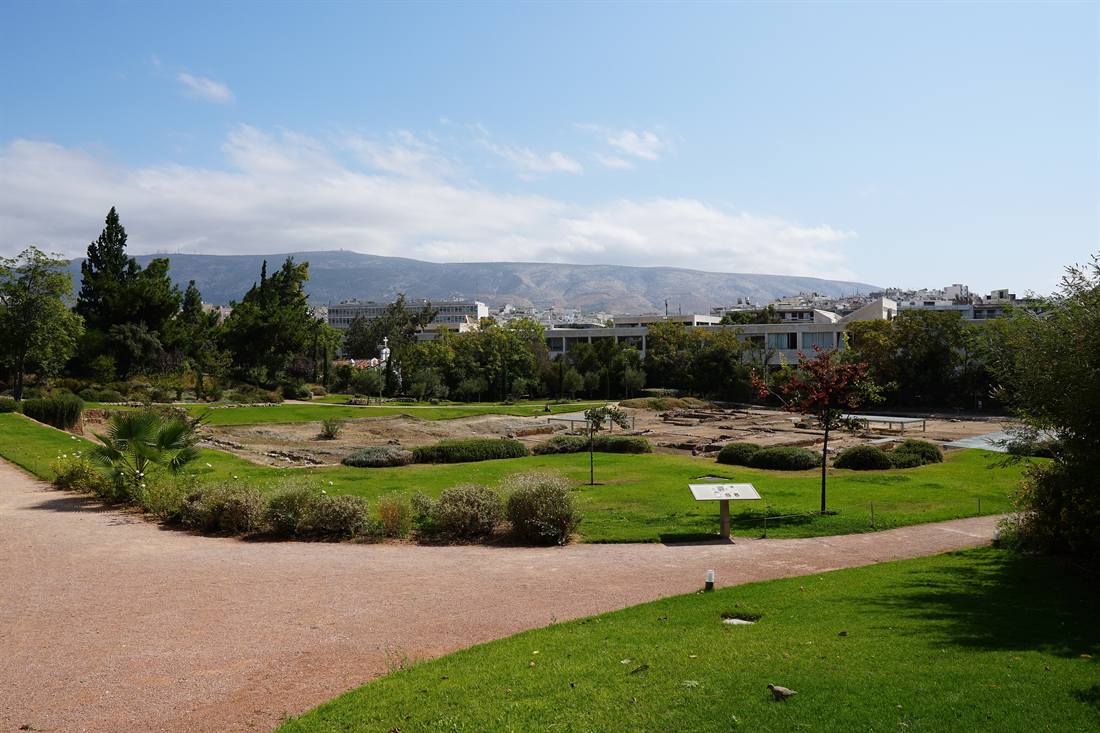
Plato’s Academy is the clearest of the free cultural sites Athens has among archaeological areas. A Greek travel directory lists it as always open, with free admission. It lies in the Akadimia Platonos district and holds four monuments.
The directory names the four monuments of this park. Each adds to the free cultural sites Athens counts among its archaeological areas. The Sacred House is a building of the Geometric period. It has seven rectangular rooms on either side of a corridor. The Gymnasium is a large rectangular building with an internal peristyle and rooms on the north side.
A second large square building with an internal peristyle dates to the fourth century BC. The fourth monument is an Early Helladic apsidal house. The directory reads it as the prehistoric home of the hero Academos.
The school is far older than these buildings. Wikipedia’s article on the Platonic Academy says Plato founded it around 387 BC on ground sacred to Athena. It puts the site about 1.5 km north of the Dipylon gates. Sulla laid waste to the grounds in 86 BC, during his siege of Athens.
Visit Plato’s Academy as a walk through open ground, not a tour of a hall. The directory entry gives the park no opening hours. That is the test for free cultural sites Athens keeps open without a gate.
A museum on the same site follows its own timetable. A news report on its opening says it is free for all. It opens daily from 09:00 to 16:00, except Mondays. The report lists digital applications, video screening and maps. It calls the museum the first museum of philosophy in Greece.
Aristotle’s Lyceum sits at the other end of the scale. A Greek travel directory lists its main entrance on Rigilis Street. It gives fixed opening hours of 08:00 to 20:00 and the tag organised archaeological site.
A news report on its opening describes protective canopies over a section of a Roman-era wrestling arena and gymnasium. The report says the site adds 1.1 hectares of open land to the city.
The directory does not tag the Lyceum as always open. That missing tag separates it from Plato’s Academy. Treat Aristotle’s Lyceum as an organised site with set hours. It stays outside the always-open group of free cultural sites Athens lists here.
Which ancient monuments are free cultural sites Athens shows from the street?
Four ancient monuments serve as free cultural sites Athens shows from the street. They are the Choragic Monument of Lysicrates, Hadrian’s Arch, the Olympieion fence line and the Tower of the Winds. You look at each one from public ground.
The Choragic Monument of Lysicrates stands in its little garden on Tripodon Street. Wikipedia’s article says the street follows an ancient street of the same name. That ancient street led to the Theatre of Dionysus. The monument marks a prize won in a dithyramb contest in 335/334 BCE.
Look at the round structure on its high square base. Wikipedia calls it the first Greek monument built in the Corinthian order on its exterior. That makes this small garden one of the free cultural sites Athens can show from the pavement. The frieze is thought to show the myth of Dionysus and the Tyrrhenian pirates.
Hadrian’s Arch towers over Amalias Avenue, according to Wikipedia’s article. The article puts it 325 metres southeast of the Acropolis. The marble arch is 18 m high, 13.5 m wide and 2.3 m deep. Its infobox lists public access as yes and the ownership as public property.
Two inscriptions face opposite ways. The one on the Acropolis side reads “this is Athens, the ancient city of Theseus”. The one on the Olympieion side reads “this is the city of Hadrian, and not of Theseus”. Stand under the arch to read both ends.
Walk on to the fence of the Temple of Olympian Zeus and look through it. Wikipedia’s article says fifteen columns stand today. It gives the Hadrian-era columns a height of 17.25 m. It places the arch at the north-west corner of the enclosure.
The Acropolis metro station on line 2 lies under Makrygianni Street. Wikipedia’s article on the station lists the temple among its nearby sights. These two free cultural sites Athens shows from the pavement sit within a short walk of that station.
The Tower of the Winds stands inside the Roman Agora, which a travel blog says charges for entry. The same blog says the view of the tower is even better from street level in Monastiraki. Wikipedia’s article gives the tower a height of about 12 m and a diameter of about 8 m.
This is the fourth of the street-side free cultural sites Athens shows. Relief figures of the eight winds run round the frieze, from Boreas in the north to Skiron in the north-west. Monastiraki station serves lines 1 and 3 on Monastiraki Square. Wikipedia’s article on the station lists the Roman Agora and Hadrian’s Library among its nearby landmarks.
All four monuments follow one rule. They stand in public space, and you look from the pavement. Looking from outside does not open the enclosure. The paid sites keep their ticket, while the street view stays free. That is the whole logic behind free cultural sites Athens shows to every passer-by.
Which libraries and cultural centres are free cultural sites Athens residents use?
Four places form the core of the free cultural sites Athens residents use. They are the National Library of Greece, the Hellenic Parliament Library, the Municipal Gallery of Athens and Technopolis. Each admits the public without a ticket. Each asks for different paperwork at the door.
The National Library of Greece works from the Stavros Niarchos Foundation Cultural Center, at Syggrou Avenue 364 in Kallithea. A foundation story on the opening says researchers, students and the general public have free access there. The older Vallianeion building at Panepistimiou 32 now holds the newspaper collection.
The open reading rooms at the centre follow a separate rule. They are the easiest of the free cultural sites Athens libraries offer to describe.
The opening announcement says they are free for reading and computer use. It adds that the full range of library services needs registration as a reader. A travel guide lists weekday hours from 09:00 to 20:00 and Saturday hours from 09:00 to 14:00.
Two free cultural sites Athens keeps on Panepistimiou Street stand side by side. They are the Vallianeion at number 32 and the Academy of Athens at number 28. Wikipedia calls the Academy the national academy of Greece and its highest research body.
The Academy keeps a research library in that building. Read the website of the Academy before you plan a visit inside.
Panepistimio station on Metro Line 2 serves both buildings. A Wikipedia article on the station says it sits next to the National Library, the university and the Academy.
The Library of the Hellenic Parliament is open to the public, a culture portal states. It is one of the free cultural sites Athens keeps for readers. The main library sits in the Parliament building on Syntagma Square. The portal lists public hours as daily 9:00 to 14:00 and 17:30 to 20:30, with Saturday 9:00 to 14:00.
Among the libraries, the door rule is paperwork, not payment. The portal says a valid ID or passport is necessary to enter. A city branch on Lenormant Street, in a renovated former tobacco factory, also lists free entry and an ID check. A travel guide places that branch on Metro Line 2 via Sepolia station.
The Municipal Gallery of Athens stands at Myllerou 32 on Avdi Square in Metaxourgeio. The nearest metro stop is Metaxourgeio. Wikipedia lists admission as free. It says the gallery holds nearly 3,000 works by Greek artists.
Those works date from the nineteenth and twentieth centuries. The City of Athens received the building as a donation. Among the free cultural sites Athens runs, this one has a building with a story.
Technopolis in Gazi is one of the free cultural sites Athens built on an industrial past. Wikipedia calls it an industrial museum and a major cultural venue of the city. It stands on the former gasworks next to Kerameikos.
Kerameikos station on Line 3 and Thiseio station on Line 1 both serve it. A city tourism site says much of its programme is free.
The music library of the Athens Concert Hall sits on Vasilissis Sofias Avenue. Wikipedia counts 126,000 titles and multimedia resources there. It notes Megaro Moussikis station on Line 3 outside the hall. A travel guide lists the access as free, with the library closed at weekends.
That makes it a quiet addition to the free cultural sites Athens lists for music readers.
Which free exhibitions fill the free cultural sites Athens runs all year?
Four venues carry the exhibitions among the free cultural sites Athens keeps open. They are the Municipal Gallery of Athens, the National Library, Technopolis and the Gennadius Library. Each venue announces new shows on its own channel. Read that channel before you travel.
For art, the Municipal Gallery of Athens leads the free cultural sites Athens has. It shows permanent and temporary exhibitions of modern Greek artists, a travel site states. It adds a collection of engravings. Wikipedia names the gallery and museum office of the city as the operator. Both sources list Monday as the closing day.
The website of the National Library of Greece sorts its activities into six groups. These are events, exhibitions, publications, a reading club, podcasts and programmes. It has separate pages for periodic exhibitions and for digital exhibitions. A digital page lets you preview a show before you travel to Kallithea.
The same site lists a general collection reading room on the third floor. Its home page carries a newsletter sign-up at the top. For a library programme, that sign-up is the first channel to use among the free cultural sites Athens libraries run.
A city tourism site says Technopolis hosts live jazz, workshops for children and craft fairs. It says much of the programme is free. For events, this is the largest of the free cultural sites Athens lists here.
The site describes the Industrial Gas Museum there as the only one of its kind in Greece. The restored control room and the original machinery belong to that museum.
The same tourism site tells readers to check the website of the venue for hours. A programme at Technopolis changes with each event. The hours of one visit do not predict the next. Check the schedule before each trip.
The Gennadius Library is a quieter pick among free cultural sites Athens residents know. It stands at Souidias Street 61 and holds over 110,000 volumes on Greek history, literature and art, according to Wikipedia. It belongs to the American School of Classical Studies.
A travel guide says the library serves research and academic purposes. It adds that the library hosts public exhibitions and events, with free entry.
Wikipedia adds that the library gained a new auditorium and an east wing in a modernisation. An auditorium is a natural home for talks and screenings. Confirm any programme on the library website, because no schedule is stated.
A Greek news outlet reported a festival weekend when more than 30 collaborating galleries offered free entry to their exhibitions. The Municipal Gallery of Athens was among them. The report named four institutions with free-entry events or curator-led tours.
The same report told readers to contact each venue and check opening hours and free-entry days. That advice fits every hall on this page. A free exhibition can sit inside a building with a security check.
The portal states that a valid ID or passport is necessary at the Parliament library entrance on Vassilissis Sophias Avenue. At the National Library, registration as a reader unlocks the full services.
So the routine for free cultural sites Athens offers is short. Read the venue channel, carry a passport or ID card, and confirm the closing day. Monday is the closing day listed for the Municipal Gallery of Athens, so book that hall for another weekday.
What rules, hours and closing days apply at free cultural sites Athens keeps?
Rules at free cultural sites Athens keeps depend on one question: does a gate stand there? Street views have no hours. Gated areas beside them follow one state schedule. It runs 08:00 to 20:00 daily from 1 April to 31 August. In winter it runs 08:00 to 15:00, from 1 November to 31 March.
A monument you view from the street has no opening hours. The hours below govern only the gates of the areas beside the free monuments. The state heritage portal prints the same schedule for the Olympieion, the Roman Agora, the Kerameikos and Aristotle’s Lyceum.
Those times help you plan the street views among the free cultural sites Athens shows beside them.
The closing time moves earlier in autumn. The Ministry of Culture’s visitor page for the Olympieion lists these steps:
- 1 to 15 September: 08:00 to 19:30
- 16 to 30 September: 08:00 to 19:00
- 1 to 15 October: 08:00 to 18:30
- 16 to 31 October: 08:00 to 18:00
The portal adds that the last entry is 20 minutes before closing time. A winter visit with a 15:00 closing hour needs to start by 14:40.
Six dates are closed days. They are 1 January, 25 March, the first day of the fifth month, Easter Sunday, 25 December and 26 December. The Ministry gives Good Friday hours of 12:00 to 17:00. It gives Holy Saturday hours of 08:30 to 15:30. A monument seen from the street stays in view on those dates.
The rules for the gated areas come from one Ministry text. The operating rules ban eating and drinking, smoking and litter. They also ban touching or removing any object. Visitors follow the security guards’ instructions, walk the marked routes and wear shoes made for walking. The rules ask for dress and behaviour that fits the site.
Dogs are covered by one clause. The ban on pets applies to the Acropolis and its slopes, to the Kerameikos and to the museums. A dog that accompanies a person with a disability is allowed even there.
Photography has one stated limit in those rules: no indecent or defamatory scenes. A film production at a monument needs a filming permit from the Ministry of Culture. The Hellenic Film Commission adds a drone rule. Aerial work for professional purposes needs a commercial licence from the Civil Aviation Authority.
The Ministry’s page for the Olympieion calls the site wheelchair accessible at its largest part. The way in is the main entrance on Vasilissis Olgas Avenue. It recommends a companion for help and lists accessible toilets. If step-free access decides your day, start with our wheelchair-accessible Athens page.
Read the Ministry’s notices before you go, because works can close a pavement near a monument.
How do you join free cultural sites Athens has into one route?
One morning links the monuments near the Acropolis station, the Tower of the Winds and the Academy of Athens. It needs two metro trips, and no walk on it takes more than 8 minutes.
The route below runs on the metro between two clusters. Near the Acropolis station, the free cultural sites Athens has sit on one short line. Walking times come from OpenStreetMap’s foot routing. Read the stops in order.
- 09:00 Acropolis station, Line 2. The station serves Plaka, Koukaki and Makrygianni, and one entrance is elevator-only.
- 09:10 Choragic Monument of Lysicrates. The walk from the station is 8 minutes.
- 09:25 Hadrian’s Arch. It stands 207 metres along the same street, a 4-minute walk, and the arch faces the monument.
- 09:35 The Olympieion fence line. The arch is about 20 metres from the temple precinct wall, a 2-minute walk. The state heritage portal puts the Olympieion 7 minutes from the Acropolis station.
- 10:00 Metro. Take Line 2 one stop to Syntagma, then Line 3 one stop to Monastiraki.
- 10:20 Tower of the Winds from the street. The foot router gives 4 minutes from Monastiraki station to the tower. The Roman Agora gate is 2 minutes from the station on the state heritage portal.
- 11:00 Metro and Academy of Athens. Take Line 3 to Syntagma and Line 2 one stop to Panepistimio. The academy at Panepistimiou 28 is 3 minutes on foot.
The Ministry’s Olympieion page carries notices. One of them has closed the area round Hadrian’s Gate for road works. Read it first. Our Athens metro guide covers the lines used here.
Syntagma Square is the middle of the route. The academy is 9 minutes from the square on foot and Hadrian’s Arch is 10 minutes. These free cultural sites Athens keeps on the Syntagma side suit anyone who starts late.
For a short day, street views need no schedule. The same travel blog calls both monuments easy to admire from outside the fences. It also says the Tower of the Winds looks better from street level. The route follows that advice. The gate hours wait for a second day.
What do travellers ask about free cultural sites Athens offers?
Free cultural sites Athens offers fall into two groups. Street views have no gate and no hours. Staffed areas keep the Ministry schedule and close on six named dates each year.
Is entry free all week at free cultural sites Athens lists?
A street view at the free cultural sites Athens keeps needs no ticket on any day. A gated area beside it follows the Ministry’s schedule. It stays closed on six dates, from 1 January to 26 December.
When do the gated areas close?
Gates beside the free cultural sites Athens lists close at 20:00 from 1 April to 31 August. They close at 15:00 from 1 November to 31 March. The closing time falls from 19:30 to 18:00 across September and October. The last entry is 20 minutes earlier.
Which site is closest to Syntagma?
The Hellenic Parliament Library stands on Syntagma Square itself. On OpenStreetMap’s foot routing, the Academy of Athens is 9 minutes from the square. Hadrian’s Arch is 10 minutes away. Among the free cultural sites Athens lists, the academy is the nearest stop on the route above.
Are the sites open on public holidays?
Gated sites close on six dates. They are 1 January, 25 March, the first day of the fifth month, Easter Sunday, 25 and 26 December. They open 12:00 to 17:00 on Good Friday and 08:30 to 15:30 on Holy Saturday. A street view has no gate.
Can I bring a dog?
The Ministry bans pets only at the Acropolis and its slopes, the Kerameikos and the museums. A dog that accompanies a person with a disability is allowed there too. The other free cultural sites Athens keeps outdoors fall outside that ban.
Is a bag check made?
The Ministry’s operating rules tell visitors to follow the security guards’ instructions. They also say to stay on marked paths and out of restricted areas. Guards at the gated areas next to the free cultural sites Athens lists decide any check on the spot.